Overview
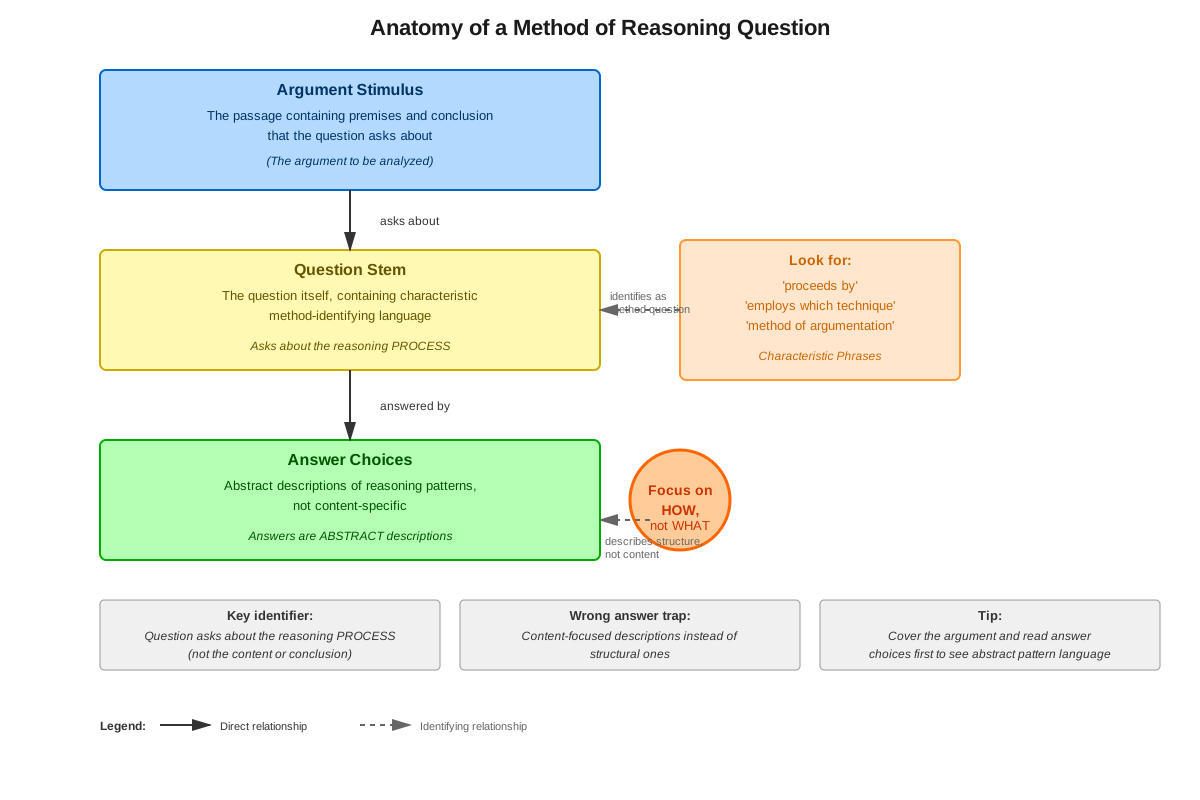
Method of reasoning questions represent one of the most frequently tested question types on the LSAT Logical Reasoning section, appearing in approximately 3-5 questions per test. These questions ask test-takers to identify and describe the argumentative technique or logical structure an author uses to reach their conclusion. Unlike questions that ask whether an argument is valid or what would strengthen it, method of reasoning questions focus purely on how the argument proceeds—the procedural blueprint of the reasoning itself.
Understanding lsat method of reasoning questions is essential because they test a fundamental skill that underlies all logical analysis: the ability to step back from the content of an argument and recognize its structural form. This metacognitive skill—thinking about thinking—is precisely what law schools value and what legal practice demands. Attorneys must constantly analyze not just what opposing counsel argues, but how they construct their arguments, identifying the logical moves and rhetorical strategies employed.
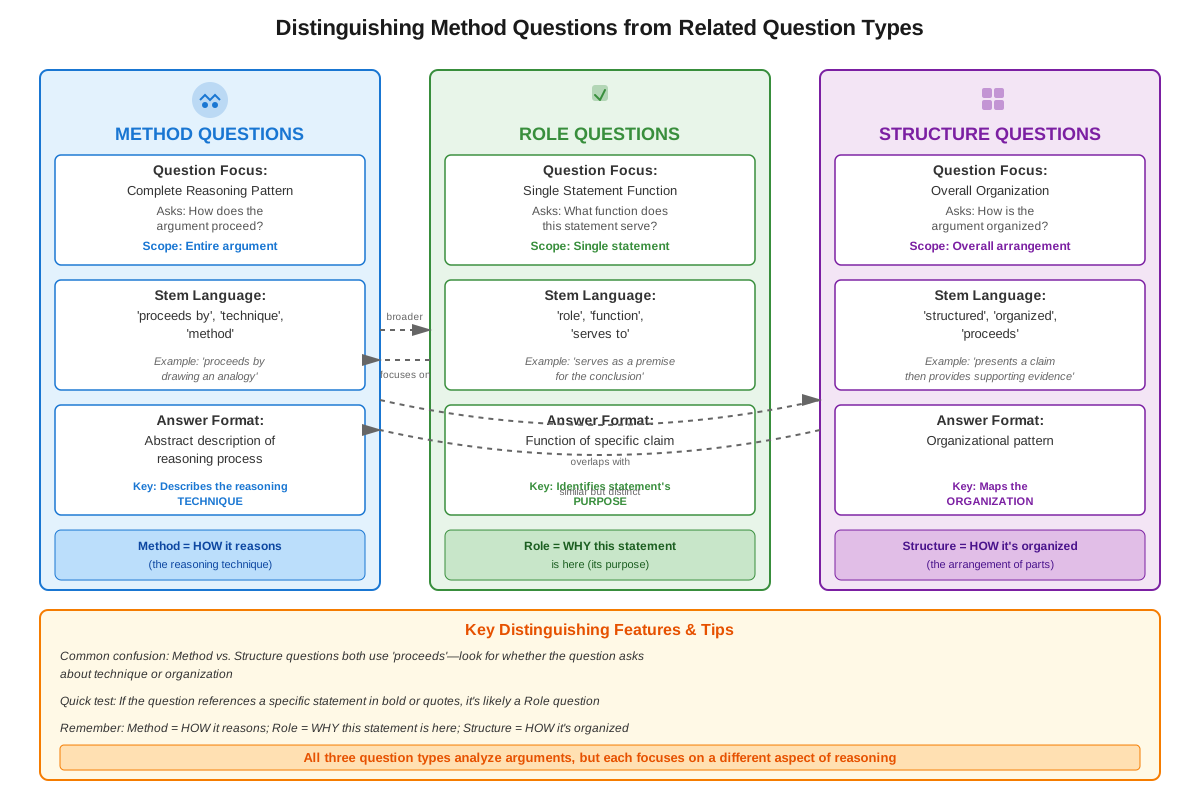
Within the broader category of method, role, and structure questions, method of reasoning questions occupy a central position. While role questions ask about the function of a specific statement within an argument, and structure questions may ask about the overall organization of a passage, method questions require identifying the complete reasoning pattern from premises to conclusion. Mastery of this question type strengthens performance across all logical reasoning tasks, as it develops the analytical framework needed to dissect arguments systematically and recognize recurring patterns of reasoning that appear throughout the LSAT.
Learning Objectives
- [ ] Identify how Method of reasoning questions appears in LSAT questions
- [ ] Explain the reasoning pattern behind Method of reasoning questions
- [ ] Apply Method of reasoning questions to solve LSAT-style problems accurately
- [ ] Distinguish between different types of argumentative techniques commonly tested in method questions
- [ ] Translate concrete arguments into abstract descriptions of reasoning patterns
- [ ] Recognize the difference between method questions and other question types in the same family
- [ ] Evaluate answer choices by matching abstract descriptions to specific argumentative moves
Prerequisites
- Basic argument structure identification: Understanding premises, conclusions, and how to identify them is essential because method questions require recognizing what role each statement plays before describing how they connect.
- Familiarity with common argument types: Knowledge of analogical reasoning, causal arguments, and conditional logic provides the vocabulary needed to describe reasoning methods accurately.
- Ability to distinguish argument from non-argument: Method questions only apply to passages containing arguments, so recognizing when reasoning is present versus mere description is foundational.
- Understanding of logical indicators: Words like "therefore," "because," "however," and "thus" signal the structure that method questions ask about.
Why This Topic Matters
Method of reasoning questions test a skill that extends far beyond standardized testing. In legal practice, attorneys must constantly analyze the argumentative strategies of opposing counsel, judicial opinions, and statutory interpretations. Recognizing whether a judge reached a decision through analogical reasoning, by eliminating alternatives, or by applying a general principle to a specific case directly impacts how one might distinguish or apply that precedent. This same analytical skill applies to policy analysis, academic research, and any field requiring critical evaluation of arguments.
On the LSAT itself, method of reasoning questions typically appear 3-5 times per test, distributed across both Logical Reasoning sections. This frequency makes them high-yield material—mastering this question type can directly improve your score by several points. These questions appear in predictable formats with identifiable question stems, making them excellent candidates for strategic preparation.
Method questions commonly appear in several contexts: arguments that use analogies between situations, arguments that proceed by eliminating alternative explanations, arguments that apply general principles to specific cases, arguments that use examples to support generalizations, and arguments that identify contradictions or inconsistencies in opposing positions. The LSAT favors certain reasoning patterns, and recognizing these patterns allows for faster, more accurate responses. Additionally, the skills developed for method questions transfer directly to other question types—understanding how an argument works makes it easier to identify its assumptions, evaluate its validity, and determine what would strengthen or weaken it.
Core Concepts
What Method of Reasoning Questions Ask
Method of reasoning questions require test-takers to describe the argumentative technique or logical procedure an author uses to reach their conclusion. The question is not whether the argument is good or bad, strong or weak, but rather how it proceeds from premises to conclusion. These questions ask for an abstract description of the reasoning pattern that could apply to many different arguments with similar structures.
The question stems for method questions follow predictable patterns:
- "The argument proceeds by..."
- "Which one of the following describes the technique of reasoning used above?"
- "The argument employs which one of the following methods?"
- "The reasoning in the argument is most vulnerable to criticism on the grounds that it..."
- "The argument uses which one of the following argumentative strategies?"
Common Reasoning Patterns
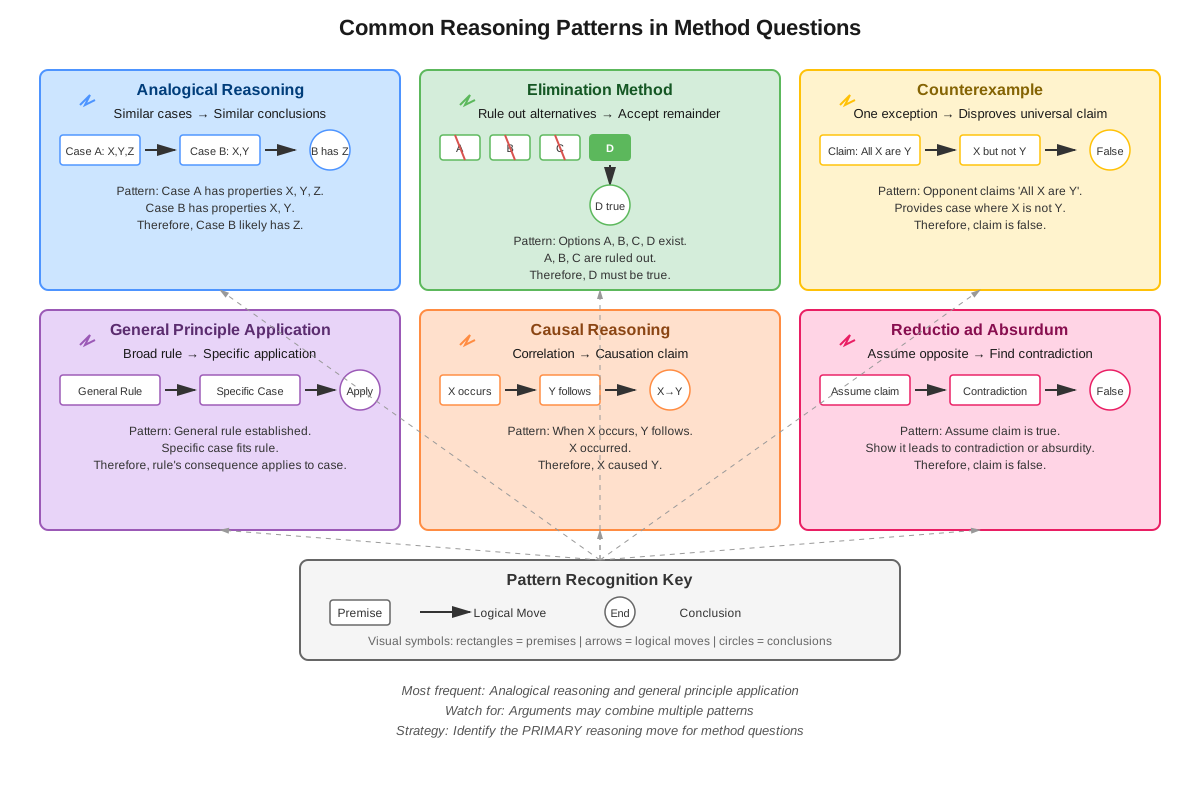
Understanding the most frequently tested reasoning patterns is crucial for success on method questions. The LSAT repeatedly tests a limited set of argumentative techniques:
Reasoning by Analogy: The argument draws a comparison between two situations, objects, or cases, suggesting that because they are similar in certain respects, they will be similar in another respect. For example: "City A implemented policy X with good results; City B is similar to City A, so policy X will likely work there too."
Elimination of Alternatives: The argument identifies multiple possible explanations or options, rules out all but one, and concludes that the remaining option must be correct. This pattern often appears as: "It could be X, Y, or Z. It's not X or Y. Therefore, it must be Z."
Application of a General Principle: The argument states a general rule, principle, or criterion, then applies it to a specific case to reach a conclusion about that case. Example: "All mammals are warm-blooded. Whales are mammals. Therefore, whales are warm-blooded."
Generalization from Examples: The argument presents one or more specific instances or examples and draws a broader conclusion that extends beyond those cases. This is inductive reasoning moving from specific to general.
Identifying a Contradiction: The argument points out an inconsistency, paradox, or contradiction in an opposing position or set of claims, often concluding that one of the contradictory claims must be false.
Causal Reasoning: The argument establishes or assumes a cause-and-effect relationship between events or phenomena, often arguing that because one thing occurred, it caused another thing to occur.
Arguing from Authority: The argument supports its conclusion by citing expert opinion, authoritative sources, or consensus among qualified individuals.
Abstract vs. Concrete Description
A critical skill for method questions is translating between concrete content and abstract structure. The argument stimulus presents specific content—particular people, places, policies, or situations. The correct answer choice describes this content in abstract, generalizable terms.
For example, if an argument states: "The new traffic light reduced accidents at the intersection of Main and Oak. A similar intersection at Elm and Pine should also get a traffic light to reduce accidents there," the abstract description would be: "draws an analogy between two similar situations to support a recommendation."
Wrong answer choices often fail this translation in predictable ways:
- They describe reasoning that doesn't appear in the argument
- They describe the content rather than the method
- They describe a step in the reasoning but not the complete method
- They use terminology that sounds sophisticated but doesn't match the actual reasoning
The Role of Intermediate Conclusions
Many method questions involve arguments with complex structures containing intermediate conclusions—statements that serve as both conclusions (supported by some premises) and premises (supporting the main conclusion). Recognizing these structures is essential because the correct answer must account for the complete reasoning chain.
For example: "All effective managers communicate clearly. Sarah communicates clearly. Moreover, anyone who communicates clearly can resolve conflicts. Therefore, Sarah can resolve conflicts." This argument has an intermediate conclusion (Sarah can resolve conflicts because she communicates clearly) that serves as a premise for the final conclusion.
Method Questions vs. Related Question Types
Understanding what method questions are NOT asking helps avoid confusion:
| Question Type | What It Asks | Key Difference from Method |
|---|---|---|
| Method of Reasoning | How does the argument proceed? | Describes the reasoning process |
| Role/Function | What role does this statement play? | Focuses on one statement's function |
| Main Point | What is the conclusion? | Identifies content, not method |
| Flaw | What's wrong with the reasoning? | Evaluates validity, not just describes |
| Parallel Reasoning | Which argument has the same structure? | Requires matching, not describing |
Descriptive vs. Evaluative Language
Method questions can be purely descriptive (neutral descriptions of how the argument proceeds) or evaluative (descriptions that include criticism of the reasoning). Question stems containing phrases like "vulnerable to criticism" or "questionable technique" signal evaluative method questions.
Descriptive method answer: "supports a general claim by providing a specific example"
Evaluative method answer: "inappropriately generalizes from a single atypical case"
Both describe the same reasoning pattern, but the evaluative version includes a judgment about the reasoning's quality.
Concept Relationships
The concepts within method of reasoning questions form a hierarchical structure. At the foundation lies argument structure identification—recognizing premises, conclusions, and their relationships. This enables pattern recognition, the ability to see that an argument uses analogy, elimination, or another technique. Pattern recognition, in turn, enables abstract translation, converting specific content into generalizable descriptions. These three skills combine to support answer evaluation, the ability to match abstract descriptions to concrete arguments.
Method questions connect directly to parallel reasoning questions, which require the same pattern recognition skills but ask test-takers to find another argument with the same structure rather than describe it. They also relate to flaw questions, as many flaws are simply method descriptions with evaluative language added (e.g., "reasoning by analogy" becomes "draws a weak analogy").
The relationship map flows as follows:
Basic Argument Structure → Pattern Recognition → Abstract Translation → Answer Evaluation
Additionally, method questions reinforce skills needed for assumption questions (understanding how premises connect to conclusions) and strengthen/weaken questions (recognizing what type of evidence would affect different reasoning patterns).
Quick check — test yourself on Method of reasoning questions so far.
Try Flashcards →High-Yield Facts
⭐ Method questions ask HOW an argument proceeds, not WHETHER it's valid or WHAT it concludes
⭐ The correct answer must describe the complete reasoning pattern from premises to conclusion, not just one step
⭐ Answer choices use abstract language that could apply to many different arguments with similar structures
⭐ The most commonly tested reasoning patterns are: analogy, elimination of alternatives, application of general principles, and generalization from examples
⭐ Question stems containing "vulnerable to criticism" or "questionable" indicate evaluative method questions that describe flawed reasoning
- Method questions typically appear 3-5 times per LSAT, making them high-frequency question types
- Wrong answers often describe reasoning that sounds sophisticated but doesn't actually appear in the stimulus
- The correct answer will match every major move in the argument, not just the general approach
- Arguments with intermediate conclusions require answer choices that account for the multi-step reasoning chain
- Descriptive method questions have neutral answer choices; evaluative method questions include judgments about reasoning quality
Common Misconceptions
Misconception: Method questions ask what the argument concludes.
Correction: Method questions ask how the argument reaches its conclusion—the procedural structure, not the content. The conclusion is part of what you analyze, not what you're looking for.
Misconception: The correct answer will use the same specific terms and examples as the stimulus.
Correction: Correct answers translate specific content into abstract, generalizable descriptions. If the stimulus discusses traffic lights, the answer will discuss "implementing a solution" or "applying a remedy," not traffic lights specifically.
Misconception: Any answer that describes something true about the argument is correct.
Correction: The correct answer must describe the primary reasoning method—the main way the argument moves from premises to conclusion. An answer might accurately describe a minor element but miss the central technique.
Misconception: Longer, more complex answer choices are more likely to be correct.
Correction: The LSAT often uses complex language in wrong answers to make them seem authoritative. The correct answer might be straightforward and simple if the reasoning pattern is straightforward and simple.
Misconception: Method questions and flaw questions are completely different.
Correction: Evaluative method questions are essentially flaw questions—they describe reasoning methods while indicating those methods are problematic. The skills overlap significantly, and many flaws are simply method descriptions with critical language added.
Misconception: You need to evaluate whether the argument is strong before selecting an answer.
Correction: For purely descriptive method questions, the argument's validity is irrelevant. You're describing what the argument does, not judging whether it does it well (unless the question stem specifically asks for criticism).
Worked Examples
Example 1: Descriptive Method Question
Stimulus: "The ancient Romans used lead pipes for plumbing, and many Romans suffered from lead poisoning. The ancient Greeks also used lead pipes for plumbing. Therefore, many Greeks probably also suffered from lead poisoning."
Question: The reasoning in the argument proceeds by
Answer Choices:
(A) applying a general principle to a specific case
(B) drawing an analogy between two similar situations
(C) eliminating alternative explanations for a phenomenon
(D) citing expert testimony to support a conclusion
(E) identifying a contradiction in an opposing view
Analysis:
First, identify the argument structure:
- Premise 1: Romans used lead pipes and suffered lead poisoning
- Premise 2: Greeks also used lead pipes
- Conclusion: Greeks probably also suffered lead poisoning
Next, recognize the reasoning pattern: The argument compares two situations (Romans and Greeks) that share a relevant similarity (both used lead pipes) and suggests they will share another characteristic (lead poisoning). This is classic reasoning by analogy.
Evaluate each answer:
- (A) No general principle is stated and then applied
- (B) CORRECT - This precisely describes the analogical reasoning
- (C) No alternatives are mentioned or eliminated
- (D) No experts or authorities are cited
- (E) No opposing view or contradiction is discussed
The correct answer is (B). This example demonstrates how to translate concrete content (Romans, Greeks, lead pipes) into abstract description (two similar situations).
Example 2: Evaluative Method Question
Stimulus: "Every successful entrepreneur I've met has been highly competitive. My friend Jordan is highly competitive. Therefore, Jordan will probably become a successful entrepreneur."
Question: The reasoning in the argument is questionable because it
Answer Choices:
(A) assumes what it sets out to prove
(B) relies on a sample that is too small to support the conclusion
(C) mistakes a characteristic common among successful entrepreneurs for a characteristic sufficient for entrepreneurial success
(D) fails to consider that competitiveness might have negative consequences
(E) draws a conclusion that contradicts one of its premises
Analysis:
First, identify the structure:
- Premise 1: All successful entrepreneurs I've met are competitive
- Premise 2: Jordan is competitive
- Conclusion: Jordan will probably be a successful entrepreneur
Next, recognize the reasoning pattern and its flaw: The argument observes that successful entrepreneurs have a certain trait (competitiveness) and concludes that having this trait makes someone likely to become a successful entrepreneur. This confuses a necessary or common characteristic with a sufficient one—just because successful entrepreneurs are competitive doesn't mean competitive people will become successful entrepreneurs.
Evaluate each answer:
- (A) The conclusion (Jordan will succeed) is not assumed in the premises
- (B) Sample size isn't the primary issue; the logical structure is
- (C) CORRECT - This precisely identifies the flaw: treating a common characteristic as if it were sufficient
- (D) Negative consequences aren't relevant to the logical flaw
- (E) No contradiction exists between premises and conclusion
The correct answer is (C). This evaluative method question requires both describing the reasoning pattern and identifying why it's problematic.
Exam Strategy
Identifying Method Questions
Develop automatic recognition of method question stems. When you see phrases like "proceeds by," "technique of reasoning," "argumentative strategy," or "method of argument," immediately shift into method-question mode. This mental shift reminds you to focus on HOW rather than WHAT or WHETHER.
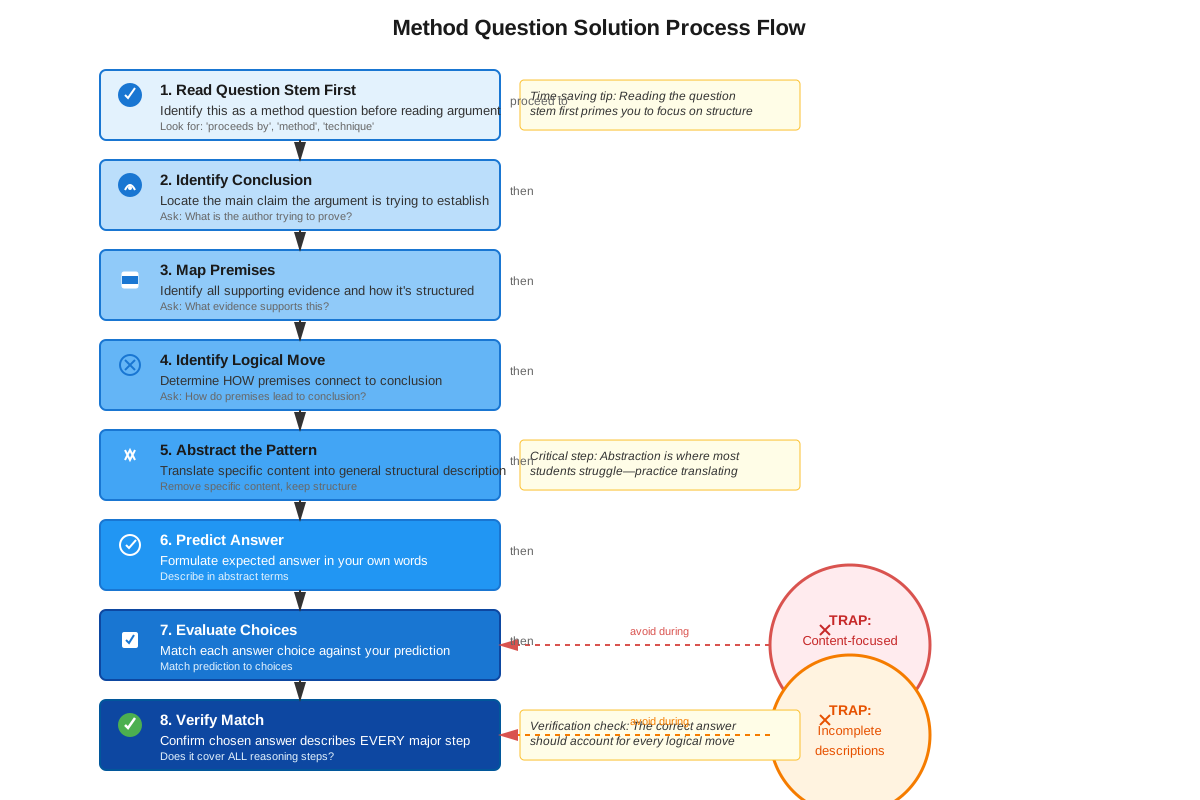
The Three-Step Approach
Step 1: Map the Argument Structure
Before looking at answer choices, identify:
- What is the conclusion?
- What are the premises?
- Are there intermediate conclusions?
- How do the premises connect to the conclusion?
Step 2: Describe the Method in Your Own Words
Create a simple, abstract description: "compares two situations," "eliminates other options," "applies a rule to a case." This prediction helps you recognize the correct answer and avoid traps.
Step 3: Match and Eliminate
Compare your prediction to each answer choice. Eliminate answers that:
- Describe reasoning not present in the stimulus
- Describe only part of the reasoning
- Use the wrong level of abstraction (too specific or too vague)
- Mismatch the evaluative tone (critical when the question is neutral, or vice versa)
Trigger Words and Phrases
Certain words in answer choices signal specific reasoning patterns:
- Analogy: "similar," "analogous," "parallel," "comparable"
- Elimination: "rules out," "eliminates," "rejects alternatives"
- General to Specific: "applies," "principle," "general rule," "criterion"
- Specific to General: "generalizes," "infers," "extrapolates," "broader conclusion"
- Contradiction: "inconsistency," "contradiction," "incompatible"
- Causal: "cause," "effect," "result," "consequence"
Time Management
Method questions typically take 60-90 seconds for strong test-takers. If you find yourself spending more than two minutes, you may be overthinking. The correct answer should clearly match the reasoning pattern once you've identified it. If no answer seems to fit, re-examine your understanding of the argument structure rather than continuing to stare at answer choices.
Common Trap Patterns
The Partial Description Trap: An answer describes one step or element of the reasoning but not the complete method. Always ask: "Does this account for how the entire argument proceeds?"
The Sophisticated Language Trap: Wrong answers often use impressive-sounding terminology that doesn't actually match the reasoning. Don't be seduced by complex vocabulary.
The Content Trap: Wrong answers sometimes restate the argument's content rather than describing its method. Remember: you're looking for abstract structure, not specific subject matter.
Memory Techniques
The PACE Acronym
Remember the four most common reasoning patterns with PACE:
- Principle application (general to specific)
- Analogy (comparing similar situations)
- Counterexample or Contradiction
- Elimination of alternatives
Visualization Strategy
Picture the argument as a journey from Point A (premises) to Point B (conclusion). The method question asks: "What vehicle did the argument use to make this journey?" An analogy is like a bridge connecting two similar places. Elimination is like removing blocked paths until only one remains. Principle application is like following a map's general rule to reach a specific destination.
The Abstract Translation Drill
Practice converting specific content to abstract descriptions:
- "The new policy worked in Sweden" → "a solution succeeded in one context"
- "Dr. Smith, a cardiologist, recommends" → "an expert in the relevant field suggests"
- "This contradicts the earlier claim" → "identifies an inconsistency"
Regular practice with this translation builds the skill that method questions test.
Summary
Method of reasoning questions test the ability to identify and describe how arguments proceed from premises to conclusions. These questions require stepping back from an argument's specific content to recognize its structural pattern—whether it reasons by analogy, eliminates alternatives, applies general principles, or uses another technique. Success depends on three core skills: accurately mapping argument structure, recognizing common reasoning patterns, and translating concrete content into abstract descriptions. The correct answer must account for the complete reasoning process, not just individual elements, and must match the evaluative tone of the question stem (neutral description versus critical evaluation). These questions appear frequently on the LSAT and test skills fundamental to legal reasoning, making them high-yield material for test preparation. Mastery requires practice identifying patterns, avoiding common traps like partial descriptions and sophisticated-sounding wrong answers, and developing the ability to predict correct answers before evaluating choices.
Key Takeaways
- Method questions ask HOW an argument proceeds, requiring abstract descriptions of reasoning patterns rather than evaluation of content or validity
- The four most common patterns are reasoning by analogy, elimination of alternatives, application of general principles, and generalization from examples
- Correct answers translate specific content into generalizable, abstract language that could apply to many arguments with similar structures
- Always map the complete argument structure before evaluating answer choices, identifying premises, conclusions, and their connections
- Distinguish between descriptive method questions (neutral) and evaluative method questions (critical), matching your answer to the question's tone
- Wrong answers often describe reasoning that sounds sophisticated but doesn't actually appear, or describe only part of the reasoning pattern
- Method question skills transfer directly to parallel reasoning, flaw questions, and general argument analysis throughout the LSAT
Related Topics
Parallel Reasoning Questions: These questions require the same pattern recognition skills as method questions but ask test-takers to identify another argument with the same structure rather than describe it. Mastering method questions provides the foundation for parallel reasoning success.
Flaw Questions: Many flaws are essentially method descriptions with evaluative language added. Understanding reasoning methods helps identify when those methods are applied inappropriately or with insufficient support.
Role and Function Questions: While method questions ask about the overall reasoning pattern, role questions focus on what function a specific statement serves within that pattern. These question types complement each other in developing structural analysis skills.
Argument Structure and Diagramming: Advanced techniques for mapping complex arguments with multiple premises, intermediate conclusions, and conditional relationships build on the basic structure identification that method questions require.
Formal Logic and Conditional Reasoning: Understanding formal logical structures helps recognize when arguments apply general principles, use conditional relationships, or employ other systematic reasoning patterns.
Practice CTA
Now that you understand how method of reasoning questions work and the patterns they test, it's time to apply these concepts to actual LSAT questions. The practice questions and flashcards will reinforce your ability to recognize reasoning patterns quickly and accurately. Remember: method questions reward pattern recognition, and pattern recognition improves with deliberate practice. Each question you work through strengthens your ability to see through specific content to the underlying structure—exactly the skill that law school and legal practice demand. Start practicing, and watch your confidence and accuracy grow!
Sign up free to keep reading
Create a free AnvayaPrep account to finish this LSAT guide on Method of reasoning questions — plus flashcards and practice questions.