Overview
Disagreement about interpretation is a critical question type within the LSAT's Logical Reasoning section that tests a student's ability to identify the precise point of contention between two speakers. Unlike questions that ask about factual disagreements or general differences of opinion, these questions specifically focus on how two individuals interpret the same evidence, concept, principle, or situation differently. This distinction is crucial: both speakers may agree on the underlying facts but diverge sharply in how they understand, apply, or characterize those facts.
This topic represents a sophisticated evolution of basic point at issue and disagreement questions. While simpler disagreement questions might ask what two speakers disagree about in general terms, lsat disagreement about interpretation questions require students to recognize that the conflict lies not in what information exists, but in what that information means or how it should be understood. These questions frequently appear in the LSAT because they mirror the type of analytical thinking essential for legal practice—attorneys constantly debate not just facts, but how statutes, precedents, and evidence should be interpreted and applied.
Mastering disagreement about interpretation questions strengthens overall logical reasoning skills by developing the ability to distinguish between surface-level content and deeper analytical frameworks. This skill connects to argument analysis, assumption identification, and principle application—all core competencies tested throughout the LSAT. Students who excel at these questions demonstrate the precise reading comprehension and analytical discrimination that law schools seek in candidates.
Learning Objectives
- [ ] Identify how Disagreement about interpretation appears in LSAT questions
- [ ] Explain the reasoning pattern behind Disagreement about interpretation
- [ ] Apply Disagreement about interpretation to solve LSAT-style problems accurately
- [ ] Distinguish between factual disagreements and interpretive disagreements in dialogue passages
- [ ] Recognize common interpretive frameworks that speakers dispute (definitions, applications, characterizations, implications)
- [ ] Evaluate answer choices to eliminate options that represent agreements, irrelevant points, or positions only one speaker holds
Prerequisites
- Basic argument structure: Understanding premises, conclusions, and how claims relate to one another is essential because disagreement questions require identifying which specific claim is contested.
- Dialogue passage format: Familiarity with two-speaker stimulus formats helps students quickly orient themselves to the structure of disagreement questions.
- Conditional reasoning fundamentals: Many interpretation disagreements involve how to apply conditional statements or principles, requiring comfort with if-then logic.
- Distinction between fact and opinion: Recognizing the difference between objective claims and subjective interpretations forms the foundation for identifying interpretive disagreements.
Why This Topic Matters
In legal practice, attorneys rarely dispute raw facts—instead, they contest what those facts mean, how laws should be applied, and what principles govern specific situations. Disagreement about interpretation questions directly assess this lawyerly skill. A prosecutor and defense attorney might agree that a defendant performed certain actions but disagree entirely about whether those actions constitute a specific crime. This mirrors the analytical challenge these LSAT questions present.
On the LSAT, disagreement about interpretation questions appear with high frequency, typically comprising 2-4 questions per Logical Reasoning section. They most commonly appear as "point at issue" questions with stems like "The dialogue provides the most support for the claim that the two speakers disagree about which one of the following?" or "On the basis of their statements, the speakers are committed to disagreeing about whether..." These questions carry significant weight because they test multiple skills simultaneously: precise reading, logical analysis, and the ability to distinguish subtle differences in reasoning.
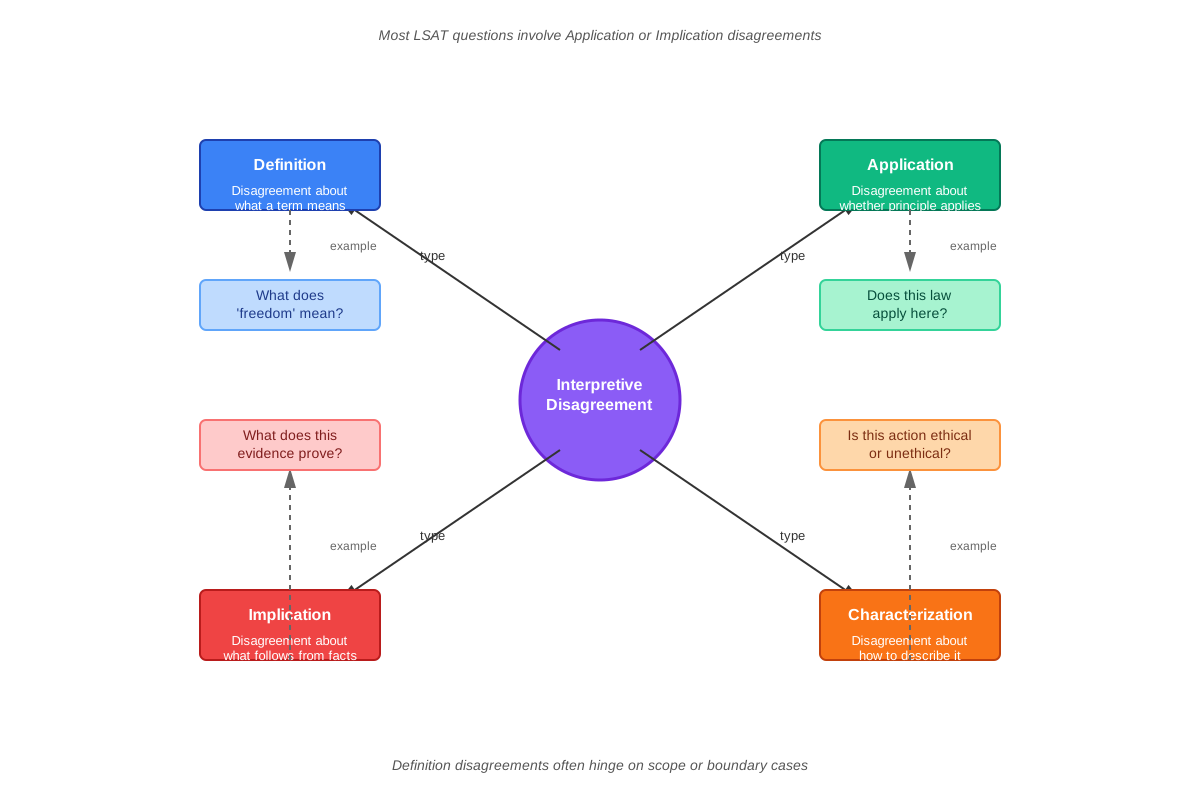
These questions appear in several recognizable patterns: speakers may disagree about how to define a term, whether a principle applies to a specific case, what conclusion follows from shared evidence, whether an action fits a particular characterization, or what the implications of an agreed-upon fact are. The LSAT frequently uses professional contexts (scientific research, policy debates, ethical dilemmas) where interpretation naturally varies among reasonable people.
Core Concepts
The Nature of Interpretive Disagreement
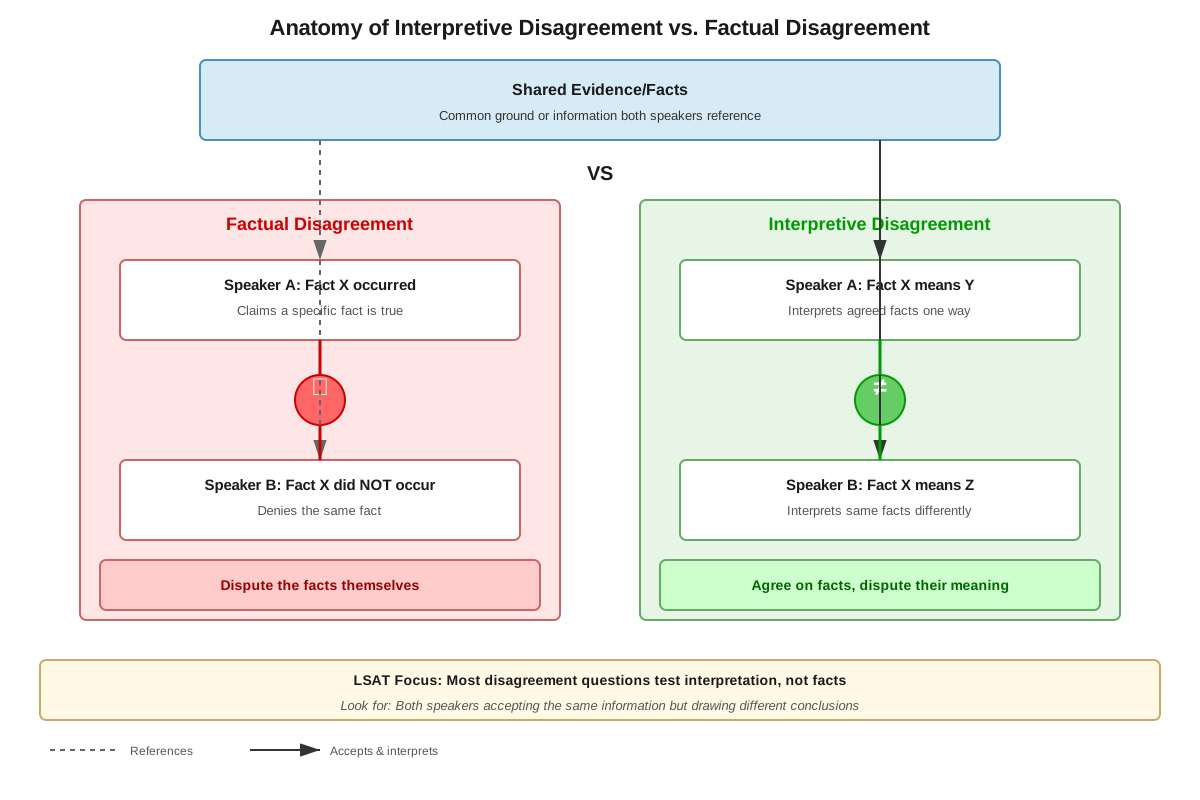
Disagreement about interpretation occurs when two speakers accept the same foundational information but diverge in their understanding of what that information means, how it should be categorized, or what conclusions it supports. This differs fundamentally from factual disagreement, where speakers contest what is true or what happened. In interpretive disagreements, the conflict exists at the analytical level rather than the empirical level.
Consider this distinction: If Speaker A says "The temperature is 70 degrees" and Speaker B says "No, it's 65 degrees," they have a factual disagreement. But if both agree it's 70 degrees, and Speaker A says "That's warm" while Speaker B says "That's cool," they have an interpretive disagreement about how to characterize the agreed-upon temperature.
The LSAT exploits this distinction because legal reasoning constantly operates in this interpretive space. Judges reviewing the same case record may interpret precedent differently. Legislators reading the same constitutional text may understand its application differently. This cognitive skill—recognizing where interpretation diverges—is fundamental to legal analysis.
Types of Interpretive Disagreements
Definitional Interpretation: Speakers disagree about how to define a key term or concept. Both may agree on the characteristics of something but disagree about whether those characteristics satisfy a particular definition. For example, two speakers might agree that a program provides financial assistance to students but disagree about whether this makes it a "scholarship" or a "loan."
Application Interpretation: Speakers disagree about whether a principle, rule, or category applies to a specific case. They may agree on both the principle and the facts but disagree about whether the facts satisfy the conditions for applying the principle. This is extremely common in LSAT questions because it mirrors how legal rules are applied to specific situations.
Characterization Interpretation: Speakers disagree about how to describe or characterize an agreed-upon situation. They might agree on what happened but disagree about whether it should be called "aggressive," "defensive," "innovative," "reckless," or any number of descriptive terms that carry different implications.
Implication Interpretation: Speakers disagree about what follows from or is implied by information they both accept. They agree on the premise but disagree about what conclusion it supports or what it suggests about related matters.
Causal Interpretation: Speakers disagree about the causal relationship between agreed-upon events. Both might acknowledge that Event A and Event B occurred, but disagree about whether A caused B, B caused A, or they're unrelated.
The Structure of Interpretation Questions
These questions follow a predictable structure that students can learn to recognize and exploit:
- The Stimulus: Presents two speakers (often named, like "Keisha" and "Marcus") who each make a statement
- The Interpretive Conflict: Embedded within their statements is a specific point where their interpretations diverge
- The Question Stem: Asks what the speakers disagree about, are committed to disagreeing about, or what their dialogue supports regarding their disagreement
- The Answer Choices: Five options, only one of which represents a genuine interpretive disagreement both speakers address
The correct answer must satisfy two critical criteria: (1) both speakers must have expressed a position on it, and (2) their positions must be incompatible. Many wrong answers fail the first criterion—they represent positions only one speaker holds. Others fail the second criterion—they represent positions that could both be true or that don't actually conflict.
Identifying Interpretive Markers
Certain linguistic markers signal interpretive disagreement in LSAT passages:
Evaluative language: Words like "should," "ought," "appropriate," "justified," "reasonable" indicate judgment rather than fact.
Categorical language: Terms like "constitutes," "qualifies as," "counts as," "is an instance of" signal debates about classification.
Modal language: Words like "must," "might," "could," "necessarily" indicate disagreement about what follows from evidence.
Contrastive language: Phrases like "actually," "in fact," "rather," "instead" often signal that the second speaker is offering a different interpretation of what the first speaker discussed.
The Agreement Trap
A critical skill in these questions is recognizing what speakers agree about, because wrong answers often present points of agreement as if they were disagreements. If both speakers accept a claim—even if they use it to support different conclusions—they don't disagree about that claim itself. The LSAT frequently includes answer choices that represent shared premises or background assumptions that both speakers would accept.
Concept Relationships
The concepts within disagreement about interpretation form a hierarchical relationship: The broad category of point at issue and disagreement questions encompasses both factual disagreements and interpretive disagreements. Within interpretive disagreements, the five types (definitional, application, characterization, implication, and causal) represent different manifestations of the same underlying phenomenon—divergent understanding of shared information.
These concepts connect directly to prerequisite knowledge: Understanding argument structure enables students to identify what claims each speaker makes, which is necessary before determining where they disagree. Conditional reasoning frequently underlies application interpretation disagreements, where speakers debate whether conditions for applying a rule are satisfied.
The relationship map flows as follows:
Argument Structure → enables identification of → Individual Speaker Positions → which are compared to reveal → Points of Agreement vs. Disagreement → which are analyzed to determine → Type of Interpretive Disagreement → which guides → Answer Choice Evaluation
This topic also connects forward to more advanced Logical Reasoning skills. Mastering interpretation disagreements strengthens assumption identification (recognizing unstated premises that drive interpretive differences), principle application (understanding how general rules apply to specific cases), and parallel reasoning (recognizing structural similarities across different content).
High-Yield Facts
⭐ Interpretive disagreements involve divergent understanding of shared information, not disputes about what information exists.
⭐ Both speakers must have expressed a position on the point of disagreement—if only one speaker addresses it, it cannot be the answer.
⭐ The correct answer represents positions that are mutually incompatible—both cannot be true simultaneously.
⭐ Speakers can agree on facts while disagreeing about interpretation, and they can agree on interpretation while disagreeing about facts.
⭐ Wrong answers frequently present points of agreement, positions only one speaker holds, or irrelevant comparisons.
- Definitional interpretation disagreements focus on whether something satisfies the criteria for a particular term or category.
- Application interpretation disagreements involve whether a principle or rule applies to a specific situation.
- Characterization disagreements concern how to describe agreed-upon facts using evaluative or descriptive language.
- The second speaker often signals interpretive disagreement with contrastive language like "actually," "rather," or "instead."
- Interpretive disagreements frequently involve modal terms (must, might, could) that indicate different views about what follows from evidence.
- Questions may ask what speakers "are committed to disagreeing about," which requires recognizing logical implications of their stated positions.
- The LSAT often uses professional or academic contexts where reasonable people naturally interpret evidence differently.
- Eliminating answer choices that represent agreements is often faster than directly identifying the disagreement.
Quick check — test yourself on Disagreement about interpretation so far.
Try Flashcards →Common Misconceptions
Misconception: If speakers reach different conclusions, they must disagree about everything in their arguments.
Correction: Speakers can share many premises and assumptions while disagreeing about a single interpretive point. The disagreement is often narrow and specific, even when their overall positions seem opposed. Identifying the precise point of divergence requires careful analysis of what each speaker actually commits to.
Misconception: The disagreement is always explicitly stated using words like "I disagree" or "that's wrong."
Correction: Interpretive disagreements are often implicit. The second speaker may not directly contradict the first but instead offer an alternative interpretation that is incompatible with the first speaker's view. Students must infer the disagreement from incompatible positions rather than looking for explicit contradiction.
Misconception: If both speakers discuss the same topic, they must disagree about it.
Correction: Speakers can discuss the same topic while actually agreeing on the specific claims they make about it. They might use that shared understanding to support different broader arguments. The test is whether their specific claims about the topic are incompatible, not whether they discuss it.
Misconception: The longest or most complex answer choice is usually correct because these questions are sophisticated.
Correction: Correct answers are often straightforward statements of the interpretive disagreement. Complex answer choices frequently introduce irrelevant distinctions or mischaracterize the speakers' positions. Clarity and precision matter more than complexity.
Misconception: Disagreement about interpretation is the same as disagreement about opinion.
Correction: While both involve subjective elements, interpretive disagreement specifically concerns how to understand, apply, or characterize information, not merely personal preferences. Two people might have different favorite colors (opinion) without any interpretive disagreement, but if they debate whether a color should be called "blue" or "purple," that's interpretive.
Misconception: The correct answer must use the same words or terms that appear in the stimulus.
Correction: Correct answers often paraphrase or abstract the disagreement rather than quoting directly. Students must recognize when an answer choice captures the substance of the disagreement even if it uses different language. Conversely, wrong answers may use stimulus language while misrepresenting the actual disagreement.
Worked Examples
Example 1: Application Interpretation
Stimulus:
Keisha: The new building code requires that all renovations to historic structures preserve their "architectural character." Since our renovation plan maintains the building's original facade and roofline, it clearly satisfies this requirement.
Marcus: Not necessarily. Architectural character includes interior features like original moldings and floor plans. Your renovation removes most of these interior elements, so it may not preserve the building's architectural character despite maintaining the exterior.
Question: The dialogue provides the most support for the claim that Keisha and Marcus disagree about whether:
Analysis:
First, identify what each speaker claims:
- Keisha: The renovation satisfies the "architectural character" requirement because it maintains facade and roofline
- Marcus: The renovation may not satisfy the requirement because it removes interior elements
What do they agree on?
- There is a requirement to preserve "architectural character"
- The renovation maintains the facade and roofline
- The renovation removes interior elements
What do they disagree about?
- Whether maintaining exterior features alone is sufficient to satisfy the "architectural character" requirement
- This is an application interpretation disagreement—they agree on the facts but disagree about whether those facts satisfy the requirement
Correct Answer: "maintaining a building's facade and roofline is sufficient to preserve its architectural character"
Keisha's argument commits her to "yes" (it is sufficient—that's why she concludes the requirement is satisfied). Marcus's argument commits him to "no" (it's not sufficient—architectural character includes interior features too).
Why Wrong Answers Fail:
- "The building code requires preserving architectural character" - Both agree on this
- "The renovation maintains the original facade" - Both agree on this fact
- "Interior features are part of a building's character" - Only Marcus addresses this; Keisha doesn't commit to a position on it
- "The renovation should be approved" - Neither speaker addresses approval, only whether a requirement is satisfied
Example 2: Characterization Interpretation
Stimulus:
Scientist A: The recent study showing correlation between variable X and outcome Y represents a major breakthrough. This finding will transform how we approach treatment.
Scientist B: I wouldn't call it a breakthrough. The study only demonstrates correlation, not causation. Until we understand the causal mechanism, we haven't made the kind of fundamental advance that merits being called a breakthrough.
Question: Scientist A and Scientist B disagree about whether:
Analysis:
Identify positions:
- Scientist A: The study is a "major breakthrough" that will "transform" treatment approaches
- Scientist B: The study should not be called a "breakthrough" because it lacks causal understanding
What do they agree on?
- The study shows correlation between X and Y
- The study does not yet demonstrate causation
- Understanding causal mechanisms matters
What do they disagree about?
- Whether the study merits being characterized as a "breakthrough"
- This is a characterization interpretation disagreement—they agree on what the study shows but disagree about how to describe its significance
Correct Answer: "the study's findings merit being characterized as a breakthrough"
Scientist A explicitly calls it a "major breakthrough." Scientist B explicitly says "I wouldn't call it a breakthrough" and explains why the characterization is inappropriate.
Key Insight: Notice that Scientist B doesn't dispute the study's importance or value—only whether "breakthrough" is the appropriate characterization. This is purely interpretive: same facts, different characterization.
Exam Strategy
Approaching the Question Stem
Read the question stem carefully to understand what type of disagreement you're identifying. Stems using "committed to disagreeing" require recognizing logical implications, not just explicit statements. Stems asking what the dialogue "provides the most support for" regarding disagreement allow for reasonable inferences from the speakers' positions.
The Two-Pass Method
First Pass - Identify Positions: Read each speaker's statement and summarize their main claim in simple terms. Don't worry about the disagreement yet—just understand what each person is saying.
Second Pass - Find the Conflict: Compare the positions to identify where they're incompatible. Look specifically for interpretive divergence—places where they understand the same information differently.
Trigger Words to Watch
In the stimulus, watch for:
- Contrastive markers: "actually," "rather," "instead," "on the contrary," "not necessarily"
- Evaluative terms: "should," "appropriate," "justified," "reasonable," "correct"
- Categorical terms: "constitutes," "qualifies as," "is an instance of," "counts as"
- Modal qualifiers: "must," "might," "necessarily," "possibly," "could"
In answer choices, watch for:
- Absolute language that goes beyond what speakers committed to
- Scope shifts that change the subject from what speakers actually discussed
- Agreement traps that present shared premises as if they were disputed
Process of Elimination Strategy
Eliminate answer choices systematically:
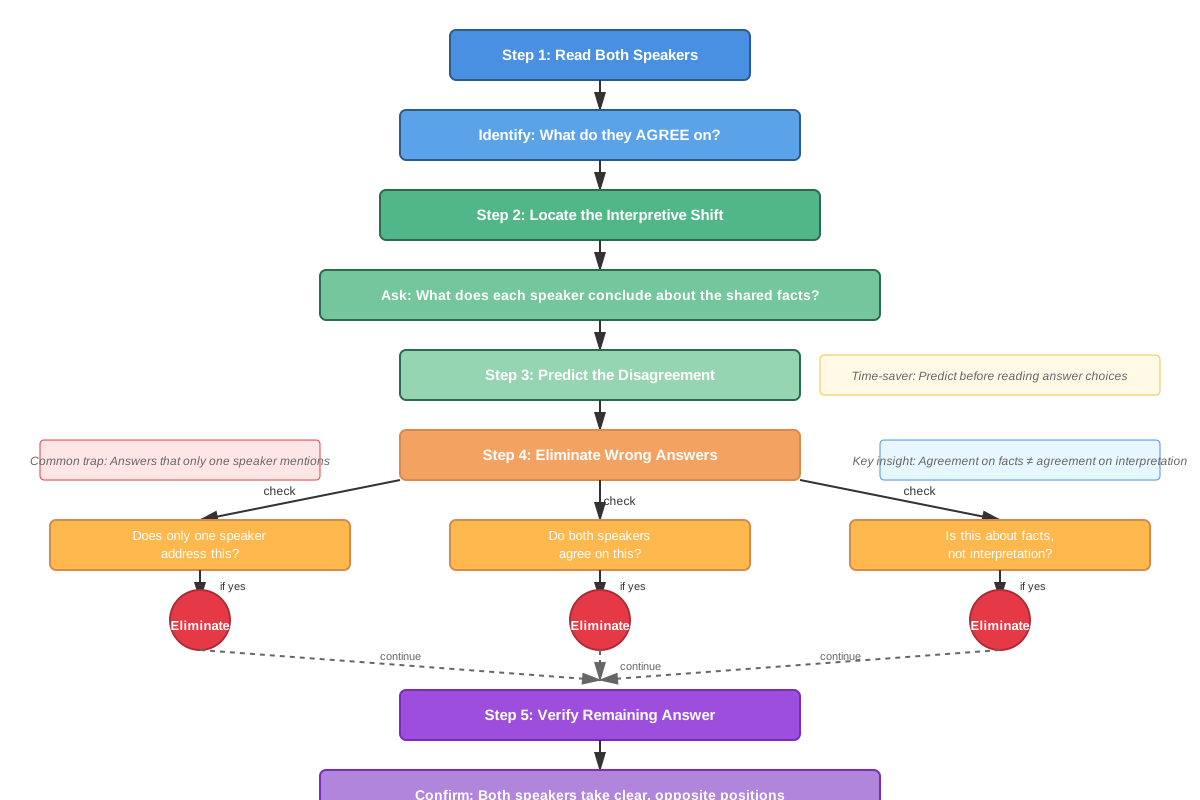
- The "Only One Speaker" Test: Cross out any answer where only one speaker has expressed a position. If you can't find where Speaker B addresses the claim, it can't be the disagreement.
- The "Agreement" Test: Eliminate any answer where both speakers would agree. If both would say "yes" or both would say "no," there's no disagreement.
- The "Irrelevant" Test: Remove answers that introduce topics neither speaker addressed, even if those topics seem related to the general subject matter.
- The "Compatible Positions" Test: Eliminate answers where both speakers' positions could be true simultaneously. Genuine disagreement requires incompatibility.
Time Allocation
Disagreement about interpretation questions typically require 1:15-1:30 to complete accurately. Allocate:
- 30-40 seconds: Reading and understanding the stimulus
- 10-15 seconds: Reading the question stem
- 35-45 seconds: Evaluating answer choices
If you find yourself spending more than 90 seconds, you may be overthinking. Return to the basic question: What specific claim do these speakers make incompatible commitments about?
Common Trap Patterns
The Broader Conclusion Trap: Wrong answers often present the speakers' overall conclusions or broader positions rather than the specific interpretive point they disagree about. The correct answer is usually more narrow and precise.
The Implicit Agreement Trap: The LSAT loves to include answer choices that represent assumptions both speakers share but never explicitly state. Just because something is unstated doesn't mean it's disputed.
The Reversal Trap: Some wrong answers correctly identify a point one speaker makes but reverse which speaker holds which position. Always verify that the answer choice aligns with what each speaker actually said.
Memory Techniques
The DICE Mnemonic
Remember the four most common types of interpretive disagreement with DICE:
- Definitional: Does it fit the definition?
- Implication: What does it imply or lead to?
- Characterization: How should we describe it?
- Execution/Application: Does the rule apply here?
The "Both Must Bite" Rule
For an answer to be correct, both speakers must have taken a bite out of that issue—they must have expressed a position on it. Visualize each speaker taking a bite from opposite sides of the same apple. If only one speaker has "bitten," it's not the disagreement.
The Agreement Highlighter Technique
When reading the stimulus, mentally highlight (or actually mark) points of agreement. This creates a visual/mental map of what's NOT in dispute, making the actual disagreement stand out by contrast. Think of it as clearing away the underbrush to reveal the path.
The "Yes/No" Test Visualization
For each answer choice, visualize asking each speaker "Do you agree with this claim?" If you can clearly see Speaker A saying "yes" and Speaker B saying "no" (or vice versa), you've found the disagreement. If both would say "yes," both would say "no," or one would say "I never addressed that," eliminate it.
Summary
Disagreement about interpretation questions test the ability to identify where two speakers diverge in their understanding, application, or characterization of shared information. Unlike factual disagreements, these questions focus on analytical divergence—how speakers interpret what something means, whether a principle applies, or how a situation should be described. Success requires distinguishing between points of agreement and genuine interpretive conflict, recognizing that speakers can share many premises while disagreeing about a specific interpretive point. The correct answer must represent a claim both speakers address with incompatible positions. Common wrong answers present points of agreement, positions only one speaker holds, or irrelevant comparisons. Mastering these questions develops the precise analytical discrimination essential for legal reasoning, where interpretation of statutes, precedents, and evidence forms the core of legal argument.
Key Takeaways
- Interpretive disagreements concern how to understand shared information, not what information exists
- Both speakers must have expressed a position on the point of disagreement—if only one addresses it, eliminate that answer
- Speakers often agree on facts while disagreeing about interpretation, or agree on interpretation while disagreeing about facts
- The five main types are definitional, application, characterization, implication, and causal interpretation disagreements
- Wrong answers frequently present points of agreement as if they were disputes—identifying agreements helps eliminate wrong answers
- Contrastive language ("actually," "rather," "instead") often signals where the second speaker's interpretation diverges
- The correct answer represents mutually incompatible positions—both cannot be true simultaneously
Related Topics
Principle Application Questions: These questions require applying general rules to specific cases, which directly builds on the application interpretation skills developed here. Understanding how speakers can disagree about whether a principle applies prepares students for questions asking them to identify which principle governs a situation.
Assumption Questions: Interpretive disagreements often stem from different unstated assumptions. Mastering disagreement about interpretation strengthens the ability to identify what assumptions drive different interpretations of the same evidence.
Parallel Reasoning: Recognizing the structure of interpretive disagreements—same information, different understanding—helps identify parallel structures in different contexts, a key skill for parallel reasoning questions.
Method of Reasoning: Understanding how speakers interpret evidence differently provides foundation for analyzing and describing argumentative methods more generally.
Practice CTA
Now that you understand the core concepts and strategies for disagreement about interpretation questions, it's time to apply this knowledge. Work through the practice questions carefully, using the two-pass method and elimination strategies outlined above. Pay special attention to identifying what speakers agree about—this skill alone will help you eliminate wrong answers quickly. Remember that these questions reward precision: the correct answer captures the specific interpretive point where speakers diverge, not their general positions or broader conclusions. Each practice question you complete strengthens your ability to spot interpretive conflicts quickly and accurately, building the analytical discrimination that distinguishes top LSAT performers. You've got this!
Sign up free to keep reading
Create a free AnvayaPrep account to finish this LSAT guide on Disagreement about interpretation — plus flashcards and practice questions.