Overview
Application questions represent one of the most sophisticated and frequently tested question types in LSAT reading comprehension. These questions require test-takers to extend the reasoning, principles, or arguments presented in a passage to new scenarios, contexts, or situations not explicitly discussed in the original text. Unlike questions that simply ask what the passage states, application questions demand that students understand the underlying logic deeply enough to recognize how it would operate in a different setting.
The essence of application questions lies in analogical reasoning and principle extraction. When the LSAT presents an application question, it tests whether a student can identify the core principle, methodology, or reasoning pattern from the passage and then determine how that same principle would apply to a novel situation. This skill mirrors the fundamental work of legal reasoning—taking established precedents, statutes, or principles and applying them to new cases. For law students and practicing attorneys, this type of reasoning forms the backbone of legal analysis, making application questions particularly relevant to the skills the LSAT aims to measure.
Within the broader landscape of reading comprehension question types, application questions occupy a middle-to-advanced difficulty tier. They build upon foundational skills like identifying main ideas and understanding passage structure, but they require an additional cognitive leap: transferring knowledge across contexts. Students must not only comprehend what the author explicitly states but also internalize the logical framework well enough to predict how it would function in circumstances the author never mentioned. This makes application questions both challenging and high-yield for score improvement, as mastering them demonstrates genuine comprehension rather than mere recognition.
Learning Objectives
- [ ] Identify how Application questions appears in LSAT questions
- [ ] Explain the reasoning pattern behind Application questions
- [ ] Apply Application questions to solve LSAT-style problems accurately
- [ ] Distinguish application questions from other question types based on question stem language
- [ ] Extract transferable principles from complex passages efficiently
- [ ] Evaluate answer choices by testing whether they maintain logical consistency with passage principles
- [ ] Recognize common trap answers that superficially resemble passage content without maintaining logical fidelity
Prerequisites
- Main Idea Identification: Understanding the central thesis of a passage is essential because application questions require knowing what principle or argument to apply to new scenarios.
- Passage Structure Analysis: Recognizing how arguments are constructed helps identify which elements are transferable principles versus context-specific details.
- Inference Skills: Application questions extend inference abilities by requiring predictions about unstated scenarios based on stated principles.
- Argument Analysis: Understanding how premises support conclusions enables recognition of the logical framework that must be preserved when applying principles to new contexts.
Why This Topic Matters
Application questions appear with remarkable consistency across LSAT administrations, typically comprising 15-25% of all reading comprehension questions. This frequency makes them one of the highest-yield question types for focused study. The LSAT uses application questions to assess whether test-takers possess the analytical flexibility required for legal reasoning—the ability to take a rule, principle, or analytical framework and determine its implications in novel circumstances.
In legal practice, attorneys constantly engage in this type of reasoning. When a new client presents a case, lawyers must identify which legal principles apply and predict how courts would extend existing precedents to these new facts. Similarly, when interpreting statutes or regulations, legal professionals must determine how general language applies to specific situations. The LSAT's application questions directly simulate this core competency.
These questions commonly appear following passages that present theoretical frameworks, analytical methodologies, critical perspectives, or argumentative positions. Science passages might ask how a researcher's methodology would apply to a different phenomenon. Humanities passages might ask how a critic's analytical framework would evaluate a new work. Social science passages might ask how a theory would explain a different social pattern. Law passages might ask how a legal principle would apply to a modified scenario. The versatility of application questions means they can follow any passage type, making them universally important across all reading comprehension content.
Core Concepts
Defining Application Questions
Application questions ask test-takers to take information, principles, reasoning patterns, or methodologies from the passage and determine how they would operate in a new context not explicitly discussed in the text. These questions test comprehension at the level of transferable understanding rather than mere recall. The fundamental cognitive task involves recognizing the essential features of an argument or principle while distinguishing them from context-specific details that don't transfer to new scenarios.
The question stems for application questions typically include phrases like:
- "Which of the following scenarios best illustrates the principle described in the passage?"
- "The author's argument would most support which of the following?"
- "Based on the passage, the methodology described would most likely be applied to..."
- "Which of the following situations is most analogous to..."
- "The reasoning in the passage would most strongly support which of the following?"
The Reasoning Pattern Behind Application Questions
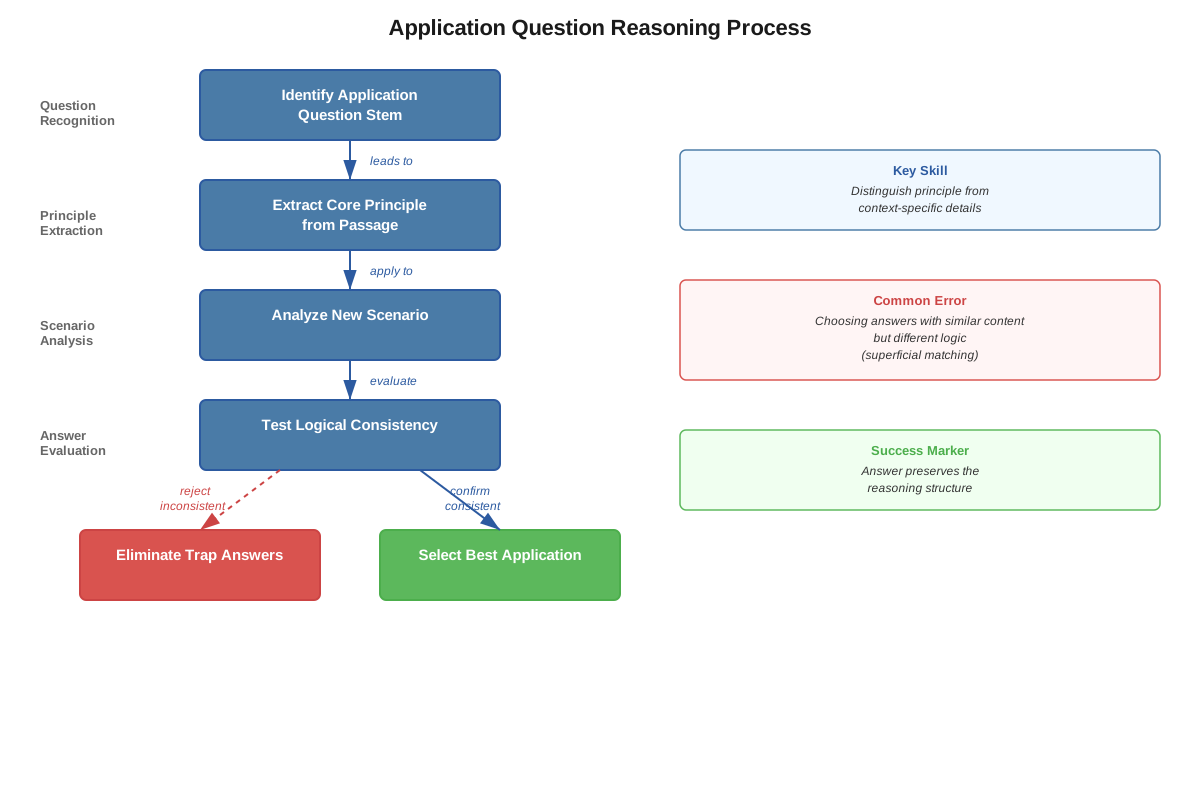
The logical structure of application questions follows a consistent pattern:
- Principle Extraction: First, identify the general principle, rule, methodology, or reasoning pattern in the passage
- Abstraction: Strip away context-specific details to understand the principle at its most general level
- Pattern Matching: Examine the new scenario in the answer choice to identify its essential features
- Logical Consistency Testing: Determine whether the new scenario maintains the same logical relationships as the original principle
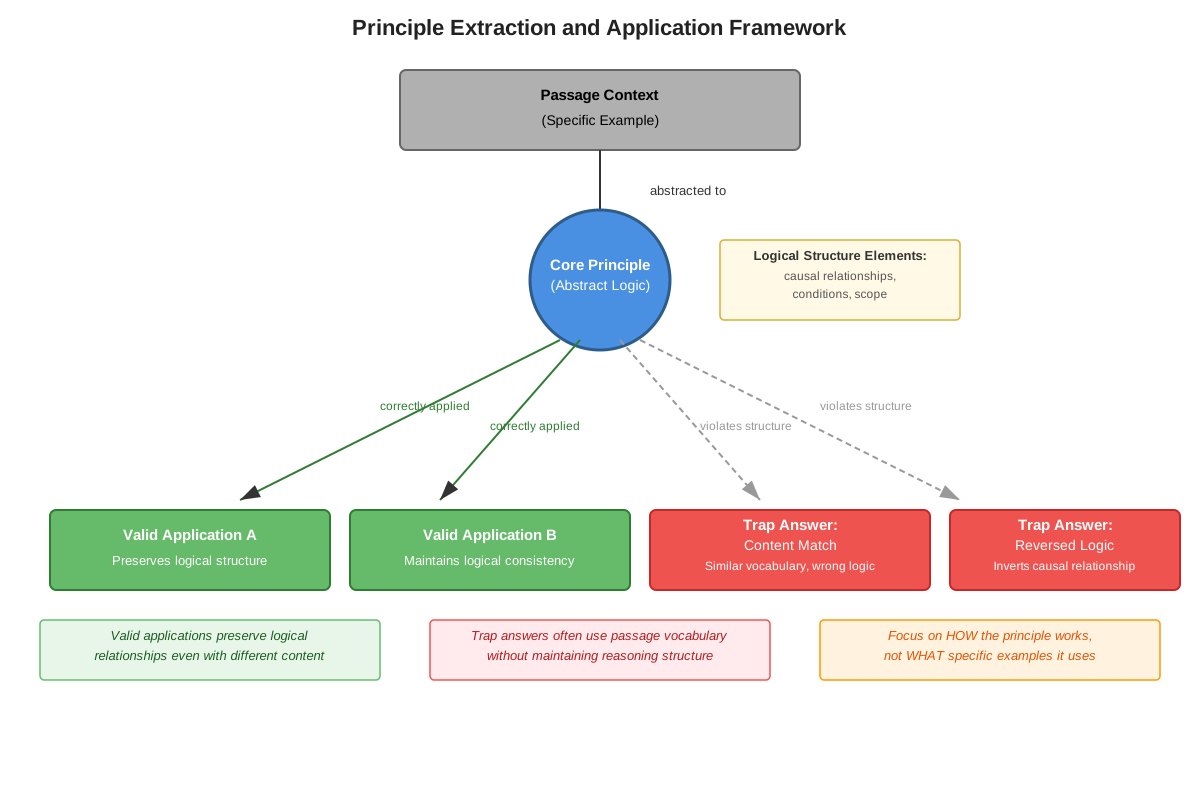
This reasoning pattern requires distinguishing between essential features (the core logical structure that must be preserved) and superficial features (specific details that can vary without changing the principle). For example, if a passage describes how economic incentives influence consumer behavior in one market, an application question might ask about a completely different market. The essential feature is the relationship between incentives and behavior; the superficial feature is which specific market is involved.
Types of Application Scenarios
Application questions present several distinct types of scenarios:
| Application Type | Description | Example Context |
|---|---|---|
| Analogous Situation | A parallel scenario in a different domain | Applying a biological principle to a social phenomenon |
| Extended Principle | Taking a stated principle to its logical implications | Determining what else a legal rule would prohibit |
| Methodological Transfer | Applying a research method to a new subject | Using a historian's analytical approach on a different period |
| Hypothetical Case | Testing how passage reasoning handles a new case | How would the author evaluate this new artwork? |
| Predictive Application | Forecasting outcomes based on passage principles | What would this theory predict about future events? |
Identifying Transferable Elements
Success with application questions depends on accurately identifying which elements of the passage transfer to new contexts. Transferable elements include:
- Causal relationships: If X causes Y in the passage, the same causal mechanism should operate in the application scenario
- Logical principles: Rules of reasoning that apply regardless of specific content
- Methodological approaches: Ways of analyzing or investigating that work across different subjects
- Evaluative criteria: Standards for judgment that apply to multiple cases
- Structural patterns: Relationships between elements that persist across contexts
Non-transferable elements that should not determine your answer include:
- Specific examples used to illustrate principles
- Particular historical periods or locations
- Named individuals or organizations
- Technical terminology specific to one domain
- Contextual details that serve only illustrative purposes
The Role of Abstraction
Abstraction is the cognitive process of moving from specific instances to general principles. When approaching application questions, students must abstract the passage content to its logical essence. Consider this process:
Concrete Level: "The study found that consumers purchased more organic produce when stores placed it at eye level rather than on bottom shelves."
Abstract Level: "Increased accessibility and visibility of an option increases selection of that option."
Application: This abstracted principle could apply to website design, library book placement, or political candidate positioning on ballots—any scenario where visibility affects choice.
The LSAT rewards test-takers who can perform this abstraction accurately while avoiding both over-generalization (making the principle too broad) and under-generalization (keeping it too tied to specific details).
Common Logical Structures in Application Questions
Several logical structures appear repeatedly in application questions:
- Necessary and Sufficient Conditions: If the passage establishes that X is necessary for Y, the application must maintain this requirement
- Proportional Relationships: If the passage describes a relationship where more of X leads to more of Y, the application should preserve this proportionality
- Contrastive Analysis: If the passage distinguishes between two approaches, the application should maintain the same basis for distinction
- Conditional Reasoning: If the passage presents if-then relationships, the application must respect these logical dependencies
Concept Relationships
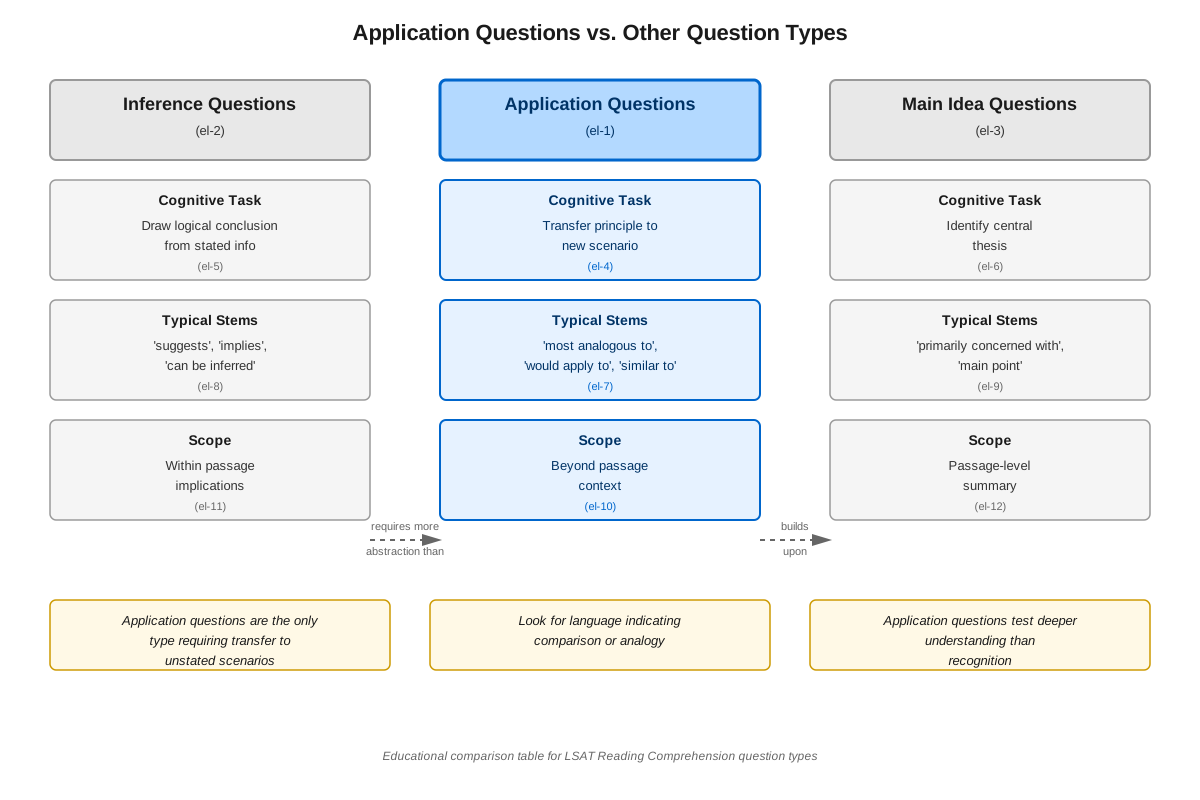
Application questions build directly upon main idea identification because students must first understand the central principle before applying it elsewhere. They also depend heavily on inference skills, but extend them further—while inference questions ask what must be true based on the passage, application questions ask what would be true in a different scenario based on passage principles.
The relationship between application questions and argument structure analysis is particularly strong. Understanding how an argument works—which premises support which conclusions, what assumptions underlie the reasoning—enables students to recognize when a new scenario preserves the same argumentative structure. This creates a progression: Structure Analysis → Principle Extraction → Application to New Contexts.
Within the topic itself, the concepts connect as follows:
Principle Extraction → enables → Abstraction → which allows → Pattern Matching → leading to → Logical Consistency Testing → resulting in → Correct Answer Selection
Additionally, understanding transferable versus non-transferable elements directly supports abstraction, as students must know which features to preserve and which to discard when moving to a general principle. The types of application scenarios provide a framework for pattern matching, helping students recognize what kind of transfer the question demands.
High-Yield Facts
⭐ Application questions typically comprise 15-25% of all reading comprehension questions on the LSAT, making them one of the most frequently tested question types.
⭐ The correct answer to an application question must preserve the logical structure of the passage principle, not merely share superficial similarities with passage content.
⭐ Question stems containing "most analogous to," "best illustrates," "would support," or "would apply to" reliably signal application questions.
⭐ Wrong answers often include scenarios that share vocabulary or subject matter with the passage but violate its logical principles.
⭐ Abstracting the passage principle to its most general form before examining answer choices significantly improves accuracy.
- Application questions test understanding at the level of transferable principles rather than specific facts or details.
- The reasoning pattern involves extraction, abstraction, pattern matching, and logical consistency testing.
- Essential features (causal relationships, logical principles, methodological approaches) must be preserved; superficial features (specific examples, names, locations) need not be.
- Application questions can follow any passage type—science, humanities, social science, or law.
- Time spent accurately identifying the transferable principle before reading answer choices reduces overall time per question by preventing multiple re-readings.
- Correct applications maintain the same relationships between elements even when the elements themselves are completely different.
- Application questions often appear as the second or third question following a passage, after main idea questions but before more detailed inference questions.
Quick check — test yourself on Application questions so far.
Try Flashcards →Common Misconceptions
Misconception: Application questions simply ask for scenarios that share the same topic or subject matter as the passage.
Correction: Application questions require logical consistency, not topical similarity. A correct answer might involve a completely different subject area but preserve the same reasoning structure, while a wrong answer might discuss the same topic but violate the passage's logical principles.
Misconception: The correct answer will use similar vocabulary or terminology from the passage.
Correction: Correct answers often deliberately avoid passage vocabulary to test whether students understand the principle itself rather than just recognizing familiar words. Wrong answers frequently include passage terminology as a trap.
Misconception: Application questions are just another type of inference question.
Correction: While both require going beyond what's explicitly stated, inference questions ask what must be true based on passage information, while application questions ask how passage principles would operate in entirely new contexts. Application requires an additional step of transferring principles across domains.
Misconception: If a passage discusses a specific example, the application question will ask about a similar example.
Correction: Application questions typically move to different domains precisely to test whether students can abstract the principle. If a passage uses an economic example, the application might involve biology, art, or law.
Misconception: The most detailed or complex answer choice is usually correct because it shows sophisticated understanding.
Correction: Correct answers maintain logical fidelity to the passage principle, regardless of complexity. Sometimes the simplest answer choice that preserves the essential logical relationship is correct, while complex answers that introduce new logical elements are wrong.
Misconception: Application questions are primarily about the author's opinion or perspective.
Correction: While some application questions do ask what the author would think about a new scenario, many focus on applying methodologies, principles, or reasoning patterns that may be described in the passage without representing the author's personal view.
Worked Examples
Example 1: Scientific Methodology Application
Passage Summary: A passage describes how evolutionary biologists use comparative anatomy to infer evolutionary relationships. When two species share a complex anatomical structure, biologists conclude they inherited it from a common ancestor rather than developing it independently, because the probability of identical complex structures evolving separately is extremely low. The passage emphasizes that this methodology works best with complex, multi-part structures rather than simple features.
Question: "The reasoning described in the passage would most support which of the following?"
Answer Choices:
(A) Linguists who discover that two languages share several basic words should conclude that the languages descended from a common ancestral language.
(B) Linguists who discover that two languages share complex grammatical structures should conclude that the languages descended from a common ancestral language.
(C) Linguists who discover that two languages are spoken in adjacent regions should conclude that the languages influenced each other.
(D) Linguists who discover that two languages share a writing system should conclude that one language borrowed from the other.
(E) Linguists who discover that two languages share simple sound patterns should conclude that the languages descended from a common ancestral language.
Step-by-Step Solution:
- Extract the Principle: The passage establishes that shared complex features (not simple ones) indicate common ancestry because independent development of complex features is improbable.
- Abstract the Principle: When two entities share complex, multi-part characteristics, this suggests inheritance from a common source rather than independent development, because complexity makes coincidental similarity unlikely.
- Identify Essential Features:
- Complexity of the shared feature (essential)
- Conclusion of common ancestry/source (essential)
- Specific domain being biology (non-essential)
- Specific feature being anatomical (non-essential)
- Evaluate Each Answer:
- (A) "Basic words" = simple features, violates the complexity requirement
- (B) "Complex grammatical structures" = complex features ✓; "common ancestral language" = common source ✓; maintains logical structure
- (C) Geographic proximity introduces a new factor not in the original principle
- (D) Writing systems could be borrowed; doesn't maintain the "common ancestry" conclusion
- (E) "Simple sound patterns" = simple features, violates the complexity requirement
Correct Answer: (B)
Connection to Learning Objectives: This example demonstrates identifying application questions (the question stem "would most support"), explaining the reasoning pattern (extraction → abstraction → matching), and applying the methodology to solve the problem accurately.
Example 2: Critical Theory Application
Passage Summary: A passage discusses a literary critic's approach to analyzing novels. The critic argues that a novel's meaning cannot be determined solely by the author's stated intentions because readers inevitably interpret texts through their own cultural and historical contexts. The critic emphasizes that these reader contexts are not distortions of "true" meaning but rather constitute meaning itself. The passage notes that this approach values multiple interpretations over singular authoritative readings.
Question: "Which of the following scenarios best illustrates the principle described in the passage?"
Answer Choices:
(A) A historian argues that understanding a historical document requires researching what the document's author intended to communicate.
(B) A musician argues that a composer's notes on a score determine how the piece should be performed.
(C) An art critic argues that a painting's meaning emerges from viewers' responses rather than solely from the artist's intentions.
(D) A scientist argues that experimental results should be interpreted according to the researcher's hypothesis.
(E) A judge argues that a law's meaning is determined by the legislators who wrote it.
Step-by-Step Solution:
- Extract the Principle: Meaning is not determined solely by creator intentions but emerges from audience interpretation through their own contexts; multiple interpretations are valid rather than one authoritative reading being correct.
- Abstract the Principle: The meaning of a created work comes from audience reception and interpretation rather than exclusively from creator intentions, and this multiplicity of meaning is legitimate rather than problematic.
- Identify Essential Features:
- Rejection of sole reliance on creator intentions (essential)
- Emphasis on audience/receiver role in creating meaning (essential)
- Validation of multiple interpretations (essential)
- Specific domain being literary criticism (non-essential)
- Evaluate Each Answer:
- (A) Emphasizes author intentions as determinative—opposite of the principle
- (B) Emphasizes composer's authority—opposite of the principle
- (C) "Meaning emerges from viewers' responses" ✓; "rather than solely from artist's intentions" ✓; maintains the principle's logic
- (D) Emphasizes researcher's predetermined framework—opposite of the principle
- (E) Emphasizes legislators' intentions as determinative—opposite of the principle
Correct Answer: (C)
Connection to Learning Objectives: This example shows how to distinguish application questions from other types, extract transferable principles while ignoring domain-specific details (literary criticism vs. visual art), and evaluate answer choices for logical consistency rather than superficial similarity.
Exam Strategy
Approaching Application Questions Systematically
When encountering an application question, follow this strategic sequence:
- Confirm Question Type (5-10 seconds): Identify trigger phrases like "most analogous," "best illustrates," "would support," or "would apply to"
- Return to Passage (20-30 seconds): Locate the relevant principle, methodology, or reasoning pattern; if the question references specific lines, read 2-3 sentences before and after for context
- Abstract the Principle (15-20 seconds): Mentally formulate the principle in general terms, stripping away domain-specific details; consider stating it as "When X, then Y" or "If X, then Y"
- Predict Answer Characteristics (10 seconds): Before reading choices, anticipate what features the correct answer must have to maintain logical consistency
- Evaluate Choices Systematically (40-60 seconds): Test each answer against the abstracted principle, eliminating those that violate essential features
Exam Tip: If you find yourself re-reading the passage multiple times while evaluating answers, you likely haven't abstracted the principle sufficiently. Invest more time in step 3 to save time overall.
Trigger Words and Phrases
Question Stem Triggers:
- "Most analogous to"
- "Best illustrates"
- "Would most support"
- "Would most likely apply to"
- "Most similar to"
- "Author would most likely agree with which of the following about [new scenario]"
- "Reasoning in the passage would most strongly support"
- "Principle described in the passage would justify"
Passage Content Triggers (indicating application questions may follow):
- Methodological descriptions ("The researcher's approach involves...")
- Theoretical frameworks ("According to this theory...")
- General principles ("This principle suggests that...")
- Analytical approaches ("The critic's method of analysis...")
- Causal explanations ("X leads to Y because...")
Process of Elimination Tips
Eliminate answers that:
- Share vocabulary with the passage but reverse its logical relationships
- Introduce new logical elements not present in the original principle
- Apply to only part of the principle while ignoring other essential features
- Confuse necessary and sufficient conditions from the passage
- Match superficial features (topic, domain) but violate logical structure
Keep answers that:
- Preserve causal relationships even in different domains
- Maintain the same logical structure with different content
- Respect conditional relationships (if-then) from the passage
- Apply the principle consistently even if the scenario seems initially unfamiliar
Time Allocation
Application questions typically require 60-90 seconds—slightly more than detail questions but less than complex inference questions. Allocate time as follows:
- 20-30 seconds: Principle extraction and abstraction
- 40-60 seconds: Answer evaluation
- Maximum 90 seconds total: If exceeding this, make your best judgment and move forward
Exam Tip: Application questions reward accuracy over speed. An extra 15 seconds spent accurately abstracting the principle prevents wasting 45 seconds re-reading the passage multiple times while evaluating answers.
Memory Techniques
The LEAP Acronym
Remember the application question process with LEAP:
- Locate the principle in the passage
- Extract the essential features
- Abstract to general form
- Pattern match with answer choices
The "Domain Swap" Visualization
Visualize the passage principle as a mathematical equation where you can substitute different values (domains) while maintaining the same operation (logical relationship). If the passage says "In economics, increased supply decreases price," visualize this as "In [DOMAIN], increased [X] decreases [Y]." The correct answer will maintain this structure: "In ecology, increased predators decrease prey population."
Essential vs. Superficial Features Mnemonic
CASTLE for essential features that transfer:
- Causal relationships
- Analytical methods
- Structural patterns
- Theoretical principles
- Logical conditions
- Evaluative criteria
SPEND for superficial features that don't transfer:
- Specific examples
- Proper names
- Exact terminology
- Numerical details
- Domain-specific context
The "If-Then" Translation
When abstracting principles, translate them into "If-Then" statements:
- Passage: "Artists who challenge conventions often face initial rejection"
- If-Then: "If someone challenges established norms, then they likely face initial resistance"
- This format makes pattern matching with new scenarios more systematic
Summary
Application questions constitute a high-frequency, high-value question type in LSAT reading comprehension, testing the ability to transfer principles, methodologies, and reasoning patterns from passage contexts to novel scenarios. Success requires a systematic approach: identifying the question type through trigger phrases, extracting the relevant principle from the passage, abstracting it to its most general logical form while distinguishing essential from superficial features, and then evaluating answer choices for logical consistency rather than topical similarity. The reasoning pattern mirrors fundamental legal thinking—applying established principles to new cases—making these questions particularly relevant to law school success. Common pitfalls include selecting answers based on shared vocabulary rather than logical structure, failing to abstract principles sufficiently, and confusing application questions with simpler inference questions. Mastery comes from practicing the extraction-abstraction-matching process until it becomes automatic, allowing efficient and accurate navigation of these sophisticated questions that reward deep comprehension over surface-level recognition.
Key Takeaways
- Application questions test whether you can transfer passage principles to new contexts, not whether you remember passage details
- The correct answer preserves logical structure and essential features while superficial features (domain, vocabulary, examples) can and often do change completely
- Invest time in abstracting the principle to its general form before evaluating answer choices—this prevents multiple re-readings and improves accuracy
- Question stems containing "most analogous," "best illustrates," "would support," or "would apply to" reliably signal application questions
- Wrong answers frequently share passage vocabulary or topic while violating its logical principles—test for logical consistency, not topical similarity
- Application questions appear in 15-25% of reading comprehension questions, making them essential for score improvement
- The LEAP process (Locate, Extract, Abstract, Pattern-match) provides a systematic approach that improves both speed and accuracy
Related Topics
Inference Questions: While application questions extend principles to new contexts, inference questions ask what must be true based on passage information within the same context. Mastering application questions builds upon inference skills by adding the transfer component.
Argument Structure Analysis: Understanding how arguments are constructed—premises, conclusions, assumptions—directly supports identifying which elements of a passage constitute transferable principles versus context-specific details.
Strengthen/Weaken Questions in Logical Reasoning: These questions also require understanding how principles apply to new information, creating cross-section synergy between Reading Comprehension and Logical Reasoning preparation.
Main Point Questions: Identifying main points helps with application questions because the central principle of a passage is often what application questions ask you to transfer to new scenarios.
Author's Perspective Questions: Understanding what the author believes helps predict how they would evaluate new scenarios, a common application question format.
Practice CTA
Now that you understand the systematic approach to application questions—from identifying them through trigger phrases to extracting and abstracting principles to evaluating answers for logical consistency—it's time to put these strategies into practice. Attempt the practice questions to reinforce the LEAP process and develop the pattern recognition that makes application questions manageable rather than intimidating. Each practice question you work through strengthens your ability to distinguish essential from superficial features and builds the confidence needed to tackle these high-value questions efficiently on test day. Remember: application questions reward deep understanding, and that understanding develops through deliberate practice. You've learned the framework—now apply it!
Sign up free to keep reading
Create a free AnvayaPrep account to finish this LSAT guide on Application questions — plus flashcards and practice questions.