Overview
Neutral answer choices represent one of the most critical skills for success on Point at Issue and Disagreement questions in LSAT Logical Reasoning. These questions ask test-takers to identify what two speakers actually disagree about—or sometimes what they agree on—and the LSAT deliberately includes answer choices that may seem relevant but are actually neutral positions that one or both speakers never address. Understanding how to identify and eliminate these neutral options is essential for achieving accuracy on these high-frequency question types.
The concept of neutral answer choices extends beyond Point at Issue questions to influence performance across multiple Logical Reasoning question types. When two speakers present arguments, they may discuss related topics without actually taking opposing stances on every aspect mentioned. A neutral answer choice presents a statement about which at least one speaker has expressed no clear position—they haven't affirmed it, denied it, or provided enough information to infer their stance. The LSAT uses these neutral options as sophisticated distractors because they often contain keywords or concepts from the stimulus, creating the illusion of relevance while failing the logical test of representing an actual point of disagreement or agreement.
Mastering the identification of lsat neutral answer choices connects directly to broader critical reasoning skills tested throughout the exam. This topic builds on fundamental argument analysis abilities—identifying conclusions, recognizing what is stated versus what is implied, and distinguishing between relevant and irrelevant information. Success with neutral answer choices requires precise reading comprehension and the discipline to avoid making unwarranted assumptions about what speakers believe based on tangential statements or partial information.
Learning Objectives
- [ ] Identify how Neutral answer choices appears in LSAT questions
- [ ] Explain the reasoning pattern behind Neutral answer choices
- [ ] Apply Neutral answer choices to solve LSAT-style problems accurately
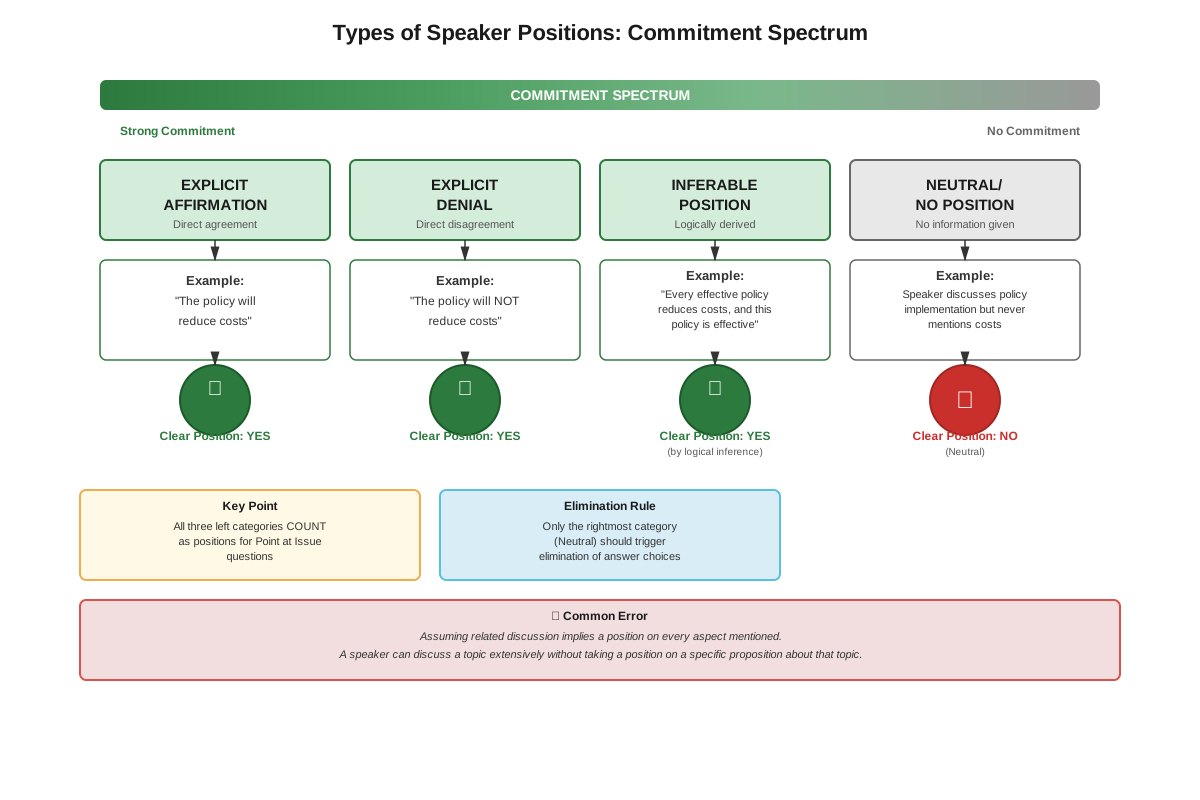
- [ ] Distinguish between statements where a speaker has no position versus statements where a position can be inferred
- [ ] Evaluate answer choices systematically using the "commitment test" for each speaker
- [ ] Recognize common patterns in how the LSAT constructs neutral distractors to appear relevant
Prerequisites
- Basic argument structure identification: Understanding premises, conclusions, and supporting evidence is necessary because Point at Issue questions require analyzing what each speaker's argument actually establishes.
- Distinction between explicit and implicit claims: Students must recognize the difference between what is directly stated and what can be reasonably inferred, as neutral answer choices often exploit confusion between these categories.
- Familiarity with Point at Issue question stems: Knowing how these questions are phrased ("disagree about whether," "committed to disagreeing about") helps focus attention on the specific logical task.
Why This Topic Matters
Point at Issue and Disagreement questions appear with remarkable consistency on every LSAT administration, typically comprising 2-4 questions per exam across the Logical Reasoning sections. This frequency, combined with the medium difficulty level, makes these questions prime targets for score improvement. Students who master neutral answer choice identification can reliably convert questions that might otherwise involve guesswork into confident, accurate responses.
In real-world applications, the skill of identifying neutral positions has profound practical value. Legal professionals must constantly distinguish between what parties actually dispute versus what remains uncontested or irrelevant to a case. Contract negotiations, appellate arguments, and settlement discussions all require precise identification of genuine points of disagreement versus areas of agreement or neutrality. The LSAT tests this skill because it directly predicts success in legal reasoning.
On the exam, neutral answer choices appear most frequently in Point at Issue questions but also surface in Principle questions, Parallel Reasoning questions, and Method of Reasoning questions where two speakers or arguments are compared. The LSAT constructs these distractors by selecting concepts mentioned by one or both speakers but presenting them in ways that don't represent actual commitments. For example, if Speaker A discusses environmental regulations and Speaker B discusses economic growth, a neutral answer choice might present a statement about "balancing environmental and economic concerns"—a topic neither speaker directly addressed, even though both mentioned related concepts.
Core Concepts
Definition of Neutral Answer Choices
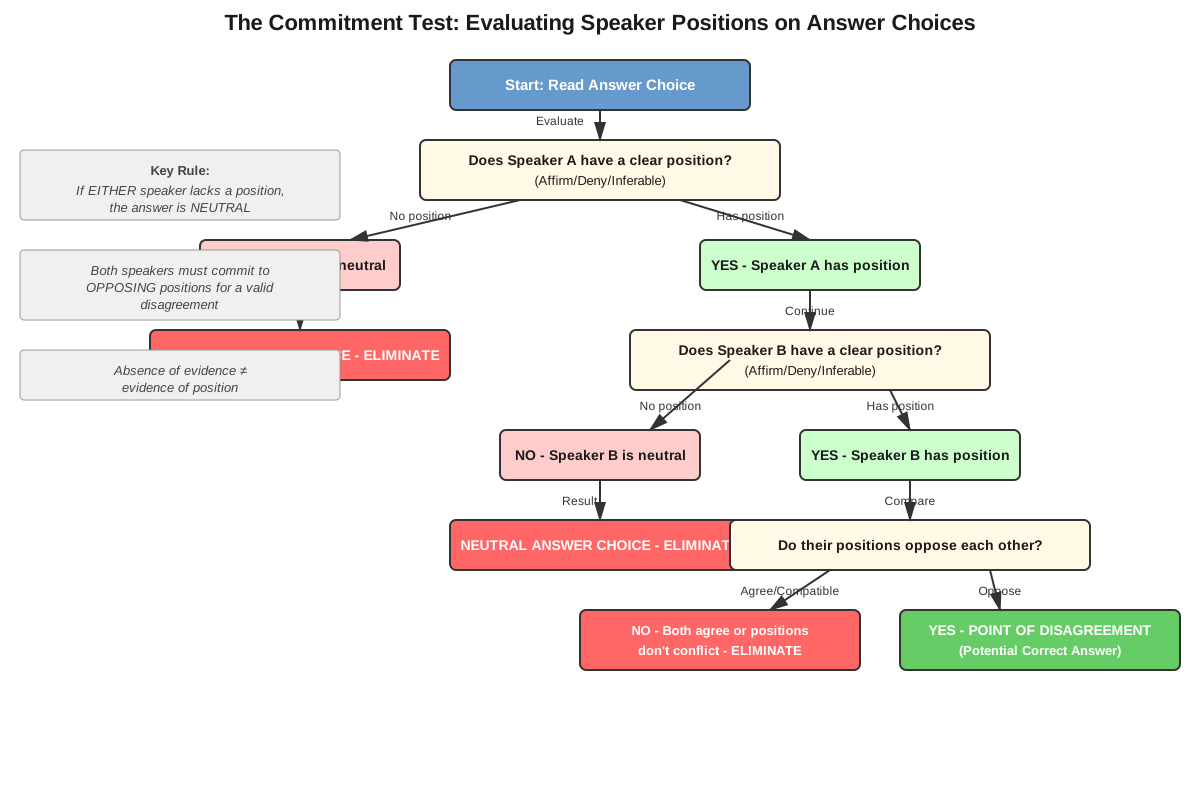
A neutral answer choice in the context of Point at Issue questions is an option where at least one speaker has not taken a clear position—either explicitly or through reasonable inference—on the statement presented. For an answer choice to represent a genuine point of disagreement, both speakers must have committed to opposing positions on that specific claim. If Speaker A affirms a statement and Speaker B denies it (or vice versa), a disagreement exists. However, if Speaker A affirms a statement and Speaker B simply hasn't addressed it, the answer choice is neutral with respect to Speaker B.
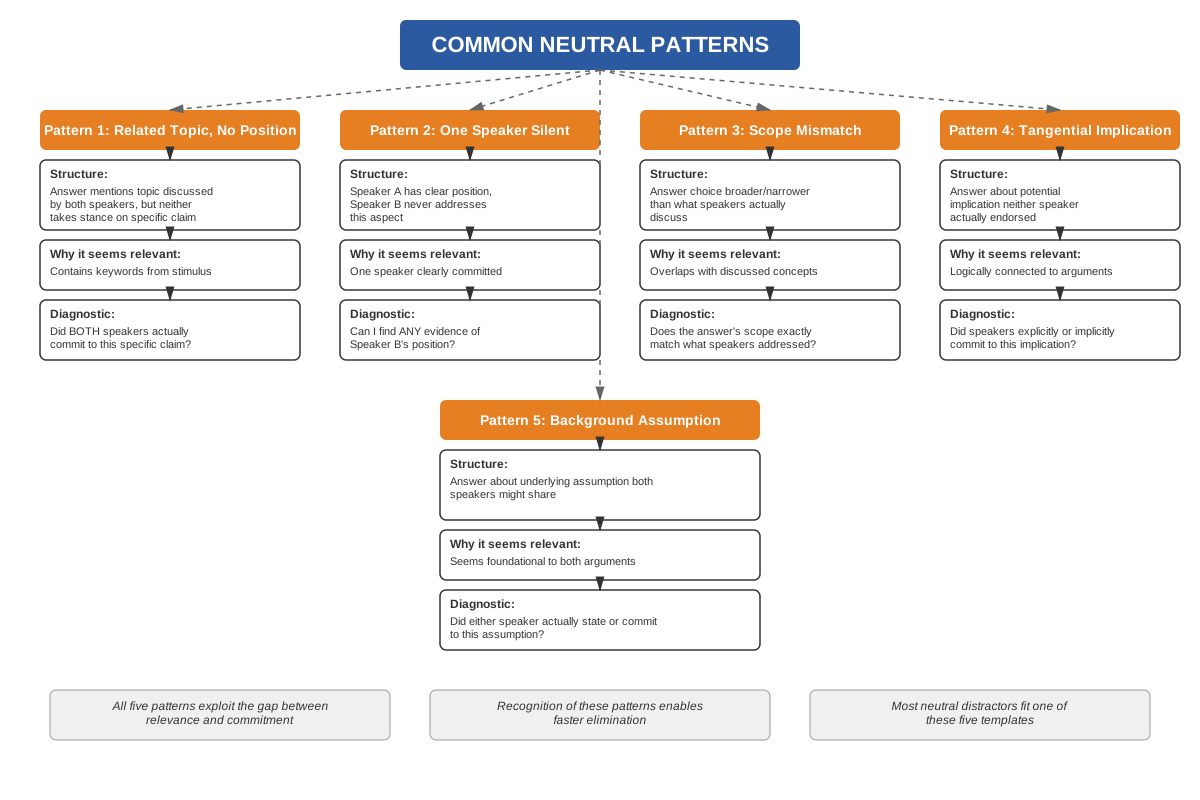
The neutrality can manifest in several ways:
- Complete silence: One speaker never mentions the concept or related ideas
- Tangential mention: A speaker references a related concept but doesn't commit to the specific claim in the answer choice
- Insufficient information: A speaker's statements don't provide enough detail to determine their position on the specific claim
- Scope mismatch: The answer choice presents a broader or narrower claim than what the speaker actually addressed
The Commitment Test
The most reliable method for identifying neutral answer choices involves applying the commitment test to each speaker individually. This systematic approach requires asking two questions for every answer choice:
- What is Speaker A's position on this statement? (Agrees/Disagrees/No clear position)
- What is Speaker B's position on this statement? (Agrees/Disagrees/No clear position)
Only when both speakers have clear, opposing positions does the answer choice represent a genuine point of disagreement. If either speaker lacks a clear position, the answer choice is neutral and must be eliminated.
| Speaker A Position | Speaker B Position | Result |
|---|---|---|
| Agrees | Disagrees | Valid disagreement ✓ |
| Disagrees | Agrees | Valid disagreement ✓ |
| Agrees | No position | Neutral - eliminate ✗ |
| Disagrees | No position | Neutral - eliminate ✗ |
| No position | Agrees | Neutral - eliminate ✗ |
| No position | Disagrees | Neutral - eliminate ✗ |
| Agrees | Agrees | Agreement, not disagreement ✗ |
| No position | No position | Neutral - eliminate ✗ |
Types of Neutral Distractors
The LSAT employs several recurring patterns when constructing neutral answer choices:
Keyword Traps: These answer choices incorporate prominent words or phrases from the stimulus, creating surface-level familiarity. A speaker might mention "technological innovation" in passing, and the answer choice presents a detailed claim about the benefits of technological innovation—a position the speaker never actually endorsed.
Scope Shifts: The answer choice presents a claim that's broader, narrower, or differently focused than what either speaker addressed. If Speaker A discusses "some regulations" and Speaker B discusses "excessive regulations," an answer choice about "all regulations" would be neutral because neither speaker committed to a position about regulations in general.
Implied Disagreement Traps: These options present statements where speakers seem to be on opposite sides based on the general thrust of their arguments, but neither has actually committed to the specific claim. If Speaker A argues for Policy X and Speaker B argues against Policy X, an answer choice stating "Policy Y would be more effective than Policy X" might be neutral if neither speaker mentioned Policy Y.
Premise vs. Conclusion Confusion: An answer choice might present something both speakers accept as a premise (making it an agreement, not a disagreement) or something neither speaker's argument depends on (making it neutral).
Distinguishing Neutral from Relevant
A critical distinction exists between relevance and commitment. An answer choice can be highly relevant to the topic under discussion while still being neutral if one or both speakers haven't taken a position on it. Consider this example:
- Speaker A: "The new highway will reduce commute times."
- Speaker B: "The new highway will cause environmental damage."
An answer choice stating "The new highway should be built" might seem like the obvious point of disagreement, but it's actually neutral unless one or both speakers explicitly stated or clearly implied a position on whether the highway should be built. Speaker A identified a benefit; Speaker B identified a cost. Neither necessarily concluded whether construction should proceed.
The Inference Boundary
Determining what can be reasonably inferred versus what constitutes an unwarranted assumption is crucial for neutral answer choice identification. The LSAT permits reasonable inferences—conclusions that follow logically from what's stated—but punishes assumptions—conclusions that require additional unstated premises.
Valid inference example: If a speaker states "All effective policies require public support, and this policy lacks public support," we can reasonably infer the speaker believes this policy is not effective.
Invalid assumption example: If a speaker states "This policy lacks public support," we cannot assume the speaker believes the policy is ineffective without additional information connecting public support to effectiveness.
Concept Relationships
The identification of neutral answer choices builds directly on fundamental argument analysis skills. Premise and conclusion identification → enables → determining what claims a speaker has committed to → which allows → applying the commitment test → leading to → accurate neutral answer choice elimination.
This topic connects intimately with scope recognition from other Logical Reasoning question types. Just as Strengthen and Weaken questions require matching the scope of answer choices to the argument's scope, Point at Issue questions demand precise scope matching between answer choices and each speaker's actual commitments.
The relationship to inference questions is particularly strong. Both question types require distinguishing what must be true, what could be true, and what we simply don't know based on the information provided. Neutral answer choices in Point at Issue questions are essentially statements about which we don't know one or both speakers' positions—parallel to "could be true but not must be true" options in inference questions.
Understanding neutral answer choices also enhances performance on Method of Reasoning questions that compare two arguments, as these questions sometimes ask about points of agreement or disagreement between argumentative approaches. The same commitment test applies: both arguments must take clear, opposing positions for a genuine disagreement to exist.
High-Yield Facts
⭐ A neutral answer choice is one where at least one speaker has not taken a clear position on the specific statement presented.
⭐ For a valid point of disagreement, both speakers must have committed to opposing positions—one affirming and one denying the claim.
⭐ Relevance to the topic does not equal commitment to a position; speakers can discuss related concepts without taking stances on every related claim.
⭐ The commitment test requires evaluating each speaker's position independently: Agrees/Disagrees/No clear position.
⭐ Keyword presence in an answer choice does not guarantee that choice represents a genuine disagreement; scope and specificity matter.
- Neutral answer choices often contain concepts mentioned by both speakers but combine them in ways neither speaker actually addressed.
- If a speaker discusses a specific subset (e.g., "some regulations"), they haven't necessarily committed to a position about the broader category (e.g., "regulations in general").
- Premises that both speakers accept are points of agreement, not disagreement, and should be eliminated unless the question asks for agreement.
- The LSAT rarely requires complex chains of inference to determine positions; if you need multiple inferential steps, the answer choice is likely neutral.
- Time pressure causes test-takers to select answer choices that "feel right" based on the general tone of disagreement rather than applying the commitment test systematically.
Quick check — test yourself on Neutral answer choices so far.
Try Flashcards →Common Misconceptions
Misconception: If two speakers are clearly arguing against each other, they must disagree about everything related to their topic.
Correction: Speakers can have opposing overall positions while agreeing on many specific points or remaining neutral on others. The LSAT tests the ability to identify the precise point of disagreement, not the general sense that speakers oppose each other.
Misconception: If an answer choice mentions concepts from both speakers' arguments, it must represent their point of disagreement.
Correction: Mentioning related concepts doesn't establish opposing commitments. An answer choice might state "Economic growth requires environmental sacrifice," but if Speaker A only discussed economic benefits and Speaker B only discussed environmental costs, neither has committed to a position on whether one requires sacrificing the other.
Misconception: You can infer a speaker's position on an answer choice based on what would be consistent with their overall argument.
Correction: The LSAT requires actual commitments, not positions that would be logically consistent. A speaker arguing for stricter regulations might logically support many specific regulations, but unless they've committed to a position on the specific regulation in the answer choice, it remains neutral.
Misconception: Neutral answer choices are always completely unrelated to the stimulus.
Correction: The most effective neutral distractors are highly relevant to the topic but present claims neither speaker has addressed. These are more tempting than obviously irrelevant options and require careful application of the commitment test.
Misconception: If you can't immediately identify what the speakers disagree about, you should look for the answer choice that seems most important or central to the topic.
Correction: Importance and centrality are irrelevant; only actual commitments matter. The genuine point of disagreement might concern a seemingly minor detail, while major concepts remain neutral.
Worked Examples
Example 1: Environmental Policy Debate
Stimulus:
Speaker A: The proposed carbon tax will effectively reduce emissions because economic incentives have historically proven successful in changing corporate behavior. Companies respond to financial pressures more reliably than to voluntary guidelines.
Speaker B: The proposed carbon tax is set at too low a level to change corporate behavior meaningfully. For economic incentives to work, they must be substantial enough to outweigh the costs of compliance.
Question: Speaker A and Speaker B disagree about whether:
Answer Choices:
(A) Economic incentives can effectively change corporate behavior
(B) The proposed carbon tax is set at an appropriate level
(C) Voluntary guidelines are effective in reducing emissions
(D) Companies respond to financial pressures
(E) Carbon taxes are the best method for reducing emissions
Analysis:
Applying the commitment test to each answer choice:
(A) Economic incentives can effectively change corporate behavior
- Speaker A: Agrees (states they "have historically proven successful")
- Speaker B: Agrees (states "For economic incentives to work" - presupposes they can work)
- Result: Agreement, not disagreement - ELIMINATE
(B) The proposed carbon tax is set at an appropriate level ⭐
- Speaker A: No explicit position, but the argument's structure suggests support for the tax as proposed
- Speaker B: Disagrees (explicitly states it's "set at too low a level")
- Result: This appears to be a disagreement, but requires careful analysis of Speaker A's commitment
Let's examine Speaker A more carefully: Does stating that "economic incentives have historically proven successful" commit Speaker A to believing this particular tax is set at an appropriate level? Speaker A discusses the general effectiveness of economic incentives but doesn't explicitly address whether this specific tax's level is appropriate. However, Speaker A's argument implicitly supports the tax as proposed by arguing it "will effectively reduce emissions." This is a reasonable inference that Speaker A believes the tax is adequate.
- Result: Valid disagreement - KEEP
(C) Voluntary guidelines are effective in reducing emissions
- Speaker A: Disagrees (states companies respond to incentives "more reliably than to voluntary guidelines")
- Speaker B: No position (never mentions voluntary guidelines)
- Result: Neutral regarding Speaker B - ELIMINATE
(D) Companies respond to financial pressures
- Speaker A: Agrees (explicitly states this)
- Speaker B: Agrees (argument presupposes this; criticizes the tax level, not the concept)
- Result: Agreement, not disagreement - ELIMINATE
(E) Carbon taxes are the best method for reducing emissions
- Speaker A: No position (supports this carbon tax but doesn't compare it to other methods)
- Speaker B: No position (criticizes this tax's level but doesn't discuss alternative methods)
- Result: Neutral for both speakers - ELIMINATE
Correct Answer: (B)
This example illustrates how neutral answer choices often involve concepts mentioned by only one speaker (like voluntary guidelines) or claims that go beyond what either speaker addressed (like "best method"). The correct answer required recognizing that Speaker A's support for the tax's effectiveness implicitly commits to the tax being set adequately.
Example 2: Education Funding
Stimulus:
Speaker A: Increasing teacher salaries would improve educational outcomes because higher pay attracts more qualified candidates to the teaching profession. Studies show that schools with higher teacher salaries have better student performance.
Speaker B: Simply increasing teacher salaries won't improve educational outcomes without also reforming teacher training programs. Many current teachers lack adequate preparation in modern pedagogical methods, and higher salaries won't address this deficiency.
Question: The dialogue provides the most support for the claim that Speaker A and Speaker B disagree about whether:
Answer Choices:
(A) Teacher training programs need reform
(B) Higher teacher salaries would improve educational outcomes
(C) More qualified candidates would improve student performance
(D) Current teachers lack adequate preparation
(E) Studies show a correlation between teacher salaries and student performance
Analysis:
(A) Teacher training programs need reform
- Speaker A: No position (never mentions training programs)
- Speaker B: Agrees (states they need reform)
- Result: Neutral regarding Speaker A - ELIMINATE
(B) Higher teacher salaries would improve educational outcomes ⭐
- Speaker A: Agrees (this is the main conclusion)
- Speaker B: Disagrees (states "simply increasing teacher salaries won't improve educational outcomes")
- Result: Valid disagreement - KEEP
(C) More qualified candidates would improve student performance
- Speaker A: Agrees (this is part of the reasoning chain)
- Speaker B: No clear position (doesn't address whether more qualified candidates would help)
- Result: Neutral regarding Speaker B - ELIMINATE
Note: This is a subtle neutral answer choice. Speaker B might seem to disagree based on the overall argumentative tone, but Speaker B specifically criticizes the sufficiency of salary increases alone, not the claim that more qualified candidates would improve performance. Speaker B's argument is compatible with believing qualified candidates would help but that salary increases won't produce those candidates without training reform.
(D) Current teachers lack adequate preparation
- Speaker A: No position (doesn't discuss current teachers' preparation)
- Speaker B: Agrees (explicitly states this)
- Result: Neutral regarding Speaker A - ELIMINATE
(E) Studies show a correlation between teacher salaries and student performance
- Speaker A: Agrees (cites these studies)
- Speaker B: No position (doesn't dispute the studies; argues about causation and sufficiency)
- Result: Neutral regarding Speaker B - ELIMINATE
Correct Answer: (B)
This example demonstrates how neutral answer choices can involve premises one speaker accepts but the other never addresses (like the studies in choice E) or claims about which one speaker has a clear position while the other remains silent (like training reform in choice A). The correct answer represents the core disagreement: whether salary increases alone would improve outcomes.
Exam Strategy
When approaching Point at Issue questions, implement this systematic process:
Step 1: Read both speakers' arguments carefully, noting the main conclusion and key premises of each. Resist the urge to immediately form an opinion about what they disagree about.
Step 2: Identify trigger words in the question stem. Phrases like "disagree about whether," "committed to disagreeing about," or "point at issue between them" all indicate you need to find opposing commitments. Questions asking for "agreement" require both speakers to hold the same position.
Step 3: Apply the commitment test to each answer choice systematically. For each option, explicitly determine:
- Speaker A's position: Agrees/Disagrees/No clear position
- Speaker B's position: Agrees/Disagrees/No clear position
Step 4: Eliminate neutral answer choices immediately. As soon as you identify that one speaker lacks a clear position, eliminate that choice without further consideration.
Step 5: Watch for scope shifts. The LSAT frequently presents answer choices that are broader, narrower, or differently focused than what the speakers actually discussed. If Speaker A discusses "some X" and the answer choice discusses "all X," that's likely a scope shift creating neutrality.
Exam Tip: The most tempting wrong answers will contain keywords from both speakers' arguments. Don't let keyword presence override the commitment test. Ask yourself: "Did this speaker actually commit to this specific claim, or did they just mention related concepts?"
Time allocation: Point at Issue questions should take approximately 1:15-1:30 minutes. The commitment test, while systematic, should become rapid with practice. If you find yourself spending more than 2 minutes, you're likely over-thinking the inferences required.
Process of elimination specific to neutral answer choices:
- Eliminate any choice where you can't identify a clear position for one speaker within 10 seconds
- Eliminate choices that present agreements (both speakers on the same side) unless the question asks for agreement
- Eliminate choices that require complex inferential chains; the LSAT keeps Point at Issue questions relatively straightforward
- Keep choices where you can point to specific text supporting opposing positions
Common trigger phrases that indicate neutral answer choices:
- "The best way to..." (when speakers discuss one way but don't compare to alternatives)
- "All..." or "Every..." (when speakers discuss some or specific instances)
- "Should..." (when speakers discuss what is or will be, not what should be)
- Combinations of concepts mentioned separately by each speaker
Memory Techniques
The CONE Acronym for identifying neutral answer choices:
- Commitment required (both speakers must have one)
- Opposing positions (they must disagree, not agree)
- No assumptions (don't infer beyond what's reasonably supported)
- Each speaker separately (test them individually, not together)
Visualization Strategy: Picture two people standing on opposite sides of a line. For the answer choice to be correct, both must be standing on opposite sides of that specific line. If one person isn't near that line at all (neutral), or if both are on the same side (agreement), eliminate the choice.
The "Quote Test" Mnemonic: For each answer choice, ask yourself: "Could I quote specific text showing this speaker's position?" If you can't quote or closely paraphrase supporting text, the position is likely neutral.
The Three-Second Rule: If you can't identify a speaker's position within three seconds of reading an answer choice, that speaker is probably neutral on that claim. This prevents over-analysis and unwarranted assumptions.
Summary
Neutral answer choices represent statements about which at least one speaker in a Point at Issue question has not taken a clear position. Mastering their identification requires systematic application of the commitment test: determining whether each speaker agrees, disagrees, or has no clear position on the specific claim presented. The LSAT constructs neutral distractors by incorporating keywords from the stimulus, shifting scope, or combining concepts mentioned separately by each speaker in ways neither actually addressed. Success demands distinguishing between relevance and commitment—answer choices can be highly relevant to the topic while remaining neutral if speakers haven't committed to positions on them. The most reliable approach involves evaluating each speaker's position independently, eliminating choices where either speaker lacks commitment, and avoiding unwarranted assumptions about what speakers believe based on what would be consistent with their arguments. This skill connects to broader logical reasoning abilities including scope recognition, inference boundaries, and precise argument analysis.
Key Takeaways
- Apply the commitment test systematically: For every answer choice, determine each speaker's position (Agrees/Disagrees/No clear position) independently before evaluating whether a disagreement exists.
- Keyword presence doesn't equal commitment: Answer choices containing words from both speakers' arguments are often neutral distractors that combine concepts neither speaker actually connected.
- Relevance and commitment are distinct: Speakers can discuss related topics without taking positions on every related claim; highly relevant answer choices can still be neutral.
- Scope precision matters critically: Watch for answer choices that are broader, narrower, or differently focused than what speakers actually addressed—these scope shifts create neutrality.
- Avoid assumption-based reasoning: The LSAT requires actual commitments, not positions that would be logically consistent with speakers' arguments; if you need multiple inferential steps, the answer is likely neutral.
- Neutral answer choices appear in predictable patterns: Recognize keyword traps, scope shifts, implied disagreement traps, and premise/conclusion confusion as recurring distractor types.
- Time efficiency comes from systematic elimination: Rapidly eliminate choices where one speaker lacks a clear position rather than agonizing over subtle distinctions between remaining options.
Related Topics
Point of Agreement Questions: These questions flip the task, asking what two speakers agree about rather than disagree about. The commitment test still applies, but you're looking for both speakers on the same side rather than opposite sides. Mastering neutral answer choice identification directly transfers to these questions.
Principle Questions with Multiple Speakers: Some Principle questions present two speakers and ask which principle their disagreement illustrates. These require first identifying the genuine point of disagreement (eliminating neutral options) before matching to principles.
Method of Reasoning Comparison Questions: These questions ask how two arguments relate to each other or how one responds to another. Identifying what each argument actually commits to—versus what remains neutral—is essential for accurate comparison.
Sufficient Assumption Questions: The skill of determining what an argument has and hasn't committed to transfers directly to identifying what additional premise would complete the argument's reasoning.
Practice CTA
Now that you understand how to identify and eliminate neutral answer choices, you're ready to apply these skills to practice questions. The commitment test becomes faster and more intuitive with repetition, transforming Point at Issue questions from uncertain guesswork into reliable points. Work through the practice questions methodically, explicitly stating each speaker's position before selecting your answer. Review the flashcards to reinforce the key patterns of neutral distractors. Remember: every Point at Issue question you master is a guaranteed point on test day—these questions reward systematic analysis over intuition. You've built the framework; now strengthen it through deliberate practice.
Sign up free to keep reading
Create a free AnvayaPrep account to finish this LSAT guide on Neutral answer choices — plus flashcards and practice questions.