Overview
Agreement questions represent a specialized category within LSAT Logical Reasoning that tests a student's ability to identify points of consensus between two speakers or arguments. Unlike their counterpart—disagreement questions—agreement questions require test-takers to pinpoint precisely what two parties would accept as true, even when their overall positions may differ substantially. These questions typically present two speakers with distinct viewpoints and ask which statement both would endorse or find acceptable based on their stated positions.
Understanding agreement questions is essential for LSAT success because they assess critical analytical skills that lawyers must employ daily: identifying common ground, recognizing shared premises, and distinguishing between areas of consensus and conflict. These questions appear regularly in the Logical Reasoning sections, and mastering them contributes directly to score improvement. The ability to parse complex arguments and extract points of agreement demonstrates sophisticated reading comprehension and logical analysis—skills that the LSAT prizes highly.
Within the broader Point at Issue and Disagreement unit, agreement questions form the complementary skill set to disagreement identification. While both question types require careful analysis of multiple perspectives, agreement questions demand a different cognitive approach: rather than seeking conflict, test-takers must identify overlap. This skill connects to fundamental logical reasoning abilities including premise identification, inference drawing, and argument structure analysis. Mastering agreement questions strengthens overall performance across all Logical Reasoning question types by developing precision in textual analysis and logical comparison.
Learning Objectives
- [ ] Identify how Agreement questions appears in LSAT questions
- [ ] Explain the reasoning pattern behind Agreement questions
- [ ] Apply Agreement questions to solve LSAT-style problems accurately
- [ ] Distinguish between statements that represent genuine agreement versus superficial similarity
- [ ] Evaluate answer choices systematically by testing each against both speakers' positions
- [ ] Recognize common trap answers that only one speaker would accept
- [ ] Analyze the logical structure of dual-speaker stimuli to extract shared commitments
Prerequisites
- Basic argument structure: Understanding premises, conclusions, and supporting evidence is necessary because agreement questions require identifying which specific claims both speakers accept
- Conditional reasoning fundamentals: Recognizing if-then relationships helps determine what each speaker is committed to accepting based on their stated positions
- Inference skills: The ability to draw valid conclusions from stated information is essential since agreement points may be implicit rather than explicitly stated
- Reading comprehension: Strong comprehension skills enable accurate interpretation of each speaker's position before comparing them
Why This Topic Matters
Agreement questions test a fundamental lawyering skill: finding common ground between opposing parties. In legal practice, identifying areas of consensus can facilitate negotiation, narrow disputes, and build persuasive arguments. The LSAT includes these questions to assess whether candidates can accurately analyze multiple perspectives and identify shared logical commitments—a skill essential for legal reasoning, mediation, and collaborative problem-solving.
On the LSAT, agreement questions appear with moderate frequency, typically comprising 2-4 questions per test across both Logical Reasoning sections. While less common than disagreement questions, they carry equal weight and often prove challenging because they require a different analytical approach than most Logical Reasoning questions. Test-takers accustomed to finding flaws or points of conflict must shift their mindset to identify consensus.
These questions commonly appear in several formats: explicit agreement questions asking "Which one of the following is a statement that both X and Y would accept?"; principle-based agreement questions asking what principle both speakers would endorse; and inference-based agreement questions requiring test-takers to identify what must be true given both speakers' commitments. The stimuli typically present two speakers with labeled positions (Speaker A and Speaker B, or named individuals like "Jordan" and "Taylor") followed by their respective statements. Understanding the precise requirements of agreement questions prevents costly errors and builds confidence in handling dual-perspective stimuli.
Core Concepts
Defining Agreement Questions
Agreement questions are LSAT Logical Reasoning questions that present two speakers or arguments and ask test-takers to identify a statement that both parties would accept as true or endorse based on their stated positions. The question stem typically includes phrases like "would be most likely to agree," "both would accept," or "is consistent with the views of both." Unlike disagreement questions that focus on conflict, agreement questions require identifying overlap, consensus, or shared logical commitments.
The fundamental challenge lies in distinguishing between genuine agreement and superficial similarity. Two speakers may use similar language or discuss the same topic without actually agreeing on any substantive point. Conversely, speakers with seemingly opposed positions may share underlying assumptions or accept certain factual claims even while disagreeing about their implications.
The Structure of Agreement Question Stimuli
Agreement question stimuli follow a predictable pattern that test-takers can leverage for efficient analysis:
- Speaker identification: The stimulus clearly labels two distinct speakers (e.g., "Politician A:" and "Politician B:" or "Critic:" and "Defender:")
- Position statements: Each speaker presents their view, typically 2-4 sentences
- Question stem: The question explicitly asks what both speakers would agree about
- Answer choices: Five options, only one of which both speakers would genuinely accept
Understanding this structure enables systematic analysis. Test-takers should read each speaker's position independently first, identifying their main claims, supporting reasons, and implicit commitments. Only after understanding each position individually should one begin comparing them for points of agreement.
Types of Agreement
Not all agreements are created equal. The LSAT tests several distinct types of agreement:
| Agreement Type | Description | Example |
|---|---|---|
| Factual Agreement | Both speakers accept the same factual claim | Both agree that sales increased last quarter |
| Principle Agreement | Both endorse the same general principle | Both accept that efficiency should be prioritized |
| Conditional Agreement | Both accept the same if-then relationship | Both agree that if costs rise, prices must increase |
| Negative Agreement | Both reject the same claim | Both deny that the policy was effective |
| Implicit Agreement | Both are committed to accepting something neither explicitly states | Both must accept that some change occurred |
Recognizing which type of agreement the question targets helps eliminate wrong answers efficiently. Factual agreements are most common, but principle-based and implicit agreements appear regularly and often prove more challenging.
The Agreement Test
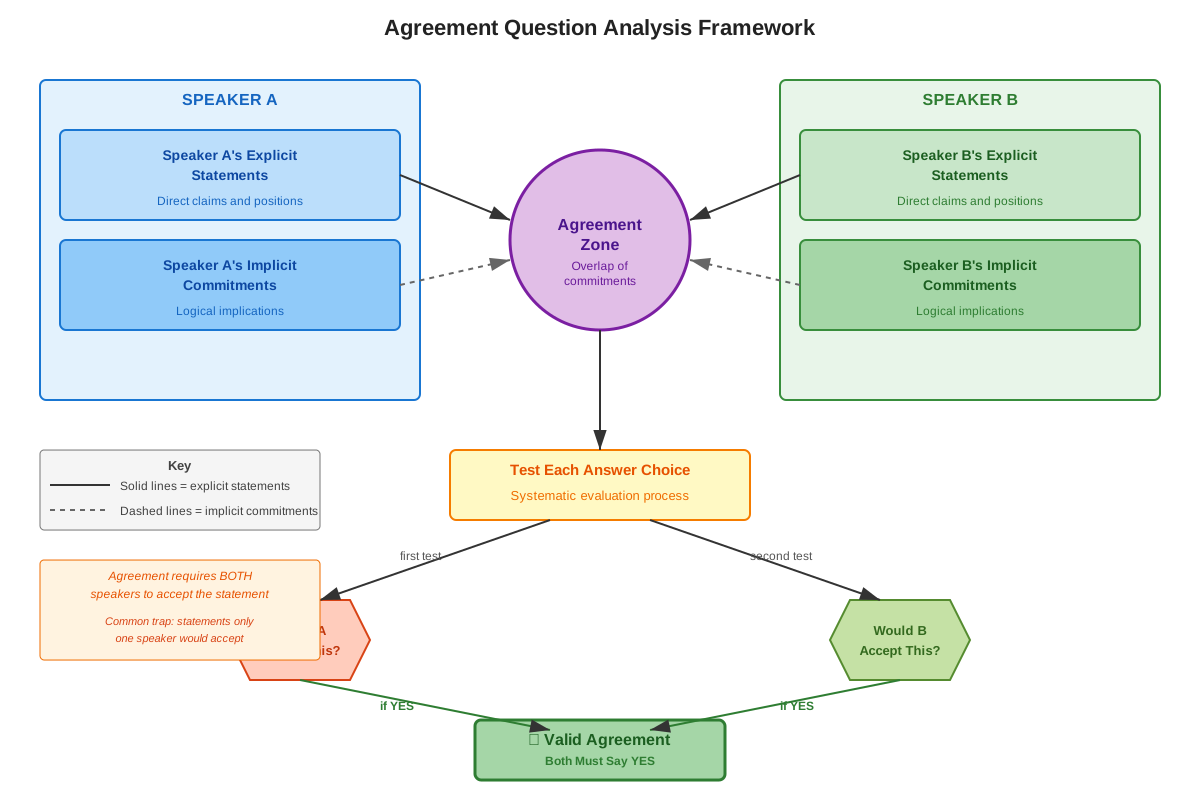
To determine whether an answer choice represents genuine agreement, apply the Agreement Test: a statement represents agreement only if both speakers would answer "yes" or "true" when asked whether they accept it. This test must be applied rigorously to each speaker independently.
The process follows these steps:
- Read the answer choice carefully
- Ask: "Based on Speaker A's stated position, would they accept this statement?"
- If yes, ask: "Based on Speaker B's stated position, would they accept this statement?"
- Only if both answers are "yes" is it a valid agreement
This systematic approach prevents the common error of selecting answers that only one speaker would accept or that seem related to both positions without representing actual agreement.
Common Agreement Question Stems
Recognizing agreement question stems immediately signals the analytical approach required. Common phrasings include:
- "Which one of the following is a statement that both X and Y would be likely to agree about?"
- "The dialogue provides the most support for the claim that X and Y agree that..."
- "X's and Y's statements provide the most support for holding that they would disagree about whether..."
- "Which one of the following principles would both X and Y be likely to accept?"
- "On the basis of their statements, X and Y are committed to agreeing about which one of the following?"
The phrase "committed to agreeing" is particularly important—it signals that the agreement may be implicit rather than explicit. Both speakers must be logically committed to accepting the statement based on what they've said, even if neither directly stated it.
Distinguishing Agreement from Related Concepts
Agreement questions exist within a family of related question types that require careful distinction:
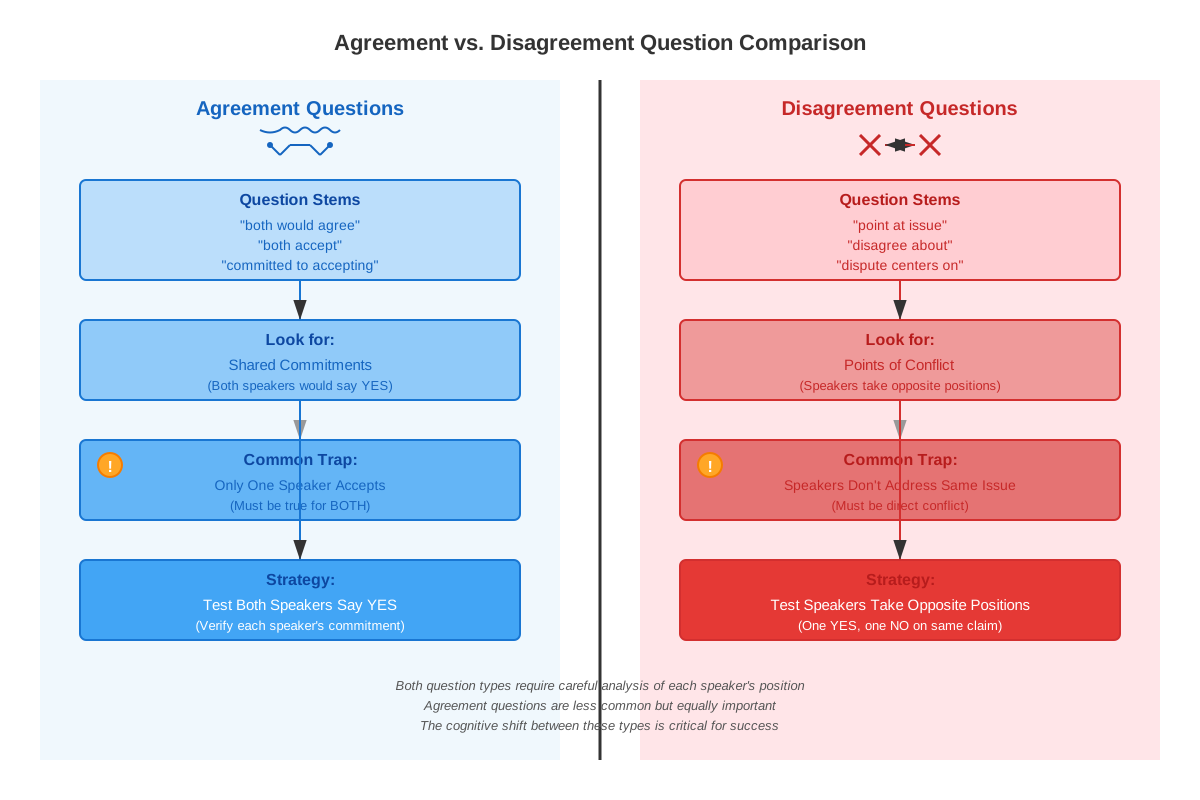
Agreement vs. Disagreement: Disagreement questions ask what speakers would dispute; agreement questions ask what they would both accept. The analytical approach differs fundamentally—disagreement requires finding conflict, while agreement requires finding consensus.
Agreement vs. Inference: Pure inference questions ask what follows from a single argument; agreement questions require identifying what follows from both arguments simultaneously. The correct answer must be supported by both speakers' positions.
Agreement vs. Main Point: Main point questions ask for the primary conclusion of an argument; agreement questions ask what both speakers would accept, which may be a minor premise or background assumption rather than either speaker's main point.
The Role of Scope in Agreement Questions
Scope plays a critical role in agreement questions. An answer choice may be too broad (making claims beyond what both speakers address) or too narrow (focusing on details only one speaker discusses). The correct answer must fall within the scope of both speakers' commitments.
Consider scope along these dimensions:
- Topic scope: Does the answer address something both speakers discuss?
- Strength scope: Does the answer make claims as strong as or stronger than what both speakers commit to?
- Temporal scope: Does the answer reference time periods both speakers address?
- Quantitative scope: Does the answer make numerical or quantitative claims both speakers would accept?
Incorrect answers frequently violate scope by introducing topics only one speaker addresses or by making stronger claims than both speakers support.
Concept Relationships
Agreement questions connect to broader Logical Reasoning skills through multiple pathways. The ability to identify agreement builds upon premise identification—recognizing what claims each speaker makes—and extends into inference drawing—determining what each speaker is committed to accepting based on their stated positions. This creates a logical progression: identify premises → understand commitments → compare commitments → find overlap.
Within the Point at Issue and Disagreement unit, agreement questions form a complementary pair with disagreement questions. Both require analyzing dual-speaker stimuli, but they demand opposite analytical focuses. Mastering both develops comprehensive skills in comparative argument analysis. The relationship can be mapped as:
Dual-Speaker Stimulus Analysis → branches into → Agreement Identification (finding consensus) and Disagreement Identification (finding conflict) → both require → Precise Textual Analysis and Logical Commitment Recognition
Agreement questions also connect to assumption questions because identifying what both speakers must accept often requires recognizing unstated assumptions. If both speakers' arguments depend on the same assumption, they are committed to agreeing about it, even if neither explicitly states it. This relationship strengthens overall assumption-identification skills.
Furthermore, agreement questions relate to principle questions when they ask which principle both speakers would endorse. This requires abstracting from specific positions to general rules, connecting agreement analysis to principle identification and application skills.
High-Yield Facts
⭐ Agreement questions require identifying statements that BOTH speakers would accept, not statements that seem related to both positions
⭐ The correct answer must pass the Agreement Test: both speakers would answer "yes" when asked if they accept the statement
⭐ Common wrong answers include statements that only one speaker would accept, even if they relate to the other speaker's topic
⭐ Agreement may be implicit—both speakers may be committed to accepting something neither explicitly states
⭐ Scope violations are the most common trap: answers that go beyond what both speakers address or commit to
- Agreement questions typically appear 2-4 times per LSAT across both Logical Reasoning sections
- Question stems containing "committed to agreeing" signal that the agreement may be implicit rather than explicit
- Both speakers may agree about facts while disagreeing about their implications or significance
- Negative agreements (both rejecting the same claim) are valid agreements
- The correct answer often involves a premise or assumption rather than either speaker's main conclusion
- Speakers with opposed overall positions can still agree about specific factual claims or principles
- Time pressure makes agreement questions particularly challenging because they require careful analysis of both positions
- Principle-based agreement questions require abstracting from specific cases to general rules both speakers would endorse
- Agreement questions reward systematic analysis over intuitive "feel" for the right answer
- Wrong answers often use language from both speakers' statements without representing actual agreement
Quick check — test yourself on Agreement questions so far.
Try Flashcards →Common Misconceptions
Misconception: If both speakers discuss the same topic, they must agree about something related to that topic.
Correction: Speakers can discuss the same topic while agreeing about nothing substantive. Agreement requires shared acceptance of specific claims, not merely shared subject matter.
Misconception: The correct answer will be something both speakers explicitly state.
Correction: Agreement is often implicit. Both speakers may be logically committed to accepting a statement neither directly articulates. The question stem phrase "committed to agreeing" specifically signals this possibility.
Misconception: If an answer choice mentions both speakers' topics, it represents agreement.
Correction: An answer can reference both speakers' concerns without representing genuine agreement. Each speaker must independently accept the statement as true based on their position.
Misconception: Speakers with opposing conclusions cannot agree about anything.
Correction: Speakers with opposed overall positions frequently agree about underlying facts, background conditions, or general principles while disagreeing about their implications or what should be done.
Misconception: Agreement questions are just the opposite of disagreement questions, so the same analytical approach works for both.
Correction: While both involve dual-speaker analysis, they require fundamentally different cognitive approaches. Disagreement questions seek conflict; agreement questions seek consensus. The mindset and elimination strategy differ substantially.
Misconception: The correct answer will be the most important or central claim in the stimulus.
Correction: The correct answer may involve a minor premise, background assumption, or peripheral fact that both speakers happen to accept, even if it's not central to either argument.
Misconception: If one speaker would "probably" accept an answer and the other "definitely" would, that's sufficient agreement.
Correction: Both speakers must clearly accept the statement based on their stated positions. Uncertainty about either speaker's acceptance disqualifies an answer choice.
Worked Examples
Example 1: Factual Agreement
Stimulus:
Economist: The recent tax reform will stimulate economic growth because it reduces the tax burden on small businesses, which are the primary drivers of job creation. When small businesses have more capital available, they invest in expansion and hire more workers.
Sociologist: I disagree that the tax reform will stimulate growth. The reform primarily benefits businesses that were already profitable, not struggling businesses that need support. Without addressing the fundamental challenges facing small businesses—such as access to credit and regulatory burdens—simply reducing taxes will have minimal impact on job creation.
Question: The economist's and sociologist's statements provide the most support for holding that they agree about which one of the following?
Answer Choices:
(A) The tax reform will stimulate economic growth
(B) Small businesses are important for job creation
(C) Reducing taxes on small businesses is the most effective way to promote economic growth
(D) The tax reform adequately addresses the challenges facing small businesses
(E) Profitable businesses will benefit more from the tax reform than struggling businesses
Analysis:
First, identify each speaker's position:
- Economist: Tax reform will stimulate growth because it helps small businesses, which drive job creation
- Sociologist: Tax reform won't stimulate growth because it doesn't address fundamental challenges facing small businesses
Now apply the Agreement Test to each answer:
(A) Would the economist accept this? Yes—it's their main conclusion. Would the sociologist accept this? No—they explicitly disagree. Eliminate.
(B) Would the economist accept this? Yes—they state small businesses are "primary drivers of job creation." Would the sociologist accept this? Yes—they discuss challenges facing small businesses and their role in job creation without disputing their importance. Keep as potential answer.
(C) Would the economist accept this? Possibly—they argue for tax reduction. Would the sociologist accept this? No—they argue other factors are more important. Eliminate.
(D) Would the economist accept this? Unclear—they don't discuss whether it's adequate. Would the sociologist accept this? No—they explicitly state it doesn't address fundamental challenges. Eliminate.
(E) Would the economist accept this? They don't discuss this distinction. Would the sociologist accept this? Yes—they explicitly state the reform "primarily benefits businesses that were already profitable." Eliminate because only one speaker clearly accepts it.
Correct Answer: (B)
Both speakers accept that small businesses are important for job creation. The economist explicitly states they are "primary drivers of job creation," and the sociologist's argument assumes their importance (otherwise, why discuss challenges facing them?). This represents factual agreement about the role of small businesses, even though the speakers disagree about whether the tax reform will effectively support them.
Example 2: Implicit Agreement
Stimulus:
Critic: The museum's new policy of allowing photography in all galleries will damage the visitor experience. People will spend more time taking photos than actually looking at the artwork, and the constant flash photography will disturb other visitors trying to appreciate the art.
Museum Director: The photography policy will actually enhance the visitor experience. Most modern smartphones don't require flash photography, so disturbance will be minimal. Furthermore, allowing photography encourages visitors to engage more deeply with the artwork as they consider composition and framing for their photos.
Question: On the basis of their statements, the critic and the museum director are committed to agreeing about which one of the following?
Analysis:
Identify each position:
- Critic: Photography policy will damage visitor experience (people will focus on photos, flash will disturb others)
- Museum Director: Photography policy will enhance visitor experience (no flash needed, encourages engagement)
Notice the question stem: "committed to agreeing"—this signals implicit agreement.
Consider what both speakers must accept:
- Both discuss the photography policy's impact on visitor experience
- Both assume that visitor experience quality matters
- Both assume that how visitors engage with artwork affects their experience
- The critic assumes flash photography will occur; the director disputes this
- Both accept that the policy allows photography in galleries (this is a factual premise for both arguments)
The correct answer would likely be something like: "The museum has implemented a policy allowing photography in galleries" or "The quality of visitor experience is an important consideration for museum policies."
Both speakers are committed to these claims even though neither explicitly states them—they form the foundation of both arguments. This demonstrates implicit agreement: shared logical commitments that underlie opposed positions.
Exam Strategy
Systematic Approach to Agreement Questions
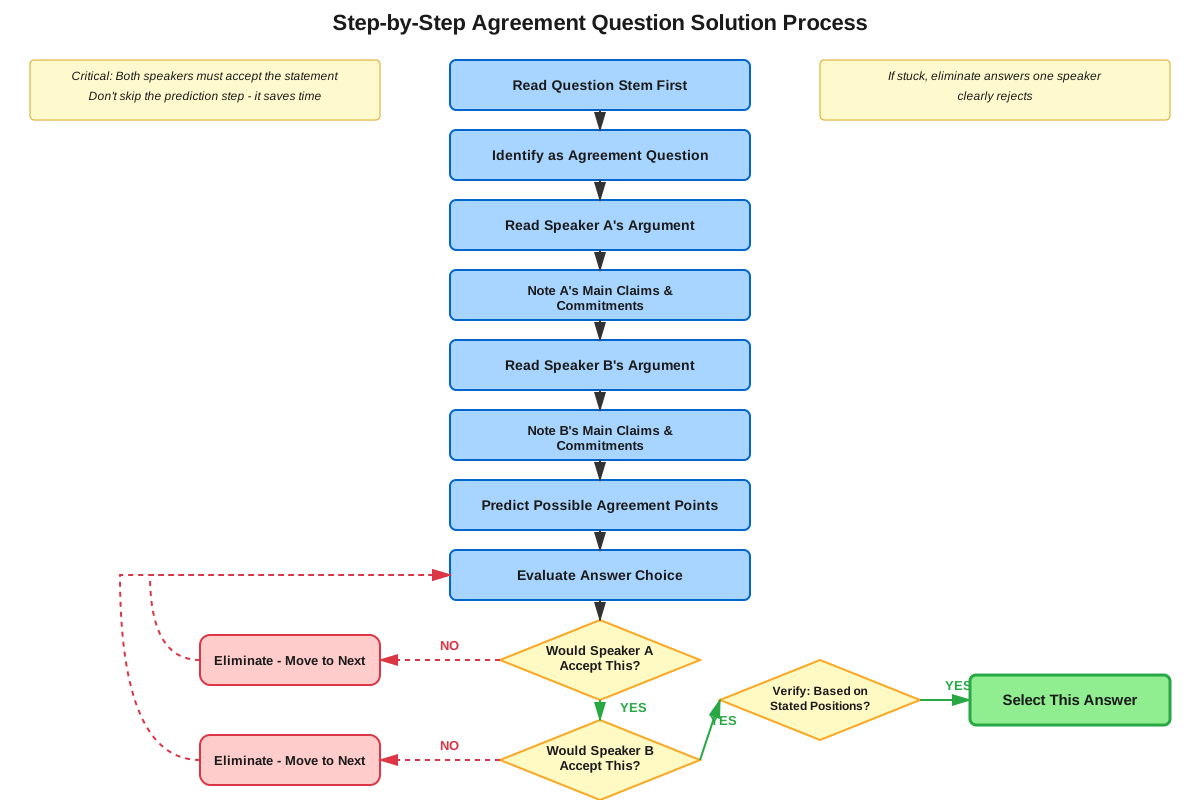
When encountering agreement questions on the LSAT, employ this systematic process:
- Identify the question type: Recognize agreement question stems immediately
- Read Speaker A's position: Understand their main claim and supporting reasons
- Read Speaker B's position: Understand their main claim and supporting reasons independently
- Note areas of overlap: Identify topics both speakers address
- Apply the Agreement Test: For each answer choice, verify both speakers would accept it
- Eliminate systematically: Remove answers that fail the test for either speaker
Trigger Words and Phrases
Watch for these question stem indicators:
- "would be likely to agree"
- "both would accept"
- "committed to agreeing"
- "provides support for holding that they agree"
- "which principle would both endorse"
These phrases signal agreement questions and should trigger the appropriate analytical approach.
Process of Elimination Strategy
Eliminate answer choices that exhibit these common patterns:
One-speaker answers: The answer only relates to one speaker's position or only one speaker would accept it. These are the most common wrong answers.
Scope violations: The answer makes claims broader or stronger than both speakers support, or introduces topics only one speaker addresses.
Disagreement points: The answer states something the speakers actually disagree about—a reversal trap for test-takers confusing agreement and disagreement questions.
Implication confusion: The answer states an implication of one speaker's position that the other speaker would reject, even though both discuss related topics.
Superficial similarity: The answer uses language from both speakers without representing genuine agreement.
Exam Tip: If you're unsure about an answer choice, explicitly ask yourself: "Would Speaker A say 'yes, I accept this'?" and "Would Speaker B say 'yes, I accept this'?" If you can't confidently answer "yes" for both, eliminate the choice.
Time Allocation
Agreement questions typically require 1.5-2 minutes to answer accurately. They demand more time than average Logical Reasoning questions because they require analyzing two positions and comparing them systematically. Don't rush—careful analysis prevents costly errors. However, if you find yourself spending more than 2.5 minutes, make your best guess and move on. You can return if time permits.
Common Trap Patterns
The LSAT uses predictable trap patterns in agreement questions:
The "Related Topic" trap: An answer discusses something both speakers mention without representing actual agreement about it.
The "One Speaker's Conclusion" trap: An answer states one speaker's main point, which the other speaker explicitly rejects.
The "Too Strong" trap: An answer makes a stronger claim than both speakers support, even though both might accept a weaker version.
The "Assumption Confusion" trap: An answer states an assumption one speaker makes that the other speaker would reject.
Recognizing these patterns accelerates elimination and improves accuracy.
Memory Techniques
The BOTH Mnemonic
Use BOTH to remember the agreement question approach:
- Both speakers must accept it
- Overlap in commitments, not just topics
- Test each speaker independently
- Heed scope limitations
Visualization Strategy
Visualize agreement questions as a Venn diagram: each speaker's position forms a circle, and the correct answer must fall in the overlapping region where both circles intersect. Wrong answers fall in one circle only or outside both circles entirely. This mental image reinforces that agreement requires genuine overlap, not merely related topics.
The "Yes-Yes" Test
Remember the "Yes-Yes" Test: The correct answer is the only one where both speakers would say "yes" when asked if they accept it. Any answer that produces "yes-no," "no-yes," or "no-no" is incorrect. This simple test prevents the most common errors.
Acronym for Common Traps
Remember SORT for common trap answer patterns:
- Scope violations (too broad or too narrow)
- One speaker only (relates to just one position)
- Reversal (states what they disagree about)
- Topic similarity (discusses related topics without agreement)
Summary
Agreement questions test the ability to identify points of consensus between two speakers or arguments presented in LSAT Logical Reasoning stimuli. Success requires systematically analyzing each speaker's position independently, then comparing them to find statements both would accept. The correct answer must pass the Agreement Test: both speakers would endorse it based on their stated positions. Common traps include answers that only one speaker would accept, answers that violate scope by going beyond what both speakers commit to, and answers that merely discuss related topics without representing genuine agreement. Agreement may be explicit (directly stated by both) or implicit (both are logically committed to accepting it). Mastering agreement questions requires shifting from the conflict-seeking mindset of most Logical Reasoning questions to a consensus-seeking approach, carefully distinguishing between superficial similarity and substantive agreement. These questions appear regularly on the LSAT and reward systematic analysis over intuitive approaches.
Key Takeaways
- Agreement questions require identifying statements that BOTH speakers would accept, not merely statements related to both positions
- Apply the Agreement Test systematically: verify each speaker would independently accept the statement
- Implicit agreement is common—both speakers may be committed to accepting something neither explicitly states
- Scope violations are the most frequent trap: answers that exceed what both speakers commit to
- Speakers with opposed conclusions can still agree about underlying facts, assumptions, or principles
- Question stems containing "committed to agreeing" signal implicit rather than explicit agreement
- Eliminate answers that only one speaker would accept, even if they relate to the other speaker's topic
Related Topics
Disagreement Questions: The complementary skill to agreement identification, requiring recognition of points of conflict between speakers. Mastering agreement questions provides the foundation for efficiently identifying disagreement.
Assumption Questions: Agreement questions often involve identifying shared assumptions between speakers, making assumption identification skills directly transferable.
Principle Questions: When agreement questions ask which principle both speakers would endorse, they combine agreement analysis with principle identification and application skills.
Inference Questions: Agreement questions require drawing valid inferences about what each speaker is committed to accepting, strengthening general inference skills.
Argument Structure Analysis: Understanding how arguments are constructed enables more efficient identification of what claims each speaker makes and what they're committed to accepting.
Practice CTA
Now that you understand the core concepts and strategies for agreement questions, it's time to apply this knowledge. Work through the practice questions systematically, using the Agreement Test and elimination strategies covered in this guide. Pay special attention to implicit agreements and scope violations—these are the most challenging aspects that separate good performance from excellent performance. Remember that agreement questions reward careful, systematic analysis over speed. With focused practice, you'll develop the precision needed to identify points of consensus efficiently and accurately, building confidence for test day. Start practicing now to transform this knowledge into mastery!
Sign up free to keep reading
Create a free AnvayaPrep account to finish this LSAT guide on Agreement questions — plus flashcards and practice questions.