Overview
In LSAT Logical Reasoning questions, particularly those involving Point at Issue and Disagreement, understanding the concept of a shared premise is crucial for distinguishing what two speakers actually disagree about versus what they both accept as true. A shared premise represents a statement, assumption, or piece of evidence that both parties in a dialogue accept without dispute. Recognizing these areas of agreement allows test-takers to eliminate answer choices that misidentify the point of contention and focus on the genuine area of disagreement between the speakers.
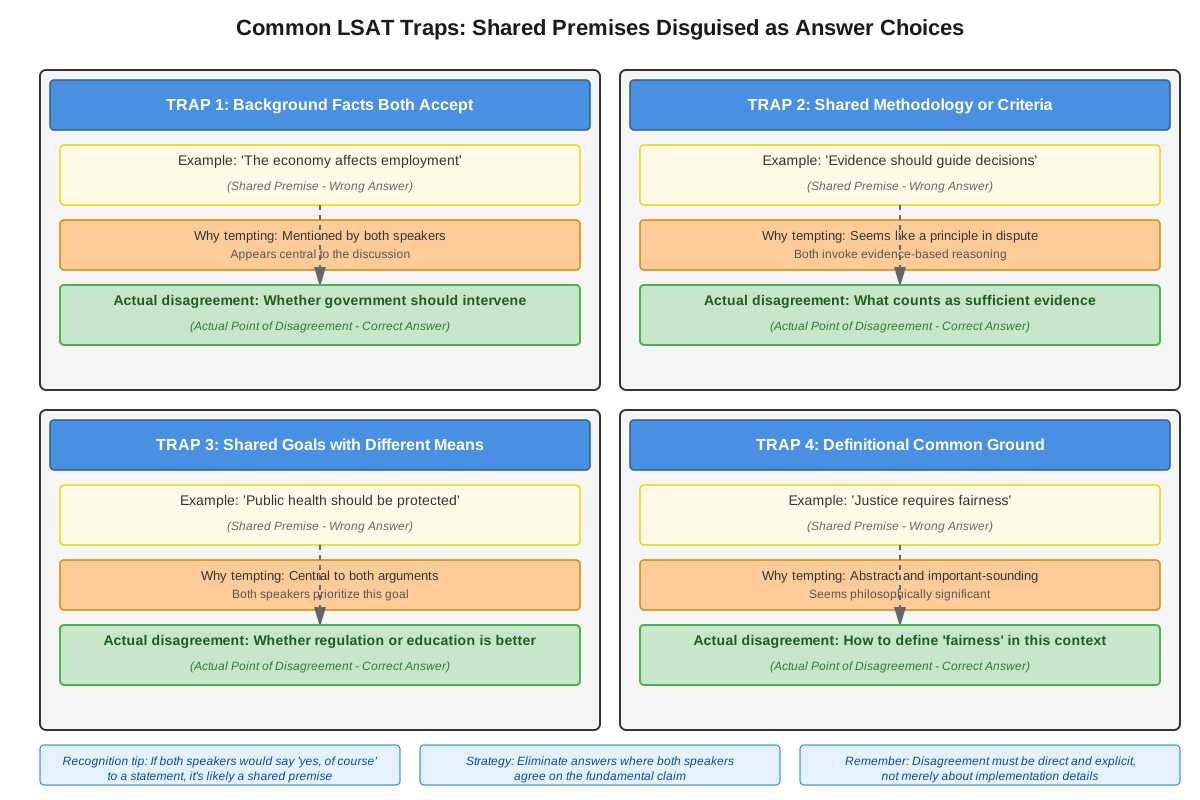
The ability to identify shared premises is fundamental to success on the LSAT because approximately 10-15% of Logical Reasoning questions involve analyzing dialogues between two speakers. These questions test whether students can parse complex arguments to determine what is actually being disputed versus what both parties take for granted. Many incorrect answer choices on Point at Issue questions deliberately present shared premises as if they were points of disagreement, making this skill essential for avoiding common traps.
Within the broader landscape of logical reasoning, shared premise identification connects directly to argument analysis, assumption identification, and the evaluation of reasoning patterns. This skill reinforces the critical thinking abilities tested throughout the LSAT: the capacity to break down complex arguments into their component parts, distinguish between explicit statements and implicit assumptions, and recognize the logical structure underlying verbal reasoning. Mastering shared premises provides a foundation for understanding how arguments build upon common ground while diverging in their conclusions or reasoning.
Learning Objectives
- [ ] Identify how Shared premise appears in LSAT questions
- [ ] Explain the reasoning pattern behind Shared premise
- [ ] Apply Shared premise to solve LSAT-style problems accurately
- [ ] Distinguish between shared premises and points of genuine disagreement in dialogue-based questions
- [ ] Recognize common patterns in how test-makers disguise shared premises as potential answer choices
- [ ] Evaluate whether a given statement represents common ground between two speakers or a contested claim
Prerequisites
- Basic argument structure: Understanding premises, conclusions, and how they connect is essential because shared premises function as uncontested building blocks within arguments.
- Conditional reasoning fundamentals: Recognizing logical relationships helps identify when both speakers accept the same conditional relationship even if they draw different conclusions.
- Assumption identification: The ability to spot implicit assumptions enables recognition of unstated shared premises that both speakers take for granted.
- Reading comprehension skills: Parsing complex dialogue requires careful attention to what each speaker explicitly states versus what they imply.
Why This Topic Matters
In real-world contexts, identifying shared premises is fundamental to productive debate, negotiation, and collaborative problem-solving. When parties recognize their common ground, they can focus discussion on genuine points of disagreement rather than talking past each other. This skill appears in legal reasoning, policy debates, scientific discourse, and everyday argumentation—making it both practically valuable and academically significant.
On the LSAT, shared premise questions appear with high frequency in the Logical Reasoning sections, which constitute approximately 50% of the exam's scored content. These questions typically take the form of "Point at Issue" or "Point of Agreement" question stems, such as "On which one of the following would the two speakers most likely agree?" or "The dialogue provides the most support for the claim that the two speakers disagree about which one of the following?" Understanding shared premises is also crucial for "Principle" questions where two speakers might share an underlying principle while disagreeing about its application.
Common manifestations in exam passages include: dialogues where speakers cite the same evidence but draw different conclusions; scenarios where both speakers accept a general principle but dispute a specific case; situations where speakers agree on facts but disagree on their significance; and exchanges where both parties share an unstated assumption that underlies their entire discussion. The LSAT frequently tests whether students can recognize that agreement on premises doesn't necessitate agreement on conclusions, and conversely, that disagreement on conclusions doesn't imply disagreement on all underlying premises.
Core Concepts
Definition of Shared Premise
A shared premise is any statement, fact, assumption, or principle that both speakers in a dialogue accept as true or valid without disputing it. In LSAT shared premise questions, these represent the common ground between two arguers—the foundation upon which they build their respective (and often opposing) arguments. Shared premises can be explicitly stated by one or both speakers, or they can be implicit assumptions that both speakers' arguments depend upon.
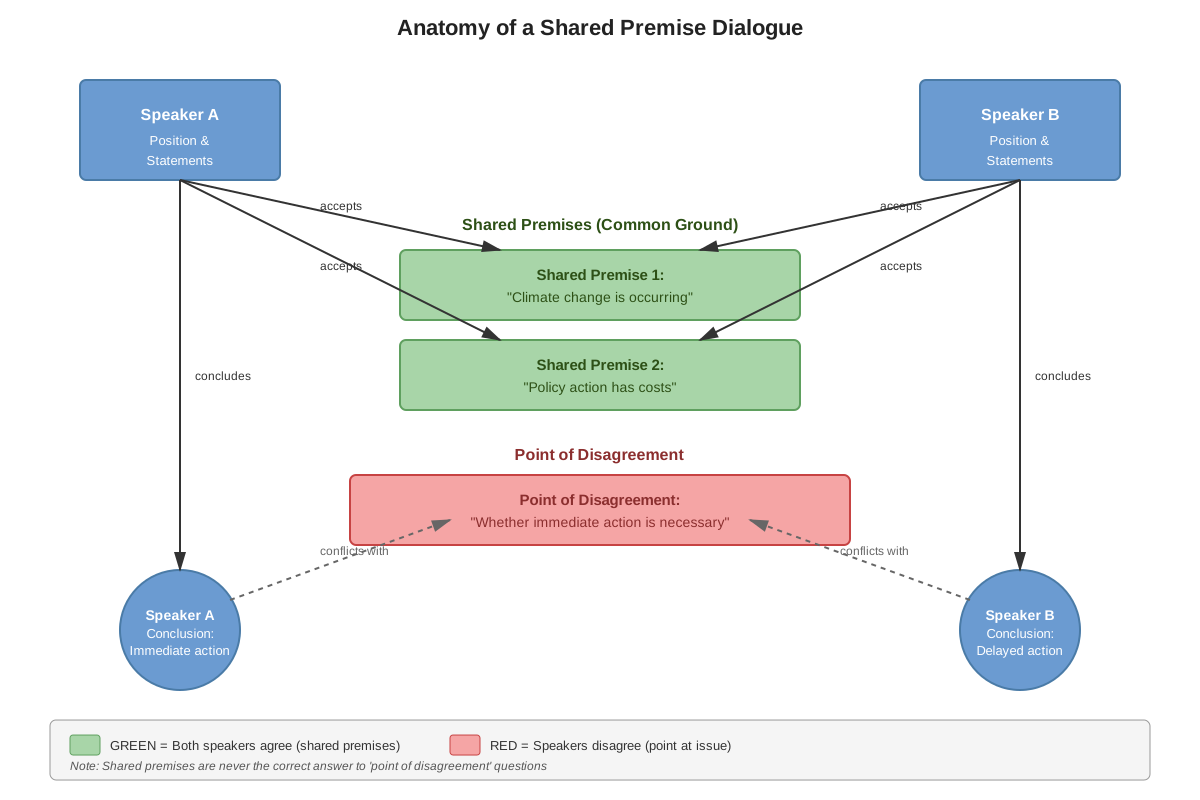
The key characteristic of a shared premise is that neither speaker challenges or contradicts it. Even if only one speaker explicitly mentions the premise, if the other speaker's argument relies on or is consistent with that premise, it qualifies as shared. For example, if Speaker A says "We should reduce carbon emissions because climate change threatens coastal cities" and Speaker B responds "We shouldn't reduce carbon emissions because the economic costs are too high," both speakers share the premise that climate change threatens coastal cities—they disagree only about what action to take in response.
Distinguishing Shared Premises from Points of Disagreement
The central challenge in point at issue and disagreement questions is separating what speakers agree upon from what they actually dispute. This distinction requires careful analysis of each speaker's position:
| Aspect | Shared Premise | Point of Disagreement |
|---|---|---|
| Speaker positions | Both accept or assume | Speakers take opposing stances |
| Explicit mention | May be stated by one, both, or neither | Usually addressed by both speakers |
| Logical function | Foundation for arguments | Subject of the debate |
| Test answer choices | Incorrect for "disagree" questions; correct for "agree" questions | Correct for "disagree" questions; incorrect for "agree" questions |
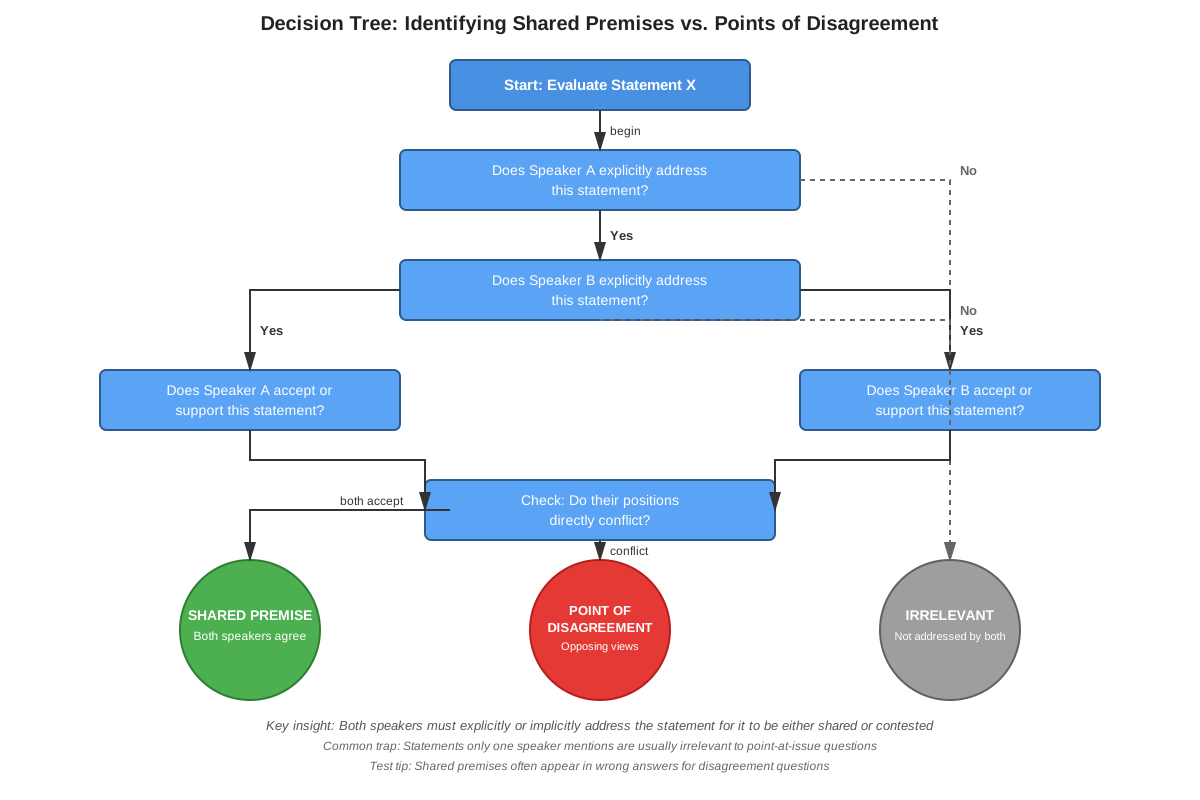
To distinguish these elements, test-takers should ask: "Could both speakers consistently hold this view given their stated positions?" If yes, it's likely a shared premise. If one speaker would necessarily reject the statement based on their argument, it represents a genuine point of disagreement.
Types of Shared Premises
Factual Shared Premises: Both speakers accept the same factual claim about the world. Example: Two speakers debating education policy might both accept that "test scores have declined over the past decade" while disagreeing about the cause or solution.
Normative Shared Premises: Both speakers accept the same value judgment or principle. Example: Speakers might both agree that "public safety is important" while disagreeing about whether a specific policy enhances or threatens safety.
Conditional Shared Premises: Both speakers accept the same if-then relationship. Example: Both might agree that "if the policy reduces crime, it should be implemented" while disagreeing about whether the policy actually reduces crime.
Implicit Shared Premises: Both speakers' arguments depend on an unstated assumption. Example: Two speakers debating whether to build a new highway might both implicitly assume that "transportation infrastructure affects economic development" even if neither explicitly states this premise.
The Reasoning Pattern Behind Shared Premises
The logical structure underlying shared premise questions follows a consistent pattern:
- Common Ground Establishment: Both speakers begin from or rely upon certain accepted facts, values, or principles
- Divergent Reasoning: Despite sharing premises, speakers apply different reasoning, emphasize different factors, or draw upon additional premises unique to their position
- Opposing Conclusions: The speakers reach different conclusions or recommend different actions
This pattern reveals a crucial insight for logical reasoning: agreement on premises does not guarantee agreement on conclusions. The LSAT tests whether students understand that the same evidence can support different conclusions depending on what additional premises or reasoning one applies. Conversely, speakers can reach the same conclusion through entirely different reasoning paths.
Identifying Shared Premises in LSAT Questions
The process for identifying shared premises involves systematic analysis:
Step 1: Read both speakers' statements carefully, noting the main claim each makes.
Step 2: Identify explicit statements of fact or principle made by each speaker.
Step 3: Determine what assumptions underlie each speaker's argument—what must be true for their reasoning to work.
Step 4: Compare the explicit statements and implicit assumptions to find overlap.
Step 5: Test potential shared premises by asking: "Does anything in Speaker B's argument contradict this?" and "Does anything in Speaker A's argument contradict this?"
Step 6: Eliminate answer choices that either speaker would reject based on their stated position.
Common Patterns in Test Construction
LSAT test-makers employ predictable patterns when constructing shared premise questions:
The Evidence Agreement Pattern: Both speakers cite or accept the same evidence but interpret it differently or draw different conclusions from it.
The Principle Agreement Pattern: Both speakers accept a general principle but disagree about whether a specific case falls under that principle or how the principle should be applied.
The Partial Overlap Pattern: Speakers agree on some aspects of a complex issue while disagreeing on others; wrong answers present the disagreement points as if they were shared.
The Implicit Foundation Pattern: Both speakers' arguments rest on an unstated assumption that neither challenges; correct answers identify this hidden common ground.
Concept Relationships
The concept of shared premises connects intimately with other logical reasoning skills. Shared premise identification → enables → accurate point of issue determination, because recognizing what speakers agree upon clarifies what remains in dispute. Similarly, assumption identification → supports → shared premise recognition, as many shared premises are implicit assumptions that both speakers rely upon without stating explicitly.
Within the topic itself, understanding the definition of shared premise → provides foundation for → distinguishing shared premises from disagreement points, which in turn → enables → successful application to LSAT questions. The various types of shared premises (factual, normative, conditional, implicit) → inform → the systematic identification process, as recognizing these categories helps test-takers know what to look for in dialogue passages.
Shared premise analysis also connects to broader LSAT skills: argument structure analysis helps identify premises versus conclusions; conditional reasoning aids in recognizing shared if-then relationships; principle questions often involve identifying shared underlying principles; and strengthen/weaken questions sometimes require recognizing what premises an argument takes for granted. Mastering shared premises thus reinforces and is reinforced by these related competencies, creating a web of mutually supporting logical reasoning skills.
High-Yield Facts
⭐ A shared premise is any statement, fact, or assumption that both speakers accept without dispute, whether explicitly stated or implicitly assumed.
⭐ Speakers can share premises while reaching opposite conclusions—agreement on evidence doesn't guarantee agreement on interpretation or action.
⭐ In Point at Issue questions, wrong answers frequently present shared premises as if they were points of disagreement.
⭐ If only one speaker explicitly mentions a claim, it can still be a shared premise if the other speaker's argument is consistent with or depends upon that claim.
⭐ The correct answer to a "point of disagreement" question must be something one speaker would affirm and the other would deny based on their stated positions.
- Implicit shared premises are often more difficult to identify than explicit ones but appear frequently in harder LSAT questions.
- Both speakers can share a general principle while disagreeing about its application to a specific case.
- Shared premises often involve background facts or context that both speakers take for granted.
- Test-makers commonly create wrong answers by presenting one speaker's unique premise as if it were shared by both.
- In "point of agreement" questions, the correct answer must be something both speakers would explicitly or implicitly endorse.
- Conditional shared premises involve both speakers accepting the same if-then relationship, even if they disagree about whether the condition is met.
- Recognizing shared premises helps eliminate 3-4 wrong answers quickly, making these questions highly efficient for time management.
Quick check — test yourself on Shared premise so far.
Try Flashcards →Common Misconceptions
Misconception: If two speakers reach different conclusions, they must disagree about all their premises. → Correction: Speakers frequently share many or most premises while disagreeing about one key premise, the interpretation of evidence, or which factors are most important. Shared premises are the rule, not the exception, in LSAT dialogues.
Misconception: A shared premise must be explicitly stated by both speakers. → Correction: A premise is shared if both speakers' arguments are consistent with it or depend upon it, even if only one speaker mentions it explicitly or if neither states it directly. Implicit shared premises are common and frequently tested.
Misconception: If Speaker A states a fact and Speaker B doesn't mention it, they don't share that premise. → Correction: Silence doesn't indicate disagreement. If Speaker B's argument assumes or is consistent with the fact Speaker A stated, it qualifies as a shared premise. Only explicit contradiction or logical inconsistency indicates lack of agreement.
Misconception: Shared premises are always factual claims rather than value judgments. → Correction: Speakers can share normative premises (value judgments about what is good, important, or desirable) just as easily as factual premises. Many LSAT dialogues involve speakers who share values but disagree about how to achieve them.
Misconception: The point of disagreement is always explicitly stated in the dialogue. → Correction: While speakers often directly address their disagreement, sometimes the actual point at issue must be inferred from their opposing positions. The LSAT tests the ability to identify implicit disagreements that underlie the explicit statements.
Misconception: In "point of agreement" questions, the correct answer will be something both speakers explicitly say. → Correction: The correct answer often identifies an implicit assumption or principle that both speakers' arguments depend upon, even if neither speaker directly states it. Test-takers must infer shared premises from the logical structure of the arguments.
Worked Examples
Example 1: Explicit vs. Implicit Shared Premises
Dialogue:
Keisha: The city should invest in expanding public transportation because traffic congestion costs our economy millions in lost productivity each year. Better public transit would reduce the number of cars on the road.
Marcus: Expanding public transportation would be a waste of resources. Most commuters prefer the convenience and flexibility of driving their own cars, so they won't switch to public transit even if it's available.
Question: Keisha and Marcus would be most likely to agree on which one of the following?
Answer Choices:
- (A) Traffic congestion has negative economic consequences
- (B) Expanding public transportation would reduce traffic congestion
- (C) Most commuters prefer driving their own cars
- (D) The city should prioritize reducing traffic congestion
- (E) Public transportation expansion would be cost-effective
Analysis:
Step 1: Identify each speaker's main claim.
- Keisha: The city should expand public transportation
- Marcus: Expanding public transportation would be wasteful
Step 2: Identify explicit premises.
- Keisha explicitly states: traffic congestion costs the economy millions; better transit would reduce cars on roads
- Marcus explicitly states: most commuters prefer driving; they won't switch to public transit
Step 3: Test each answer choice.
(A) Traffic congestion has negative economic consequences: Keisha explicitly states this ("costs our economy millions"). Does Marcus's argument contradict this? No—Marcus never disputes the economic costs of congestion; he only argues that public transit expansion won't solve the problem. This is a shared premise. ✓
(B) Expanding public transportation would reduce traffic congestion: Keisha believes this, but Marcus implicitly rejects it by arguing that commuters won't switch to public transit, meaning expansion wouldn't reduce cars on roads. This is a point of disagreement. ✗
(C) Most commuters prefer driving their own cars: Marcus explicitly states this. Keisha doesn't address commuter preferences directly. However, her argument assumes that better public transit would lead people to use it, which suggests she might disagree with Marcus's claim about preferences. This is likely a point of disagreement or at least not clearly shared. ✗
(D) The city should prioritize reducing traffic congestion: Keisha's argument suggests she supports this, but Marcus never indicates whether reducing congestion should be a priority—he only argues that public transit expansion is the wrong method. This goes beyond what we can infer as shared. ✗
(E) Public transportation expansion would be cost-effective: Keisha implies this; Marcus explicitly denies it ("waste of resources"). This is a point of disagreement. ✗
Correct Answer: (A)
Key Lesson: This example demonstrates that speakers can share factual premises (traffic congestion is economically harmful) while disagreeing about solutions. The shared premise often provides the background context that makes their disagreement meaningful.
Example 2: Shared Principle with Different Applications
Dialogue:
Dr. Chen: Medical schools should not consider undergraduate major when evaluating applicants. A student's ability to succeed in medical school depends on critical thinking skills and dedication, which can be demonstrated through achievement in any rigorous academic field.
Dr. Patel: On the contrary, medical schools should give preference to applicants with science backgrounds. Students who have already studied biology and chemistry will be better prepared for the intensive science curriculum of medical school and are more likely to succeed.
Question: The dialogue provides the most support for the claim that Dr. Chen and Dr. Patel disagree about whether:
Answer Choices:
- (A) medical schools should consider applicants' likelihood of success
- (B) critical thinking skills are important for medical school success
- (C) undergraduate major is relevant to predicting medical school success
- (D) biology and chemistry are part of medical school curriculum
- (E) medical school has an intensive curriculum
Analysis:
Step 1: Identify the main disagreement.
- Dr. Chen: undergraduate major should NOT be considered
- Dr. Patel: science backgrounds should be PREFERRED
Step 2: Identify shared premises.
Both doctors implicitly share the principle that medical schools should admit students likely to succeed (they disagree about what predicts success). Both accept that medical school includes science curriculum. Both seem to value academic achievement.
Step 3: Test each answer choice by asking: Would one affirm and the other deny this?
(A) medical schools should consider applicants' likelihood of success: Both doctors' arguments assume this principle—they disagree about what factors predict success, not about whether success should be considered. Shared premise. ✗
(B) critical thinking skills are important for medical school success: Dr. Chen explicitly states this. Dr. Patel doesn't contradict it; he simply emphasizes science preparation. Likely shared. ✗
(C) undergraduate major is relevant to predicting medical school success: Dr. Chen would deny this (major doesn't matter if critical thinking is demonstrated). Dr. Patel would affirm this (science majors are better prepared). Point of disagreement. ✓
(D) biology and chemistry are part of medical school curriculum: Dr. Patel explicitly states this. Dr. Chen doesn't contradict it—she just doesn't think prior study of these subjects is necessary. Shared premise. ✗
(E) medical school has an intensive curriculum: Dr. Patel mentions "intensive science curriculum." Dr. Chen doesn't address this, but nothing in her argument contradicts it. Shared premise. ✗
Correct Answer: (C)
Key Lesson: This example illustrates how speakers can share an underlying principle (admit students likely to succeed) and factual premises (medical school includes science) while disagreeing about a specific predictive factor (whether undergraduate major matters). The disagreement is narrower than it might initially appear.
Exam Strategy
When approaching lsat shared premise questions, employ this systematic strategy:
Identify the question type first: Determine whether the question asks for a point of agreement or disagreement. Question stems like "most likely to agree" or "committed to agreeing" indicate shared premise questions, while "disagree about whether" or "point at issue" indicate disagreement questions.
Read actively for structure: As you read each speaker's statement, mentally note: (1) their main conclusion, (2) their explicit premises, and (3) what assumptions their argument requires. This three-part analysis provides the foundation for identifying shared elements.
Watch for trigger phrases that signal shared premises:
- "The fact that..." (often introduces accepted background)
- "Given that..." (signals assumed common ground)
- "Since..." or "Because..." (introduces premises that may be shared)
- "Of course..." or "Clearly..." (often indicates uncontroversial shared assumptions)
Apply the consistency test: For each answer choice, ask: "Is this statement consistent with both speakers' arguments?" If yes, it's potentially shared. Then ask: "Does either speaker's argument require or assume this?" If yes for both, it's definitely shared.
Use process of elimination strategically:
- In disagreement questions, eliminate any answer choice that both speakers would accept or that neither addresses
- In agreement questions, eliminate any answer choice that either speaker would reject or that represents their point of dispute
Beware of common traps:
- Answer choices that present one speaker's unique premise as if both share it
- Choices that are too extreme or go beyond what either speaker commits to
- Statements that seem related to the topic but that neither speaker actually addresses
- Choices that confuse the speakers' conclusions with their premises
Time allocation: These questions typically take 60-90 seconds. Spend 30-40 seconds on initial reading and analysis, then 30-50 seconds evaluating answer choices. If you find yourself spending more than 90 seconds, make your best guess and move on—these questions, while important, shouldn't consume disproportionate time.
Double-check by negation: Before selecting your answer in a disagreement question, verify that one speaker would affirm the statement and the other would deny it. For agreement questions, verify that both speakers would affirm it (or at least that neither would deny it).
Memory Techniques
SHARED Acronym for identifying shared premises:
- Statements both accept
- Hidden assumptions both need
- Agreement on facts or values
- Reasoning foundations both use
- Evidence both cite
- Dispute is elsewhere, not here
The Foundation Visualization: Picture two speakers standing on a shared platform (the shared premises) but pointing in opposite directions (their different conclusions). This image reinforces that common ground supports divergent positions.
The "Both Would Say" Test: When evaluating whether something is shared, mentally insert "Both speakers would say..." before the statement. If it sounds accurate for both, it's likely shared.
The Disagreement Locator: Remember "CORE" for finding the actual disagreement:
- Conclusions differ
- One premise unique to each
- Reasoning diverges
- Emphasis on different factors
Color-Coding Mental Technique: As you read, mentally "highlight" explicit statements in one color, implicit assumptions in another, and conclusions in a third. This mental organization helps you quickly identify what's shared versus what's disputed.
Summary
Shared premises represent the common ground between two speakers in LSAT dialogue questions—the facts, values, assumptions, or principles that both parties accept without dispute. Mastering the identification of shared premises is essential for success on Point at Issue and Point of Agreement questions, which constitute a significant portion of Logical Reasoning sections. The key insight is that speakers can share many or most premises while still reaching opposite conclusions, and conversely, that disagreement on conclusions doesn't imply disagreement on all underlying premises. Successful test-takers systematically analyze each speaker's explicit statements and implicit assumptions, then apply consistency tests to determine what both speakers would accept. Common traps include answer choices that present shared premises as points of disagreement or that attribute one speaker's unique premise to both speakers. By recognizing the logical structure underlying these questions—common ground supporting divergent reasoning—students can efficiently eliminate wrong answers and identify correct responses with confidence.
Key Takeaways
- Shared premises are statements, facts, or assumptions that both speakers accept, whether explicitly stated or implicitly assumed
- Agreement on premises doesn't guarantee agreement on conclusions—speakers can share evidence while interpreting it differently
- In Point at Issue questions, wrong answers frequently disguise shared premises as disagreements
- Systematic analysis of each speaker's explicit claims and implicit assumptions is essential for identifying shared premises
- The correct answer to disagreement questions must be something one speaker would affirm and the other would deny
- Shared premises often provide the background context that makes the speakers' disagreement meaningful and focused
- Efficient identification of shared premises enables quick elimination of 3-4 wrong answers, making these high-value questions for time management
Related Topics
Point of Disagreement Identification: Building directly on shared premise recognition, this skill involves pinpointing the specific claim or principle that speakers actually dispute, enabling mastery of the full range of dialogue-based questions.
Assumption Identification: Many shared premises are implicit assumptions that both speakers rely upon; strengthening assumption identification skills enhances the ability to recognize unstated shared premises.
Principle Questions: These often involve identifying shared underlying principles that speakers apply differently, making shared premise recognition directly applicable to another high-frequency question type.
Argument Structure Analysis: Understanding how premises support conclusions provides the foundation for distinguishing shared premises from points of disagreement and recognizing the logical architecture of dialogues.
Conditional Reasoning in Dialogues: Many shared premises take conditional form (if-then relationships), so advancing conditional reasoning skills enables recognition of more complex shared premises.
Practice CTA
Now that you've mastered the core concepts of shared premises, it's time to put your knowledge into action. Work through the practice questions to reinforce your ability to identify shared premises quickly and accurately under test conditions. The flashcards will help you internalize the key distinctions and patterns you'll need to recognize instantly on test day. Remember: shared premise questions are high-yield opportunities to gain points efficiently—with systematic practice, you'll develop the pattern recognition that makes these questions feel almost automatic. Your investment in mastering this topic will pay dividends across multiple question types in the Logical Reasoning sections!
Sign up free to keep reading
Create a free AnvayaPrep account to finish this LSAT guide on Shared premise — plus flashcards and practice questions.