Overview
Abstract rule matching is a critical skill tested in the Logical Reasoning section of the LSAT, particularly within principle questions. This question type requires test-takers to identify the underlying logical structure or rule that governs a specific situation, then apply that same abstract principle to a different context. Unlike questions that focus on the content of an argument, abstract rule matching demands that students look past surface-level details and recognize the formal logical relationship between premises and conclusions. This skill represents one of the most sophisticated forms of logical reasoning tested on the LSAT, as it requires both analytical abstraction and precise pattern recognition.
The importance of mastering lsat abstract rule matching cannot be overstated. These questions appear regularly throughout the Logical Reasoning sections, often in the form of "Which one of the following principles most closely conforms to the principle illustrated above?" or "The pattern of reasoning in which one of the following is most similar to that in the argument above?" Success on these questions directly correlates with overall LSAT performance because they test the fundamental ability to separate form from content—a skill essential for legal reasoning and case analysis in law school and legal practice.
Within the broader landscape of Logical Reasoning, abstract rule matching sits at the intersection of several key competencies: argument structure analysis, conditional reasoning, and analogical thinking. While other question types may ask students to strengthen, weaken, or identify assumptions in arguments, abstract rule matching questions require a meta-level analysis where the argument's logical architecture becomes the focus itself. This makes it both challenging and high-yield, as mastering this skill simultaneously strengthens performance across multiple question types.
Learning Objectives
- [ ] Identify how Abstract rule matching appears in LSAT questions
- [ ] Explain the reasoning pattern behind Abstract rule matching
- [ ] Apply Abstract rule matching to solve LSAT-style problems accurately
- [ ] Distinguish between surface-level content similarities and structural logical parallels
- [ ] Construct abstract representations of concrete arguments to facilitate comparison
- [ ] Evaluate answer choices by systematically comparing logical structures rather than topical content
- [ ] Recognize common structural patterns that frequently appear in abstract rule matching questions
Prerequisites
- Basic argument structure: Understanding premises, conclusions, and how they connect is essential because abstract rule matching requires identifying these elements before abstracting them into formal patterns.
- Conditional reasoning fundamentals: Familiarity with if-then statements and their logical properties enables recognition of conditional structures that often form the basis of abstract rules.
- Principle question basics: General understanding of how principles function in Logical Reasoning provides the foundation for recognizing when a question asks for abstract pattern matching versus content-based principle application.
- Argument diagramming: The ability to visually represent argument structure helps in comparing the logical architecture of different arguments.
Why This Topic Matters
Abstract rule matching represents a fundamental lawyering skill: the ability to recognize when precedent applies to a new situation based on structural similarity rather than superficial resemblance. In legal practice, attorneys constantly identify the underlying principle in one case and determine whether it governs a different factual scenario. The LSAT tests this exact cognitive process, making abstract rule matching questions among the most legally relevant on the exam.
From an exam statistics perspective, abstract rule matching questions appear with high frequency across LSAT administrations. Approximately 3-5 questions per test involve some form of abstract pattern recognition, whether explicitly labeled as "parallel reasoning" questions or embedded within principle questions. These questions typically appear in both Logical Reasoning sections and carry the same weight as any other question, making them worth roughly 2-3% of the total LSAT score each. Given their predictable appearance and the systematic approach available for solving them, they represent high-yield study material with excellent return on investment.
On the LSAT, abstract rule matching most commonly appears in three question formats: (1) "parallel reasoning" questions that ask which answer choice exhibits the same pattern of reasoning as the stimulus; (2) "principle-application" questions that require matching an abstract principle to a concrete situation; and (3) "principle-identification" questions that ask test-takers to extract the general rule from a specific example. Each format tests the same core skill—recognizing logical structure independent of content—but packages it differently to assess various aspects of this competency.
Core Concepts
The Nature of Abstract Rule Matching
Abstract rule matching is the process of identifying the formal logical structure underlying an argument or situation, then recognizing that same structure in a different context with different content. The key insight is that logical validity depends on form, not content. An argument structured as "All A are B; X is an A; therefore X is a B" has the same logical form whether discussing dogs and mammals or electrons and particles. LSAT abstract rule matching questions exploit this principle by presenting arguments where surface content differs dramatically but underlying structure remains identical.
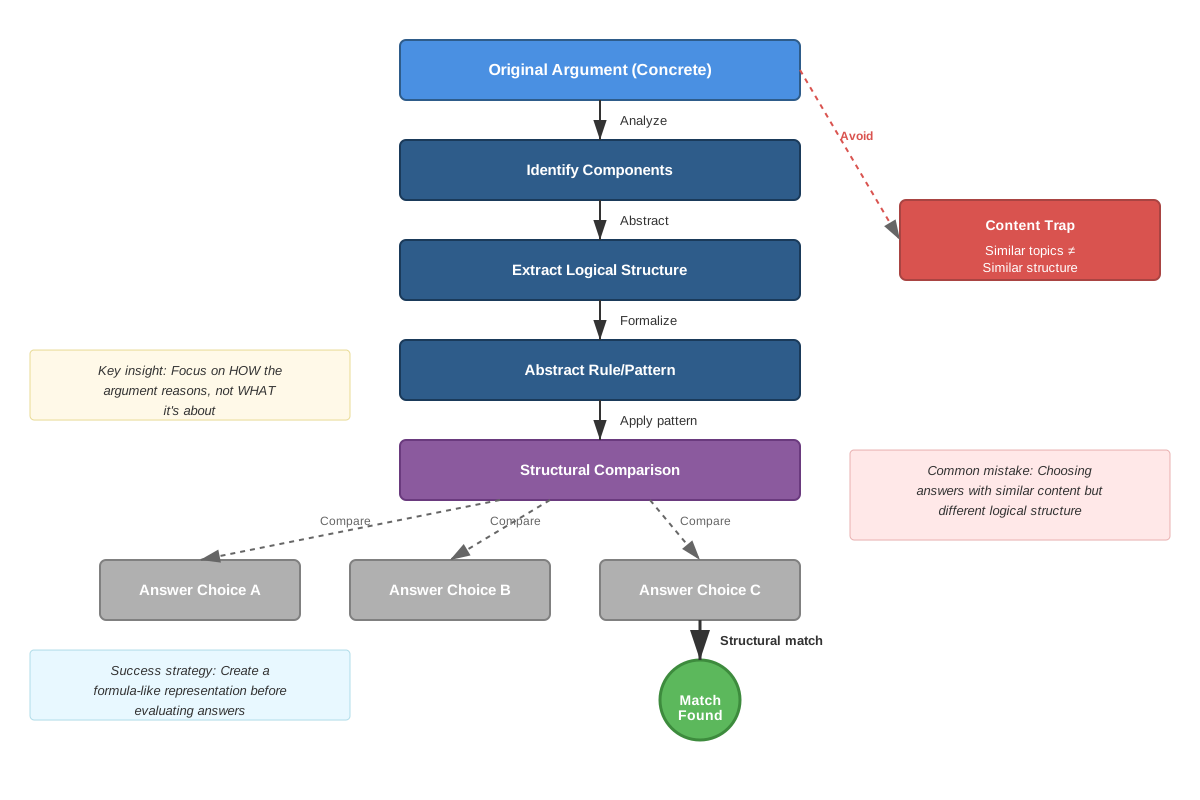
The abstraction process involves several cognitive steps. First, identify the argument's components: premises, conclusion, and the logical relationship connecting them. Second, strip away specific content words and replace them with variables or generic placeholders. Third, note any special logical features such as conditional statements, causal claims, analogies, or quantifiers. Fourth, represent the structure in a way that facilitates comparison with other arguments. This systematic approach transforms what initially appears to be a content-based task into a formal pattern-matching exercise.
Structural Elements to Abstract
When performing abstract rule matching, certain structural elements require particular attention:
Quantifiers: Note whether statements use universal quantifiers (all, every, none), existential quantifiers (some, at least one), or specific quantities. An argument using "all" has a different structure than one using "most" or "some."
Conditional relationships: Identify if-then structures and their logical properties. Pay attention to whether the argument affirms the antecedent, denies the consequent, or commits a conditional reasoning fallacy.
Causal claims: Recognize when arguments assert causal relationships versus mere correlation. The structure differs between "A causes B" and "A is associated with B."
Analogical reasoning: Note when arguments draw parallels between two situations and use similarity in one respect to infer similarity in another respect.
Normative versus descriptive claims: Distinguish between statements about what is (descriptive) and what should be (normative/prescriptive). Arguments mixing these have distinct structures.
Common Logical Patterns in Abstract Rule Matching
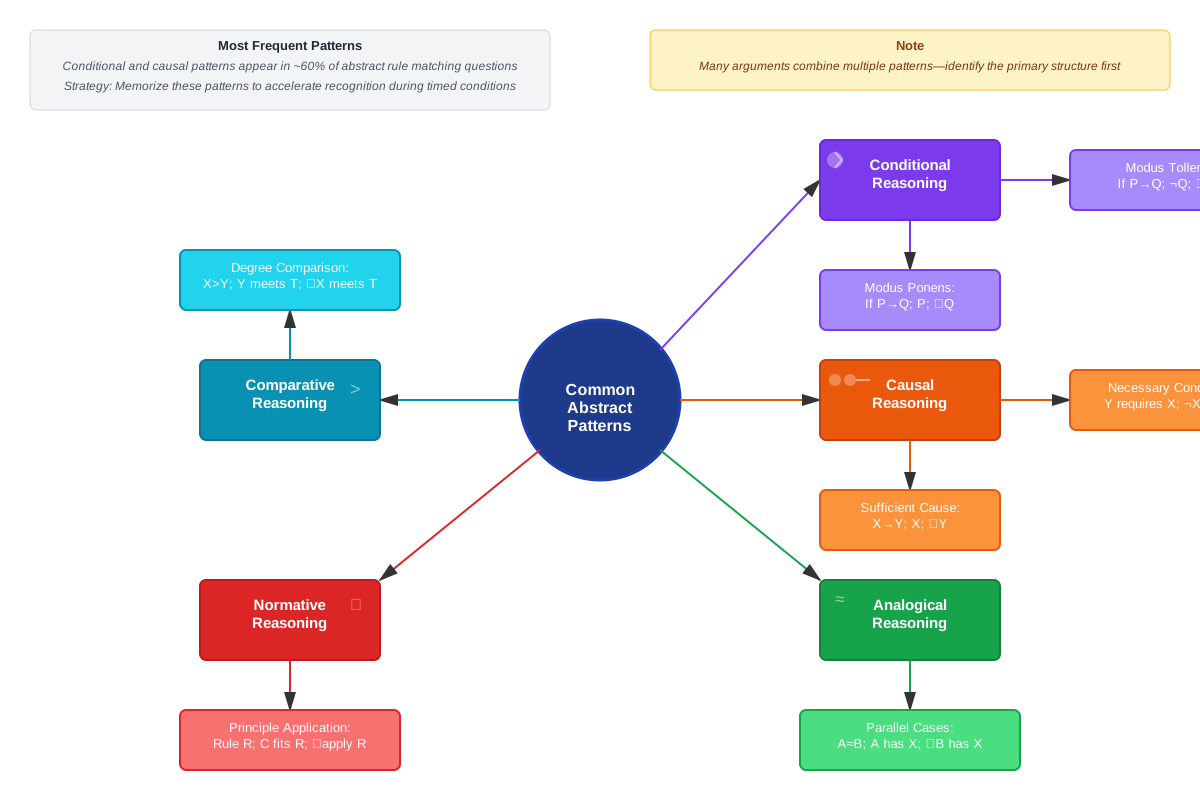
Several logical patterns appear repeatedly in principle questions involving abstract rule matching:
| Pattern Type | Structure | Example |
|---|---|---|
| Modus Ponens | If A then B; A; therefore B | If it rains, the ground gets wet; it's raining; so the ground will get wet |
| Modus Tollens | If A then B; not B; therefore not A | If qualified, hired; not hired; so not qualified |
| Disjunctive Syllogism | A or B; not A; therefore B | Coffee or tea; no coffee; so tea |
| Universal Application | All A are B; X is A; therefore X is B | All mammals breathe; whales are mammals; whales breathe |
| Analogical Structure | X has properties P, Q, R; Y has properties P, Q; therefore Y probably has R | This drug worked in rats; humans are similar to rats; so it will probably work in humans |
| Causal Reasoning | A correlates with B; no alternative explanation; therefore A causes B | Exercise correlates with health; no confounds; so exercise causes health |
The Matching Process
Effective abstract rule matching follows a systematic methodology:
- Read and diagram the stimulus: Identify the conclusion first, then locate premises supporting it. Note the logical connectors and relationship type.
- Abstract the structure: Replace specific content with variables while preserving logical relationships. For example, "All doctors are educated; Maria is a doctor; therefore Maria is educated" becomes "All X are Y; Z is X; therefore Z is Y."
- Identify distinctive features: Note any unusual structural elements that will help eliminate answer choices quickly—for instance, the presence of a conditional, a comparison, or a normative claim.
- Predict the pattern: Before looking at answer choices, articulate the structure you're seeking. This prevents being misled by content similarities.
- Evaluate answer choices systematically: Check each answer choice against your abstract representation, eliminating those with structural mismatches.
- Verify the match: Confirm that the correct answer preserves all structural elements, including quantifiers, logical operators, and the relationship between premises and conclusion.
Content Versus Structure: The Critical Distinction
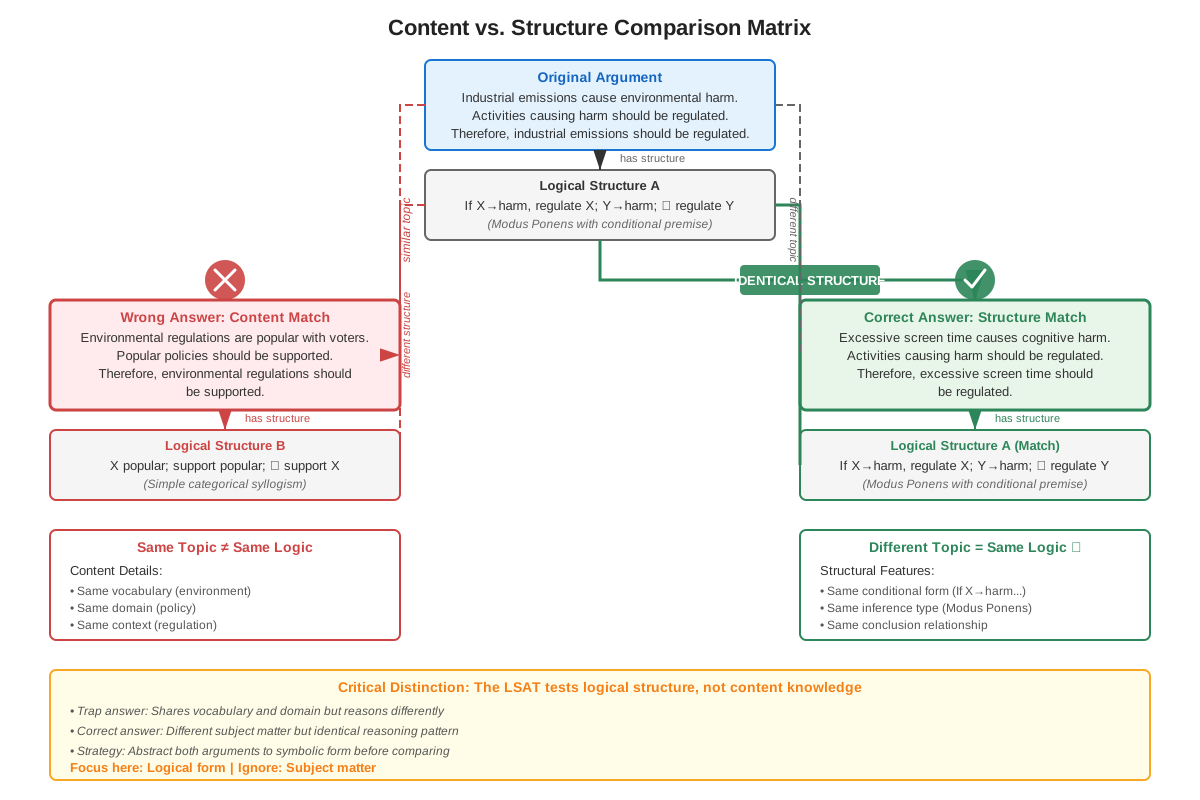
The most challenging aspect of abstract rule matching is maintaining focus on structure while ignoring content. The LSAT deliberately includes wrong answer choices with similar content but different structure, as well as correct answers with completely different content but identical structure. Consider this example:
Stimulus: "All effective teachers are patient. Professor Jones is patient. Therefore, Professor Jones is an effective teacher."
This argument has a specific flaw: it affirms the consequent (if effective then patient; patient; therefore effective). The correct parallel must have the same flawed structure, regardless of content:
Correct parallel: "All poisonous mushrooms are colorful. This mushroom is colorful. Therefore, this mushroom is poisonous."
Incorrect parallel (similar content, different structure): "All effective teachers are patient. Professor Smith is an effective teacher. Therefore, Professor Smith is patient." (This is valid modus ponens, not the flawed affirming the consequent.)
The distinction requires disciplined attention to logical form. Students must train themselves to see past engaging or familiar content and focus exclusively on the argument's architecture.
Special Considerations for Flawed Reasoning
Many abstract rule matching questions involve flawed reasoning, requiring test-takers to match not just valid logical structures but specific logical fallacies. Common flaws that appear in these questions include:
- Affirming the consequent: If A then B; B; therefore A
- Denying the antecedent: If A then B; not A; therefore not B
- False dichotomy: Presenting two options as exhaustive when others exist
- Composition/Division: Inferring properties of the whole from parts or vice versa
- Equivocation: Using a term with different meanings in different parts of the argument
- Circular reasoning: Using the conclusion as a premise
When matching flawed reasoning, the correct answer must replicate the same flaw, not just any flaw. This requires precise identification of the specific logical error in the stimulus.
Concept Relationships
Abstract rule matching builds directly on foundational logical reasoning skills. Argument structure analysis provides the raw material—identifying premises and conclusions—that abstract rule matching then transforms into formal patterns. Conditional reasoning supplies many of the specific structures (modus ponens, modus tollens) that frequently appear in matching questions. The relationship flows: Argument Structure → Conditional Reasoning → Abstract Rule Matching.
Within the topic itself, concepts connect hierarchically. Understanding the nature of abstraction (separating form from content) enables recognition of structural elements (quantifiers, conditionals, causal claims). Recognizing these elements facilitates identification of common logical patterns. Mastering these patterns allows systematic application of the matching process. Finally, distinguishing content from structure and handling flawed reasoning represent advanced applications of the foundational concepts.
Abstract rule matching also connects forward to other LSAT skills. The ability to recognize logical patterns enhances performance on assumption questions (by identifying what structural element is missing), strengthen/weaken questions (by understanding what would affect the logical relationship), and even Reading Comprehension (by recognizing argumentative structures in passages). The skill of formal abstraction—seeing the skeleton beneath the flesh—proves valuable across the entire exam.
Quick check — test yourself on Abstract rule matching so far.
Try Flashcards →High-Yield Facts
⭐ Abstract rule matching requires focusing on logical structure, not content similarity—arguments about completely different topics can have identical logical form.
⭐ The correct answer in parallel reasoning questions must match every structural element: quantifiers, conditional relationships, number of premises, and type of conclusion.
⭐ Flawed parallel reasoning questions require matching the specific flaw, not just finding any flawed argument.
⭐ Conditional statements (if-then) appear in approximately 60% of abstract rule matching questions, making conditional reasoning fluency essential.
⭐ The conclusion's logical relationship to premises matters more than the conclusion's content—match whether it's definitive, probable, normative, etc.
- Arguments with universal quantifiers ("all," "every," "none") have different structures than those with particular quantifiers ("some," "most").
- Causal arguments have distinct structures from correlational arguments, even when discussing the same variables.
- The presence or absence of intermediate conclusions affects argument structure and must be matched.
- Normative conclusions ("should," "ought") require normative premises; descriptive conclusions require descriptive premises—mixing these creates a structural mismatch.
- Analogical arguments require matching both the comparison structure and the inference drawn from the comparison.
- Arguments proceeding from general principle to specific application differ structurally from those moving from specific examples to general conclusions.
- The number of premises matters—a two-premise argument has a different structure than a three-premise argument.
Common Misconceptions
Misconception: If two arguments discuss similar topics, they probably have similar logical structures. → Correction: Content similarity is irrelevant and often deliberately misleading. Two arguments about education can have completely different logical structures, while arguments about education and plumbing might be structurally identical. Always abstract away the content before comparing.
Misconception: Any flawed argument can match another flawed argument in parallel reasoning questions. → Correction: The specific type of flaw must match exactly. An argument that affirms the consequent cannot correctly parallel an argument that commits a false dichotomy, even though both are flawed. The logical error itself is part of the structure that must be replicated.
Misconception: The correct answer will use similar vocabulary or grammatical structures as the stimulus. → Correction: The LSAT deliberately varies surface features while preserving deep structure. Matching sentence length, vocabulary level, or grammatical construction is irrelevant to logical structure. Focus exclusively on the logical relationships between claims.
Misconception: Abstract rule matching questions are too time-consuming and should be skipped. → Correction: While these questions can be time-intensive if approached unsystematically, using a structured method (abstract first, then match) makes them highly manageable. Moreover, their predictable appearance and systematic solvability make them excellent candidates for point capture.
Misconception: If the conclusion matches, the arguments are parallel. → Correction: Matching conclusions is necessary but insufficient. The premises must support the conclusion in the same way, using the same logical relationships. An argument reaching a definitive conclusion from universal premises differs from one reaching the same conclusion from probabilistic premises.
Misconception: Principle questions and parallel reasoning questions test different skills. → Correction: Both question types fundamentally test abstract rule matching—the ability to recognize when the same logical principle applies across different contexts. Principle questions often make the abstraction more explicit, but the underlying cognitive task is identical.
Worked Examples
Example 1: Parallel Reasoning with Valid Structure
Stimulus: "Every successful entrepreneur takes calculated risks. Samantha takes calculated risks. Therefore, Samantha is a successful entrepreneur."
Question: Which one of the following exhibits the same pattern of reasoning as the argument above?
Step 1 - Identify the conclusion: "Samantha is a successful entrepreneur"
Step 2 - Identify the premises:
- Premise 1: Every successful entrepreneur takes calculated risks
- Premise 2: Samantha takes calculated risks
Step 3 - Abstract the structure:
- All X are Y (or: If X, then Y)
- Z is Y
- Therefore, Z is X
Step 4 - Identify distinctive features: This is a conditional reasoning flaw—specifically, affirming the consequent. The argument assumes that being Y (taking calculated risks) is sufficient for being X (successful entrepreneur), when the premise only establishes that being X is sufficient for being Y.
Step 5 - Predict the pattern: We need an argument that:
- Establishes a conditional relationship (if X then Y)
- Affirms the consequent (Y is true)
- Incorrectly concludes the antecedent (therefore X is true)
Step 6 - Evaluate answer choices:
(A) "All professional athletes train daily. Marcus trains daily. Therefore, Marcus is a professional athlete."
- Structure: All X are Y; Z is Y; therefore Z is X
- This matches perfectly! It commits the same affirming the consequent error.
(B) "All professional athletes train daily. Marcus is a professional athlete. Therefore, Marcus trains daily."
- Structure: All X are Y; Z is X; therefore Z is Y
- This is valid modus ponens, not the flawed structure we need. Eliminate.
(C) "Some professional athletes train daily. Marcus trains daily. Therefore, Marcus might be a professional athlete."
- Structure: Some X are Y; Z is Y; therefore Z might be X
- The quantifier changed from "all" to "some," and the conclusion is probabilistic rather than definitive. Eliminate.
(D) "No professional athletes avoid training. Marcus trains daily. Therefore, Marcus is a professional athlete."
- Structure: No X are non-Y; Z is Y; therefore Z is X
- While this also commits a flaw, the structure differs because it uses a negative universal rather than a positive universal. Eliminate.
Answer: (A) - This perfectly replicates the logical structure, including the specific flaw of affirming the consequent.
Example 2: Principle Application
Stimulus: "A journalist should not publish unverified information, even if it comes from a usually reliable source. The potential harm from spreading false information outweighs the benefit of being first to report a story."
Question: Which one of the following judgments most closely conforms to the principle stated above?
Step 1 - Extract the abstract principle:
- When action X has potential harm H and potential benefit B
- And H outweighs B
- Then one should not do X
- Even if there are factors that would normally justify X (like source reliability)
Step 2 - Identify key structural elements:
- Harm-benefit analysis
- Harm predominates
- Normative conclusion (should not)
- Acknowledgment of countervailing consideration that is ultimately overridden
Step 3 - Predict what we're looking for: An answer that weighs harms against benefits, concludes the harm is greater, and recommends against an action despite some factor that might normally justify it.
Step 4 - Evaluate answer choices:
(A) "A doctor should not prescribe an experimental treatment, even if the patient requests it, because the risks of unknown side effects outweigh the potential benefits."
- Harm-benefit analysis: ✓
- Harm predominates: ✓
- Normative conclusion against action: ✓
- Countervailing factor overridden (patient request): ✓
- This matches the principle structure perfectly.
(B) "A teacher should verify information before presenting it to students because accuracy is important in education."
- This supports verification but doesn't include the harm-benefit weighing structure or the "even if" countervailing consideration. Eliminate.
(C) "A company should not release a product until it has been thoroughly tested, regardless of market pressure."
- This has the normative conclusion and countervailing factor, but doesn't explicitly articulate the harm-benefit analysis. Close, but (A) is more precise.
Answer: (A) - This applies the same principle structure: weighing harms against benefits, determining harm predominates, and recommending against action despite a countervailing consideration.
Exam Strategy
When approaching abstract rule matching questions on the LSAT, employ this systematic strategy:
Trigger words to watch for: "parallel reasoning," "same pattern of reasoning," "most similar to," "conforms to the principle," "illustrates the same principle," "reasoning most closely parallels." These phrases signal that structural matching is required.
Initial approach: Before reading answer choices, invest 30-45 seconds abstracting the stimulus. Write down the structure using variables or shorthand. This upfront investment prevents being misled by content similarities in wrong answers and typically saves time overall.
Process of elimination strategy:
- First pass: Eliminate answers with obvious structural mismatches (wrong number of premises, different quantifiers, different conclusion type)
- Second pass: Among remaining choices, check conditional structures and logical relationships
- Final verification: Confirm the survivor matches every structural element
Time allocation: Budget approximately 90-120 seconds for abstract rule matching questions—slightly more than average Logical Reasoning questions. The systematic approach justifies the extra time and yields high accuracy. If a question exceeds two minutes, make your best guess and move on; these questions can become time sinks if you get stuck comparing subtle differences.
Common traps to avoid:
- Don't be seduced by content similarity—the LSAT uses this as a distractor
- Don't assume the first answer that "seems right" is correct—verify systematically
- Don't ignore quantifiers—"all" versus "some" changes the structure fundamentally
- Don't match conclusions in isolation—the relationship between premises and conclusion matters
Advanced technique: For parallel reasoning questions, check the conclusion type first. If the stimulus has a definitive conclusion, eliminate any answer with a probabilistic conclusion (or vice versa). This often eliminates 2-3 answers immediately, making the remaining comparison much simpler.
Exam Tip: If you're running short on time, abstract rule matching questions are good candidates for educated guessing. Eliminate answers with obvious structural mismatches (different quantifiers, wrong number of premises), then guess from the remaining choices. Even partial structural analysis improves odds significantly.
Memory Techniques
Mnemonic for structural elements to check - "QQCNR":
- Quantifiers (all, some, none, most)
- Qualifiers (definite vs. probable conclusions)
- Conditionals (if-then structures)
- Normative vs. descriptive (should vs. is)
- Relationship type (causal, analogical, categorical)
Visualization strategy: Picture arguments as building blueprints. Two buildings can look completely different (content) but have identical structural plans (form). When matching, you're comparing blueprints, not finished buildings. This mental image helps maintain focus on structure over content.
Acronym for common flaws - "FACED":
- False dichotomy
- Affirming the consequent
- Circular reasoning
- Equivocation
- Denying the antecedent
The "X, Y, Z" technique: When abstracting, consistently use X for the first category/concept, Y for the second, and Z for specific instances. This standardization makes comparison across arguments much easier and reduces cognitive load.
The "skeleton" metaphor: Content is flesh; structure is skeleton. Strip away the flesh to see if the skeletons match. This vivid image reinforces the abstraction process and helps resist the temptation to focus on content.
Summary
Abstract rule matching represents a sophisticated logical reasoning skill that requires separating an argument's formal structure from its specific content. Success depends on systematically identifying structural elements—quantifiers, conditionals, causal relationships, and logical connectors—then comparing these elements across different arguments while ignoring surface-level content similarities. The LSAT tests this skill through parallel reasoning questions and principle questions, both of which require recognizing when the same logical pattern applies across different contexts. Mastery involves developing a disciplined approach: abstract the stimulus into formal structure, identify distinctive features, predict the pattern, and systematically evaluate answer choices against the abstract representation. The key insight is that logical validity depends on form, not content—arguments about entirely different subjects can be structurally identical, while arguments about the same subject can be structurally distinct. This skill proves essential not only for LSAT success but for legal reasoning generally, as it mirrors the process of applying legal precedent to new factual situations.
Key Takeaways
- Abstract rule matching requires focusing exclusively on logical structure while ignoring content—the most common error is being distracted by topical similarity
- Every structural element must match in parallel reasoning questions: quantifiers, conditionals, number of premises, type of conclusion, and the logical relationship between premises and conclusion
- Flawed parallel reasoning questions demand matching the specific logical error, not just finding any flawed argument
- Systematic abstraction before evaluating answer choices prevents being misled and ultimately saves time
- Conditional reasoning appears in the majority of abstract rule matching questions, making fluency with if-then structures essential
- The relationship between premises and conclusion matters more than the content of those claims—match how the conclusion follows, not what the conclusion says
- Principle questions and parallel reasoning questions test the same fundamental skill: recognizing when identical logical patterns apply across different contexts
Related Topics
Conditional Reasoning Mastery: Deep understanding of if-then statements, contrapositives, and conditional chains provides the foundation for recognizing the conditional structures that frequently appear in abstract rule matching questions. Mastering this topic enables faster pattern recognition and more accurate structural analysis.
Formal Logic and Diagramming: Advanced techniques for representing arguments symbolically enhance abstraction skills. Learning formal logic notation provides a precise language for capturing argument structure, making comparison across arguments more systematic and reliable.
Argument Structure Analysis: Comprehensive understanding of how premises support conclusions, including intermediate conclusions and complex argument chains, enables more sophisticated structural matching. This topic deepens the ability to recognize subtle structural variations.
Logical Fallacies: Detailed knowledge of specific reasoning errors—affirming the consequent, false dichotomy, circular reasoning, etc.—is essential for flawed parallel reasoning questions. Mastering fallacy identification allows precise matching of logical errors.
Principle Questions - Application and Identification: Exploring the full range of principle question types shows how abstract rule matching applies across different question formats. This broader context reinforces the core skill while demonstrating its versatility.
Practice CTA
Now that you understand the systematic approach to abstract rule matching, it's time to apply these concepts to actual LSAT questions. The practice questions and flashcards will reinforce your ability to abstract argument structures, recognize logical patterns, and match structures across different contexts. Remember: abstract rule matching is a learnable skill that improves dramatically with deliberate practice. Each question you work through strengthens your pattern recognition and builds the mental discipline to focus on structure over content. Approach the practice materials systematically, using the techniques outlined in this guide, and you'll see measurable improvement in both accuracy and speed. Your investment in mastering this high-yield topic will pay dividends across the entire Logical Reasoning section!
Sign up free to keep reading
Create a free AnvayaPrep account to finish this LSAT guide on Abstract rule matching — plus flashcards and practice questions.