Overview
Legal principles represent a critical category within LSAT Logical Reasoning sections, appearing in what are formally known as principle questions. These questions test a student's ability to identify, apply, and reason with general rules or standards that govern specific situations. Unlike pure argument analysis questions, principle questions require test-takers to move between abstract rules and concrete applications, demonstrating both analytical precision and conceptual flexibility.
On the LSAT, legal principles function as broad normative statements that establish conditions under which certain conclusions should follow. These principles might address ethical obligations, procedural requirements, definitional standards, or causal relationships. The exam frequently presents scenarios where students must either identify which principle justifies a given action or decision, or apply a stated principle to determine which situation it governs. Mastering this question type is essential because principle questions appear consistently across both Logical Reasoning sections, typically comprising 10-15% of all Logical Reasoning questions.
Understanding lsat legal principles connects directly to broader Logical Reasoning competencies, particularly conditional reasoning, argument structure analysis, and sufficient/necessary condition identification. Success with principle questions requires recognizing that legal principles operate as conditional statements—they specify when certain outcomes are warranted, required, or prohibited. This topic bridges abstract logical reasoning with practical application, mirroring the analytical skills required in legal practice where attorneys must apply general legal doctrines to specific factual scenarios.
Learning Objectives
- [ ] Identify how Legal principles appears in LSAT questions
- [ ] Explain the reasoning pattern behind Legal principles
- [ ] Apply Legal principles to solve LSAT-style problems accurately
- [ ] Distinguish between "identify the principle" and "apply the principle" question variants
- [ ] Recognize the conditional logic structure underlying legal principles
- [ ] Evaluate answer choices by testing principles against specific scenarios
- [ ] Construct valid applications of principles to novel situations
Prerequisites
- Conditional Logic: Understanding if-then relationships is essential because legal principles are structured as conditional statements specifying when conclusions follow from premises.
- Argument Structure: Recognizing premises, conclusions, and reasoning patterns enables students to identify what principle would justify a given argument's logical move.
- Sufficient and Necessary Conditions: Distinguishing these conditions is critical for properly applying principles, as principles typically establish sufficient conditions for conclusions or necessary conditions for actions.
- Formal Logic Notation: Familiarity with symbolic representation helps translate complex principles into testable logical structures.
Why This Topic Matters
Legal principles form the conceptual foundation of legal reasoning itself. In legal practice, attorneys constantly apply general rules (statutes, precedents, doctrines) to specific factual situations. The LSAT tests this skill because it predicts success in law school case analysis and legal writing. Students who master principle questions demonstrate the ability to think systematically about how general rules govern particular instances—the core of legal analysis.
On the LSAT, principle questions appear with remarkable consistency. Across both Logical Reasoning sections, test-takers can expect 3-5 principle questions per exam, making this a high-yield topic. These questions appear in several formats: "Which principle, if valid, most helps to justify the reasoning?" or "The situation described above most closely conforms to which one of the following principles?" or "Which one of the following judgments conforms to the principle stated above?" This variety means students must develop flexible analytical approaches.
Common manifestations include questions about ethical decision-making (when is an action morally required?), policy justification (what principle supports this regulation?), definitional application (does this situation meet the stated criteria?), and procedural fairness (what standard governs this process?). The principles themselves often address topics like responsibility, fairness, rights, obligations, causation, and justification—concepts central to legal reasoning across all practice areas.
Core Concepts
Structure of Legal Principles
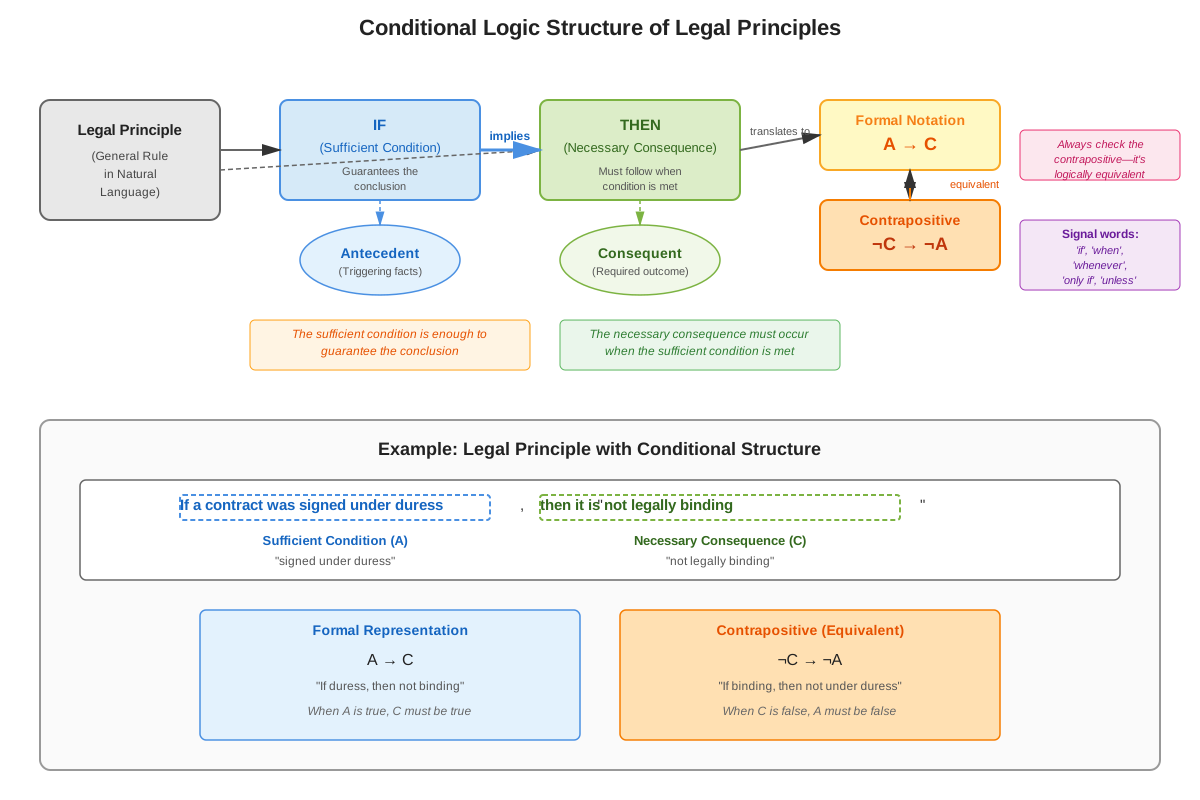
Legal principles on the LSAT function as general rules that establish relationships between conditions and conclusions. These principles typically take the form: "If [conditions are met], then [conclusion follows]" or "Whenever [situation X occurs], [outcome Y] is warranted/required/prohibited." Understanding this conditional structure is fundamental to success.
Most principles contain three key components:
- Triggering conditions: The circumstances that must be present for the principle to apply
- Operative terms: The action, judgment, or conclusion that follows when conditions are met
- Scope limitations: Implicit or explicit boundaries on when the principle applies
For example, a principle might state: "A person is morally responsible for an outcome only if that person could have reasonably foreseen that outcome." Here, "could have reasonably foreseen" is the triggering condition, "morally responsible" is the operative term, and the principle is limited to questions of moral (not legal or causal) responsibility.
Principle Question Types
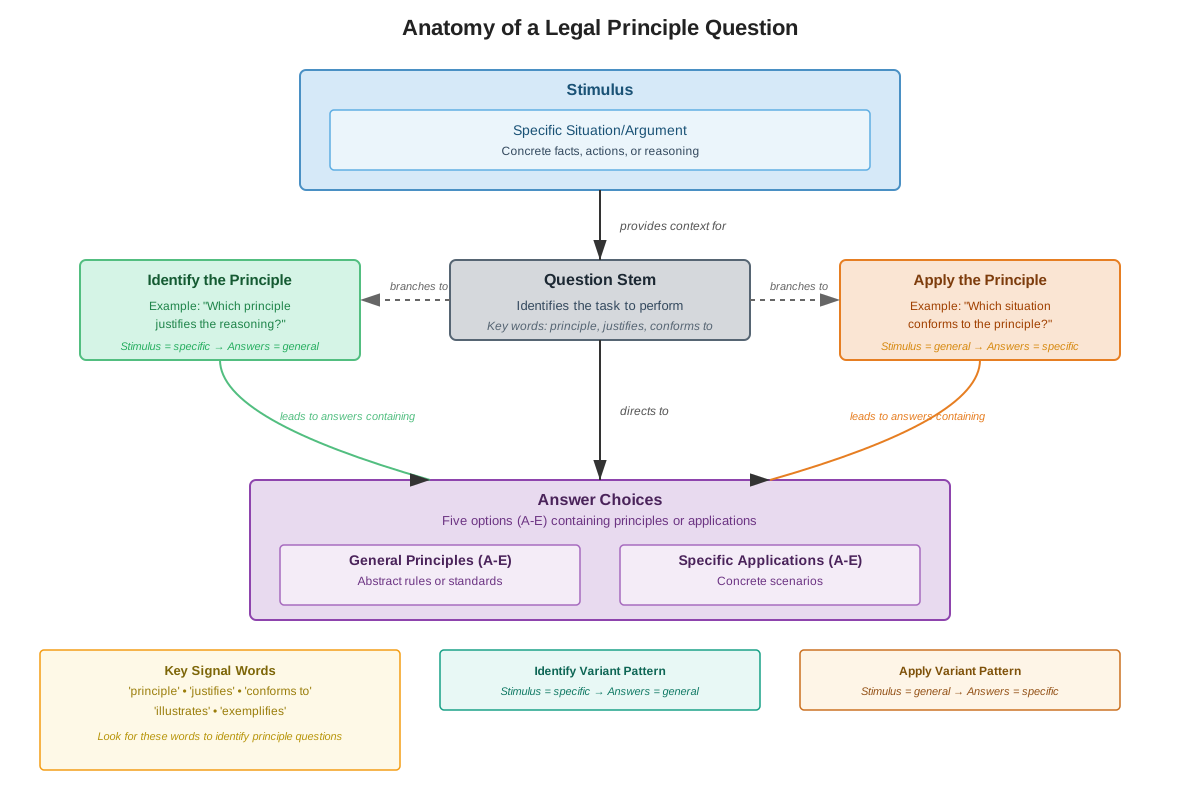
The LSAT presents principle questions in two primary formats, each requiring distinct analytical approaches:
| Question Type | Task | Key Strategy |
|---|---|---|
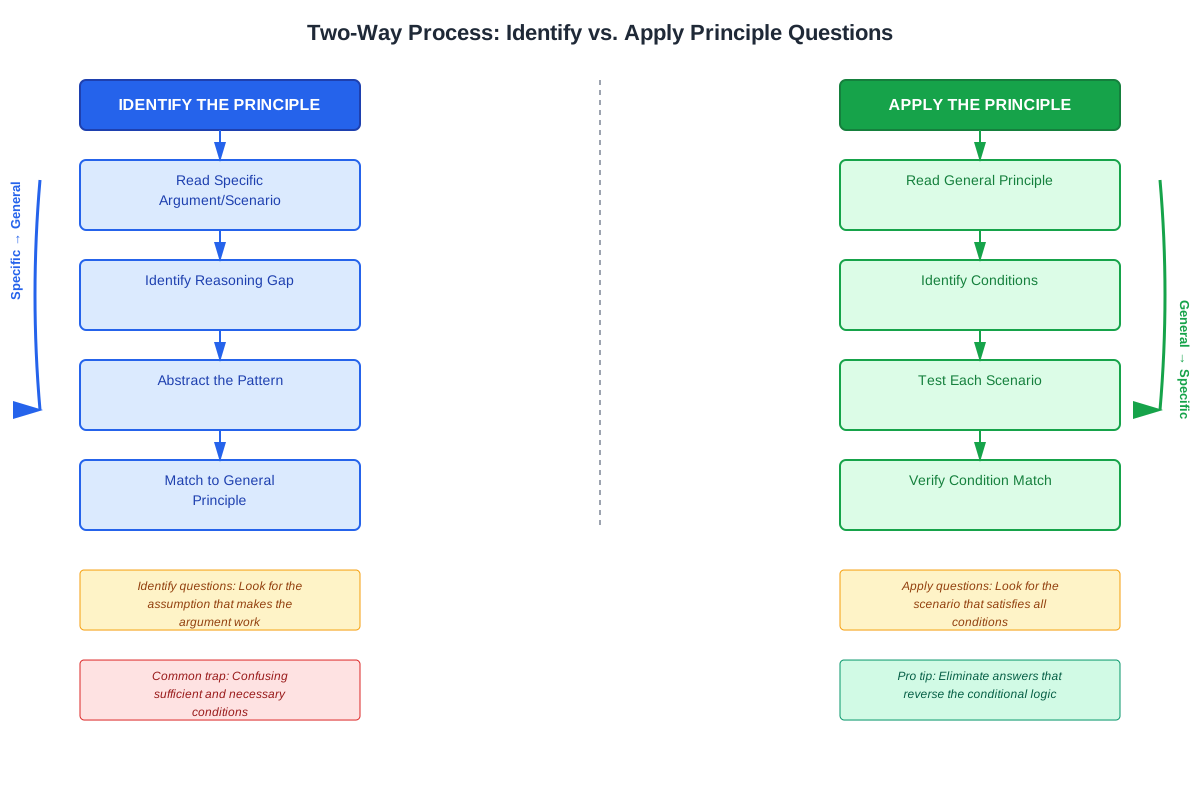
| Identify the Principle | Determine which general rule justifies or explains the reasoning in the stimulus | Abstract from specific facts to general rule; match the logical structure |
| Apply the Principle | Determine which specific situation conforms to or is governed by a stated principle | Test each answer choice against the principle's conditions; verify all requirements are met |
Identify the Principle questions present an argument or decision and ask which principle best justifies it. The stimulus provides specific facts and a conclusion; the correct answer articulates the general rule that makes that conclusion follow from those facts. These questions test upward abstraction—moving from particular to general.
Apply the Principle questions provide a general principle in the stimulus and ask which answer choice represents a situation governed by that principle. These questions test downward application—moving from general to particular. Success requires carefully checking whether each answer choice satisfies all conditions specified in the principle.
Conditional Logic in Principles
Understanding the conditional logic underlying legal principles is crucial for accurate application. Most principles establish sufficient conditions for conclusions: "If X, then Y" means X is sufficient for Y. When applying such principles, students must verify that the sufficient condition is fully satisfied before concluding that Y follows.
Consider this principle: "A contract is voidable if one party entered into it under duress." This establishes duress as a sufficient condition for voidability. To apply this principle, one must confirm that duress actually occurred. However, the principle does NOT establish duress as necessary—contracts might be voidable for other reasons too.
Some principles establish necessary conditions: "A person can be held liable for negligence only if that person owed a duty of care." This makes "owing a duty of care" necessary for negligence liability. Without this condition, negligence liability cannot follow, but satisfying this condition alone doesn't guarantee liability (other elements are also required).
Abstraction Levels
Effective principle reasoning requires operating at the appropriate level of abstraction. Principles that are too specific fail to capture the general rule; principles that are too broad extend beyond what the argument justifies.
The correct principle matches the logical structure of the argument while remaining general enough to apply beyond the specific facts. For instance, if an argument concludes that "Company X should not be praised for its charitable donation because it was motivated solely by tax benefits," the principle should address motivation and praise generally, not Company X specifically. A well-calibrated principle might state: "An action motivated solely by self-interest does not warrant moral praise."
Scope and Limitations
Careful attention to scope is essential. Principles often contain limiting language that restricts their application:
- Temporal limitations: "only when," "before," "after"
- Conditional qualifiers: "if and only if," "unless," "except when"
- Degree specifications: "primarily," "solely," "partially"
- Domain restrictions: "moral responsibility" vs. "legal liability" vs. "causal responsibility"
Missing these limitations leads to misapplication. A principle about "moral obligations" doesn't govern questions of legal requirements. A principle requiring that something be "the primary cause" isn't satisfied when something is merely "a contributing cause."
Concept Relationships
Legal principles connect intimately with conditional logic: every principle can be translated into conditional form, making conditional reasoning skills directly applicable. The relationship flows: Conditional Logic → enables → Principle Structure Recognition → enables → Accurate Principle Application.
Within principle questions themselves, the concepts form a hierarchy: Understanding Principle Structure → supports → Distinguishing Question Types → determines → Selecting Appropriate Strategy → leads to → Correct Answer Selection.
The abstraction level concept connects to argument structure analysis: Identifying Argument Components → enables → Abstracting to General Rule → produces → Properly Scoped Principle. Similarly, scope limitations connect to formal logic: Recognizing Logical Operators → enables → Identifying Scope Restrictions → prevents → Overgeneralization Errors.
Principle questions also relate to other Logical Reasoning question types. They share structural similarities with Sufficient Assumption questions (both involve identifying what rule makes an argument valid) and Parallel Reasoning questions (both require matching logical structures). Understanding these connections enables students to transfer skills across question types.
High-Yield Facts
⭐ Legal principles on the LSAT are conditional statements that establish when certain conclusions are warranted, required, or prohibited.
⭐ "Identify the principle" questions require abstracting from specific facts to a general rule; "apply the principle" questions require testing specific scenarios against stated conditions.
⭐ The correct principle matches the logical structure of the argument at the appropriate level of abstraction—neither too specific nor too broad.
⭐ Most principles establish sufficient conditions (if X, then Y), not necessary conditions (only if X, then Y); distinguishing these is critical for accurate application.
⭐ Scope limitations in principles (temporal, conditional, degree-based, or domain-specific) must be carefully observed to avoid misapplication.
- Principle questions typically comprise 10-15% of Logical Reasoning questions, making them high-yield for score improvement.
- The correct answer to a principle question must account for ALL relevant elements in the stimulus or scenario, not just some.
- Wrong answers often fail by being too narrow (excluding relevant cases), too broad (including irrelevant cases), or structurally mismatched.
- Principles about moral responsibility, ethical obligations, and fairness appear frequently on the LSAT.
- When applying principles, verify that EVERY condition specified in the principle is satisfied in the answer choice scenario.
- Principles may be stated explicitly or may need to be inferred from the reasoning pattern in the stimulus.
- The language of principles often includes normative terms: "should," "ought," "justified," "warranted," "required," "prohibited."
Quick check — test yourself on Legal principles so far.
Try Flashcards →Common Misconceptions
Misconception: Legal principles must involve actual laws or legal concepts.
Correction: LSAT legal principles are general normative or descriptive rules that can address any domain—ethics, policy, causation, definition, or procedure. The term "legal" refers to the logical structure (rule-based reasoning), not the content domain.
Misconception: The correct principle is the one that sounds most like something a lawyer would say.
Correction: The correct principle is determined by logical structure and scope matching, not by sophisticated legal terminology. Simple, clearly stated principles that accurately capture the reasoning pattern are often correct.
Misconception: If a principle applies to a situation, that principle must be the correct answer.
Correction: Multiple principles might technically apply to a situation. The correct answer is the principle that BEST captures the reasoning or MOST CLOSELY conforms to the specific situation, accounting for all relevant details.
Misconception: Principles establish both sufficient and necessary conditions simultaneously.
Correction: Most principles establish only sufficient conditions (if X, then Y) OR only necessary conditions (only if X, then Y), not both. Carefully distinguish the logical direction.
Misconception: When identifying a principle, the correct answer should use the same specific terms as the stimulus.
Correction: The correct principle abstracts from specific terms to general categories. An argument about "Company X's donation" should yield a principle about "actions" or "charitable giving" generally, not about Company X specifically.
Misconception: Longer, more detailed principles are more likely to be correct.
Correction: Length doesn't determine correctness. The correct principle might be concise or detailed, depending on what's needed to capture the reasoning structure accurately. Excessively detailed principles often introduce irrelevant specificity.
Misconception: Principles must be universally true or morally correct.
Correction: LSAT principles are presented as "if valid" or as standards being applied in the stimulus. The question tests logical application, not whether the principle is actually true or morally sound.
Worked Examples
Example 1: Identify the Principle
Stimulus: "The city council should not approve the new development project. While the project would create jobs and increase tax revenue, it would also destroy a historically significant neighborhood. Economic benefits alone do not justify eliminating irreplaceable cultural heritage."
Question: Which principle, if valid, most helps to justify the reasoning above?
Answer Choices:
(A) Development projects should be approved only when they create significant economic benefits.
(B) Irreplaceable cultural heritage should not be sacrificed for economic gain.
(C) City councils should prioritize job creation over historical preservation.
(D) Economic benefits and cultural preservation should be weighted equally in development decisions.
(E) Development projects that destroy neighborhoods should never be approved.
Analysis:
Step 1: Identify the argument structure.
- Premise: Project creates economic benefits BUT destroys historical neighborhood
- Conclusion: Council should NOT approve the project
- Reasoning: Economic benefits alone don't justify eliminating cultural heritage
Step 2: Abstract to a general principle.
The argument moves from "economic benefits + destruction of irreplaceable cultural heritage" to "should not approve." The key reasoning is that economic benefits are insufficient to justify destroying irreplaceable cultural heritage.
Step 3: Evaluate each answer choice.
(A) Too narrow and wrong direction: This suggests economic benefits are sufficient for approval, contradicting the argument.
(B) CORRECT: This principle directly captures the reasoning. If irreplaceable cultural heritage shouldn't be sacrificed for economic gain, then the project (which would sacrifice such heritage for economic gain) shouldn't be approved. This matches the logical structure perfectly.
(C) Contradicts the argument: The argument opposes prioritizing jobs over preservation.
(D) Too weak: Equal weighting doesn't justify the conclusion that the project should be rejected; it might suggest a tie or further deliberation.
(E) Too broad: The argument specifically concerns irreplaceable cultural heritage, not all neighborhoods. This overgeneralizes.
Answer: (B)
Connection to Learning Objectives: This example demonstrates identifying how legal principles appear in LSAT questions (as justifications for conclusions) and applying the reasoning pattern (abstracting from specific facts to general rule while maintaining appropriate scope).
Example 2: Apply the Principle
Stimulus: "A professional is ethically obligated to refuse a client's request if fulfilling that request would require the professional to violate established standards of the profession, even if the client would benefit from the service and no law would be broken."
Question: The principle above, if valid, most helps to justify which one of the following judgments?
Answer Choices:
(A) An accountant should refuse a client's request to use an aggressive but legal tax strategy that the accountant believes is unethical.
(B) A doctor should refuse a patient's request for a cosmetic procedure that violates medical professional standards, even though the procedure is legal and the patient desires it.
(C) A lawyer should refuse to represent a client in a case where the lawyer believes the client is morally wrong, even if representation would be legal.
(D) An engineer should refuse to approve a building design that meets legal requirements but that the engineer believes is unsafe.
(E) A therapist should refuse to continue treating a client who refuses to pay outstanding bills, even if treatment would benefit the client.
Analysis:
Step 1: Identify the principle's conditions.
The principle establishes an ethical obligation to refuse when:
- Fulfilling the request would violate professional standards (not personal beliefs or safety concerns)
- Even if the client would benefit
- Even if no law would be broken
Step 2: Test each answer choice against ALL conditions.
(A) Fails condition 1: The strategy is described as "legal" and the accountant's objection is based on personal ethical belief, not established professional standards. The passage doesn't confirm violation of professional standards.
(B) CORRECT:
- Condition 1: ✓ Violates "medical professional standards" (explicitly stated)
- Condition 2: ✓ Patient desires/would benefit from the procedure
- Condition 3: ✓ The procedure is legal
All conditions are satisfied.
(C) Fails condition 1: The lawyer's objection is based on moral judgment about the client, not violation of professional standards of legal practice.
(D) Fails condition 1: The concern is safety, not violation of professional standards. While safety might be related to engineering standards, the answer choice frames this as the engineer's belief about safety, not violation of established standards.
(E) Fails condition 1: This involves non-payment, not violation of professional standards. The refusal is based on business considerations, not professional ethical standards.
Answer: (B)
Connection to Learning Objectives: This example demonstrates applying legal principles to solve LSAT-style problems by systematically testing each answer choice against all specified conditions in the principle.
Exam Strategy
Approaching Principle Questions
Step 1: Identify the question type immediately. Look for key phrases:
- "Which principle most helps to justify..." = Identify the principle
- "Which judgment conforms to the principle..." = Apply the principle
- "The reasoning above most closely conforms to which principle..." = Identify the principle
Step 2: For "Identify the Principle" questions:
- Read the stimulus carefully, identifying premises and conclusion
- Note the logical gap—what unstated assumption connects premises to conclusion?
- Abstract one level: replace specific terms with general categories
- Predict the principle before reading answer choices
- Eliminate answers that are too narrow, too broad, or structurally mismatched
Step 3: For "Apply the Principle" questions:
- Break down the principle into its component conditions
- Note any scope limitations or qualifiers
- For each answer choice, systematically verify whether ALL conditions are satisfied
- Eliminate any choice that fails even one condition
- Be especially careful with "only if" (necessary condition) vs. "if" (sufficient condition)
Trigger Words and Phrases
Watch for these high-yield indicators:
Conditional language: "if," "only if," "when," "whenever," "unless," "except when"
Normative terms: "should," "ought," "must," "required," "obligated," "justified," "warranted," "prohibited"
Scope limiters: "solely," "primarily," "exclusively," "partially," "at least," "no more than"
Causal language: "because," "results in," "leads to," "causes," "responsible for"
Process of Elimination Tips
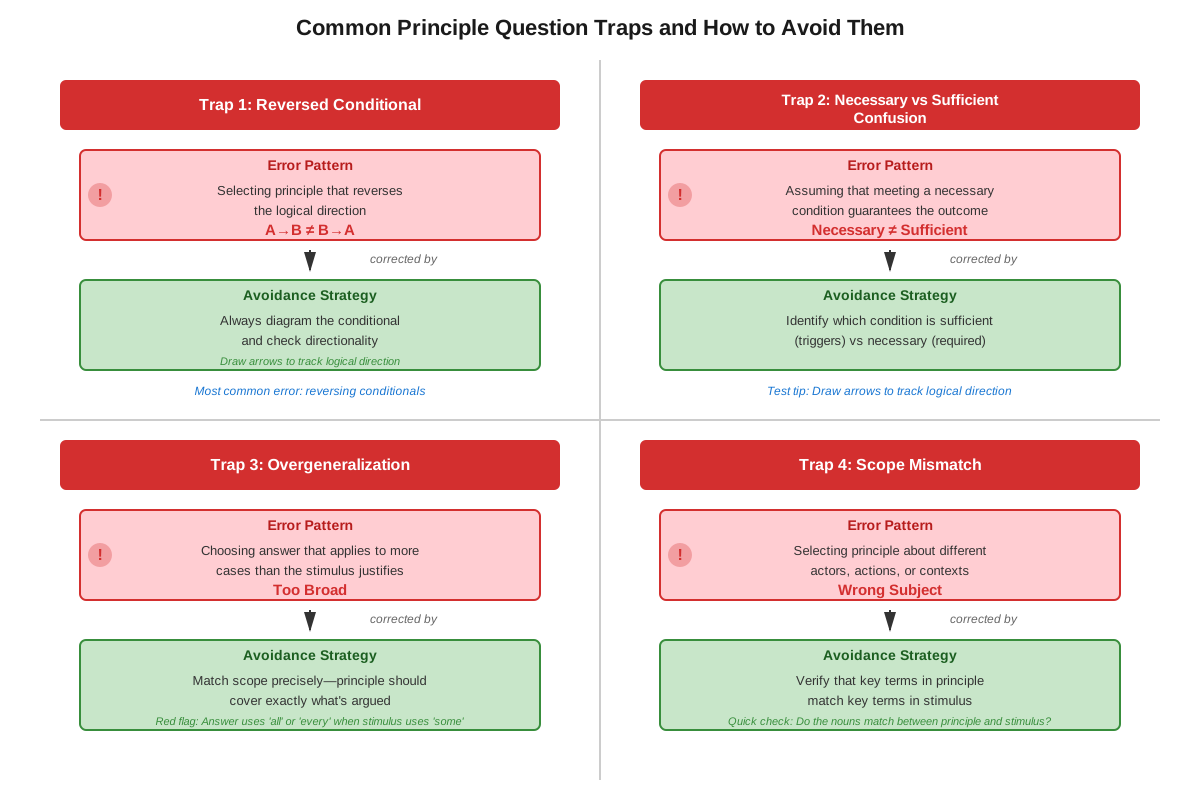
Eliminate answers that:
- Change the logical direction (sufficient ↔ necessary)
- Are too specific (mention details not relevant to the reasoning)
- Are too broad (extend beyond what the argument supports)
- Introduce new concepts not present in the stimulus
- Fail to account for all relevant elements in the stimulus
- Contain extreme language ("always," "never") when the stimulus is more moderate
Time Allocation
Principle questions typically require 1:30-2:00 minutes. Allocate time as follows:
- 30-40 seconds: Read and analyze stimulus
- 10-15 seconds: Predict or break down principle
- 45-60 seconds: Evaluate answer choices
- 10-15 seconds: Verify and select
If stuck between two answers, return to the stimulus and verify which answer better matches the logical structure and scope. Don't rely on which "sounds better"—use structural analysis.
Memory Techniques
SCOPE Mnemonic for evaluating principles:
- Structure: Does the logical structure match?
- Conditions: Are all conditions satisfied?
- Operative terms: Do the key terms align?
- Precision: Is the abstraction level appropriate?
- Exceptions: Are scope limitations observed?
The Abstraction Ladder visualization: Picture a ladder with three rungs:
- Top rung: Too abstract/broad (includes irrelevant cases)
- Middle rung: Just right (captures the reasoning at appropriate generality)
- Bottom rung: Too specific (tied to particular facts)
The correct principle sits on the middle rung.
IF-THEN-CHECK for applying principles:
- IF: Identify the triggering conditions in the principle
- THEN: Note what conclusion follows when conditions are met
- CHECK: Verify each answer choice satisfies ALL conditions
The Three Questions for principle identification:
- What specific facts are given?
- What conclusion is drawn?
- What general rule would make that conclusion follow from those facts?
Summary
Legal principles on the LSAT test the fundamental skill of moving between general rules and specific applications—the core of legal reasoning. These questions appear in two primary formats: identifying which principle justifies given reasoning, and applying a stated principle to determine which situation it governs. Success requires understanding that principles function as conditional statements with specific triggering conditions, operative terms, and scope limitations. The key analytical moves are abstracting from specific facts to appropriately general rules (for identification questions) and systematically verifying that all conditions are satisfied (for application questions). Students must carefully attend to the logical structure, distinguish sufficient from necessary conditions, and maintain appropriate scope—neither too narrow nor too broad. Mastering principle questions requires practice in conditional logic, structural analysis, and precise reading of qualifiers and limitations.
Key Takeaways
- Legal principles are conditional statements that establish when conclusions are warranted; they appear in 10-15% of Logical Reasoning questions
- "Identify the principle" questions require abstracting from specific facts to general rules; "apply the principle" questions require testing scenarios against stated conditions
- The correct principle matches the logical structure at the appropriate abstraction level—general enough to be a principle, specific enough to capture the reasoning
- Carefully distinguish sufficient conditions (if X, then Y) from necessary conditions (only if X, then Y) when applying principles
- Scope limitations—temporal, conditional, degree-based, or domain-specific—must be observed to avoid misapplication
- Systematic verification of ALL conditions in a principle is essential for application questions; missing even one condition makes an answer incorrect
- Wrong answers typically fail by being too narrow, too broad, structurally mismatched, or by introducing irrelevant concepts
Related Topics
Sufficient Assumption Questions: These questions ask what additional premise would make an argument valid, closely related to identifying principles that justify reasoning. Mastering legal principles provides direct preparation for sufficient assumption questions.
Necessary Assumption Questions: Understanding the distinction between sufficient and necessary conditions in principles helps with identifying what an argument depends upon, a key skill for necessary assumption questions.
Parallel Reasoning Questions: Both principle questions and parallel reasoning questions require matching logical structures, making the structural analysis skills developed here directly transferable.
Conditional Logic Advanced Applications: Deeper study of complex conditional chains, contrapositive reasoning, and formal logic notation enhances principle question performance, especially for complex multi-condition principles.
Argument Evaluation: The ability to identify what principle justifies reasoning strengthens overall argument analysis skills, improving performance across all Logical Reasoning question types.
Practice CTA
Now that you've mastered the conceptual foundation of legal principles, it's time to cement your understanding through active practice. Attempt the practice questions to test your ability to identify and apply principles under timed conditions. Use the flashcards to reinforce the key distinctions between question types, condition types, and common traps. Remember: principle questions reward systematic analysis over intuition. Each practice question is an opportunity to refine your analytical process and build the confidence needed for test day success. Your investment in mastering this high-yield topic will pay dividends across the entire Logical Reasoning section!
Sign up free to keep reading
Create a free AnvayaPrep account to finish this LSAT guide on Legal principles — plus flashcards and practice questions.