Overview
Moral principles represent one of the most frequently tested and conceptually rich areas within LSAT Logical Reasoning. These questions require test-takers to identify, apply, or evaluate principles that govern ethical decision-making, obligations, rights, and judgments about right and wrong conduct. Unlike purely formal logic questions, moral principle questions engage with normative reasoning—the type of thinking that determines what ought to be done rather than merely what is the case.
On the LSAT, principle questions involving moral reasoning typically present scenarios where actions, policies, or judgments must be evaluated against general ethical standards. These questions test your ability to recognize the underlying moral framework that justifies a particular conclusion, or conversely, to apply a stated moral principle to determine which specific situation it governs. The complexity lies not in mathematical calculation but in precise conceptual matching: identifying which general rule corresponds to which particular case, and understanding the logical structure that connects abstract principles to concrete applications.
Mastering lsat moral principles is essential because these questions appear consistently across multiple Logical Reasoning sections and often determine score differentiation at higher percentile ranges. They connect to broader LSAT skills including conditional reasoning, sufficient and necessary conditions, argument structure analysis, and the ability to move fluidly between abstract and concrete levels of reasoning. Success with moral principle questions demonstrates the analytical flexibility that law schools seek in candidates, as legal reasoning itself frequently involves applying general statutes and precedents to specific factual situations.
Learning Objectives
- [ ] Identify how Moral principles appears in LSAT questions
- [ ] Explain the reasoning pattern behind Moral principles
- [ ] Apply Moral principles to solve LSAT-style problems accurately
- [ ] Distinguish between sufficient and necessary conditions within moral principles
- [ ] Evaluate whether a given principle justifies a specific moral judgment
- [ ] Recognize common structural patterns in moral principle arguments
- [ ] Differentiate between principles that prescribe actions versus those that evaluate character or intentions
Prerequisites
- Basic conditional logic: Understanding "if-then" statements is essential because moral principles are typically structured as conditional rules (if certain conditions obtain, then certain obligations or judgments follow).
- Argument structure identification: Recognizing premises and conclusions allows students to identify where principles function within arguments—whether as assumptions, explicit premises, or general rules being applied.
- Distinction between descriptive and normative claims: Moral principles make normative claims (what should be) rather than descriptive claims (what is), and recognizing this distinction prevents category errors in reasoning.
Why This Topic Matters
Moral reasoning forms the backbone of legal and ethical decision-making in professional contexts. Lawyers must constantly apply general legal principles to specific cases, evaluate whether actions comply with ethical standards, and construct arguments that justify particular judgments based on broader rules. The LSAT tests this skill directly through principle questions because it predicts success in legal education and practice.
Exam statistics reveal that principle questions, including those focused on moral principles, appear in approximately 15-20% of Logical Reasoning questions across both scored LR sections. This translates to roughly 8-10 questions per test—a significant portion that can substantially impact overall scores. These questions appear in multiple formats: "Which principle most helps justify the reasoning?" "Which principle, if valid, most helps to justify the judgment?" "The situation described above most closely conforms to which one of the following principles?" and "Which principle underlies the argument?"
Common manifestations in LSAT passages include scenarios involving fairness in resource allocation, obligations arising from professional roles, justifications for punishment or reward, conditions under which deception is permissible, and standards for evaluating praise or blame. The test frequently presents everyday ethical dilemmas—workplace decisions, personal relationships, civic responsibilities—requiring test-takers to identify the general moral framework that structures the reasoning.
Core Concepts
Structure of Moral Principles
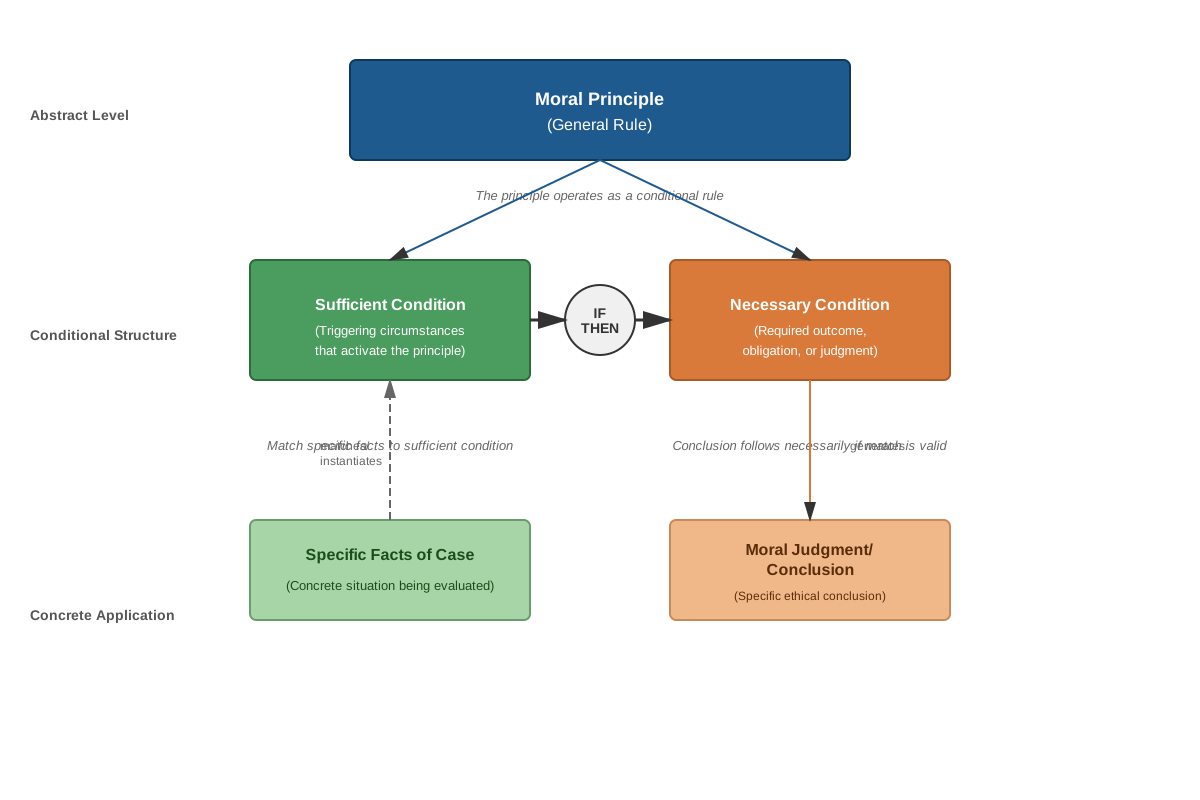
Moral principles on the LSAT typically take the form of conditional statements that establish relationships between circumstances and moral judgments or obligations. The standard structure follows this pattern: "If [condition(s)], then [moral judgment/obligation]." The condition specifies the circumstances under which the principle applies, while the consequent specifies what follows morally—what one ought to do, what judgment is appropriate, or what rights or obligations exist.
For example: "If a person voluntarily accepts the benefits of a cooperative scheme, then that person has an obligation to bear a fair share of the burdens." Here, "voluntarily accepts benefits" is the triggering condition, and "has an obligation to bear fair share of burdens" is the moral consequent. Understanding this structure is crucial because LSAT questions test whether you can match the conditions in a specific scenario to the conditions specified in a principle.
Types of Moral Principles
Prescriptive principles specify what actions ought to be performed or avoided. These principles generate obligations or prohibitions: "One ought to keep promises," "It is wrong to harm innocent people," or "People should help those in need when doing so requires minimal sacrifice." On the LSAT, prescriptive principles often appear in questions asking what someone should do in a given situation.
Evaluative principles establish standards for judging actions, character, or outcomes as good/bad, praiseworthy/blameworthy, or just/unjust. Rather than directly commanding action, these principles provide criteria for moral assessment: "An action is praiseworthy only if performed with good intentions," or "A policy is just only if it treats similar cases similarly." These principles help determine whether moral approval or disapproval is warranted.
Rights-based principles specify entitlements or protections that individuals possess: "People have a right to control their own property," or "Individuals are entitled to privacy in their personal affairs." These principles often interact with obligation-based principles, as one person's right typically generates obligations in others to respect that right.
Sufficient vs. Necessary Conditions in Moral Principles
The logical structure of moral principles critically depends on understanding sufficient and necessary conditions. A sufficient condition is one that, if present, guarantees the moral judgment or obligation follows. A necessary condition is one that must be present for the moral judgment or obligation to apply, though its presence alone doesn't guarantee the judgment.
Consider: "If an action causes unnecessary suffering, then it is morally wrong." Here, causing unnecessary suffering is presented as a sufficient condition for moral wrongness—whenever this condition is met, wrongness follows. However, the principle doesn't claim this is the only way an action can be wrong (it's not necessary for wrongness).
Contrast with: "An action is praiseworthy only if it is performed voluntarily." This establishes voluntary performance as a necessary condition—without it, no action can be praiseworthy. However, voluntary performance alone isn't sufficient; other conditions might also be required.
| Logical Form | Moral Principle Example | What It Means |
|---|---|---|
| If A, then B | If you make a promise, then you ought to keep it | A is sufficient for B; making promises generates obligations |
| Only if A, then B | You are obligated to help only if you can do so without significant cost | A is necessary for B; obligation requires low cost |
| If and only if A, then B | An action is just if and only if it treats equals equally | A is both necessary and sufficient for B |
Application vs. Justification
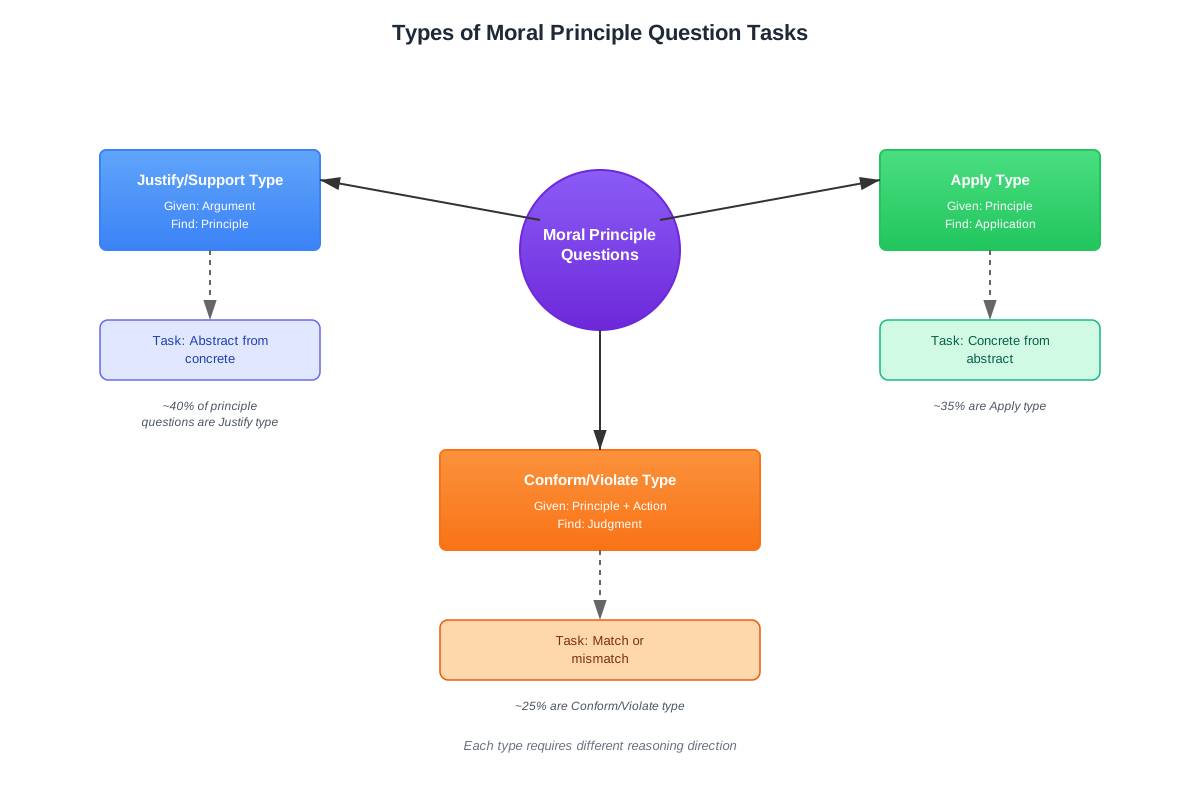
LSAT moral principle questions test two distinct reasoning directions. Application questions provide a general principle and ask which specific situation it governs or what judgment it supports in a particular case. These questions move from abstract to concrete: given the rule, what follows in this scenario?
Justification questions present a specific moral judgment or decision and ask which principle best supports or justifies it. These questions move from concrete to abstract: given this particular judgment, what general rule would make it reasonable? Justification questions are typically more challenging because multiple principles might seem relevant, requiring careful attention to which principle most precisely matches the reasoning structure.
Scope and Specificity
Effective principle matching requires attention to scope—how broadly or narrowly a principle applies. A principle stating "One should never lie" has universal scope, while "One should not lie to patients about terminal diagnoses unless disclosure would cause severe psychological harm" has narrow, specified scope. LSAT questions often include answer choices with principles that are too broad (covering cases beyond what the argument addresses) or too narrow (failing to cover the case at hand).
Specificity refers to how detailed the conditions are. More specific principles include more conditions or qualifications: "If a professional has specialized knowledge, has voluntarily entered a relationship of trust, and the other party is vulnerable, then the professional has heightened obligations of care." Each additional condition narrows when the principle applies, making precise matching essential.
Concept Relationships
The concepts within moral principles form an interconnected logical system. The structure of moral principles (conditional form) determines how sufficient and necessary conditions function within them, which in turn affects both application (using principles to reach judgments about cases) and justification (identifying which principles support given judgments). The distinction between prescriptive, evaluative, and rights-based principles represents different types of moral content that can fill the same logical structure.
Scope and specificity operate as constraints on principle matching—they determine whether a principle is appropriately matched to a case. A principle with incorrect scope (too broad or narrow) fails to match even if its logical structure seems right. Similarly, insufficient attention to specific conditions leads to misapplication.
These concepts connect to prerequisite knowledge of conditional logic by applying "if-then" reasoning to normative rather than purely factual claims. They extend argument structure analysis by adding a layer of abstraction—identifying not just what conclusion follows from what premises, but what general rule licenses the inference from particular facts to particular judgments.
Relationship map: Conditional Logic Foundation → Moral Principle Structure → Sufficient/Necessary Conditions → Application (abstract to concrete) ↔ Justification (concrete to abstract) → Scope/Specificity Constraints → Accurate Principle Matching
Quick check — test yourself on Moral principles so far.
Try Flashcards →High-Yield Facts
- ⭐ Moral principles on the LSAT are typically structured as conditional statements with triggering conditions and moral consequents
- ⭐ Application questions move from general principle to specific case; justification questions move from specific judgment to general principle
- ⭐ A principle can be too broad (covering cases beyond the argument) or too narrow (failing to cover the case at hand)
- ⭐ Sufficient conditions guarantee the moral judgment follows; necessary conditions must be present but don't alone guarantee the judgment
- ⭐ The correct principle must match both the logical structure AND the specific content of the reasoning
- Prescriptive principles specify obligations or prohibitions about what should be done
- Evaluative principles provide standards for judging actions, character, or outcomes
- Rights-based principles establish entitlements that generate corresponding obligations in others
- Multiple conditions in a principle create a conjunction—all must be satisfied for the principle to apply
- Principles with "only if" establish necessary conditions; principles with "if" establish sufficient conditions
- Incorrect answer choices often include principles that are logically valid but don't match the specific moral content of the argument
- The most common error is selecting a principle that seems morally reasonable but doesn't structurally match the argument's reasoning
- Principles involving intentions, consequences, rights, fairness, and harm appear most frequently on the LSAT
- Correct principles must account for all relevant conditions mentioned in the argument without adding extraneous requirements
- When multiple principles seem applicable, the most specific principle that fully covers the case is typically correct
Common Misconceptions
Misconception: Any morally reasonable principle that relates to the topic will be correct. → Correction: The correct principle must precisely match the logical structure and specific conditions of the argument. A principle can be morally sound but still be wrong if it doesn't capture the exact reasoning pattern used.
Misconception: Principles are just common-sense moral rules, so intuition is sufficient. → Correction: LSAT principle questions test logical precision, not moral intuition. The correct answer requires careful analysis of conditional structure, scope, and the specific relationship between conditions and conclusions.
Misconception: If a principle covers the case described, it's the right answer. → Correction: The principle must cover the case without being too broad (covering additional cases not addressed by the argument) or too narrow (requiring conditions not present in the argument). Scope matching is essential.
Misconception: "If" and "only if" are interchangeable in moral principles. → Correction: These establish different logical relationships. "If A, then B" makes A sufficient for B, while "B only if A" makes A necessary for B. Confusing these reverses the logical relationship and leads to incorrect answers.
Misconception: The principle with the most conditions or qualifications is most accurate. → Correction: Additional conditions must be justified by the argument. A principle with extraneous conditions that aren't relevant to the reasoning is incorrect, even if it seems more nuanced or sophisticated.
Misconception: Justification questions ask for any principle that would support the conclusion. → Correction: Justification questions ask for the principle that best captures the reasoning actually used in the argument, not just any principle that could support the conclusion. The principle must match the specific inferential path taken.
Worked Examples
Example 1: Application Question
Stimulus: "Professor Chen argues that the university should not accept the donation from the pharmaceutical company. She reasons that accepting money from an organization that will benefit from the university's research creates a conflict of interest that undermines the integrity of the research process."
Question: Which principle, if valid, most helps to justify Professor Chen's reasoning?
Answer Choices:
(A) Universities should refuse all donations from private corporations
(B) If accepting a donation creates a conflict of interest that undermines research integrity, then the donation should be refused
(C) Research integrity is more important than financial considerations
(D) Organizations that benefit from research should not fund that research
(E) Universities have an obligation to maintain public trust
Analysis:
Step 1: Identify the argument structure. Professor Chen moves from a specific condition (accepting money creates conflict of interest that undermines integrity) to a specific conclusion (should not accept the donation).
Step 2: Determine what principle would justify this inference. We need a conditional principle where the condition matches "creates conflict of interest that undermines integrity" and the consequent matches "should refuse the donation."
Step 3: Evaluate each choice:
(A) Too broad—applies to all corporate donations, not just those creating conflicts of interest. The argument specifically concerns conflicts of interest, not all corporate funding.
(B) Correct—This precisely matches the reasoning structure. The condition (accepting donation creates conflict undermining integrity) maps exactly to the argument's premise, and the consequent (should refuse) maps to the conclusion.
(C) Too vague—doesn't establish the specific conditional relationship between conflict of interest and refusing donations. This is a general value statement, not a principle that licenses the specific inference.
(D) Too broad—would prohibit all funding from benefiting organizations, even without conflicts of interest. The argument specifically concerns conflicts that undermine integrity.
(E) Doesn't address the specific reasoning about conflicts of interest. While potentially relevant to the broader context, it doesn't capture the inferential structure of the argument.
Key Takeaway: The correct principle must match both the specific conditions mentioned (conflict of interest undermining integrity) and the logical structure (if this condition, then this conclusion). Broader or vaguer principles fail to capture the precise reasoning.
Example 2: Justification Question
Stimulus: "Maya received widespread praise for her decision to report the safety violations at her company, even though doing so cost her the promotion she had been working toward for years. The praise was deserved because Maya acted on principle despite significant personal cost."
Question: The reasoning above most closely conforms to which one of the following principles?
Answer Choices:
(A) Actions that benefit society deserve praise
(B) An action is praiseworthy if it is performed for moral reasons despite significant personal sacrifice
(C) People should report safety violations regardless of personal consequences
(D) Principled action is more important than career advancement
(E) Actions are praiseworthy only if they involve personal sacrifice
Analysis:
Step 1: Identify the judgment being made and the reasoning supporting it. Judgment: Maya's action deserves praise. Reasoning: She acted on principle despite significant personal cost.
Step 2: Determine what principle would make this reasoning valid. We need a principle establishing that acting on principle despite personal cost is sufficient for deserving praise.
Step 3: Evaluate each choice:
(A) Doesn't match the reasoning—the argument focuses on acting on principle despite cost, not on societal benefit. While reporting violations may benefit society, that's not the stated basis for praise.
(B) Correct—This captures both elements of the reasoning: (1) acting for moral reasons/on principle, and (2) despite significant personal sacrifice. The conditional structure (if these conditions, then praiseworthy) matches the argument's logic.
(C) This is a prescriptive principle about what people should do, not an evaluative principle about what deserves praise. It doesn't address the reasoning about why praise is deserved.
(D) A comparative value claim that doesn't establish the conditional relationship between the specified conditions and praiseworthiness. It's too general and doesn't capture the specific reasoning structure.
(E) Too strong—claims personal sacrifice is necessary for praiseworthiness ("only if"), but the argument only claims it's sufficient in combination with principled action. This principle would incorrectly imply that actions without sacrifice can never be praiseworthy.
Key Takeaway: Justification questions require identifying the principle that captures the specific reasoning path used, including all relevant conditions (both "principled action" and "personal sacrifice") and the correct logical relationship (sufficient, not necessary).
Exam Strategy
Trigger words and phrases signal moral principle questions: "principle," "generalization," "proposition," "conforms to," "justifies the reasoning," "judgment," "if valid, most helps to," "illustrates," and "underlying principle." When you see these, immediately shift to principle-matching mode rather than standard argument evaluation.
Approach process:
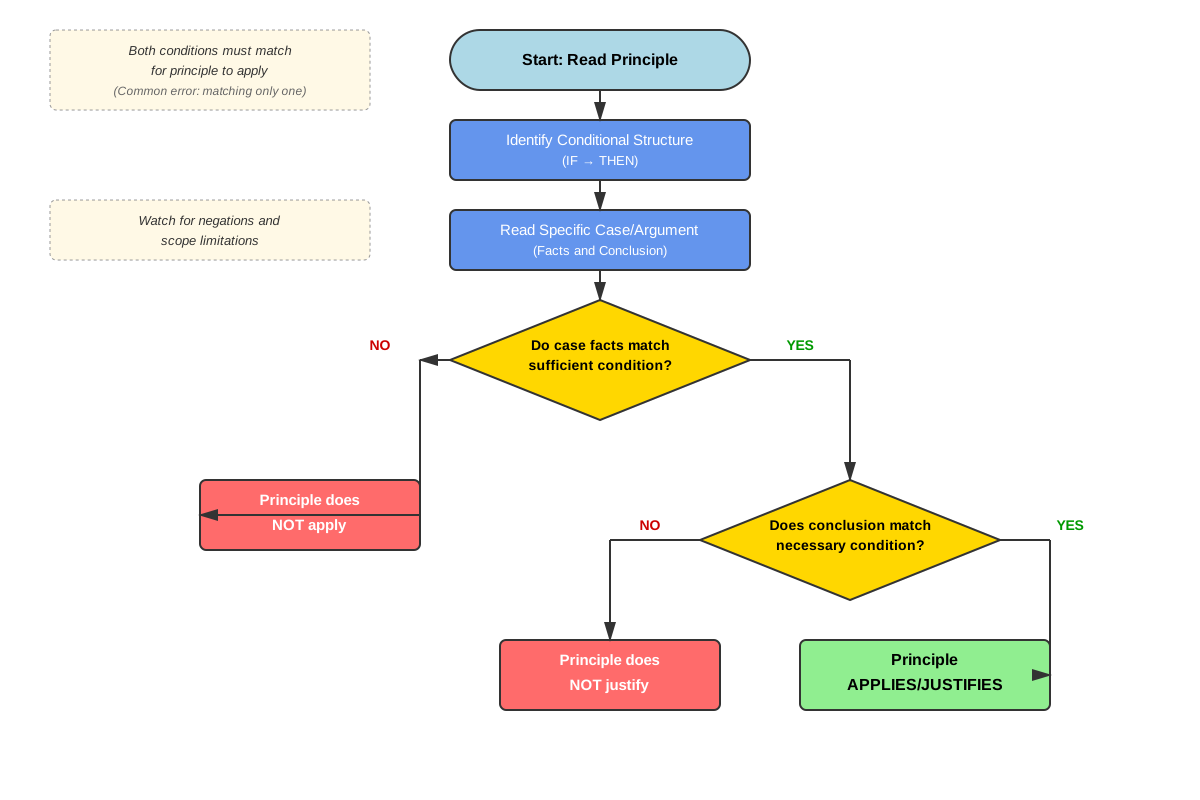
- Identify the question type: Is this application (principle to case) or justification (case to principle)?
- Map the argument structure: For justification questions, identify the specific judgment and the exact reasoning supporting it. For application questions, identify the principle's conditions and consequent.
- Predict the answer: Before looking at choices, articulate in your own words what principle would work. This prevents being swayed by attractive but incorrect options.
- Eliminate systematically: Remove choices that are too broad (cover cases beyond the argument), too narrow (miss essential elements), or structurally mismatched (wrong conditional relationship).
- Verify scope and specificity: The correct answer should cover exactly what the argument covers—no more, no less.
Process of elimination tips:
- Eliminate principles that introduce new concepts not mentioned in the argument
- Remove principles with reversed conditional logic (sufficient/necessary confusion)
- Discard principles that are morally appealing but structurally wrong
- Eliminate principles that address only one element when the argument involves multiple conditions
- Remove principles that are too absolute when the argument involves qualified claims
Time allocation: Spend 1:15-1:30 on principle questions. They require careful analysis but shouldn't consume excessive time. If stuck between two choices, verify which one matches all conditions without adding extras.
Exam Tip: The most common trap is selecting a principle that seems morally correct or philosophically sophisticated but doesn't match the argument's specific reasoning. Always prioritize structural match over moral plausibility.
Memory Techniques
SCOPE - Remember principle matching requirements:
- Structure must match (conditional logic)
- Conditions must align (all relevant factors)
- Outcome/consequent must fit (the moral judgment)
- Precision in scope (not too broad/narrow)
- Exact reasoning path (justification questions)
"If-Then-Check" - For any principle:
- If - Identify the triggering conditions
- Then - Identify the moral consequent
- Check - Verify both match the argument exactly
Visualization strategy: Picture principles as templates or stencils. The argument is a shape that must fit through the template perfectly—not too small (principle too broad) and not too large (principle too narrow). The correct principle is the template that matches exactly.
PRAISE mnemonic for evaluative principles (what makes actions praiseworthy):
- Principle-based motivation
- Right intentions
- Adverse circumstances overcome
- Integrity maintained
- Sacrifice involved
- Effects considered
Summary
Moral principles on the LSAT test the ability to identify, apply, and evaluate general ethical rules that govern specific situations. These principles typically take conditional form, establishing relationships between circumstances and moral judgments or obligations. Success requires distinguishing between application (using principles to reach judgments) and justification (identifying principles that support given judgments), understanding sufficient versus necessary conditions, and precisely matching scope and specificity. The most common errors involve selecting principles that are morally reasonable but structurally mismatched, or failing to account for all relevant conditions in the argument. Mastery demands careful attention to logical structure, systematic elimination of incorrect scope, and verification that the principle captures the exact reasoning path used in the argument.
Key Takeaways
- Moral principles function as conditional rules connecting circumstances to moral judgments or obligations
- Application questions move from abstract principle to concrete case; justification questions move from concrete judgment to abstract principle
- Correct principles must match both logical structure (sufficient/necessary conditions) and specific content (all relevant factors)
- Scope errors (too broad or too narrow) are the most common reason for incorrect answers
- Distinguish between prescriptive principles (what ought to be done), evaluative principles (standards for judgment), and rights-based principles (entitlements)
- The principle that most precisely captures the reasoning used is correct, even if other principles could support the conclusion
- Systematic elimination based on structural mismatch and scope errors is more reliable than intuitive selection
Related Topics
Conditional Logic in Arguments: Deepening understanding of sufficient and necessary conditions enhances principle analysis, as moral principles are sophisticated applications of conditional reasoning to normative claims.
Assumption Questions: Many assumption questions involve implicit moral principles that bridge factual premises to normative conclusions, making principle recognition skills directly transferable.
Parallel Reasoning: Identifying parallel argument structures requires the same pattern-matching skills used in principle questions, particularly recognizing when abstract structures match despite different content.
Strengthen/Weaken Questions: Principles often function as strengtheners (providing general rules that support reasoning) or can be weakened (showing exceptions to general rules), connecting principle analysis to argument evaluation.
Flaw Questions: Recognizing when arguments misapply principles or rely on principles with incorrect scope develops critical evaluation skills applicable to flaw identification.
Practice CTA
Now that you've mastered the conceptual framework of moral principles in LSAT Logical Reasoning, it's time to cement your understanding through active practice. Attempt the practice questions to apply these concepts to realistic LSAT scenarios, and use the flashcards to reinforce the key distinctions and structures you've learned. Remember: principle questions reward precision and systematic analysis. Each practice question you work through builds the pattern recognition and structural analysis skills that will serve you throughout the LSAT. You've built the foundation—now strengthen it through deliberate practice!
Sign up free to keep reading
Create a free AnvayaPrep account to finish this LSAT guide on Moral principles — plus flashcards and practice questions.