Overview
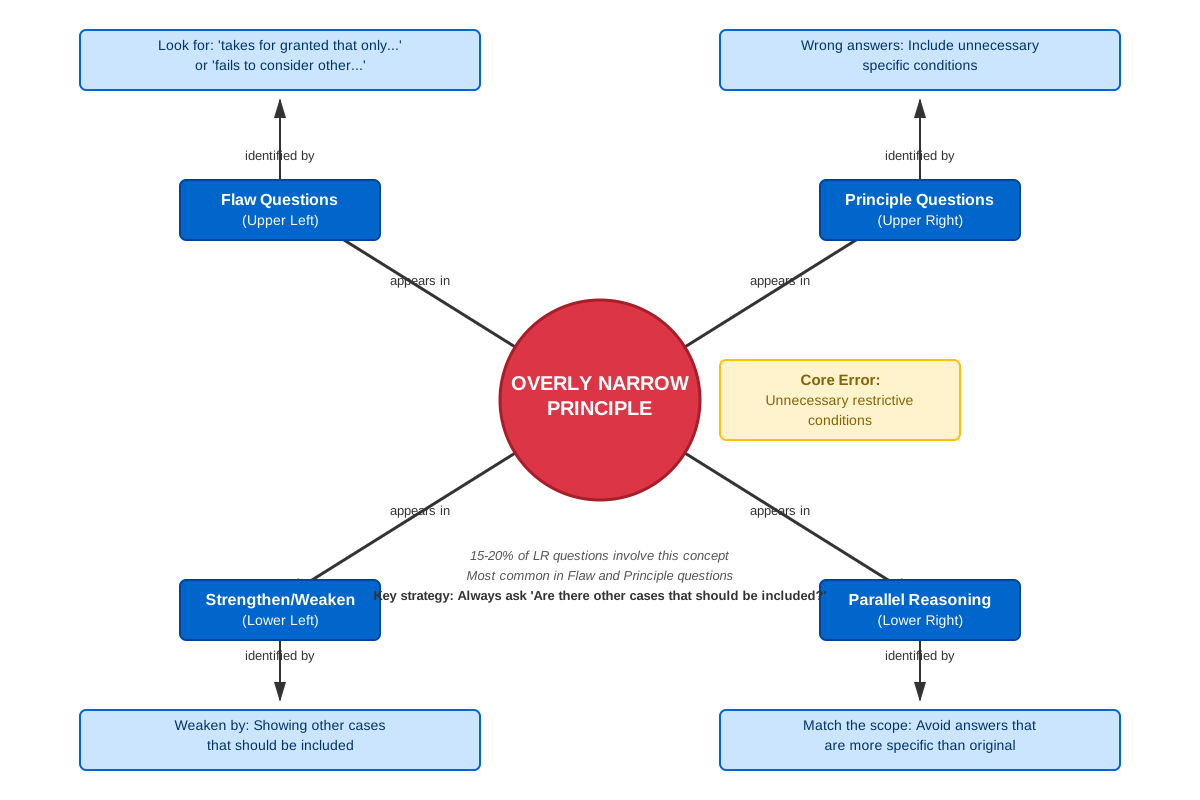
The overly narrow principle is a critical error pattern that appears frequently in LSAT Logical Reasoning sections, particularly within principle questions. This concept tests a student's ability to recognize when a proposed principle fails to capture the full scope of a situation or argument because it is too restrictive in its conditions or application. Understanding this flaw is essential for success on the LSAT because it appears in multiple question types, including Flaw questions, Principle questions (both application and identification), and Parallel Reasoning questions.
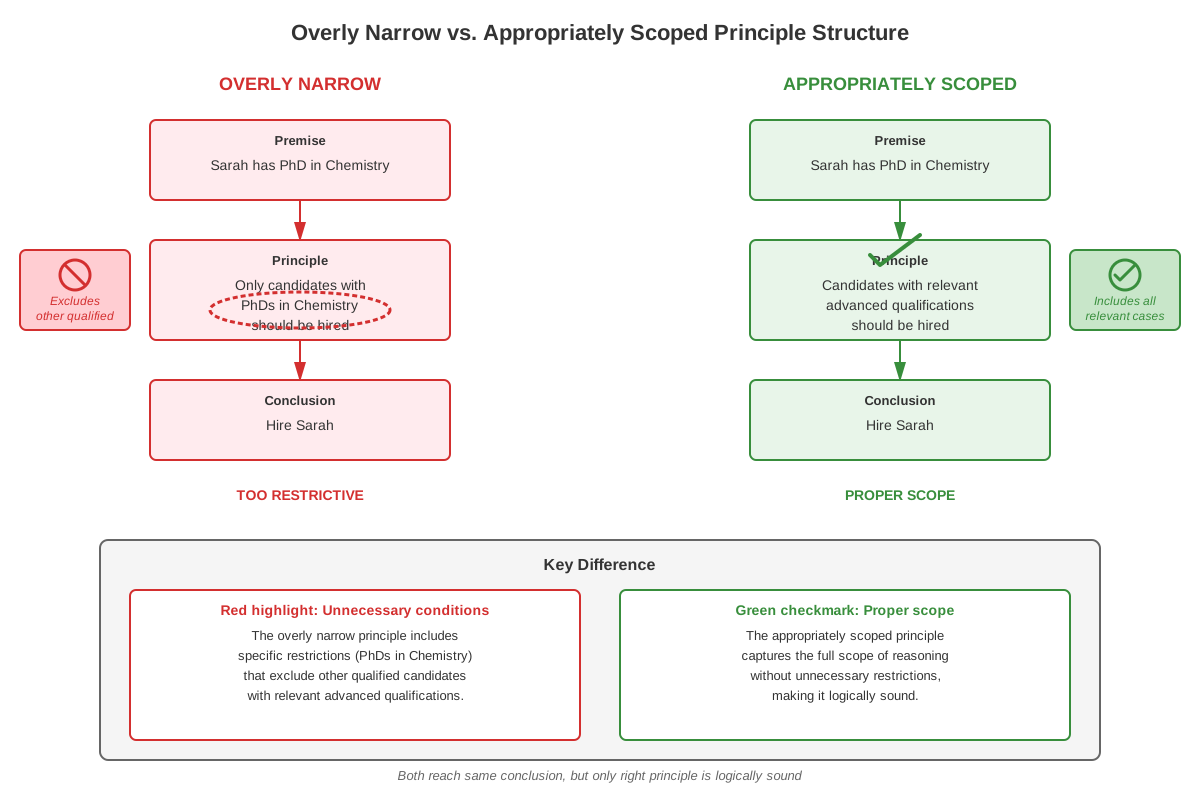
An overly narrow principle occurs when someone attempts to justify a conclusion or action using a rule or guideline that is more specific than necessary, thereby excluding legitimate cases that should fall under the same reasoning. For example, if someone argues "We should hire Sarah because she has a PhD in chemistry," the implicit principle might be "Only candidates with PhDs in chemistry should be hired." This principle is overly narrow because it excludes other qualified candidates who might have different but equally relevant credentials. The LSAT tests whether students can identify when principles are unnecessarily restrictive and fail to account for the full range of situations the argument actually supports.
Mastering the lsat overly narrow principle concept connects directly to broader logical reasoning skills, including understanding sufficient and necessary conditions, recognizing scope issues, and evaluating the strength of generalizations. This topic sits at the intersection of formal logic and practical reasoning, requiring students to think critically about how broadly or narrowly rules should apply. Success with overly narrow principle questions demonstrates sophisticated analytical thinking—the ability to see not just what an argument says, but what it logically commits to and whether those commitments are appropriately calibrated.
Learning Objectives
- [ ] Identify how overly narrow principle appears in LSAT questions
- [ ] Explain the reasoning pattern behind overly narrow principle
- [ ] Apply overly narrow principle to solve LSAT-style problems accurately
- [ ] Distinguish between overly narrow principles and appropriately scoped principles
- [ ] Recognize the relationship between overly narrow principles and sufficient/necessary condition errors
- [ ] Evaluate answer choices to determine which principles are too restrictive for the given argument
- [ ] Generate broader principles that would properly support a given conclusion without being overly narrow
Prerequisites
- Basic conditional logic: Understanding "if-then" statements is essential because overly narrow principles often involve adding unnecessary sufficient conditions
- Argument structure analysis: Recognizing premises and conclusions allows students to evaluate whether a principle adequately bridges the reasoning gap
- Principle question types: Familiarity with how the LSAT asks about principles (application, identification, conformity) provides context for where overly narrow principles appear
- Scope concepts: Understanding how arguments can be too broad or too narrow helps students calibrate the appropriate level of generality
Why This Topic Matters
The overly narrow principle concept appears in approximately 15-20% of Logical Reasoning questions across typical LSAT administrations, making it a high-frequency topic that directly impacts scores. This concept is particularly important because it appears in multiple question types: Flaw questions may ask students to identify that an argument relies on an overly restrictive principle; Principle questions may include wrong answer choices that are too narrow to support the conclusion; and Parallel Reasoning questions may test whether students can match the scope of principles across arguments.
In real-world applications, recognizing overly narrow principles is crucial for legal reasoning, policy analysis, and ethical decision-making. Lawyers must ensure that legal precedents are applied appropriately without being overly restrictive, and policymakers must craft rules that cover all relevant cases without being unnecessarily narrow. The LSAT tests this skill because it reflects the kind of precise thinking required in law school and legal practice.
Common manifestations on the LSAT include: answer choices in Principle-Support questions that add unnecessary conditions; Flaw questions where the argument assumes a principle that is more specific than the evidence warrants; Necessary Assumption questions where the correct answer broadens an overly narrow implicit principle; and Strengthen/Weaken questions where the correct answer exploits the gap created by an overly narrow principle. Students who master this concept gain a significant advantage in eliminating wrong answers and identifying subtle logical flaws.
Core Concepts
Definition of Overly Narrow Principle
An overly narrow principle is a rule, guideline, or generalization that includes more specific conditions than are necessary or justified by the evidence or reasoning provided. This creates a logical gap because the principle fails to cover all situations that should logically fall under the same reasoning. The principle is "overly narrow" because it restricts application to a subset of cases when the underlying logic would support a broader application.
Consider this structure: An argument concludes that Action X should be taken in Situation Y. An overly narrow principle would state "Action X should be taken only when Conditions A, B, and C are all present," when the argument's reasoning actually only requires Condition A. The additional conditions (B and C) make the principle unnecessarily restrictive.
The Logical Structure
The error pattern follows this template:
- Evidence presented: Specific facts or circumstances (e.g., "This medication reduced symptoms in clinical trials")
- Conclusion drawn: A specific action or judgment (e.g., "Therefore, we should approve this medication")
- Overly narrow principle invoked: A rule that includes unnecessary specificity (e.g., "Medications should be approved only if they reduce symptoms in clinical trials AND have no side effects AND cost less than $100")
The problem is that the conclusion might be justified by a broader principle (e.g., "Medications should be approved if they reduce symptoms and their benefits outweigh their risks"), but the overly narrow version adds conditions that weren't part of the original reasoning.
Distinguishing Features
| Aspect | Overly Narrow Principle | Appropriately Scoped Principle |
|---|---|---|
| Conditions | Includes unnecessary specific conditions | Includes only necessary conditions |
| Coverage | Excludes legitimate cases | Covers all relevant cases |
| Relationship to evidence | More restrictive than evidence supports | Aligned with evidence provided |
| Generalizability | Limited to very specific circumstances | Applicable to appropriate range of situations |
How Overly Narrow Principles Manifest in Arguments
Type 1: Adding Unnecessary Sufficient Conditions
The most common form involves adding extra conditions to the "if" part of a conditional statement. If an argument says "We should hire this candidate because she has relevant experience," an overly narrow principle would be "We should hire candidates if and only if they have relevant experience AND a graduate degree AND five years at a Fortune 500 company." The additional conditions narrow the principle beyond what the argument supports.
Type 2: Overly Specific Categories
Arguments may use overly narrow categories when broader ones would be more appropriate. For example, concluding "This novel is valuable because it won the Pulitzer Prize" might invoke the principle "Only Pulitzer Prize-winning novels are valuable," when the reasoning would support "Award-winning novels are valuable" or even "Critically acclaimed novels are valuable."
Type 3: Temporal or Contextual Over-Specification
Some overly narrow principles add unnecessary temporal or contextual restrictions. An argument about a specific historical event might be generalized to a principle that only applies to that exact time period, when the reasoning would support a broader temporal application.
The Relationship to Sufficient and Necessary Conditions
Understanding overly narrow principles requires clarity about sufficient and necessary conditions. An overly narrow principle often mistakes what is sufficient for what is necessary, or adds unnecessary elements to sufficient conditions. If having a medical degree is sufficient to qualify someone as a healthcare expert, an overly narrow principle might claim that having a medical degree AND ten years of experience AND board certification are all necessary, when any one might be sufficient.
Recognition Patterns on the LSAT
The LSAT signals overly narrow principles through several patterns:
- Absolute language: Words like "only," "exclusively," "solely," "must," and "all" often indicate overly restrictive principles
- Compound conditions: Multiple conditions joined by "and" may signal unnecessary narrowness
- Specific examples elevated to requirements: When a principle treats one example as the only acceptable case
- Mismatched scope: When the principle's scope is noticeably narrower than the argument's conclusion
Concept Relationships
The overly narrow principle concept connects intimately with several other logical reasoning concepts. At its foundation, it relates to conditional logic: an overly narrow principle typically involves adding unnecessary sufficient conditions or confusing sufficient and necessary conditions. This flows directly from understanding that if A is sufficient for B, we don't need A + C + D to also be sufficient for B.
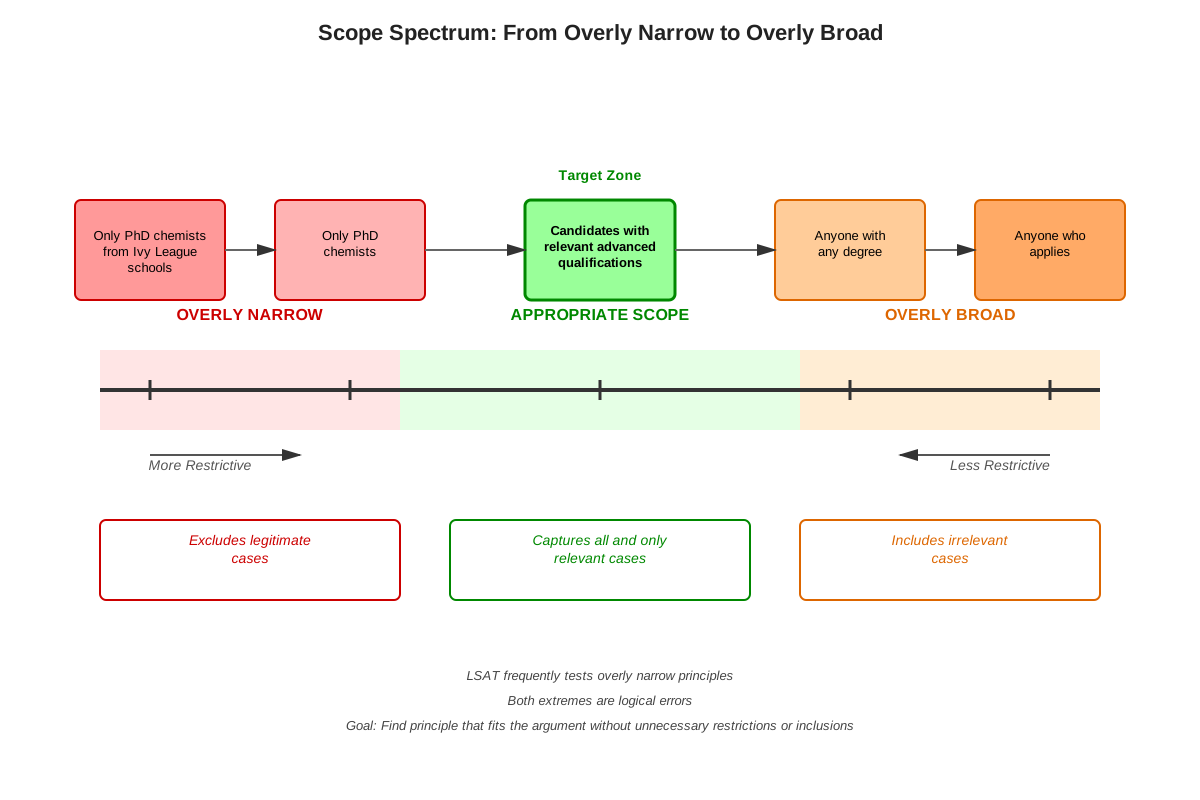
The concept also connects to scope errors more broadly. Just as arguments can be too broad (overgeneralizing), they can be too narrow (undergeneralizing). Overly narrow principles represent a specific type of scope error where the rule or guideline is more restrictive than warranted.
Relationship map: Conditional Logic → Sufficient/Necessary Conditions → Overly Narrow Principles → Scope Errors → Flaw Recognition → Principle Questions
Additionally, overly narrow principles relate to assumption identification. When an argument relies on an overly narrow principle, the gap between evidence and conclusion can often be closed by assuming a broader principle. In Necessary Assumption questions, the correct answer might broaden an implicit overly narrow principle to make the argument work.
The concept also connects to parallel reasoning: matching the scope of principles across arguments requires recognizing when principles are comparably narrow or broad. An argument using an overly narrow principle should be matched with another argument using a similarly restrictive principle.
High-Yield Facts
⭐ Overly narrow principles include more specific conditions than the argument's reasoning actually requires or supports
⭐ The most common form adds unnecessary sufficient conditions, creating compound requirements where simpler ones would suffice
⭐ Words like "only," "exclusively," "solely," and "must" frequently signal overly narrow principles in answer choices
⭐ An overly narrow principle excludes legitimate cases that should fall under the same reasoning as the argument's conclusion
⭐ Overly narrow principles often appear as wrong answers in Principle-Support questions because they fail to justify the full conclusion
- Recognizing overly narrow principles requires comparing the principle's scope to the argument's actual reasoning, not just its conclusion
- Overly narrow principles can result from treating specific examples as necessary requirements rather than as sufficient instances
- The correction for an overly narrow principle involves broadening it to cover all relevant cases without making it too broad
- Overly narrow principles often confuse "this is one way to achieve the goal" with "this is the only way to achieve the goal"
- In Flaw questions, overly narrow principles may be described as "takes a single instance as establishing a universal requirement" or "assumes that what is sufficient is also necessary"
Quick check — test yourself on Overly narrow principle so far.
Try Flashcards →Common Misconceptions
Misconception: Any principle that includes specific details is overly narrow → Correction: Specificity is only problematic when it's unnecessary. A principle can include specific conditions if those conditions are actually required by the argument's reasoning. The key is whether the specificity is justified by the evidence and logic presented.
Misconception: Overly narrow principles are the same as overly broad principles, just in the opposite direction → Correction: While both are scope errors, they have different logical structures and different effects on arguments. Overly narrow principles exclude cases that should be included; overly broad principles include cases that should be excluded. The LSAT tests these as distinct concepts requiring different analytical approaches.
Misconception: If a principle supports the conclusion, it cannot be overly narrow → Correction: An overly narrow principle might support the specific conclusion in the argument while still being overly narrow. The issue is that it fails to capture the full scope of what the reasoning supports, even if it technically covers the particular case discussed.
Misconception: Overly narrow principles always use absolute language like "only" or "must" → Correction: While such language often signals overly narrow principles, they can also be expressed in other ways. The logical structure matters more than specific trigger words. A principle can be overly narrow even with qualified language if its conditions are unnecessarily restrictive.
Misconception: The correct answer in Principle questions should match the argument's specificity exactly → Correction: The correct principle should be appropriately scoped—neither too narrow nor too broad. It should cover all cases the argument's reasoning supports without extending to cases the reasoning doesn't support. This often means being somewhat more general than the specific example in the argument.
Worked Examples
Example 1: Principle-Support Question
Argument: "The city council should approve the new park proposal. The proposal includes plans for accessible playgrounds, and accessible playgrounds benefit families with young children who have disabilities."
Question: Which principle, if valid, most helps to justify the reasoning above?
Answer Choices:
- (A) City councils should approve proposals that include accessible playgrounds designed specifically for children with mobility impairments under age 5
- (B) City councils should approve proposals that benefit families with young children who have disabilities
- (C) City councils should approve all proposals that benefit any segment of the community
- (D) City councils should approve proposals that include accessible playgrounds and also provide adequate parking
- (E) City councils should prioritize proposals that benefit families with young children
Analysis:
First, identify the argument's structure:
- Evidence: The proposal includes accessible playgrounds; accessible playgrounds benefit families with young children who have disabilities
- Conclusion: The city council should approve the proposal
Now evaluate each answer choice for appropriate scope:
(A) is overly narrow because it adds multiple unnecessary conditions: "specifically for children with mobility impairments" (the argument just says disabilities generally), "under age 5" (the argument says young children but doesn't specify an age), and these restrictions make the principle too specific to support the reasoning.
(B) is appropriately scoped because it captures exactly what the argument establishes: the proposal benefits families with young children who have disabilities, and that's sufficient reason for approval. This principle covers the case without adding unnecessary conditions.
(C) is too broad because it would justify approving any proposal that benefits anyone, which goes beyond what the argument supports.
(D) is overly narrow because it adds an unnecessary condition about parking that wasn't mentioned in the argument.
(E) is too vague because "prioritize" doesn't clearly support "should approve," and it doesn't specify the disability aspect that's central to the argument.
Correct Answer: (B)
The key insight is that (A) and (D) are overly narrow by adding specific conditions not present in the original reasoning, while (B) captures the appropriate scope.
Example 2: Flaw Question
Argument: "Professor Martinez argues that the university should adopt open-access publishing for all faculty research. She points out that her recent paper, which was published in an open-access journal, received significantly more citations than her previous papers published in traditional subscription journals. Therefore, the university should require all faculty to publish exclusively in open-access journals."
Question: The reasoning in the argument is flawed in that it:
Answer Choices:
- (A) Assumes that what is true of one professor's experience must be true of all professors' experiences
- (B) Treats evidence that open-access publishing was beneficial in one case as establishing that it is the only acceptable publishing method
- (C) Fails to consider that factors other than open access might have contributed to the increased citations
- (D) Presumes that increased citations are the only measure of research quality
- (E) Overlooks the possibility that some research is not suitable for open-access publication
Analysis:
The argument moves from "open-access worked well in this case" to "only open-access should be used." This is a classic overly narrow principle error, but we need to identify how it's described.
(A) describes a generalization error but doesn't capture the "only" aspect of the conclusion.
(B) correctly identifies the overly narrow principle flaw: The argument treats one successful case as establishing an exclusive requirement. The evidence shows open-access can be beneficial, but the conclusion demands it as the only option. This is the overly narrow principle error—taking what's sufficient (open-access publishing) and treating it as necessary and exclusive.
(C) identifies a different flaw (alternative explanations) that's also present but doesn't address the overly narrow principle issue.
(D) points out an assumption about citations but doesn't address the narrow scope of the conclusion.
(E) identifies a consideration the argument overlooks but doesn't describe the logical structure of the flaw.
Correct Answer: (B)
This example shows how overly narrow principles appear in Flaw questions: the argument establishes that something works in one case and concludes it should be the only approach, creating an unnecessarily restrictive principle.
Exam Strategy
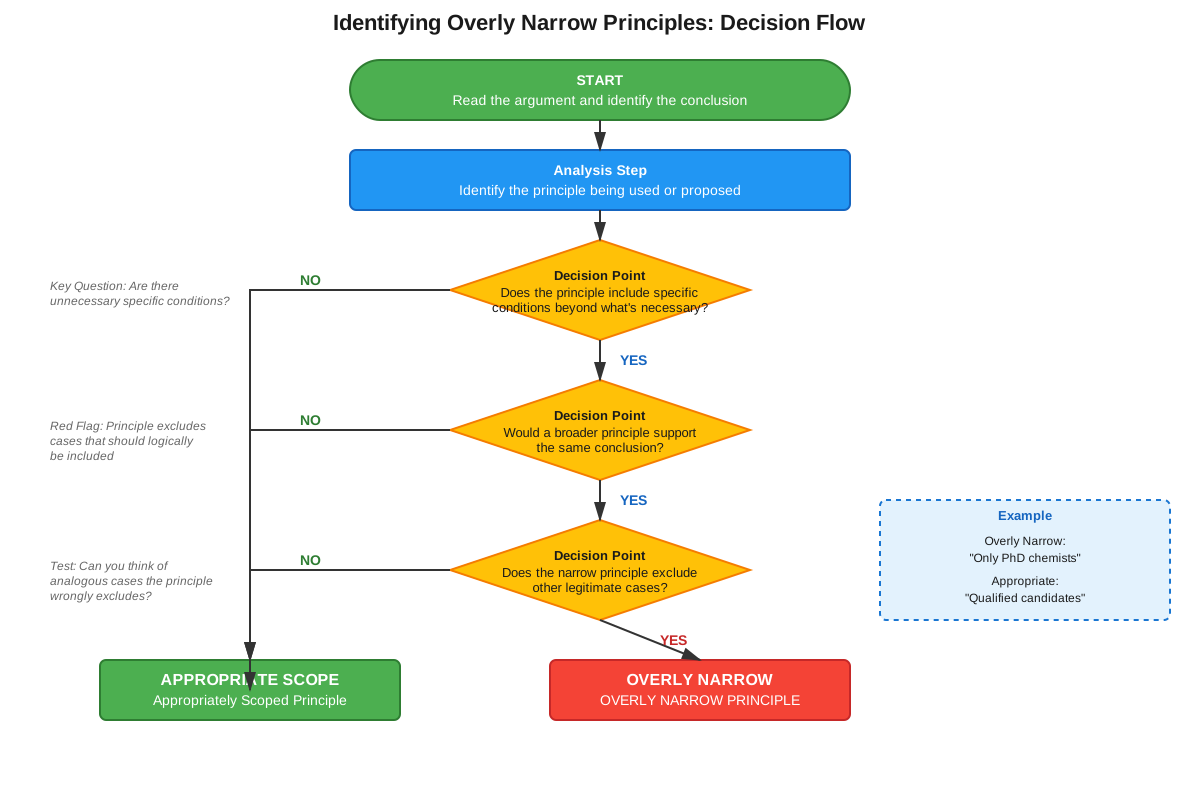
When approaching LSAT questions involving overly narrow principles, follow this systematic process:
Step 1: Identify the argument's core reasoning
Before evaluating principles, clearly understand what evidence the argument provides and what conclusion it draws. Map out the logical connection: "Based on X, the argument concludes Y."
Step 2: Determine what principle would be sufficient
Ask yourself: "What general rule would make this reasoning work?" The answer should be as broad as the reasoning supports but no broader.
Step 3: Watch for scope mismatches
Compare each answer choice's scope to your predicted principle. Eliminate choices that:
- Add conditions not mentioned in the argument
- Specify categories more narrowly than necessary
- Include temporal or contextual restrictions not present in the reasoning
- Use absolute language ("only," "exclusively") when the argument doesn't require it
Step 4: Apply the "coverage test"
For Principle-Support questions, ask: "Would this principle justify the conclusion?" For overly narrow principles, also ask: "Does this principle exclude cases that the argument's reasoning would actually support?"
Exam Tip: In Principle questions, wrong answers are often overly narrow rather than overly broad. Test-makers know students tend to look for principles that match the argument's specificity, so they create traps by adding one or two extra conditions that seem plausible but aren't necessary.
Trigger phrases to watch for:
- "Only if" (introduces necessary conditions that may be overly restrictive)
- "Exclusively," "solely," "must" (absolute language suggesting narrow scope)
- Multiple conditions joined by "and" (compound requirements that may be unnecessary)
- Specific examples or categories when broader ones would work
- Precise numerical or temporal specifications not in the original argument
Time allocation: Spend 15-20 seconds identifying the argument's reasoning structure, then 30-40 seconds evaluating answer choices. Don't rush the initial analysis—understanding the argument's scope is crucial for recognizing overly narrow principles.
Process of elimination strategy:
- First pass: Eliminate obviously too broad or too narrow choices
- Second pass: For remaining choices, test whether each condition is necessary
- Final selection: Choose the principle that covers all cases the reasoning supports without extending beyond them
Memory Techniques
Acronym: SCOPE
- Specificity check: Are conditions more specific than needed?
- Coverage test: Does it cover all relevant cases?
- Only/exclusively: Watch for absolute language
- Principle breadth: Is it as broad as reasoning supports?
- Extra conditions: Are there unnecessary additions?
Visualization: Picture a principle as a net trying to catch fish (cases the reasoning supports). An overly narrow principle has holes that are too small—it catches some fish but lets others that should be caught slip through. The goal is a net with appropriately sized holes that catches all the right fish without catching wrong ones.
Mnemonic for common overly narrow patterns: "CATS"
- Compound conditions (unnecessary "and" requirements)
- Absolute language (only, exclusively, must)
- Temporal over-specification (unnecessary time restrictions)
- Specific examples treated as requirements
Memory aid: Think "Don't be TOO picky"—overly narrow principles are too picky about conditions, excluding cases that should qualify.
Summary
The overly narrow principle concept is a high-frequency LSAT topic that tests whether students can recognize when rules or guidelines are unnecessarily restrictive. An overly narrow principle includes more specific conditions than the argument's reasoning actually requires, thereby excluding legitimate cases that should fall under the same logic. This error appears across multiple question types, including Principle-Support questions (as wrong answer choices), Flaw questions (as a reasoning error to identify), and Necessary Assumption questions (where broadening an overly narrow principle may be required). Success requires understanding the relationship between evidence and conclusions, recognizing when conditions are truly necessary versus merely sufficient, and calibrating principles to be appropriately scoped—neither too narrow nor too broad. The key skill is comparing the scope of proposed principles to what the argument's reasoning actually supports, eliminating choices that add unnecessary specificity through compound conditions, absolute language, or over-specified categories. Mastering this concept provides a significant advantage in Logical Reasoning sections because it enables rapid elimination of wrong answers and precise identification of logical flaws.
Key Takeaways
- Overly narrow principles include unnecessary specific conditions that exclude cases the argument's reasoning would support
- The most common form adds extra sufficient conditions, creating compound requirements where simpler ones would work
- Trigger words like "only," "exclusively," and "solely" frequently signal overly narrow principles in answer choices
- Correcting an overly narrow principle requires broadening it to cover all relevant cases without making it too broad
- This concept appears in 15-20% of Logical Reasoning questions across multiple question types
- Success requires comparing the principle's scope to the argument's actual reasoning, not just matching surface-level details
- Overly narrow principles often confuse "this is one sufficient way" with "this is the only necessary way"
Related Topics
Overly Broad Principles: The opposite error where principles are too general and include cases they shouldn't. Mastering overly narrow principles provides the foundation for recognizing when principles extend too far.
Sufficient vs. Necessary Conditions: Understanding the distinction between what's enough to guarantee a result versus what's required is essential for recognizing overly narrow principles, which often confuse these concepts.
Scope Errors in Arguments: Overly narrow principles are one type of scope error. Understanding scope more broadly enables recognition of various ways arguments can fail by being too restrictive or too expansive.
Principle Application Questions: These questions ask students to apply a given principle to specific situations, requiring precise understanding of the principle's scope to avoid overly narrow interpretations.
Flaw Question Types: Many flaw questions involve overly narrow principles, so mastering this concept enhances performance across the broader category of flaw identification.
Practice CTA
Now that you understand overly narrow principles, it's time to cement your knowledge through practice. Work through the practice questions to test your ability to identify overly narrow principles in various contexts and question types. Use the flashcards to reinforce key concepts and recognition patterns. Remember: recognizing overly narrow principles is a skill that improves dramatically with deliberate practice. Each question you analyze strengthens your ability to spot scope mismatches and unnecessary conditions, directly improving your LSAT score. You've built the foundation—now apply it!
Sign up free to keep reading
Create a free AnvayaPrep account to finish this LSAT guide on Overly narrow principle — plus flashcards and practice questions.