Overview
Permissible versus required is a critical distinction that appears frequently in LSAT Logical Reasoning sections, particularly within principle questions. This concept tests a student's ability to differentiate between actions or behaviors that are merely allowed (permissible) and those that are obligatory (required). The distinction may seem straightforward at first glance, but the LSAT exploits this conceptual boundary with sophisticated language and complex scenarios that demand precise analytical thinking.
Understanding this distinction is essential because the LSAT frequently presents arguments where the conclusion claims something is required when the premises only establish that it is permissible, or vice versa. These logical gaps represent common reasoning flaws that appear across multiple question types, including Flaw questions, Necessary Assumption questions, and Principle questions. The test makers deliberately craft answer choices that blur the line between permission and obligation, making this one of the most frequently tested conceptual distinctions on the exam.
This topic connects to broader Logical Reasoning skills including conditional logic, modal reasoning (dealing with possibility and necessity), and normative reasoning (dealing with what ought to be done). Mastering the permissible versus required distinction strengthens overall performance on principle-based questions and enhances the ability to identify subtle logical errors in arguments. Students who can reliably spot when an argument conflates permission with obligation gain a significant advantage on test day, as this pattern appears in approximately 10-15% of Logical Reasoning questions across various question types.
Learning Objectives
- [ ] Identify how permissible versus required appears in LSAT questions
- [ ] Explain the reasoning pattern behind permissible versus required
- [ ] Apply permissible versus required to solve LSAT-style problems accurately
- [ ] Distinguish between modal operators (may, must, can, should) in argument premises and conclusions
- [ ] Recognize when an argument illegitimately shifts from permissibility to requirement or vice versa
- [ ] Evaluate whether a principle establishes permission, obligation, or prohibition
- [ ] Construct valid inferences that respect the permissible/required boundary
Prerequisites
- Basic conditional logic: Understanding "if-then" statements is essential because permissibility and requirement often appear in conditional form (e.g., "If X, then Y is permitted" versus "If X, then Y is required")
- Argument structure analysis: The ability to identify premises and conclusions is necessary to spot when an argument shifts between permissible and required claims
- Modal reasoning fundamentals: Basic familiarity with concepts of possibility, necessity, and obligation helps distinguish between what can happen and what must happen
- Principle question types: General understanding of how principles function in LSAT questions provides context for where this distinction most commonly appears
Why This Topic Matters
The permissible versus required distinction has profound real-world applications in legal reasoning, ethical decision-making, and policy analysis. In legal contexts, the difference between what citizens are permitted to do and what they are required to do forms the foundation of rights and obligations. Constitutional law, for instance, frequently turns on whether the government may take certain actions versus whether it must take them. Similarly, professional ethics codes distinguish between permissible conduct and mandatory conduct, with different consequences for violations.
On the LSAT, this topic appears with remarkable frequency. Approximately 12-15% of Logical Reasoning questions involve some aspect of the permissible/required distinction, making it one of the highest-yield concepts to master. The distinction appears most commonly in:
- Principle questions (both "identify the principle" and "apply the principle" variants)
- Flaw questions where arguments conflate permission with obligation
- Necessary Assumption questions where the gap between premises and conclusion involves a shift from permissible to required
- Strengthen/Weaken questions where answer choices must respect the modal strength of the conclusion
The LSAT tests this concept because it mirrors the type of precise reasoning essential for legal analysis. Law students and lawyers must constantly distinguish between what the law permits and what it requires, making this a fundamental skill for legal education. Test makers exploit common reasoning errors where people assume that because something is permissible, it must be done, or conversely, that because something is not required, it must be prohibited.
Core Concepts
The Fundamental Distinction
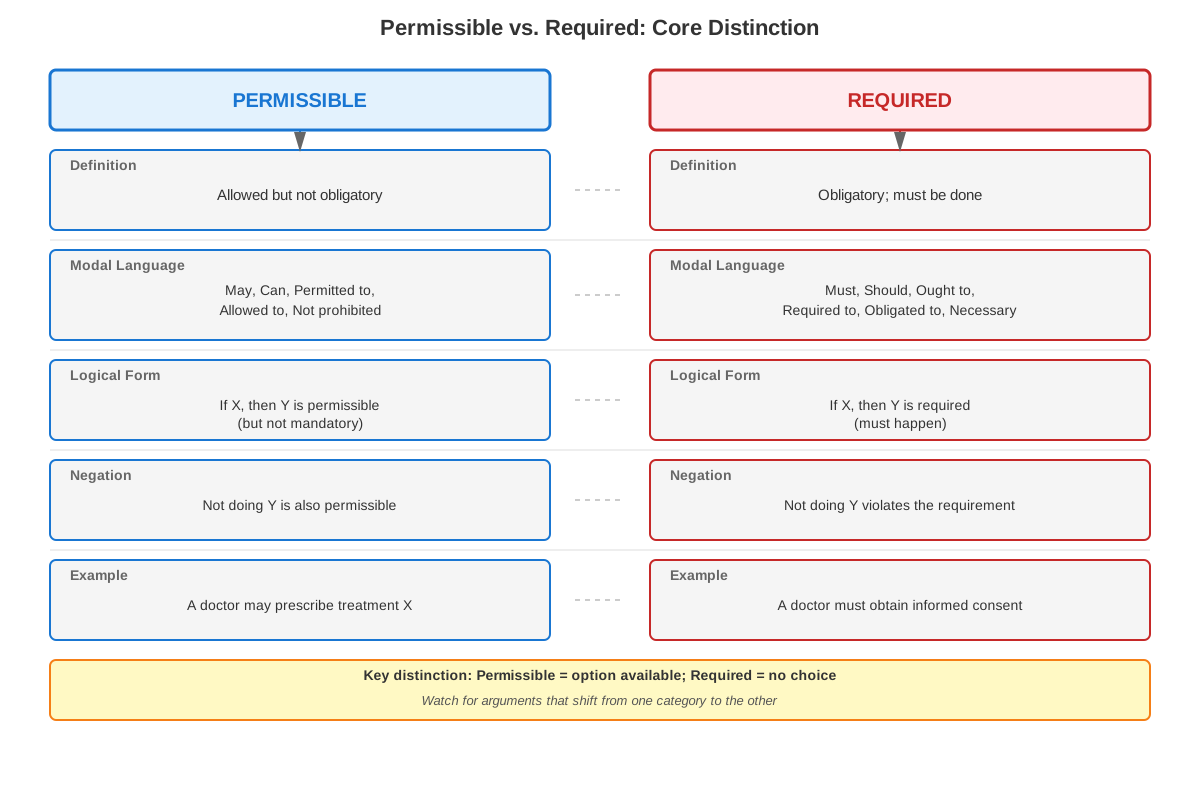
The core of this topic rests on understanding two distinct normative categories. Something is permissible when it is allowed or acceptable to do it—there is no prohibition against the action, but there is also no obligation to perform it. Something is required when it must be done—there is an obligation or duty to perform the action, and failing to do so constitutes a violation of some rule, principle, or standard.
Consider this simple framework:
| Category | Meaning | Modal Language | Logical Status |
|---|---|---|---|
| Required | Must be done; obligatory | must, should, ought, required, necessary, obligated | Failure to do = violation |
| Permissible | May be done; allowed | may, can, permitted, allowed, acceptable, not prohibited | Doing it = acceptable; not doing it = also acceptable |
| Prohibited | Must not be done; forbidden | must not, cannot, prohibited, forbidden, impermissible | Doing it = violation |
The critical insight is that permissibility creates a zone of discretion. If an action is permissible, an agent has the freedom to choose whether to perform it. If an action is required, no such discretion exists—the action must be performed regardless of preference or convenience.
Modal Operators and Logical Strength
Modal operators are words that express the mode or manner in which something is true. In the context of lsat permissible versus required questions, these operators signal the logical strength of a claim:
Strong modal operators (indicating requirement):
- Must
- Should
- Ought to
- Required
- Necessary
- Obligated to
- Has a duty to
Weak modal operators (indicating permissibility):
- May
- Can
- Might
- Permitted to
- Allowed to
- Acceptable to
- Not prohibited from
The LSAT frequently tests whether students recognize that an argument's premises contain weak modal operators while its conclusion contains strong modal operators (or vice versa). This represents a logical gap—the conclusion claims more than the premises establish.
The Illicit Modal Shift
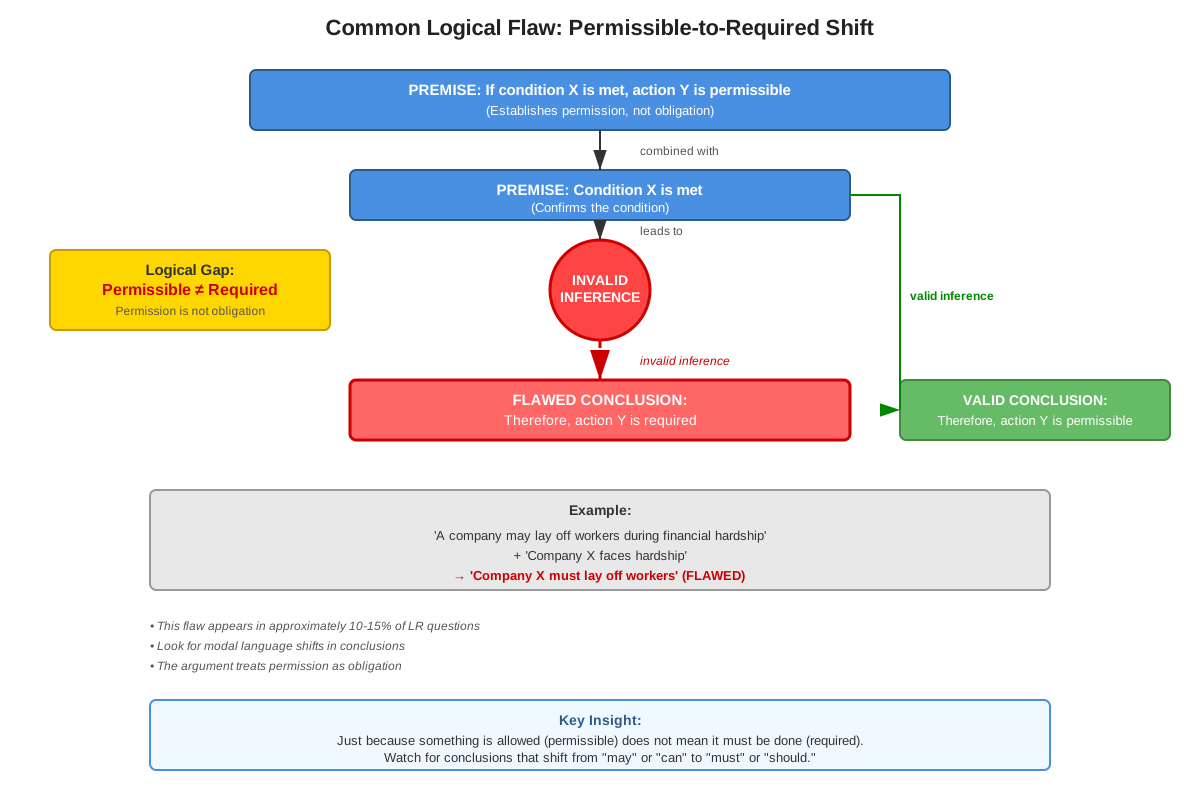
An illicit modal shift occurs when an argument moves from permissibility to requirement (or vice versa) without justification. This is one of the most common logical flaws on the LSAT. The pattern typically looks like this:
Pattern 1: Permissible to Required
- Premise: Action X is permissible under certain conditions
- Conclusion: Therefore, Action X is required under those conditions
Pattern 2: Required to Permissible
- Premise: Action X is required under certain conditions
- Conclusion: Therefore, Action X is merely permissible under those conditions
Pattern 3: Not Required to Prohibited
- Premise: Action X is not required
- Conclusion: Therefore, Action X is prohibited
Pattern 4: Not Prohibited to Required
- Premise: Action X is not prohibited
- Conclusion: Therefore, Action X is required
Each of these patterns represents faulty reasoning because the conclusion makes a stronger (or different) normative claim than the premises support.
Conditional Permissibility and Requirement
The distinction becomes more complex when combined with conditional logic. Consider these two principles:
Conditional Permissibility: "If condition C obtains, then action A is permissible"
- This means: When C is true, doing A is allowed (but not required)
- It does NOT mean: When C is true, A must be done
- It does NOT mean: When C is false, A is prohibited
Conditional Requirement: "If condition C obtains, then action A is required"
- This means: When C is true, A must be done
- It does NOT mean: When C is false, A is prohibited
- It DOES mean: When C is true, A is permissible (because what is required is also permitted)
A crucial logical relationship: If something is required, it is also permissible (you cannot be obligated to do something that is forbidden). However, the converse is not true—if something is permissible, it is not necessarily required.
Normative Hierarchies
Understanding the logical relationships between these normative categories helps avoid reasoning errors:
Required → Permissible → Not ProhibitedThis hierarchy shows that:
- Everything required is also permissible
- Everything permissible is also not prohibited
- But permissibility does not imply requirement
- And lack of prohibition does not imply permissibility (there might be no rule either way)
Context-Dependent Applications
The LSAT often presents scenarios where the permissible/required distinction depends on specific circumstances. A principle might establish that:
- Action A is required in context C1
- Action A is merely permissible in context C2
- Action A is prohibited in context C3
Success on these questions requires careful attention to the conditions under which different normative statuses apply. Students must track which circumstances trigger obligations versus which circumstances merely create permissions.
Concept Relationships
The permissible versus required distinction serves as a foundational concept that connects to multiple areas of Logical Reasoning. Understanding these relationships enhances overall analytical ability:
Internal Relationships: Within this topic, the core distinction between permissible and required connects directly to the concept of illicit modal shifts. Recognizing the distinction enables identification of the shift, which in turn allows students to spot logical flaws and identify necessary assumptions. The normative hierarchy (required → permissible → not prohibited) provides the logical framework that explains why certain inferences are valid while others are not.
Connection to Conditional Logic: The permissible/required distinction frequently appears embedded within conditional statements. A student must first parse the conditional structure ("If X, then Y") and then determine whether Y represents a permission or an obligation. This creates a two-layer analysis: conditional logic + modal logic.
Connection to Necessary Assumptions: Many Necessary Assumption questions involve arguments that conclude something is required based on premises that only establish it is permissible. The necessary assumption bridges this gap, typically by adding a principle that converts permission into obligation under specified circumstances.
Connection to Flaw Questions: The illicit modal shift from permissible to required (or vice versa) represents a distinct flaw category. Recognizing this pattern connects to the broader skill of flaw identification and classification.
Connection to Principle Questions: Principle questions directly test whether students can match specific situations to general principles while respecting the permissible/required boundary. A principle stating "X is permissible" cannot be used to justify a conclusion that "X is required."
Relationship Map:
Modal Operators → Permissible vs. Required Distinction → Illicit Modal Shifts → Flaw Identification
                                                      → Necessary Assumptions → Assumption Questions
                                                      → Principle Application → Principle Questions
                                                      → Conditional Permissibility → Conditional Logic
High-Yield Facts
⭐ If something is required, it is also permissible, but if something is permissible, it is not necessarily required—this asymmetric relationship is the most frequently tested concept.
⭐ An argument that concludes "X is required" based on premises stating "X is permissible" commits an illicit modal shift—this flaw appears in approximately 8-10% of Flaw questions.
⭐ Modal operators like "must," "should," and "ought" indicate requirements, while "may," "can," and "might" indicate permissibility—recognizing these trigger words is essential for rapid question analysis.
⭐ "Not required" does not mean "prohibited"—there is a logical space between obligation and prohibition where actions are merely permissible.
⭐ "Not prohibited" does not mean "required"—the absence of a prohibition does not create an obligation.
- Conditional permissibility ("If X, then Y is permissible") does not establish that Y must occur when X is true, only that Y is allowed.
- Conditional requirement ("If X, then Y is required") does establish that Y must occur when X is true, and also that Y is permissible in that context.
- An action can be permissible in one context and required in another—context-sensitivity is crucial for principle application questions.
- The LSAT often uses synonyms to disguise modal operators: "acceptable" = permissible, "obligated" = required, "justified" can mean either depending on context.
- Principle questions frequently test whether students can identify that a principle establishes permission rather than obligation, or vice versa.
- Arguments that move from "X is not required" to "X should not be done" commit a modal shift error by treating lack of obligation as prohibition.
- When evaluating answer choices in Principle questions, eliminate any choice that claims something is required when the scenario only shows it is permissible.
Quick check — test yourself on Permissible versus required so far.
Try Flashcards →Common Misconceptions
Misconception: If something is not required, it must be prohibited.
Correction: There is a middle ground—actions can be permissible without being required. The normative landscape includes three categories (required, permissible, prohibited), not just two. Most actions fall into the permissible category where agents have discretion.
Misconception: If something is permissible, it should be done.
Correction: Permissibility means an action is allowed, not that it ought to be performed. Permissibility creates freedom of choice—the action may be done or not done without violating any rule or principle. The LSAT exploits this by presenting arguments that treat permission as recommendation or obligation.
Misconception: "Can" and "should" are interchangeable modal operators.
Correction: "Can" indicates permissibility (ability or allowance), while "should" indicates requirement (obligation or duty). An argument that concludes "X should be done" based on premises stating "X can be done" commits a logical error. This distinction is crucial for identifying flawed reasoning.
Misconception: If a principle says "X is permissible when Y," then X is required when Y.
Correction: Conditional permissibility establishes only that X is allowed when Y is true, not that X must be done. The principle creates a permission, not an obligation. To establish requirement, the principle would need to state "X is required when Y" or use equivalent language like "X must be done when Y."
Misconception: All "should" statements indicate requirements.
Correction: While "should" typically indicates obligation, context matters. Sometimes "should" expresses recommendation rather than strict requirement. However, on the LSAT, "should" generally signals a stronger normative claim than "may" or "can," and students should treat it as indicating obligation unless context clearly suggests otherwise.
Misconception: If something is not prohibited, it is required.
Correction: The absence of prohibition establishes only that an action is not forbidden—it might be permissible or required, but additional information is needed to determine which. This error conflates "not prohibited" with "obligatory," skipping over the permissible category entirely.
Misconception: Required and permissible are mutually exclusive categories.
Correction: These categories overlap—everything required is also permissible. The categories are not mutually exclusive but rather hierarchical. What is required must be allowed (you cannot be obligated to do something forbidden). The distinction is that required actions must be done, while merely permissible actions may or may not be done.
Worked Examples
Example 1: Identifying an Illicit Modal Shift
Question Stem: "The reasoning in the argument is flawed in that the argument..."
Argument:
"The company's ethics policy states that employees may report suspected misconduct directly to the board of directors if they believe their immediate supervisor is involved in the misconduct. Chen believes her supervisor is involved in misconduct. Therefore, Chen should report the suspected misconduct directly to the board of directors."
Analysis:
Step 1: Identify the conclusion
The conclusion is: "Chen should report the suspected misconduct directly to the board of directors." The modal operator "should" indicates this is a requirement or obligation.
Step 2: Identify the premises
- Premise 1: The policy states employees "may report" directly to the board under certain conditions (modal operator "may" indicates permissibility)
- Premise 2: Chen meets those conditions (she believes her supervisor is involved)
Step 3: Evaluate the logical connection
The premises establish that Chen is permitted to report directly to the board. The conclusion claims that Chen should (is required to) report directly to the board. This represents an illicit modal shift from permissible to required.
Step 4: Identify the flaw
The argument treats something that is permissible as if it were required. The policy gives Chen the option to report directly to the board, but it does not obligate her to do so. She might have other permissible options (reporting to a different supervisor, reporting to HR, etc.).
Correct Answer Choice (example): "treats something that is permissible as though it were obligatory"
Connection to Learning Objectives: This example demonstrates how to identify the permissible versus required distinction in LSAT questions (Objective 1), explains the reasoning pattern of an illicit modal shift (Objective 2), and shows how to apply this knowledge to solve the problem (Objective 3).
Example 2: Applying a Principle
Question Stem: "Which one of the following judgments conforms to the principle stated above?"
Principle:
"A journalist is permitted to protect the identity of a confidential source when revealing that identity would expose the source to serious harm and when the information provided by the source serves the public interest."
Analysis:
Step 1: Parse the principle structure
- This is a conditional permissibility statement: "If [conditions], then [action is permitted]"
- Conditions: (1) revealing identity would expose source to serious harm AND (2) information serves public interest
- Action: protecting the source's identity
- Modal status: PERMITTED (not required)
Step 2: Understand what the principle does and does not establish
- Does establish: When both conditions are met, protecting identity is permissible
- Does NOT establish: When conditions are met, protecting identity is required
- Does NOT establish: When conditions are not met, protecting identity is prohibited
- Does NOT establish: When conditions are met, revealing identity is prohibited
Step 3: Evaluate answer choices
Answer Choice A: "Journalist Martinez revealed the identity of a source because the information did not serve the public interest, so Martinez acted impermissibly."
Evaluation: INCORRECT. The principle establishes when protection is permitted, not when revelation is prohibited. The absence of the conditions does not make revelation impermissible.
Answer Choice B: "Journalist Rodriguez protected a source's identity even though revealing it would not have exposed the source to serious harm. Since the information served the public interest, Rodriguez acted permissibly."
Evaluation: INCORRECT. The principle requires BOTH conditions for permissibility. Only one condition is met here.
Answer Choice C: "Journalist Kim protected a source's identity. Revealing the identity would have exposed the source to serious harm, and the information served the public interest. Therefore, Kim was required to protect the source's identity."
Evaluation: INCORRECT. This commits the permissible-to-required error. The principle establishes permission, not obligation.
Answer Choice D: "Journalist Patel protected a source's identity. Revealing the identity would have exposed the source to serious harm, and the information served the public interest. Therefore, Patel acted permissibly."
Evaluation: CORRECT. Both conditions are met, and the conclusion correctly identifies the action as permissible (not required, not obligatory—just permissible).
Step 4: Confirm the correct answer
Answer D correctly applies the principle by recognizing that when the conditions are satisfied, the action is permitted. It does not overreach by claiming the action was required, and it does not underreach by claiming the action was merely not prohibited.
Connection to Learning Objectives: This example shows how permissible versus required appears in principle application questions (Objective 1), demonstrates the reasoning pattern of conditional permissibility (Objective 2), and illustrates the process of accurately applying the distinction to eliminate wrong answers and select the correct one (Objective 3).
Exam Strategy
Approaching Permissible vs. Required Questions
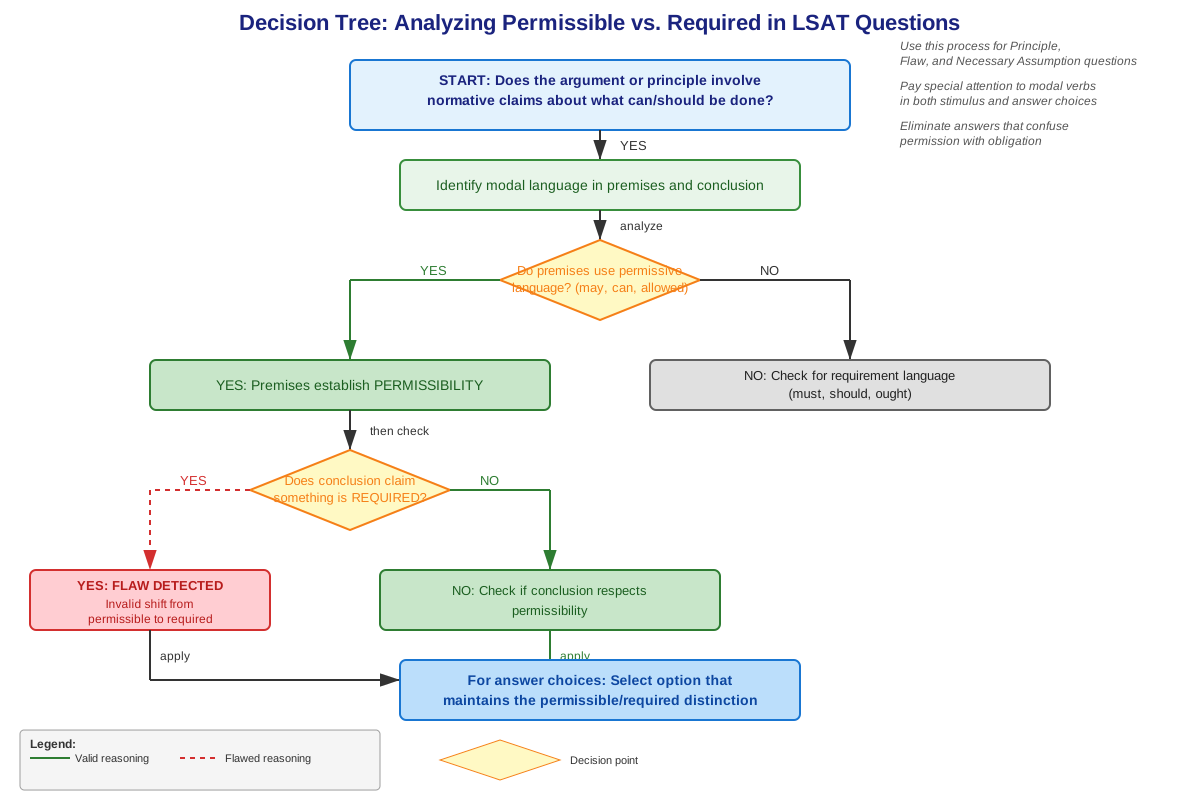
Step 1: Identify modal operators immediately
As soon as you begin reading a stimulus or answer choice, circle or mentally note every modal operator (must, should, may, can, ought, permitted, required, etc.). This creates a visual map of the argument's normative structure.
Step 2: Classify each claim
Determine whether each premise and the conclusion expresses:
- A requirement (obligation, duty)
- A permission (allowance, acceptability)
- A prohibition (forbidding, impermissibility)
- A neutral description (no normative claim)
Step 3: Check for modal shifts
Compare the modal strength of the premises to the modal strength of the conclusion. If the conclusion is stronger (e.g., "required") than the premises (e.g., "permissible"), you have likely identified a flaw or gap.
Trigger Words and Phrases
High-alert phrases for permissibility:
- "may"
- "can"
- "is permitted to"
- "is allowed to"
- "is acceptable to"
- "has the right to"
- "is not prohibited from"
- "is justified in" (context-dependent)
High-alert phrases for requirement:
- "must"
- "should"
- "ought to"
- "is required to"
- "is obligated to"
- "has a duty to"
- "is necessary to"
- "needs to"
Danger phrases that signal potential modal shifts:
- "Therefore, X should..." (following premises about what "may" be done)
- "Thus, X must..." (following premises about what "can" be done)
- "So X is required..." (following premises about what is "permissible")
Process of Elimination Tips
In Flaw Questions:
- Eliminate answer choices that describe structural flaws (circular reasoning, ad hominem) when you have identified a modal shift
- Look specifically for answer choices containing language like "treats what is permissible as obligatory" or "confuses permission with requirement"
- Be wary of answer choices that reverse the error (e.g., "treats what is required as merely permissible" when the argument actually treats what is permissible as required)
In Principle Questions:
- Eliminate any answer choice that claims something is required when the principle only establishes it is permissible
- Eliminate any answer choice that claims something is merely permissible when the principle establishes it is required
- Eliminate answer choices that apply the principle when its conditions are not met
In Necessary Assumption Questions:
- Look for answer choices that bridge the gap between permissible (in premises) and required (in conclusion)
- The necessary assumption often takes the form: "If X is permissible under conditions C, then X is required under conditions C"
Time Allocation Advice
Permissible versus required questions should not consume excessive time once you have mastered the distinction. Allocate approximately:
- 15-20 seconds: Initial read and identification of modal operators
- 20-30 seconds: Analysis of the modal relationship between premises and conclusion
- 30-40 seconds: Evaluation of answer choices
- Total: 65-90 seconds for most questions involving this concept
If you find yourself spending more than 90 seconds, you may be overcomplicating the analysis. The distinction is binary—either the argument respects the permissible/required boundary or it does not. Trust your initial identification of modal operators and move forward confidently.
Exam Tip: When in doubt between two answer choices, reread the conclusion's modal operator. The correct answer must match the modal strength of what the argument actually claims, not what it should claim or what would make the argument valid.
Memory Techniques
The PeRmission Acronym
Permissible = Possible to do or not do (discretion exists)
Required = Really must be done (no discretion)
This simple acronym helps recall that permissibility involves choice while requirement involves obligation.
The Modal Strength Ladder
Visualize a ladder with three rungs:
TOP:    REQUIRED (must, should, ought)
MIDDLE: PERMISSIBLE (may, can, allowed)
BOTTOM: PROHIBITED (must not, cannot, forbidden)
Arguments that climb the ladder without justification (from permissible to required) commit a logical error. Arguments that descend the ladder without justification (from required to permissible) also commit an error. Valid reasoning stays on the same rung or provides explicit justification for movement.
The "May vs. Must" Mantra
Before selecting an answer in any principle or flaw question, mentally recite: "Does the argument confuse MAY with MUST?" This simple check catches the majority of permissible versus required errors.
The Traffic Light Analogy
- Green light (permissible): You may go, but you are not required to go
- Red light (prohibited): You must not go
- Flashing red light (required): You must stop (then may proceed)
This analogy helps remember that permissibility creates options, while requirements eliminate options. Just as a green light does not require you to proceed immediately (you might wait for a pedestrian), permissibility does not create obligation.
The Conditional Permissibility Formula
For conditional statements involving permissibility, remember:
"IF → MAY" ≠ "IF → MUST"
When you see a conditional with "may" in the consequent, mentally note that the condition triggers permission, not obligation. This prevents the common error of treating conditional permissions as conditional requirements.
Summary
The permissible versus required distinction is a high-yield concept that appears throughout LSAT Logical Reasoning sections, particularly in principle questions, flaw questions, and necessary assumption questions. The fundamental distinction is straightforward: permissible actions are allowed but not obligatory, while required actions must be performed. However, the LSAT tests this concept with sophisticated language and complex scenarios that exploit common reasoning errors. The most frequent error is the illicit modal shift, where arguments conclude that something is required based on premises establishing only that it is permissible, or vice versa. Success requires careful attention to modal operators (must, should, may, can) and recognition that these operators signal different logical strengths. Students must understand that if something is required, it is also permissible, but the converse is not true—permissibility does not imply requirement. Mastering this distinction enables rapid identification of logical flaws, accurate application of principles, and confident elimination of incorrect answer choices across multiple question types.
Key Takeaways
- Permissible means allowed but not required—there is discretion to perform or not perform the action without violating any rule
- Required means obligatory—the action must be performed, and failure to do so constitutes a violation
- Modal operators are critical signals: "must/should/ought" indicate requirements, while "may/can/permitted" indicate permissibility
- The illicit modal shift from permissible to required (or vice versa) is one of the most common logical flaws on the LSAT
- If something is required, it is also permissible, but if something is permissible, it is not necessarily required—this asymmetric relationship is essential for valid reasoning
- Conditional permissibility ("If X, then Y is permissible") does not establish that Y must occur when X is true
- Careful attention to modal operators in both premises and conclusions enables rapid identification of reasoning errors and correct answer choices
Related Topics
Conditional Logic: The permissible versus required distinction frequently appears embedded within conditional statements. Mastering conditional logic enhances the ability to parse complex principles that establish permissions or obligations under specified conditions.
Sufficient and Necessary Conditions: Understanding the difference between sufficient and necessary conditions helps clarify when principles establish that conditions are sufficient for permissibility versus necessary for requirement.
Flaw Question Types: The illicit modal shift represents one category of logical flaw. Studying other flaw types (causal reasoning errors, sampling errors, equivocation) provides a comprehensive framework for flaw identification.
Strengthen and Weaken Questions: These question types often involve answer choices that either bridge or widen the gap between permissible and required claims, making the distinction relevant for evaluating argument strength.
Formal Logic and Quantifiers: Advanced principle questions sometimes combine modal operators with quantifiers (all, some, none), requiring integration of multiple logical systems.
Practice CTA
Now that you have mastered the conceptual foundation of permissible versus required, it is time to apply this knowledge to actual LSAT questions. The practice questions and flashcards for this topic will reinforce your ability to identify modal operators, spot illicit modal shifts, and accurately apply principles while respecting the permissible/required boundary. Consistent practice with these materials will build the automaticity needed to handle these questions quickly and confidently on test day. Remember: the distinction may seem simple in isolation, but the LSAT tests it in sophisticated ways that reward careful analysis and precise reasoning. Approach each practice question methodically, and you will develop the pattern recognition skills that separate high scorers from average performers. You have the conceptual tools—now sharpen them through deliberate practice.
Sign up free to keep reading
Create a free AnvayaPrep account to finish this LSAT guide on Permissible versus required — plus flashcards and practice questions.