Overview
Principle conform questions represent one of the most strategically important question types within LSAT Logical Reasoning sections. These questions ask test-takers to identify which specific situation, action, or judgment conforms to (or is justified by) a general principle stated in the stimulus. Unlike principle identification questions where you must extract the principle from a specific case, principle conform questions provide the principle upfront and require you to recognize its proper application among the answer choices.
Mastering principle conform questions is essential for LSAT success because they appear with high frequency—typically 2-4 times per Logical Reasoning section—and they test a fundamental legal reasoning skill: the ability to apply general rules to specific circumstances. This mirrors the core task attorneys perform daily when applying legal precedents, statutes, or ethical guidelines to particular client situations. The LSAT uses these questions to assess whether prospective law students can bridge the gap between abstract rules and concrete scenarios, a skill that proves indispensable throughout legal education and practice.
Within the broader landscape of principle questions on the LSAT, conform questions occupy a unique position. They require both comprehension of abstract conditional reasoning and the ability to match logical structures between general statements and specific instances. This topic connects directly to conditional logic, sufficient and necessary conditions, and argument structure analysis—all foundational elements of LSAT Logical Reasoning. Students who excel at principle conform questions typically demonstrate strong pattern recognition abilities and can quickly identify when specific facts satisfy the conditions laid out in a general rule.
Learning Objectives
- [ ] Identify how Principle conform questions appears in LSAT questions
- [ ] Explain the reasoning pattern behind Principle conform questions
- [ ] Apply Principle conform questions to solve LSAT-style problems accurately
- [ ] Distinguish principle conform questions from other principle question types based on question stem language
- [ ] Analyze the logical structure of principles to identify their sufficient and necessary conditions
- [ ] Evaluate answer choices systematically by testing whether specific scenarios satisfy all components of the stated principle
- [ ] Recognize common trap answers that partially but incompletely conform to the principle
Prerequisites
- Conditional Logic Fundamentals: Understanding "if-then" statements is essential because principles are typically expressed as conditional rules that must be applied to specific situations
- Argument Structure Recognition: The ability to identify premises, conclusions, and reasoning patterns enables students to parse both the principle and the answer choices effectively
- Sufficient and Necessary Conditions: Distinguishing between what's required versus what's enough to trigger a principle is critical for accurate application
- Basic Logical Reasoning Question Types: Familiarity with how LSAT questions are structured helps students quickly identify principle conform questions and adopt the appropriate strategy
Why This Topic Matters
Principle conform questions assess a cognitive skill that extends far beyond standardized testing. In legal practice, attorneys constantly apply general legal principles to specific factual scenarios—determining whether a client's situation falls under a particular statute, whether conduct violates an ethical rule, or whether precedent applies to a new case. Law school examinations heavily emphasize this skill through issue-spotting and rule application, making principle conform questions excellent predictors of law school performance.
On the LSAT itself, principle conform questions appear with remarkable consistency. Each Logical Reasoning section typically contains 2-4 of these questions, accounting for approximately 8-16% of all Logical Reasoning questions on any given test. This frequency, combined with their medium difficulty level, makes them high-yield targets for score improvement. Students who develop systematic approaches to these questions can reliably convert them into correct answers, significantly boosting their overall Logical Reasoning performance.
These questions commonly appear in several formats. The most straightforward version presents a principle in the stimulus and asks which answer choice conforms to or is justified by that principle. Variations include questions asking which action would be prohibited by the principle, which judgment the principle supports, or which situation illustrates the principle in action. Regardless of format, the core task remains constant: matching the logical structure of specific scenarios to the conditions specified in the general principle.
Core Concepts
Understanding Principle Conform Question Structure
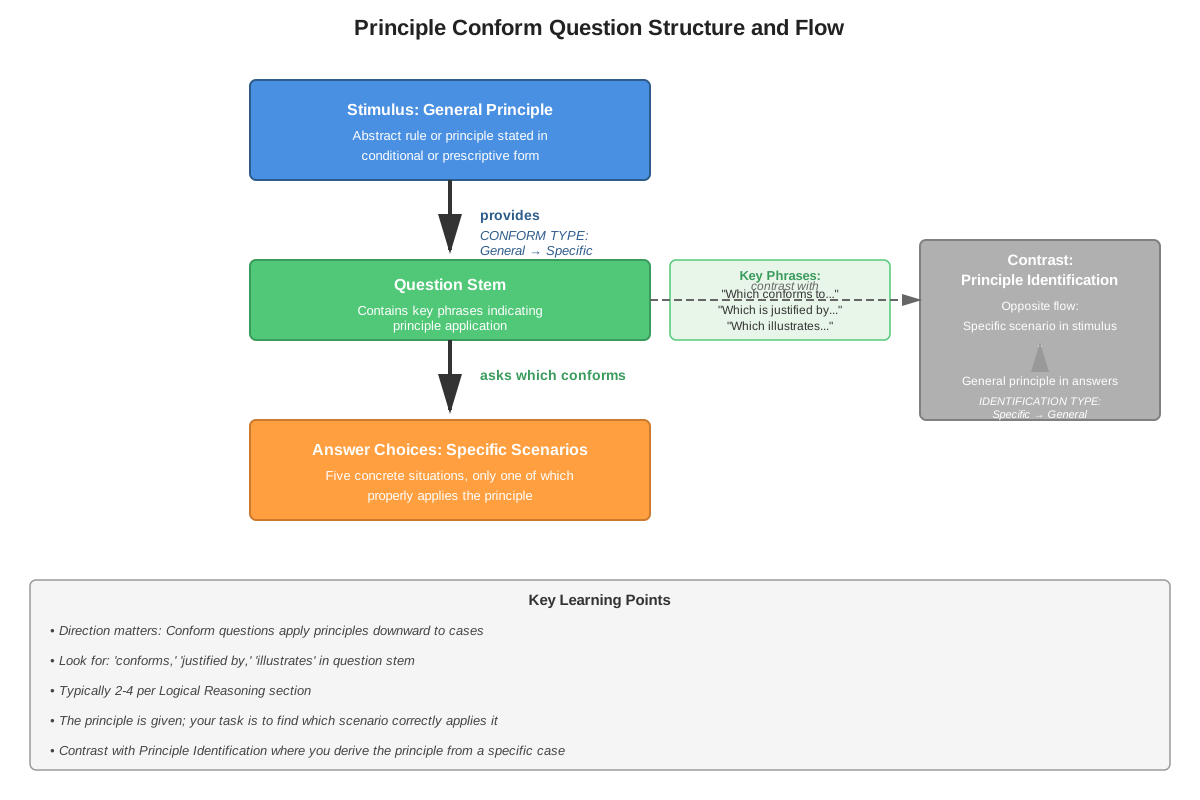
Principle conform questions follow a distinctive structure that sets them apart from other Logical Reasoning question types. The stimulus presents a general principle—typically a conditional statement or rule that establishes when certain actions are justified, required, prohibited, or recommended. This principle functions as the standard against which answer choices must be evaluated. The question stem then directs test-takers to identify which specific scenario among the answer choices conforms to, is justified by, or illustrates the application of that principle.
The principle itself usually contains multiple components that must all be satisfied for proper application. These components often include:
- Triggering conditions: The circumstances that must be present for the principle to apply
- Resulting action or judgment: What follows when the triggering conditions are met
- Qualifying limitations: Exceptions, restrictions, or additional requirements that constrain the principle's application
Consider this example principle: "A journalist is justified in protecting a source's identity when revealing that identity would expose the source to serious harm and when the information provided serves the public interest." This principle contains two triggering conditions (risk of serious harm AND public interest) that must both be satisfied before the resulting action (protecting source identity) is justified.
The Logical Structure of Principles
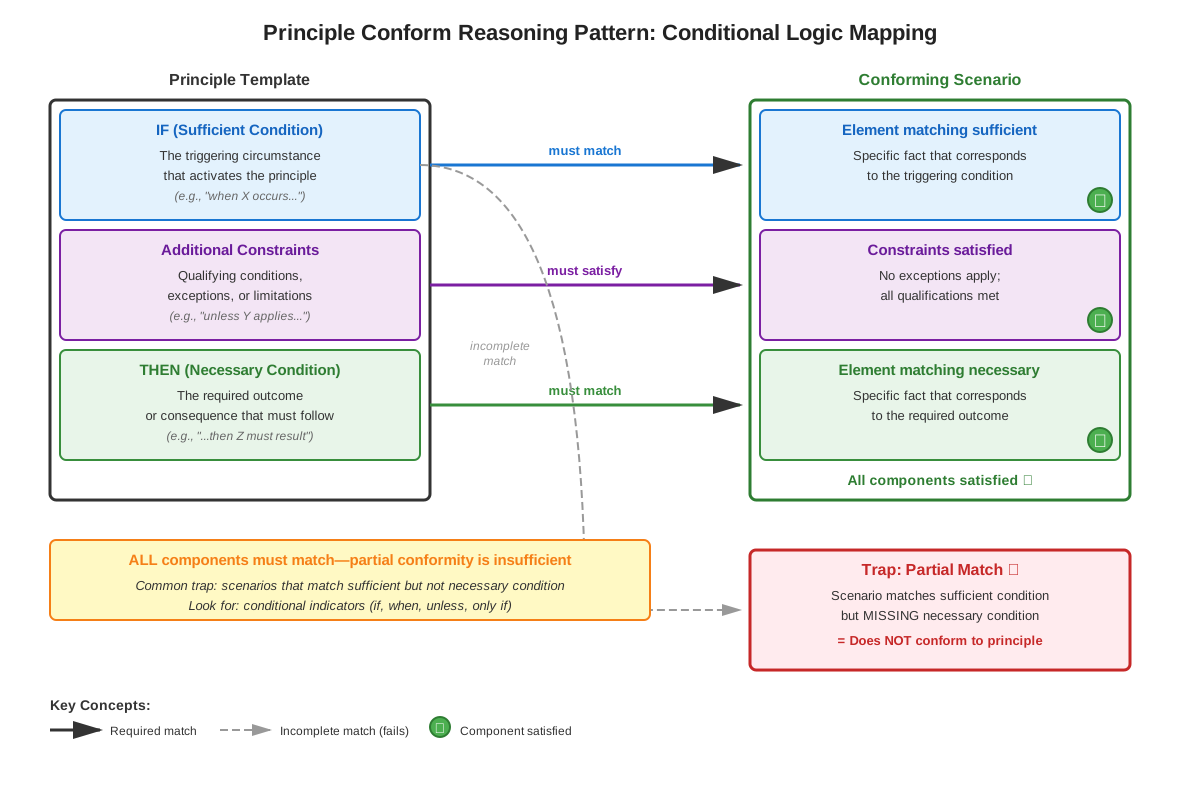
Most principles on the LSAT can be translated into conditional logic notation, which reveals their underlying structure. A principle stating "Action X is justified when conditions A and B are present" translates to: If A AND B → X is justified. Understanding this structure is crucial because conforming to the principle requires satisfying ALL sufficient conditions.
The logical structure typically follows one of these patterns:
| Pattern Type | Structure | Example |
|---|---|---|
| Simple Conditional | If A → B | If a promise was made freely, it should be kept |
| Conjunctive Sufficient | If A AND B → C | If an action harms others AND provides no benefit, it's wrong |
| Disjunctive Sufficient | If A OR B → C | If a law is unjust OR ineffective, it should be reformed |
| Conditional with Exception | If A → B, unless C | Confidentiality should be maintained unless disclosure prevents harm |
Recognizing which pattern a principle follows allows test-takers to systematically evaluate whether answer choices satisfy the logical requirements. A conforming answer must provide all elements specified in the sufficient condition and demonstrate the appropriate necessary condition.
The Application Process
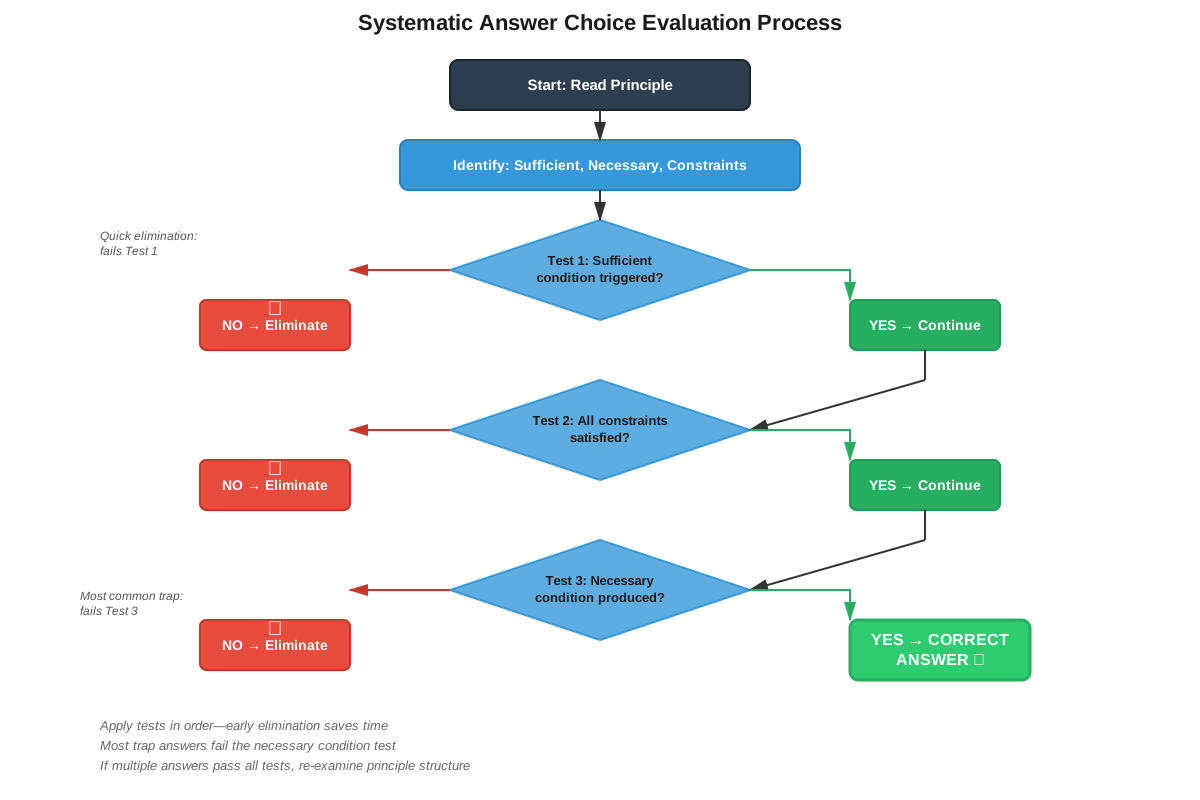
Applying a principle to specific scenarios requires a methodical approach. First, identify all components of the principle and their logical relationships. Second, examine each answer choice to determine whether it provides facts that satisfy every component. Third, verify that the conclusion or action in the answer choice matches what the principle prescribes.
The most common error in principle conform questions occurs when test-takers select answers that satisfy only some components of the principle. If a principle requires both condition A and condition B, an answer choice that satisfies only condition A does not conform, regardless of how perfectly it matches that single component. This "partial match" trap appears frequently and accounts for many incorrect responses.
Distinguishing Conforming from Non-Conforming Scenarios
A scenario conforms to a principle when it satisfies all logical requirements specified by that principle. This means:
- All sufficient conditions are met (if the principle requires A AND B, both must be present)
- The resulting action or judgment matches what the principle prescribes
- No disqualifying exceptions or limitations are violated
- The logical relationship between conditions and conclusions is preserved
Non-conforming scenarios typically fail in one of these ways:
- Incomplete satisfaction: Meeting only some of the required conditions
- Reversed logic: Satisfying necessary but not sufficient conditions
- Wrong conclusion: Meeting the conditions but reaching a different conclusion than the principle prescribes
- Scope violation: Applying the principle beyond its stated limitations
Question Stem Variations
LSAT principle conform questions use specific language patterns in their question stems that signal the task at hand. Recognizing these patterns allows for immediate identification and appropriate strategic response. Common question stem formulations include:
- "Which one of the following judgments conforms to the principle above?"
- "The principle stated above, if valid, most helps to justify which one of the following?"
- "Which one of the following actions is justified by the principle?"
- "The principle above, if established, would most support which one of the following judgments?"
Each formulation asks essentially the same thing: identify the answer choice that properly applies the stated principle. The word "conforms" explicitly signals this question type, while phrases like "justified by" or "most helps to justify" indicate that the principle serves as the basis for evaluating the answer choices.
Concept Relationships
The concepts within principle conform questions form an interconnected logical framework. Understanding the logical structure of principles serves as the foundation for the entire topic—without recognizing how principles function as conditional statements, test-takers cannot systematically evaluate conformity. This structural understanding directly enables the application process, which provides the step-by-step methodology for matching principles to scenarios.
The application process, in turn, depends on the ability to distinguish conforming from non-conforming scenarios. This distinction requires both structural analysis (does the scenario satisfy all logical components?) and scope analysis (does the scenario fall within the principle's domain of application?). These skills work together: structural analysis identifies what must be present, while scope analysis determines whether what's present actually matches what's required.
Question stem variations connect to all other concepts by determining how the principle-to-scenario matching task is framed. Different question stems may emphasize justification, conformity, or illustration, but all require the same underlying analytical process. Recognizing the question stem pattern allows test-takers to activate the appropriate mental framework immediately.
The relationship map flows as follows:
Principle Structure Recognition → enables → Logical Component Identification → guides → Systematic Application Process → produces → Conformity Evaluation → yields → Correct Answer Selection
This topic also connects to prerequisite knowledge. Conditional logic provides the formal framework for understanding principle structure. Sufficient and necessary conditions determine what must be present (sufficient) versus what must follow (necessary) in principle applications. Argument structure skills enable parsing of both principles and answer choice scenarios into their component parts.
High-Yield Facts
⭐ Principle conform questions typically appear 2-4 times per Logical Reasoning section, making them high-frequency question types
⭐ A conforming answer must satisfy ALL sufficient conditions specified in the principle, not just some of them
⭐ The most common trap answers satisfy only partial components of the principle while appearing superficially similar
⭐ Question stems containing "conforms to," "justified by," or "illustrates" signal principle conform questions
⭐ Principles expressed with "and" require all conditions to be met; principles with "or" require only one condition
- Principle conform questions test application of general rules to specific cases, mirroring core legal reasoning skills
- The principle always appears in the stimulus; answer choices contain specific scenarios to evaluate
- Conforming scenarios must match both the conditions AND the conclusion prescribed by the principle
- Reversed logic (satisfying necessary but not sufficient conditions) creates common incorrect answers
- Time-efficient strategy involves eliminating answers that clearly fail to satisfy any major component of the principle
Quick check — test yourself on Principle conform questions so far.
Try Flashcards →Common Misconceptions
Misconception: If an answer choice satisfies the most important-sounding part of the principle, it must be correct → Correction: All components of a principle carry equal logical weight. A scenario that satisfies the seemingly "main" condition but fails to satisfy a secondary condition does not conform to the principle. Every element specified in the sufficient condition must be present.
Misconception: An answer choice that reaches the same conclusion as the principle automatically conforms to it → Correction: Conformity requires satisfying the conditions that justify the conclusion, not merely reaching the same conclusion. An answer might support the same action or judgment through different reasoning that doesn't match the principle's logical structure.
Misconception: Principle conform questions ask you to identify the best principle for a situation → Correction: This describes principle identification questions, not conform questions. In conform questions, the principle is given in the stimulus, and you must find which specific scenario it applies to among the answer choices.
Misconception: If an answer choice contains similar language to the principle, it probably conforms → Correction: Surface-level vocabulary overlap doesn't guarantee logical conformity. Test-makers deliberately use similar terminology in trap answers that fail to satisfy the principle's logical structure. Focus on whether the logical relationships match, not whether the words sound similar.
Misconception: The correct answer will explicitly state all components of the principle → Correction: Conforming answers often imply or presuppose certain conditions rather than stating them explicitly. Test-takers must recognize when facts in an answer choice, even if not directly stated, satisfy the principle's requirements through reasonable inference.
Worked Examples
Example 1: Complete Analysis
Stimulus: "A company is ethically required to recall a product when the company has clear evidence that the product poses a safety risk to consumers and when the cost of the recall would not threaten the company's financial viability."
Question Stem: "Which one of the following judgments most closely conforms to the principle stated above?"
Answer Choices:
(A) TechCorp should recall its smartphone model because independent testing revealed battery defects that could cause fires, even though the recall would cost $50 million and TechCorp's annual profit is only $40 million.
(B) AutoMaker must recall its sedan model because government crash tests showed a safety defect in the airbag system, and the company has sufficient financial reserves to absorb the recall costs.
(C) PharmaCo should not recall its medication despite reports of adverse reactions because the company has not yet completed its internal investigation into whether these reactions indicate a genuine safety risk.
(D) FoodCorp is required to recall its product line because consumer complaints suggest possible contamination, and the recall would cost less than 5% of the company's annual revenue.
(E) ToyCo must recall its children's toy because it contains small parts that pose choking hazards, though the company disputes whether the parts actually detach easily enough to create real danger.
Analysis:
First, identify the principle's components:
- Sufficient Condition 1: Clear evidence of safety risk
- Sufficient Condition 2: Recall cost would NOT threaten financial viability
- Necessary Condition: Ethical requirement to recall
Both sufficient conditions must be satisfied for the recall to be ethically required.
Evaluating (A): Satisfies condition 1 (clear evidence of fire risk) but FAILS condition 2 (recall cost of $50M exceeds annual profit of $40M, threatening viability). Does not conform.
Evaluating (B): Satisfies condition 1 (government tests showed defect = clear evidence) AND satisfies condition 2 (sufficient reserves = recall won't threaten viability). The conclusion (must recall) matches the principle's prescription. This conforms completely.
Evaluating (C): FAILS condition 1 (no clear evidence yet, investigation incomplete). The conclusion (should not recall) actually contradicts what the principle would require if conditions were met. Does not conform.
Evaluating (D): FAILS condition 1 (complaints "suggest possible" contamination is not "clear evidence"). Though condition 2 is satisfied, both conditions must be met. Does not conform.
Evaluating (E): Condition 1 is ambiguous (contains hazardous parts, but company disputes the risk = unclear whether there's "clear evidence"). This ambiguity alone makes it weaker than (B). Does not conform as clearly as (B).
Correct Answer: (B) — It's the only choice that unambiguously satisfies both sufficient conditions and reaches the conclusion the principle prescribes.
Example 2: Complex Conditional Structure
Stimulus: "A journalist should publish information obtained from a confidential source only if the information reveals wrongdoing that significantly affects the public interest and the journalist has independently verified the information's accuracy through at least one additional source."
Question Stem: "The principle above most strongly supports which one of the following judgments?"
Analysis of Principle Structure:
- This is a conditional with conjunctive sufficient conditions
- Condition 1: Information reveals significant public-interest wrongdoing
- Condition 2: Independent verification through additional source
- Conclusion: Should publish (only if both conditions met)
Answer Choice Analysis:
Consider this answer: "Reporter Martinez should publish the documents leaked by an anonymous government employee showing that the agency misallocated $2 million in public funds, given that Martinez confirmed the documents' authenticity through the agency's own public financial records."
Evaluation:
- Condition 1: ✓ Misallocation of $2M in public funds = wrongdoing affecting public interest
- Condition 2: ✓ Confirmed through public financial records = independent verification through additional source
- Conclusion: ✓ Should publish matches the principle's prescription
This answer conforms because it satisfies both required conditions and reaches the appropriate conclusion.
Contrast with a trap answer: "Reporter Chen should publish allegations from a confidential source that a senator accepted bribes, because such corruption clearly affects the public interest."
Evaluation:
- Condition 1: ✓ Bribery allegations = significant public-interest wrongdoing
- Condition 2: ✗ No mention of independent verification
- This fails to conform because it satisfies only one of two required conditions
Exam Strategy
When approaching lsat principle conform questions, implement this systematic process:
Step 1: Identify the Question Type (5-10 seconds)
Look for trigger phrases: "conforms to the principle," "justified by the principle," "illustrates the principle." This identification activates the appropriate mental framework.
Step 2: Analyze the Principle's Structure (15-20 seconds)
Break down the principle into its logical components:
- What are the sufficient conditions (what must be present)?
- What is the necessary condition (what follows when conditions are met)?
- Are conditions connected by "and" (all required) or "or" (one sufficient)?
- Are there exceptions or limitations?
Exam Tip: Physically mark or mentally note each distinct condition. If a principle has three components connected by "and," you're looking for an answer that satisfies all three.
Step 3: Predict Answer Characteristics (5 seconds)
Before reading answer choices, briefly consider what a conforming scenario must include. This prediction prevents you from being swayed by attractive but incorrect answers.
Step 4: Evaluate Each Answer Systematically (30-40 seconds total)
For each answer choice:
- Check whether it satisfies the first condition (if not, eliminate immediately)
- Check whether it satisfies the second condition (if not, eliminate)
- Continue for all conditions
- Verify the conclusion matches what the principle prescribes
Step 5: Verify Your Selection (5-10 seconds)
Before moving on, confirm that your chosen answer satisfies every component of the principle and that you haven't fallen for a partial-match trap.
Trigger Words to Watch For:
In the principle:
- "Only if" (introduces necessary condition)
- "If" or "when" (introduces sufficient condition)
- "And" (all conditions required)
- "Or" (any one condition sufficient)
- "Unless" (introduces exception)
In answer choices:
- "Although" or "even though" (may signal that a condition isn't met)
- "Probably" or "might" (may indicate insufficient certainty for "clear evidence" requirements)
- "Some" or "most" (may indicate scope mismatch with principle requiring "all")
Process-of-Elimination Strategy:
Principle conform questions are excellent candidates for aggressive elimination:
- First pass: Eliminate any answer that clearly fails to satisfy at least one major component of the principle (typically eliminates 2-3 answers)
- Second pass: Among remaining answers, identify which most completely satisfies all components (typically narrows to 1-2 answers)
- Final verification: Between final contenders, identify which has no ambiguity or missing elements
Time Allocation:
Budget approximately 1:20-1:30 for principle conform questions (slightly above the 1:20 average per question). The extra time investment pays dividends because these questions reward systematic analysis. Rushing through the principle analysis to save 10 seconds often results in missing a crucial component and selecting a trap answer.
Memory Techniques
Acronym for Principle Analysis: SCALE
- Sufficient conditions (what must be present?)
- Conclusion prescribed (what follows?)
- All or any (are conditions connected by "and" or "or"?)
- Limitations (are there exceptions?)
- Evaluate each answer against all components
Visualization Strategy: Picture the principle as a gate with multiple locks. An answer choice can only pass through (conform) if it has keys for ALL locks. A key that opens only some locks leaves the gate closed (doesn't conform).
Mnemonic for Common Trap Patterns: PARIS
- Partial match (satisfies some but not all conditions)
- Alternative reasoning (reaches same conclusion through different logic)
- Reversed logic (satisfies necessary but not sufficient conditions)
- Incomplete information (missing data needed to verify conformity)
- Scope mismatch (applies principle beyond its stated domain)
Memory Aid for Question Stem Recognition:
"Conforms, Justified, Illustrates" = CJI = "Can Judge It" (you can judge whether scenarios match the principle)
This distinguishes conform questions from identification questions where you must extract the principle.
Summary
Principle conform questions require test-takers to apply general rules to specific scenarios, testing the fundamental legal reasoning skill of matching abstract principles to concrete situations. These high-frequency questions (2-4 per Logical Reasoning section) provide the principle in the stimulus and ask which answer choice conforms to, is justified by, or illustrates that principle. Success requires understanding the logical structure of principles—typically conditional statements with sufficient and necessary conditions—and systematically evaluating whether answer choices satisfy all components. The most common errors involve selecting answers that partially match the principle or that reach the same conclusion through different reasoning. A methodical approach that breaks principles into their constituent parts, identifies whether conditions are conjunctive (all required) or disjunctive (one sufficient), and verifies that answer choices satisfy every component will reliably yield correct answers. These questions reward careful analysis over speed, making them excellent targets for score improvement through deliberate practice and strategic application of the SCALE framework.
Key Takeaways
- Principle conform questions provide the principle in the stimulus and ask which specific scenario among the answer choices conforms to it
- All sufficient conditions in a principle must be satisfied for a scenario to conform—partial matches are incorrect
- Question stems using "conforms to," "justified by," or "illustrates" signal this question type and require principle-to-scenario matching
- The most common trap answers satisfy only some components of the principle while appearing superficially correct
- Principles with "and" require all conditions; principles with "or" require only one condition to be met
- Systematic evaluation using the SCALE framework (Sufficient conditions, Conclusion, All or any, Limitations, Evaluate) prevents errors
- These questions appear 2-4 times per section and reward methodical analysis over speed, making them high-yield targets for score improvement
Related Topics
Principle Identification Questions: While conform questions provide the principle and ask for application, identification questions present a specific scenario and ask you to identify which general principle it illustrates. Mastering conform questions builds the foundation for identification questions by developing principle analysis skills.
Parallel Reasoning Questions: These questions require matching logical structures between arguments, similar to how conform questions require matching the structure of principles to scenarios. The pattern-recognition skills developed through principle conform practice transfer directly to parallel reasoning.
Conditional Logic and Formal Logic: Deeper study of conditional statements, contrapositives, and logical operators enhances principle analysis abilities. Understanding formal logic notation allows for more precise principle structure identification.
Sufficient Assumption Questions: These questions ask what additional premise would make an argument valid, requiring similar skills in identifying what conditions must be satisfied. The logical gap-filling in sufficient assumption questions parallels the condition-matching in principle conform questions.
Practice CTA
Now that you've mastered the conceptual framework for principle conform questions, it's time to cement your understanding through active practice. Attempt the practice questions designed for this topic, focusing on applying the SCALE framework systematically to each question. Use the flashcards to reinforce recognition of question stem patterns and common trap answer characteristics. Remember: principle conform questions reward methodical analysis and pattern recognition—skills that improve dramatically with deliberate practice. Each question you work through builds your ability to quickly identify logical structures and match principles to scenarios, directly translating to points on test day. You've built the foundation; now apply it to achieve mastery.
Sign up free to keep reading
Create a free AnvayaPrep account to finish this LSAT guide on Principle conform questions — plus flashcards and practice questions.