Overview
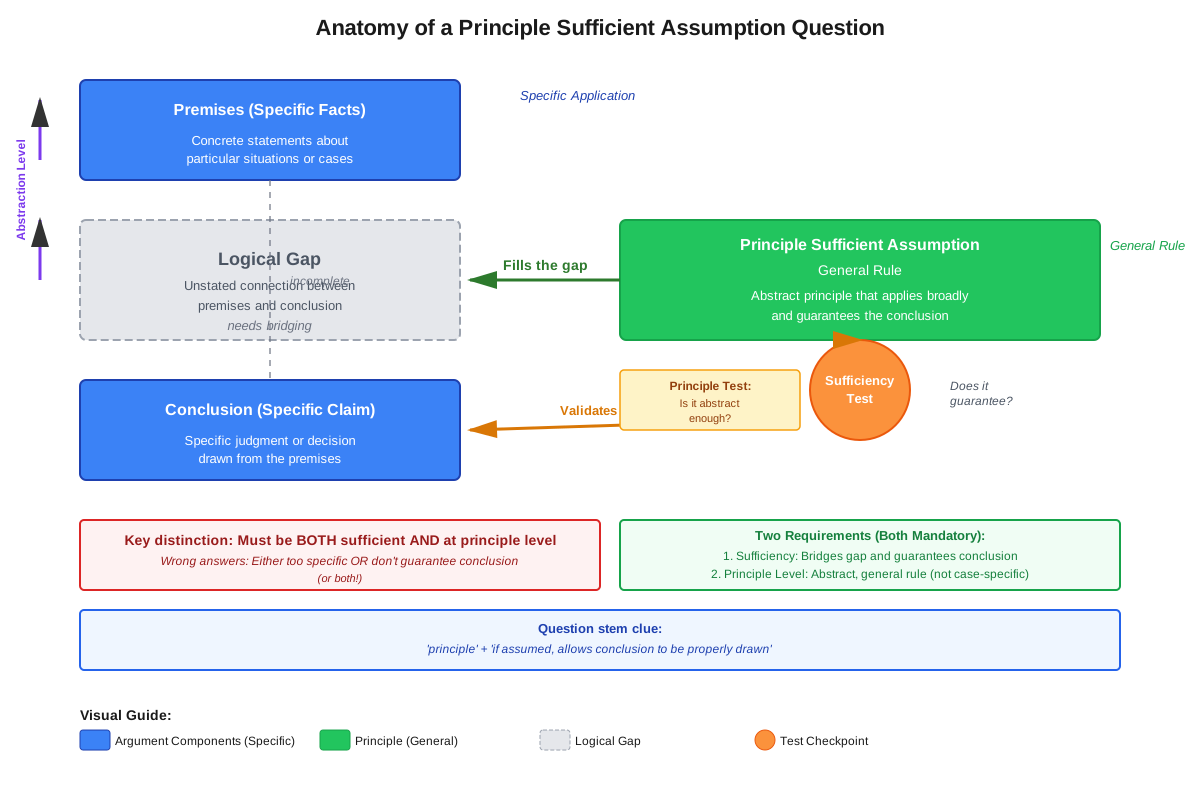
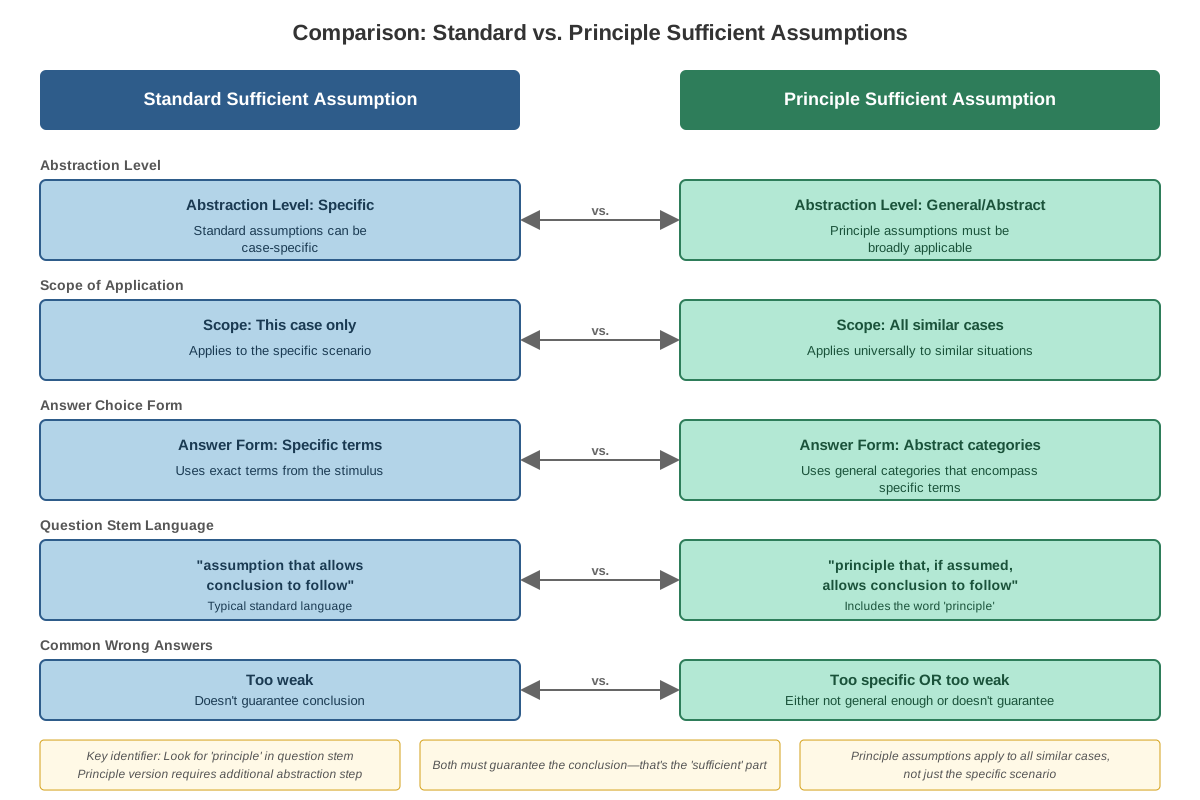
Principle sufficient assumption questions represent a sophisticated fusion of two critical LSAT question types: principle questions and sufficient assumption questions. These questions ask test-takers to identify a broad, general rule or principle that, if assumed to be true, would guarantee the validity of an argument's conclusion. Unlike standard sufficient assumption questions that might require only a narrow logical bridge, principle sufficient assumption questions demand a more abstract, universally applicable statement that could govern similar situations beyond the specific scenario presented.
Understanding this question type is essential for LSAT success because it appears regularly in the Logical Reasoning sections and tests multiple skills simultaneously: the ability to abstract from specific cases to general rules, to identify logical gaps in arguments, and to recognize what would make an argument's reasoning airtight. These questions typically appear 2-4 times per LSAT administration, making them high-yield material that can significantly impact overall scores. Mastering principle questions of this variety demonstrates advanced logical reasoning capabilities that the LSAT specifically targets.
Within the broader landscape of Logical Reasoning, principle sufficient assumption questions occupy a unique intersection. They require the structural analysis skills needed for sufficient assumption questions—identifying premises, conclusions, and logical gaps—while also demanding the conceptual elevation required for principle questions. This dual nature makes them more challenging than either question type alone, but also means that mastering them strengthens performance across multiple question families, including strengthen questions, justify questions, and other principle variants.
Learning Objectives
- [ ] Identify how Principle sufficient assumption appears in LSAT questions
- [ ] Explain the reasoning pattern behind Principle sufficient assumption
- [ ] Apply Principle sufficient assumption to solve LSAT-style problems accurately
- [ ] Distinguish principle sufficient assumption questions from standard sufficient assumption questions
- [ ] Evaluate answer choices by testing whether they provide both sufficiency and appropriate generality
- [ ] Construct the logical bridge needed to connect premises to conclusions in principle form
Prerequisites
- Basic argument structure identification: Recognizing premises, conclusions, and intermediate conclusions is fundamental because principle sufficient assumption questions require mapping the logical gap between what's stated and what's concluded.
- Understanding of conditional logic: Sufficient assumptions create conditional relationships where the assumption guarantees the conclusion, making fluency with "if-then" reasoning essential.
- Familiarity with standard sufficient assumption questions: These provide the foundation for understanding what makes an argument valid before adding the complexity of principle-level abstraction.
- Basic principle question exposure: Understanding how principles operate as general rules governing specific cases helps distinguish when an assumption needs to be stated at a principle level versus a specific level.
Why This Topic Matters
In legal reasoning and everyday argumentation, the ability to identify underlying principles that justify specific conclusions is invaluable. Lawyers must regularly articulate the general legal principles that support their arguments about particular cases. Policy makers need to justify specific decisions by reference to broader governing principles. The LSAT principle sufficient assumption question type directly tests this real-world reasoning skill by requiring test-takers to bridge the gap between concrete situations and abstract rules.
On the LSAT itself, principle sufficient assumption questions appear with notable frequency—typically 2-4 questions per test across both Logical Reasoning sections. These questions are often classified as "Justify" or "Principle-Justify" questions, with question stems like "Which one of the following principles, if valid, most helps to justify the reasoning above?" or "The conclusion follows logically if which one of the following principles is assumed?" The LSAT test-makers favor these questions because they efficiently assess multiple competencies: logical gap identification, abstract reasoning, and the ability to work with general rules.
These questions commonly appear in passages discussing ethical dilemmas, policy decisions, comparative evaluations, or situations requiring judgment calls. The arguments typically present specific facts or circumstances and draw a conclusion about what should be done, what is justified, or how something should be classified. The test-taker must identify what general principle would make that specific conclusion logically follow from those specific premises.
Core Concepts
The Nature of Sufficient Assumptions
A sufficient assumption is a statement that, when added to an argument's existing premises, guarantees the truth of the conclusion. If the premises are true and the sufficient assumption is true, the conclusion must be true—no exceptions, no additional information needed. This creates what logicians call a "valid" argument structure. The sufficient assumption "fills the gap" between what the argument establishes and what it claims to prove.
In formal terms, if we have premises P1, P2, and P3 leading to conclusion C, and there's a logical gap, a sufficient assumption S makes the argument valid: (P1 + P2 + P3 + S) → C is necessarily true. The sufficient assumption might be broader than strictly necessary—it just needs to be enough to guarantee the conclusion.
The Principle Component
A principle in LSAT terminology is a general rule, standard, or criterion that applies across multiple situations. Principles are abstract and universal in scope, not tied to the specific details of a single case. For example, "People should keep their promises" is a principle, while "John should meet Sarah at 3pm because he promised to" is a specific application of that principle.
Principles on the LSAT typically take conditional form: "If [general condition], then [general consequence]" or "All [category] should [action] when [circumstance]." They establish relationships between categories, actions, and outcomes that can govern numerous specific instances. The key characteristic is generalizability—a principle must be stated broadly enough to apply beyond the immediate argument.
Combining Sufficiency and Principle
When a question asks for a principle sufficient assumption, it requires an answer that satisfies both criteria simultaneously. The correct answer must:
- Be stated as a general principle (abstract, broad, applicable to multiple cases)
- Function as a sufficient assumption (guarantee the conclusion when added to the premises)
This combination creates a specific challenge: the answer cannot be too narrow (or it fails the principle requirement) but also cannot be too broad (or it may not specifically address the logical gap in the argument). The ideal answer is the most general statement that still bridges the exact gap between premises and conclusion.
The Logical Gap in Principle Arguments
Arguments requiring principle sufficient assumptions typically exhibit a characteristic structure: they move from specific factual premises to a normative or evaluative conclusion. Common patterns include:
- Fact-to-Ought: Premises describe what is; conclusion states what should be
- Specific-to-Classification: Premises give details about X; conclusion categorizes X
- Comparison-to-Judgment: Premises compare A and B; conclusion judges which is better/worse/justified
The logical gap exists because the premises alone don't establish the evaluative standard, classification criterion, or normative principle needed to reach the conclusion. The principle sufficient assumption supplies this missing standard in general form.
Question Stem Recognition
Lsat principle sufficient assumption questions use distinctive language in their question stems:
- "Which one of the following principles, if valid, most helps to justify the reasoning?"
- "The conclusion follows logically if which one of the following is assumed?"
- "Which one of the following principles, if established, would justify the conclusion?"
- "The argument's conclusion is properly drawn if which one of the following is assumed?"
Key trigger phrases include "principle," "if valid," "if assumed," "if established," combined with "justify," "follows logically," or "properly drawn." The presence of "principle" distinguishes these from standard sufficient assumption questions, while "justify" or "follows logically" indicates the sufficiency requirement.
Answer Choice Characteristics
Correct answers to principle sufficient assumption questions share identifiable features:
| Feature | Description | Example Language |
|---|---|---|
| Conditional structure | Often uses if-then format | "If X has property P, then X should..." |
| Abstract terms | Uses categories rather than specific names | "Any policy that..." rather than "This policy..." |
| Broad applicability | Could apply to situations beyond the argument | "Whenever someone..." not "In this case..." |
| Precise gap-filling | Connects exact premise concepts to conclusion concepts | Links the specific characteristics mentioned to the specific judgment made |
Wrong answers typically fail in predictable ways: too specific (not a principle), too broad (doesn't address the specific gap), reverses the logic, or addresses irrelevant considerations.
Concept Relationships
The relationships among concepts within principle sufficient assumption questions flow hierarchically and functionally. At the foundation lies argument structure analysis, which enables identification of premises and conclusions. This analysis reveals the logical gap—the disconnect between what's established and what's concluded.
The sufficient assumption concept provides the functional requirement: whatever fills this gap must guarantee the conclusion. Meanwhile, the principle concept provides the formal requirement: the gap-filler must be stated as a general rule. These two requirements converge in the principle sufficient assumption, which must satisfy both simultaneously.
This topic connects backward to prerequisite knowledge of conditional logic because principles typically express conditional relationships, and sufficiency itself is a conditional concept (if premises + assumption, then conclusion). It connects forward to other principle question types: principle sufficient assumptions are more constrained than general principle questions (which might only need to support or conform to the argument) but share the same requirement for abstract, general formulation.
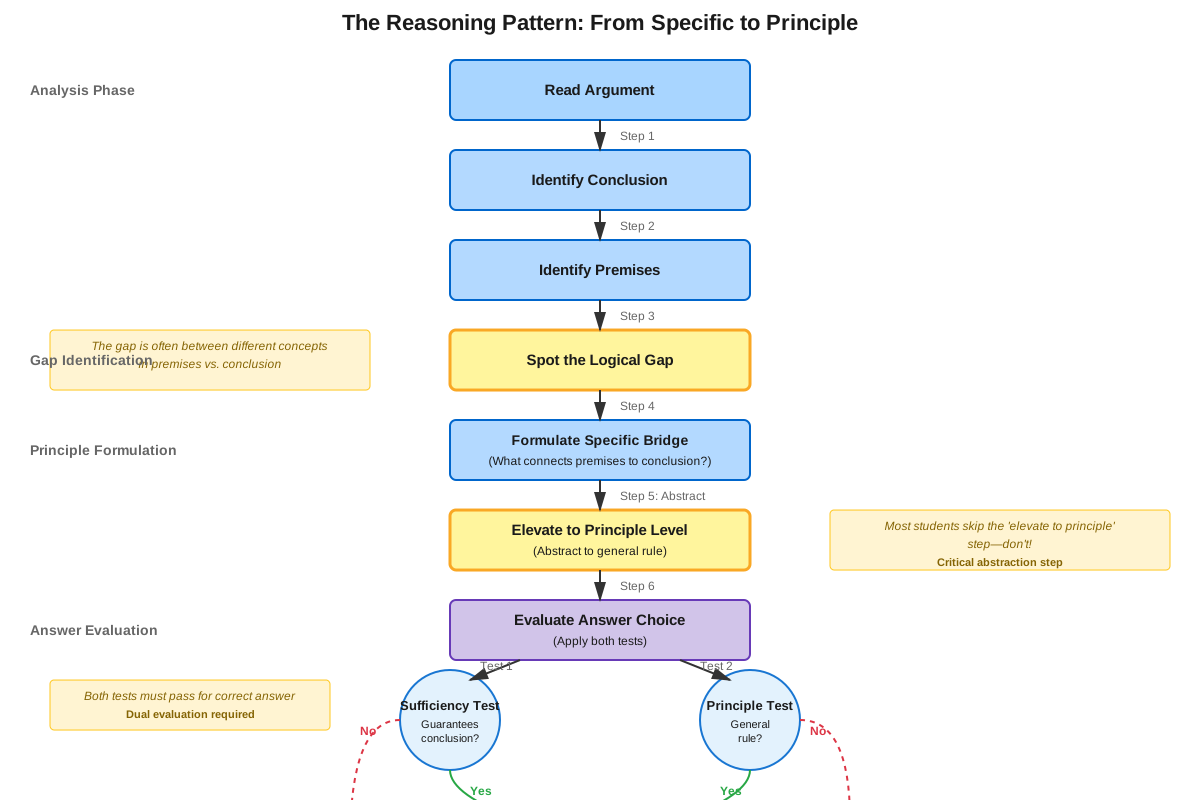
The relationship map: Argument Analysis → Gap Identification → Sufficient Assumption Requirement + Principle Requirement → Principle Sufficient Assumption → Answer Evaluation → Correct Answer Selection.
High-Yield Facts
- ⭐ Principle sufficient assumption questions require answers that are both general rules AND logically sufficient to guarantee the conclusion
- ⭐ The correct answer must connect the specific concepts in the premises to the specific concepts in the conclusion using general/abstract language
- ⭐ Question stems containing both "principle" and "justify" or "follows logically" signal this question type
- ⭐ Wrong answers often fail by being too specific (not a principle) or too general (doesn't bridge the exact gap)
- ⭐ The logical gap typically involves moving from descriptive facts to normative/evaluative conclusions
- Correct principles are usually stated in conditional form: "If [general condition], then [general consequence]"
- The principle must be broad enough to apply beyond the specific case but specific enough to address the argument's exact reasoning
- These questions appear 2-4 times per LSAT test, making them high-yield for score improvement
- The correct answer makes the argument valid (conclusion must be true if premises and principle are true)
- Principle sufficient assumptions often establish criteria for evaluation, classification, or obligation that the premises alone don't provide
- Testing answer choices by applying them to the argument's structure is more reliable than trying to pre-phrase the exact principle
- The scope of the principle should match the scope of the conclusion—no broader, no narrower than necessary
Quick check — test yourself on Principle sufficient assumption so far.
Try Flashcards →Common Misconceptions
Misconception: Any general statement that supports the conclusion is correct.
Correction: The principle must do more than support—it must guarantee the conclusion. Many wrong answers offer relevant principles that strengthen the argument without making it logically valid. The test is sufficiency: if the premises and principle are true, must the conclusion be true?
Misconception: The correct answer should use the exact same specific terms as the argument.
Correction: Principles must be stated abstractly and generally. If an answer choice uses the specific names, places, or particular details from the argument, it's likely too narrow to be a principle. Look for categorical terms and general descriptions instead.
Misconception: The broadest, most universal principle is always correct.
Correction: While principles must be general, they must also address the specific logical gap in the argument. An extremely broad principle like "People should act ethically" might be true but won't justify a specific conclusion about a particular action unless it connects the exact premise concepts to the exact conclusion concepts.
Misconception: Principle sufficient assumption questions are the same as strengthen questions.
Correction: Strengthen questions ask what makes the conclusion more likely or better supported; principle sufficient assumption questions ask what makes the conclusion logically guaranteed. The standard is much higher—the answer must create a valid argument, not just a stronger one.
Misconception: The principle must be something most people would agree with or that seems obviously true.
Correction: The LSAT doesn't test whether principles are wise, popular, or morally correct. A principle is correct if it performs the logical function of guaranteeing the conclusion from the premises, regardless of whether it represents good policy or common sense.
Worked Examples
Example 1: Environmental Policy Argument
Argument: "The new industrial regulation will significantly reduce air pollution in the region. However, it will also cause the closure of several factories, resulting in job losses. Therefore, the regulation should not be implemented."
Question: Which one of the following principles, if valid, most helps to justify the reasoning above?
Analysis:
Step 1 - Identify the structure:
- Premise 1: Regulation reduces pollution
- Premise 2: Regulation causes job losses
- Conclusion: Regulation should not be implemented
Step 2 - Identify the logical gap:
The premises establish both a benefit (pollution reduction) and a cost (job losses). The conclusion opposes implementation. What's missing? A principle that establishes when costs outweigh benefits, specifically that job losses outweigh environmental benefits, or more generally, that economic considerations trump environmental ones.
Step 3 - Formulate what the principle must do:
The principle must establish that when a policy has the characteristics described in the premises (reduces pollution but causes job losses), it should not be implemented. This needs to be stated generally.
Step 4 - Evaluate answer choices:
(A) "Environmental benefits should never be pursued at the cost of economic harm."
- This is general (principle ✓)
- Does it guarantee the conclusion? If we accept this principle, and the regulation causes economic harm (job losses) for environmental benefit (pollution reduction), then it should not be pursued. This works! (sufficient ✓)
(B) "This regulation will harm more people than it helps."
- Too specific—uses "this regulation" rather than general terms (principle ✗)
(C) "Job losses are always unacceptable regardless of other benefits."
- Too extreme and doesn't specifically connect to the environmental vs. economic trade-off in the argument (doesn't fit the gap precisely)
(D) "Pollution reduction is important but not as important as employment."
- This supports the conclusion but doesn't guarantee it—"not as important" doesn't necessarily mean "should not be implemented" (insufficient)
Correct Answer: (A) provides both the generality of a principle and the sufficiency to guarantee that this regulation, which trades environmental benefits for economic costs, should not be implemented.
Example 2: Academic Integrity Argument
Argument: "Professor Chen discovered that a student's paper contained several paragraphs identical to a published article, without citation. The student claimed not to have known about proper citation requirements. Nevertheless, Professor Chen gave the student a failing grade for the assignment."
Question: The professor's decision follows logically if which one of the following principles is assumed?
Analysis:
Step 1 - Identify the structure:
- Premise 1: Student's paper contained uncited identical material
- Premise 2: Student claimed ignorance of citation rules
- Conclusion: Failing grade was appropriate
Step 2 - Identify the logical gap:
The premises establish plagiarism (uncited identical material) and the student's claimed ignorance. The conclusion is that failure was deserved. The gap: Why does plagiarism warrant failure even when the student claims ignorance? We need a principle that establishes that ignorance doesn't excuse this violation, or that this type of violation warrants failure regardless of intent.
Step 3 - What must the principle establish:
A general rule that when someone commits this type of academic violation (using others' work without citation), a failing grade is appropriate regardless of whether they knew the rules. This must be stated as a principle applicable to students generally, not just this student.
Step 4 - Evaluate potential answers:
(A) "Students who plagiarize should fail, regardless of whether they intended to cheat."
- General enough (principle ✓)
- Connects the act (plagiarism/uncited material) to the consequence (failing) without requiring intent (sufficient ✓)
- This would justify the professor's decision
(B) "Ignorance of academic rules is never an excuse for violations."
- This is a principle, but it doesn't specifically establish that the consequence (failing grade) is appropriate—only that ignorance isn't an excuse (insufficient)
(C) "This student should have known the citation requirements."
- Too specific to this student (principle ✗)
Correct Answer: (A) provides the principle-level bridge: it establishes a general rule (students who plagiarize should fail) that applies regardless of the factor the student raised (ignorance/lack of intent), thereby justifying the specific conclusion that this student's failing grade was appropriate.
Exam Strategy
When approaching lsat principle sufficient assumption questions, employ a systematic process that maximizes accuracy while managing time effectively:
Step 1 - Recognize the question type (5-10 seconds): Scan the question stem for the combination of "principle" with "justify," "follows logically," or "properly drawn/inferred." This signals that you need both generality and sufficiency.
Step 2 - Analyze the argument structure (20-30 seconds): Identify the conclusion first (often signaled by "therefore," "thus," "so"), then identify the premises. Pay special attention to the type of conclusion—is it normative (should/ought), evaluative (better/worse), or classificatory (is/is not)?
Step 3 - Identify the logical gap (15-20 seconds): Ask yourself: "What's missing between these premises and this conclusion?" Often the gap involves an unstated evaluative criterion, a missing category definition, or an assumed priority between competing values. The gap is usually between descriptive premises and a prescriptive/evaluative conclusion.
Step 4 - Predict the principle's function (10-15 seconds): Rather than trying to predict exact wording, identify what the principle must connect: "It needs to establish that when [premise concepts], then [conclusion concept]." This functional prediction guides answer evaluation.
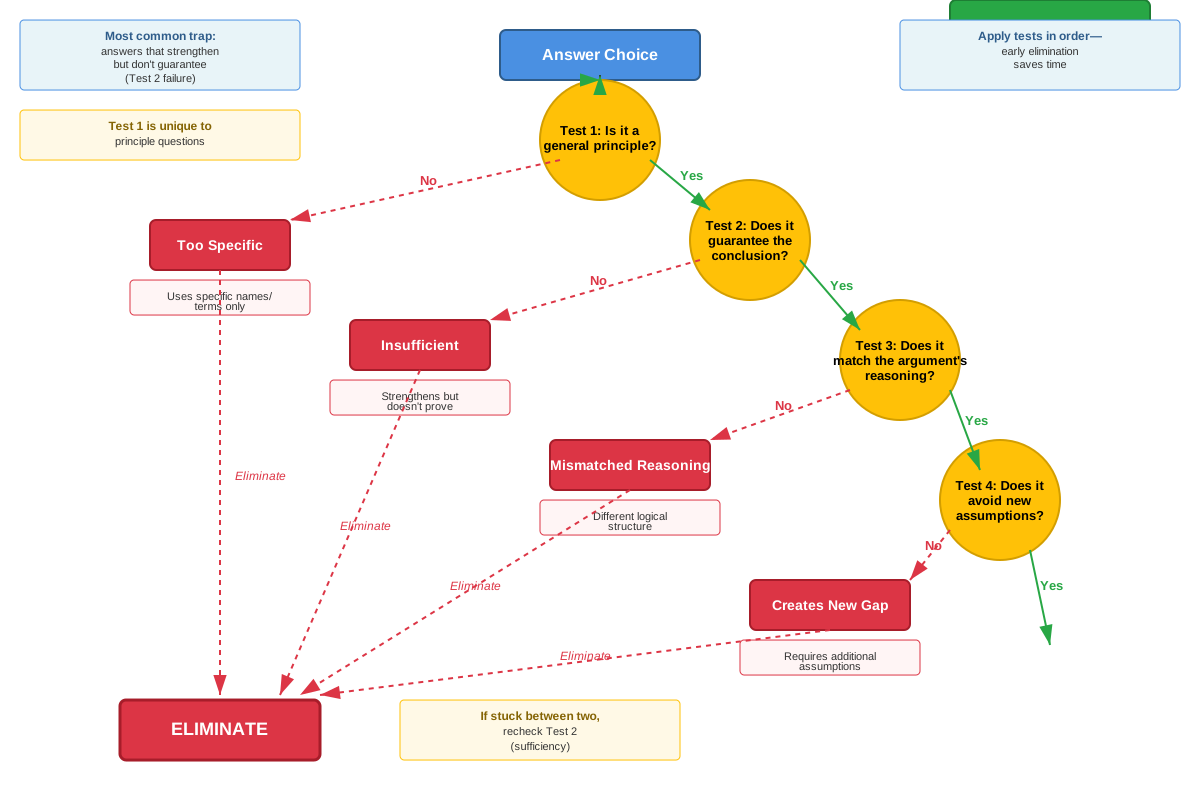
Step 5 - Evaluate answer choices systematically (30-45 seconds): For each answer, apply a two-part test:
- Generality test: Is this stated as a general principle (abstract terms, broad applicability)?
- Sufficiency test: If I add this to the premises, does the conclusion necessarily follow?
Exam Tip: Wrong answers often pass one test but fail the other. An answer might be perfectly general but address the wrong gap, or it might bridge the right gap but be too specific to qualify as a principle.
Trigger words to watch for:
- In question stems: "principle," "if valid," "if assumed," "justify," "follows logically"
- In correct answers: "whenever," "any," "all," "if...then," "should," "ought," categorical terms
- In wrong answers: specific names from the argument, "this case," "here," overly extreme language ("never," "always" without qualification)
Process of elimination tips:
- Eliminate answers that are too specific (use particular details from the argument rather than general categories)
- Eliminate answers that reverse the logic (make the conclusion a premise or vice versa)
- Eliminate answers that address irrelevant considerations not mentioned in the argument
- Between remaining choices, select the one that most precisely connects premise concepts to conclusion concepts
Time allocation: Allocate 1:15-1:30 for these questions—slightly more than average because they require careful analysis of both the argument and the abstract relationship between answer choices and the argument's logic. However, don't exceed 1:45; if stuck, make an educated guess and move on.
Memory Techniques
The "GAPS" acronym for identifying what the principle must do:
- General rule (not specific to this case)
- Abstract language (categories, not particular names)
- Premise-to-conclusion bridge (connects what's stated to what's concluded)
- Sufficient guarantee (makes conclusion necessarily true)
The "Two-Test" visualization: Picture a principle sufficient assumption as a bridge that must pass two inspections. The first inspector checks if it's built with general materials (principle requirement). The second inspector checks if it's strong enough to guarantee safe passage from premises to conclusion (sufficiency requirement). Both inspections must pass.
The "Zoom Out" technique: When evaluating whether an answer is a principle, imagine zooming out from the specific case to see if the statement could apply to many similar situations. If zooming out makes the statement nonsensical or irrelevant, it's too specific.
The "Must Be True" test for sufficiency: After reading an answer choice, say to yourself: "If the premises are true AND this principle is true, must the conclusion be true?" If you can imagine any scenario where premises + principle are true but conclusion is false, it's not sufficient.
Mnemonic for common gap types - "FENCE":
- Fact to ought (descriptive to normative)
- Evaluation criteria (what makes something better/worse)
- Necessary conditions (what must be true for classification)
- Comparison standards (how to weigh competing values)
- Exception rules (when general rules don't apply)
Summary
Principle sufficient assumption questions represent a sophisticated LSAT question type that combines two distinct requirements: the answer must be stated as a general, abstract principle applicable beyond the specific case, and it must function as a sufficient assumption that guarantees the argument's conclusion. These questions typically present arguments that move from specific factual premises to normative or evaluative conclusions, creating a logical gap that requires a principle-level bridge. Success requires systematic analysis: identifying the argument's structure, recognizing the logical gap (often between descriptive facts and prescriptive conclusions), and evaluating answer choices using both the generality test (is it stated as a principle?) and the sufficiency test (does it guarantee the conclusion?). The correct answer will use abstract, categorical language while precisely connecting the concepts in the premises to the concepts in the conclusion. Common pitfalls include selecting answers that are too specific, too broad, or that merely strengthen rather than guarantee the conclusion. Mastering this question type enhances performance across multiple Logical Reasoning question families and appears 2-4 times per LSAT, making it high-yield material for score improvement.
Key Takeaways
- Principle sufficient assumption questions require answers that are both general principles AND logically sufficient to guarantee conclusions
- The logical gap typically involves moving from descriptive premises to normative/evaluative conclusions requiring an unstated standard or criterion
- Correct answers use abstract, categorical language applicable to multiple situations, not specific details from the argument
- Apply the two-part test: generality (is it a principle?) and sufficiency (does it guarantee the conclusion?)
- Question stems combine "principle" language with "justify" or "follows logically" language to signal this question type
- Wrong answers commonly fail by being too specific (not a principle), too broad (doesn't address the exact gap), or merely strengthening rather than guaranteeing
- These questions appear 2-4 times per LSAT and test multiple high-level reasoning skills simultaneously
Related Topics
Standard Sufficient Assumption Questions: These require identifying what would guarantee an argument's conclusion but without the principle-level generality requirement. Mastering principle sufficient assumptions makes standard sufficient assumption questions easier because the logical analysis is similar, just without the abstraction requirement.
Principle-Support Questions: These ask which principle the argument conforms to or illustrates, rather than which principle would justify it. Understanding principle sufficient assumptions helps distinguish between principles that merely align with an argument versus those that logically necessitate its conclusion.
Necessary Assumption Questions: While sufficient assumptions guarantee conclusions, necessary assumptions are required for conclusions. Understanding the difference between sufficiency and necessity is crucial for avoiding confusion between these question types.
Strengthen Questions: These ask what makes conclusions more likely rather than guaranteed. Recognizing that principle sufficient assumptions must do more than strengthen—they must ensure validity—helps maintain the higher standard these questions demand.
Practice CTA
Now that you understand the structure and strategy behind principle sufficient assumption questions, it's time to apply this knowledge. Work through the practice questions systematically, using the GAPS framework and two-part test for each answer choice. These questions reward careful analysis and strategic thinking—skills that improve dramatically with deliberate practice. Each question you work through strengthens your ability to identify logical gaps, evaluate abstract principles, and recognize what makes arguments valid. Your investment in mastering this high-yield question type will pay dividends across the entire Logical Reasoning section. Begin practicing now to transform understanding into performance!
Sign up free to keep reading
Create a free AnvayaPrep account to finish this LSAT guide on Principle sufficient assumption — plus flashcards and practice questions.