Overview
Strengthen questions represent one of the most frequently tested question types in the LSAT's Logical Reasoning sections, appearing in approximately 4-6 questions per test. These questions assess a test-taker's ability to identify information that would make an argument more convincing, more likely to be true, or better supported by evidence. Unlike assumption questions that ask what must be true for an argument to work, strengthen questions ask what additional information would provide the most support to the conclusion.
Mastering strengthen questions is essential for achieving a competitive LSAT score because they test critical thinking skills that law schools value highly: the ability to evaluate arguments, identify logical gaps, and recognize what evidence would make a position more defensible. These questions require understanding not just what an argument says, but what it assumes, where it might be vulnerable, and what information would shore up those vulnerabilities. The skill of strengthening arguments translates directly to legal practice, where attorneys must constantly bolster their positions with supporting evidence and anticipate counterarguments.
Within the broader landscape of Logical Reasoning, strengthen questions form a natural counterpart to strengthen and weaken questions as a category. They share fundamental analytical approaches with assumption questions, flaw questions, and evaluation questions—all of which require identifying the logical structure of arguments and their potential weaknesses. Understanding strengthen questions provides a foundation for tackling their mirror image (weaken questions) and helps develop the argument analysis skills that underpin success across all Logical Reasoning question types.
Learning Objectives
- [ ] Identify how Strengthen questions appears in LSAT questions
- [ ] Explain the reasoning pattern behind Strengthen questions
- [ ] Apply Strengthen questions to solve LSAT-style problems accurately
- [ ] Distinguish between answer choices that strengthen an argument versus those that are merely consistent with it
- [ ] Recognize the most common argument structures that appear in strengthen questions
- [ ] Evaluate the relative strength of multiple strengthening answer choices
- [ ] Identify trap answers that appear to strengthen but actually introduce irrelevant information
Prerequisites
- Basic argument structure: Understanding premises, conclusions, and how they connect is essential because strengthen questions require identifying what additional support would help the conclusion follow from the premises.
- Conditional reasoning: Familiarity with if-then statements and their contrapositives helps recognize how certain answer choices create logical connections that support conclusions.
- Causal reasoning: Many strengthen questions involve causal arguments, so understanding cause-and-effect relationships enables recognition of what evidence would support causal claims.
- Assumption identification: Recognizing unstated assumptions in arguments is crucial because the best strengthening answer choices often provide evidence for those assumptions.
Why This Topic Matters
Strengthen questions appear with remarkable consistency on every LSAT administration, making them one of the highest-yield question types to master. Typically, test-takers will encounter 8-12 strengthen or weaken questions combined across both Logical Reasoning sections, with strengthen questions comprising roughly half of that total. This frequency means that mastering this question type can directly impact 4-6 questions per test—a significant portion of the 50-52 scored Logical Reasoning questions.
In legal practice, the ability to strengthen arguments is fundamental to advocacy. Attorneys must constantly identify what evidence would make their client's position more compelling, what testimony would support their theory of the case, and what additional facts would make their legal arguments more persuasive to judges and juries. Law schools specifically value this skill because it demonstrates the analytical thinking required for legal reasoning.
On the LSAT, strengthen questions commonly appear in several formats. The most straightforward asks: "Which one of the following, if true, most strengthens the argument?" Variations include questions asking what would "most support the conclusion," "provide the most evidence for," or "most justify the reasoning." Some questions specify that the correct answer will strengthen the argument "by doing X" (such as "by addressing a potential objection" or "by ruling out an alternative explanation"). Understanding these variations helps test-takers quickly identify strengthen questions and apply the appropriate strategy.
Core Concepts
The Fundamental Structure of Strengthen Questions
Strengthen questions ask test-takers to identify information that, if true, would make an argument's conclusion more likely to be correct or better supported by its premises. The key phrase "if true" is crucial—it means test-takers should accept the answer choice as fact and then evaluate whether that fact provides support to the argument. The task is not to determine whether the answer choice is actually true, but rather to assess its impact on the argument's logical strength.
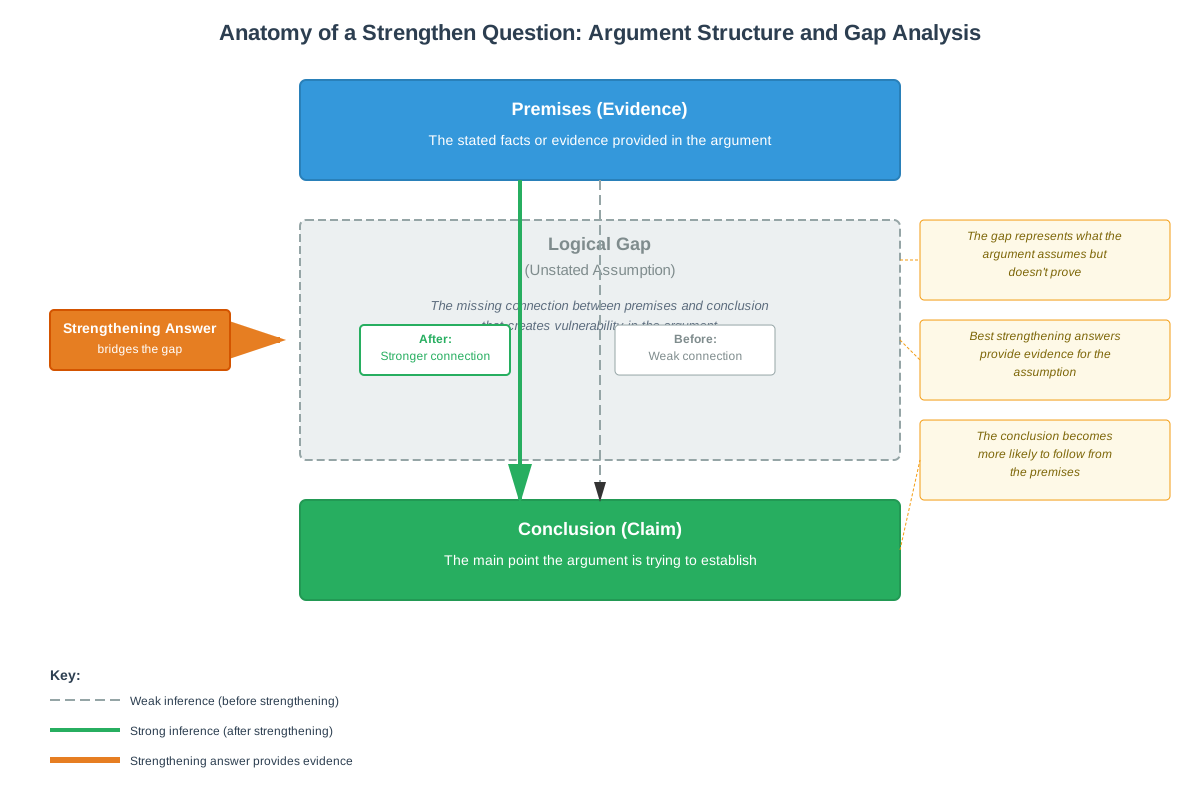
Every strengthen question involves three essential components: the argument's premises (stated evidence), the argument's conclusion (the claim being made), and the logical gap between them (unstated assumptions or potential weaknesses). The correct answer will provide new information that bridges this gap, making the conclusion follow more reliably from the premises.
Identifying Strengthen Questions
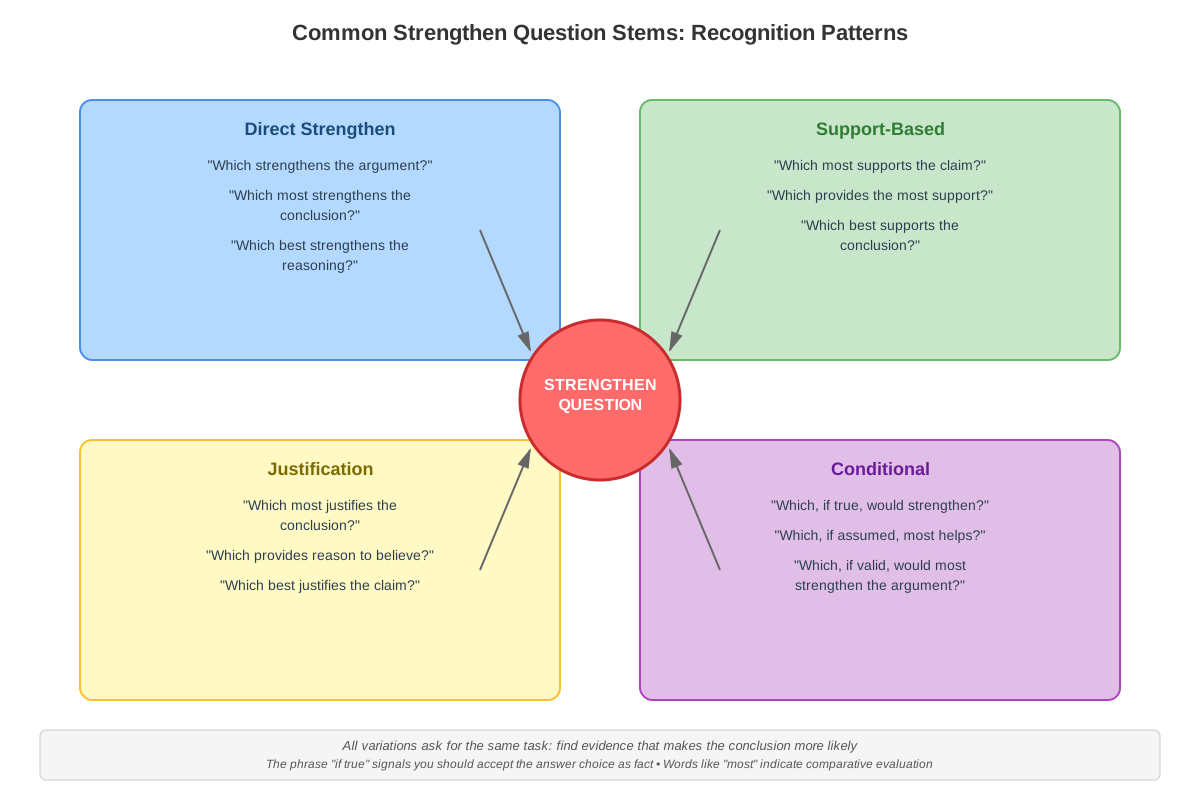
LSAT strengthen questions use predictable language patterns that signal the question type. Common question stems include:
- "Which one of the following, if true, most strengthens the argument?"
- "Which one of the following, if true, provides the most support for the conclusion?"
- "Which one of the following, if true, most helps to justify the reasoning above?"
- "The argument would be most strengthened if which one of the following were true?"
- "Which one of the following, if true, would most support the claim that...?"
Recognizing these stems immediately allows test-takers to shift into the appropriate analytical mode: looking for gaps in the argument and predicting what information would fill those gaps.
The Reasoning Pattern Behind Strengthen Questions
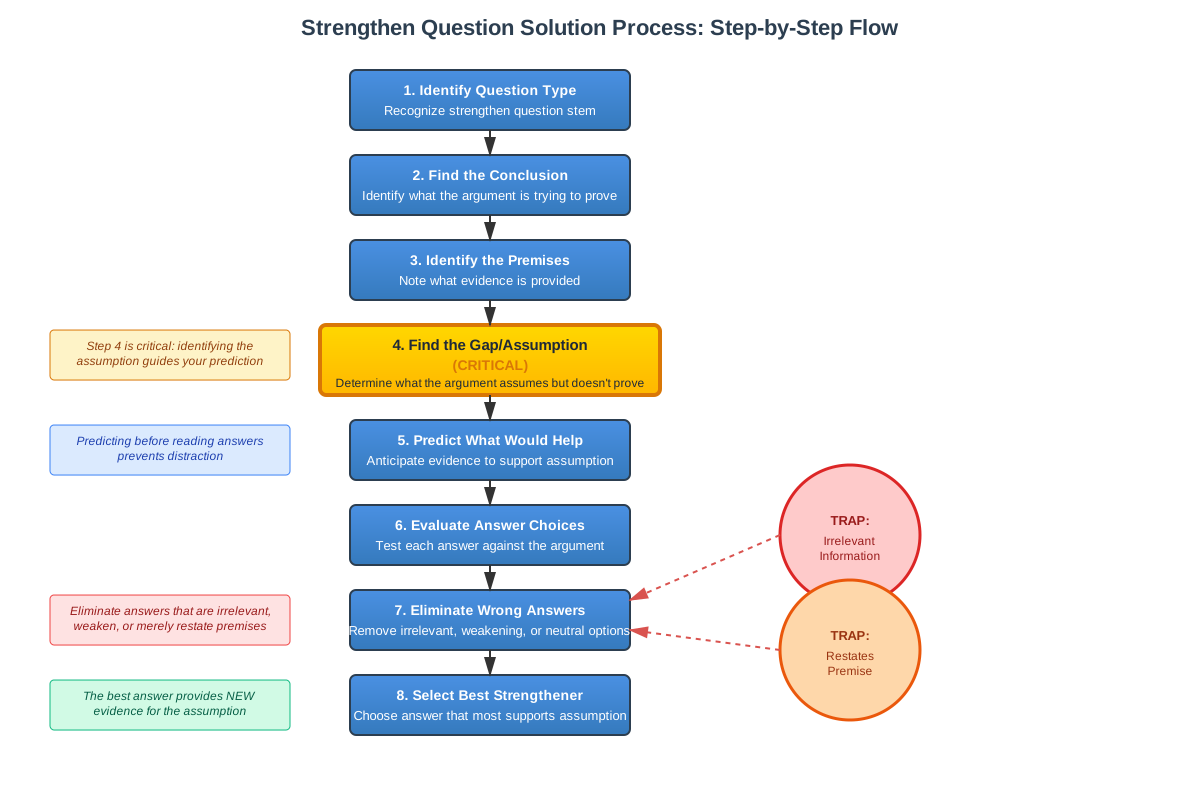
The logical reasoning pattern for strengthen questions follows a systematic approach:
- Identify the conclusion: Determine exactly what claim the argument is trying to establish
- Identify the premises: Note what evidence is explicitly provided
- Identify the gap: Recognize what assumptions the argument makes or what potential objections exist
- Predict the strengthener: Before looking at answer choices, anticipate what information would help bridge the gap
- Evaluate answer choices: Assess each option's impact on the argument's logical strength
This pattern works because strengthen questions exploit predictable logical vulnerabilities. Arguments on the LSAT typically contain gaps between premises and conclusions—unstated assumptions that must be true for the reasoning to work. The correct answer provides evidence that makes these assumptions more likely to be true or eliminates potential objections to the conclusion.
Types of Strengthening Evidence
Different argument structures require different types of strengthening evidence:
| Argument Type | Strengthening Strategy | Example |
|---|---|---|
| Causal | Provide evidence of correlation, eliminate alternative causes, or show mechanism | If arguing A causes B, show that when A is absent, B doesn't occur |
| Analogical | Strengthen the similarity between compared items | If comparing X to Y, show additional relevant similarities |
| Statistical | Provide evidence that the sample is representative | If generalizing from a study, show the sample wasn't biased |
| Predictive | Show past patterns or relevant precedents | If predicting future events, show similar past situations had predicted outcomes |
| Prescriptive | Demonstrate feasibility or eliminate negative consequences | If recommending action X, show X is practical and won't cause problems |
The Degree of Strengthening
Not all strengthening answer choices are created equal. The LSAT often includes multiple answer choices that provide some support to the argument, but the correct answer provides the most support. Test-takers must evaluate the relative strength of different pieces of evidence.
A strongly strengthening answer choice typically:
- Directly addresses the argument's central assumption
- Eliminates the most significant alternative explanation
- Provides evidence for the most vulnerable part of the reasoning
- Creates a logical connection between premise and conclusion
A weakly strengthening answer choice might:
- Address a peripheral concern rather than the main gap
- Provide indirect rather than direct support
- Strengthen only one premise rather than the connection to the conclusion
- Be consistent with the argument without actively supporting it
Common Argument Structures in Strengthen Questions
Causal arguments are among the most frequent in strengthen questions. These arguments claim that one thing causes another. To strengthen a causal argument, the correct answer typically:
- Shows correlation between cause and effect
- Eliminates alternative causes
- Demonstrates a mechanism linking cause to effect
- Shows that when the cause is absent, the effect doesn't occur
Comparison arguments draw analogies between two situations. To strengthen these, the correct answer usually:
- Highlights additional relevant similarities
- Shows that apparent differences are actually insignificant
- Demonstrates that the comparison is appropriate for the conclusion being drawn
Sampling/generalization arguments draw broad conclusions from limited evidence. These are strengthened by:
- Showing the sample is representative
- Demonstrating the sample size is adequate
- Eliminating sampling bias
- Showing consistency across different samples
Concept Relationships
The concepts within strengthen questions form an interconnected analytical framework. Identifying strengthen questions through their characteristic stems → enables → applying the reasoning pattern of finding gaps → which requires → understanding argument structures (causal, analogical, statistical) → which determines → what type of strengthening evidence is needed → which must be evaluated for → degree of strengthening to select the best answer.
Strengthen questions connect intimately to prerequisite topics. Assumption identification provides the foundation for strengthen questions because the best strengthening answers typically provide evidence for unstated assumptions. Causal reasoning knowledge directly applies when evaluating causal arguments in strengthen questions. Conditional reasoning helps recognize when answer choices create logical connections that support conclusions.
The relationship to related topics is equally important. Strengthen questions form a natural pair with weaken questions—understanding what strengthens an argument automatically illuminates what would weaken it. Both question types require the same initial analysis (identifying conclusion, premises, and gaps) but apply opposite evaluative criteria. Assumption questions ask what must be true for an argument to work, while strengthen questions ask what additional information would make it work better. Flaw questions identify logical errors, and strengthen questions often provide evidence that would remedy those flaws.
High-Yield Facts
⭐ Strengthen questions appear 4-6 times per LSAT, making them one of the highest-frequency question types in Logical Reasoning sections.
⭐ The correct answer must provide NEW information not already stated in the argument; restating premises never strengthens.
⭐ "If true" means accept the answer choice as fact—never evaluate whether the answer choice is actually true or likely.
⭐ The best strengthener addresses the argument's central assumption or biggest gap, not peripheral concerns.
⭐ Eliminating alternative explanations is one of the most powerful strengthening strategies, especially for causal arguments.
- Strengthen questions test the same analytical skills as assumption questions but ask for supporting evidence rather than necessary conditions.
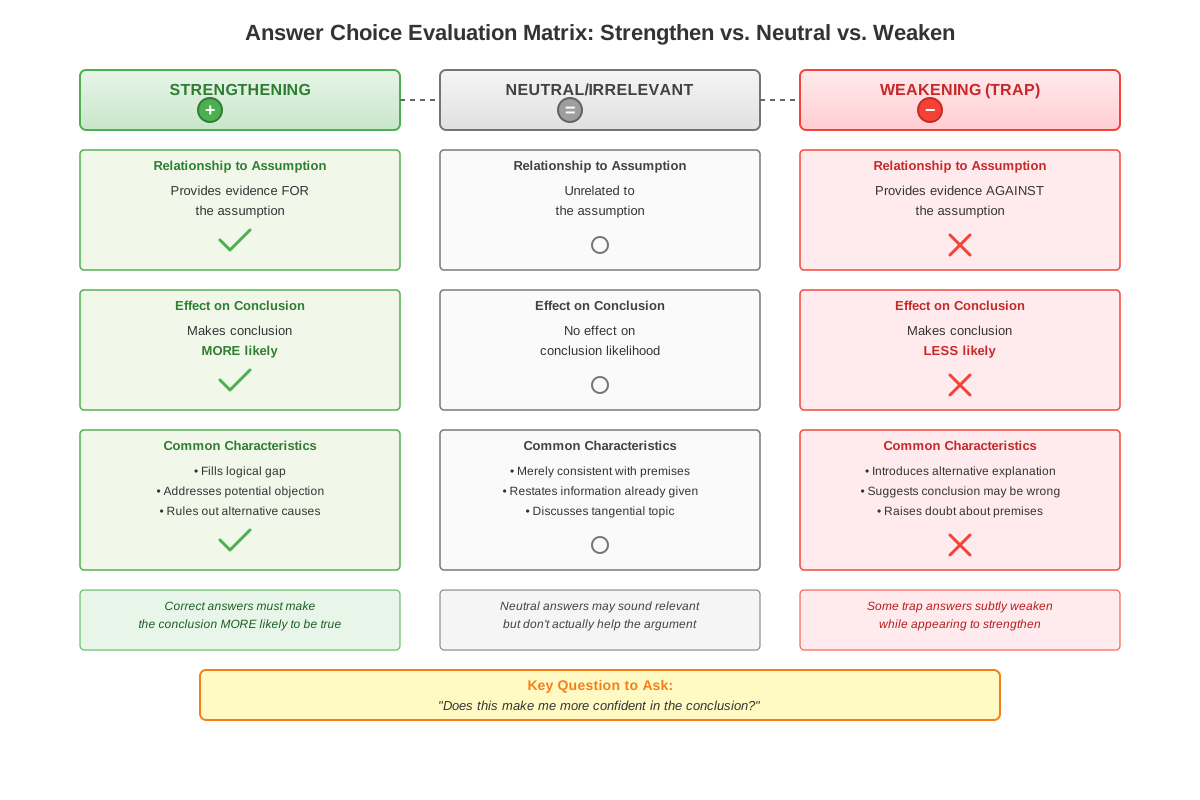
- Answer choices that are merely consistent with the argument do not strengthen it—they must actively provide support.
- The correct answer often makes the conclusion more likely but rarely makes it certain or proven.
- Causal arguments are strengthened by showing correlation, mechanism, or elimination of alternative causes.
- Statistical arguments are strengthened by showing representative samples and eliminating bias.
- Comparison arguments are strengthened by highlighting relevant similarities or showing differences are insignificant.
- The phrase "most strengthens" indicates multiple answers may provide some support, but only one provides the most.
- Strengthening an argument is different from proving it—the conclusion can still be false even with the strengthening evidence.
Quick check — test yourself on Strengthen questions so far.
Try Flashcards →Common Misconceptions
Misconception: Any answer choice that is consistent with the argument strengthens it.
Correction: Consistency is not sufficient for strengthening. An answer must actively provide support by addressing assumptions, eliminating alternatives, or creating logical connections. An answer can be perfectly consistent with an argument while providing zero additional support for its conclusion.
Misconception: The correct answer will prove the conclusion or make it certain.
Correction: Strengthen questions ask for support, not proof. The correct answer makes the conclusion more likely or better supported, but the conclusion could still potentially be false. The standard is "most strengthens," not "proves conclusively."
Misconception: If an answer choice strengthens one premise, it strengthens the argument.
Correction: Strengthening a premise is only valuable if that premise was questionable and relevant to the conclusion. The goal is to strengthen the connection between premises and conclusion, not to provide additional support for premises that are already accepted as given.
Misconception: Longer or more detailed answer choices provide stronger support.
Correction: The strength of support depends on logical relevance, not length or detail. A concise answer that directly addresses the central gap is far stronger than a lengthy answer that discusses peripheral issues.
Misconception: The correct answer must address every potential weakness in the argument.
Correction: The correct answer need only provide the most support among the available options. It doesn't need to address every possible objection or make the argument airtight—it just needs to strengthen it more than the other choices do.
Misconception: Strengthen questions and assumption questions are essentially the same.
Correction: While related, these question types differ fundamentally. Assumption questions ask what must be true for the argument to work (necessary conditions), while strengthen questions ask what additional information would make the argument work better (sufficient support). An assumption is required; a strengthener is helpful but not required.
Misconception: The correct answer will always introduce completely new concepts.
Correction: While the correct answer must provide new information, it often relates directly to concepts already mentioned in the argument. The best strengtheners typically address the relationship between existing concepts rather than introducing entirely unrelated ideas.
Worked Examples
Example 1: Causal Argument
Argument: "City officials attribute the 30% decrease in traffic accidents over the past year to the installation of new traffic cameras at major intersections. The cameras were installed at the beginning of last year, and accident rates have declined steadily since then."
Question: Which one of the following, if true, most strengthens the city officials' argument?
Analysis:
- Conclusion: The traffic cameras caused the decrease in accidents
- Premises: Cameras were installed; accidents decreased 30% afterward
- Gap: This is a classic causal argument with a correlation-causation gap. The argument assumes that the cameras caused the decrease, but other factors could explain it (better weather, fewer drivers, improved road conditions, etc.)
- Prediction: The best strengthener would eliminate alternative explanations or show a mechanism connecting cameras to fewer accidents
Answer Choices:
(A) Neighboring cities without traffic cameras saw no decrease in accident rates during the same period
(B) The traffic cameras are equipped with the latest digital technology
(C) Most drivers in the city are aware that traffic cameras have been installed
(D) The city's population increased by 5% during the past year
(E) Traffic cameras have been used successfully in other countries
Evaluation:
- (A) This is the correct answer. It eliminates alternative explanations by showing that cities without cameras (but presumably subject to the same regional factors like weather, economic conditions, etc.) didn't experience the same decrease. This makes it much more likely that the cameras specifically caused the decrease.
- (B) The technology type is irrelevant to whether cameras reduce accidents. This doesn't address the causal gap.
- (C) Driver awareness might seem relevant, but it doesn't eliminate alternative explanations or strengthen the causal connection. Awareness could exist without affecting behavior.
- (D) This actually introduces a potential weakener (more people might mean more accidents), but it doesn't strengthen the causal claim.
- (E) Success elsewhere provides weak analogical support but doesn't address whether cameras caused THIS city's decrease or whether other factors were responsible.
Connection to Learning Objectives: This example demonstrates how to identify the reasoning pattern (causal), predict what would strengthen it (eliminating alternatives), and apply that understanding to select the correct answer.
Example 2: Statistical/Sampling Argument
Argument: "A recent survey of 500 adults found that 78% prefer reading news online rather than in print newspapers. Therefore, print newspapers will likely become obsolete within the next decade."
Question: Which one of the following, if true, most strengthens the argument?
Analysis:
- Conclusion: Print newspapers will likely become obsolete within a decade
- Premises: Survey of 500 adults showed 78% prefer online news
- Gaps: Multiple gaps exist: (a) Is the sample representative? (b) Do preferences translate to behavior? (c) Will current preferences persist? (d) Does 78% preference mean print becomes obsolete?
- Prediction: The best strengthener would address the most significant gap—likely the representativeness of the sample or the connection between preference and obsolescence
Answer Choices:
(A) The 500 adults surveyed were randomly selected from across all age groups and demographics
(B) Online news sources have increased in number over the past five years
(C) Some people who prefer online news occasionally still read print newspapers
(D) The survey was conducted by a reputable polling organization
(E) Print newspaper circulation has declined by 15% over the past three years
Evaluation:
- (A) This is the correct answer. It addresses the sampling concern by showing the survey is representative, making it more likely that the 78% figure reflects the broader population. This strengthens the evidentiary basis for the prediction.
- (B) This provides context but doesn't strengthen the connection between the survey results and the conclusion about obsolescence.
- (C) This actually slightly weakens the argument by suggesting print newspapers retain some value even among those who prefer online news.
- (D) The organization's reputation might make the survey more credible, but this is weaker than showing the sample is representative. A reputable organization could still have an unrepresentative sample.
- (E) This provides independent support for declining print readership but doesn't strengthen the connection between the survey results and the conclusion. It's additional evidence rather than strengthening evidence for the argument as presented.
Connection to Learning Objectives: This example shows how to distinguish between answer choices that provide some support versus the one that provides the most support, and how to recognize that addressing sampling concerns strengthens statistical arguments.
Exam Strategy
When approaching LSAT strengthen questions, follow this systematic process:
Step 1: Identify the question type by scanning for trigger phrases like "most strengthens," "most supports," or "most justifies." This takes 2-3 seconds and ensures the correct analytical approach.
Step 2: Read the argument actively with the goal of identifying conclusion, premises, and gaps. Mark or mentally note the conclusion (often signaled by "therefore," "thus," "so," or "consequently"). Identify what evidence is provided and what assumptions connect that evidence to the conclusion.
Step 3: Articulate the gap before looking at answer choices. Ask: "What is this argument assuming?" or "What alternative explanations exist?" or "What could go wrong with this reasoning?" Spending 10-15 seconds on this prediction dramatically improves accuracy.
Step 4: Evaluate answer choices systematically. For each option, ask: "If this were true, would it make the conclusion more likely?" Use the process of elimination aggressively—four answers are wrong.
Exam Tip: The phrase "if true" is your permission to accept even seemingly unlikely answer choices as fact. Never eliminate an answer because it seems implausible in the real world.
Trigger words to watch for in answer choices:
- Elimination language: "no other," "only," "the sole"—these eliminate alternatives
- Correlation language: "whenever," "in all cases where"—these establish patterns
- Mechanism language: "by means of," "through the process of"—these explain how
- Representativeness language: "randomly selected," "across all groups"—these address sampling
Process-of-elimination tips:
- Eliminate answers that restate premises without adding new information
- Eliminate answers that address irrelevant issues not connected to the conclusion
- Eliminate answers that are merely consistent with the argument without supporting it
- Eliminate answers that strengthen a premise but not the connection to the conclusion
- When two answers both strengthen, choose the one addressing the central gap rather than a peripheral concern
Time allocation: Spend approximately 1:20-1:30 per strengthen question. Allocate 20-30 seconds to reading and analyzing the argument, 10-15 seconds to predicting the strengthener, and 40-60 seconds to evaluating answer choices. If stuck between two answers, choose the one that addresses the biggest logical gap.
Memory Techniques
STRENGTHEN mnemonic for the systematic approach:
- Spot the question type (identify strengthen question)
- Target the conclusion (find what's being argued)
- Recognize the premises (note the evidence)
- Expose the gap (identify assumptions)
- Name the need (predict what would help)
- Gauge each answer (evaluate support provided)
- Test the connection (ensure relevance to conclusion)
- Highlight the strongest (choose best support)
- Eliminate the rest (remove wrong answers)
- Nail your choice (select with confidence)
CAUSAL mnemonic for strengthening causal arguments:
- Correlation (show cause and effect occur together)
- Alternatives eliminated (rule out other explanations)
- Unique to cause (effect doesn't occur without cause)
- Similar cases (show pattern across instances)
- Absence matters (no cause means no effect)
- Link mechanism (explain how cause produces effect)
Visualization strategy: Picture the argument as a bridge with the premises on one side and the conclusion on the other. The gap is the missing section of bridge. The correct answer provides materials that fill that gap, making the bridge stronger and more likely to hold. Wrong answers either provide materials for the wrong part of the bridge or provide materials that don't actually connect anything.
The "NEW" rule: The correct answer must provide New information that is Evidence Worthy—it must be new (not restated), it must be evidence (not opinion or speculation), and it must be worthy of consideration (relevant to the conclusion).
Summary
Strengthen questions are high-frequency LSAT question types that test the ability to identify what additional information would make an argument more convincing. Success requires a systematic approach: identifying the conclusion and premises, recognizing the logical gap between them, predicting what information would bridge that gap, and selecting the answer choice that provides the most support. The correct answer introduces new information that addresses the argument's central assumption, eliminates alternative explanations, or creates a stronger logical connection between premises and conclusion. Common argument types include causal arguments (strengthened by eliminating alternatives or showing mechanism), statistical arguments (strengthened by demonstrating representative samples), and comparison arguments (strengthened by highlighting relevant similarities). The key distinction is between answers that merely agree with the argument versus those that actively support it, and between answers that provide some support versus the one that provides the most support.
Key Takeaways
- Strengthen questions appear 4-6 times per LSAT and ask for new information that makes a conclusion more likely or better supported
- The systematic approach is: identify conclusion → identify premises → identify gap → predict strengthener → evaluate answers
- The correct answer must provide NEW information that addresses the argument's central assumption or biggest logical gap
- "If true" means accept the answer choice as fact regardless of real-world plausibility
- Eliminating alternative explanations is one of the most powerful strengthening strategies, especially for causal arguments
- Distinguish between answers that are merely consistent with the argument versus those that actively provide support
- The best strengthener addresses the connection between premises and conclusion, not just individual premises
Related Topics
Weaken Questions: The mirror image of strengthen questions, asking what information would make an argument less convincing. Mastering strengthen questions makes weaken questions significantly easier because the same analytical approach applies with opposite evaluative criteria.
Assumption Questions: These ask what must be true for an argument to work, while strengthen questions ask what would make it work better. Understanding assumptions is crucial for predicting what would strengthen an argument.
Flaw Questions: These identify logical errors in arguments. Many strengthen questions can be approached by first identifying the flaw, then selecting an answer that would remedy it.
Evaluate Questions: These ask what information would be most useful in assessing an argument's strength. The analytical skills developed for strengthen questions directly transfer to evaluate questions.
Sufficient Assumption Questions: These ask what, if added to the argument, would make the conclusion follow logically. This is a more extreme version of strengthening—making the argument valid rather than just stronger.
Practice CTA
Now that you understand the core concepts and strategies for strengthen questions, it's time to apply this knowledge. Work through the practice questions to reinforce your ability to identify gaps in arguments and select the answer choices that provide the most support. Each practice question is an opportunity to refine your systematic approach and build the pattern recognition that leads to consistent success. Remember: strengthen questions are highly learnable—with focused practice, you can master this high-yield question type and significantly improve your LSAT score. Start practicing now to transform your understanding into performance!
Sign up free to keep reading
Create a free AnvayaPrep account to finish this LSAT guide on Strengthen questions — plus flashcards and practice questions.