Overview
The distinction between prohibited versus discouraged represents a critical conceptual boundary that appears frequently in LSAT Logical Reasoning sections, particularly within principle questions. This distinction tests a student's ability to recognize the difference between absolute prohibitions (actions that must not be done under any circumstances) and discouragements (actions that should generally be avoided but may be permissible under certain conditions). Understanding this nuance is essential because the LSAT frequently constructs questions where answer choices hinge on whether a principle establishes a hard rule or merely expresses a preference or recommendation.
This topic sits at the intersection of conditional reasoning, normative language interpretation, and principle application—three pillars of LSAT success. When the exam presents a principle stating that something is "prohibited," it establishes an absolute constraint: if the conditions are met, the action cannot occur. Conversely, when something is "discouraged," the principle suggests the action should typically be avoided, but exceptions may exist based on competing considerations or special circumstances. The LSAT exploits test-takers' tendency to treat these terms interchangeably, creating trap answers that either overstate the strength of a discouragement or understate the absoluteness of a prohibition.
Mastering the lsat prohibited versus discouraged distinction enhances performance across multiple question types, including Principle-Application questions, Principle-Identification questions, Must Be True questions, and even some Strengthen/Weaken questions where the strength of a normative claim matters. This topic connects directly to understanding modal qualifiers (must, should, may, can), conditional logic (sufficient and necessary conditions), and the interpretation of normative versus descriptive statements—all fundamental skills for achieving a competitive LSAT score.
Learning Objectives
- [ ] Identify how Prohibited versus discouraged appears in LSAT questions
- [ ] Explain the reasoning pattern behind Prohibited versus discouraged
- [ ] Apply Prohibited versus discouraged to solve LSAT-style problems accurately
- [ ] Distinguish between absolute prohibitions and qualified discouragements in complex stimulus language
- [ ] Recognize trap answers that conflate prohibition with discouragement or vice versa
- [ ] Evaluate whether a given scenario violates a prohibition or merely acts against a discouragement
- [ ] Construct valid inferences about what must, may, or cannot occur based on prohibitive versus discouraging principles
Prerequisites
- Conditional Logic Fundamentals: Understanding sufficient and necessary conditions is essential because prohibitions often function as conditional statements (if X, then not Y), while discouragements suggest weaker conditional relationships.
- Modal Qualifiers: Familiarity with terms like "must," "should," "may," "can," and "cannot" provides the linguistic foundation for distinguishing absolute requirements from recommendations.
- Normative versus Descriptive Statements: Recognizing the difference between statements that describe what is the case versus what ought to be the case helps identify when principles are being applied.
- Basic Principle Question Structure: Understanding how principle questions ask students to either apply a general rule to a specific case or identify a general rule from a specific case provides the framework for this topic.
Why This Topic Matters
The prohibited versus discouraged distinction appears in approximately 15-20% of Logical Reasoning questions across typical LSAT administrations, making it a high-frequency concept that directly impacts scores. This topic most commonly surfaces in Principle questions (both application and identification variants), but also appears in Must Be True/Most Strongly Supported questions where the strength of a normative claim determines what can be validly inferred.
In real-world contexts, this distinction underlies legal reasoning, ethical decision-making, and policy interpretation. Legal codes distinguish between mandatory prohibitions (criminal laws) and advisory discouragements (best practices guidelines). Professional ethics differentiate between conduct that violates rules (leading to sanctions) and conduct that is merely inadvisable (subject to professional judgment). Understanding this distinction prepares students not only for LSAT success but also for the nuanced reasoning required in law school and legal practice.
On the LSAT, this topic typically appears in questions where:
- A principle establishes what "must not" be done versus what "should not" be done
- Answer choices require distinguishing between violations of absolute rules and departures from recommendations
- The stimulus describes an action, and the question asks whether it conforms to or violates a stated principle
- Multiple principles with varying strengths must be compared or reconciled
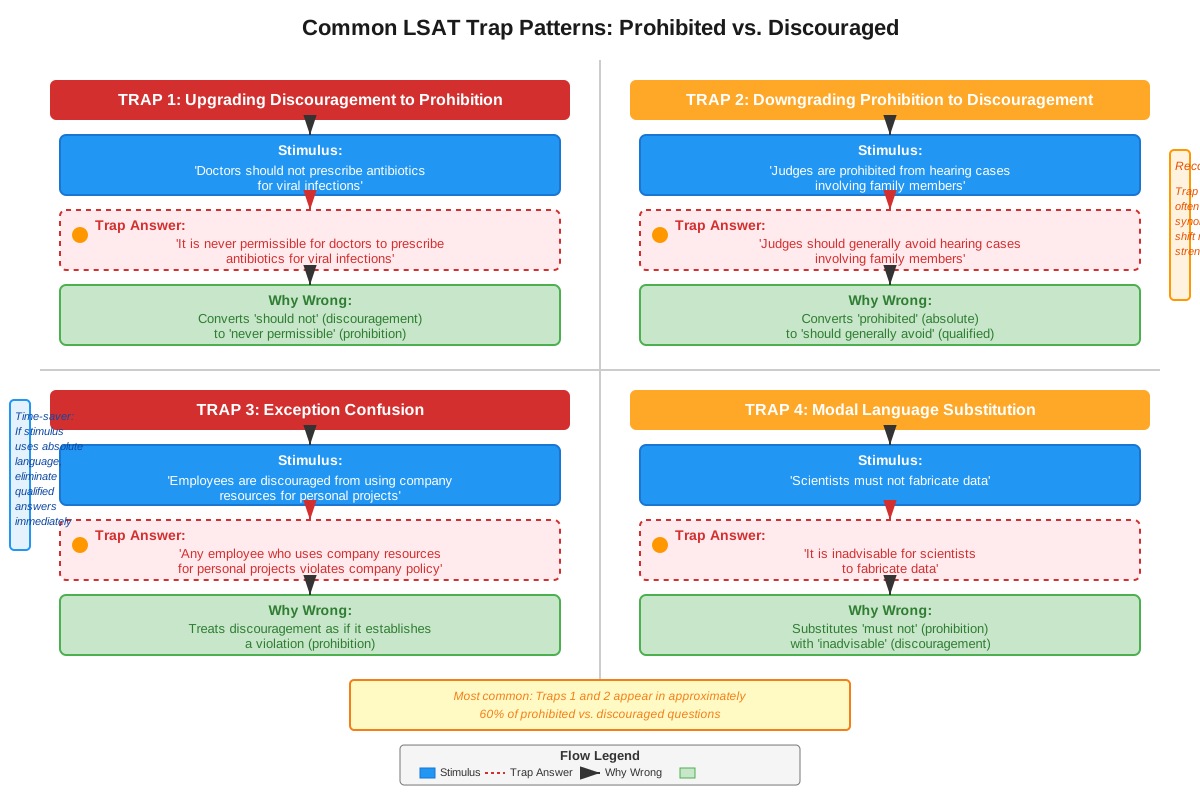
The LSAT deliberately constructs wrong answers that mischaracterize the strength of normative claims, making this one of the most reliable sources of trap answers for unprepared test-takers.
Core Concepts
The Nature of Prohibition
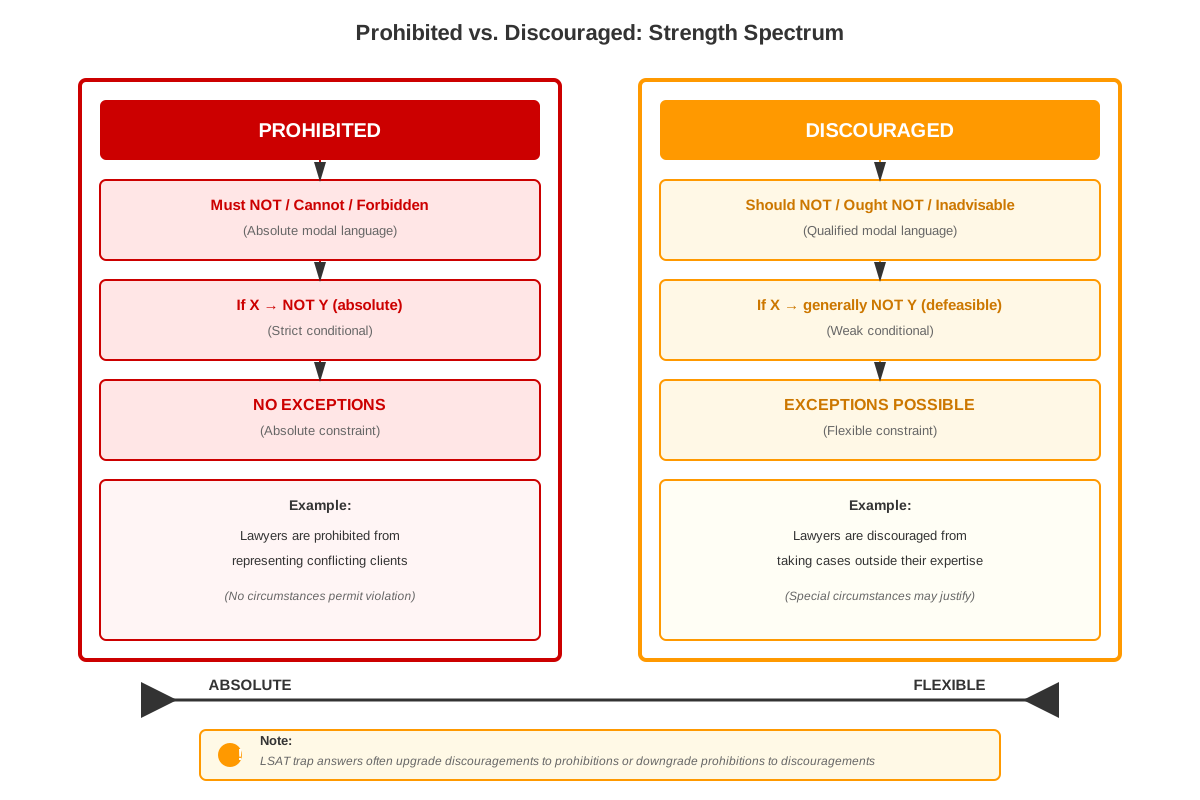
A prohibition establishes an absolute constraint on action. When something is prohibited, it means the action cannot permissibly occur under the specified conditions—there are no exceptions within the scope of the principle. Prohibitions typically use language such as "must not," "cannot," "is forbidden," "is not permitted," or "is prohibited."
The logical structure of a prohibition often takes the form of a conditional with a negated consequent: "If conditions C are met, then action A must not occur" (C → ~A). This creates a strong inference: whenever we know the conditions are satisfied, we can definitively conclude the action should not happen. Conversely, if we observe the action occurring, we can infer the conditions were not met (by contrapositive: A → ~C).
Example: "Attorneys are prohibited from representing clients when doing so would create a conflict of interest." This establishes an absolute rule: if a conflict exists, representation must not occur. An attorney who represents a client despite a conflict violates the prohibition.
The Nature of Discouragement
A discouragement expresses a preference or recommendation against an action without establishing an absolute prohibition. When something is discouraged, it means the action should generally be avoided, but circumstances might justify proceeding anyway. Discouragements typically use language such as "should not," "is inadvisable," "is discouraged," "ought not," or "is not recommended."
The logical structure of a discouragement is weaker than a prohibition. It might be represented as: "If conditions C are met, then action A should generally not occur, unless countervailing factors exist." This creates a defeasible inference—one that holds in typical cases but admits exceptions. Observing the action does not necessarily indicate any violation; it may simply reflect a judgment that exceptional circumstances warranted proceeding.
Example: "Attorneys are discouraged from taking cases outside their primary area of expertise." This expresses a preference but allows for exceptions. An attorney who occasionally handles such cases does not violate any rule, though they act against the recommendation.
Comparative Analysis
| Feature | Prohibition | Discouragement |
|---|---|---|
| Strength | Absolute | Qualified/Conditional |
| Exceptions | None within scope | Permitted based on circumstances |
| Typical Language | Must not, cannot, forbidden, prohibited | Should not, inadvisable, discouraged, not recommended |
| Logical Form | C → ~A (strict conditional) | C → generally ~A (defeasible conditional) |
| Violation | Clear rule-breaking | Departure from recommendation |
| Inference Strength | Definitive conclusions | Presumptive conclusions |
Identifying Strength Indicators in LSAT Language
The LSAT uses precise language to signal whether a principle establishes a prohibition or discouragement. Key indicators include:
Prohibition indicators:
- "Must not" / "Cannot" / "May not"
- "Is prohibited" / "Is forbidden" / "Is impermissible"
- "Never" (when used normatively)
- "Under no circumstances"
- "Is required not to"
Discouragement indicators:
- "Should not" / "Ought not"
- "Is discouraged" / "Is inadvisable" / "Is not recommended"
- "Generally should avoid"
- "Preferably not"
- "It would be better not to"
Ambiguous language requiring context:
- "Wrong" (could be moral prohibition or mere inadvisability)
- "Inappropriate" (could be absolute or contextual)
- "Unacceptable" (typically stronger, closer to prohibition)
Application to Scenarios
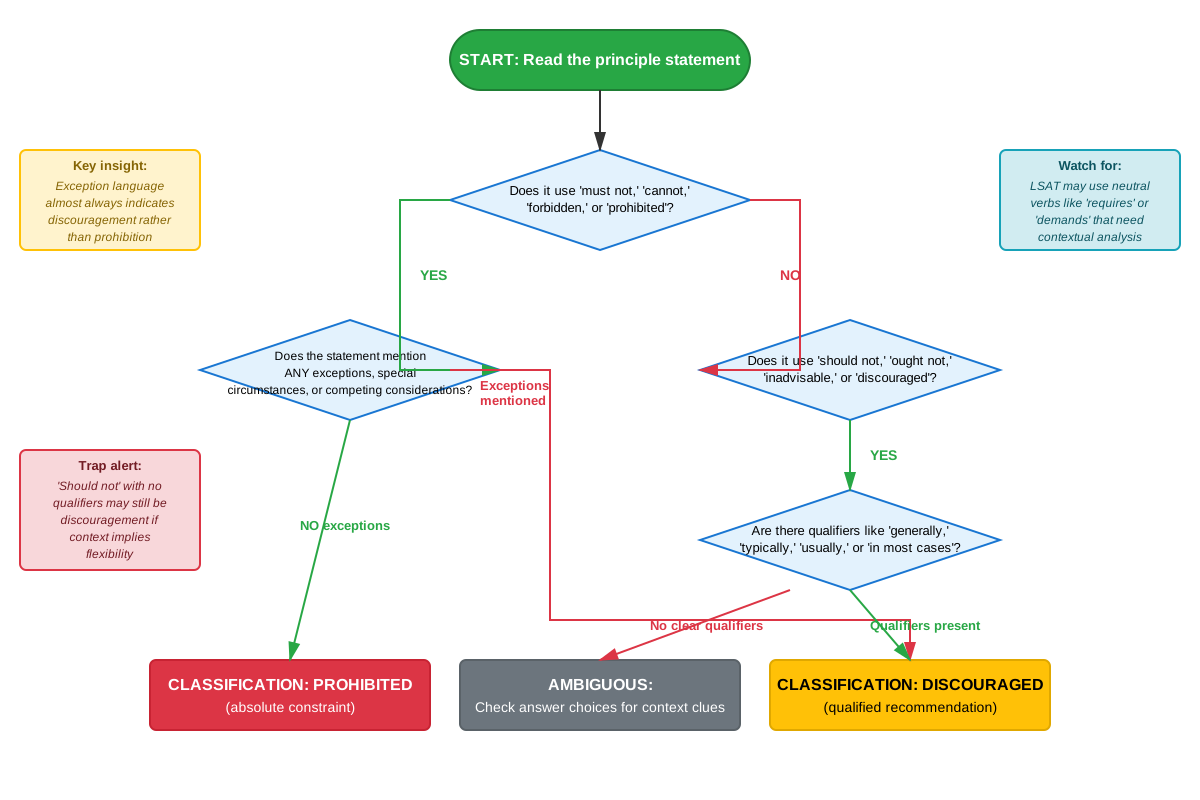
When applying prohibited versus discouraged principles to specific scenarios, follow this analytical framework:
- Identify the principle's strength: Determine whether the language establishes an absolute prohibition or a qualified discouragement.
- Determine whether conditions are met: Assess whether the scenario satisfies the conditions that trigger the principle.
- Evaluate the action: Determine what action occurred or is proposed.
- Draw appropriate inferences:
- For prohibitions: If conditions are met and action occurred, a violation exists; if action is proposed, it must not proceed.
- For discouragements: If conditions are met and action occurred, it goes against the recommendation but may be justified; if action is proposed, it should generally not proceed unless special circumstances exist.
The Role of Competing Considerations
A crucial distinction between prohibitions and discouragements lies in how they interact with competing considerations. Prohibitions typically override other considerations within their scope—they represent non-negotiable constraints. Discouragements, by contrast, can be outweighed by sufficiently strong competing factors.
Example: If a principle prohibits lawyers from revealing client confidences, then no competing consideration (except perhaps those explicitly carved out in the principle itself) can justify revelation. If a principle merely discourages lawyers from working excessive hours, then competing considerations (urgent client need, case deadline) might justify doing so without any violation.
Scope Limitations and Exceptions
Both prohibitions and discouragements can include explicit scope limitations or exceptions. The key difference is that:
- Prohibitions with exceptions: The prohibition is absolute within its defined scope, but the scope itself may be limited. "Attorneys are prohibited from revealing client confidences, except when required by law." Within the scope (absent legal requirement), the prohibition is absolute.
- Discouragements with exceptions: The discouragement applies generally but admits of contextual override. "Attorneys are discouraged from taking cases outside their expertise, except when no qualified attorney is available." The exception here is illustrative rather than exhaustive—other circumstances might also justify proceeding.
Concept Relationships
The prohibited versus discouraged distinction builds directly on conditional logic: prohibitions function as strict conditionals (if conditions met, then action must not occur), while discouragements function as defeasible conditionals (if conditions met, then action should generally not occur, absent countervailing factors). This connection means that students who master conditional reasoning can more easily recognize the logical structure underlying these normative principles.
The distinction also connects to modal qualifiers and strength of language. Understanding the hierarchy of modal terms (must > should > may) enables students to quickly categorize principles by strength. This skill transfers to other Logical Reasoning question types, including Must Be True questions (where conclusion strength must match premise strength) and Flaw questions (where overstated conclusions represent common errors).
Within principle questions specifically, the prohibited versus discouraged distinction relates to principle application (applying a general rule to a specific case) and principle identification (identifying which general rule governs a specific case). In application questions, students must determine whether a scenario violates, conforms to, or merely departs from a stated principle. In identification questions, students must select a principle with the appropriate strength to justify the reasoning in the stimulus.
Relationship Map:
Conditional Logic → provides logical structure for → Prohibited versus Discouraged → determines strength of → Principle Application → enables accurate → Inference Drawing → supports performance on → Must Be True, Principle, and Flaw Questions
The distinction also connects forward to more advanced topics like conflicting principles and exception handling, where students must determine which principle takes precedence when multiple normative claims apply to a single scenario.
Quick check — test yourself on Prohibited versus discouraged so far.
Try Flashcards →High-Yield Facts
⭐ Prohibitions establish absolute constraints: If something is prohibited under specified conditions, it cannot permissibly occur when those conditions are met—no exceptions exist within the principle's scope.
⭐ Discouragements admit exceptions: If something is discouraged, it should generally be avoided, but competing considerations may justify proceeding without any violation.
⭐ "Must not" signals prohibition; "should not" signals discouragement: These modal qualifiers are the most reliable linguistic markers of principle strength on the LSAT.
⭐ Violating a prohibition is always wrong within scope; acting against a discouragement may be justified: This difference determines whether an action represents rule-breaking or merely a departure from a recommendation.
⭐ Trap answers often conflate the two: Wrong answer choices frequently treat a discouragement as if it were a prohibition (claiming a violation occurred when someone merely acted inadvisably) or treat a prohibition as if it were a discouragement (suggesting exceptions exist when none do).
- Prohibitions use conditional logic with negated consequents: C → ~A (if conditions, then not action).
- Discouragements create presumptions rather than absolute rules: they establish what should typically occur but allow for contextual override.
- The contrapositive of a prohibition is valid and strong: if the prohibited action occurs, the triggering conditions were not met.
- Competing considerations can outweigh discouragements but not prohibitions (within scope).
- Explicit exceptions to prohibitions define the scope; explicit exceptions to discouragements are illustrative examples rather than exhaustive lists.
- "Never" in normative contexts typically signals prohibition; "generally not" signals discouragement.
- The strength of a principle determines what inferences are valid: prohibitions support definitive conclusions; discouragements support qualified conclusions.
- Context matters for ambiguous terms: "inappropriate" might signal prohibition in formal contexts or mere discouragement in informal contexts.
Common Misconceptions
Misconception: If something is discouraged, it means it's prohibited in most cases but allowed in rare exceptions.
Correction: Discouragement means the action should generally be avoided but may be justified by competing considerations—it's not a prohibition with rare exceptions, but rather a recommendation that can be outweighed. The action never violates a rule; it simply goes against a preference.
Misconception: "Should not" and "must not" are essentially the same, just different ways of expressing the same idea.
Correction: These terms represent fundamentally different strengths of normative claim. "Must not" establishes an absolute prohibition with no permissible exceptions within scope, while "should not" establishes a qualified recommendation that admits of contextual override. The LSAT exploits this distinction systematically.
Misconception: If someone acts against a discouragement, they've done something wrong.
Correction: Acting against a discouragement means acting contrary to a recommendation, not violating a rule. Whether the action is justified depends on the circumstances and competing considerations. Discouragements guide judgment but don't establish violations.
Misconception: Prohibitions never have exceptions.
Correction: Prohibitions are absolute within their defined scope, but the scope itself may include explicit limitations or exceptions. "Prohibited except when..." defines the scope; within that scope, the prohibition is absolute. The key is distinguishing scope limitations (which are part of the rule) from contextual overrides (which don't exist for prohibitions).
Misconception: If a principle says something is "wrong" or "inappropriate," it's automatically a prohibition.
Correction: These terms are ambiguous and require contextual interpretation. "Wrong" might indicate moral prohibition or mere inadvisability. "Inappropriate" might signal absolute impermissibility or contextual unsuitability. The LSAT often includes additional language to clarify strength, and students must attend to these cues rather than assuming strength from ambiguous terms alone.
Misconception: The difference between prohibition and discouragement only matters for principle questions.
Correction: While most prominent in principle questions, this distinction affects any question type where the strength of a normative claim matters—including Must Be True questions (where overstating a discouragement as a prohibition would be invalid), Flaw questions (where treating a recommendation as an absolute rule represents an error), and even some Assumption questions (where the strength of a required principle matters).
Worked Examples
Example 1: Principle Application
Stimulus: "University policy states that professors should not assign final examinations during the last week of classes, as this prevents students from adequately preparing for exams in other courses. Professor Martinez assigned a final examination during the last week of classes because her course covered time-sensitive material that could not be tested later."
Question: Does Professor Martinez's action violate university policy?
Analysis:
Step 1: Identify the principle's strength. The policy states professors "should not" assign exams during the last week—this is discouragement language, not prohibition language. If the policy said "must not" or "are prohibited from," it would establish an absolute rule.
Step 2: Determine whether conditions are met. The conditions (assigning a final exam during the last week) are clearly met by Professor Martinez's action.
Step 3: Evaluate the action against the principle. Since the principle is a discouragement rather than a prohibition, Professor Martinez's action goes against the recommendation but does not necessarily violate policy. The question becomes whether her justification (time-sensitive material) provides sufficient grounds for departing from the recommendation.
Step 4: Draw appropriate inferences. Professor Martinez has not violated university policy because the policy establishes a discouragement, not a prohibition. Her action is contrary to the recommendation, but discouragements admit of exceptions when competing considerations (like pedagogical necessity) justify them. An answer choice stating she "violated policy" would be incorrect; an answer choice stating she "acted contrary to the policy's recommendation but may have been justified in doing so" would be correct.
Key Takeaway: The word "should" rather than "must" is dispositive. This single word determines whether the action represents a violation or merely a justified departure from a recommendation.
Example 2: Principle Identification
Stimulus: "Chen declined to write a letter of recommendation for her former student because doing so would have required her to misrepresent the student's qualifications. Chen explained that while she wanted to help the student, she could not in good conscience provide a misleading recommendation."
Question: Which principle most strongly supports Chen's decision?
Answer Choices:
(A) Professors should not write letters of recommendation for students whose qualifications they cannot honestly represent.
(B) Professors are prohibited from writing letters of recommendation that misrepresent a student's qualifications.
(C) Professors should generally avoid writing letters of recommendation unless they can provide strong endorsements.
(D) It is inadvisable for professors to write letters of recommendation for former students with whom they have lost contact.
Analysis:
The stimulus indicates Chen "could not in good conscience" provide a misleading recommendation—this suggests an absolute constraint, not merely a preference. She didn't say it would be inadvisable or that she preferred not to; she said she could not do it.
(A) uses "should not" (discouragement language), which is too weak. Chen's reasoning suggests something stronger than a mere recommendation against the action.
(B) uses "are prohibited from" (prohibition language), which matches the absolute nature of Chen's constraint. She treats providing a misleading recommendation as something that cannot be done, not merely something that should be avoided.
(C) uses "should generally avoid" (discouragement language) and addresses a different issue (strength of endorsement rather than honesty).
(D) uses "inadvisable" (discouragement language) and addresses an irrelevant issue (contact with students).
Correct Answer: (B). The principle must match the strength of reasoning in the stimulus. Chen's absolute refusal ("could not") requires a prohibition principle, not a discouragement principle.
Key Takeaway: Match principle strength to reasoning strength. When someone says they "cannot" do something (absolute language), select a prohibition principle; when someone says they "should not" do something (qualified language), select a discouragement principle.
Exam Strategy
Recognition Triggers
When approaching LSAT questions involving prohibited versus discouraged, watch for these trigger words and phrases:
Prohibition triggers: must not, cannot, may not, prohibited, forbidden, impermissible, never, under no circumstances, required not to, not allowed
Discouragement triggers: should not, ought not, discouraged, inadvisable, not recommended, preferably not, generally should avoid, better not to
Exam Tip: If you see "should" or "discouraged," immediately note that exceptions are possible. If you see "must" or "prohibited," note that no exceptions exist within scope.
Question Approach Framework
- Read the principle first (in application questions) or the scenario first (in identification questions) to understand what's being evaluated.
- Identify and mark strength indicators: Circle or underline modal qualifiers (must, should, may) and normative terms (prohibited, discouraged, forbidden, inadvisable).
- Categorize the principle: Mentally label it as "PROHIBITION" or "DISCOURAGEMENT" before proceeding.
- For application questions: Determine whether the scenario satisfies the principle's conditions, then evaluate whether the action violates (prohibition) or merely departs from (discouragement) the principle.
- For identification questions: Assess the strength of reasoning in the stimulus, then select a principle with matching strength.
Eliminating Wrong Answers
The most common trap answers in prohibited versus discouraged questions:
- Strength mismatch: An answer choice treats a discouragement as a prohibition (claiming a violation when only a departure occurred) or treats a prohibition as a discouragement (suggesting exceptions when none exist).
- Scope confusion: An answer choice applies a prohibition or discouragement to circumstances outside its defined scope.
- Reversal errors: An answer choice confuses what is prohibited/discouraged with what is required/encouraged.
Elimination Strategy: When two answer choices differ only in strength (one uses "must not," the other "should not"), the correct answer almost always depends on matching the strength to the stimulus language. Check the stimulus carefully for modal qualifiers.
Time Management
Prohibited versus discouraged questions typically require 1:15-1:30 to complete accurately. Allocate time as follows:
- 20-30 seconds: Read and categorize the principle by strength
- 30-40 seconds: Analyze the scenario or evaluate answer choices
- 20-30 seconds: Confirm the answer matches principle strength and scope
If you find yourself spending more than 1:45 on such a question, you may be overcomplicating the analysis. The key insight usually hinges on a single word indicating strength.
Memory Techniques
The "MUST vs. SHOULD" Mnemonic
MUST = Mandatory Under Stated Terms (prohibition)
SHOULD = Suggested Heuristic Open to Unique Logical Departures (discouragement)
The Traffic Light Visualization
Visualize prohibitions as red lights: you must stop, no exceptions (within scope). Visualize discouragements as yellow lights: you should generally proceed with caution or stop, but circumstances might justify proceeding.
The "Exception Test"
When encountering a principle, ask: "Could I imagine a reasonable exception to this?" If yes, it's likely a discouragement. If no (within the stated scope), it's likely a prohibition. This quick mental test helps categorize principles rapidly.
The Strength Spectrum
Memorize this hierarchy of normative strength:
STRONGEST → Prohibited / Must not / Cannot / Forbidden
↓
Required / Must / Obligated
↓
Should / Ought / Recommended
↓
May / Permitted / Allowed
↓
WEAKEST → Discouraged / Should not / Inadvisable
Position any principle you encounter on this spectrum to understand its strength relative to other claims.
Summary
The prohibited versus discouraged distinction represents a fundamental difference in normative strength that the LSAT tests extensively across Logical Reasoning questions. Prohibitions establish absolute constraints using language like "must not," "cannot," or "prohibited," creating strict conditionals that admit no exceptions within their defined scope. Discouragements establish qualified recommendations using language like "should not," "discouraged," or "inadvisable," creating defeasible presumptions that can be outweighed by competing considerations. The LSAT systematically exploits test-takers' tendency to conflate these categories, constructing trap answers that either overstate discouragements as prohibitions or understate prohibitions as discouragements. Success requires careful attention to modal qualifiers, precise categorization of principle strength, and accurate matching of principles to scenarios. Students must recognize that violating a prohibition represents rule-breaking, while acting against a discouragement represents a departure from a recommendation that may be justified by circumstances. This distinction appears most prominently in principle questions but affects any question type where normative strength matters, making it a high-yield topic for LSAT preparation.
Key Takeaways
- Prohibitions are absolute within scope; discouragements admit exceptions: This fundamental difference determines whether an action violates a rule or merely departs from a recommendation.
- Modal qualifiers are dispositive: "Must not" signals prohibition; "should not" signals discouragement. These single words determine the correct answer in many questions.
- Trap answers conflate strength: The most common wrong answers treat discouragements as prohibitions or prohibitions as discouragements.
- Match principle strength to reasoning strength: In identification questions, select principles whose strength matches the absoluteness or qualifiedness of the reasoning in the stimulus.
- Competing considerations can outweigh discouragements but not prohibitions: This difference determines when exceptions are permissible.
- Context clarifies ambiguous terms: Words like "wrong" or "inappropriate" require contextual interpretation; look for additional language indicating strength.
- This distinction appears across question types: While most prominent in principle questions, prohibited versus discouraged affects Must Be True, Flaw, and other question types where normative strength matters.
Related Topics
Conditional Logic and Contrapositives: Understanding how prohibitions function as conditionals with negated consequents (C → ~A) and how to derive valid contrapositives deepens mastery of prohibited versus discouraged reasoning.
Sufficient versus Necessary Conditions: Exploring how prohibitions establish necessary conditions (if action occurs, conditions were not met) and how discouragements create weaker relationships enhances principle analysis skills.
Strength of Language in Arguments: Studying how conclusion strength must match premise strength in Must Be True questions builds on the same attention to modal qualifiers required for prohibited versus discouraged distinctions.
Conflicting Principles and Exception Handling: Advanced topics involving multiple principles with different strengths require mastery of prohibited versus discouraged as a foundation for determining which principle takes precedence.
Normative versus Descriptive Reasoning: Understanding the broader distinction between "is" and "ought" statements provides philosophical context for prohibited versus discouraged principles.
Practice CTA
Now that you've mastered the conceptual foundation of prohibited versus discouraged, it's time to cement your understanding through active practice. Attempt the practice questions associated with this topic, paying special attention to identifying modal qualifiers and categorizing principle strength before evaluating answer choices. Use the flashcards to reinforce recognition of prohibition versus discouragement language until it becomes automatic. Remember: the difference between a good LSAT score and a great one often comes down to mastering these subtle but systematic distinctions. Every question you practice builds the pattern recognition that will serve you on test day. You've got this!
Sign up free to keep reading
Create a free AnvayaPrep account to finish this LSAT guide on Prohibited versus discouraged — plus flashcards and practice questions.