Overview
Descriptive reasoning represents one of the fundamental reasoning patterns tested throughout the LSAT Logical Reasoning section. Unlike prescriptive or normative reasoning that tells us what should be done, descriptive reasoning focuses on explaining, characterizing, or describing what is the case—presenting facts, observations, phenomena, or situations without necessarily drawing evaluative conclusions or making recommendations. On the LSAT, recognizing descriptive reasoning is crucial because many stimulus passages present purely factual information that serves as the foundation for various question types, from Main Point questions to Method of Reasoning questions.
Understanding lsat descriptive reasoning enables test-takers to distinguish between passages that merely report information and those that construct arguments with premises supporting conclusions. This distinction becomes particularly important when identifying argument structure, evaluating reasoning patterns, or determining what role a particular statement plays within a passage. Descriptive reasoning often appears in background information, context-setting statements, or in passages where the author's primary purpose is to explain rather than persuade or advocate.
Within the broader framework of argument fundamentals, descriptive reasoning occupies a foundational position. Before students can effectively analyze arguments, identify flaws, or evaluate conclusions, they must first recognize when reasoning is purely descriptive versus when it becomes argumentative. This skill connects directly to understanding logical reasoning more broadly, as the LSAT frequently tests whether students can differentiate between factual descriptions, explanatory accounts, and persuasive arguments—each requiring different analytical approaches and strategic thinking.
Learning Objectives
- [ ] Identify how Descriptive reasoning appears in LSAT questions
- [ ] Explain the reasoning pattern behind Descriptive reasoning
- [ ] Apply Descriptive reasoning to solve LSAT-style problems accurately
- [ ] Distinguish descriptive reasoning from prescriptive and argumentative reasoning in stimulus passages
- [ ] Recognize the structural markers and linguistic cues that signal purely descriptive content
- [ ] Evaluate how descriptive statements function within larger argumentative contexts
- [ ] Predict question types most likely to feature descriptive reasoning passages
Prerequisites
- Basic argument structure: Understanding premises, conclusions, and how they relate is essential because descriptive reasoning often provides the factual foundation upon which arguments are built
- Reading comprehension fundamentals: The ability to parse complex sentences and identify main ideas enables recognition of when a passage is describing rather than arguing
- Familiarity with LSAT question types: Knowing the various Logical Reasoning question formats helps identify where descriptive reasoning typically appears and how it's tested
Why This Topic Matters
Descriptive reasoning appears in approximately 15-20% of LSAT Logical Reasoning questions, either as the primary reasoning pattern in a stimulus or as a component within more complex passages. Understanding this pattern proves essential for success on Main Point questions, Method of Reasoning questions, and Role of Statement questions, where distinguishing descriptive content from argumentative content directly determines the correct answer.
In real-world contexts, descriptive reasoning forms the backbone of scientific reporting, journalism, historical accounts, and factual testimony. Legal professionals must constantly distinguish between factual descriptions (what happened) and legal arguments (what those facts mean or what should be done about them). This skill translates directly to legal practice, where attorneys must separate witness testimony describing events from expert opinions offering interpretations or conclusions.
On the LSAT, descriptive reasoning commonly appears in several specific contexts: passages explaining scientific phenomena without advocating for particular theories, historical accounts presenting sequences of events, descriptions of social or economic trends, and explanations of how systems or processes work. The test-makers frequently use descriptive passages to assess whether students can recognize when an author is merely reporting information versus when they're constructing an argument. Additionally, descriptive reasoning often appears in the background or context portions of longer stimulus passages, setting up the factual foundation before an argument begins.
Core Concepts
Definition and Characteristics of Descriptive Reasoning
Descriptive reasoning is a reasoning pattern focused on characterizing, explaining, or reporting what exists, what happened, or how something works, without making evaluative judgments or prescriptive recommendations. This type of reasoning answers questions like "What is it?", "How does it function?", "What occurred?", or "What are its features?" rather than "What should be done?" or "Is this good or bad?"
Key characteristics that distinguish descriptive reasoning include:
- Factual focus: Presents information as observable facts, data, or established knowledge
- Neutral tone: Avoids evaluative language suggesting approval, disapproval, or judgment
- Explanatory purpose: Aims to increase understanding rather than persuade or advocate
- Absence of normative claims: Does not include statements about what ought to be or should happen
- Observational basis: Typically grounded in observation, measurement, or documented evidence
Linguistic Markers of Descriptive Reasoning
Recognizing descriptive reasoning requires attention to specific linguistic patterns and word choices. Descriptive passages typically employ:
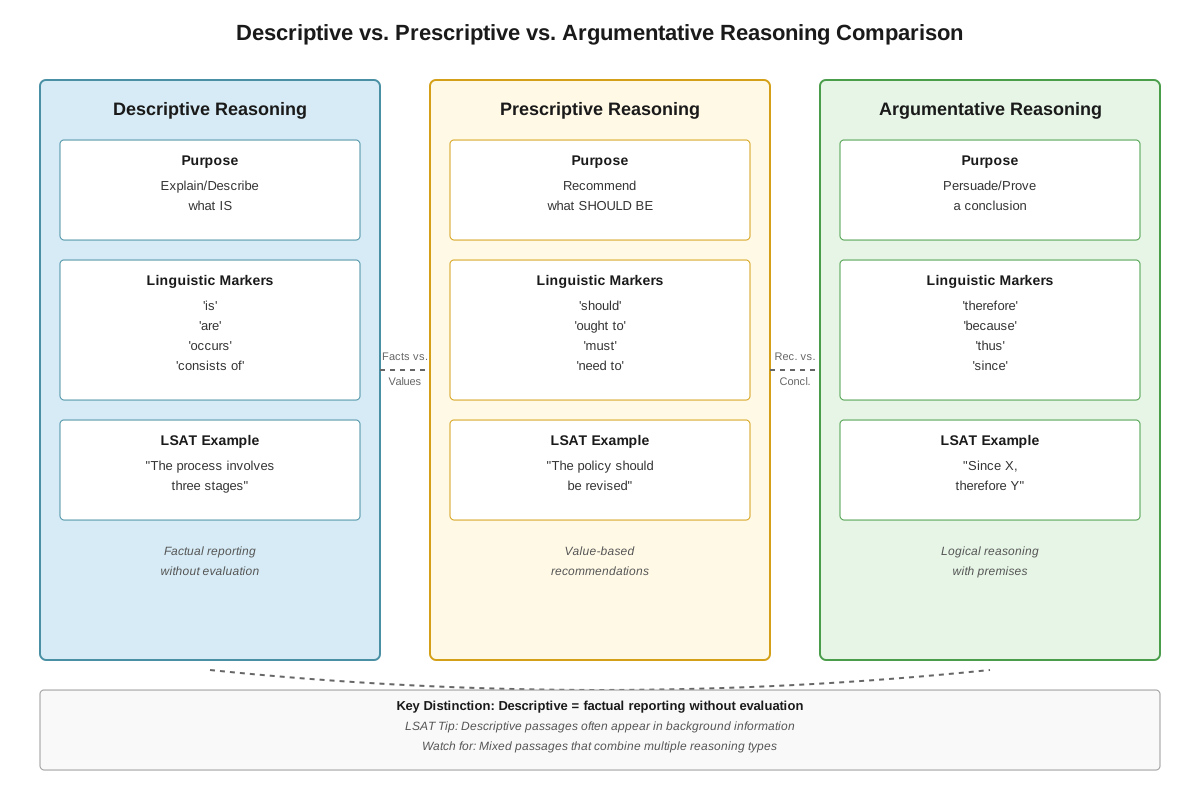
Neutral verbs: "is," "are," "consists of," "contains," "includes," "functions as," "operates by," "occurs when," "results from," "involves"
Factual qualifiers: "historically," "typically," "generally," "in most cases," "research shows," "studies indicate," "data reveals"
Descriptive adjectives: Objective characterizations rather than evaluative terms (e.g., "large" rather than "excessive," "frequent" rather than "problematic")
Temporal markers: "during," "when," "after," "before," "while"—indicating sequence or timing without causal claims
Descriptive Reasoning vs. Other Reasoning Types
Understanding descriptive reasoning requires distinguishing it from related but distinct reasoning patterns:
| Reasoning Type | Primary Purpose | Example Language | LSAT Function |
|---|---|---|---|
| Descriptive | Explain what is | "The process involves..." | Provides factual foundation |
| Prescriptive | Recommend what should be | "We must implement..." | Presents policy recommendations |
| Argumentative | Prove a conclusion | "Therefore, it follows that..." | Constructs logical arguments |
| Causal | Establish cause-effect | "Because X, Y occurred..." | Explains mechanisms |
| Evaluative | Judge quality/value | "This approach is superior..." | Makes value judgments |
Descriptive Reasoning in LSAT Stimulus Passages
On the LSAT, descriptive reasoning appears in three primary contexts:
1. Pure descriptive passages: The entire stimulus consists of descriptive content, typically followed by questions asking about the passage's main point, purpose, or structure. These passages might describe scientific processes, historical events, or social phenomena without taking argumentative positions.
2. Background information: Descriptive reasoning often appears in the opening sentences of stimulus passages, establishing factual context before an argument begins. Recognizing where description ends and argument begins is crucial for identifying conclusions and premises.
3. Evidence within arguments: Descriptive statements frequently serve as premises supporting argumentative conclusions. For example, a passage might describe survey results (descriptive) and then argue what those results prove (argumentative).
The Explanatory Function
A critical aspect of descriptive reasoning is its explanatory function—it seeks to make something understandable by describing its components, mechanisms, or characteristics. However, explanation differs from argumentation. An explanation answers "how" or "why" something occurs by describing the mechanism or process, while an argument attempts to prove that something is true or should be done.
For example:
- Explanatory (descriptive): "Photosynthesis occurs when chlorophyll in plant cells absorbs light energy, which drives chemical reactions converting carbon dioxide and water into glucose."
- Argumentative: "Because plants perform photosynthesis, they must have access to adequate sunlight; therefore, the proposed building will harm the garden by blocking light."
The first statement describes a process; the second uses that process as a premise to support a conclusion.
Recognizing Implicit Descriptive Reasoning
Sometimes descriptive reasoning appears implicitly rather than explicitly. A passage might present what appears to be an argument but is actually describing a reasoning process or belief system without endorsing it. Signal phrases include:
- "Proponents argue that..."
- "The theory holds that..."
- "According to this view..."
- "Historians have interpreted..."
These phrases indicate the author is describing what others think or claim, not necessarily making those claims themselves—a crucial distinction for Main Point and Author's Attitude questions.
Concept Relationships
Descriptive reasoning connects to other argument fundamentals in several essential ways. First, it provides the factual foundation upon which arguments are constructed—premises in arguments often consist of descriptive statements about the world that support argumentative conclusions. This relationship flows as: Descriptive statements → serve as → Premises → which support → Conclusions.
The relationship between descriptive and argumentative reasoning is particularly important: descriptive reasoning describes what is, while argumentative reasoning proves or advocates for a position. However, these often appear together in LSAT passages, with descriptive content providing context or evidence for argumentative claims. Understanding where one ends and the other begins enables accurate identification of argument structure.
Descriptive reasoning also relates closely to causal reasoning, though they differ in important ways. Descriptive reasoning may describe correlations or sequences without claiming causation, while causal reasoning explicitly argues that one thing causes another. The progression often follows: Descriptive observation → interpreted through → Causal reasoning → leading to → Causal claims.
Within the broader framework of logical reasoning, descriptive reasoning represents the foundational level—pure information presentation—upon which more complex reasoning patterns build. The hierarchy flows: Descriptive reasoning (what is) → Explanatory reasoning (why/how it is) → Evaluative reasoning (whether it's good/bad) → Prescriptive reasoning (what should be done).
High-Yield Facts
⭐ Descriptive reasoning focuses on characterizing what exists or occurs without making evaluative judgments or recommendations
⭐ Linguistic markers of descriptive reasoning include neutral verbs like "is," "consists of," "functions as," and "involves"
⭐ Descriptive passages answer "what," "how," or "when" questions rather than "should" or "ought" questions
⭐ On the LSAT, descriptive reasoning commonly appears in background information before arguments begin
⭐ Distinguishing descriptive from argumentative content is essential for correctly identifying conclusions and premises
- Descriptive reasoning can serve as evidence (premises) within larger arguments without itself being argumentative
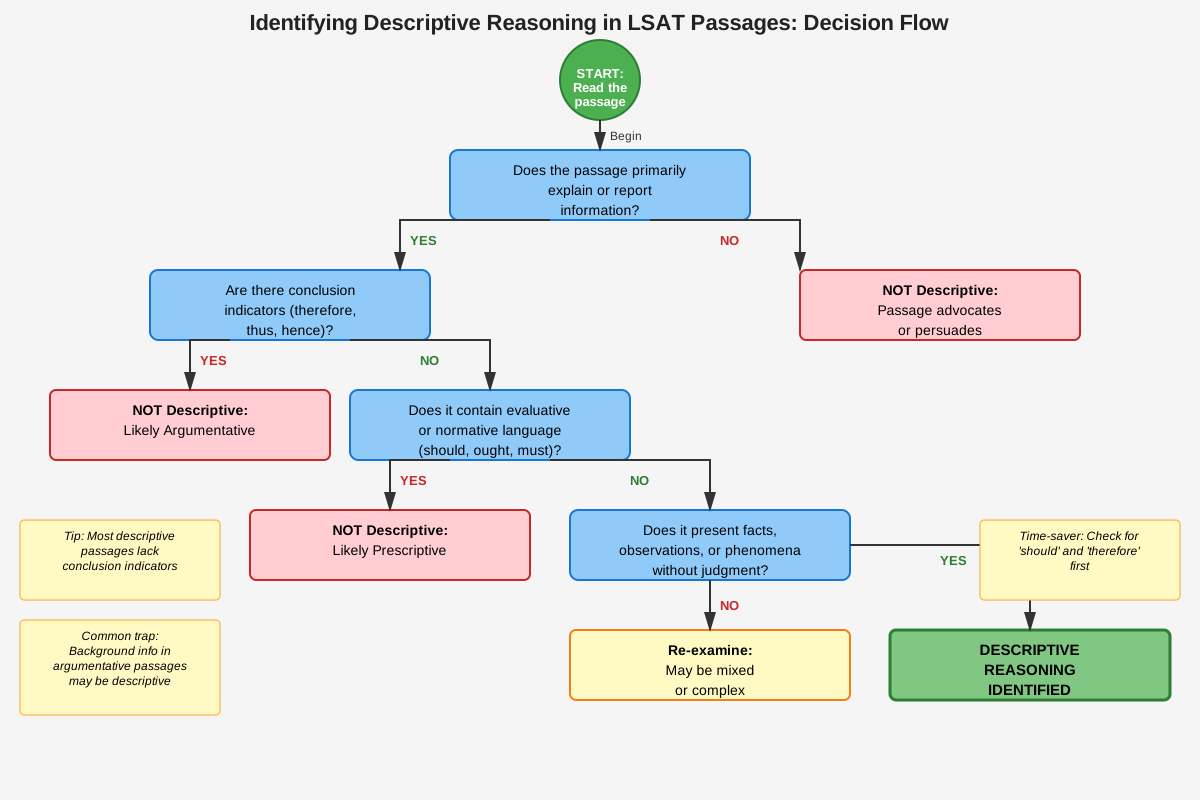
- Pure descriptive passages typically lack conclusion indicators like "therefore," "thus," or "consequently"
- Explanatory descriptions (describing how something works) differ from causal arguments (proving one thing causes another)
- Authors may describe others' arguments without endorsing them—this is descriptive, not argumentative
- Descriptive reasoning appears most frequently in Main Point, Method of Reasoning, and Role of Statement questions
- Approximately 15-20% of LSAT Logical Reasoning questions feature primarily descriptive reasoning
- Descriptive statements use objective, measurable language rather than subjective evaluative terms
Quick check — test yourself on Descriptive reasoning so far.
Try Flashcards →Common Misconceptions
Misconception: All explanations are arguments → Correction: Explanations that describe how something works or why something occurs are descriptive reasoning, not arguments. Arguments attempt to prove conclusions; explanations describe mechanisms or processes. An explanation becomes an argument only when it's used as a premise to support a separate conclusion.
Misconception: Descriptive reasoning never appears with conclusion indicators → Correction: While pure descriptive passages typically lack conclusion indicators, descriptive statements can appear as premises in arguments that do contain conclusions. The presence of "therefore" doesn't make the entire passage argumentative—only the conclusion and its relationship to premises.
Misconception: Any passage containing facts is purely descriptive → Correction: Arguments frequently contain factual premises (descriptive statements) that support argumentative conclusions. The presence of facts doesn't preclude argumentation; rather, facts often serve as the evidence supporting argumentative claims.
Misconception: Describing someone else's argument means endorsing it → Correction: Authors frequently describe others' positions, theories, or arguments without agreeing with them. Phrases like "proponents claim" or "according to this theory" signal descriptive reporting of others' views, not the author's own argumentative position.
Misconception: Causal descriptions are always causal arguments → Correction: Describing an established causal relationship (e.g., "heat causes water to boil") is descriptive reasoning about a known mechanism. Causal argumentation involves trying to prove that a causal relationship exists or applies in a specific case. The difference lies in whether the causal claim is presented as established fact or as a conclusion requiring support.
Misconception: Descriptive reasoning is less important than argumentative reasoning on the LSAT → Correction: Understanding descriptive reasoning is equally important because correctly identifying when reasoning is descriptive versus argumentative determines success on numerous question types. Misidentifying descriptive content as argumentative (or vice versa) leads to incorrect answers on Main Point, Method of Reasoning, and structural questions.
Worked Examples
Example 1: Identifying Descriptive Reasoning
Stimulus: "Coral reefs form in shallow tropical waters where sunlight penetrates to the ocean floor. The reefs consist of colonies of coral polyps, small animals that secrete calcium carbonate to build protective structures. Over centuries, these structures accumulate, creating the complex reef ecosystems that support diverse marine life. The Great Barrier Reef, stretching over 2,300 kilometers along Australia's coast, represents the world's largest coral reef system."
Question: The reasoning in the passage is best described as:
(A) Arguing that coral reefs require protection
(B) Describing the formation and characteristics of coral reefs
(C) Explaining why coral reefs are ecologically important
(D) Comparing different types of reef systems
(E) Advocating for increased study of marine ecosystems
Analysis:
Step 1: Identify the reasoning pattern. The passage uses neutral, factual language: "form," "consist of," "secrete," "accumulate," "represents." No evaluative terms or recommendations appear.
Step 2: Determine the passage's purpose. Each sentence provides factual information about coral reefs—where they form, what they're made of, how they develop, and an example. The passage answers "what are coral reefs?" and "how do they form?"
Step 3: Eliminate answers suggesting argumentation or evaluation. (A) suggests advocacy—not present. (C) implies an argument about importance—the passage doesn't argue reefs are important, just describes them. (E) suggests a recommendation—absent from the passage.
Step 4: Distinguish between remaining options. (D) suggests comparison—the passage mentions only one reef system as an example, not a comparison. (B) accurately captures the descriptive nature: the passage describes formation ("form in shallow tropical waters") and characteristics ("consist of colonies," "accumulate," "support diverse marine life").
Answer: (B) - This is pure descriptive reasoning, characterizing what coral reefs are and how they form without making arguments or recommendations.
Connection to Learning Objectives: This example demonstrates identifying descriptive reasoning (Objective 1), explaining the pattern—factual, neutral, explanatory (Objective 2), and applying recognition skills to select the correct answer (Objective 3).
Example 2: Distinguishing Descriptive from Argumentative Content
Stimulus: "Throughout the 20th century, urban populations grew dramatically as people migrated from rural areas seeking employment opportunities. This migration pattern resulted in the expansion of cities and the development of suburban areas. However, this growth has created significant infrastructure challenges. Therefore, city planners must prioritize investment in public transportation systems to accommodate increasing population density."
Question: Which of the following best describes the structure of the reasoning above?
(A) A phenomenon is described, and a recommendation is made based on that description
(B) A historical trend is explained, and its causes are analyzed
(C) A problem is identified, and multiple solutions are compared
(D) A theory is presented, and evidence is provided to support it
(E) A process is described, and its benefits are enumerated
Analysis:
Step 1: Identify where descriptive reasoning ends and argumentative reasoning begins. The first two sentences are purely descriptive: "populations grew," "people migrated," "resulted in expansion." These describe historical facts without evaluation.
Step 2: Locate the shift to argumentation. The third sentence introduces evaluation: "challenges" is an evaluative term suggesting problems. The fourth sentence, beginning with "Therefore," presents a conclusion: "city planners must prioritize investment."
Step 3: Map the structure. Descriptive content (sentences 1-2) → Evaluative observation (sentence 3) → Argumentative conclusion (sentence 4). The descriptive reasoning provides context for an argument.
Step 4: Match structure to answer choices. (A) correctly identifies both components: "phenomenon is described" (the migration and urban growth) and "recommendation is made" (the "must prioritize" conclusion). (B) focuses only on description, missing the argumentative conclusion. (C) suggests multiple solutions—only one appears. (D) mischaracterizes the structure as theory and evidence. (E) focuses only on description, missing the prescriptive conclusion.
Answer: (A) - The passage combines descriptive reasoning (describing urban growth patterns) with prescriptive argumentation (recommending transportation investment).
Connection to Learning Objectives: This example demonstrates distinguishing descriptive from argumentative content (Objective 4), identifying structural markers like "Therefore" (Objective 5), and evaluating how descriptive statements function within argumentative contexts (Objective 6).
Exam Strategy
When approaching LSAT questions involving descriptive reasoning, employ this systematic strategy:
Step 1: Scan for conclusion indicators. Before reading carefully, quickly scan for words like "therefore," "thus," "consequently," "should," "must," or "ought." Their absence suggests potentially pure descriptive reasoning; their presence indicates where argumentation begins.
Step 2: Identify the passage's primary purpose. Ask: "Is this passage trying to prove something, recommend something, or simply explain/describe something?" This determines whether reasoning is primarily descriptive or argumentative.
Step 3: Watch for evaluative language shifts. Note when neutral, factual language shifts to evaluative terms like "problem," "challenge," "beneficial," "harmful," "superior," or "inadequate." These signal transitions from descriptive to evaluative or argumentative reasoning.
Step 4: Distinguish description from endorsement. When passages describe others' views, theories, or arguments, recognize this as descriptive reporting unless the author explicitly endorses those views. Phrases like "proponents argue," "critics claim," or "according to theory X" signal description, not advocacy.
Exam Tip: On Main Point questions, if the passage is purely descriptive, the correct answer will characterize what the passage describes, not what it argues or recommends. Wrong answers often mischaracterize descriptive passages as argumentative.
Trigger words indicating descriptive reasoning:
- "consists of," "involves," "includes," "contains"
- "occurs when," "happens during," "results from"
- "is characterized by," "functions as," "operates by"
- "historically," "typically," "generally," "in most cases"
- "research shows," "studies indicate," "data reveals"
Process of elimination for descriptive reasoning questions:
- Eliminate answers suggesting argumentation when the passage is purely descriptive
- Eliminate answers suggesting recommendations or prescriptions when the passage only describes
- Eliminate answers suggesting evaluation or judgment when the passage uses neutral language
- Eliminate answers that confuse describing others' arguments with making those arguments
Time allocation: Descriptive reasoning passages are often more straightforward than complex arguments. Allocate 30-45 seconds for reading purely descriptive stimuli, reserving more time for question analysis. However, passages mixing descriptive and argumentative content require careful attention to where transitions occur—allocate 60-75 seconds for these.
Memory Techniques
D-E-S-C-R-I-B-E Mnemonic for identifying descriptive reasoning:
- Data-focused (presents facts and information)
- Explanatory (explains how or what, not proves why you should believe)
- Statements are neutral (lacks evaluative language)
- Conclusion indicators absent (no "therefore," "thus," "should")
- Reporting (may describe others' views without endorsing)
- Informative purpose (aims to inform, not persuade)
- Background often (frequently appears as context before arguments)
- Evidence potential (can serve as premises in larger arguments)
Visualization Strategy: Picture descriptive reasoning as a camera lens—it captures and reports what exists without judging or recommending. When reading a passage, visualize whether the author is acting as a camera (descriptive) or as an advocate (argumentative).
The "What vs. Should" Test: Create a mental checklist:
- Does the passage answer "What is it?" or "How does it work?" → Likely descriptive
- Does the passage answer "What should be done?" or "Is this good/bad?" → Likely argumentative
Contrast Pairs for quick recognition:
| Descriptive | Argumentative |
|---|---|
| "The policy includes..." | "The policy should include..." |
| "Studies show X occurs..." | "Therefore, X must be addressed..." |
| "The process involves..." | "This process is flawed because..." |
| "Historically, Y happened..." | "Y proves that we must..." |
Summary
Descriptive reasoning represents a fundamental pattern in LSAT Logical Reasoning, focusing on characterizing, explaining, or reporting what exists or occurs without making evaluative judgments or prescriptive recommendations. This reasoning type answers "what," "how," or "when" questions using neutral, factual language and typically lacks conclusion indicators like "therefore" or prescriptive terms like "should" or "must." On the LSAT, descriptive reasoning appears in approximately 15-20% of questions, either as pure descriptive passages or as background information and premises within larger arguments. Success requires distinguishing descriptive content from argumentative content, recognizing linguistic markers of description, and understanding how descriptive statements function within argumentative contexts. The ability to identify when an author is merely describing versus when they're arguing or recommending directly determines correct answers on Main Point, Method of Reasoning, and Role of Statement questions. Mastering descriptive reasoning provides the foundation for analyzing more complex argument structures and reasoning patterns throughout the Logical Reasoning section.
Key Takeaways
- Descriptive reasoning characterizes what exists or occurs without evaluating or recommending, using neutral, factual language
- Linguistic markers include "consists of," "involves," "occurs when," and absence of conclusion indicators like "therefore"
- Distinguishing descriptive from argumentative content is essential for identifying argument structure and answering Main Point questions correctly
- Descriptive reasoning commonly appears as background information before arguments begin or as factual premises within arguments
- Describing others' arguments or theories is descriptive reporting, not endorsement—watch for phrases like "proponents claim" or "according to this view"
- Pure descriptive passages answer "what," "how," or "when" questions, while argumentative passages answer "should" or "ought" questions
- Approximately 15-20% of LSAT Logical Reasoning questions feature primarily descriptive reasoning, making this a high-yield topic for test preparation
Related Topics
Argument Structure and Components: Understanding descriptive reasoning enables deeper analysis of how arguments are constructed, as descriptive statements often serve as premises supporting conclusions. Mastering this topic allows progression to identifying complex argument structures.
Method of Reasoning Questions: These questions frequently test whether students can characterize reasoning as descriptive, argumentative, analogical, or causal. Strong command of descriptive reasoning improves accuracy on this question type.
Main Point and Primary Purpose Questions: Distinguishing descriptive from argumentative passages directly determines success on these questions, as the correct answer must match the passage's actual purpose—describing versus arguing.
Causal Reasoning: Understanding the difference between describing causal relationships and arguing for causal claims builds on descriptive reasoning fundamentals and represents the next level of reasoning complexity.
Prescriptive vs. Descriptive Reasoning: This advanced topic explores the is-ought distinction in depth, building directly on the foundation established by understanding descriptive reasoning patterns.
Practice CTA
Now that you've mastered the fundamentals of descriptive reasoning, it's time to reinforce your understanding through active practice. Attempt the practice questions designed specifically for this topic, paying careful attention to distinguishing descriptive from argumentative content. Use the flashcards to drill the linguistic markers and key characteristics until recognition becomes automatic. Remember: the LSAT rewards pattern recognition, and descriptive reasoning appears frequently enough that mastering it will directly improve your score. Each practice question you complete strengthens your ability to quickly and accurately identify reasoning patterns under timed conditions—an essential skill for test day success. You've built the foundation; now apply it!
Sign up free to keep reading
Create a free AnvayaPrep account to finish this LSAT guide on Descriptive reasoning — plus flashcards and practice questions.