Overview
The LSAT Logical Reasoning section is designed to test not just reasoning ability, but also careful reading and attention to detail. Among the most insidious challenges test-takers face are common question stem traps—subtle variations in question wording that fundamentally change what the question is asking. These traps exploit natural reading tendencies, causing even well-prepared students to answer a different question than the one actually posed. A student might execute flawless logical analysis only to select a wrong answer because they misread "weaken" as "strengthen" or overlooked the word "EXCEPT" in the stem.
Understanding lsat common question stem traps is not merely about avoiding careless errors; it represents a fundamental skill in question stem recognition that separates high scorers from average performers. The LSAT deliberately includes these traps because legal reasoning demands precision in understanding exactly what is being asked. An attorney who misunderstands the scope of a legal question can provide a technically correct answer to the wrong question—a costly mistake. The exam mirrors this reality by rewarding students who read with surgical precision and punishing those who skim or make assumptions about question types.
Within the broader framework of logical reasoning, question stem recognition serves as the critical first step in the problem-solving process. Before analyzing argument structure, identifying assumptions, or evaluating answer choices, a test-taker must correctly identify the task at hand. This topic connects directly to all other Logical Reasoning concepts because the question stem determines which analytical tools to deploy. Mastering common traps ensures that subsequent analytical work addresses the actual question, making this skill foundational to consistent high performance across all Logical Reasoning question types.
Learning Objectives
- [ ] Identify how Common question stem traps appears in LSAT questions
- [ ] Explain the reasoning pattern behind Common question stem traps
- [ ] Apply Common question stem traps to solve LSAT-style problems accurately
- [ ] Distinguish between similar question types that require different analytical approaches
- [ ] Recognize modifier words that fundamentally alter question requirements
- [ ] Develop a systematic pre-reading protocol to avoid stem misinterpretation
- [ ] Categorize question stems by their logical demands and expected answer characteristics
Prerequisites
- Basic question type taxonomy: Understanding fundamental LSAT question categories (strengthen, weaken, assumption, inference, etc.) provides the foundation for recognizing when stems deviate from standard formulations
- Argument structure analysis: The ability to identify conclusions, premises, and reasoning patterns is necessary because question stem traps often involve subtle shifts in which element of an argument to address
- Conditional logic fundamentals: Many stem traps involve reversals or negations that require comfort with logical operators to detect accurately
Why This Topic Matters
In legal practice, precision in understanding questions determines case outcomes. Attorneys must distinguish between "What must be true?" and "What could be true?" or risk building arguments on faulty foundations. The LSAT tests this precision through question stem variations that mirror real-world legal distinctions. A lawyer who confuses "necessary" with "sufficient" conditions might draft a contract with unintended loopholes; similarly, an LSAT test-taker who misreads a question stem will select answers that are logically sound but contextually wrong.
Exam statistics reveal that question stem traps appear with remarkable frequency. Approximately 15-20% of Logical Reasoning questions include some form of stem trap—whether through EXCEPT formulations, negative phrasing, or subtle modifier words. Each Logical Reasoning section typically contains 25-26 questions, meaning 4-5 questions per section may include these traps. Given that most LSAT administrations include two Logical Reasoning sections, students face 8-10 potential trap questions per exam. The impact on scoring is substantial: missing these questions due to stem misreading can lower a score by 3-5 points, potentially dropping a student from the 170s to the 160s.
These traps appear across all question types but are particularly common in assumption questions (where "assumes" vs. "fails to consider" creates opposite tasks), strengthen/weaken questions (where directional confusion is frequent), and inference questions (where "must be true" vs. "could be true" vs. "most strongly supported" require different levels of logical certainty). The LSAT also strategically places trap-laden questions throughout sections, not just at the end, meaning vigilance must remain constant regardless of time pressure or question position.
Core Concepts
The EXCEPT Trap
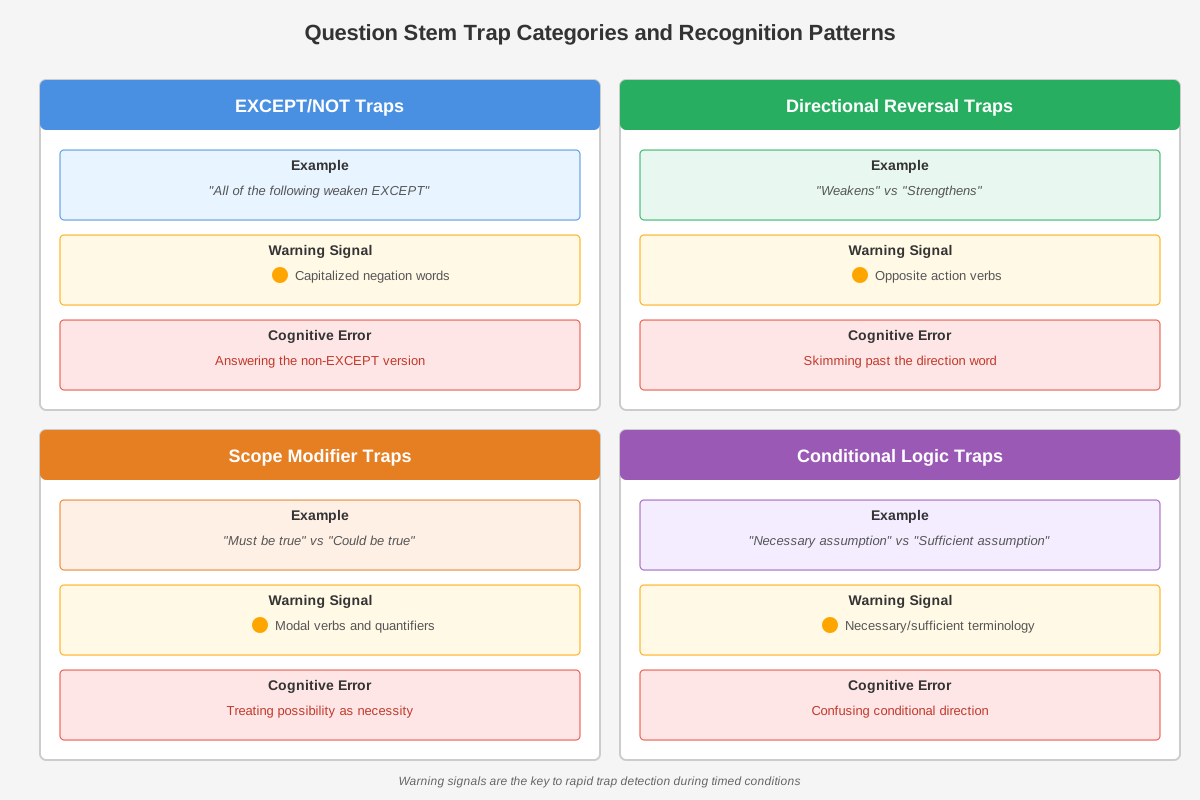
The EXCEPT trap represents one of the most common and costly question stem variations. Standard question stems ask students to identify an answer that performs a specific function (e.g., "Which one of the following strengthens the argument?"). EXCEPT questions invert this task, asking students to identify the one answer that does NOT perform that function. The correct answer to an EXCEPT question is typically neutral or performs the opposite function, while four wrong answers all perform the stated function.
The psychological mechanism behind this trap involves automatic processing. Experienced test-takers develop pattern recognition for common question types, and their brains begin processing answer choices before fully registering the EXCEPT modifier. This premature analysis leads them to select an answer that would be correct for the non-EXCEPT version of the question. The trap is particularly effective because EXCEPT questions often appear after several standard questions of the same type, reinforcing the expected pattern.
Recognition strategies include:
- Physically circling or underlining "EXCEPT" in the question stem
- Reformulating the question in your own words before reading choices
- Expecting four answers that perform the stated function and one that doesn't
- Using process of elimination by marking answers that DO perform the function
Negative Phrasing Traps
Negative phrasing traps involve questions that ask for what does NOT follow, what would NOT weaken, or what is NOT assumed. These differ from EXCEPT questions in that the negative is built into the question's logical structure rather than being an exception modifier. Examples include: "Which one of the following is NOT supported by the passage?" or "The argument does NOT depend on which assumption?"
The cognitive challenge stems from double-negative processing. When a question asks "Which does NOT weaken?" the correct answer might strengthen the argument, be irrelevant, or simply fail to weaken it. Students must hold the negative frame in mind while evaluating each answer choice, which increases cognitive load and error probability. The trap becomes more effective when combined with complex argument structures or abstract content that already demands significant mental resources.
Strength-of-Claim Modifiers
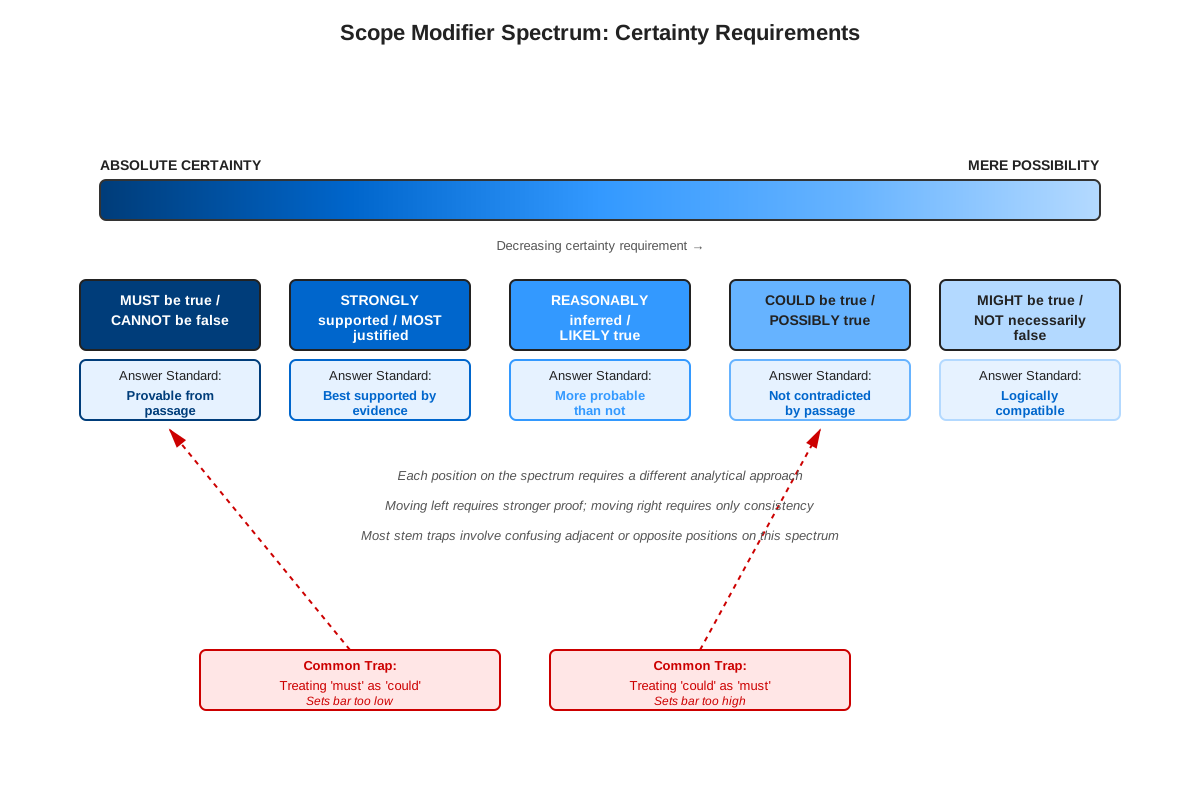
Strength-of-claim modifiers subtly alter the logical standard required for a correct answer. These modifiers include words like "must," "could," "most strongly," "best," "primarily," and "most reasonably." Each modifier establishes a different threshold of logical certainty or support:
| Modifier | Logical Standard | Example Question |
|---|---|---|
| Must be true | Logical necessity; no other possibility | "Which must be true if the statements above are true?" |
| Could be true | Logical possibility; consistent with premises | "Which could be true based on the information?" |
| Most strongly supported | Highest degree of support among options | "Which is most strongly supported by the passage?" |
| Most helps to explain | Best explanatory power, not necessarily complete | "Which most helps to explain the discrepancy?" |
| Primarily functions to | Main purpose among possibly multiple purposes | "The statement primarily functions to..." |
The trap occurs when students apply the wrong standard. A student might select an answer that COULD be true when the question asks what MUST be true, or choose something that partially explains when the question asks what MOST helps explain. These errors reflect insufficient attention to the modifier's specific logical requirement.
Directional Confusion Traps
Directional confusion traps exploit the similarity between opposite question types. The most common manifestation involves strengthen versus weaken questions, but the trap also appears in support versus challenge, justify versus undermine, and similar pairings. The question stem might ask "Which most weakens?" but a student reads it as "Which most strengthens?" and selects an answer that would be perfect for the opposite task.
This trap succeeds because strengthen and weaken questions share similar structural elements—both reference the argument, both ask about impact, and both appear frequently enough that students develop strong associations with each type. The brain's pattern-matching systems can trigger the wrong template, especially under time pressure or fatigue. The trap is particularly effective when the argument topic is engaging or controversial, as students may focus on content rather than task.
Scope Shift Traps
Scope shift traps involve subtle changes in what element of the argument the question addresses. An argument might contain multiple claims, sub-conclusions, or reasoning steps, and the question stem specifies which element to focus on. Common scope shifts include:
- "The argument's conclusion" vs. "the claim that X" (when X is a premise)
- "The reasoning is flawed because" vs. "the argument is vulnerable to criticism because" (similar but potentially different standards)
- "The author's position" vs. "the position the author attributes to others"
- "The principle illustrated" vs. "the principle that would justify"
Students fall into this trap by analyzing the wrong part of the argument. They might identify a perfect assumption for the main conclusion when the question asks about a subsidiary claim, or they might evaluate the author's reasoning when the question asks about an opponent's position mentioned in the passage.
Temporal and Conditional Modifiers
Temporal modifiers like "initially," "ultimately," "before," and "after" specify when something occurs in an argument's logical sequence. Conditional modifiers like "if," "unless," "only if," and "provided that" establish logical relationships between conditions. Questions incorporating these modifiers test whether students can track complex logical structures accurately.
The trap manifests when students overlook these modifiers and treat the question as simpler than it actually is. For example, "Which, if true, would most strengthen the argument?" requires identifying something that WOULD strengthen IF it were true, not something that DOES strengthen based on information already provided. Similarly, "Which initially appears to weaken but actually strengthens?" requires two-stage analysis that students might collapse into single-stage evaluation.
Comparison and Relative Judgment Traps
These traps appear in questions asking for "most," "least," "best," or "worst" among options. Unlike questions seeking a single correct answer with four clearly wrong choices, these questions often present multiple answers with some merit, requiring comparative judgment. The correct answer isn't necessarily perfect—it's simply better than the alternatives according to the specified criterion.
Students trap themselves by seeking absolute correctness rather than relative superiority. They might eliminate the correct answer because it has a minor flaw, not recognizing that all other answers have more significant flaws. Alternatively, they might select the first answer that seems good without comparing it to remaining options. This trap is particularly effective on strengthen/weaken questions where multiple answers affect the argument but to different degrees.
Concept Relationships
The various question stem traps interconnect through their shared exploitation of automatic processing and pattern recognition. EXCEPT traps and negative phrasing traps both involve logical inversion, requiring students to search for the opposite of what they might instinctively seek. These connect to directional confusion traps because all three involve maintaining the correct logical orientation while processing information.
Strength-of-claim modifiers relate to comparison and relative judgment traps because both involve calibrating the appropriate standard of evaluation. A "must be true" question requires absolute certainty (a strength-of-claim issue), while a "most strongly supported" question requires comparative judgment among options. Understanding one helps master the other.
Scope shift traps connect to prerequisite knowledge of argument structure analysis. Students who can accurately identify conclusions, premises, and intermediate claims are better equipped to recognize when a question targets a specific argument element. This skill then enables better performance on temporal and conditional modifier questions, which often specify relationships between argument components.
The relationship map flows as follows:
Question Stem Recognition → Trap Identification → Appropriate Analytical Framework Selection → Accurate Answer Evaluation → Correct Answer Selection
Each trap type represents a potential disruption at the "Trap Identification" stage, which cascades through subsequent stages. Mastering trap recognition therefore improves performance across all downstream analytical processes.
Quick check — test yourself on Common question stem traps so far.
Try Flashcards →High-Yield Facts
⭐ EXCEPT questions require identifying the one answer that does NOT perform the stated function; four answers will perform that function
⭐ Strength-of-claim modifiers ("must," "could," "most strongly") establish different logical standards that determine answer correctness
⭐ Directional confusion between strengthen/weaken questions is among the most common stem traps, especially under time pressure
⭐ Negative phrasing ("does NOT," "fails to," "is NOT") inverts the logical task and requires conscious reorientation
⭐ Scope shift traps target different argument elements; always verify which specific claim or reasoning step the question addresses
- Temporal modifiers ("initially," "ultimately") require tracking logical sequence, not just logical relationships
- Comparative questions ("most," "best") require evaluating all five answers against each other, not just finding one that works
- Question stems with multiple modifiers (e.g., "Which, if true, would LEAST weaken?") combine multiple trap types and demand extra care
- Circling or underlining key modifier words physically engages attention and reduces automatic processing errors
- The LSAT strategically places trap questions throughout sections, not clustered at the end, requiring constant vigilance
Common Misconceptions
Misconception: EXCEPT questions are just harder versions of standard questions requiring the same analysis.
Correction: EXCEPT questions require fundamentally different answer evaluation—students must identify what doesn't fit rather than what does fit, and the correct answer often has opposite characteristics from standard versions of that question type.
Misconception: "Most strongly supported" and "must be true" are interchangeable standards.
Correction: "Must be true" requires logical necessity with no possible exceptions, while "most strongly supported" allows for the best answer among imperfect options. An answer can be most strongly supported without being logically necessary.
Misconception: If an answer strengthens an argument, it cannot be correct for a weaken question, even if the question includes "EXCEPT."
Correction: In "All of the following weaken EXCEPT" questions, an answer that strengthens is often correct because it's the one that does NOT weaken. Students must remember that EXCEPT inverts the task.
Misconception: Circling keywords in question stems is unnecessary for experienced test-takers who can read carefully.
Correction: Even experienced test-takers benefit from physical engagement with trap words because automatic processing occurs unconsciously. The physical act of circling interrupts automatic processing and forces conscious attention.
Misconception: Scope shift traps only appear in complex arguments with multiple conclusions.
Correction: Scope shifts can occur in relatively simple arguments when questions target premises, background information, or subsidiary claims rather than main conclusions. Argument complexity doesn't determine trap presence.
Misconception: Time pressure causes stem trap errors, so slowing down eliminates them.
Correction: While time pressure exacerbates trap errors, they also occur when students read too quickly at the beginning of sections. The solution isn't simply slowing down but implementing systematic stem analysis regardless of time available.
Worked Examples
Example 1: EXCEPT Trap with Strengthen Question
Question Stem: "Each of the following, if true, strengthens the argument EXCEPT:"
Argument: "Company profits have declined for three consecutive quarters. The decline coincides with the implementation of new management software. Therefore, the new software has caused the profit decline."
Answer Choices:
(A) The software implementation disrupted normal workflow for two months
(B) Competitors who use similar software have also experienced profit declines
(C) The company's market share has remained stable during the three quarters
(D) Employee productivity metrics decreased after software implementation
(E) The software was implemented without adequate training
Step 1: Identify the trap
The word "EXCEPT" inverts the task. We need the one answer that does NOT strengthen, while four answers WILL strengthen.
Step 2: Reformulate the question
"Which answer fails to strengthen (or possibly weakens) the argument that the software caused profit decline?"
Step 3: Evaluate each answer
- (A) Strengthens—disrupted workflow provides a mechanism for causation
- (B) Strengthens—parallel cases support causal connection
- (C) Does NOT strengthen—stable market share suggests external factors aren't responsible, but doesn't connect software to profits
- (D) Strengthens—decreased productivity provides causal mechanism
- (E) Strengthens—inadequate training explains why software would cause problems
Step 4: Select the answer that doesn't strengthen
(C) is correct because it addresses market share, not the software-profit connection. It's neutral or possibly weakens by suggesting the problem isn't market-related.
Common error: Students who miss the EXCEPT would select (B) because it provides the strongest support, not recognizing that strong support makes it wrong for an EXCEPT question.
Example 2: Strength-of-Claim Modifier with Inference Question
Question Stem: "If the statements above are true, which one of the following MUST also be true?"
Passage: "All members of the committee voted for the proposal. Some committee members are lawyers. No lawyers voted against the proposal."
Answer Choices:
(A) Some lawyers voted for the proposal
(B) All lawyers on the committee voted for the proposal
(C) Most committee members are lawyers
(D) The proposal will be implemented
(E) No non-lawyers voted against the proposal
Step 1: Identify the logical standard
"MUST be true" requires logical necessity—the answer cannot possibly be false if the premises are true.
Step 2: Analyze the logical structure
- Premise 1: All committee members voted FOR
- Premise 2: Some committee members are lawyers
- Premise 3: No lawyers voted AGAINST
Step 3: Evaluate each answer against the "must be true" standard
(A) MUST be true: If some committee members are lawyers (Premise 2) and all committee members voted for the proposal (Premise 1), then those lawyer committee members voted for it. This is logically necessary.
(B) Could be true but not necessary: We know some committee members are lawyers, but we don't know if ALL lawyers are on the committee. Lawyers not on the committee might exist.
(C) Not supported: We only know "some" committee members are lawyers, which could mean a minority.
(D) Not supported: Voting for a proposal doesn't guarantee implementation.
(E) Could be true but not necessary: Premise 1 tells us all committee members (including non-lawyers) voted for, but this doesn't address non-lawyers who aren't on the committee.
Step 4: Select the only answer that MUST be true
(A) is correct because it follows by logical necessity from combining premises.
Common error: Students might select (B) because it seems strongly supported, not recognizing the scope shift between "lawyers on the committee" and "all lawyers." The "must be true" standard requires eliminating any answer with even slight logical gaps.
Exam Strategy
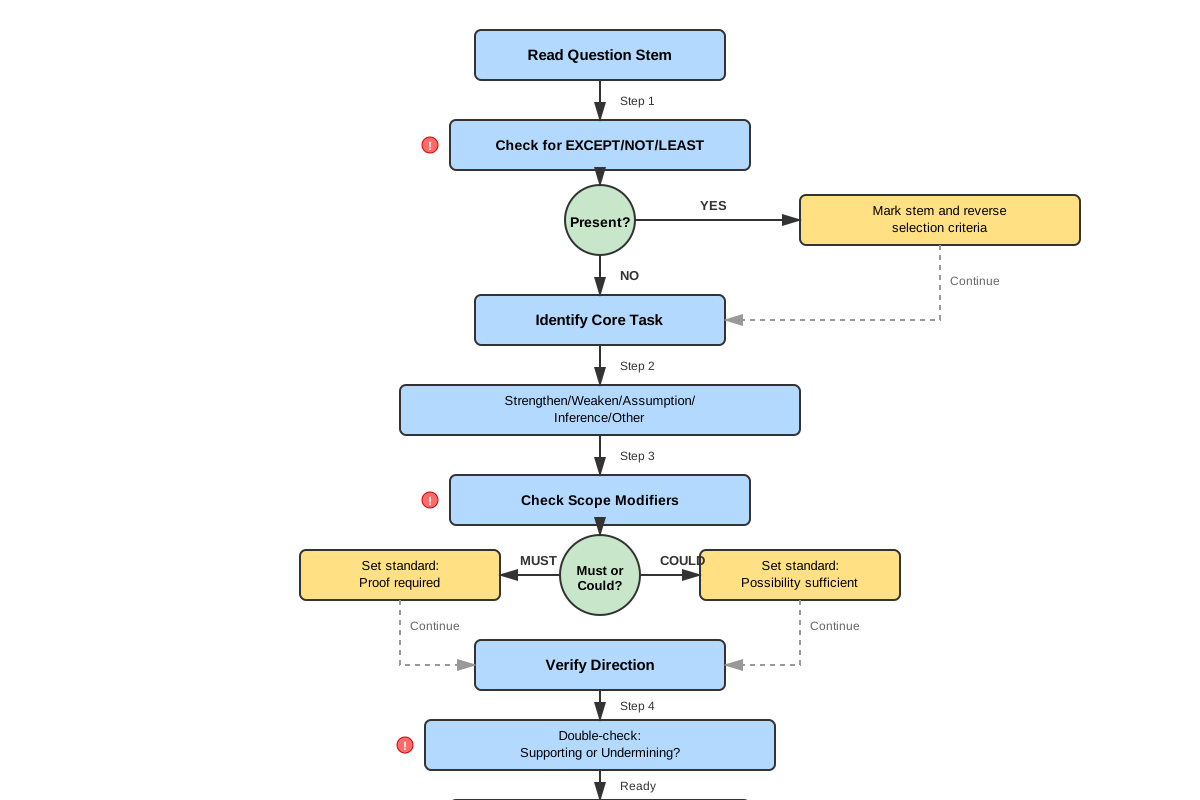
Pre-reading protocol: Before reading any argument or answer choices, invest 3-5 seconds in active question stem analysis. This small time investment prevents much larger time losses from analyzing the wrong question. Specifically:
- Identify the question type (strengthen, weaken, assumption, inference, etc.)
- Circle or underline trap words (EXCEPT, NOT, LEAST, MOST, MUST, COULD)
- Reformulate in your own words to ensure comprehension
- Set your analytical frame based on the specific task
Trigger words to watch for:
High-alert words: EXCEPT, NOT, LEAST, MUST, COULD, MOST, IF, UNLESS, ONLY IF, PRIMARILY, INITIALLY, ULTIMATELY, BEST, WORST
When these words appear, pause and ensure you understand their logical function before proceeding. These words aren't decorative—they fundamentally alter what constitutes a correct answer.
Process-of-elimination strategies:
For EXCEPT questions, use a marking system:
- Mark answers that DO perform the stated function with a checkmark
- The unmarked answer (or the one marked differently) is correct
- Expect four checkmarks and one blank
For strength-of-claim questions, eliminate answers that:
- Fall short of the required standard (e.g., "could be true" when "must be true" is required)
- Exceed the required standard unnecessarily (rare but possible)
- Address the wrong scope or timeframe
For directional questions (strengthen/weaken), physically note the direction:
- Write "STR" or "WEAK" at the top of your scratch paper
- Check this notation before selecting your answer
- If you find yourself attracted to an answer that goes the opposite direction, reread the stem
Time allocation advice:
Don't rush question stem reading to "save time" for argument analysis. Misreading a stem wastes far more time than careful stem reading takes. Budget approximately:
- 5 seconds: Question stem analysis and trap identification
- 45-60 seconds: Argument analysis
- 30-45 seconds: Answer choice evaluation
- Total: 80-110 seconds per question
If you find yourself spending more than 90 seconds on a question, verify you're answering the actual question asked. Stem misreading is a common cause of extended question time because students pursue the wrong analytical path.
Memory Techniques
EXCEPT-ion Rule Mnemonic: "Four fit, one doesn't sit"
- In EXCEPT questions, four answers "fit" the stated function
- One answer "doesn't sit" with the others—that's your answer
Strength-of-Claim Spectrum: Visualize a certainty ladder
MUST (top rung - absolute certainty)
MOST STRONGLY (high rung - best available support)
MOST REASONABLY (middle rung - reasonable inference)
COULD (low rung - mere possibility)
Match your answer to the appropriate rung based on the question's modifier.
Directional Arrows: When you see strengthen/weaken questions, draw an arrow:
- ↑ for strengthen (makes argument stronger, builds it up)
- ↓ for weaken (makes argument weaker, tears it down)
Keep this arrow visible while evaluating answers.
SCOPE Acronym for Scope Shift Prevention:
- Specific claim targeted
- Conclusion vs. premise identification
- Own position vs. others' positions
- Part of argument addressed
- Element the question focuses on
NOT-ice Board: For negative phrasing questions, imagine a "NOT-ice board" (notice board) posted in your mind. Every time you see "NOT," "EXCEPT," or similar negatives, mentally post it on this board so it remains visible throughout your analysis.
Summary
Common question stem traps represent a critical LSAT skill that separates careful readers from careless ones. These traps—including EXCEPT formulations, negative phrasing, strength-of-claim modifiers, directional confusion, scope shifts, temporal/conditional modifiers, and comparison requirements—exploit natural reading tendencies and automatic processing to cause students to answer questions different from those actually asked. Mastery requires developing systematic question stem analysis protocols that interrupt automatic processing, force conscious attention to modifier words, and establish the correct analytical framework before engaging with arguments or answer choices. The traps appear in 15-20% of Logical Reasoning questions across all question types, making them high-yield targets for score improvement. Success depends not on reading more slowly overall, but on investing focused attention during the critical question stem reading phase, using physical engagement techniques like circling keywords, and maintaining vigilance throughout the section regardless of time pressure or question position.
Key Takeaways
- Question stem traps appear in approximately 15-20% of Logical Reasoning questions, making them a high-frequency, high-impact topic that can affect 8-10 questions per LSAT administration
- EXCEPT questions invert the standard task: four answers perform the stated function, and the correct answer is the one that doesn't
- Strength-of-claim modifiers establish different logical standards: "must be true" requires necessity, "most strongly supported" requires comparative judgment, and "could be true" requires mere possibility
- Physical engagement with trap words (circling, underlining) interrupts automatic processing and forces conscious attention to critical modifiers
- Directional confusion between strengthen and weaken questions is among the most common and costly stem traps, especially under time pressure
- Scope shift traps require identifying which specific argument element (conclusion, premise, subsidiary claim) the question targets before beginning analysis
- Systematic pre-reading protocols that invest 3-5 seconds in stem analysis prevent much larger time losses from pursuing wrong analytical paths
Related Topics
Question Type Deep Dives: After mastering stem trap recognition, students should study individual question types in depth (assumption questions, strengthen/weaken questions, inference questions, etc.) to understand how traps manifest differently across question categories and develop type-specific strategies.
Conditional Logic and Formal Logic: Many stem traps involve conditional relationships ("if," "only if," "unless") that require formal logic skills to parse accurately. Strengthening conditional logic abilities enhances trap detection and resolution.
Argument Structure and Diagramming: Since scope shift traps require identifying specific argument elements, advanced argument diagramming skills enable more accurate targeting of the question's focus and reduce scope-related errors.
Time Management and Pacing Strategies: Understanding when to invest extra time in stem analysis versus when to move quickly through straightforward questions optimizes overall section performance and ensures trap-heavy questions receive appropriate attention.
Practice CTA
Now that you understand the mechanics and patterns of common question stem traps, the next critical step is application. Attempt the practice questions associated with this topic, paying special attention to your question stem reading process. Before looking at any answer choices, verify that you've correctly identified the question type and any trap words. Use the flashcards to reinforce recognition of specific trap patterns and modifier words until identification becomes automatic. Remember: every trap you learn to recognize is a potential point saved on test day. The difference between a good LSAT score and a great one often comes down to avoiding these preventable errors. You've built the knowledge foundation—now build the recognition speed and accuracy through deliberate practice.
Sign up free to keep reading
Create a free AnvayaPrep account to finish this LSAT guide on Common question stem traps — plus flashcards and practice questions.