Overview
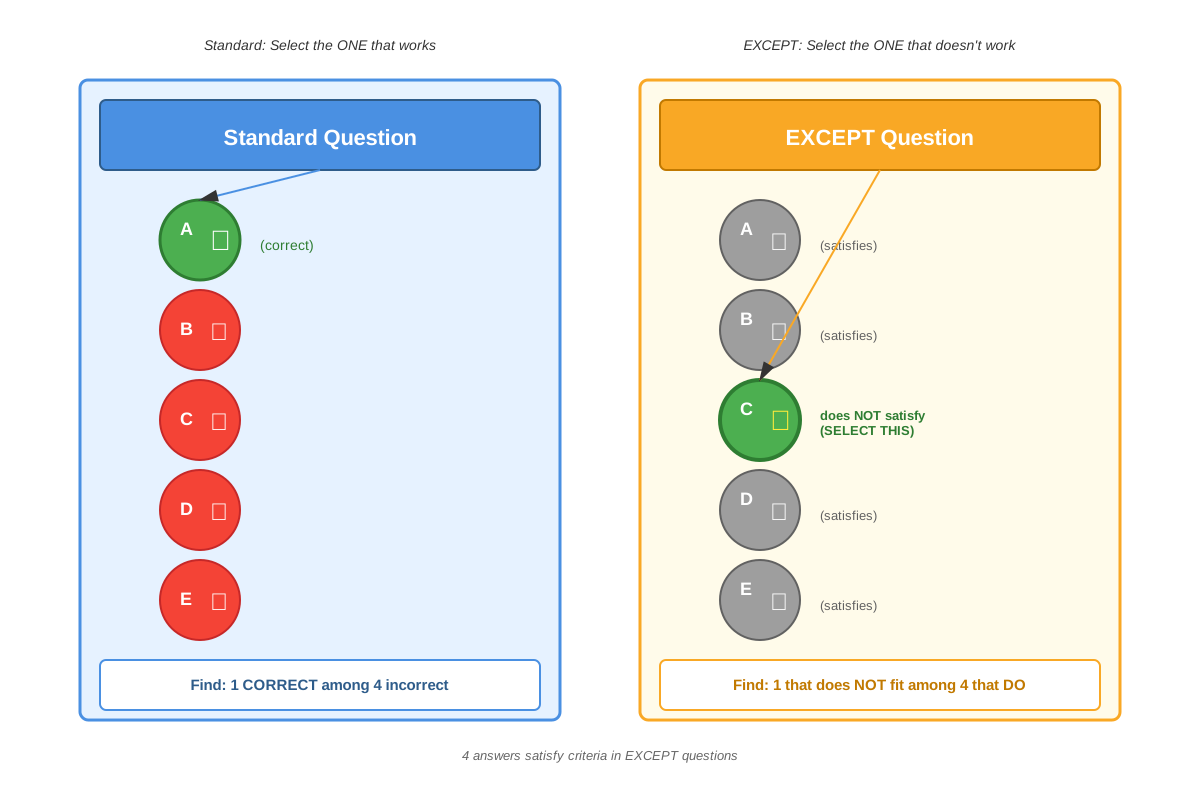
EXCEPT stems strategy is a critical skill within LSAT Logical Reasoning that requires test-takers to reverse their typical approach to answer selection. Unlike standard question stems where students identify the one correct answer among four incorrect options, EXCEPT questions flip this paradigm: students must identify the one answer choice that does NOT satisfy the question's criteria while four answer choices DO meet that criteria. This reversal creates a unique cognitive challenge that frequently trips up even well-prepared test-takers, making mastery of this strategy essential for achieving a competitive LSAT score.
The importance of EXCEPT stems strategy extends beyond simply recognizing these question types. These questions test a student's ability to maintain careful attention to detail under pressure, systematically evaluate multiple answer choices against specific criteria, and avoid the automatic pattern-matching that works for standard questions. EXCEPT questions appear regularly across both Logical Reasoning sections, often targeting high-value question types such as strengthening, weakening, assumption identification, and inference questions. Because these questions invert normal reasoning processes, they serve as excellent discriminators between average and exceptional test performance.
Within the broader framework of question stem recognition, EXCEPT stems represent a meta-category that modifies other question types rather than standing alone. Understanding EXCEPT stems strategy connects directly to all major Logical Reasoning question families, as any standard question type can be transformed into an EXCEPT variant. This makes the strategy both universally applicable and uniquely challenging—students must not only identify the EXCEPT format but also correctly identify the underlying question type being modified, then apply the appropriate reasoning while maintaining awareness of the inverted selection criteria.
Learning Objectives
- [ ] Identify how EXCEPT stems strategy appears in LSAT questions
- [ ] Explain the reasoning pattern behind EXCEPT stems strategy
- [ ] Apply EXCEPT stems strategy to solve LSAT-style problems accurately
- [ ] Distinguish between EXCEPT questions and their standard counterparts within 5 seconds of reading the stem
- [ ] Develop a systematic checking process to avoid selecting answers that DO satisfy the criteria
- [ ] Recognize the most common question types that appear in EXCEPT format and adjust reasoning accordingly
Prerequisites
- Basic question stem recognition: Understanding standard LSAT question types (strengthen, weaken, assumption, inference, etc.) is essential because EXCEPT questions modify these base types rather than creating entirely new categories.
- Argument structure analysis: The ability to identify premises, conclusions, and reasoning gaps enables proper evaluation of how each answer choice relates to the argument when working through EXCEPT questions.
- Conditional reasoning fundamentals: Many EXCEPT questions involve conditional statements, requiring comfort with sufficient/necessary conditions to evaluate answer choices systematically.
- Process of elimination skills: EXCEPT questions require marking four correct answers before identifying the one exception, making systematic elimination techniques more critical than in standard questions.
Why This Topic Matters
EXCEPT questions appear with remarkable consistency across LSAT administrations, typically comprising 3-6 questions per test across both Logical Reasoning sections. This frequency translates to approximately 5-10% of all Logical Reasoning questions, making them too significant to ignore or approach casually. More importantly, EXCEPT questions tend to appear among the medium-to-difficult questions in each section, meaning they often determine score differentiation in the competitive 160-170+ range where most law school applicants cluster.
The practical significance of mastering EXCEPT stems strategy extends to real-world legal reasoning. Attorneys regularly engage in "all but one" analysis when identifying exceptions to rules, finding the single case that doesn't fit a pattern, or determining which piece of evidence fails to support a theory. The cognitive flexibility required to shift between standard and inverted reasoning patterns mirrors the mental agility demanded in legal practice, where arguments must be evaluated from multiple perspectives.
On the LSAT, EXCEPT questions most commonly appear in the following formats: "Each of the following weakens the argument EXCEPT," "All of the following are supported by the passage EXCEPT," "Each of the following is an assumption required by the argument EXCEPT," and "All of the following strengthen the conclusion EXCEPT." These questions frequently target complex arguments with multiple vulnerabilities or passages with rich informational content, as such stimuli provide the necessary material for constructing four answer choices that satisfy the criteria and one that doesn't.
Core Concepts
The Fundamental Inversion Principle
The lsat except stems strategy centers on recognizing and adapting to a fundamental inversion: while standard questions ask "Which one of the following DOES X?", EXCEPT questions ask "Which one of the following does NOT do X?" or equivalently "All of the following do X EXCEPT." This seemingly simple reversal creates profound cognitive challenges because human pattern recognition naturally seeks confirmation rather than exception. Test-takers must consciously override their instinct to stop at the first answer that satisfies the stated criteria—in EXCEPT questions, that's exactly what they should eliminate.
The inversion operates on two levels simultaneously. First, the selection criteria inverts: instead of seeking one correct answer among four incorrect ones, students seek one incorrect answer among four correct ones. Second, the evaluation process inverts: each answer choice that would normally be correct must now be eliminated, while the answer that would normally be wrong becomes the credited response. This double inversion requires maintaining heightened metacognitive awareness throughout the question-solving process.
Recognition Markers and Trigger Language
EXCEPT questions announce themselves through specific linguistic markers that students must train themselves to spot instantly. The most common formulations include:
| Trigger Phrase | Frequency | Typical Question Type |
|---|---|---|
| "Each of the following... EXCEPT" | Very High | All types |
| "All of the following... EXCEPT" | Very High | All types |
| "...EXCEPT:" (colon after EXCEPT) | High | All types |
| "Which one... does NOT" | Medium | Inference, Must Be True |
| "...with the EXCEPTION of" | Low | Principle, Parallel |
The word "EXCEPT" typically appears in all capital letters, making it visually distinctive. However, test-takers under time pressure often skim past this crucial word, processing only the underlying question type. Developing a habit of circling or marking "EXCEPT" physically on the test booklet creates a visual reminder that persists throughout the question-solving process.
The Four-Plus-One Structure
Every EXCEPT question follows a predictable structure: four answer choices satisfy the stated criteria (strengthen, weaken, assume, etc.), while one answer choice fails to satisfy that criteria. Understanding this structure enables strategic approaches to answer selection. The "exception" answer typically falls into one of three categories:
- Irrelevant: The answer choice has no meaningful connection to the argument or passage, neither supporting nor undermining the stated criteria
- Opposite effect: The answer choice does the reverse of what the criteria requires (e.g., weakens when the question asks what strengthens EXCEPT)
- Insufficient: The answer choice moves in the right direction but fails to actually satisfy the criteria fully
Recognizing these patterns helps students predict what type of answer they're seeking, though the specific category varies by question and shouldn't be assumed in advance.
Systematic Evaluation Process
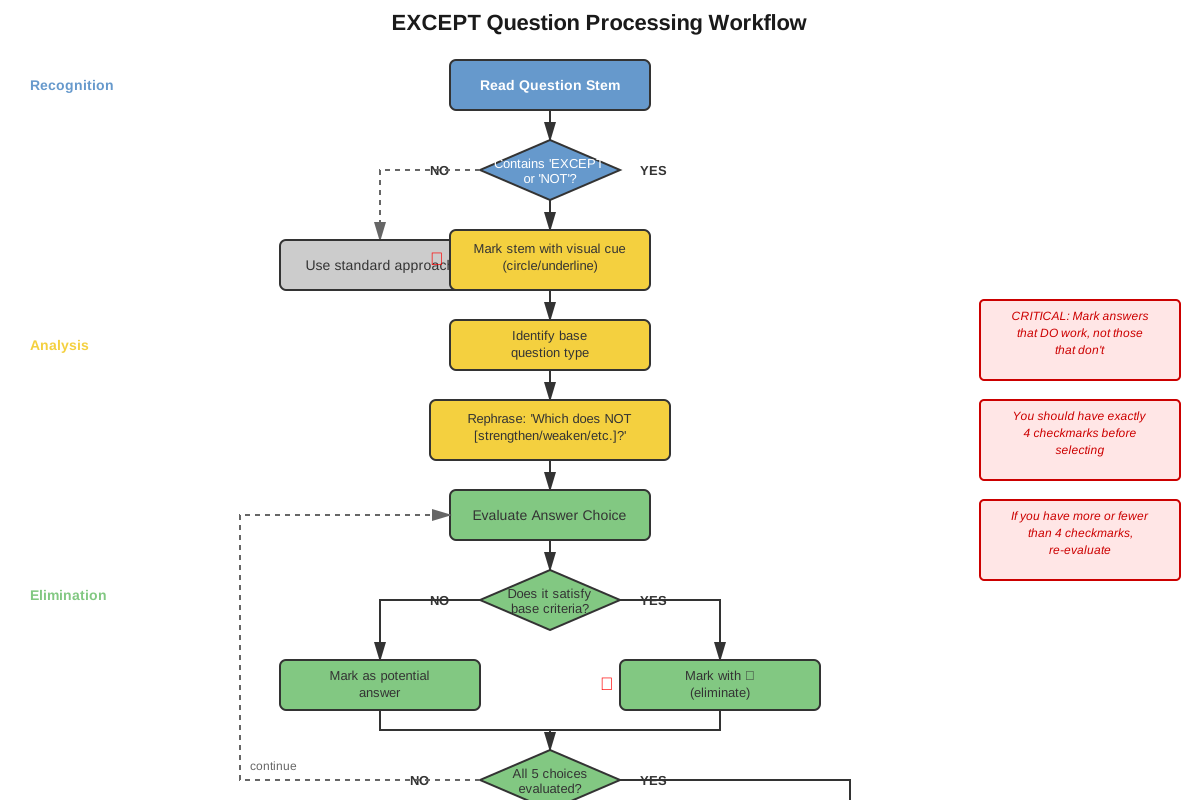
Effective EXCEPT stems strategy requires a methodical approach that differs from standard question-solving processes. The recommended process follows these steps:
- Identify and mark the EXCEPT: Circle or underline "EXCEPT" in the question stem to maintain awareness
- Determine the underlying question type: Identify whether the question asks about strengthening, weakening, assumptions, inferences, etc.
- Predict the four correct answers: Consider what types of answers WOULD satisfy the criteria
- Evaluate each answer systematically: Mark each answer with a clear notation system
- Verify the exception: Confirm that the remaining answer genuinely fails to satisfy the criteria
The notation system proves particularly crucial. Many successful test-takers use checkmarks (✓) for answers that DO satisfy the criteria and leave blank or mark with an X the one answer that doesn't. This visual tracking prevents confusion when returning to review the question.
Common Question Type Combinations
While EXCEPT can modify any question type, certain combinations appear more frequently on the LSAT:
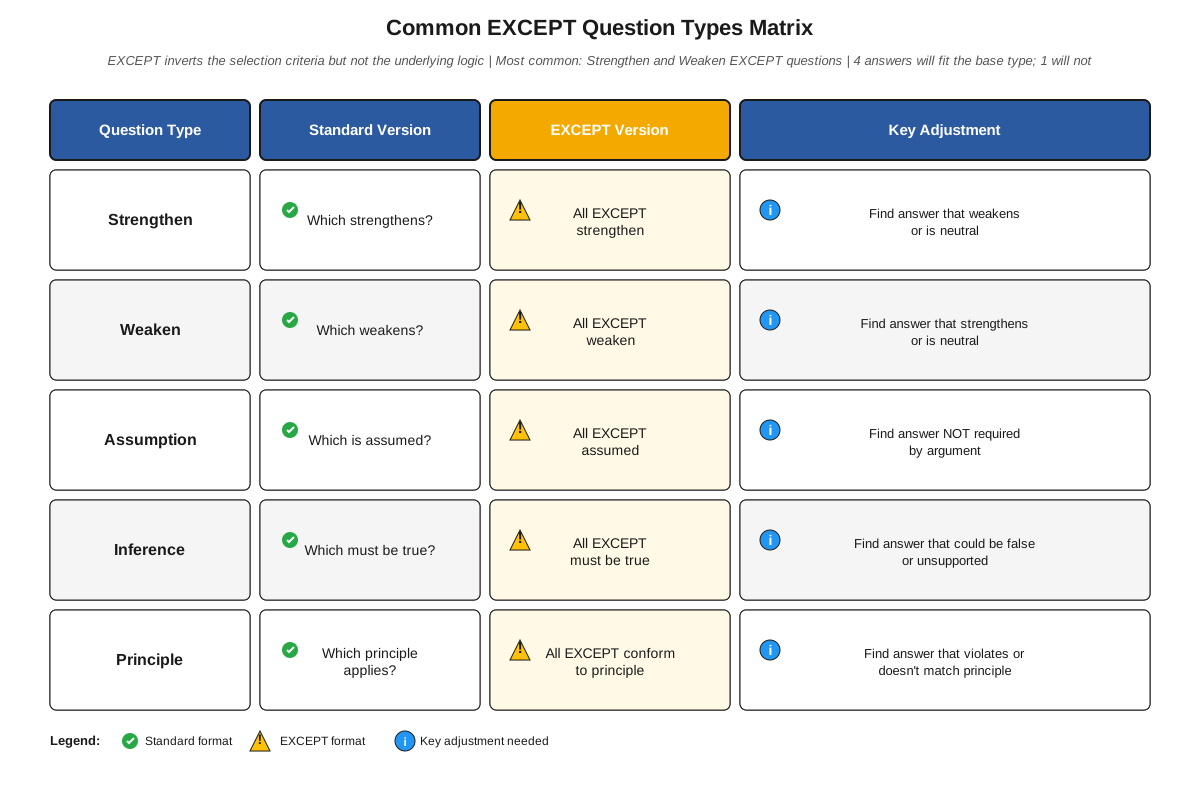
Weaken EXCEPT: "Each of the following weakens the argument EXCEPT" requires identifying four answers that undermine the conclusion and one that either strengthens, is neutral, or insufficiently weakens. These questions often appear with arguments containing multiple assumptions or vulnerabilities.
Strengthen EXCEPT: "All of the following strengthen the argument EXCEPT" requires finding four answers that support the conclusion and one that either weakens, is irrelevant, or provides insufficient support. These typically accompany arguments with several potential supporting considerations.
Assumption EXCEPT: "Each of the following is an assumption required by the argument EXCEPT" asks students to identify four necessary assumptions and one statement that, while possibly true or even helpful, isn't required for the argument's validity. These questions test deep understanding of logical necessity versus sufficiency.
Inference EXCEPT: "All of the following can be properly inferred EXCEPT" requires identifying four statements supported by the passage and one that goes beyond what the passage establishes. These questions reward careful attention to the scope and strength of claims.
The Cognitive Load Challenge
EXCEPT questions impose higher cognitive load than standard questions because they require maintaining multiple pieces of information simultaneously: the EXCEPT format, the underlying question type, the argument structure, and the evaluation status of each answer choice. This increased load makes EXCEPT questions particularly susceptible to careless errors when students rush or lose focus. Recognizing this inherent challenge helps students allocate appropriate time and mental resources to these questions.
Concept Relationships
The EXCEPT stems strategy functions as a modifier that layers onto foundational question stem recognition skills. The relationship flows as follows: Question Stem Recognition → identifies base question type → EXCEPT Stems Strategy → inverts selection criteria → Systematic Evaluation → produces correct answer selection. Without solid question stem recognition, students cannot identify what criteria the four "correct" answers must satisfy, making EXCEPT questions impossible to solve reliably.
EXCEPT stems strategy connects bidirectionally with argument structure analysis. Strong argument analysis enables students to predict what types of answers will strengthen, weaken, or assume, which in turn helps identify the exception. Conversely, working through EXCEPT questions reinforces argument analysis skills by requiring students to evaluate multiple relationships between evidence and conclusion rather than stopping at the first viable answer.
The strategy also relates closely to process of elimination techniques, but with an inverted application. In standard questions, elimination removes wrong answers to reveal the correct one. In EXCEPT questions, elimination removes correct answers to reveal the exception. This relationship means students must develop comfort with both positive selection ("this is right") and negative selection ("this is the one that doesn't fit").
Finally, EXCEPT stems strategy connects forward to time management and test-taking strategy. Because these questions require evaluating all five answer choices rather than potentially stopping early, they typically consume 15-30 seconds more than equivalent standard questions. Recognizing this time cost enables better pacing decisions during actual test administration.
High-Yield Facts
⭐ EXCEPT questions require identifying the ONE answer that does NOT satisfy the criteria, while four answers DO satisfy it
⭐ The word "EXCEPT" almost always appears in all capital letters in the question stem
⭐ EXCEPT questions can modify any standard question type: strengthen, weaken, assumption, inference, principle, parallel, etc.
⭐ The exception answer typically falls into one of three categories: irrelevant, opposite effect, or insufficient
⭐ Students must evaluate all five answer choices in EXCEPT questions; stopping early leads to errors
- EXCEPT questions appear 3-6 times per LSAT test across both Logical Reasoning sections
- Marking each answer with a clear notation system (checkmarks for "satisfies criteria") prevents confusion
- The most common EXCEPT formats are Weaken EXCEPT, Strengthen EXCEPT, and Assumption EXCEPT
- EXCEPT questions typically take 15-30 seconds longer than equivalent standard questions
- Circling or underlining "EXCEPT" in the question stem creates a persistent visual reminder
- The credited response in an EXCEPT question would typically be an incorrect answer in the standard version of that question type
- Many test-takers miss EXCEPT questions not because they can't identify the exception, but because they forget about the EXCEPT format mid-question
Quick check — test yourself on EXCEPT stems strategy so far.
Try Flashcards →Common Misconceptions
Misconception: EXCEPT questions are asking for the "wrong" or "false" answer.
Correction: EXCEPT questions ask for the answer that doesn't satisfy a specific criteria. The exception answer isn't necessarily false or wrong in absolute terms—it simply doesn't perform the function that the other four answers perform (strengthening, weakening, etc.). An answer can be completely true but still be the exception if it's irrelevant to the argument.
Misconception: If an answer choice is irrelevant to the argument, it can't be correct in an EXCEPT question.
Correction: Irrelevant answers are frequently the credited response in EXCEPT questions. If the question asks "Each of the following strengthens EXCEPT," an irrelevant answer neither strengthens nor weakens, making it the perfect exception among four answers that do strengthen.
Misconception: The exception answer will always do the opposite of what the question asks (e.g., weaken when the question asks what strengthens EXCEPT).
Correction: While opposite-effect answers sometimes serve as the exception, many EXCEPT questions credit irrelevant or insufficient answers instead. Students who only look for opposite effects will miss exceptions that simply fail to engage with the argument.
Misconception: EXCEPT questions are fundamentally different question types that require unique reasoning skills.
Correction: EXCEPT questions are standard question types with inverted selection criteria. The reasoning required to evaluate whether an answer strengthens an argument remains identical whether the question is "Which strengthens?" or "Which strengthens EXCEPT?" The only difference is which answer gets selected at the end.
Misconception: Once you find an answer that doesn't satisfy the criteria, you can select it immediately without checking remaining answers.
Correction: While this instinct works for standard questions, EXCEPT questions require verifying that the other four answers DO satisfy the criteria. Occasionally, two answers might fail to satisfy the criteria, indicating either a misunderstanding of the argument or the question type. Checking all five answers provides quality control.
Misconception: EXCEPT questions are inherently harder than standard questions and should be skipped.
Correction: EXCEPT questions test the same skills as standard questions with an added layer of attention management. With proper strategy and practice, they become no more difficult than their standard counterparts. Skipping them forfeits 5-10% of available Logical Reasoning points.
Worked Examples
Example 1: Weaken EXCEPT Question
Argument: "The city's new traffic cameras have reduced accidents at intersections by 30%. Therefore, the city should install traffic cameras at all intersections to maximize safety."
Question Stem: Each of the following weakens the argument EXCEPT:
Answer Choices:
(A) The intersections that received cameras were specifically chosen because they had the highest accident rates, making them unrepresentative of all intersections.
(B) The 30% reduction in accidents occurred during the same period when the city implemented a major driver education campaign.
(C) Traffic cameras are expensive to install and maintain, potentially diverting funds from other safety measures with better cost-effectiveness ratios.
(D) Studies show that traffic cameras reduce accidents at monitored intersections but increase accidents at nearby unmonitored intersections as drivers change routes.
(E) The traffic cameras use advanced technology that can detect vehicles running red lights and speeding.
Solution Process:
Step 1: Identify and mark "EXCEPT" - This is a Weaken EXCEPT question, so four answers will weaken and one won't.
Step 2: Analyze the argument structure - The argument uses evidence (30% reduction at some intersections) to conclude that cameras should be installed at ALL intersections. The gap involves assuming that the sample is representative and that the cameras caused the reduction.
Step 3: Evaluate each answer:
(A) Weakens - Attacks the representativeness of the sample, suggesting results won't generalize. ✓
(B) Weakens - Provides an alternative explanation for the reduction, undermining the causal claim that cameras caused the improvement. ✓
(C) Weakens - Introduces cost-benefit considerations that challenge whether installing cameras everywhere is the best approach. ✓
(D) Weakens - Suggests that expanding cameras might not actually improve overall safety due to displacement effects. ✓
(E) Does NOT weaken - Simply describes what the cameras do without providing any reason to doubt the conclusion. This is the exception.
Answer: (E)
This example demonstrates how the exception can be an irrelevant answer that neither supports nor undermines the argument. Answer choice (E) provides factual information about the cameras but doesn't engage with whether installing them everywhere is a good idea.
Example 2: Assumption EXCEPT Question
Argument: "Archaeologists discovered pottery fragments at the excavation site that match the style used by the Minoan civilization. Since no other ancient civilization in the region used this distinctive pottery style, the site must have been a Minoan settlement."
Question Stem: The argument depends on each of the following assumptions EXCEPT:
Answer Choices:
(A) The pottery fragments found at the site are ancient rather than modern reproductions.
(B) The pottery fragments were originally created at or near the excavation site rather than transported there from elsewhere.
(C) The distinctive pottery style was used exclusively by the Minoans and not adopted by other civilizations.
(D) The Minoan civilization was the most advanced civilization in the region during the relevant time period.
(E) The pottery fragments are representative of the site's overall artifacts rather than anomalous items.
Solution Process:
Step 1: Mark "EXCEPT" - Four answers will be necessary assumptions; one won't be required.
Step 2: Identify the argument's logic - Evidence: pottery matches Minoan style + no other civilization used this style → Conclusion: site was a Minoan settlement. The argument assumes the pottery is authentic, was created by Minoans, and indicates settlement rather than just trade or transport.
Step 3: Test each answer using the negation technique:
(A) Required assumption - If the pottery were modern reproductions, the conclusion would collapse entirely. ✓
(B) Required assumption - If the pottery were transported from elsewhere, the site might not have been a Minoan settlement (could have been a trade post of another civilization). ✓
(C) Required assumption - If other civilizations adopted the style, finding this pottery wouldn't prove Minoan settlement. ✓
(D) NOT required - The argument doesn't depend on the Minoans being "most advanced." Even if they were less advanced than others, the pottery evidence could still indicate their settlement. This is the exception.
(E) Required assumption - If the pottery fragments were anomalous (perhaps a single traded item), they wouldn't support the conclusion of a settlement. ✓
Answer: (D)
This example illustrates how the exception in an Assumption EXCEPT question is often a statement that might be true or even helpful but isn't logically necessary for the argument's validity. The Minoans' relative advancement level is simply irrelevant to whether the pottery indicates their settlement.
Exam Strategy
When approaching EXCEPT questions on the LSAT, implement a three-phase strategy: recognition, systematic evaluation, and verification.
Recognition Phase: Train your eyes to catch "EXCEPT" immediately upon reading the question stem. Consider using a physical marking strategy—circle it, underline it, or draw a box around it. This physical action creates both visual and kinesthetic memory that persists throughout your work on the question. Many test-takers benefit from reading the question stem twice when EXCEPT appears, ensuring full comprehension before moving to answer choices.
Systematic Evaluation Phase: Develop a consistent notation system and use it religiously. One effective approach: place a checkmark (✓) next to each answer that DOES satisfy the criteria. After evaluating all five choices, the one without a checkmark is your answer. Alternatively, some students prefer marking "Y" (yes, satisfies criteria) or "N" (no, doesn't satisfy). The specific system matters less than consistency—using the same approach every time reduces cognitive load and prevents errors.
Exam Tip: Never select an answer in an EXCEPT question until you've evaluated all five choices. Even if you're confident you've found the exception at choice (B), verify that choices (C), (D), and (E) do satisfy the criteria. This quality control catches misunderstandings of the argument or question type.
Trigger Words and Phrases: Beyond "EXCEPT" itself, watch for these related formulations:
- "All of the following... EXCEPT"
- "Each of the following... EXCEPT"
- "...with the EXCEPTION of"
- "Which one... does NOT"
- "...EXCEPT:" (note the colon)
Time Allocation: Budget approximately 1:45-2:00 minutes for EXCEPT questions compared to 1:15-1:30 for standard questions of the same type. The additional time accounts for evaluating all five answers rather than potentially stopping early. If you're running short on time, EXCEPT questions are generally not good candidates for skipping—they test the same skills as standard questions and yield the same point value.
Process of Elimination Specifics: In EXCEPT questions, elimination works in reverse. You're eliminating answers that DO satisfy the criteria to reveal the one that doesn't. This means you want to find reasons to eliminate four answers, which feels counterintuitive. Embrace this reversal: actively look for why each answer DOES strengthen, weaken, assume, etc., and mark those for elimination.
Common Trap Patterns: Test-makers know students often forget about the EXCEPT format mid-question. They frequently place a strong example of what the question asks for (e.g., a powerful weakener in a Weaken EXCEPT question) in position (A) or (B). Students who forget about EXCEPT will select this answer and move on, falling into the trap. Maintaining awareness of EXCEPT throughout prevents this error.
Memory Techniques
The "Four Plus One" Mnemonic: Remember that EXCEPT questions always have FOUR answers that FIT and ONE that's OUT. The acronym FOUR-FIT-ONE-OUT helps maintain the correct mental model while working through answer choices.
The Inversion Visualization: Picture a standard question as a target with one bullseye (correct answer) and four misses. Now visualize an EXCEPT question as an inverted target with four bullseyes (answers that satisfy criteria) and one miss (the exception). This visual metaphor reinforces the fundamental reversal.
The Checkmark System: Develop muscle memory for marking answers. Every time you confirm an answer DOES satisfy the criteria, physically mark it with a checkmark. The kinesthetic action of making four checkmarks reinforces that you're looking for the fifth, unmarked answer.
The "STOP-EXCEPT" Acronym:
- Spot the EXCEPT in the question stem
- Type: identify the underlying question type
- Outline what would satisfy the criteria
- Process each answer systematically
- Eliminate the four that satisfy
- X-amine the remaining answer
- Confirm it's truly the exception
- Enter your answer
- Proceed to the next question
- Trust your systematic process
The Color-Coding Technique: If you use highlighters during practice, consider using one color for standard questions and a different color for EXCEPT questions. This visual distinction during practice builds automatic recognition that transfers to test day.
Summary
The EXCEPT stems strategy represents a critical meta-skill in LSAT Logical Reasoning that modifies standard question types by inverting selection criteria. Rather than identifying one correct answer among four incorrect options, test-takers must identify one answer that fails to satisfy stated criteria while four others succeed. This fundamental reversal demands heightened attention management, systematic evaluation processes, and conscious override of natural pattern-matching instincts. Success requires immediate recognition of EXCEPT language in question stems, accurate identification of the underlying question type being modified, and methodical evaluation of all five answer choices using consistent notation systems. The exception answer typically falls into one of three categories: irrelevant to the argument, producing an opposite effect from what's requested, or insufficient to satisfy the criteria. While EXCEPT questions appear 3-6 times per test and require slightly more time than standard questions, they test identical reasoning skills with an added attention layer. Mastery comes through deliberate practice that builds automatic recognition and systematic processing habits, transforming these questions from potential traps into reliable scoring opportunities.
Key Takeaways
- EXCEPT questions invert standard selection criteria: seek the one answer that does NOT satisfy the criteria while four others DO
- Recognition is critical: the word "EXCEPT" typically appears in all capitals and must be immediately identified and marked
- Systematic evaluation is non-negotiable: all five answer choices must be evaluated with consistent notation before selecting an answer
- EXCEPT modifies existing question types: master standard strengthen, weaken, assumption, and inference questions first, then apply EXCEPT strategy as a modifier
- The exception typically falls into three categories: irrelevant, opposite effect, or insufficient—but don't assume which category in advance
- Time management matters: budget 15-30 seconds more for EXCEPT questions than equivalent standard questions
- Physical marking strategies prevent errors: circle "EXCEPT" in the stem and use checkmarks or other notation to track which answers satisfy criteria
Related Topics
Standard Question Stem Recognition: Before mastering EXCEPT stems, students must develop fluency with standard question types including strengthen, weaken, necessary assumption, sufficient assumption, inference, principle, parallel reasoning, flaw, and method of reasoning questions. EXCEPT strategy builds directly on this foundation.
Argument Structure and Diagramming: Understanding how to break down arguments into premises, conclusions, and assumptions enables more effective evaluation of answer choices in EXCEPT questions, particularly for Assumption EXCEPT and Strengthen/Weaken EXCEPT variants.
Conditional Logic and Formal Logic: Many EXCEPT questions involve conditional statements or formal logical relationships. Mastering sufficient and necessary conditions, contrapositives, and logical operators enhances accuracy on these questions.
Advanced Process of Elimination: While basic elimination skills are prerequisite knowledge, advanced techniques for managing partial eliminations, comparing relative strength of answers, and handling uncertainty become particularly important in EXCEPT questions where all five answers require evaluation.
Time Management and Pacing Strategies: Understanding how EXCEPT questions fit into overall section timing enables better strategic decisions about when to invest the additional time these questions require versus when to make educated guesses under time pressure.
Practice CTA
Now that you've mastered the conceptual framework and strategic approach for EXCEPT stems, it's time to cement your understanding through deliberate practice. Access the practice questions and flashcards specifically designed to reinforce EXCEPT stems strategy. Focus on building automatic recognition of EXCEPT language, developing consistent notation habits, and maintaining awareness throughout the question-solving process. Remember that EXCEPT questions reward systematic thinking over speed—accuracy comes first, then efficiency develops through repetition. Each practice question you complete strengthens the neural pathways that will serve you on test day. Your investment in mastering this high-yield strategy will pay dividends across both Logical Reasoning sections, potentially adding multiple points to your final score. Begin your practice now and transform EXCEPT questions from potential pitfalls into confident scoring opportunities.
Sign up free to keep reading
Create a free AnvayaPrep account to finish this LSAT guide on EXCEPT stems strategy — plus flashcards and practice questions.