Overview
Mixed task question stems represent a sophisticated category of LSAT logical reasoning questions that require test-takers to perform multiple analytical operations simultaneously. Unlike standard question types that ask for a single task—such as identifying an assumption, finding a flaw, or strengthening an argument—mixed task questions combine two or more distinct reasoning operations within a single question stem. These questions test not only the ability to recognize what task is being requested but also the capacity to integrate multiple analytical skills in a coordinated fashion.
Understanding mixed task question stems is essential for LSAT success because they appear with increasing frequency on modern LSAT administrations and typically carry higher difficulty ratings. These questions challenge students to move beyond compartmentalized thinking about question types and instead develop a flexible, integrated approach to argument analysis. The ability to recognize and efficiently tackle mixed task questions often separates high scorers from average performers, as these questions require both technical precision and strategic thinking under time pressure.
Within the broader framework of question stem recognition, mixed task questions occupy a critical position. They build upon foundational knowledge of individual question types while demanding synthesis across multiple analytical frameworks. Mastering this topic strengthens overall logical reasoning skills by forcing students to see connections between different aspects of argument structure, evidence evaluation, and logical inference—connections that enhance performance across all question types, not just mixed task stems themselves.
Learning Objectives
- [ ] Identify how Mixed task question stems appears in LSAT questions
- [ ] Explain the reasoning pattern behind Mixed task question stems
- [ ] Apply Mixed task question stems to solve LSAT-style problems accurately
- [ ] Distinguish between genuine mixed task questions and single-task questions with complex wording
- [ ] Prioritize which analytical task to perform first when confronting a mixed task question
- [ ] Recognize the most common task combinations that appear on the LSAT
- [ ] Develop efficient time management strategies specific to mixed task questions
Prerequisites
- Basic question type identification: Understanding standard LSAT question types (assumption, strengthen, weaken, flaw, inference, etc.) is essential because mixed task questions combine these fundamental categories
- Argument structure analysis: The ability to identify conclusions, premises, and gaps in reasoning provides the foundation for performing multiple analytical tasks on a single argument
- Conditional reasoning: Many mixed task questions involve conditional statements, requiring fluency with sufficient/necessary conditions to navigate multiple analytical demands
- Evidence evaluation: Understanding how evidence relates to conclusions is crucial when questions ask to both evaluate and modify arguments simultaneously
Why This Topic Matters
Mixed task question stems represent a high-stakes component of LSAT logical reasoning sections. Statistical analysis of recent LSAT administrations reveals that approximately 10-15% of logical reasoning questions contain mixed task elements, with this percentage trending upward in recent years. These questions typically appear in the medium-to-difficult range of question difficulty, making them critical for students aiming for scores above the 160 threshold.
In real-world legal practice, attorneys must constantly perform multiple analytical operations simultaneously—evaluating evidence while identifying assumptions, strengthening their own arguments while anticipating weaknesses, and drawing inferences while considering alternative explanations. Mixed task questions directly simulate this multidimensional analytical thinking that characterizes effective legal reasoning. Law schools value this skill because it predicts success in case analysis, legal writing, and oral advocacy.
On the LSAT, mixed task questions commonly appear in several formats: questions that ask test-takers to identify both a flaw and what would fix it; questions requiring identification of an assumption while also evaluating what would weaken the argument; and questions demanding inference-drawing while simultaneously assessing argument structure. These questions often appear in the latter half of logical reasoning sections, where test-makers place more challenging items. Understanding mixed task stems enables efficient question triage and prevents the time-wasting confusion that occurs when students misidentify what a question is actually asking.
Core Concepts
Definition and Characteristics of Mixed Task Question Stems
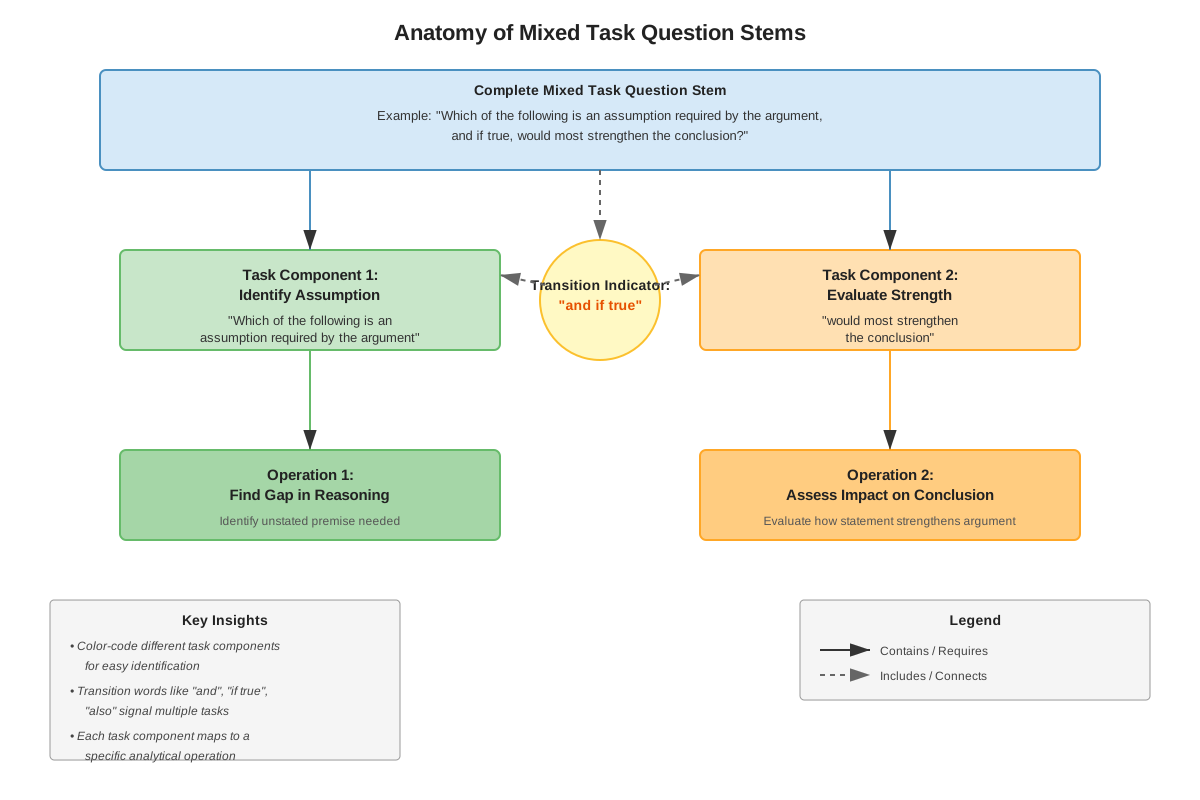
Mixed task question stems are LSAT logical reasoning questions that explicitly or implicitly require test-takers to perform two or more distinct analytical operations to arrive at the correct answer. Unlike straightforward question types that request a single task (e.g., "Which one of the following is an assumption required by the argument?"), mixed task questions integrate multiple analytical demands within their structure.
The defining characteristic of these questions is that the correct answer must satisfy multiple criteria simultaneously. A response might need to both identify a flaw AND explain why that flaw matters, or recognize an assumption AND demonstrate how that assumption could be challenged. This dual requirement distinguishes mixed task questions from merely complex single-task questions that use sophisticated language but ultimately ask for one analytical operation.
Common Task Combinations
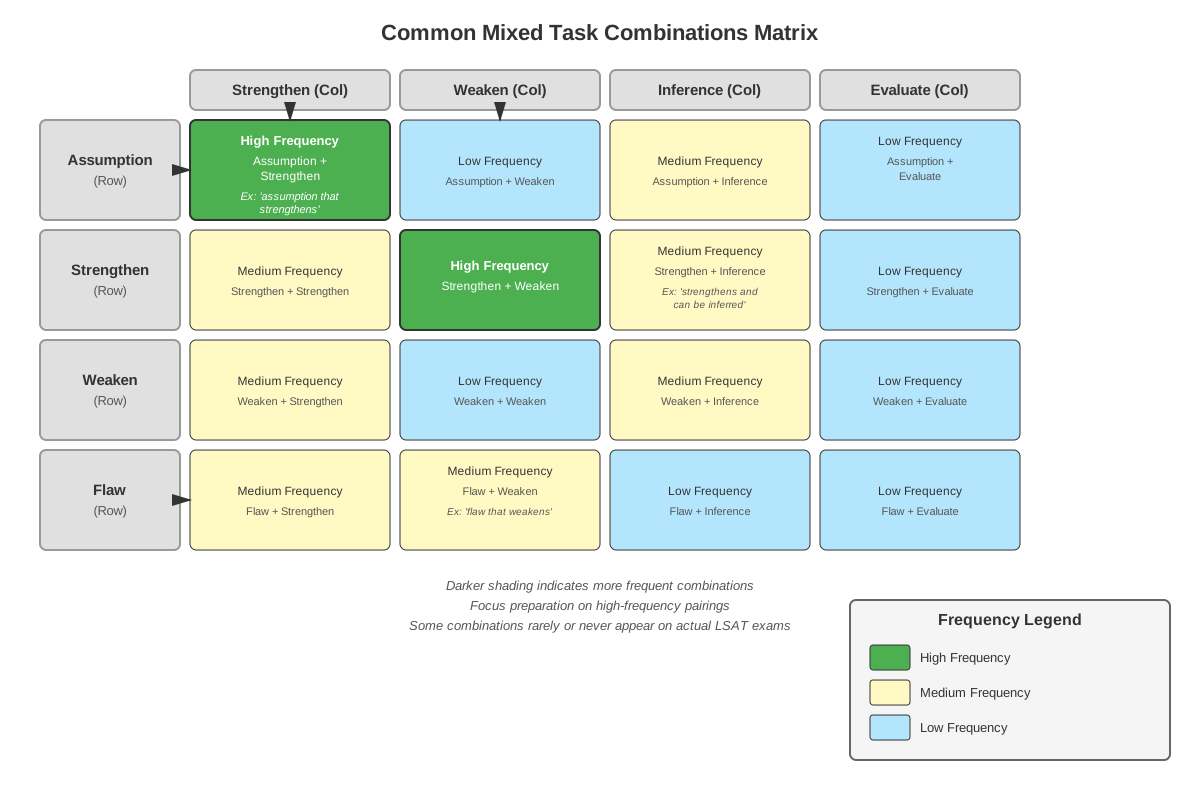
The LSAT employs several recurring combinations of analytical tasks in mixed task question stems:
Flaw + Solution Combination: These questions ask test-takers to identify a reasoning error and simultaneously recognize what would correct or address that error. Example stem: "The reasoning in the argument is flawed in that it fails to consider which one of the following possibilities?"
Assumption + Evaluation Combination: These stems require identifying what the argument assumes while also assessing how that assumption affects argument strength. Example stem: "The argument depends on assuming which one of the following, the truth of which would most strengthen the conclusion?"
Inference + Justification Combination: These questions demand drawing a conclusion while also explaining what evidence supports that inference. Example stem: "If the statements above are true, which one of the following must also be true and is most strongly supported by those statements?"
Principle + Application Combination: These stems ask test-takers to identify an underlying principle while simultaneously applying it to a specific situation. Example stem: "Which one of the following principles, if valid, most helps to justify the reasoning above while also explaining the apparent discrepancy?"
Recognition Patterns
Identifying mixed task question stems requires attention to specific linguistic markers:
- Compound question structures: Stems containing "and," "while also," "in that it," or "thereby" often signal multiple tasks
- Conditional phrasing within stems: Language like "if true, would" combined with another analytical verb indicates dual requirements
- Qualifying phrases: Terms such as "most helps to justify while also," "both identifies and explains," or "not only...but also" explicitly mark mixed tasks
- Implicit dual requirements: Some stems appear to ask one question but require multiple analytical steps to evaluate answer choices correctly
Strategic Approach Framework
Successfully navigating mixed task questions requires a systematic approach:
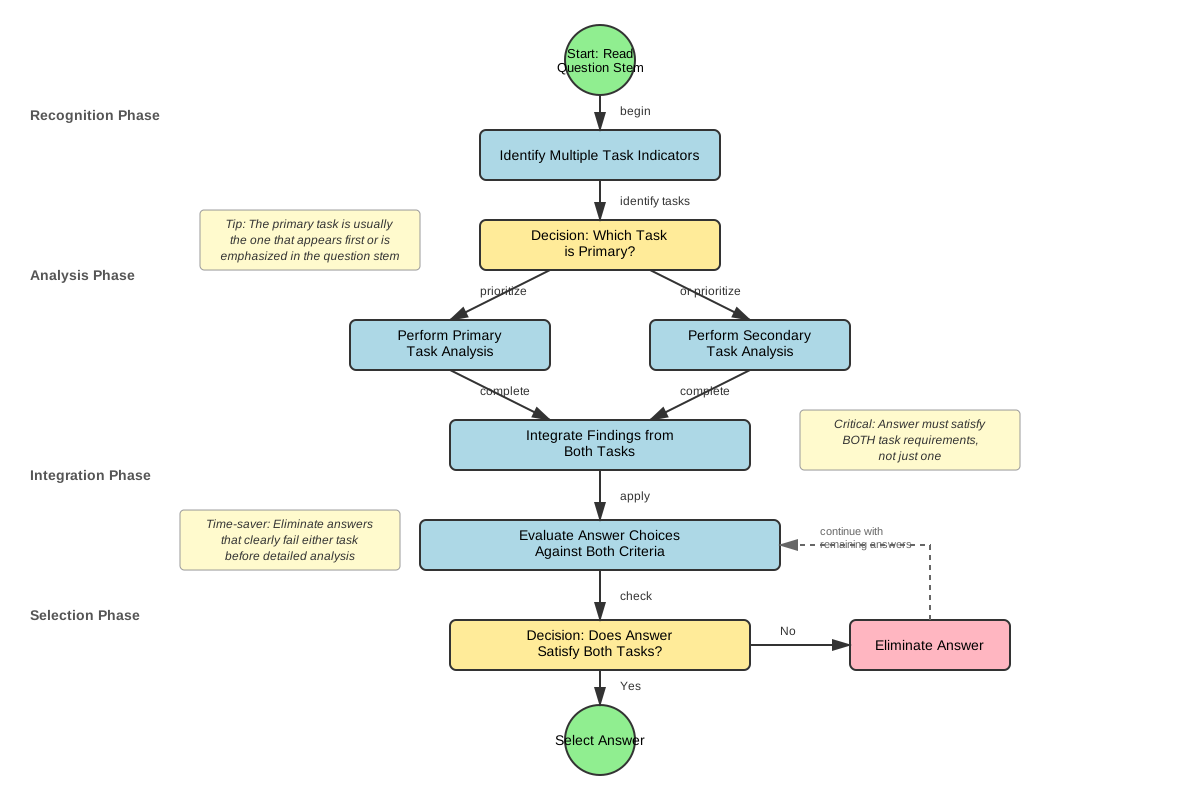
Step 1 - Stem Decomposition: Break the question stem into its component tasks. Identify each distinct analytical operation required.
Step 2 - Task Prioritization: Determine which task to perform first. Generally, start with the more concrete or restrictive task, as this narrows the answer pool more efficiently.
Step 3 - Sequential Elimination: Apply each task criterion sequentially to answer choices, eliminating options that fail either requirement.
Step 4 - Integration Check: Verify that the remaining answer choice(s) satisfy both tasks simultaneously, not just each task independently.
Analytical Complexity Levels
Mixed task questions exist on a spectrum of complexity:
| Complexity Level | Characteristics | Example Task Combination |
|---|---|---|
| Basic Mixed | Two closely related tasks; one task naturally leads to the other | Identify assumption + show assumption is necessary |
| Moderate Mixed | Two distinct but compatible tasks; requires separate analysis of each | Find flaw + identify what would fix it |
| Advanced Mixed | Multiple tasks with potential tension; requires sophisticated integration | Draw inference + evaluate competing explanations + identify principle |
The Role of Answer Choice Structure
In mixed task questions, answer choices themselves often reflect the dual nature of the question. Some answer choices may satisfy one criterion but fail the other, serving as attractive wrong answers for students who only recognize one of the required tasks. Understanding this structure helps test-takers avoid partial-credit thinking—on the LSAT, an answer must be completely correct, satisfying all requirements.
Concept Relationships
Mixed task question stems exist at the intersection of multiple logical reasoning competencies. The relationship begins with question stem recognition, the foundational skill of identifying what a question asks. This skill branches into recognition of individual question types (assumption, flaw, strengthen, weaken, inference, principle), each of which represents a distinct analytical operation.
Mixed task questions synthesize these individual operations: Question Stem Recognition → Individual Task Identification → Task Combination Recognition → Integrated Analysis.
The connection to argument structure analysis is bidirectional. Understanding argument components (premises, conclusion, assumptions, evidence) enables performance of multiple analytical tasks, while practicing mixed task questions deepens structural understanding by requiring examination of arguments from multiple angles simultaneously.
Conditional reasoning frequently intersects with mixed task questions, particularly in combinations involving inference-drawing and assumption-identification. The logical relationships expressed through conditional statements often form the basis for both tasks in a mixed question.
The relationship to time management is critical: mixed task questions typically require 15-30 seconds more processing time than standard questions. Recognizing this relationship allows strategic allocation of time resources during the exam.
High-Yield Facts
⭐ Mixed task question stems require satisfying multiple analytical criteria simultaneously, not just sequentially
⭐ Approximately 10-15% of logical reasoning questions contain mixed task elements on recent LSAT administrations
⭐ The most common task combination is flaw identification + solution recognition
⭐ Answer choices in mixed task questions often satisfy one criterion but not both, serving as attractive distractors
⭐ Decomposing the question stem into component tasks is the essential first step in approaching these questions
- Mixed task questions typically appear in the medium-to-difficult range of question difficulty
- Compound linguistic structures ("and," "while also," "in that it") frequently signal mixed task requirements
- Starting with the more restrictive or concrete task improves elimination efficiency
- Some mixed task questions appear to ask one question but implicitly require multiple analytical operations
- Advanced mixed task questions may involve three or more distinct analytical operations
- The ability to recognize mixed task stems correlates strongly with overall LSAT logical reasoning performance
- Time pressure makes mixed task questions particularly challenging, as they resist rushed analysis
Quick check — test yourself on Mixed task question stems so far.
Try Flashcards →Common Misconceptions
Misconception: Mixed task questions are just harder versions of regular questions and should be approached the same way.
Correction: Mixed task questions require a fundamentally different approach involving systematic decomposition and sequential application of multiple criteria. Treating them as standard questions leads to overlooking one of the required analytical tasks.
Misconception: If an answer choice satisfies one of the required tasks, it's probably correct.
Correction: The correct answer must satisfy ALL required tasks simultaneously. Partial satisfaction is insufficient, and answer choices that meet only one criterion are deliberately designed distractors.
Misconception: Mixed task questions always explicitly state both tasks in the question stem.
Correction: Some mixed task questions have implicit dual requirements that only become apparent when evaluating answer choices. The stem may appear to ask one question while the answer choices reveal a second analytical dimension.
Misconception: You should perform both analytical tasks simultaneously to save time.
Correction: Attempting to evaluate both criteria at once typically leads to confusion and errors. The most efficient approach is sequential: apply one criterion to eliminate answer choices, then apply the second criterion to the remaining options.
Misconception: Mixed task questions are rare and not worth special preparation.
Correction: These questions appear with sufficient frequency (10-15% of logical reasoning questions) and difficulty to significantly impact scores. They represent a high-yield study area, particularly for students aiming for top-tier scores.
Misconception: The order in which you apply the analytical tasks doesn't matter.
Correction: Task prioritization significantly affects efficiency. Starting with the more restrictive or concrete task typically eliminates more answer choices more quickly, saving valuable time.
Worked Examples
Example 1: Flaw + Solution Combination
Argument: "Studies show that people who drink coffee daily have lower rates of Parkinson's disease than those who don't drink coffee. Therefore, drinking coffee must prevent Parkinson's disease."
Question Stem: "The reasoning in the argument is most vulnerable to criticism on the grounds that it fails to consider which one of the following?"
Analysis:
Step 1 - Stem Decomposition: This question requires two tasks: (1) identifying the flaw in the reasoning, and (2) recognizing what consideration would address that flaw.
Step 2 - Flaw Identification: The argument commits a correlation-causation error. It observes a correlation (coffee drinking associated with lower Parkinson's rates) and concludes causation (coffee prevents Parkinson's). The flaw is failing to consider alternative explanations for the correlation.
Step 3 - Solution Recognition: The correct answer must identify a consideration that, if true, would explain the correlation without requiring that coffee causes the prevention of Parkinson's disease.
Step 4 - Answer Evaluation:
(A) "Whether people who drink coffee daily also engage in other healthy behaviors" - This addresses alternative explanations but doesn't directly challenge the causal claim.
(B) "Whether people in early stages of Parkinson's disease naturally avoid coffee due to symptoms" - CORRECT: This identifies reverse causation as an unconsidered possibility. If early Parkinson's causes coffee avoidance, the correlation would exist without coffee preventing the disease. This both identifies the flaw (ignoring alternative causal directions) and provides the specific consideration that addresses it.
(C) "Whether coffee has other health benefits" - This is irrelevant to the causal claim about Parkinson's.
Integration Check: Answer (B) satisfies both requirements: it identifies what the argument fails to consider (reverse causation) and explains how this consideration undermines the conclusion.
Example 2: Assumption + Evaluation Combination
Argument: "The new traffic light at the intersection has reduced accidents by 40% in the six months since installation. The city should install similar lights at all major intersections to improve overall traffic safety."
Question Stem: "The argument depends on which one of the following assumptions, the falsity of which would most weaken the recommendation?"
Analysis:
Step 1 - Stem Decomposition: This question requires: (1) identifying an assumption the argument depends on, and (2) recognizing that this assumption, if false, would weaken the argument (evaluation component).
Step 2 - Assumption Identification: The argument moves from evidence about one intersection to a recommendation about all major intersections. This requires assuming that the conditions at the test intersection are representative of other major intersections.
Step 3 - Evaluation Component: The correct answer must be an assumption that, if proven false, would undermine the recommendation to install lights at all major intersections.
Step 4 - Answer Evaluation:
(A) "Traffic lights are the most cost-effective safety measure available" - This is not necessary to the argument; the argument could work even if other measures are equally cost-effective.
(B) "The intersection where the light was installed had similar traffic patterns to other major intersections" - CORRECT: This is a necessary assumption. If false (the test intersection was unique), the evidence wouldn't support the broad recommendation. The falsity directly weakens the argument by breaking the connection between the evidence and the recommendation.
(C) "Accidents at the intersection were caused by lack of traffic control" - While relevant, this isn't necessary; the argument works even if accidents had multiple causes.
Integration Check: Answer (B) satisfies both requirements: it's an assumption the argument depends on (representativeness), and its falsity would weaken the recommendation (by making the evidence non-generalizable).
Exam Strategy
When confronting mixed task question stems on the LSAT, implement this strategic approach:
Recognition Phase: Invest 5-10 seconds carefully reading the question stem, watching for compound structures, multiple verbs requiring different analytical operations, or qualifying phrases that signal dual requirements. If the stem contains "and," "while also," "in that," or similar connectors, immediately flag it as potentially mixed task.
Decomposition Phase: Before looking at answer choices, explicitly identify each required task. Write brief notes if helpful: "1. Find flaw, 2. Identify fix" or "1. Assumption, 2. Weakener." This prevents overlooking one of the requirements during answer evaluation.
Prioritization Decision: Determine which task to apply first. Generally, apply the more restrictive criterion first. For example, if the question asks for an assumption that would also strengthen the argument, start by identifying assumptions (more restrictive) rather than strengtheners (broader category).
Sequential Elimination: Apply your first criterion to all answer choices, eliminating those that fail. Then apply your second criterion only to remaining choices. This sequential approach is more efficient than trying to evaluate both criteria simultaneously.
Trigger Words to Watch:
- "While also" - signals explicit dual requirement
- "In that it" - often introduces a second analytical dimension
- "Thereby" - suggests one task leads to or accomplishes another
- "Both...and" - explicitly marks two requirements
- "Not only...but also" - indicates multiple criteria
- "If true, would" combined with another analytical verb - suggests evaluation plus another task
Time Management: Allocate 15-30 seconds extra for mixed task questions compared to standard questions. If you're running short on time, consider whether you can confidently identify one of the two required tasks; if so, you can eliminate some answer choices even without fully analyzing both requirements.
Process of Elimination Specific Tips: Wrong answers in mixed task questions typically fall into three categories: (1) satisfies neither criterion, (2) satisfies only the first criterion, or (3) satisfies only the second criterion. The most attractive wrong answers satisfy one criterion strongly, tempting students who only recognize one of the required tasks.
Memory Techniques
DECOMPOSE Acronym for approaching mixed task questions:
- Dissect the question stem into component tasks
- Evaluate which task is more restrictive
- Consider each answer against first criterion
- Omit answers that fail first test
- Measure remaining answers against second criterion
- Prioritize the answer satisfying both requirements
- Overall integration check
- Select with confidence
- Eliminate doubt by confirming dual satisfaction
Visual Technique: Imagine mixed task questions as a Venn diagram. The correct answer must fall in the overlap zone where both circles (representing each required task) intersect. Wrong answers fall outside this overlap, satisfying at most one circle.
The "AND Test": When you think you've found the right answer, explicitly state: "This answer does [Task 1] AND it does [Task 2]." If you can't confidently complete both parts of this statement, reconsider.
Color Coding Mental Strategy: Mentally assign one "color" to each required task. As you evaluate an answer choice, visualize it "lighting up" in each color as it satisfies each criterion. The correct answer should "light up" in all required colors.
Summary
Mixed task question stems represent a sophisticated LSAT question category requiring test-takers to perform multiple analytical operations simultaneously. These questions, appearing in 10-15% of logical reasoning items, combine two or more distinct tasks—such as identifying a flaw while recognizing its solution, or finding an assumption while evaluating what would weaken it. Success requires systematic decomposition of question stems into component tasks, strategic prioritization of which task to apply first, and sequential elimination of answer choices that fail either criterion. The most common combinations involve flaw-solution pairs, assumption-evaluation pairs, and inference-justification pairs. Recognition depends on identifying linguistic markers like compound structures, qualifying phrases, and conditional phrasing within stems. The correct answer must satisfy all required criteria simultaneously, while attractive wrong answers typically satisfy only one requirement. Mastering mixed task questions demands moving beyond compartmentalized thinking about individual question types to develop integrated analytical skills that characterize high-level logical reasoning performance.
Key Takeaways
- Mixed task question stems require satisfying multiple analytical criteria simultaneously, not just performing multiple steps sequentially
- Systematic decomposition of the question stem into component tasks is the essential first step and prevents overlooking required analytical operations
- The most efficient approach involves sequential application of criteria: apply the more restrictive task first to eliminate answer choices, then apply the second criterion to remaining options
- Common task combinations include flaw + solution, assumption + evaluation, inference + justification, and principle + application
- Linguistic markers such as "while also," "in that it," "thereby," and compound structures signal mixed task requirements
- Wrong answers frequently satisfy one criterion but not both, making them attractive to students who only recognize one of the required tasks
- Allocating 15-30 seconds extra time for mixed task questions improves accuracy without significantly impacting overall section timing
Related Topics
Advanced Question Type Integration: Building on mixed task question stems, this topic explores how to handle questions that combine three or more analytical operations, preparing students for the most challenging logical reasoning items.
Parallel Reasoning with Multiple Structures: This advanced topic applies mixed task principles to parallel reasoning questions, requiring identification of multiple structural elements simultaneously.
Comparative Argument Analysis: Understanding mixed task questions enables progression to questions requiring simultaneous analysis of multiple arguments or perspectives within a single stimulus.
Strategic Question Triage: Mastering mixed task recognition improves overall section strategy by enabling accurate difficulty assessment and optimal question ordering decisions.
Practice CTA
Now that you understand the structure and strategy behind mixed task question stems, it's time to put this knowledge into action. Attempt the practice questions designed specifically for this topic, focusing on implementing the DECOMPOSE approach and sequential elimination strategy. Use the flashcards to reinforce recognition of common task combinations and trigger words. Remember: mixed task questions separate good scores from great scores—your investment in mastering this challenging question type will pay significant dividends on test day. Each practice question you work through builds the integrated analytical skills that characterize top LSAT performers. Start practicing now to transform this knowledge into automatic, efficient performance under timed conditions.
Sign up free to keep reading
Create a free AnvayaPrep account to finish this LSAT guide on Mixed task question stems — plus flashcards and practice questions.