Overview
Question stem prediction is a critical strategic skill in LSAT logical reasoning that involves anticipating the type of question being asked before reading the question stem itself. This technique allows test-takers to engage with the stimulus (the argument or passage) more efficiently by priming their analytical focus toward the most relevant logical features. Rather than reading passively and then scrambling to understand what the question demands, skilled test-takers develop the ability to recognize patterns in argument structure that signal specific question types, enabling them to read with purpose and identify key elements proactively.
Mastering question stem recognition through prediction transforms the LSAT experience from reactive to strategic. When students can accurately predict that a flawed argument will likely lead to a "flaw in reasoning" question, or that a complete, valid argument suggests a "main conclusion" or "method of reasoning" question, they save precious seconds and reduce cognitive load. This skill becomes particularly valuable given that Logical Reasoning sections comprise approximately half of the scored LSAT content, with each section containing 24-26 questions that must be completed in 35 minutes. The ability to predict question stems creates a competitive advantage by allowing students to identify conclusion indicators, premise markers, logical gaps, and reasoning patterns during their first read-through of the stimulus.
The relationship between question stem prediction and broader Logical Reasoning competencies is foundational. This skill integrates argument structure analysis, conditional reasoning recognition, and flaw identification into a cohesive strategic approach. Students who master prediction naturally develop stronger skills in all question types because they learn to read arguments through multiple analytical lenses simultaneously, recognizing which features matter most for different question categories.
Learning Objectives
- [ ] Identify how question stem prediction appears in LSAT questions
- [ ] Explain the reasoning pattern behind question stem prediction
- [ ] Apply question stem prediction to solve LSAT-style problems accurately
- [ ] Distinguish between argument structures that signal different question types
- [ ] Develop a systematic approach to analyzing stimuli that enables accurate prediction
- [ ] Recognize the correlation between specific logical flaws and their corresponding question types
Prerequisites
- Basic argument structure: Understanding premises, conclusions, and how they connect is essential because question stem prediction relies on identifying these components quickly
- Familiarity with LSAT question types: Knowledge of the major question categories (assumption, strengthen, weaken, flaw, inference, etc.) provides the framework for what students are predicting
- Conditional reasoning fundamentals: Many predictable patterns involve conditional statements, making this knowledge crucial for accurate anticipation
- Indicator word recognition: Ability to spot conclusion and premise indicators enables rapid argument mapping during the prediction process
Why This Topic Matters
In real-world legal practice, attorneys must quickly assess arguments, identify weaknesses, and determine what additional information would strengthen or undermine a position. Question stem prediction develops these same analytical reflexes, training students to evaluate arguments from multiple perspectives simultaneously. This metacognitive skill—thinking about how one will need to think—translates directly to legal reasoning, case analysis, and strategic argumentation.
On the LSAT, Logical Reasoning questions appear in two sections, each containing 24-26 questions, collectively representing approximately 50% of the exam score. Question stem prediction impacts performance across all question types, making it one of the highest-yield skills students can develop. Research on LSAT performance indicates that students who employ strategic reading approaches, including prediction, score 3-5 points higher on average than those who read reactively.
This topic appears in every single Logical Reasoning question, though its utility varies by question type. The most predictable question types include flaw questions (which almost always follow flawed arguments with identifiable reasoning errors), assumption questions (which follow arguments with explicit logical gaps), and inference questions (which typically follow fact sets without argumentative structure). Method of reasoning questions usually follow complex or unusual argumentative structures, while strengthen/weaken questions follow arguments with clear vulnerabilities. Recognizing these patterns before reading the question stem allows students to identify relevant information during their initial read, dramatically improving both speed and accuracy.
Core Concepts
The Prediction Process
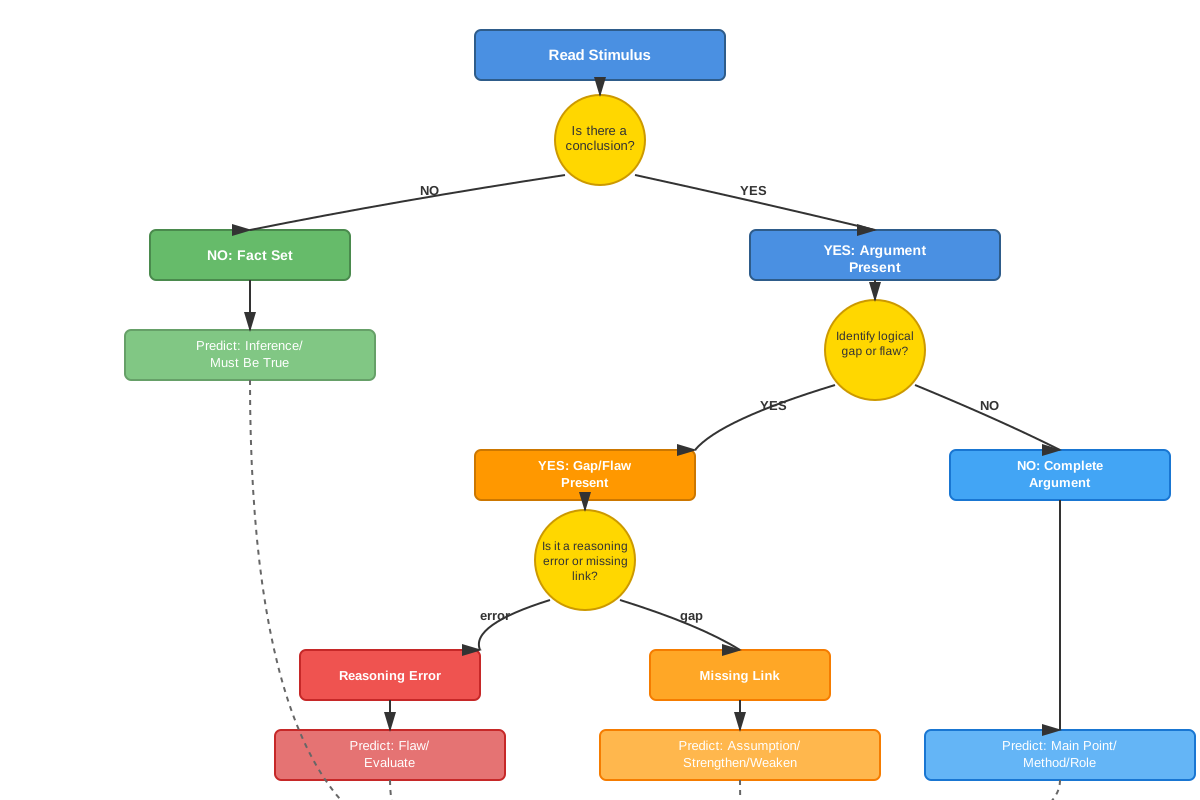
The lsat question stem prediction process involves a systematic analysis of the stimulus that occurs during the initial read-through. Rather than reading passively, students trained in prediction actively evaluate multiple dimensions of the argument simultaneously: Is there a conclusion? Is the reasoning flawed? Are there gaps between premises and conclusion? Is this a fact set or an argument? This multi-dimensional analysis creates a mental model that suggests probable question types.
The prediction process follows this sequence:
- Identify whether the stimulus contains an argument or merely presents facts
- Locate the conclusion (if present) and assess its relationship to the premises
- Evaluate the logical structure for gaps, flaws, or assumptions
- Note any unusual features (conditional reasoning, causal claims, analogies, statistical reasoning)
- Generate a hypothesis about the most likely question type(s)
- Verify the hypothesis against the actual question stem
This process becomes increasingly automatic with practice, eventually requiring only 2-3 seconds of additional processing time while yielding significant benefits in comprehension and accuracy.
Argument Structure Signals
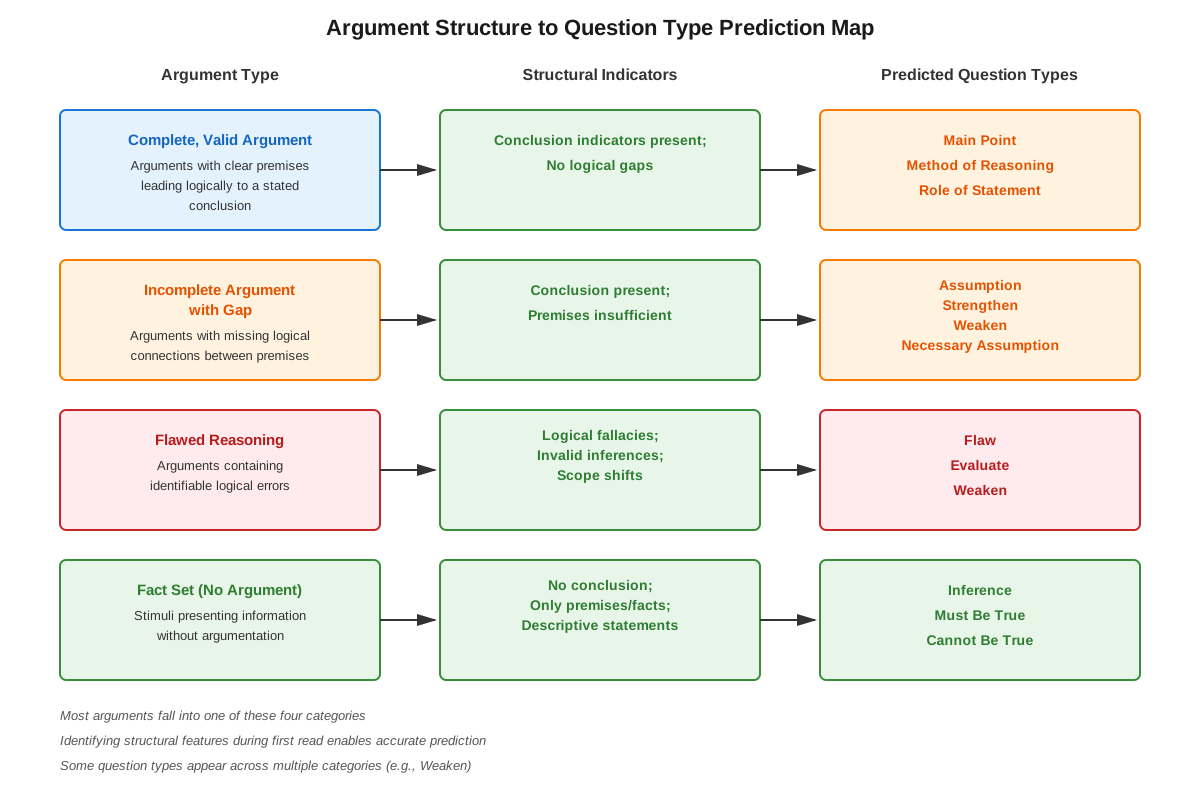
Different argument structures reliably predict specific question types. Understanding these correlations forms the foundation of effective prediction:
| Argument Feature | Likely Question Types | Recognition Markers |
|---|---|---|
| Obvious logical flaw | Flaw, Weaken, Assumption | Gap between premises and conclusion, scope shift, unwarranted inference |
| Complete, valid reasoning | Main Point, Method of Reasoning, Parallel Reasoning | Tight logical connection, sufficient support for conclusion |
| Fact set (no conclusion) | Inference, Must Be True | Absence of conclusion indicators, purely descriptive statements |
| Causal claim in conclusion | Assumption, Weaken, Strengthen | "Causes," "leads to," "results in" language |
| Conditional reasoning | Sufficient Assumption, Inference | "If...then," "only if," "unless" constructions |
| Comparison or analogy | Flaw, Weaken, Parallel Reasoning | Explicit comparison between two situations |
Flaw-Based Prediction
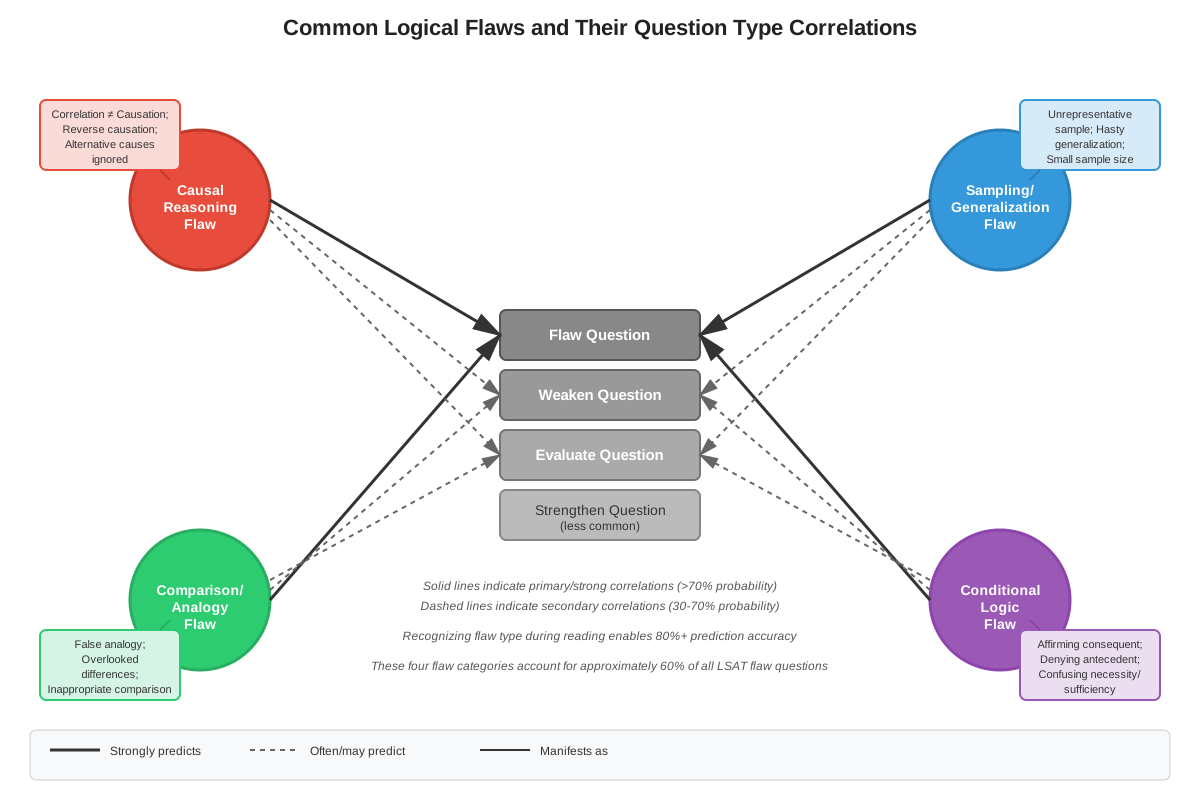
Arguments containing identifiable logical flaws most reliably predict question types. Common flaws include:
Scope shifts: When the conclusion discusses a different category or group than the premises (e.g., premises about "some doctors" leading to a conclusion about "all physicians"), this strongly predicts flaw, assumption, or weaken questions.
Causal reasoning errors: When an argument concludes a causal relationship from correlational evidence, or fails to consider alternative causes, this pattern almost always leads to flaw, assumption, weaken, or strengthen questions.
Sampling problems: Arguments that generalize from unrepresentative samples or small data sets typically generate flaw or weaken questions.
Necessary vs. sufficient confusion: Arguments that treat sufficient conditions as necessary (or vice versa) reliably predict flaw or assumption questions.
Structural Completeness Indicators
Arguments that appear logically complete—where premises provide sufficient support for the conclusion without obvious gaps—typically generate different question types than flawed arguments. These complete arguments often lead to:
- Main Point questions: When the argument is well-structured but the conclusion might be embedded or complex
- Method of Reasoning questions: When the argumentative technique is sophisticated or unusual
- Parallel Reasoning questions: When the logical structure is clear and could be matched to another argument
The key distinction is that complete arguments don't invite criticism (weaken/flaw) or require filling gaps (assumption/strengthen), but rather call for description or replication.
Fact Set Recognition
Stimuli that present only facts without advancing an argument—lacking a conclusion—almost exclusively generate inference or "must be true" questions. Recognition markers include:
- Absence of conclusion indicator words ("therefore," "thus," "consequently")
- Purely descriptive or informational tone
- Multiple discrete facts without argumentative connection
- Conditional statements presented as factual rules rather than reasoning steps
When students recognize a fact set, they should shift their reading strategy to focus on logical implications, combinations of statements, and what must follow from the given information.
Question Type Frequency and Prediction Accuracy
Not all question types are equally predictable. Understanding prediction reliability helps students calibrate confidence:
Highly predictable (80-95% accuracy):
- Flaw questions following obviously flawed arguments
- Inference questions following fact sets
- Assumption questions following arguments with clear gaps
Moderately predictable (60-80% accuracy):
- Strengthen/Weaken questions following vulnerable arguments
- Method of Reasoning questions following complex arguments
- Sufficient Assumption questions following conditional reasoning
Less predictable (40-60% accuracy):
- Parallel Reasoning questions (can follow various structures)
- Principle questions (can apply to many argument types)
- Paradox/Resolution questions (often disguised as standard arguments)
Concept Relationships
Question stem prediction integrates multiple analytical skills into a unified strategic approach. The relationship begins with argument structure recognition → which enables flaw identification → which suggests probable question types → which directs focused reading strategies → which improves answer choice evaluation.
The connection to prerequisite knowledge is direct: students must first master basic argument structure before they can recognize patterns that predict question types. Conditional reasoning knowledge specifically enables prediction of sufficient assumption and inference questions, while understanding common flaws allows prediction of flaw, assumption, and weaken questions.
Within the prediction process itself, concepts build hierarchically. The foundational distinction between arguments and fact sets determines the broad category of possible questions (argumentative questions vs. inference questions). Within argumentative stimuli, the presence or absence of flaws creates a secondary division (critical questions vs. descriptive questions). Finally, specific flaw types or structural features narrow the prediction to particular question types.
This topic also connects forward to advanced Logical Reasoning skills. Mastering prediction enables more sophisticated techniques like pre-phrasing (predicting the correct answer before reading choices) and strategic skipping (recognizing difficult question types that should be saved for later). The analytical framework developed through prediction practice transfers directly to Reading Comprehension, where similar structural analysis improves passage navigation and question anticipation.
Quick check — test yourself on Question stem prediction so far.
Try Flashcards →High-Yield Facts
⭐ Arguments with obvious logical flaws predict flaw, assumption, or weaken questions with 85%+ accuracy
⭐ Stimuli without conclusions (fact sets) predict inference or "must be true" questions with 90%+ reliability
⭐ Causal claims in conclusions strongly predict assumption, strengthen, or weaken questions
⭐ Complete, valid arguments typically generate main point, method of reasoning, or parallel reasoning questions
⭐ Conditional reasoning in the stimulus often signals sufficient assumption or inference questions
- Arguments with scope shifts between premises and conclusion reliably predict assumption questions
- Analogies and comparisons in arguments frequently lead to flaw or parallel reasoning questions
- Statistical reasoning in stimuli often generates flaw or weaken questions about sampling or representation
- Arguments with multiple sub-conclusions typically produce main point or method of reasoning questions
- Unusual or complex argumentative structures predict method of reasoning questions
- The presence of counterexamples or objections within the stimulus often signals strengthen or weaken questions
Common Misconceptions
Misconception: Every stimulus can be accurately predicted before reading the question stem.
Correction: While many question types are highly predictable, some stimuli can support multiple question types, and certain questions (like principle or paradox questions) are deliberately designed to be less predictable. Prediction is a probabilistic tool, not a guarantee, and students should remain flexible when their prediction proves incorrect.
Misconception: If the prediction is wrong, the student has wasted time and should abandon the technique.
Correction: Even incorrect predictions provide value by forcing active engagement with the argument structure. The analytical work done during prediction—identifying the conclusion, evaluating logical connections, noting potential flaws—remains useful regardless of the actual question type. Students should verify their prediction against the actual stem and adjust their approach in 1-2 seconds, not start over.
Misconception: Prediction means deciding on one specific question type before reading the stem.
Correction: Effective prediction involves generating a range of probable question types based on argument features, not committing to a single possibility. Students should think "this flawed causal argument will likely be flaw, assumption, or weaken" rather than "this is definitely a flaw question."
Misconception: Strong arguments never generate critical question types like flaw or weaken questions.
Correction: The LSAT sometimes presents relatively strong arguments and asks students to identify potential weaknesses or assumptions. The strength of an argument exists on a spectrum, and even well-reasoned arguments can be questioned. Students should remain open to critical question types even when arguments appear solid.
Misconception: Prediction is only useful for fast test-takers who have extra time.
Correction: Prediction actually saves time by directing attention to relevant information during the initial read. Students who predict effectively often complete Logical Reasoning sections faster than those who read reactively because they avoid re-reading and immediately understand what the question demands. This technique is especially valuable for students who struggle with timing.
Worked Examples
Example 1: Flawed Causal Argument
Stimulus: "A recent study found that people who drink green tea daily have lower rates of heart disease than those who don't drink green tea. Therefore, drinking green tea must prevent heart disease."
Prediction Process:
- Argument identification: Yes, this is an argument (conclusion indicator "therefore")
- Conclusion location: "Drinking green tea must prevent heart disease"
- Logical structure evaluation: The argument moves from correlation (tea drinkers have lower heart disease rates) to causation (tea prevents heart disease)
- Flaw identification: Classic causal reasoning flaw—fails to consider alternative explanations (maybe tea drinkers exercise more, or correlation is reversed, or there's a common cause)
- Prediction: This will almost certainly be a flaw, assumption, or weaken question
Actual Question Stem: "Which one of the following identifies a flaw in the reasoning above?"
Analysis: The prediction was accurate. Recognizing the causal flaw during the initial read allows immediate focus on the gap between correlation and causation. The correct answer will likely point out that the argument fails to establish that tea causes the health benefit rather than merely being associated with it.
Connection to Learning Objectives: This example demonstrates how identifying reasoning patterns (causal flaw) enables accurate question stem prediction, which in turn directs analytical focus to the most relevant logical features.
Example 2: Fact Set Without Argument
Stimulus: "All members of the chess club are also members of the debate team. Some members of the debate team are seniors. No juniors are members of the chess club."
Prediction Process:
- Argument identification: No conclusion present—these are three factual statements
- Structural analysis: Conditional and categorical relationships presented as facts
- Conclusion absence: No indicator words, no claim being supported
- Prediction: This is a fact set, so the question will almost certainly be inference, must be true, or could be true
Actual Question Stem: "If the statements above are true, which one of the following must also be true?"
Analysis: The prediction was accurate. Recognizing the fact set structure immediately signals that the task involves deriving logical implications rather than evaluating argumentative reasoning. During the initial read, focus should be on understanding the relationships and considering what follows necessarily from the given information (e.g., some debate team members who are seniors are not in the chess club, since no juniors are in chess club but some debate members are seniors).
Connection to Learning Objectives: This example illustrates how distinguishing between arguments and fact sets—a fundamental aspect of question stem prediction—determines the appropriate analytical approach and dramatically narrows the range of possible question types.
Exam Strategy
When approaching Logical Reasoning questions with prediction in mind, follow this strategic framework:
During Initial Read:
- Actively identify the conclusion within the first 10 seconds
- Note any obvious flaws, gaps, or unusual reasoning patterns
- Generate a mental hypothesis: "This looks like a flaw/assumption/inference question"
- Don't commit rigidly to your prediction—remain flexible
Trigger Words for Prediction:
- "Therefore," "thus," "consequently" → Argument present, evaluate for flaws
- "If...then," "only if," "unless" → Conditional reasoning, possible sufficient assumption or inference question
- "Causes," "leads to," "results in" → Causal claim, likely assumption/strengthen/weaken
- "Study shows," "research indicates" → Often contains sampling or causal flaws
- Absence of conclusion indicators → Likely fact set, predict inference question
Verification Process:
When reading the actual question stem, spend 1-2 seconds confirming or adjusting your prediction. If your prediction was incorrect, quickly identify what you missed in the stimulus structure and adjust your analytical focus accordingly. Don't dwell on prediction errors—use them as learning opportunities for future questions.
Process of Elimination Tips:
- If you predicted a flaw question correctly, eliminate answer choices that describe reasoning patterns not present in the stimulus
- If you predicted an inference question, eliminate choices that go beyond what the stimulus establishes
- If you predicted assumption/strengthen/weaken, eliminate choices that don't address the specific gap you identified
Time Allocation:
Prediction should add no more than 2-3 seconds to your initial read time, but it typically saves 5-10 seconds during answer evaluation by providing clear criteria for elimination. For a 35-minute section with 25 questions, this efficiency gain can save 2-3 minutes overall, allowing time for difficult questions or review.
Exam Tip: If you find yourself frequently surprised by question stems, you're likely reading too passively. Increase active engagement by forcing yourself to predict before reading the stem, even if your early predictions are often wrong. Accuracy improves rapidly with practice.
Memory Techniques
FLAW-CAP Mnemonic for recognizing predictable flaw patterns:
- Fact/opinion confusion
- Language ambiguity
- Analogy weakness
- Weak correlation-causation
- Circular reasoning
- Assumption gaps
- Part-to-whole errors
The "Conclusion Check" Visualization: Picture a traffic light when reading each stimulus. Green light = clear conclusion present (proceed to evaluate reasoning). Yellow light = conclusion unclear or embedded (slow down, identify carefully). Red light = no conclusion (stop looking for flaws, switch to inference mode).
Question Type Families Acronym - FAWS vs. DIMS:
- FAWS questions (Flaw, Assumption, Weaken, Strengthen) require flawed or vulnerable arguments
- DIMS questions (Describe, Inference, Method, Structure) work with complete arguments or fact sets
The Gap Finder Technique: Visualize the argument as a bridge. Premises are one side, conclusion is the other. If you can see water (a gap) between them, predict assumption/strengthen/weaken questions. If the bridge is complete, predict descriptive questions.
Summary
Question stem prediction is a strategic reading technique that transforms LSAT Logical Reasoning performance by enabling test-takers to anticipate question types based on argument structure and logical features. By actively analyzing whether a stimulus contains an argument or fact set, identifying conclusions and their relationship to premises, recognizing common flaws and reasoning patterns, and noting distinctive features like conditional logic or causal claims, students can reliably predict the most likely question types before reading the question stem. This prediction process directs analytical focus to the most relevant information, reduces cognitive load, improves reading efficiency, and enhances answer evaluation accuracy. While not every question type is equally predictable, mastering this skill provides a significant competitive advantage across all Logical Reasoning questions, particularly for the highly predictable categories of flaw, assumption, inference, and weaken questions that collectively comprise the majority of Logical Reasoning content.
Key Takeaways
- Question stem prediction involves analyzing argument structure during the initial read to anticipate the question type before seeing the actual stem
- Arguments with obvious logical flaws reliably predict flaw, assumption, or weaken questions, while fact sets without conclusions predict inference questions
- The prediction process should add only 2-3 seconds to reading time but saves significantly more time during answer evaluation
- Effective prediction requires distinguishing between arguments and fact sets, identifying conclusions, recognizing common flaws, and noting distinctive reasoning patterns
- Even incorrect predictions provide value by forcing active engagement with argument structure and logical relationships
- Causal claims, conditional reasoning, scope shifts, and sampling issues are high-yield structural features that enable accurate prediction
- Prediction accuracy improves rapidly with deliberate practice and should be incorporated into every Logical Reasoning question during preparation
Related Topics
Argument Structure Mapping: Building on prediction skills, this advanced technique involves diagramming complex arguments to visualize logical relationships, enabling even more precise question type anticipation and answer evaluation.
Pre-phrasing Strategies: Once students can accurately predict question types, they can develop the ability to predict correct answers before reading the choices, dramatically improving accuracy and speed.
Conditional Logic Mastery: Deep understanding of conditional reasoning enables prediction of sufficient assumption questions and complex inference questions, representing a natural progression from basic prediction skills.
Flaw Taxonomy: Comprehensive knowledge of all LSAT flaw types enhances prediction accuracy for the largest category of Logical Reasoning questions and builds the foundation for assumption and weaken question mastery.
Practice CTA
Now that you understand the strategic framework for question stem prediction, it's time to put these concepts into practice. Attempt the practice questions associated with this topic, focusing on making explicit predictions before reading each question stem. Track your prediction accuracy and analyze any mismatches between your predictions and actual question types—these mismatches reveal opportunities for refinement. Use the flashcards to reinforce recognition of argument structures and their corresponding question types. Remember that prediction accuracy improves dramatically with deliberate practice, and even early mistakes accelerate your learning by highlighting patterns you haven't yet internalized. Commit to predicting on every practice question for the next week, and you'll notice measurable improvements in both speed and accuracy. Your investment in mastering this foundational skill will pay dividends across every Logical Reasoning section you encounter.
Sign up free to keep reading
Create a free AnvayaPrep account to finish this LSAT guide on Question stem prediction — plus flashcards and practice questions.