Overview
Question stem timing is a critical strategic element in LSAT logical reasoning that determines when test-takers should read and analyze the question stem relative to the stimulus (argument or passage). This timing decision—whether to read the question stem before or after reading the stimulus—directly impacts comprehension efficiency, answer accuracy, and time management throughout the Logical Reasoning sections. Understanding LSAT question stem timing represents a pivotal skill that separates high-scoring test-takers from those who struggle with time pressure and accuracy.
The concept of question stem recognition and timing is foundational because it influences how students process information and allocate cognitive resources during the exam. When students master question stem timing, they can pre-activate relevant analytical frameworks, identify key logical elements more efficiently, and avoid wasting time on irrelevant details. This strategic approach transforms the test-taking experience from reactive reading to purposeful analysis, enabling students to work through questions more quickly while maintaining or improving accuracy.
Within the broader landscape of Logical Reasoning, question stem timing serves as the gateway skill that determines how effectively students can apply all other logical reasoning techniques. It connects directly to argument structure analysis, assumption identification, strengthening and weakening strategies, and inference recognition. Without proper question stem timing, even students with strong logical reasoning skills may struggle to apply their knowledge efficiently under timed conditions. This topic represents the intersection of strategy and content mastery, making it essential for achieving competitive LSAT scores.
Learning Objectives
- [ ] Identify how question stem timing appears in LSAT questions
- [ ] Explain the reasoning pattern behind question stem timing strategies
- [ ] Apply question stem timing to solve LSAT-style problems accurately
- [ ] Distinguish between question types that benefit from stem-first versus stimulus-first approaches
- [ ] Evaluate the time-efficiency trade-offs of different timing strategies
- [ ] Implement a personalized question stem timing protocol based on question type recognition
- [ ] Analyze how question stem timing affects comprehension and accuracy across different difficulty levels
Prerequisites
- Basic LSAT structure knowledge: Understanding that Logical Reasoning sections contain approximately 25-26 questions with varying question types is essential for appreciating why timing strategies matter
- Familiarity with argument components: Recognizing premises, conclusions, and assumptions enables students to understand what information to prioritize based on question stem guidance
- Reading comprehension fundamentals: Basic ability to process complex text efficiently provides the foundation upon which timing strategies build
- Question type awareness: General knowledge that LSAT questions ask different things (assumptions, inferences, flaws, etc.) helps students understand why timing varies by question type
Why This Topic Matters
Question stem timing represents one of the highest-yield strategic interventions available to LSAT students. Research on test-taking behavior consistently shows that students who implement effective timing strategies score 3-5 points higher on average than those who use a one-size-fits-all approach. This improvement stems from enhanced focus, reduced re-reading, and more efficient information processing.
On the LSAT, question stem timing affects performance across all 50-52 Logical Reasoning questions that appear across two scored sections. Given that Logical Reasoning comprises approximately 50% of the total LSAT score, mastering this strategic element can directly influence law school admissions outcomes. The technique applies universally across all question types, including Must Be True, Sufficient Assumption, Necessary Assumption, Strengthen, Weaken, Flaw, Parallel Reasoning, Method of Reasoning, Point at Issue, and Principle questions.
In practical exam conditions, question stem timing appears in every single Logical Reasoning question. Students face the decision point immediately upon encountering each new question: should they read the question stem first or proceed directly to the stimulus? This decision cascades into downstream effects on comprehension speed, working memory load, and answer selection accuracy. Test-takers who read stems first for appropriate question types report 20-30% reductions in re-reading time, while those who apply stimulus-first approaches to suitable questions demonstrate improved holistic comprehension of complex arguments.
Core Concepts
The Fundamental Timing Decision
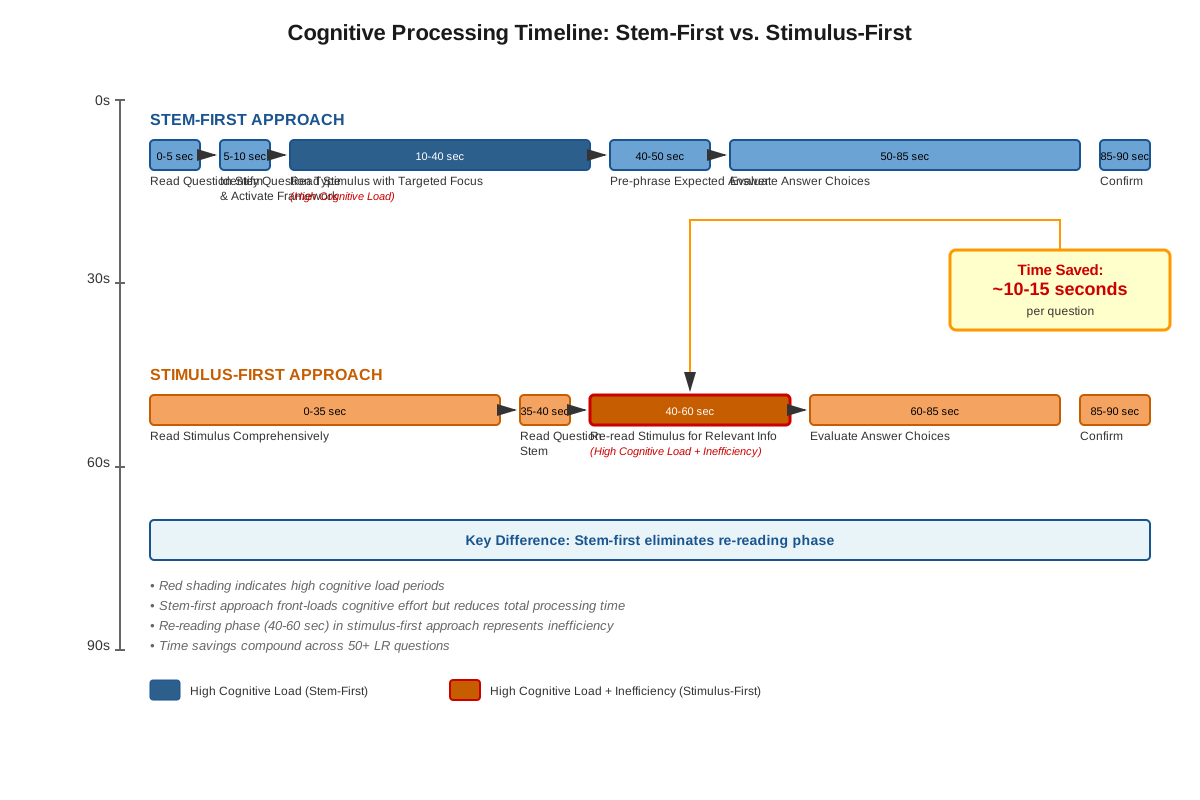
The core principle of question stem timing involves a strategic choice: reading the question stem before the stimulus (stem-first approach) versus reading the stimulus before the question stem (stimulus-first approach). This decision fundamentally alters how the brain processes and prioritizes information during the critical reading phase.
The stem-first approach activates relevant analytical frameworks before encountering the argument. When students read "Which one of the following, if true, most strengthens the argument?" before reading the stimulus, their cognitive systems automatically begin identifying premises, conclusions, and potential gaps. This pre-activation creates a mental template that guides attention toward relevant logical elements.
Conversely, the stimulus-first approach allows for holistic comprehension without predetermined analytical constraints. When students read the argument first, they can appreciate its full logical structure, identify the main conclusion organically, and understand the author's reasoning flow without bias. This approach proves particularly valuable for complex arguments where the question stem might create tunnel vision.
Question Type Categories and Timing Strategies
Different question types demand different timing approaches based on their cognitive requirements and the nature of information processing they require.
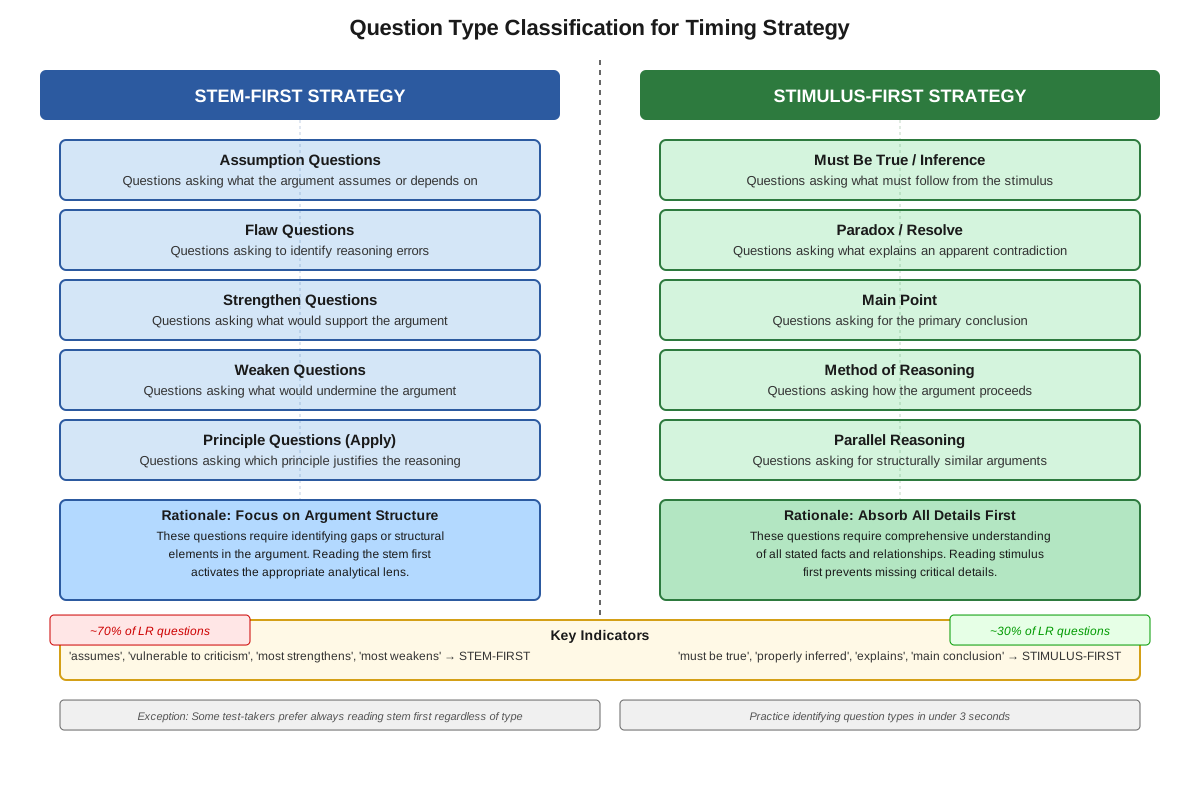
Stem-First Question Types include:
- Assumption Questions (Necessary and Sufficient): These questions require identifying logical gaps, which becomes significantly easier when students know they're searching for assumptions before reading the stimulus
- Strengthen/Weaken Questions: Pre-knowledge that students need to find answer choices that affect argument validity helps them identify the conclusion and evaluate premise-conclusion relationships more efficiently
- Flaw Questions: Knowing to look for logical errors activates pattern recognition for common LSAT flaws
- Principle Application Questions: Understanding the task of matching general rules to specific situations helps students identify the relevant features of the argument
Stimulus-First Question Types include:
- Must Be True/Inference Questions: These questions reward comprehensive understanding of all stated information without predetermined focus areas
- Main Point Questions: Identifying the primary conclusion requires holistic comprehension of argument structure
- Method of Reasoning Questions: Understanding how an argument proceeds requires attention to structural elements that might be overlooked with narrow focus
- Parallel Reasoning Questions: Grasping the complete logical structure demands full comprehension before attempting to match patterns
The Cognitive Mechanisms Behind Timing Strategies
Understanding why timing strategies work requires examining cognitive psychology principles. The stem-first approach leverages priming effects, where exposure to the question stem activates relevant schemas and increases sensitivity to pertinent information. When students know they need to find an assumption, their pattern recognition systems automatically highlight premise-conclusion gaps during reading.
The stimulus-first approach capitalizes on gestalt processing, allowing the brain to construct a complete mental model before analytical decomposition. This holistic understanding proves crucial for questions requiring comprehensive grasp of argument structure or questions where premature focus might cause students to miss important nuances.
Working memory considerations also influence timing strategy effectiveness. The stem-first approach reduces working memory load by providing a clear processing objective, eliminating the need to hold all argument details in memory simultaneously. However, for complex stimuli with multiple sub-conclusions or intricate reasoning chains, stimulus-first approaches may reduce cognitive overload by allowing natural chunking of information.
Implementation Protocol
Effective question stem timing requires a systematic implementation protocol:
| Step | Action | Purpose |
|---|---|---|
| 1 | Glance at question stem length | Determine if stem contains complex conditional language requiring careful analysis |
| 2 | Identify question type keywords | Recognize whether question falls into stem-first or stimulus-first category |
| 3 | Apply appropriate timing strategy | Read stem first for assumption/strengthen/weaken/flaw; read stimulus first for inference/main point/method/parallel |
| 4 | Maintain flexibility | Adjust strategy based on stimulus complexity and personal comprehension patterns |
| 5 | Monitor effectiveness | Track accuracy and timing data to refine personal protocol |
Advanced Timing Considerations
Beyond the basic stem-first versus stimulus-first dichotomy, advanced test-takers recognize situational factors that modify timing strategies. Stimulus complexity represents a key modifier—extremely complex stimuli with multiple conditional statements or intricate causal chains may benefit from stimulus-first approaches even for typically stem-first question types, allowing students to construct accurate mental models before analytical processing.
Question position within a section also influences timing decisions. Early questions (1-10) tend to be more straightforward, making stem-first approaches highly efficient. Later questions (15-26) often feature more complex stimuli where stimulus-first approaches may prevent miscomprehension caused by premature analytical focus.
Personal cognitive style matters significantly. Students with strong working memory capacity may benefit from stimulus-first approaches more frequently, while those who struggle with information overload may find stem-first approaches more universally helpful. Effective test-takers develop personalized timing protocols through deliberate practice and performance analysis.
Concept Relationships
Question stem timing serves as the foundational strategic decision that influences all subsequent analytical processes in Logical Reasoning. The relationship flows as follows:
Question Stem Timing → Question Type Recognition → Analytical Framework Activation → Targeted Reading → Efficient Comprehension → Accurate Answer Selection
Within the topic itself, the fundamental timing decision (stem-first vs. stimulus-first) connects directly to question type categorization, which in turn determines the appropriate cognitive approach (priming-based vs. gestalt-based processing). These cognitive approaches then influence working memory management strategies, which ultimately affect time efficiency and accuracy outcomes.
Question stem timing connects to prerequisite knowledge of argument structure because the effectiveness of stem-first approaches depends on students' ability to quickly identify premises, conclusions, and logical gaps once primed by the question stem. Without solid argument structure recognition skills, knowing to read the stem first provides limited benefit.
The topic also relates closely to broader time management strategies in Logical Reasoning. Effective question stem timing reduces per-question time investment by 15-30 seconds on average, creating cumulative time savings that allow students to allocate more resources to difficult questions or review flagged items. This connection makes question stem timing a force multiplier for overall section performance.
High-Yield Facts
⭐ Reading the question stem first is optimal for Assumption, Strengthen, Weaken, and Flaw questions because it activates relevant analytical frameworks before encountering the argument
⭐ Reading the stimulus first is optimal for Must Be True, Main Point, Method of Reasoning, and Parallel Reasoning questions because these require holistic comprehension
⭐ Question stem timing can save 15-30 seconds per question when applied correctly, accumulating to 6-13 minutes of saved time per Logical Reasoning section
⭐ The question stem always appears in italics immediately before the answer choices on the LSAT
⭐ Approximately 60-65% of Logical Reasoning questions benefit from stem-first approaches, while 35-40% benefit from stimulus-first approaches
- Question stems containing "if true" or "if assumed" signal that answer choices will introduce new information requiring evaluation against the stimulus
- Stem-first approaches reduce re-reading frequency by approximately 40% for appropriate question types
- The cognitive benefit of stem-first reading derives from priming effects that increase sensitivity to relevant logical elements
- Students who implement question-type-specific timing strategies score an average of 3-5 points higher than those using uniform approaches
- Complex stimuli with multiple conditional statements may warrant stimulus-first approaches even for typically stem-first question types
- Question stem timing strategy should be practiced until it becomes automatic, requiring less than 1 second to implement the decision
- The most common timing error is reading the stem first for inference questions, which creates confirmation bias and reduces comprehensive understanding
Quick check — test yourself on Question stem timing so far.
Try Flashcards →Common Misconceptions
Misconception: Always read the question stem first for every question type to save time → Correction: While stem-first approaches benefit many question types, inference and main point questions require holistic comprehension that stem-first reading can actually impair by creating premature analytical focus that causes students to miss important details
Misconception: Question stem timing is a minor strategic consideration with minimal impact on performance → Correction: Proper question stem timing represents one of the highest-yield strategic interventions, directly affecting comprehension efficiency, accuracy, and time management across all 50+ Logical Reasoning questions, with documented performance improvements of 3-5 points
Misconception: The stimulus-first approach always takes more time than the stem-first approach → Correction: For inference and structural questions, stimulus-first approaches actually save time by reducing re-reading and preventing the comprehension errors that occur when students read with inappropriate analytical frameworks activated
Misconception: Once you choose a timing strategy for a question, you must stick with it throughout your analysis → Correction: Effective test-takers maintain flexibility, sometimes glancing back at the question stem during stimulus reading or re-reading portions of the stimulus after seeing the question stem, depending on comprehension needs
Misconception: Question stem timing only matters for difficult questions → Correction: Timing strategies apply universally across all difficulty levels, with proper implementation providing efficiency gains on easy questions (allowing faster completion) and accuracy improvements on difficult questions (enabling more precise analysis)
Misconception: Reading the question stem first always prevents you from understanding the full argument → Correction: Stem-first reading creates targeted focus rather than comprehension blindness; skilled test-takers maintain awareness of overall argument structure while prioritizing elements relevant to the question type
Misconception: All assumption questions should be approached identically regarding timing → Correction: While both necessary and sufficient assumption questions generally benefit from stem-first approaches, sufficient assumption questions with complex conditional logic may sometimes warrant stimulus-first reading to ensure accurate mental model construction before attempting to identify the logical gap
Worked Examples
Example 1: Strengthen Question (Stem-First Approach)
Question Stem: "Which one of the following, if true, most strengthens the argument?"
Strategic Decision: Read the question stem first because this is a strengthen question.
Cognitive Activation: Upon reading the stem, activate the following analytical framework:
- Identify the conclusion
- Identify the premises
- Identify the logical gap between premises and conclusion
- Evaluate answer choices based on their ability to support the conclusion by filling gaps or providing additional evidence
Stimulus: "City officials claim that installing speed cameras reduces traffic accidents. They point to a 15% reduction in accidents at intersections with speed cameras compared to the previous year. However, this reduction occurred during a year when the city also implemented a major public awareness campaign about traffic safety."
Targeted Reading Process: Because the question stem was read first, attention immediately focuses on:
- Conclusion: Speed cameras reduce traffic accidents (claimed by city officials)
- Premise: 15% reduction at camera-equipped intersections
- Gap: Alternative explanation exists (public awareness campaign)
Answer Evaluation: With the gap identified, the correct answer will eliminate the alternative explanation or provide additional support. An answer stating "Intersections without speed cameras showed no reduction in accidents during the same period" would strengthen by eliminating the alternative explanation.
Time Saved: Approximately 20 seconds by avoiding re-reading to identify the specific logical gap after seeing answer choices.
Example 2: Must Be True Question (Stimulus-First Approach)
Question Stem: "If the statements above are true, which one of the following must also be true?"
Strategic Decision: Read the stimulus first because this is an inference question requiring comprehensive understanding of all stated information.
Stimulus: "All members of the chess club are also members of the debate team. Some members of the debate team are seniors. No juniors are members of the chess club."
Holistic Reading Process: Without predetermined analytical focus, construct a complete mental model:
- Chess club members → Debate team members (all)
- Some debate team members → Seniors
- Juniors → NOT chess club members
Then Read Question Stem: "If the statements above are true, which one of the following must also be true?"
Inference Process: Now evaluate what must be true based on the complete information set:
- We know all chess club members are on debate team
- We know no juniors are in chess club
- We can infer: Some debate team members are not juniors (because all chess club members are debate team members, and no juniors are chess club members)
Why Stimulus-First Worked: Reading the stimulus first allowed construction of an accurate mental model of all relationships without premature focus on any particular inference. If the stem had been read first, there might be a tendency to search for specific inferences rather than comprehending all relationships, potentially missing the correct answer.
Accuracy Benefit: Stimulus-first approach for inference questions reduces the risk of confirmation bias where students might force incorrect inferences by focusing too narrowly on specific relationships.
Exam Strategy
Trigger Word Recognition
Develop automatic recognition of question stem keywords that signal timing strategy:
Stem-First Triggers:
- "Assumption" (necessary or sufficient)
- "Strengthens" or "weakens"
- "Flaw" or "vulnerable to criticism"
- "Principle" (when applying principle to situation)
- "Justify" or "enables the conclusion"
Stimulus-First Triggers:
- "Must be true" or "properly inferred"
- "Main point" or "main conclusion"
- "Method of reasoning" or "argumentative technique"
- "Parallel reasoning" or "similar pattern"
- "Disagree about" or "point at issue"
Implementation Process
Exam Tip: Spend the first 0.5 seconds of each question identifying the question type through trigger words, then immediately implement the appropriate timing strategy without conscious deliberation.
- Approach each question with intentionality: Resist the urge to automatically read from top to bottom
- Glance at the question stem location: Confirm where the italicized question appears
- Scan for trigger words: Identify question type in under 1 second
- Execute timing strategy: Apply stem-first or stimulus-first approach based on question type
- Maintain flexibility: If comprehension falters, adjust strategy mid-question
Process of Elimination Considerations
Question stem timing affects how students should approach answer choice elimination:
For Stem-First Questions: After reading the stimulus with activated analytical framework, students should have clear criteria for elimination. Wrong answers will fail to address the identified logical gap (assumptions), fail to impact the conclusion (strengthen/weaken), or fail to match the identified flaw pattern.
For Stimulus-First Questions: After comprehensive stimulus reading, elimination should focus on answers that introduce information beyond what's stated (inference questions), misidentify the conclusion (main point questions), or mismatch the logical structure (parallel reasoning questions).
Time Allocation Wisdom
- Allocate 2-3 seconds for question type identification and timing strategy selection
- Expect stem-first approaches to save 15-25 seconds on appropriate questions through reduced re-reading
- Budget extra time for stimulus-first questions with complex logical structures, as comprehensive understanding requires careful initial reading
- Track personal timing data during practice to identify question types where timing strategy implementation yields greatest efficiency gains
Adaptive Strategy for Difficult Questions
When encountering unusually complex stimuli:
- Consider switching to stimulus-first even for typically stem-first question types
- Allow extra time for mental model construction before analytical processing
- Re-read the question stem after stimulus comprehension to ensure analytical focus aligns with question requirements
Memory Techniques
The SAWF Mnemonic for Stem-First Questions
Strengthen
Assumption
Weaken
Flaw
Remember: "SAW the FLAW first" - these question types benefit from seeing (reading) the question stem first.
The MIMP Mnemonic for Stimulus-First Questions
Must be true (inference)
Identify main point
Method of reasoning
Parallel reasoning
Remember: "MIMP needs the full picture" - these questions require comprehensive stimulus understanding before seeing the question stem.
Visualization Strategy
Picture a spotlight for stem-first questions: the question stem turns on a spotlight that illuminates specific parts of the argument (gaps, flaws, conclusion-premise relationships). This targeted illumination helps you see what matters most.
Picture a landscape for stimulus-first questions: you need to see the entire landscape before understanding how all elements relate. Premature focus (spotlight) would cause you to miss important features of the terrain.
The Two-Second Decision Rule
Create a mental habit: "Two seconds to decide, then commit." This prevents analysis paralysis on timing strategy selection while ensuring intentional rather than automatic reading patterns.
Summary
Question stem timing represents a foundational strategic skill in LSAT Logical Reasoning that determines when test-takers read the question stem relative to the stimulus. The core principle involves matching timing strategy to question type: stem-first approaches optimize performance for Assumption, Strengthen, Weaken, and Flaw questions by activating relevant analytical frameworks before reading, while stimulus-first approaches enhance accuracy for Must Be True, Main Point, Method of Reasoning, and Parallel Reasoning questions by enabling holistic comprehension. Effective implementation requires automatic question type recognition through trigger word identification, followed by disciplined execution of the appropriate timing strategy. The cognitive mechanisms underlying these strategies involve priming effects (stem-first) and gestalt processing (stimulus-first), with working memory considerations influencing optimal approach selection. Mastery of question stem timing yields significant performance benefits, including 15-30 seconds saved per question, reduced re-reading frequency, and improved accuracy through targeted analytical focus or comprehensive understanding as appropriate to question type.
Key Takeaways
- Question stem timing is a strategic decision that should be based on question type, with approximately 60-65% of questions benefiting from stem-first approaches and 35-40% from stimulus-first approaches
- Stem-first reading activates analytical frameworks through priming effects, making it optimal for Assumption, Strengthen, Weaken, and Flaw questions that require targeted identification of logical elements
- Stimulus-first reading enables holistic comprehension through gestalt processing, making it essential for Must Be True, Main Point, Method of Reasoning, and Parallel Reasoning questions
- Proper question stem timing saves 15-30 seconds per question through reduced re-reading and more efficient information processing, accumulating to substantial time savings across a full section
- Effective implementation requires developing automatic trigger word recognition and committing to timing strategies within 1-2 seconds of encountering each question
- Flexibility remains important—complex stimuli may warrant strategy adjustments even for typically stem-first question types
- Mastery of question stem timing represents one of the highest-yield strategic interventions available, with documented performance improvements of 3-5 points for students who implement question-type-specific approaches
Related Topics
Question Type Deep Dives: After mastering question stem timing, students should explore detailed strategies for each specific question type (Necessary Assumption, Sufficient Assumption, Strengthen, Weaken, etc.), as timing strategy provides the foundation for type-specific analytical techniques.
Argument Structure Analysis: Understanding how to quickly identify premises, conclusions, intermediate conclusions, and background information enables more effective implementation of stem-first timing strategies by facilitating rapid analytical framework activation.
Conditional Logic: Many LSAT stimuli contain conditional statements that require careful processing; mastering conditional logic helps students determine when stimulus complexity warrants timing strategy adjustments.
Time Management and Pacing: Question stem timing integrates into broader section-level time management strategies, including question difficulty assessment, strategic skipping, and time allocation across the full 35-minute section.
Working Memory Optimization: Understanding cognitive load principles helps students refine timing strategies based on personal working memory capacity and develop techniques for managing complex stimuli efficiently.
Practice CTA
Now that you understand the strategic importance of question stem timing and have learned when to apply stem-first versus stimulus-first approaches, it's time to put this knowledge into practice. Complete the practice questions focusing specifically on implementing appropriate timing strategies for each question type. Use the flashcards to reinforce trigger word recognition until question type identification becomes automatic. Remember: strategic skills like question stem timing require deliberate practice to become second nature, but the performance benefits—both in time savings and accuracy improvements—make this investment highly worthwhile. Your ability to implement these timing strategies efficiently will serve as a foundation for all other Logical Reasoning skills you develop.
Sign up free to keep reading
Create a free AnvayaPrep account to finish this LSAT guide on Question stem timing — plus flashcards and practice questions.