Overview
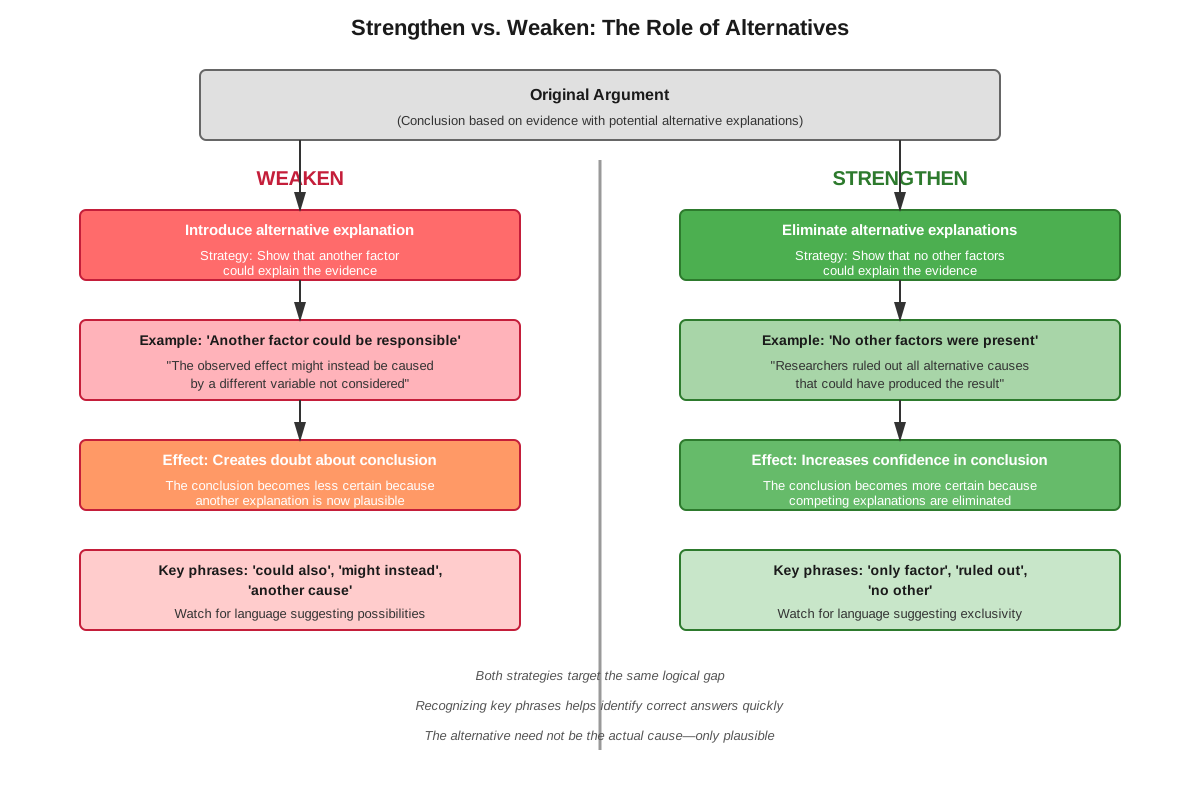
Introducing alternatives is a critical reasoning pattern that appears frequently in LSAT Logical Reasoning sections, particularly within strengthen and weaken questions. This technique involves presenting an alternative explanation, cause, or scenario that competes with the conclusion presented in an argument. When a question asks you to weaken an argument, introducing an alternative explanation often serves as one of the most powerful methods to undermine the author's reasoning. Conversely, eliminating alternative explanations can significantly strengthen an argument by showing that the proposed explanation is the most plausible one available.
Understanding how to recognize and deploy alternative explanations is essential for achieving a competitive LSAT score. Many arguments on the LSAT commit the logical fallacy of assuming that one explanation is correct without adequately ruling out other possibilities. Test-makers frequently exploit this gap in reasoning by crafting answer choices that either introduce new alternatives (to weaken) or eliminate competing alternatives (to strengthen). The ability to quickly identify when an argument is vulnerable to alternative explanations—and to evaluate whether an answer choice effectively introduces or eliminates such alternatives—separates high-scoring test-takers from average performers.
This topic connects intimately with broader Logical Reasoning concepts including causal reasoning, correlation versus causation, and assumption identification. When an argument moves from evidence to conclusion, it often makes implicit assumptions about what other factors are NOT at play. LSAT introducing alternatives questions test whether you can identify these hidden assumptions and recognize when alternative scenarios would undermine or support the argument's logical structure. Mastering this skill will enhance your performance not only on strengthen and weaken questions but also on assumption, flaw, and evaluation questions throughout the Logical Reasoning section.
Learning Objectives
- [ ] Identify how Introducing alternatives appears in LSAT questions
- [ ] Explain the reasoning pattern behind Introducing alternatives
- [ ] Apply Introducing alternatives to solve LSAT-style problems accurately
- [ ] Distinguish between relevant and irrelevant alternative explanations in argument contexts
- [ ] Evaluate the strength of alternative explanations relative to original conclusions
- [ ] Recognize common argument structures that are vulnerable to alternative explanations
- [ ] Construct effective alternative explanations that target specific logical gaps in arguments
Prerequisites
- Basic argument structure: Understanding premises, conclusions, and how evidence supports claims is essential because introducing alternatives targets the connection between evidence and conclusion
- Causal reasoning fundamentals: Recognizing when arguments make causal claims helps identify where alternative causes might weaken the reasoning
- Correlation vs. causation: Distinguishing between these concepts is necessary because many alternative explanations exploit the gap between observed correlations and claimed causal relationships
- Assumption identification: Recognizing unstated assumptions allows you to see where alternative explanations can exploit logical gaps in arguments
Why This Topic Matters
In real-world reasoning, the ability to consider alternative explanations is fundamental to critical thinking, scientific inquiry, and legal argumentation. Doctors must consider alternative diagnoses before settling on a treatment plan. Lawyers must anticipate alternative theories that opposing counsel might present. Scientists must rule out alternative hypotheses before claiming their theory is correct. The LSAT tests this essential reasoning skill because it directly relates to the analytical thinking required in law school and legal practice.
On the LSAT, introducing alternatives appears in approximately 15-20% of all Logical Reasoning questions, making it one of the highest-yield patterns to master. This technique most commonly appears in:
- Weaken questions: Where the correct answer introduces an alternative explanation that undermines the argument's conclusion
- Strengthen questions: Where the correct answer eliminates or reduces the plausibility of alternative explanations
- Assumption questions: Where the correct answer identifies that the argument assumes no relevant alternatives exist
- Flaw questions: Where the argument's error involves failing to consider alternative explanations
- Evaluate questions: Where determining the relevance of alternatives helps assess argument strength
The pattern appears across diverse content areas including scientific studies, business decisions, historical explanations, and policy recommendations. Test-makers favor this pattern because it tests sophisticated reasoning: the ability to see beyond what's explicitly stated and recognize what else might account for the observed evidence.
Core Concepts
The Logic of Alternative Explanations
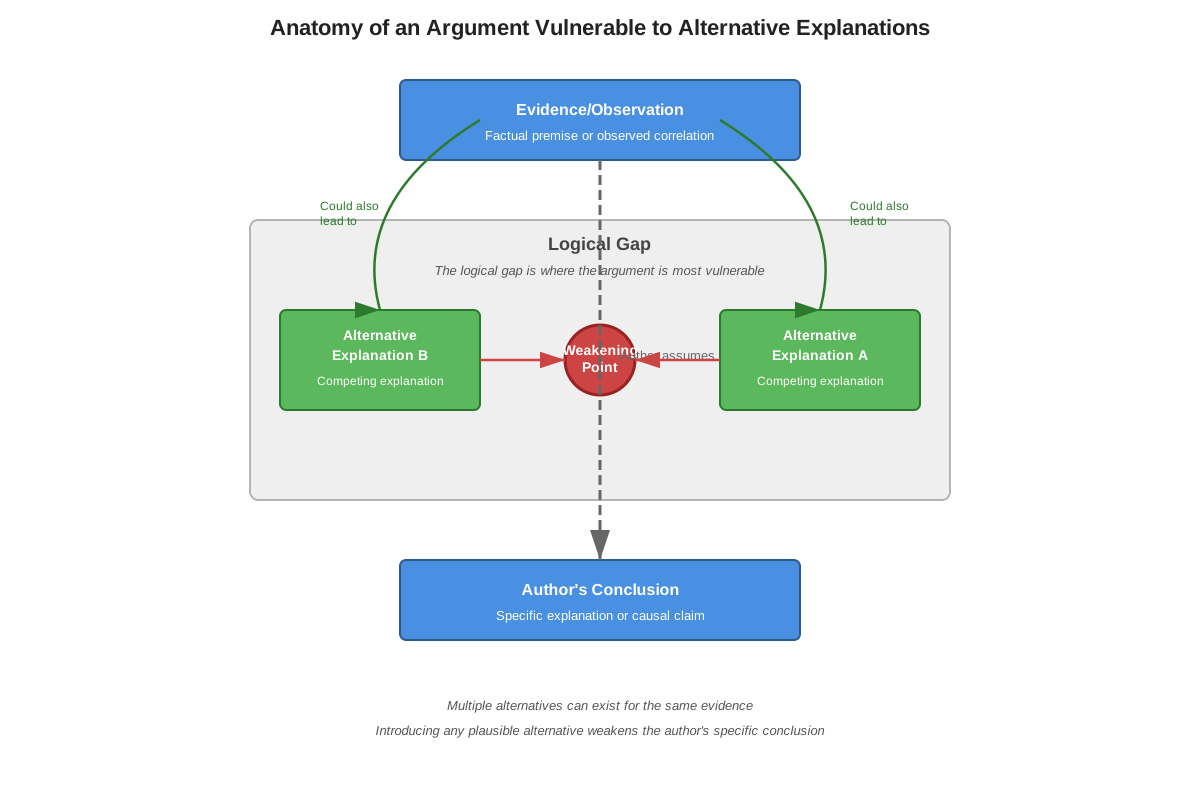
An alternative explanation is a competing account that could explain the same evidence or observations presented in an argument, but leads to a different conclusion. The fundamental logical structure involves:
- Evidence/Observation: Some phenomenon or data point is observed
- Proposed Explanation: The argument offers one explanation for this evidence
- Alternative Explanation: Another explanation could account for the same evidence
- Logical Impact: If the alternative is plausible, it weakens confidence in the original explanation
The power of introducing alternatives lies in demonstrating that the evidence does not uniquely support the conclusion. When multiple explanations can account for the same evidence, the argument's reasoning becomes less compelling because the conclusion is no longer the only—or even the most likely—interpretation of the facts.
How Alternatives Weaken Arguments
When an answer choice introduces an alternative explanation in a weaken question, it undermines the argument by showing that the conclusion might not follow from the premises. Consider this structure:
Argument Pattern:
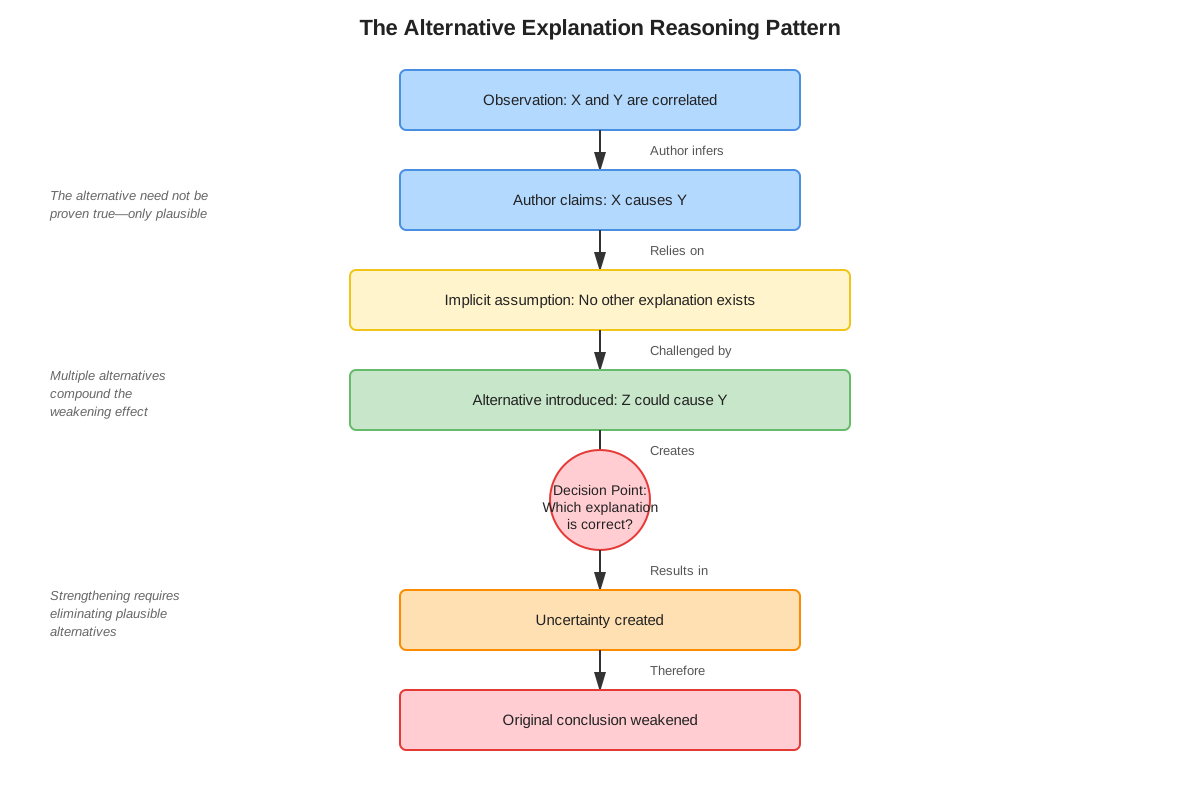
- Premise: X and Y are correlated (they occur together)
- Conclusion: X causes Y
Weakening Alternative:
- Alternative explanation: Z causes both X and Y (common cause)
- OR: Y actually causes X (reverse causation)
- OR: The correlation is coincidental or due to sampling bias
The alternative doesn't need to prove the original conclusion is wrong; it merely needs to show that another explanation is plausible, thereby reducing confidence in the original reasoning. This is why even a single strong alternative can significantly weaken an argument—it introduces reasonable doubt about whether the conclusion necessarily follows from the evidence.
How Eliminating Alternatives Strengthens Arguments
Conversely, when an answer choice eliminates or rules out alternative explanations in a strengthen question, it bolsters the argument by showing that competing accounts are implausible. This works by:
- Identifying potential alternatives: Recognizing what other factors could explain the evidence
- Providing evidence against alternatives: Showing these other explanations don't apply
- Increasing conclusion probability: Making the original explanation more likely by comparison
For example, if an argument claims that a new teaching method improved test scores, eliminating the alternative that students were simply more motivated this year (for unrelated reasons) strengthens the claim that the teaching method itself caused the improvement.
Types of Alternative Explanations
| Type | Description | Example Context |
|---|---|---|
| Alternative Cause | A different factor caused the observed effect | Drug study: improvement due to placebo effect rather than medication |
| Reverse Causation | The supposed effect actually caused the supposed cause | Wealth and education: wealth enables education rather than education creating wealth |
| Common Cause | A third factor caused both observed phenomena | Ice cream sales and drowning: both increase in summer |
| Coincidence | The correlation is random or due to chance | Spurious correlations in small sample sizes |
| Alternative Interpretation | The same evidence supports a different conclusion | Archaeological findings: ritual site vs. living quarters |
| Alternative Method | A different approach could achieve the same result | Business success: market conditions vs. management strategy |
Recognizing Vulnerability to Alternatives
Arguments are particularly vulnerable to alternative explanations when they:
- Make causal claims from correlational evidence: Observing that two things occur together and concluding one causes the other
- Rely on limited evidence: Drawing broad conclusions from narrow observations
- Ignore context: Failing to account for background factors that might influence results
- Assume uniqueness: Treating their explanation as the only possible account without justification
- Overlook temporal complexity: Not considering that timing might suggest different causal relationships
The key diagnostic question is: "Could something else explain this evidence?" If the answer is yes, and the argument hasn't addressed that possibility, it's vulnerable to alternatives.
Evaluating Alternative Strength
Not all alternatives are equally effective at weakening arguments. Strong alternatives share these characteristics:
- Relevance: They directly address the same evidence and conclusion
- Plausibility: They represent realistic possibilities, not far-fetched scenarios
- Specificity: They target the precise logical gap in the argument
- Sufficiency: They adequately account for the observed evidence
Weak alternatives might be tangentially related, highly improbable, or fail to fully explain the evidence. On the LSAT, incorrect answer choices often present alternatives that seem relevant but don't actually impact the argument's core reasoning.
Concept Relationships
The concept of introducing alternatives serves as a bridge between several fundamental logical reasoning principles. Causal reasoning provides the foundation: most arguments vulnerable to alternatives make some form of causal claim, either explicitly or implicitly. When you understand how causation works, you can identify where alternative causes might intervene.
Assumption identification connects directly to alternatives because every argument that's vulnerable to alternative explanations makes an implicit assumption that no such alternatives exist. The argument assumes its explanation is correct without ruling out competitors. This relationship flows as: Identify assumption → Recognize unstated exclusion of alternatives → Introduce alternative to weaken or eliminate alternative to strengthen.
The relationship to correlation versus causation is particularly tight. Many LSAT arguments observe a correlation and jump to a causal conclusion. This logical leap creates vulnerability: alternative explanations (reverse causation, common cause, coincidence) can account for the correlation without accepting the causal claim. The pattern flows: Correlation observed → Causal conclusion drawn → Alternative causal relationship introduced → Original conclusion weakened.
Within strengthen and weaken questions specifically, introducing alternatives represents one of several weakening strategies (alongside attacking premises, exposing flaws, and questioning relevance) and one of several strengthening strategies (alongside providing additional evidence, ruling out objections, and confirming assumptions). The choice of which strategy to employ depends on the argument's specific structure and vulnerabilities.
The concept map flows as:
Argument Structure → identifies → Logical Gaps → exploited by → Alternative Explanations → which either → Weaken (when introduced) or Strengthen (when eliminated) → the Conclusion
High-Yield Facts
⭐ Introducing an alternative explanation weakens an argument by showing the conclusion is not the only plausible interpretation of the evidence
⭐ Eliminating alternative explanations strengthens an argument by making the proposed explanation more likely by comparison
⭐ Arguments that move from correlation to causation are highly vulnerable to alternative explanations involving reverse causation or common causes
⭐ An alternative explanation doesn't need to prove the original conclusion wrong—it only needs to be plausible enough to create reasonable doubt
⭐ The most effective alternatives directly address the same evidence discussed in the argument rather than introducing tangential information
- Alternative explanations are most powerful when they account for all the evidence presented in the argument
- Strengthen questions often feature correct answers that rule out the most obvious alternative explanation
- Weaken questions rarely require you to completely disprove the conclusion; introducing doubt through alternatives is sufficient
- Arguments that use words like "must be," "proves," or "establishes" are particularly vulnerable to alternatives because they claim certainty
- The LSAT favors alternatives that exploit the gap between necessary and sufficient conditions in causal reasoning
- Time-order information (what happened first) can help evaluate whether an alternative explanation is plausible
- Alternative explanations in scientific contexts often involve confounding variables or selection bias
- Business and policy arguments frequently overlook alternative strategies or external factors that could explain outcomes
- Historical arguments are vulnerable to alternative interpretations of the same evidence
- An argument that explicitly considers and rules out alternatives is much stronger than one that ignores them entirely
Quick check — test yourself on Introducing alternatives so far.
Try Flashcards →Common Misconceptions
Misconception: An alternative explanation must completely account for all evidence to weaken an argument effectively.
Correction: An alternative only needs to be plausible enough to raise reasonable doubt about the conclusion. Even if it explains only part of the evidence, it can weaken the argument by showing the conclusion isn't the only viable interpretation.
Misconception: Any alternative scenario weakens an argument equally well.
Correction: The strength of an alternative depends on its relevance and plausibility. An alternative that's far-fetched or doesn't directly address the argument's reasoning has little weakening power. The LSAT tests your ability to distinguish between relevant and irrelevant alternatives.
Misconception: Introducing alternatives only appears in weaken questions.
Correction: While introducing alternatives is a common weakening strategy, the concept appears across multiple question types. Strengthen questions ask you to eliminate alternatives, assumption questions identify unstated assumptions about alternatives, and flaw questions point out when arguments fail to consider alternatives.
Misconception: If an argument mentions one alternative and dismisses it, the argument is immune to alternative explanations.
Correction: Addressing one alternative doesn't protect against all alternatives. An argument might dismiss one competing explanation while remaining vulnerable to others. The LSAT often tests whether you can identify alternatives the argument hasn't considered.
Misconception: The alternative explanation must be more likely than the original conclusion to weaken the argument.
Correction: An alternative doesn't need to be more probable than the original explanation—it just needs to be possible enough to undermine certainty. If two explanations are roughly equally plausible, the argument's conclusion becomes much less certain, which constitutes effective weakening.
Misconception: Alternatives that introduce new information are always wrong answers because they go "outside the scope."
Correction: Introducing new information is exactly what alternative explanations do—they bring in factors the argument didn't consider. This is different from irrelevant scope violations. Relevant alternatives introduce new factors that directly impact the argument's reasoning, while scope violations introduce tangential information.
Misconception: Strengthening an argument requires proving the conclusion is definitely true.
Correction: Strengthening only requires making the conclusion more likely or the reasoning more sound. Eliminating one plausible alternative explanation strengthens the argument even if other alternatives might still exist. The LSAT tests relative strength, not absolute proof.
Worked Examples
Example 1: Weaken by Introducing an Alternative
Argument:
"A recent study found that employees who work from home are 20% more productive than those who work in the office. This clearly demonstrates that the flexibility of working from home causes increased productivity. Therefore, companies should allow all employees to work remotely to maximize productivity."
Question: Which of the following, if true, most weakens the argument?
Analysis Process:
- Identify the conclusion: Working from home causes increased productivity, so companies should allow remote work
- Identify the evidence: Study showing 20% productivity increase for remote workers
- Identify the reasoning pattern: Correlation (remote work and productivity occur together) → Causation (remote work causes productivity)
- Recognize vulnerability: The argument assumes remote work itself caused the productivity increase, but alternative explanations could account for the correlation
- Consider possible alternatives:
- Reverse causation: More productive employees were selected for remote work
- Common cause: A third factor affects both remote work eligibility and productivity
- Selection bias: Only certain types of workers were allowed to work remotely
- Confounding variable: Remote workers might differ in other relevant ways
Correct Answer: "The employees who were permitted to work from home were selected based on their demonstrated ability to work independently and their history of high productivity."
Why this works: This answer introduces an alternative explanation—the employees were already more productive before working from home. The selection process, not the remote work itself, explains the productivity difference. This directly undermines the causal claim by showing that the correlation could result from how workers were chosen rather than from the remote work arrangement. The argument's conclusion that companies should allow all employees to work remotely is weakened because the productivity benefit might not extend to employees who weren't pre-selected for high productivity.
Connection to learning objectives: This example demonstrates how to identify vulnerability to alternatives (correlation-to-causation reasoning), explain the pattern (selection bias as an alternative cause), and apply the concept to weaken the argument effectively.
Example 2: Strengthen by Eliminating an Alternative
Argument:
"Archaeological evidence shows that the ancient city of Petra experienced a sudden population decline around 363 CE, the same year a major earthquake struck the region. The earthquake must have caused the population decline by destroying the city's water management system, making the area uninhabitable."
Question: Which of the following, if true, most strengthens the argument?
Analysis Process:
- Identify the conclusion: The earthquake caused the population decline by destroying the water system
- Identify the evidence: Population decline and earthquake occurred in the same year
- Identify the reasoning pattern: Temporal correlation + proposed mechanism → Causal conclusion
- Recognize potential alternatives:
- Economic factors: Trade routes shifted, reducing the city's prosperity
- Political factors: Regional conflicts or administrative changes
- Environmental factors: Drought or climate change unrelated to the earthquake
- Gradual decline: The population was already declining for other reasons
- Determine what would strengthen: Eliminating the most plausible alternatives would make the earthquake explanation more likely
Correct Answer: "Historical records indicate that Petra's economy remained strong and trade routes continued to function normally until 363 CE, and no evidence of warfare or political upheaval exists for that period."
Why this works: This answer eliminates two major alternative explanations—economic decline and political factors—that could have caused the population decrease. By ruling out these competing accounts, the answer makes the earthquake explanation more plausible by comparison. The argument becomes stronger because fewer viable alternatives remain to explain the population decline. The answer doesn't prove the earthquake caused the decline, but it increases the probability by eliminating other likely causes.
Alternative correct approach: "Archaeological excavations reveal that Petra's water management infrastructure shows extensive earthquake damage dating to 363 CE, while other city structures remained largely intact."
Why this alternative also works: This strengthens by providing additional evidence for the proposed mechanism (water system destruction) while implicitly ruling out alternatives that would have damaged other structures equally. It makes the specific causal pathway more plausible.
Connection to learning objectives: This example shows how eliminating alternatives strengthens arguments, demonstrates the reasoning pattern in a historical context, and illustrates how to evaluate which alternatives are most relevant to address.
Exam Strategy
Identifying Alternative Explanation Questions
Watch for these trigger phrases in question stems:
- "Which of the following, if true, most weakens the argument?" (often answered by introducing alternatives)
- "Which of the following, if true, most strengthens the argument?" (often answered by eliminating alternatives)
- "The argument is most vulnerable to criticism on the grounds that it..." (may point to failure to consider alternatives)
- "The argument assumes that..." (may identify assumption that no alternatives exist)
Recognizing Vulnerable Arguments
As you read the stimulus, flag arguments that:
- Use causal language ("causes," "leads to," "results in," "produces") based on correlational evidence
- Make claims about "the reason" or "the explanation" without considering other possibilities
- Draw conclusions from studies or observations without controlling for other variables
- Use absolute language ("must be," "proves," "establishes") that leaves no room for alternatives
- Present before-and-after scenarios without accounting for other changes
Approaching Answer Choices
For Weaken Questions:
- Identify what the argument claims causes or explains the evidence
- Ask: "What else could explain this evidence?"
- Evaluate each answer choice: Does it present a plausible alternative explanation?
- Eliminate answers that are irrelevant, implausible, or don't address the core reasoning
- Select the alternative that most directly competes with the argument's explanation
For Strengthen Questions:
- Identify the most obvious alternative explanation the argument hasn't addressed
- Look for answer choices that rule out or reduce the plausibility of alternatives
- Eliminate answers that introduce new alternatives (these would weaken, not strengthen)
- Select the answer that makes the original explanation more likely by comparison
Process of Elimination Tips
Eliminate alternatives that:
- Address different evidence than what the argument discusses
- Are so implausible they don't create reasonable doubt
- Actually support the conclusion rather than competing with it
- Introduce tangential factors that don't affect the causal relationship
- Confuse necessary and sufficient conditions
Keep alternatives that:
- Directly explain the same evidence using a different mechanism
- Are realistic and plausible in the argument's context
- Target the specific logical gap between premises and conclusion
- Account for the observed correlation without accepting the causal claim
Time Management
- Spend 15-20 seconds identifying the argument's conclusion and reasoning pattern
- Spend 10-15 seconds predicting what type of alternative would weaken or what alternative needs elimination to strengthen
- Spend 30-40 seconds evaluating answer choices with your prediction in mind
- If stuck between two answers, ask: "Which alternative more directly competes with the argument's specific explanation?"
Exam Tip: The LSAT rarely requires you to have specialized knowledge to identify alternatives. The correct alternative will be understandable and relevant based solely on the information in the stimulus. If an answer choice requires outside expertise to evaluate, it's likely wrong.
Memory Techniques
The CAUSE Acronym for Identifying Alternatives
When evaluating whether an argument is vulnerable to alternatives, remember CAUSE:
- Correlation claimed as causation
- Assumptions about uniqueness (only one explanation)
- Uncontrolled variables in studies or observations
- Selection bias or sampling issues
- Evidence that could support multiple interpretations
If any of these elements appear, the argument is likely vulnerable to alternative explanations.
The "What Else?" Question
Train yourself to automatically ask "What else could explain this?" whenever you see:
- A causal conclusion
- A study or observation
- A before-and-after comparison
- An explanation for a phenomenon
This simple question activates your alternative-seeking mindset.
Visualization: The Competing Paths Diagram
Visualize the evidence as a starting point with multiple paths leading away from it. The argument claims one path leads to the conclusion. An alternative explanation is simply another path from the same evidence to a different conclusion. Strengthening blocks off the alternative paths; weakening adds new paths.
Evidence → [Path 1: Argument's explanation] → Conclusion
         → [Path 2: Alternative explanation] → Different conclusion
         → [Path 3: Another alternative] → Yet another conclusion
The Reverse-Common-Coincidence Triad
For causal arguments, remember the three most common alternatives:
- Reverse: The supposed effect actually causes the supposed cause
- Common: A third factor causes both observed phenomena
- Coincidence: The correlation is random or due to uncontrolled factors
This triad covers the vast majority of alternative explanations on the LSAT.
Summary
Introducing alternatives is a fundamental reasoning pattern that appears throughout LSAT Logical Reasoning, particularly in strengthen and weaken questions. The core principle is straightforward: when multiple explanations can account for the same evidence, confidence in any single explanation decreases. Arguments become vulnerable to alternatives when they make causal claims from correlational evidence, assume their explanation is unique without justification, or fail to control for other variables. To weaken such arguments, introduce a plausible alternative explanation that competes with the conclusion. To strengthen them, eliminate or reduce the plausibility of competing alternatives. The key to mastering this topic is developing the habit of asking "What else could explain this evidence?" whenever you encounter causal reasoning. Success requires distinguishing between relevant alternatives that directly address the argument's reasoning and irrelevant tangents that don't impact the logical connection between premises and conclusion. This skill integrates with broader logical reasoning concepts including causal reasoning, assumption identification, and the correlation-causation distinction, making it essential for high performance across multiple question types.
Key Takeaways
- Introducing alternatives weakens arguments by showing the conclusion isn't the only plausible explanation for the evidence; eliminating alternatives strengthens arguments by making the proposed explanation more likely by comparison
- Arguments that move from correlation to causation are highly vulnerable to alternatives involving reverse causation, common causes, or coincidence
- An effective alternative explanation must be relevant and plausible but doesn't need to be more likely than the original conclusion—creating reasonable doubt is sufficient
- The pattern appears across multiple question types: weaken questions (introduce alternatives), strengthen questions (eliminate alternatives), assumption questions (identify unstated exclusion of alternatives), and flaw questions (point out failure to consider alternatives)
- Always ask "What else could explain this evidence?" when evaluating arguments, especially those making causal claims or drawing conclusions from studies and observations
- Not all alternatives are equally effective—the strongest ones directly address the same evidence, target the specific logical gap, and represent realistic possibilities rather than far-fetched scenarios
- Mastering alternatives requires integrating knowledge of causal reasoning, assumption identification, and the distinction between necessary and sufficient conditions
Related Topics
Causal Reasoning Patterns: Understanding the full range of causal reasoning structures will deepen your ability to identify where alternative causes can intervene. This includes necessary vs. sufficient causes, causal chains, and multiple causation scenarios.
Conditional Logic and Assumptions: Many arguments vulnerable to alternatives make conditional assumptions (if X, then Y) that alternatives can exploit. Strengthening your conditional logic skills will enhance your ability to spot these vulnerabilities.
Flaw Question Types: Many flaws involve failing to consider alternatives. Studying common logical fallacies will help you recognize argument structures that are systematically vulnerable to alternative explanations.
Experimental Design and Studies: LSAT arguments frequently cite studies or experiments. Understanding basic principles of experimental design (control groups, randomization, confounding variables) will help you identify alternative explanations in scientific contexts.
Sufficient Assumption Questions: These questions often require you to identify assumptions that rule out alternatives. Mastering introducing alternatives will make sufficient assumption questions more approachable.
Practice CTA
Now that you understand how introducing alternatives works in LSAT Logical Reasoning, it's time to put this knowledge into practice. Work through the practice questions to test your ability to identify vulnerable arguments, introduce effective alternatives to weaken reasoning, and eliminate alternatives to strengthen conclusions. Pay special attention to how different argument structures create different vulnerabilities. The flashcards will help you internalize the key patterns and trigger phrases that signal alternative explanation questions. Remember: mastery comes from active application, not passive reading. Each practice question you work through strengthens your pattern recognition and builds the intuition you need for test day success. You've got this!
Sign up free to keep reading
Create a free AnvayaPrep account to finish this LSAT guide on Introducing alternatives — plus flashcards and practice questions.