Overview
Strengthening recommendations represents a specialized category within LSAT Logical Reasoning that tests a student's ability to identify which answer choice best supports a proposed course of action or policy recommendation. Unlike standard strengthen questions that focus on bolstering an argument's conclusion through evidence or reasoning, strengthening recommendations questions require test-takers to evaluate practical considerations, feasibility factors, and contextual elements that make a recommended action more advisable or likely to succeed. These questions appear regularly on the LSAT and demand a nuanced understanding of how practical considerations interact with argumentative reasoning.
The importance of mastering LSAT strengthening recommendations cannot be overstated. These questions bridge the gap between pure logical analysis and real-world decision-making, requiring students to think beyond abstract validity and consider implementation factors, resource constraints, comparative advantages, and potential obstacles. A recommendation might be logically sound in principle but practically weak without proper support—and the LSAT tests precisely this distinction. Students must learn to identify what makes a recommendation not just theoretically valid but practically compelling and executable.
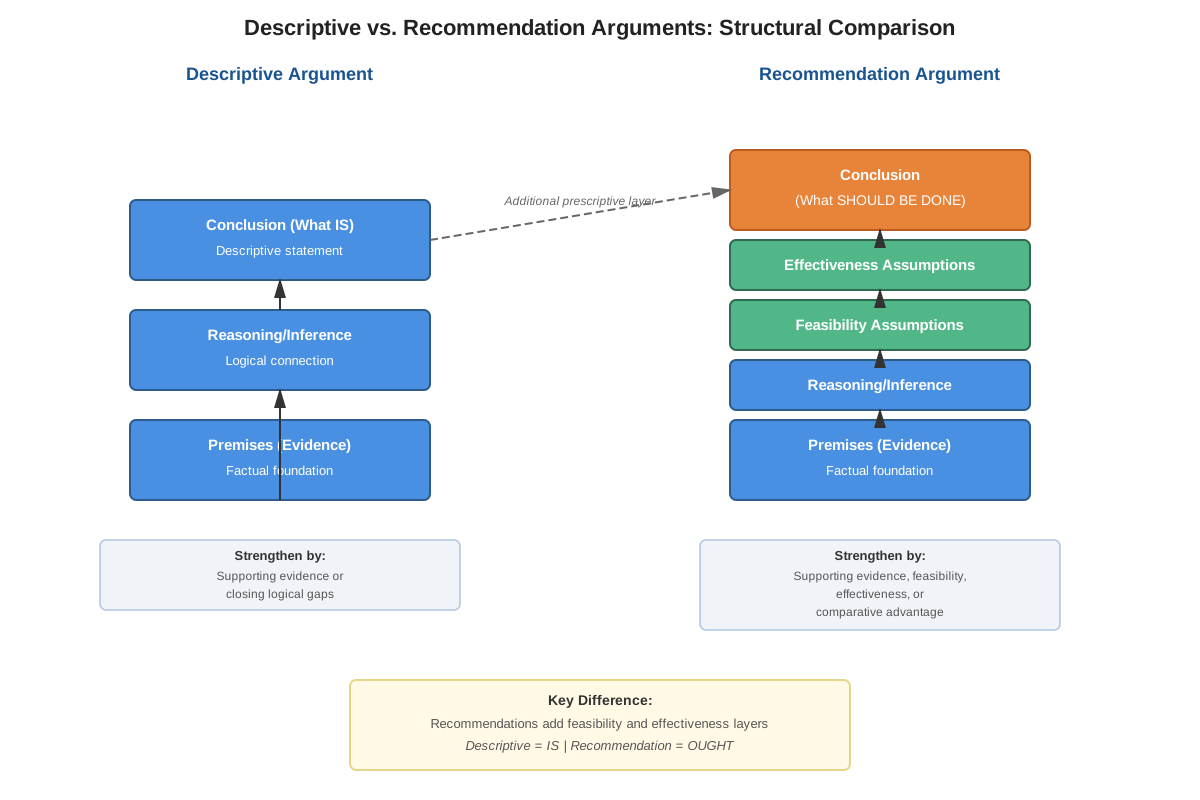
Within the broader framework of strengthen and weaken questions, strengthening recommendations occupies a unique position. While traditional strengthen questions ask test-takers to support a descriptive claim or causal argument, recommendation questions involve prescriptive conclusions—statements about what should be done. This shift from "is" to "ought" introduces additional layers of complexity, including considerations of values, priorities, feasibility, and comparative effectiveness. Understanding this distinction is crucial for selecting correct answers and avoiding trap choices that strengthen the wrong aspect of the argument.
Learning Objectives
- [ ] Identify how Strengthening recommendations appears in LSAT questions
- [ ] Explain the reasoning pattern behind Strengthening recommendations
- [ ] Apply Strengthening recommendations to solve LSAT-style problems accurately
- [ ] Distinguish between strengthening a recommendation and strengthening a descriptive conclusion
- [ ] Evaluate answer choices based on feasibility, effectiveness, and practical implementation factors
- [ ] Recognize common wrong answer patterns in recommendation strengthen questions
Prerequisites
- Basic argument structure identification: Understanding premises, conclusions, and how they connect is essential because recommendation arguments follow the same structural patterns with an added prescriptive element.
- Standard strengthen question techniques: Familiarity with how to support conclusions generally provides the foundation for the specialized approach needed for recommendations.
- Conditional reasoning fundamentals: Many recommendations involve if-then relationships about outcomes, requiring comfort with conditional logic to evaluate supporting evidence.
- Assumption identification: Recognizing unstated assumptions is critical because strengthening a recommendation often means validating assumptions about feasibility, effectiveness, or desirability.
Why This Topic Matters
In real-world contexts, professionals constantly evaluate recommendations—from business strategies to policy proposals to legal arguments. The ability to assess what makes a recommendation stronger or weaker is fundamental to effective decision-making in law, business, medicine, and public policy. Lawyers, in particular, must regularly advise clients on courses of action, weighing practical considerations against theoretical possibilities. The LSAT tests this skill because it directly predicts success in legal reasoning and advocacy.
On the LSAT itself, strengthening recommendations questions appear with significant frequency. Approximately 15-20% of strengthen questions involve recommendations rather than purely descriptive conclusions. These questions typically appear 2-4 times per Logical Reasoning section, making them a high-yield topic that can substantially impact overall scores. The questions often involve policy recommendations, business decisions, scientific research proposals, or personal advice scenarios.
Common manifestations include arguments recommending that a city adopt a new policy, that a company implement a business strategy, that researchers pursue a particular methodology, or that individuals take specific actions to achieve goals. The stimulus typically presents a problem or goal, proposes a solution or course of action, and provides some reasoning. The question stem asks which answer choice "most strengthens the recommendation" or "provides the most support for the proposal." Success requires identifying what practical consideration would make the recommendation more advisable, feasible, or likely to succeed.
Core Concepts
The Structure of Recommendation Arguments
A recommendation argument differs from a descriptive argument in its conclusion type. While descriptive arguments conclude that something is the case, recommendation arguments conclude that something should be done. The basic structure includes:
- Context/Problem: A situation requiring action or decision
- Recommendation: A proposed course of action (the conclusion)
- Reasoning: Why this action is advisable
- Implicit assumptions: Unstated beliefs about feasibility, effectiveness, or desirability
For example: "The city faces traffic congestion. Therefore, the city should build a new subway line because public transportation reduces car usage." The recommendation is "build a subway line," supported by reasoning about public transportation's effects.
What Strengthens a Recommendation
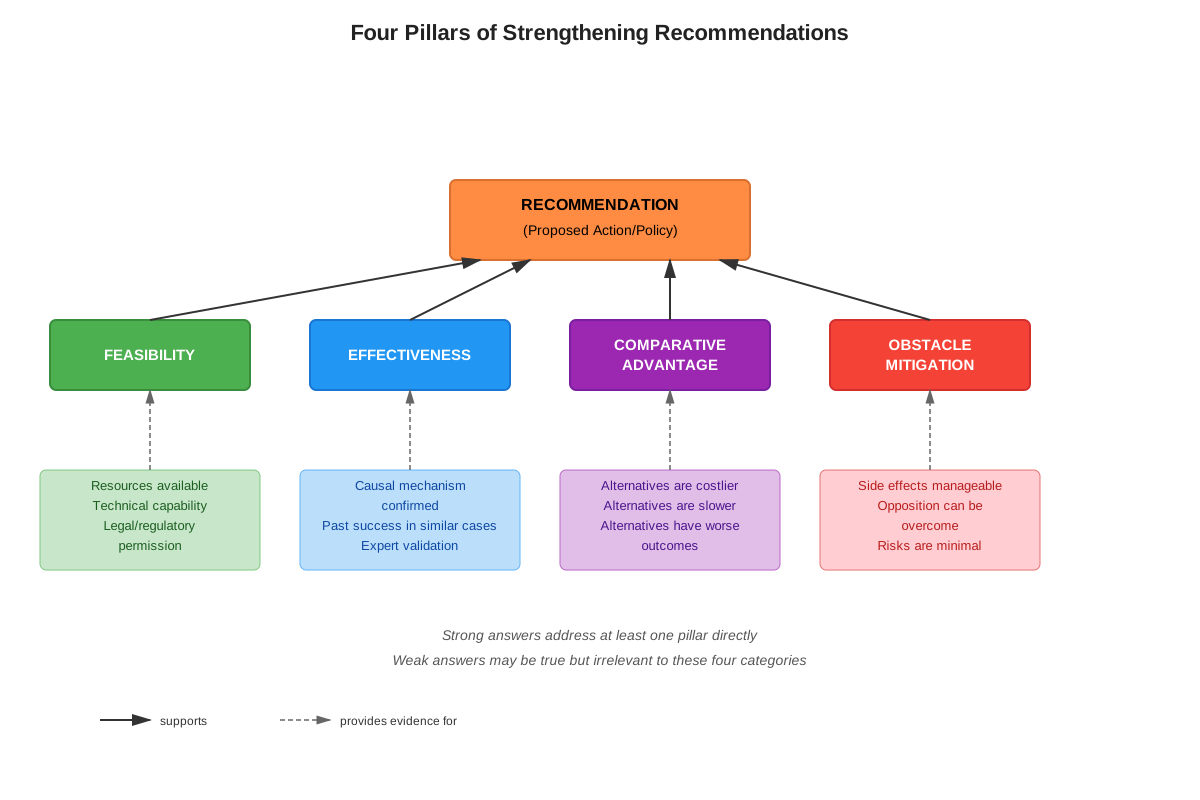
Strengthening a recommendation involves providing information that makes the proposed action more advisable, practical, or likely to achieve its intended goal. Key categories of strengthening information include:
Feasibility factors: Information showing the recommendation can actually be implemented. This includes availability of resources, technical capability, legal permissibility, or practical logistics. If a recommendation requires $10 million and strengthening information reveals the budget has $15 million available, feasibility increases.
Effectiveness evidence: Data or reasoning showing the recommended action will actually produce the desired outcome. This might include precedent (it worked elsewhere), causal mechanisms (explaining how it will work), or comparative advantage (it works better than alternatives).
Obstacle removal: Information eliminating or minimizing potential problems with the recommendation. If a concern is that the action might have negative side effects, evidence that those side effects won't occur strengthens the recommendation.
Comparative superiority: Evidence that the recommended action is better than alternatives. Recommendations exist in a context of choices, so showing the proposed action outperforms other options provides strong support.
The Feasibility-Effectiveness Distinction
A critical distinction in recommendation questions separates feasibility (can we do it?) from effectiveness (will it work?). Many wrong answers strengthen one dimension while the correct answer strengthens the other—or the correct answer strengthens the dimension the argument actually needs.
| Dimension | Question It Answers | Example Strengthener |
|---|---|---|
| Feasibility | Can the recommendation be implemented? | "The city has sufficient funds for the project" |
| Effectiveness | Will the recommendation achieve its goal? | "Similar projects reduced traffic by 40%" |
| Desirability | Should we want this outcome? | "Reduced traffic improves public health" |
| Comparative | Is this better than alternatives? | "This approach costs less than other options" |
Implicit Assumptions in Recommendations
Every recommendation rests on assumptions that, if false, would undermine the advice. Strengthening a recommendation often means validating these assumptions. Common assumption types include:
- No prohibitive obstacles exist: The recommendation assumes nothing will prevent implementation
- The proposed action will have the intended effect: Assumes the causal mechanism works as expected
- Benefits outweigh costs: Assumes the positive outcomes justify the investment or effort
- No better alternative exists: Assumes this is the optimal or at least a good choice
- Relevant conditions will remain stable: Assumes the context won't change in ways that undermine the recommendation
Wrong Answer Patterns in Recommendation Questions
Understanding common wrong answer types helps eliminate choices efficiently:
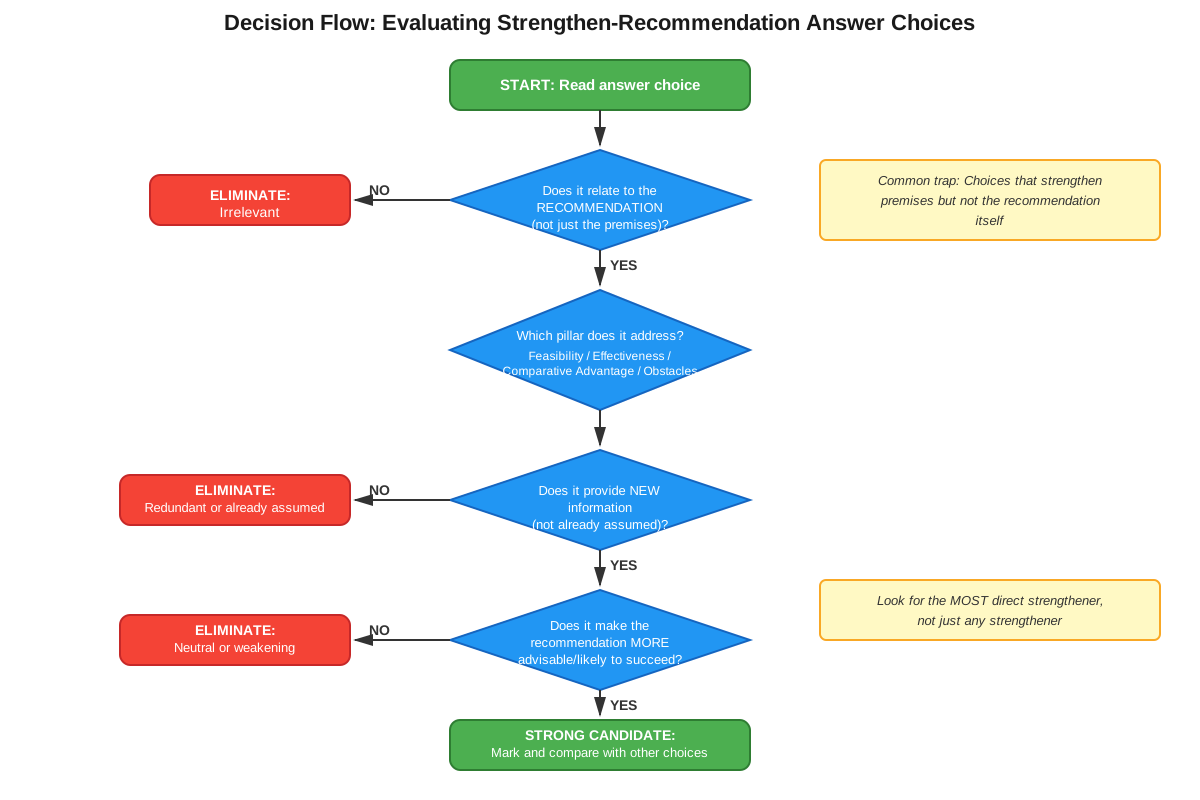
Strengthens the wrong conclusion: The answer supports a premise or intermediate claim but not the actual recommendation. For example, if the recommendation is "build a subway," an answer showing "traffic is indeed bad" strengthens the problem description, not the proposed solution.
Weakens rather than strengthens: Some answers actually make the recommendation less advisable, testing whether students read the question stem carefully.
Irrelevant information: The answer provides true information that doesn't impact whether the recommendation is advisable. For instance, historical facts unrelated to feasibility or effectiveness.
Addresses a non-issue: The answer resolves a concern that wasn't actually a problem for the argument, wasting effort on an irrelevant dimension.
Too weak or indirect: The answer provides minimal support when a stronger, more direct option exists.
Concept Relationships
The concepts within strengthening recommendations form an interconnected system. The structure of recommendation arguments provides the foundation—understanding what makes an argument a recommendation enables identification of these questions. This structure reveals implicit assumptions, which represent the gaps in reasoning that need support. Recognizing these assumptions guides the search for strengthening information.
The feasibility-effectiveness distinction operates as a diagnostic tool applied to both the argument's assumptions and the answer choices. By categorizing what type of support an argument needs, test-takers can predict correct answer characteristics. This distinction connects directly to what strengthens a recommendation, as feasibility and effectiveness represent two major categories of strengthening information.
Understanding wrong answer patterns serves as the elimination complement to recognizing correct answers. While positive knowledge identifies what strengthens recommendations, pattern recognition eliminates traps, creating a two-pronged approach: predict what's needed, then eliminate what doesn't fit.
The relationship to prerequisite topics flows naturally: basic argument structure extends to recommendation structure (adding the prescriptive element); standard strengthen techniques adapt to the recommendation context (shifting from supporting "is" to supporting "should"); assumption identification becomes more complex (adding feasibility and comparative assumptions to logical assumptions).
Textual relationship map:
Argument Structure → Reveals → Implicit Assumptions
                                        ↓
                              Categorize by Type
                                        ↓
                    Feasibility vs. Effectiveness vs. Comparative
                                        ↓
                              Predict Answer Type
                                        ↓
                    Evaluate Choices + Eliminate Patterns
                                        ↓
                              Select Strongest Support
High-Yield Facts
⭐ Strengthening a recommendation requires showing the proposed action is advisable, feasible, or likely to achieve its intended goal—not just that the problem exists.
⭐ Feasibility strengtheners show the recommendation CAN be implemented; effectiveness strengtheners show it WILL work as intended.
⭐ The correct answer often validates a key assumption about obstacles, resources, precedent, or comparative advantage.
⭐ Wrong answers frequently strengthen premises or problem descriptions rather than the actual recommendation.
⭐ Evidence that the recommendation worked in similar circumstances provides strong support through precedent.
- Recommendations always involve prescriptive conclusions using "should," "ought," "must," or "recommend" language.
- Comparative information showing the recommendation is better than alternatives strengthens by establishing relative superiority.
- Information eliminating potential negative side effects or unintended consequences strengthens by removing obstacles.
- Evidence of available resources (money, time, personnel, technology) strengthens feasibility.
- Causal mechanism explanations showing how the recommendation will produce desired outcomes strengthen effectiveness.
- Expert endorsement or successful precedent from analogous situations provides strong support.
- Information showing conditions are favorable for implementation (timing, political will, public support) strengthens feasibility.
- Data demonstrating the magnitude of expected benefits strengthens by showing the recommendation is worthwhile.
- Evidence that alternatives have failed or are inferior strengthens by process of elimination.
- Information confirming that key stakeholders support or will cooperate with the recommendation strengthens implementation likelihood.
Quick check — test yourself on Strengthening recommendations so far.
Try Flashcards →Common Misconceptions
Misconception: Any information that supports any part of the argument strengthens the recommendation.
Correction: Only information that makes the recommended action itself more advisable strengthens the recommendation. Supporting the problem description or a premise doesn't strengthen the conclusion that a specific action should be taken.
Misconception: Showing that a problem is severe automatically strengthens a recommendation to address it.
Correction: Problem severity might justify action generally, but doesn't strengthen a specific recommendation unless it also shows that particular solution is appropriate, feasible, or effective. A severe problem could require a different solution entirely.
Misconception: Feasibility and effectiveness are interchangeable—if something can be done, it will work.
Correction: Feasibility (can we do it?) and effectiveness (will it achieve the goal?) are distinct dimensions. Something might be perfectly feasible but ineffective, or potentially effective but infeasible. The argument's specific gaps determine which type of support is needed.
Misconception: The correct answer must completely prove the recommendation is correct.
Correction: Strengthen questions ask for support, not proof. The correct answer makes the recommendation more advisable than it was before, even if doubts remain. Look for the answer that provides the most support, not absolute certainty.
Misconception: Information about what happened in the past is irrelevant to recommendations about future actions.
Correction: Precedent—evidence that the recommendation or similar actions worked previously—provides powerful support. Past success in analogous situations strengthens the likelihood of future success, making historical information highly relevant.
Misconception: If an answer choice is true, it strengthens the argument.
Correction: Truth and relevance are separate. An answer can be factually true but logically irrelevant to whether the recommendation is advisable. The correct answer must be both true (in the context of the question) and relevant to the specific recommendation's strength.
Misconception: Strengthening a recommendation means showing there are no alternatives.
Correction: While showing alternatives are inferior can strengthen a recommendation, it's not necessary to eliminate all alternatives. Showing the proposed action has merit, is feasible, or is effective strengthens it even if other options might also work.
Worked Examples
Example 1: City Transportation Policy
Stimulus: "City planners recommend that Riverside should implement a bike-sharing program to reduce downtown traffic congestion. Studies show that bike-sharing programs in other cities have led to decreased car usage among residents who live within two miles of downtown areas."
Question: Which of the following, if true, most strengthens the city planners' recommendation?
Answer Choices:
A) Traffic congestion in Riverside has increased by 30% over the past five years.
B) A significant portion of Riverside's downtown traffic comes from residents who live within two miles of the downtown area.
C) Bike-sharing programs are becoming increasingly popular in cities across the country.
D) The city of Riverside has a budget surplus that could fund new transportation initiatives.
E) Most Riverside residents support efforts to reduce traffic congestion.
Analysis:
First, identify the recommendation: Riverside should implement a bike-sharing program.
Second, identify the reasoning: Bike-sharing reduces car usage among people living within two miles of downtown (in other cities).
Third, identify the implicit assumption: This reasoning assumes that Riverside has a significant population living within two miles of downtown who currently drive there—otherwise, the mechanism that worked elsewhere won't apply.
Now evaluate each choice:
Choice A: This strengthens the premise that traffic congestion is a problem, but doesn't strengthen the recommendation that bike-sharing specifically is the solution. The problem could be severe but require a different solution. Eliminate.
Choice B: This directly validates the key assumption. If much of Riverside's downtown traffic comes from nearby residents (within two miles), then the bike-sharing program can target the right population. The mechanism that worked elsewhere (reducing car usage among nearby residents) can work in Riverside because that population exists and contributes to the problem. Strong candidate.
Choice C: This provides general information about bike-sharing popularity but doesn't address whether it will work in Riverside specifically or whether Riverside has the conditions that made it work elsewhere. Popularity doesn't equal effectiveness. Eliminate.
Choice D: This addresses feasibility (funding is available) but doesn't address effectiveness (will it work?). While feasibility matters, the argument's main gap is whether the mechanism will work in Riverside's specific context. Weaker than B.
Choice E: This shows public support for the goal (reducing congestion) but not for the specific method (bike-sharing), and doesn't address whether bike-sharing will actually achieve that goal in Riverside. Eliminate.
Correct Answer: B
This example demonstrates the importance of distinguishing between strengthening the problem description (A), strengthening feasibility (D), and strengthening effectiveness by validating key assumptions (B). The correct answer bridges the gap between "it worked elsewhere" and "it will work here" by confirming Riverside has the relevant conditions.
Example 2: Business Strategy Recommendation
Stimulus: "The marketing director recommends that Acme Corporation should shift its advertising budget from television commercials to social media platforms. The director argues that social media advertising costs significantly less per impression than television advertising and reaches a younger demographic."
Question: Which of the following, if true, most strengthens the marketing director's recommendation?
Answer Choices:
A) Acme Corporation's target customers are primarily under 35 years old and use social media daily.
B) Television advertising rates have increased by 15% over the past year.
C) Many successful companies have recently increased their social media advertising budgets.
D) Social media platforms offer detailed analytics about advertising effectiveness.
E) Acme Corporation's competitors spend heavily on television advertising.
Analysis:
Identify the recommendation: Shift advertising budget from TV to social media.
Identify the reasoning: Social media costs less per impression and reaches younger demographics.
Identify implicit assumptions: (1) Acme wants to reach younger demographics, (2) Cost per impression is the relevant metric, (3) Reaching people on social media will translate to business results for Acme.
Evaluate choices:
Choice A: This validates the crucial assumption that Acme's target customers are young and use social media. The reasoning says social media reaches younger demographics, but that only matters if Acme wants to reach younger demographics. This choice confirms the match between the medium's strength and Acme's needs. Strong candidate.
Choice B: This makes TV more expensive, which might make alternatives more attractive, but doesn't strengthen the specific recommendation to choose social media. Other alternatives might be even better. This is comparative information but incomplete. Weaker than A.
Choice C: This shows what others are doing but doesn't show it's effective or appropriate for Acme specifically. Popularity doesn't equal suitability. Eliminate.
Choice D: This addresses a feature of social media but doesn't show that social media will be effective for Acme's specific goals. Analytics are useful but don't guarantee results. Eliminate.
Choice E: This might suggest an opportunity (competitors aren't using social media, so Acme could differentiate) but doesn't strengthen the claim that social media is better for Acme. Competitors might be making the right choice for their circumstances. Eliminate.
Correct Answer: A
This example illustrates how the correct answer often validates the connection between the recommendation's stated advantages and the specific entity's needs. The reasoning provides general advantages (reaches young people, costs less), but the recommendation is only strong if those advantages matter for Acme specifically.
Exam Strategy
Approaching Recommendation Questions
Step 1: Identify the recommendation clearly. Look for prescriptive language: "should," "ought to," "must," "recommend," "advise," "propose." Underline or mentally note the specific action being recommended.
Step 2: Separate the recommendation from its supporting reasoning. What reasons does the argument give for why this action should be taken? What benefits does it claim will result?
Step 3: Identify the gap or assumption. Ask: "What must be true for this recommendation to be advisable?" Common gaps include:
- Is it feasible? (resources, capability, legality)
- Will it work? (effectiveness, causal mechanism)
- Is it better than alternatives? (comparative advantage)
- Will conditions remain favorable? (stability, no obstacles)
Step 4: Predict the answer type. Based on the gap, predict whether the correct answer will address feasibility, effectiveness, comparative advantage, or obstacle removal.
Step 5: Eliminate wrong answer patterns:
- Strengthens the problem, not the solution
- Irrelevant information
- Weakens instead of strengthens
- Addresses the wrong dimension (feasibility when effectiveness is needed)
Trigger Words and Phrases
Watch for these indicators in question stems:
- "Most strengthens the recommendation"
- "Provides the most support for the proposal"
- "Best justifies the advice"
- "Most supports the suggested course of action"
In stimuli, recommendation language includes:
- "Should," "ought to," "must"
- "Recommend," "advise," "propose," "suggest"
- "The best approach would be"
- "It would be advisable to"
Process of Elimination Tips
First pass: Eliminate answers that strengthen the wrong part of the argument (premises rather than conclusion) or that are clearly irrelevant.
Second pass: Among remaining choices, eliminate those that address the wrong dimension. If the argument needs effectiveness support, eliminate pure feasibility answers.
Final selection: Choose the answer that most directly validates the key assumption or provides the strongest support for the specific recommendation's advisability.
Time Allocation
Recommendation questions often require slightly more time than standard strengthen questions because they involve an additional layer of analysis (the prescriptive element). Allocate:
- 15-20 seconds: Read and understand the stimulus
- 10 seconds: Identify the recommendation and gap
- 30-40 seconds: Evaluate answer choices
- Total: 55-70 seconds per question
If stuck between two answers, return to the recommendation itself and ask which answer makes that specific action more advisable. Don't get distracted by answers that are true or interesting but don't directly support the recommendation.
Memory Techniques
The FEAR Acronym for What Strengthens Recommendations
Feasibility: Can it be done? (resources, capability, permission)
Effectiveness: Will it work? (precedent, mechanism, evidence)
Advantage: Is it better than alternatives? (comparative superiority)
Removal: Are obstacles eliminated? (side effects, barriers addressed)
When evaluating answer choices, run through FEAR to categorize what type of support each provides, then match to what the argument needs.
The "Problem vs. Solution" Visualization
Visualize the argument as two boxes:
[PROBLEM BOX] → [SOLUTION BOX]
   Premises        Recommendation
Wrong answers often strengthen the Problem Box (showing the problem is real or severe). Correct answers strengthen the arrow or the Solution Box (showing the solution is appropriate, feasible, or effective).
The Three Questions Mnemonic: "CAN-WILL-BEST"
For any recommendation, ask:
- CAN it be done? (feasibility)
- WILL it work? (effectiveness)
- Is it BEST? (comparative)
The correct answer typically addresses whichever question the argument leaves most open.
The Precedent Power Principle
Remember: "Past success predicts future success." Evidence that the recommendation or similar actions worked before provides powerful support. When you see historical or comparative data in answer choices, evaluate whether it establishes relevant precedent.
Summary
Strengthening recommendations questions test the ability to identify what makes a proposed course of action more advisable, feasible, or likely to succeed. Unlike standard strengthen questions that support descriptive conclusions, these questions involve prescriptive conclusions about what should be done. The key to success lies in distinguishing between supporting the problem description and supporting the proposed solution, recognizing whether the argument needs feasibility support (can it be done?) or effectiveness support (will it work?), and identifying implicit assumptions about obstacles, resources, precedent, or comparative advantage. Common wrong answers strengthen the wrong part of the argument, address irrelevant considerations, or provide the wrong type of support. The correct answer typically validates a key assumption that bridges the gap between the reasoning provided and the recommendation's advisability, often by confirming that conditions exist for the recommendation to work, that precedent supports its effectiveness, or that it compares favorably to alternatives. Mastering this question type requires careful attention to the specific action being recommended and systematic evaluation of what would make that particular action more worthy of adoption.
Key Takeaways
- Strengthening a recommendation means making the proposed action more advisable, not just showing the problem is real or severe
- Distinguish between feasibility (can it be done?), effectiveness (will it work?), and comparative advantage (is it best?) when evaluating support
- The correct answer typically validates a key assumption about whether the recommendation will achieve its intended goal in the specific context
- Wrong answers often strengthen premises or problem descriptions rather than the recommendation itself
- Evidence of precedent (it worked elsewhere in similar circumstances) provides powerful support for recommendations
- Always identify the specific action being recommended before evaluating answer choices—support must make that particular action more advisable
- The gap between "it works generally" and "it will work here" often represents the key assumption that needs strengthening
Related Topics
Weakening Recommendations: The mirror image of this topic, involving identification of what makes a recommendation less advisable. Mastering strengthening recommendations provides the foundation for recognizing weakeners, as they often exploit the same assumptions in reverse.
Necessary Assumption Questions: These questions require identifying what must be true for an argument to work. The assumptions identified in recommendation arguments often appear as correct answers in necessary assumption questions, making the skills highly transferable.
Evaluate the Argument Questions: These questions ask what information would be most useful in assessing an argument's strength. Understanding what strengthens recommendations helps identify what information would be most relevant for evaluation.
Principle Questions: Some principle questions involve applying general rules to specific recommendations. Understanding recommendation structure and what makes them strong facilitates matching principles to situations.
Parallel Reasoning with Recommendations: Advanced questions may ask for arguments with parallel structure where both involve recommendations. Recognizing the distinctive features of recommendation arguments enables accurate matching.
Practice CTA
Now that you understand the core concepts and strategies for strengthening recommendations questions, it's time to put your knowledge into practice. Work through the practice questions systematically, applying the FEAR framework and the three-step approach of identifying the recommendation, finding the gap, and predicting the answer type. Use the flashcards to reinforce key distinctions between feasibility and effectiveness, and to memorize common wrong answer patterns. Remember: these questions appear frequently on the LSAT and represent high-yield opportunities to improve your score. Each practice question you complete strengthens your pattern recognition and builds the confidence you need to excel on test day. You've built the foundation—now apply it!
Sign up free to keep reading
Create a free AnvayaPrep account to finish this LSAT guide on Strengthening recommendations — plus flashcards and practice questions.