Overview
Weakening recommendations represent a critical subset of strengthen and weaken questions on the LSAT Logical Reasoning section. Unlike standard weakening questions that target factual claims or causal arguments, weakening recommendations specifically challenge proposals, suggestions, or courses of action that an author advocates. These questions require test-takers to identify information that undermines the advisability, effectiveness, or appropriateness of a recommended action or policy.
The LSAT frequently tests the ability to evaluate recommendations because this skill mirrors the analytical reasoning required in legal practice. Attorneys must constantly assess whether proposed strategies, policies, or courses of action will achieve their intended goals or whether unforeseen consequences might undermine them. When facing lsat weakening recommendations questions, students must recognize that the task differs from merely showing that a factual claim is false—instead, they must demonstrate that following the recommendation would be inadvisable, counterproductive, or less effective than the argument suggests.
Understanding weakening recommendations connects directly to broader logical reasoning competencies tested throughout the LSAT. This topic builds upon fundamental argument analysis skills while requiring nuanced evaluation of practical reasoning, cost-benefit analysis, and consideration of alternative outcomes. Mastery of this question type enhances performance not only on weaken questions but also on assumption, flaw, and evaluation questions, as all these question types require understanding the gap between evidence and conclusion in prescriptive arguments.
Learning Objectives
- [ ] Identify how Weakening recommendations appears in LSAT questions
- [ ] Explain the reasoning pattern behind Weakening recommendations
- [ ] Apply Weakening recommendations to solve LSAT-style problems accurately
- [ ] Distinguish between weakening factual claims and weakening recommendations
- [ ] Recognize the common structural vulnerabilities in recommendation arguments
- [ ] Evaluate answer choices by assessing their impact on the recommendation's advisability
- [ ] Identify implicit assumptions that recommendation arguments depend upon
Prerequisites
- Basic argument structure identification: Understanding premises, conclusions, and the distinction between descriptive and prescriptive claims is essential because recommendations always involve prescriptive conclusions.
- Fundamental weakening principles: Familiarity with how evidence can undermine conclusions provides the foundation for the more specific task of undermining recommendations.
- Causal reasoning: Many recommendations assume causal relationships (e.g., "doing X will cause Y"), so understanding how to weaken causal claims is directly applicable.
- Assumption identification: Recognizing unstated assumptions helps identify the gaps in reasoning that weakening answer choices exploit.
Why This Topic Matters
In legal practice, attorneys constantly evaluate whether to recommend specific strategies to clients, whether proposed legislation will achieve its goals, or whether a particular legal argument will succeed. The ability to identify weaknesses in recommendations—to see why a proposed course of action might fail or produce unintended consequences—is fundamental to sound legal judgment. This practical reasoning skill extends beyond law to business, policy, medicine, and everyday decision-making.
On the LSAT, weakening questions constitute approximately 12-15% of all Logical Reasoning questions, and a significant portion of these specifically target recommendations rather than factual claims. Test-takers can expect to encounter 3-5 weakening recommendation questions per exam. These questions appear consistently across all difficulty levels, though harder versions often involve complex conditional reasoning or require distinguishing between multiple plausible weakeners.
Weakening recommendations typically appear in several formats: policy proposals (e.g., "The city should implement parking restrictions"), personal advice (e.g., "Consumers should avoid buying generic brands"), business strategies (e.g., "The company should expand into international markets"), or procedural recommendations (e.g., "Researchers should use methodology X instead of Y"). The arguments supporting these recommendations often cite benefits, address concerns, or compare alternatives, and the correct weakening answer reveals why the recommendation might not achieve its intended purpose or might produce negative consequences.
Core Concepts
The Structure of Recommendation Arguments
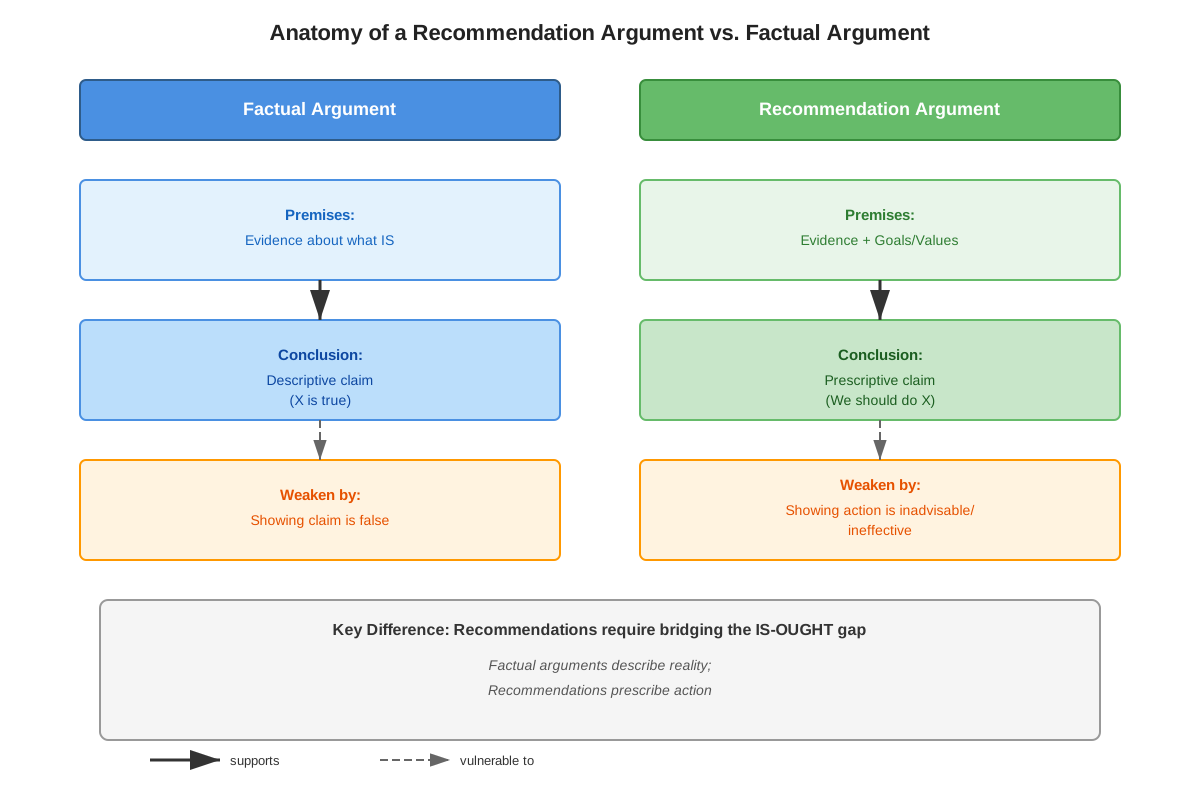
A recommendation argument contains a prescriptive conclusion—a statement about what should, ought to, or must be done. The structure typically includes: (1) a goal or desired outcome, (2) a proposed action to achieve that goal, and (3) evidence suggesting the action will succeed. For example: "To reduce traffic congestion [goal], the city should build a new highway [recommendation], because highways increase road capacity [evidence]."
The critical distinction between recommendation arguments and factual arguments lies in the conclusion type. Factual arguments conclude that something is the case; recommendation arguments conclude that something should be done. This difference fundamentally changes what counts as a weakener. For factual claims, weakeners show the claim is false or less likely to be true. For recommendations, weakeners show the proposed action is inadvisable, even if the factual premises remain true.
Types of Weakeners for Recommendations
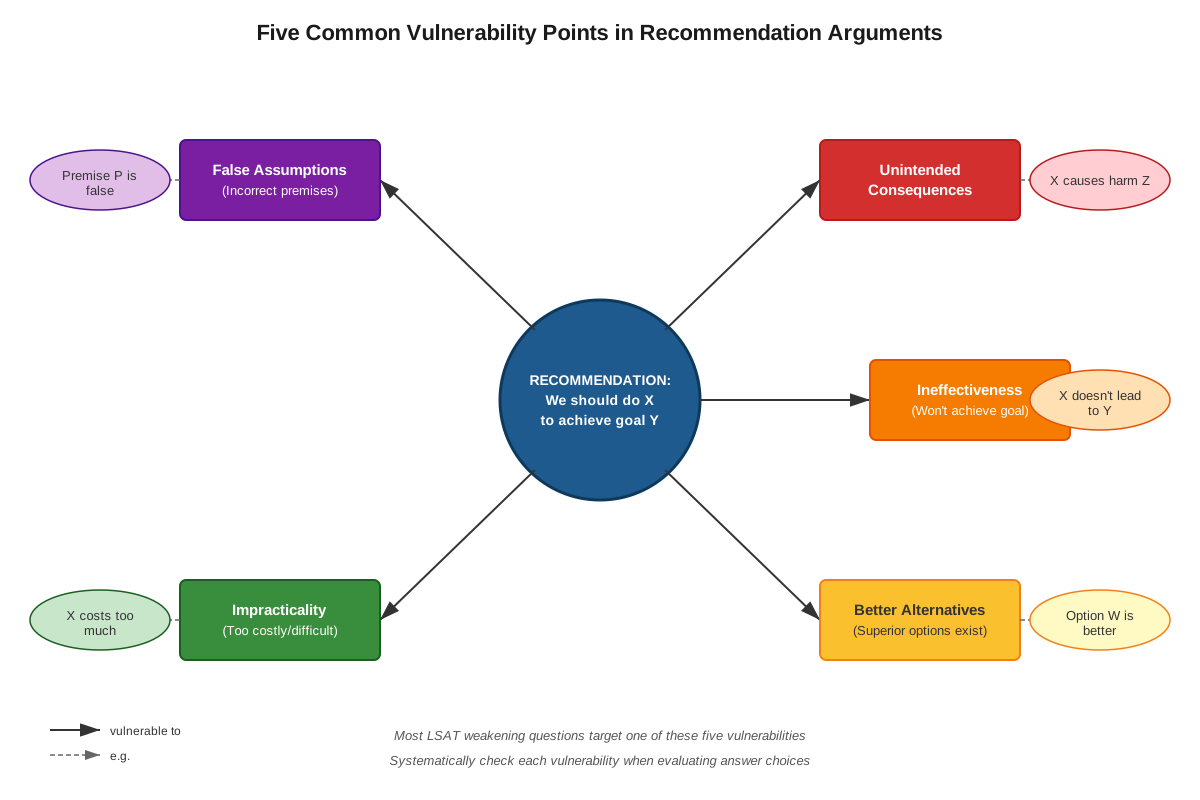
Effectiveness weakeners demonstrate that the recommendation won't achieve its stated goal. These are the most common type and directly challenge whether the proposed action will produce the desired outcome. For instance, if someone recommends building a highway to reduce congestion, evidence that new highways induce additional traffic demand would be an effectiveness weakener.
Cost-benefit weakeners show that negative consequences outweigh the benefits. Even if a recommendation might achieve its stated goal, it could be inadvisable due to excessive costs, harmful side effects, or opportunity costs. If building the highway would destroy valuable wetlands and cost more than alternative solutions, this weakens the recommendation even if it might reduce some congestion.
Alternative superiority weakeners indicate that a different course of action would better achieve the goal. These weakeners don't necessarily show the recommendation would fail, but they undermine its status as the best or most advisable option. Evidence that expanding public transit would reduce congestion more effectively and cheaply than building a highway weakens the highway recommendation.
Feasibility weakeners reveal practical obstacles that prevent implementation. A recommendation might theoretically work but be inadvisable because it's impossible, illegal, or practically unachievable. If the proposed highway route crosses protected federal land where construction is prohibited, this weakens the recommendation regardless of its potential effectiveness.
Assumption-targeting weakeners exploit unstated premises that the recommendation depends upon. Every recommendation rests on assumptions about how the world works, what conditions exist, or what will remain constant. Identifying and undermining these assumptions effectively weakens the recommendation.
The Reasoning Pattern in Recommendation Arguments
Recommendation arguments follow a predictable logical structure:
- Current situation: Description of a problem, need, or opportunity
- Proposed action: The recommendation itself
- Expected outcome: What the recommendation is supposed to achieve
- Supporting evidence: Why the arguer believes the action will produce the outcome
The reasoning pattern typically involves an implicit causal claim: "If we do X, then Y will result." This creates vulnerability because the argument assumes:
- X is possible to implement
- X will actually cause Y (not just correlate with it)
- No other factors will prevent Y
- No negative consequences Z will outweigh Y
- X is the best way to achieve Y
Weakening answer choices exploit these assumptions by introducing information that breaks the causal chain, reveals obstacles, or shows that the cost-benefit analysis is unfavorable.
Distinguishing Recommendations from Predictions
Students often confuse recommendation arguments with prediction arguments. A prediction states what will happen; a recommendation states what should be done. Consider:
- Prediction: "The company will expand internationally next year."
- Recommendation: "The company should expand internationally next year."
This distinction matters because weakening strategies differ. To weaken a prediction, show why the predicted event won't occur. To weaken a recommendation, show why the action is inadvisable—even if it's possible or likely to occur. The question stem language typically signals which type you're dealing with: "weakens the recommendation," "calls into question the advice," or "casts doubt on the proposal" all indicate recommendation arguments.
Common Structural Vulnerabilities
| Vulnerability Type | Description | Example Weakener |
|---|---|---|
| Unintended consequences | The recommendation produces harmful side effects | The policy would create a black market |
| False assumption about current conditions | The argument assumes facts that aren't true | The problem the recommendation addresses doesn't actually exist |
| Ignoring constraints | The recommendation overlooks practical limitations | The necessary resources aren't available |
| Temporal issues | Timing problems undermine effectiveness | The benefits won't materialize until after the critical period |
| Scope mismatch | The recommendation doesn't address the full scope of the problem | The solution only helps a small subset of affected parties |
Concept Relationships
The concepts within weakening recommendations form an interconnected system. The structure of recommendation arguments provides the foundation for understanding all other concepts—recognizing that a conclusion is prescriptive rather than descriptive determines which weakening strategies apply. This structural understanding leads directly to identifying types of weakeners, as each type targets a specific component of the recommendation's structure (effectiveness targets the means-end connection, cost-benefit targets the overall advisability, etc.).
The reasoning pattern in recommendations connects to structural vulnerabilities because the pattern reveals where assumptions hide. The implicit causal claim "doing X will cause Y" creates vulnerability to effectiveness weakeners, while the unstated assumption "Y is worth achieving at any cost" creates vulnerability to cost-benefit weakeners. Understanding the reasoning pattern enables prediction of which vulnerabilities likely exist in any given argument.
The distinction between recommendations and predictions relates back to prerequisite knowledge of argument types and forward to exam strategy. Recognizing this distinction prevents misapplication of weakening strategies and helps eliminate wrong answer choices that would weaken a prediction but not a recommendation.
Concept flow: Argument structure identification → Recognition of prescriptive conclusion → Analysis of reasoning pattern → Identification of implicit assumptions → Prediction of vulnerabilities → Selection of answer choice that exploits vulnerability → Verification that the answer makes the recommendation inadvisable
This topic connects to prerequisite knowledge of causal reasoning because many recommendations assume causal relationships. It also connects to assumption questions since weakening recommendations often involves identifying and undermining unstated assumptions. Looking forward, mastery of weakening recommendations enhances performance on strengthen questions (by understanding what would make recommendations more advisable), flaw questions (by recognizing common errors in prescriptive reasoning), and evaluation questions (by knowing what information would help assess a recommendation's merit).
High-Yield Facts
⭐ Weakening a recommendation requires showing the proposed action is inadvisable, not merely showing that a factual premise is questionable.
⭐ The most common weakeners demonstrate that the recommendation won't achieve its stated goal (effectiveness weakeners).
⭐ A recommendation can be weakened even if it might work, by showing that costs outweigh benefits or that alternatives are superior.
⭐ Question stems containing "recommendation," "advice," "proposal," "should," or "ought to" signal recommendation arguments.
⭐ Correct weakening answers often reveal unintended negative consequences of implementing the recommendation.
- Recommendation arguments always contain prescriptive conclusions using normative language (should, ought, must, advisable).
- Feasibility weakeners show that practical obstacles prevent implementation, making the recommendation inadvisable regardless of theoretical effectiveness.
- Many recommendation arguments assume that current conditions will remain stable during implementation—weakeners often challenge this assumption.
- Alternative superiority weakeners don't need to show the recommendation would fail, only that a different approach would work better.
- Temporal mismatches (benefits arriving too late or costs occurring too early) effectively weaken time-sensitive recommendations.
- Scope limitations weaken recommendations when the proposed action addresses only part of the problem it claims to solve.
- Recommendations based on analogies to other situations are vulnerable to weakeners showing relevant differences between the situations.
- Evidence that the stated goal is already achieved or unnecessary weakens the recommendation by eliminating the rationale for action.
- Weakeners showing that the recommendation addresses a symptom rather than the root cause are particularly effective.
Quick check — test yourself on Weakening recommendations so far.
Try Flashcards →Common Misconceptions
Misconception: Any information that contradicts a premise in the argument weakens the recommendation.
Correction: Weakening a recommendation requires showing that following the advice is inadvisable. Merely contradicting a premise doesn't necessarily make the recommendation bad advice if other reasons support it or if the premise isn't essential to the recommendation's merit.
Misconception: If a recommendation might achieve some benefit, it cannot be weakened.
Correction: A recommendation can be inadvisable even if it produces some benefits, particularly if costs outweigh benefits, if negative side effects are severe, or if alternative approaches would work better. The question is whether the action is advisable overall, not whether it has any positive effects.
Misconception: Weakening recommendations is the same as weakening causal arguments.
Correction: While many recommendations involve causal reasoning, weakening them requires additional considerations. Even if the causal claim is sound (doing X will cause Y), the recommendation can still be weak if Y isn't worth the cost, if X has negative side effects, or if there's a better way to achieve Y.
Misconception: The correct answer must prove the recommendation is definitely bad advice.
Correction: On the LSAT, weakening answers need only make the recommendation less advisable or more questionable. They don't need to definitively prove the recommendation is wrong—they just need to provide a significant reason to doubt its wisdom.
Misconception: Information about what happened in the past cannot weaken a recommendation about future action.
Correction: Historical evidence frequently weakens recommendations, particularly when it shows that similar actions failed previously, produced unintended consequences, or that conditions have changed making the recommendation less applicable. Past results often provide the best evidence about likely future outcomes.
Misconception: If the recommendation would help the stated goal, any negative consequences are irrelevant.
Correction: Negative consequences are highly relevant to whether a recommendation is advisable. A recommendation that achieves its stated goal but produces severe negative side effects or excessive costs is poor advice. Comprehensive evaluation requires weighing all consequences, not just the intended ones.
Worked Examples
Example 1: Environmental Policy Recommendation
Argument: "To reduce plastic waste in the ocean, coastal cities should ban single-use plastic bags. Studies show that plastic bags constitute a significant portion of ocean debris, and cities that have implemented bag bans have seen reductions in plastic litter. Therefore, coastal cities should adopt similar bans."
Question: Which of the following, if true, most weakens the recommendation?
Answer Choices:
(A) Some coastal cities have already implemented plastic bag bans.
(B) Plastic bottles contribute more to ocean plastic waste than plastic bags do.
(C) After bag bans, most consumers switch to single-use paper bags, which require more energy to produce and transport than plastic bags, resulting in greater overall environmental harm.
(D) Not all coastal cities have the same amount of plastic waste in nearby waters.
(E) Some consumers reuse plastic bags for household purposes before disposing of them.
Analysis:
First, identify the recommendation structure:
- Goal: Reduce plastic waste in the ocean
- Recommendation: Coastal cities should ban single-use plastic bags
- Evidence: Bags are significant ocean debris; bans reduce plastic litter
Now evaluate each answer:
(A) This doesn't weaken the recommendation. That some cities have already acted doesn't make it inadvisable for others to do so. If anything, this might suggest the recommendation is feasible. Eliminate.
(B) This is tempting but doesn't weaken the recommendation. Even if bottles contribute more, reducing bag waste could still be advisable. The recommendation doesn't claim bags are the largest source, only that reducing them would help. This is a scope shift wrong answer. Eliminate.
(C) This is a cost-benefit weakener. It shows that implementing the recommendation produces a negative consequence (greater environmental harm from paper bags) that outweighs the intended benefit (reducing plastic waste). Even if the recommendation achieves its stated goal of reducing plastic bags, it's inadvisable because the overall environmental impact is worse. This is correct.
(D) This suggests the recommendation might not apply equally to all cities, but it doesn't show the recommendation is inadvisable for any particular city. This is too weak and doesn't directly challenge the recommendation's merit. Eliminate.
(E) This provides minor context but doesn't significantly weaken the recommendation. Even if some bags are reused, the recommendation could still be advisable if the overall impact is positive. Eliminate.
Correct Answer: (C)
Connection to Learning Objectives: This example demonstrates how to identify a recommendation (prescriptive conclusion with "should"), analyze its reasoning pattern (causal claim that bans will reduce ocean plastic), and apply weakening strategies (recognizing that unintended consequences can make a recommendation inadvisable even if it achieves its stated goal).
Example 2: Business Strategy Recommendation
Argument: "Acme Corporation should expand its product line to include luxury goods. Market research indicates growing demand for luxury products among Acme's existing customer base, and luxury items typically have higher profit margins than Acme's current mid-range products. Expanding into luxury goods would therefore increase Acme's profitability."
Question: Which of the following, if true, most seriously weakens the recommendation?
Answer Choices:
(A) Some of Acme's competitors already sell luxury goods.
(B) Acme's brand is strongly associated with affordability and value, and customers who seek luxury goods typically prefer brands with established luxury reputations.
(C) The profit margin on luxury goods is 40%, compared to 25% for mid-range products.
(D) Market research is not always accurate in predicting consumer behavior.
(E) Acme's current product line includes over 200 different items.
Analysis:
Identify the structure:
- Goal: Increase Acme's profitability
- Recommendation: Expand product line to include luxury goods
- Evidence: Growing demand among existing customers; luxury items have higher margins
Evaluate each answer:
(A) Competition doesn't necessarily make the recommendation inadvisable. Many markets have multiple competitors. This doesn't show Acme would fail or that expansion is a bad idea. Eliminate.
(B) This is an effectiveness weakener that targets a crucial assumption: that Acme can successfully sell luxury goods. The argument assumes Acme's existing customers will buy luxury items from Acme, but this answer reveals that brand perception creates a significant obstacle. Customers seeking luxury goods prefer established luxury brands, and Acme's value-oriented brand identity works against luxury positioning. This makes the recommendation inadvisable because the expansion likely won't achieve its goal of increasing profitability—the luxury products probably won't sell well. This is correct.
(C) This actually supports the recommendation by confirming the higher margins mentioned in the argument. Eliminate.
(D) This is too vague and weak. Yes, market research isn't perfect, but this doesn't provide specific reason to doubt this particular recommendation. It's a generic weakener that could apply to any argument using market research. Eliminate.
(E) The size of the current product line is irrelevant to whether adding luxury goods is advisable. This is a red herring. Eliminate.
Correct Answer: (B)
Connection to Learning Objectives: This example illustrates how weakening recommendations often involves identifying implicit assumptions (here, that Acme can successfully compete in the luxury market) and showing why those assumptions are questionable. The correct answer doesn't prove the recommendation will definitely fail, but it provides a substantial reason to doubt its advisability by revealing a significant obstacle to success.
Exam Strategy
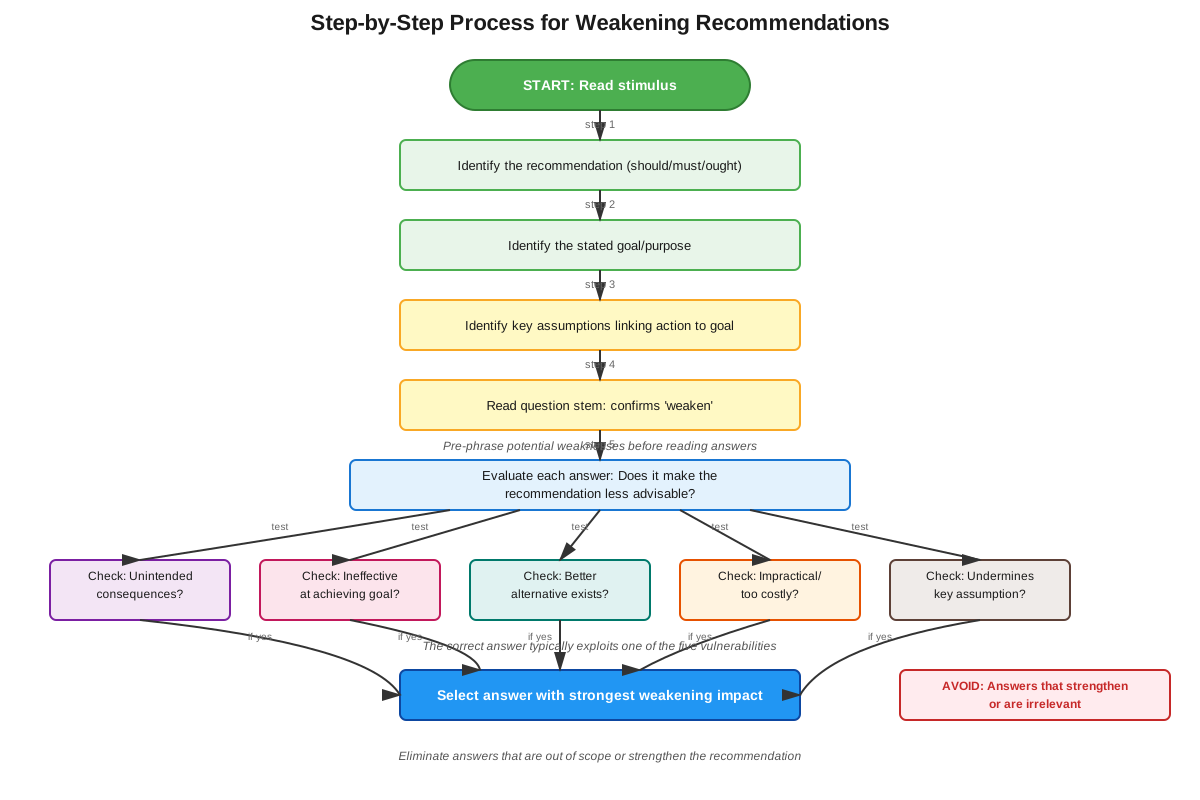
When approaching lsat weakening recommendations questions, follow this systematic process:
Step 1: Identify the recommendation by finding the prescriptive conclusion. Look for normative language: "should," "ought to," "must," "advisable," "recommend," or "propose." Underline or mentally note this conclusion.
Step 2: Identify the goal that the recommendation aims to achieve. Ask: "What is this action supposed to accomplish?" The goal might be explicitly stated or implied by context.
Step 3: Map the reasoning by identifying what evidence supports the belief that the recommendation will achieve its goal. Look for causal claims, analogies, or appeals to authority.
Step 4: Predict vulnerabilities before reading answer choices. Ask:
- Will this action actually achieve the goal?
- Are there negative side effects?
- Is there a better alternative?
- Is this feasible?
- What assumptions does this depend on?
Step 5: Evaluate answer choices by asking: "If this were true, would it make the recommendation less advisable?" Don't just ask whether it weakens a premise—ask whether it makes following the advice a worse idea.
Exam Tip: The correct answer often introduces new information not mentioned in the argument. Don't eliminate answers just because they bring up new considerations—weakeners frequently work by revealing factors the argument overlooked.
Trigger words and phrases to watch for:
In question stems:
- "Weakens the recommendation"
- "Calls into question the advice"
- "Casts doubt on the proposal"
- "Undermines the suggestion"
- "Provides reason to reject the plan"
In arguments:
- "Should," "ought to," "must" (signal recommendations)
- "In order to," "to achieve" (signal goals)
- "Would result in," "will lead to" (signal expected outcomes)
- "Therefore," "thus," "so" (signal conclusions)
Process-of-elimination tips:
Eliminate answers that:
- Support the recommendation (surprisingly common wrong answer type)
- Are irrelevant to whether the action is advisable
- Weaken a premise but not the recommendation (the recommendation might still be good advice even if one premise is questionable)
- Are too weak (provide only minor concerns that don't significantly impact advisability)
- Address the wrong goal (weaken a different objective than what the recommendation aims to achieve)
Time allocation advice:
Spend 15-20 seconds on initial reading and identification of the recommendation structure. Spend 10-15 seconds predicting vulnerabilities. Spend 45-60 seconds evaluating answer choices. If you're torn between two answers, ask: "Which one more directly makes the recommendation inadvisable?" The correct answer typically has a clearer, more substantial impact on whether the action should be taken.
Exam Tip: When stuck between two answers, one often weakens a factual premise while the other weakens the recommendation itself. Choose the one that makes the proposed action less advisable, not just the one that challenges a fact in the argument.
Memory Techniques
WEAKEN-R Mnemonic for types of recommendation weakeners:
- Won't work (effectiveness)
- Expensive consequences (cost-benefit)
- Alternative is better (superiority)
- Kan't be done (feasibility)
- Expected conditions won't hold (assumption)
- Negative side effects (unintended consequences)
- Root cause unaddressed (scope)
Visualization Strategy: Picture the recommendation as a bridge from the current situation to the desired goal. Weakeners either:
- Break the bridge (won't work)
- Show the bridge leads to a cliff (negative consequences)
- Reveal a better bridge nearby (alternatives)
- Show the bridge is blocked (feasibility)
- Show the destination isn't where you thought (false assumptions)
The "Should I?" Test: When evaluating whether an answer weakens a recommendation, imagine someone asking you for advice: "Should I do X?" If the answer choice would make you say, "Well, maybe you shouldn't because..." then it's a weakener. If it wouldn't change your advice, it's not.
Acronym for Common Vulnerabilities: FACES
- Feasibility problems
- Alternatives superior
- Costs exceed benefits
- Effectiveness doubted
- Side effects harmful
Summary
Weakening recommendations constitutes a high-yield LSAT question type that requires understanding the unique structure of prescriptive arguments. Unlike weakening factual claims, weakening recommendations demands showing that a proposed action is inadvisable—that it won't achieve its goal, that costs outweigh benefits, that alternatives are superior, or that implementation faces insurmountable obstacles. The reasoning pattern in recommendation arguments typically involves an implicit causal claim connecting the proposed action to a desired outcome, creating vulnerability to effectiveness weakeners that break this causal chain. Successful test-takers recognize that recommendations can be weakened even when factual premises remain unchallenged, by introducing information about unintended consequences, practical constraints, or superior alternatives. The key distinction between recommendations and predictions, combined with systematic analysis of goals, proposed actions, and supporting evidence, enables accurate identification of answer choices that genuinely undermine the advisability of the recommended course of action.
Key Takeaways
- Weakening recommendations requires showing the proposed action is inadvisable, not merely challenging factual premises
- Recommendation arguments contain prescriptive conclusions using normative language (should, ought, must)
- The five main weakener types are: effectiveness, cost-benefit, alternative superiority, feasibility, and assumption-targeting
- Correct answers often introduce new information about unintended consequences or overlooked factors
- Always identify the goal of the recommendation and evaluate whether the answer choice makes achieving that goal less likely or less worthwhile
- Distinguish between information that weakens a premise and information that makes the recommendation inadvisable—only the latter is correct
- Predict vulnerabilities before reading answer choices by asking: Will it work? What could go wrong? Is there a better way?
Related Topics
Strengthening Recommendations: The mirror image of this topic, involving answer choices that make recommendations more advisable by showing they'll be effective, feasible, or superior to alternatives. Mastering weakening recommendations provides the foundation for understanding strengthening strategies.
Necessary Assumption Questions: Many recommendation arguments depend on unstated assumptions about feasibility, effectiveness, or the absence of negative consequences. Understanding how to weaken recommendations by targeting assumptions directly enhances performance on necessary assumption questions.
Flaw Questions: Recommendation arguments often contain identifiable logical flaws such as failing to consider alternatives, overlooking costs, or assuming correlation implies causation. The analytical skills developed for weakening recommendations transfer directly to flaw identification.
Evaluate Questions: These questions ask what information would be most useful in assessing an argument's strength. For recommendation arguments, the relevant information typically addresses the same vulnerabilities that weakeners exploit—effectiveness, costs, feasibility, and alternatives.
Causal Reasoning: Since many recommendations assume causal relationships (doing X will cause Y), understanding how to weaken causal claims enhances ability to weaken recommendations. This topic provides deeper exploration of causal reasoning patterns.
Practice CTA
Now that you've mastered the conceptual framework for weakening recommendations, it's time to apply these strategies to actual LSAT questions. The practice questions and flashcards will reinforce your ability to quickly identify recommendation structures, predict vulnerabilities, and select answer choices that genuinely undermine the advisability of proposed actions. Remember: consistent practice with immediate feedback is the most effective way to transform conceptual understanding into test-day performance. Each practice question you complete strengthens your pattern recognition and builds the confidence needed to tackle these high-yield questions efficiently and accurately. You've built the foundation—now apply it!
Sign up free to keep reading
Create a free AnvayaPrep account to finish this LSAT guide on Weakening recommendations — plus flashcards and practice questions.