Overview
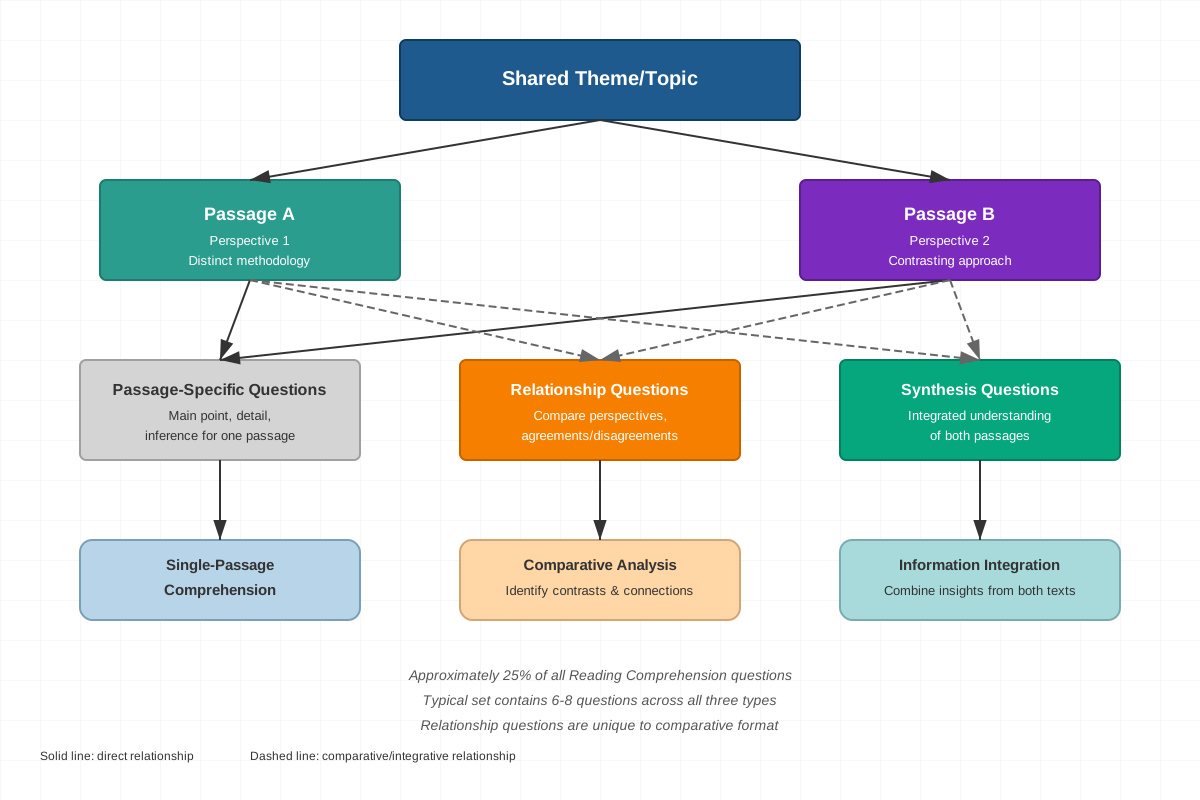
Comparative humanities passages represent a unique challenge within the LSAT Reading Comprehension section, requiring test-takers to analyze and synthesize information from two related passages simultaneously. Introduced in 2007, this format presents two shorter passages (Passage A and Passage B) that address a common theme from different perspectives, methodologies, or time periods. These passages typically explore topics in literature, philosophy, art history, music theory, cultural criticism, or other humanities disciplines. Unlike traditional single-passage questions, comparative reading demands that students not only comprehend each passage independently but also identify relationships, contrasts, and points of agreement or disagreement between the two texts.
The significance of lsat comparative humanities passages extends beyond mere content comprehension. These questions test critical analytical skills that lawyers must employ daily: evaluating multiple perspectives on a single issue, identifying subtle distinctions in argumentation, and synthesizing information from diverse sources. The LSAT uses humanities topics because they often involve interpretive debates, subjective judgments, and nuanced theoretical positions—precisely the kind of material that reveals a test-taker's ability to handle complex, ambiguous information. Success with these passages requires recognizing not just what each author says, but how their approaches, assumptions, and conclusions relate to one another.
Within the broader reading comprehension framework, comparative humanities passages occupy a strategic position. They combine the interpretive demands of traditional humanities passages with the additional cognitive load of tracking two distinct voices, arguments, and rhetorical strategies. Mastering this topic builds essential skills for all Reading Comprehension questions: active reading, structural analysis, author's purpose identification, and precise textual support for answer choices. The comparative format intensifies these demands while adding unique question types that explicitly test relationship recognition and synthesis abilities.
Learning Objectives
- [ ] Identify how Comparative humanities passages appears in LSAT questions
- [ ] Explain the reasoning pattern behind Comparative humanities passages
- [ ] Apply Comparative humanities passages to solve LSAT-style problems accurately
- [ ] Distinguish between points of agreement and disagreement across paired passages
- [ ] Analyze the rhetorical strategies and structural approaches used by different authors addressing the same topic
- [ ] Synthesize information from both passages to answer questions requiring integrated understanding
- [ ] Evaluate the relative strength of evidence and argumentation across comparative texts
Prerequisites
- Basic reading comprehension skills: The ability to identify main ideas, supporting details, and author's tone in single passages forms the foundation for comparative analysis
- Understanding of passage structure: Recognizing how arguments are organized (thesis, evidence, counterarguments, conclusions) enables tracking of parallel or contrasting structures across passages
- Familiarity with humanities content: Basic exposure to literary analysis, philosophical reasoning, or cultural criticism helps navigate the subject matter without getting lost in unfamiliar terminology
- Question type recognition: Knowing standard LSAT question formats (main point, inference, strengthen/weaken) allows focus on the comparative dimension rather than basic question mechanics
Why This Topic Matters
Comparative humanities passages appear in every LSAT Reading Comprehension section, making them unavoidable and high-stakes. Typically, one of the four passage sets in each section follows the comparative format, accounting for approximately 25% of all Reading Comprehension questions. This consistent presence means that mastery of comparative passages directly impacts overall LSAT scores, particularly since these questions often prove more challenging than traditional single-passage questions due to their increased cognitive demands.
In legal practice, attorneys constantly evaluate competing interpretations, reconcile conflicting precedents, and synthesize information from multiple sources—precisely the skills tested by comparative passages. Law school case discussions frequently involve comparing different judicial opinions on similar issues, making the analytical framework developed through comparative passage practice directly transferable to legal education. The humanities focus adds another layer of relevance: legal reasoning often involves interpretive questions about intent, meaning, and application that mirror the hermeneutic challenges found in literary or philosophical analysis.
On the exam, comparative humanities passages generate several distinctive question types. Relationship questions ask how the passages relate to each other (agreement, disagreement, complementary perspectives). Cross-passage inference questions require synthesizing information from both texts. Comparative author's attitude questions test understanding of how each author would respond to the other's claims. Structural parallel questions ask students to identify similar rhetorical moves or organizational strategies across passages. Additionally, standard question types (main point, detail, inference) appear but with the added complexity of specifying "Passage A," "Passage B," or "both passages," requiring precise tracking of which author said what.
Core Concepts
Structure of Comparative Passages
Comparative humanities passages follow a consistent structural format that test-takers must recognize immediately. Each comparative set contains two passages, labeled Passage A and Passage B, with a combined length roughly equivalent to a single traditional passage (approximately 450-500 words total). Passage A typically runs 200-250 words, while Passage B follows with similar length. The passages share a common theme or topic but approach it from different angles, time periods, theoretical frameworks, or evaluative stances.
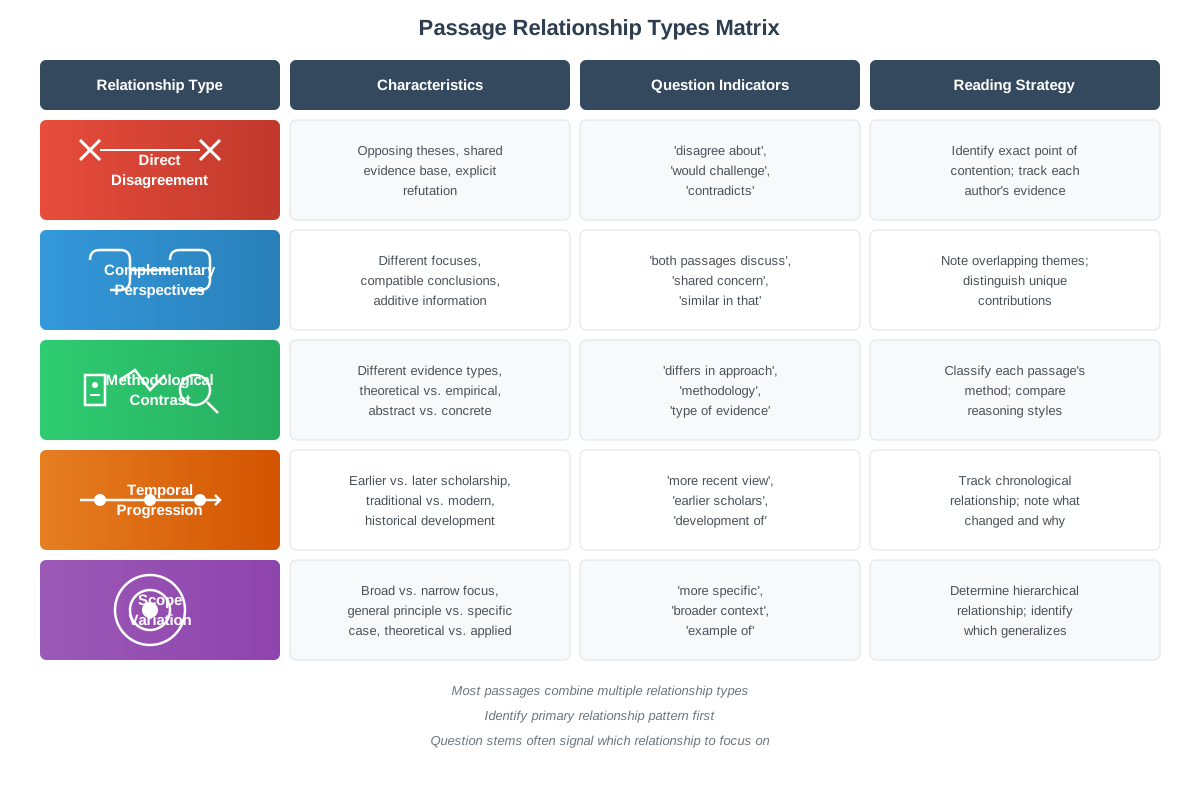
The relationship between passages falls into several predictable patterns:
| Relationship Type | Description | Example Topics |
|---|---|---|
| Contrasting Perspectives | Authors disagree on interpretation, evaluation, or approach | Passage A praises modernist poetry's innovation; Passage B criticizes its obscurity |
| Complementary Approaches | Authors examine different aspects of the same phenomenon | Passage A discusses historical context of jazz; Passage B analyzes its musical techniques |
| Chronological Development | Earlier and later views on the same topic | Passage A presents 19th-century art criticism; Passage B offers contemporary reassessment |
| Theoretical vs. Practical | Abstract principles versus concrete applications | Passage A outlines aesthetic theory; Passage B applies it to specific artworks |
| Broad vs. Narrow Focus | General overview versus specific case study | Passage A surveys Renaissance humanism; Passage B examines one humanist philosopher |
Reading Strategy for Comparative Passages
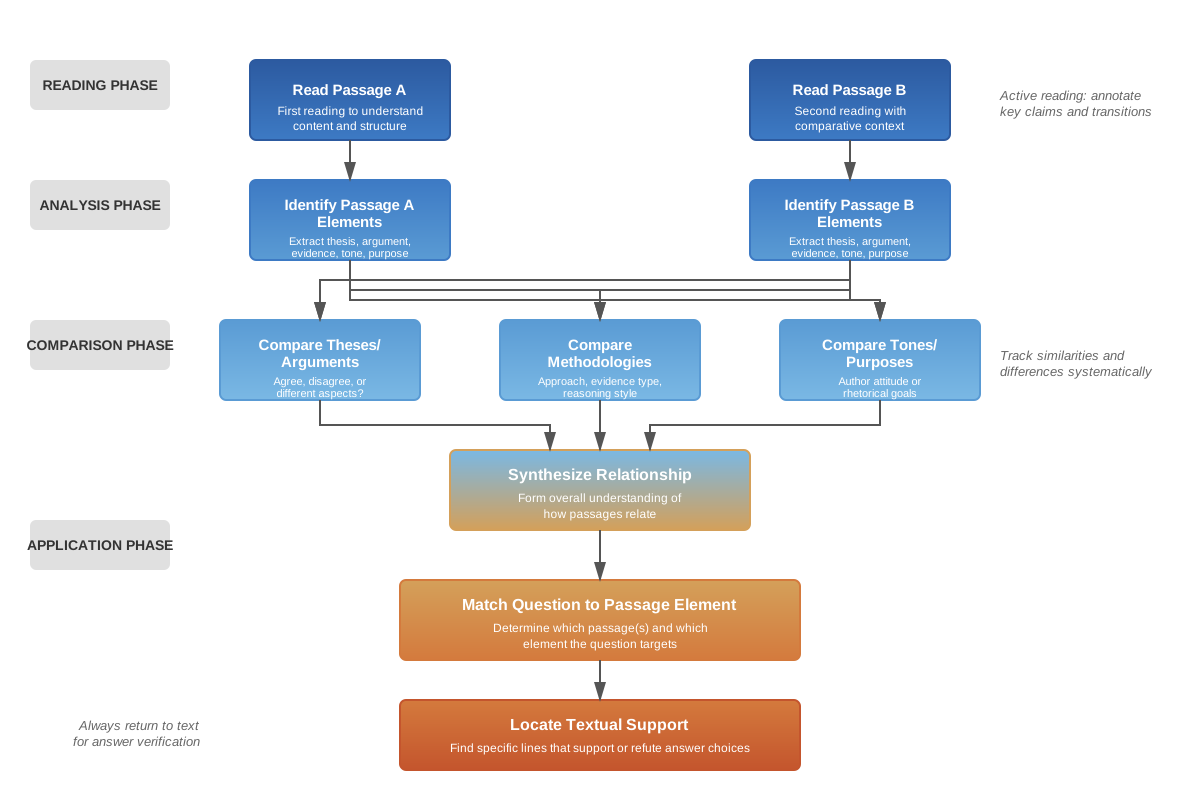
Effective navigation of lsat comparative humanities passages requires a modified reading approach. The optimal strategy involves reading Passage A completely first, noting its main point, tone, and key supporting details. Before moving to Passage B, test-takers should pause to predict: What might a contrasting view look like? What aspects of the topic did Passage A not address? This predictive moment primes the mind for comparative analysis.
When reading Passage B, active comparison must occur simultaneously with comprehension. Mental or marginal notes should track: Where does this author agree with Passage A? Where do they disagree? What new information or perspective does this add? What terminology or concepts appear in both passages? This comparative reading layer distinguishes successful test-takers from those who treat the passages as independent texts.
Question Types Unique to Comparative Passages
Several question formats appear exclusively or predominantly in comparative reading contexts:
Relationship Questions directly ask how the passages relate: "Which one of the following most accurately describes the relationship between Passage A and Passage B?" These questions reward students who identified the fundamental connection during reading rather than searching for it afterward.
Cross-Passage Application Questions present a scenario, claim, or example from one passage and ask how the other author would respond: "The author of Passage B would most likely respond to the claim in lines 15-18 of Passage A by..." These questions test genuine synthesis, requiring understanding of both authors' perspectives and reasoning patterns.
Comparative Attitude Questions ask about differences in tone, emphasis, or evaluation: "Compared to the author of Passage A, the author of Passage B is more..." These questions often hinge on subtle distinctions in word choice, qualifiers, or rhetorical emphasis.
Shared Element Questions identify commonalities: "Both passages mention which of the following?" or "The authors of both passages would be most likely to agree with which one of the following statements?" These questions test careful reading and precise recall of what each passage actually stated.
Analytical Framework for Humanities Content
Humanities passages on the LSAT typically involve interpretive debates rather than factual disputes. Understanding the common analytical moves in humanities discourse helps anticipate passage content and question focus:
Interpretive Claims: Authors assert particular readings or meanings of texts, artworks, or cultural phenomena. These claims are supported by textual evidence, contextual information, or theoretical frameworks.
Evaluative Judgments: Authors assess the quality, significance, or value of artistic or intellectual works. These judgments often reflect underlying aesthetic or philosophical commitments.
Historical Contextualization: Authors situate works within their historical, cultural, or intellectual contexts to explain their meaning or significance.
Theoretical Application: Authors apply critical theories (feminist, postcolonial, formalist, etc.) to analyze cultural products.
Comparative Analysis: Authors compare works, movements, or periods to highlight similarities, differences, or developments.
Recognizing these analytical moves helps predict how passages will develop and what kinds of questions will follow.
Tracking Agreement and Disagreement
The most critical skill for comparative passages involves precisely identifying where authors agree and disagree. Agreement and disagreement operate at multiple levels:
Factual Agreement: Both authors accept the same basic facts (dates, events, biographical information).
Interpretive Disagreement: Authors disagree about the meaning, significance, or implications of agreed-upon facts.
Methodological Differences: Authors use different approaches or frameworks even when reaching similar conclusions.
Emphasis Variation: Authors focus on different aspects of a topic without necessarily contradicting each other.
Partial Agreement: Authors agree on some points while disagreeing on others, requiring careful tracking of which claims fall into which category.
Test-takers must avoid the trap of assuming that different passages automatically disagree. Many comparative sets present complementary rather than contradictory perspectives, and questions often test whether students can distinguish genuine disagreement from mere difference in focus.
Concept Relationships
The concepts within comparative humanities passages form an interconnected analytical framework. Passage structure provides the foundation—understanding how each passage is organized enables efficient navigation and information retrieval. This structural awareness feeds directly into reading strategy, which layers comparative analysis onto basic comprehension. The reading strategy must adapt to the specific relationship type between passages (contrasting, complementary, chronological), making relationship identification a crucial early step that shapes all subsequent analysis.
Question types emerge from the comparative structure and relationship patterns. Relationship questions test whether students correctly identified the connection between passages. Cross-passage application questions require both understanding of the analytical framework (how humanities arguments work) and precise tracking of agreement and disagreement (knowing each author's position). Comparative attitude questions depend on recognizing subtle differences in tone and emphasis that become apparent only through careful comparative reading.
The analytical framework for humanities content connects to prerequisite knowledge of basic humanities reasoning while providing specialized tools for LSAT passages. This framework helps predict passage development, anticipate question focus, and eliminate wrong answers that mischaracterize the type of claim being made (confusing factual statements with interpretive judgments, for example).
Tracking agreement and disagreement represents the synthesis of all other concepts—it requires structural awareness (where in each passage are key claims made?), strategic reading (active comparison while reading), relationship recognition (is this a disagreement or just different emphasis?), and understanding of humanities reasoning (are they disagreeing about facts or interpretations?). This tracking skill directly enables success on the highest-value question types: cross-passage application and shared element questions.
High-Yield Facts
⭐ Comparative passages appear exactly once in every LSAT Reading Comprehension section, accounting for 5-8 questions per test.
⭐ The passages always share a common topic but approach it from different perspectives, time periods, or methodological frameworks—they are never completely unrelated.
⭐ Questions will explicitly specify "Passage A," "Passage B," or "both passages" when asking about content, requiring precise tracking of which author made which claim.
⭐ Agreement between passages is often factual or contextual, while disagreement typically involves interpretation, evaluation, or emphasis—recognizing this distinction is crucial for answering relationship questions correctly.
⭐ Cross-passage application questions reward understanding of each author's reasoning pattern and underlying assumptions, not just memorization of stated claims.
- Passage B often responds to, critiques, or builds upon the perspective presented in Passage A, creating an implicit dialogue between the texts.
- Questions asking what "both passages mention" or "both authors agree on" require extremely precise reading—the concept must appear explicitly in both passages, not just be implied.
- Comparative passages typically contain fewer questions (5-8) than traditional single passages (6-8), but the questions often prove more time-consuming due to their complexity.
- The humanities topics in comparative passages frequently involve aesthetic judgments, interpretive debates, or historical reassessments where reasonable people can disagree.
- Wrong answers on comparative questions often attribute claims from one passage to the other author or confuse disagreement with mere difference in focus.
Quick check — test yourself on Comparative humanities passages so far.
Try Flashcards →Common Misconceptions
Misconception: If two passages discuss the same topic, they must disagree with each other.
Correction: Many comparative passages present complementary perspectives that examine different aspects of a topic without contradicting each other. The passages might discuss different time periods, focus on different examples, or use different analytical approaches while remaining compatible. Questions often test whether students can distinguish genuine disagreement from mere difference in emphasis or scope.
Misconception: Reading both passages before looking at questions is inefficient and wastes time.
Correction: Attempting to answer comparative questions without reading both passages completely leads to frequent wrong answers and ultimately wastes more time through confusion and re-reading. The comparative questions explicitly require synthesis and relationship recognition that is impossible without understanding both passages. The most efficient approach involves reading both passages with active comparison, then attacking questions systematically.
Misconception: If Passage A makes a claim and Passage B doesn't mention it, Passage B disagrees with that claim.
Correction: Silence is not disagreement. Passage B might simply focus on different aspects of the topic without taking a position on claims made in Passage A. Questions asking about disagreement require explicit contradiction or incompatibility, not mere absence of discussion. This distinction is particularly important for "both passages agree" questions, where the correct answer must be explicitly supported by both texts.
Misconception: Comparative passages are always harder than traditional single passages, so they should be saved for last.
Correction: While comparative passages add complexity through their dual structure, they often contain more predictable question types and clearer answer choices because the relationship between passages constrains the possibilities. Some test-takers find comparative passages easier because the comparison provides additional context and structure. The decision about passage order should depend on individual strengths and the specific content of each passage set, not a blanket assumption about comparative difficulty.
Misconception: The correct answer to a cross-passage application question will use the same terminology as the original passage.
Correction: Correct answers frequently paraphrase or restate ideas using different language, testing genuine understanding rather than keyword matching. The author of Passage B might "respond" to Passage A's claim by offering an example, proposing an alternative explanation, or questioning an assumption—none of which requires using Passage A's exact words. Students must focus on conceptual relationships rather than surface-level vocabulary matches.
Worked Examples
Example 1: Identifying Relationship Type
Passage A (abbreviated): "The Impressionist painters revolutionized art by abandoning the studio and painting outdoors, capturing the fleeting effects of natural light. Their loose brushwork and bright colors shocked contemporary critics but ultimately liberated painting from academic constraints. Works like Monet's 'Impression, Sunrise' demonstrate how this movement prioritized immediate visual experience over detailed representation."
Passage B (abbreviated): "While Impressionism's technical innovations are undeniable, its historical significance has been overstated. The movement's focus on pleasant, bourgeois leisure scenes avoided the social and political upheavals of late 19th-century France. Artists like Courbet and Daumier, who directly engaged with contemporary social issues, deserve recognition as the true revolutionaries of modern art. Impressionism's 'revolution' was primarily aesthetic, not substantive."
Question: Which one of the following most accurately describes the relationship between Passage A and Passage B?
Analysis Process:
- Identify Passage A's main claim: Impressionism revolutionized art through technical innovation and liberation from academic constraints (positive evaluation).
- Identify Passage B's main claim: Impressionism's significance is overstated; true revolution requires social engagement, not just aesthetic innovation (critical evaluation).
- Locate points of agreement: Both passages acknowledge Impressionism's technical innovations ("technical innovations are undeniable" in B matches A's discussion of new techniques).
- Locate points of disagreement: The passages disagree about the significance and nature of Impressionism's "revolutionary" status. Passage A sees aesthetic innovation as genuinely revolutionary; Passage B argues that revolution requires social engagement.
- Characterize the relationship: Passage B challenges Passage A's evaluation while accepting its factual claims—this is a contrasting perspective relationship where disagreement centers on interpretation and significance rather than facts.
Correct Answer Type: "Passage B questions the significance that Passage A attributes to Impressionism's innovations" or "Passage B offers a more critical assessment of a movement that Passage A praises."
Key Takeaway: The relationship hinges on evaluative disagreement (how important was Impressionism?) rather than factual disagreement (what did Impressionists do?). Recognizing this distinction eliminates wrong answers that overstate the disagreement or miss the shared factual foundation.
Example 2: Cross-Passage Application
Passage A (abbreviated): "Jazz improvisation represents the highest form of musical creativity, requiring performers to compose spontaneously while maintaining harmonic coherence and rhythmic drive. Unlike classical musicians who interpret pre-existing scores, jazz artists create new music in real-time, making each performance unique. This spontaneity connects jazz to oral traditions and distinguishes it from Western art music's emphasis on fixed compositions."
Passage B (abbreviated): "The distinction between improvisation and interpretation is less clear than commonly assumed. Classical performers make countless spontaneous decisions about phrasing, dynamics, and timing that significantly shape each performance. Bach's keyboard players were expected to improvise ornaments and embellishments. The notion that classical music involves mere reproduction of scores reflects modern recording culture more than historical practice."
Question: The author of Passage B would most likely respond to Passage A's claim about jazz improvisation's uniqueness by:
Analysis Process:
- Identify the specific claim in Passage A: Jazz improvisation is unique because it involves spontaneous composition, unlike classical music's interpretation of fixed scores.
- Understand Passage B's core argument: The improvisation/interpretation distinction is overstated; classical performance involves significant spontaneous creativity.
- Apply Passage B's reasoning to Passage A's claim: Passage B would challenge the sharp distinction Passage A draws between jazz and classical music. Passage B's author would argue that classical performance also involves creative spontaneity.
- Predict the response: Passage B would likely point out that classical musicians also make spontaneous creative decisions, and that historical classical practice included improvisation, thus questioning jazz's claimed uniqueness.
- Evaluate answer choices: Look for options that apply Passage B's "blurred distinction" argument to challenge Passage A's "sharp distinction" claim.
Correct Answer Type: "Pointing out that classical musicians also engage in spontaneous creative decision-making during performance" or "Noting that the distinction between improvisation and interpretation is less absolute than Passage A suggests."
Wrong Answer Types to Eliminate:
- Answers that have Passage B agreeing with Passage A (contradicts the contrasting relationship)
- Answers that introduce new topics not discussed in Passage B
- Answers that mischaracterize Passage B's position (e.g., claiming Passage B says classical music is superior)
- Answers that address different claims from Passage A than the question specifies
Key Takeaway: Cross-passage application requires understanding not just what each author said, but how they reason and what assumptions underlie their arguments. The correct answer extends Passage B's logic to address Passage A's specific claim.
Exam Strategy
Initial Reading Approach: Read Passage A completely and actively, noting main point, tone, and key supporting details. Before moving to Passage B, pause for 5-10 seconds to predict: What might a different perspective look like? This prediction primes comparative thinking. While reading Passage B, actively note points of agreement, disagreement, and different emphasis. Use marginal notations: "A agrees," "B contradicts," "B adds new angle."
Trigger Words for Relationship Recognition: Watch for explicit signals in Passage B that indicate its relationship to Passage A:
- Contrast signals: "however," "nevertheless," "in contrast," "overstated," "fails to consider"
- Agreement signals: "similarly," "likewise," "as [Passage A] notes," "building on"
- Qualification signals: "while," "although," "to some extent," "partially"
- Extension signals: "furthermore," "additionally," "another aspect," "beyond"
Question Order Strategy: Attack questions in this order for maximum efficiency:
- Passage A-only questions: Answer while Passage A is freshest in memory
- Passage B-only questions: Answer while Passage B is freshest in memory
- Relationship questions: These require synthesis but are often straightforward once both passages are understood
- Cross-passage application questions: Save these for last as they're typically most time-consuming and benefit from having answered other questions that reinforced understanding
Process of Elimination for Comparative Questions:
- Eliminate answers that attribute claims to the wrong passage (check each passage explicitly)
- Eliminate answers that overstate disagreement (passages often agree on facts while disagreeing on interpretation)
- Eliminate answers that understate disagreement (don't confuse different emphasis with agreement)
- For "both passages" questions, eliminate any answer not explicitly supported by BOTH texts
- For cross-passage application, eliminate answers that mischaracterize the responding author's position or reasoning pattern
Time Allocation: Comparative passages should take approximately 8-9 minutes total: 3-4 minutes for reading both passages with active comparison, 4-5 minutes for answering 5-8 questions. If a question requires re-reading both passages, it's often more efficient to skip it temporarily and return after answering questions that reinforced passage understanding.
Annotation Strategy: Mark the following while reading:
- Main point of each passage (bracket or star)
- Explicit agreements between passages (mark both locations)
- Explicit disagreements or contrasts (mark both locations)
- Tone indicators (circle words revealing author's attitude)
- Structural parallels (similar argumentative moves in both passages)
Memory Techniques
COMPARE Acronym for reading strategy:
- Connect the topic (identify shared theme)
- Outline each passage's main point
- Mark agreements explicitly
- Pinpoint disagreements precisely
- Analyze the relationship type
- Recognize each author's tone
- Expect synthesis questions
Relationship Types Mnemonic: "C-C-C-T-B" (See Three Bees)
- Contrasting perspectives
- Complementary approaches
- Chronological development
- Theoretical vs. practical
- Broad vs. narrow focus
Question Type Visualization: Picture two people having a conversation:
- Relationship questions: How are they talking? (agreeing, debating, building on each other)
- Cross-passage application: What would Person B say about Person A's claim?
- Shared element questions: What do both people mention?
- Comparative attitude questions: Who is more enthusiastic/critical/cautious?
Agreement vs. Disagreement Distinction: Remember "FIDE"
- Facts: Usually agreed upon
- Interpretations: Often disagreed upon
- Details: May differ without disagreeing
- Evaluations: Frequently contrasting
Passage B Reading Reminder: "ABCD" - Always Be Comparing During reading of Passage B, constantly ask: "How does this compare to what Passage A said?"
Summary
Comparative humanities passages represent a distinctive and high-stakes component of LSAT Reading Comprehension, appearing exactly once per section and testing the ability to analyze and synthesize information from two related texts. These passages present different perspectives, approaches, or time periods addressing a common humanities topic—literature, philosophy, art, or cultural criticism. Success requires a modified reading strategy that layers active comparison onto basic comprehension: reading Passage A completely, predicting contrasts, then reading Passage B while tracking agreements, disagreements, and differences in emphasis. The relationship between passages typically follows predictable patterns (contrasting perspectives, complementary approaches, chronological development, theoretical versus practical, or broad versus narrow focus), and identifying this relationship early guides all subsequent analysis. Questions unique to comparative passages—relationship questions, cross-passage application, comparative attitude, and shared element questions—test synthesis skills essential for legal reasoning. The key distinction students must master involves recognizing that passages often agree on facts while disagreeing on interpretations or evaluations, and that different emphasis does not constitute disagreement. Effective time management, strategic question ordering, and precise tracking of which author said what enable test-takers to navigate these complex passages efficiently and accurately.
Key Takeaways
- Comparative humanities passages appear once per Reading Comprehension section, making them unavoidable and accounting for approximately 25% of section questions
- Active comparative reading—tracking agreements, disagreements, and emphasis differences while reading Passage B—is essential for efficiency and accuracy
- Passages typically agree on factual matters while disagreeing on interpretations, evaluations, or significance, requiring careful distinction between these levels of analysis
- Cross-passage application questions test reasoning patterns and underlying assumptions, not just memorization of stated claims
- Question specifications ("Passage A," "Passage B," "both passages") must be followed precisely—wrong answers frequently attribute claims to the incorrect passage
- The relationship between passages (contrasting, complementary, chronological, theoretical/practical, broad/narrow) should be identified during reading to guide question approach
- Silence is not disagreement—Passage B's failure to mention a claim from Passage A does not constitute contradiction or disagreement with that claim
Related Topics
Traditional Single-Passage Humanities: Mastering comparative passages builds directly on skills developed with single humanities passages, including identifying main points, recognizing author's tone, and understanding interpretive arguments. The comparative format adds synthesis demands but relies on the same foundational comprehension abilities.
Comparative Science Passages: The comparative format appears across all Reading Comprehension content areas. Skills developed with humanities passages—relationship recognition, tracking agreements and disagreements, cross-passage synthesis—transfer directly to comparative science passages, though the content and reasoning patterns differ.
Argument Structure and Reasoning: Understanding how humanities arguments work (interpretive claims supported by textual evidence, evaluative judgments reflecting underlying commitments, theoretical applications) connects to broader LSAT skills in analyzing argument structure, identifying assumptions, and evaluating reasoning quality.
Perspective and Point of View: Comparative passages intensify the need to track different perspectives and understand how point of view shapes interpretation—skills that appear throughout Reading Comprehension and connect to Logical Reasoning questions about argument evaluation and perspective-taking.
Practice CTA
Now that you've mastered the core concepts, strategies, and common pitfalls of comparative humanities passages, it's time to apply this knowledge to authentic LSAT questions. The practice questions and flashcards accompanying this guide will reinforce your ability to identify relationships, track agreements and disagreements, and synthesize information across passages. Each practice question you complete strengthens the neural pathways for comparative analysis, making these skills increasingly automatic and efficient. Remember: comparative passages reward active, strategic reading more than any other Reading Comprehension format. Your investment in deliberate practice with these passages will pay dividends not only on test day but throughout law school and legal practice, where synthesizing multiple perspectives is a daily requirement. Approach each practice passage as an opportunity to refine your comparative reading technique and build confidence with this high-yield question type.
Sign up free to keep reading
Create a free AnvayaPrep account to finish this LSAT guide on Comparative humanities passages — plus flashcards and practice questions.