Overview
Comparative science passages represent one of the most challenging and high-stakes question types within the LSAT Reading Comprehension section. Introduced in 2007, comparative reading tasks require test-takers to analyze two shorter passages (Passage A and Passage B) that address related scientific topics from different perspectives, methodologies, or conclusions. These paired passages typically total 450-500 words combined and are followed by 5-7 questions that test not only comprehension of each passage individually but also the ability to synthesize information across both texts and identify relationships between the authors' viewpoints.
The science-focused comparative passages are particularly important because they combine two distinct challenges: the technical vocabulary and complex reasoning chains typical of scientific writing, and the comparative analysis skills required to track similarities, differences, and points of tension between two authors. Unlike standalone science passages where students can focus on a single argumentative thread, comparative science passages demand constant mental switching between perspectives while maintaining awareness of how each author's claims relate to the other's position. This cognitive load makes these passages among the most time-consuming and error-prone on the exam.
Mastering comparative science passages builds directly on foundational reading comprehension skills while adding layers of analytical complexity. Success requires not only understanding scientific concepts and experimental methodology but also recognizing rhetorical relationships such as agreement, disagreement, qualification, extension, and rebuttal. These passages serve as a bridge between basic comprehension and the sophisticated analytical reasoning tested throughout the LSAT, making them essential preparation for both the Reading Comprehension section and the logical reasoning skills needed across the entire exam.
Learning Objectives
By the end of this study guide, students should be able to:
- [ ] Identify how Comparative science passages appears in LSAT questions
- [ ] Explain the reasoning pattern behind Comparative science passages
- [ ] Apply Comparative science passages to solve LSAT-style problems accurately
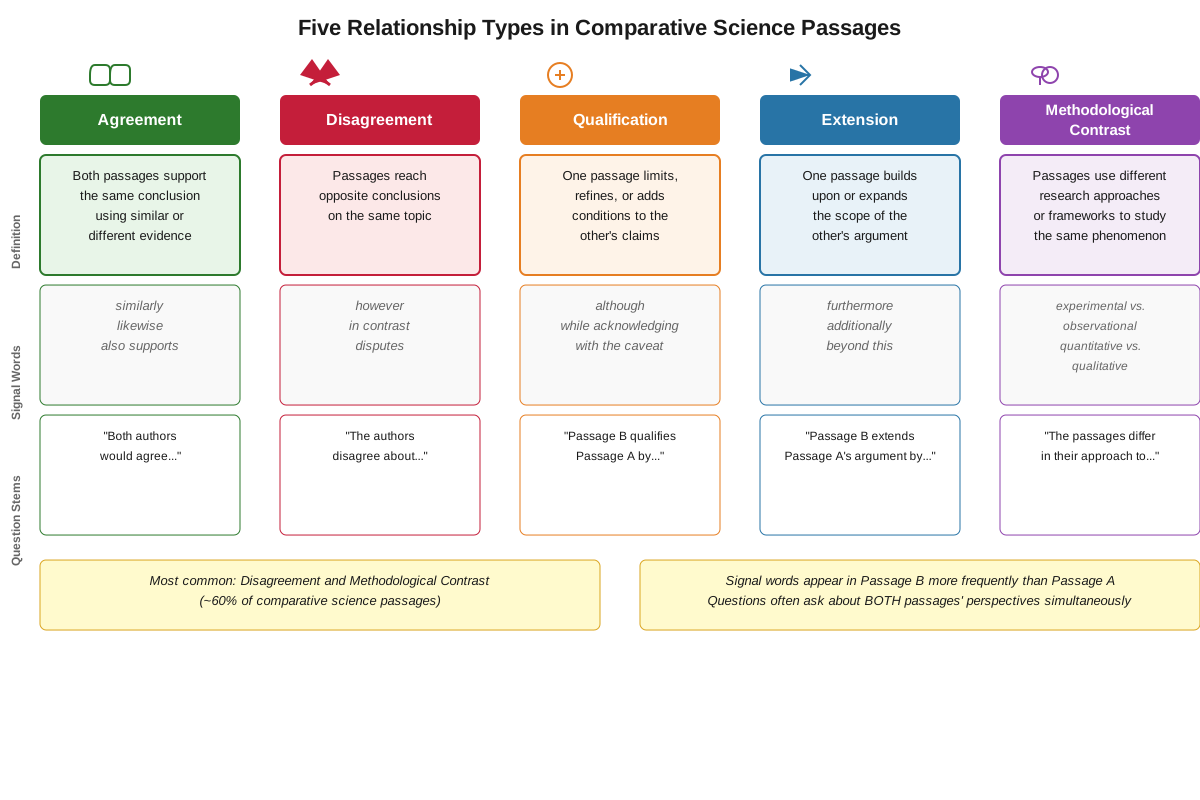
- [ ] Distinguish between five common relationship types between paired science passages (agreement, disagreement, qualification, extension, and methodological contrast)
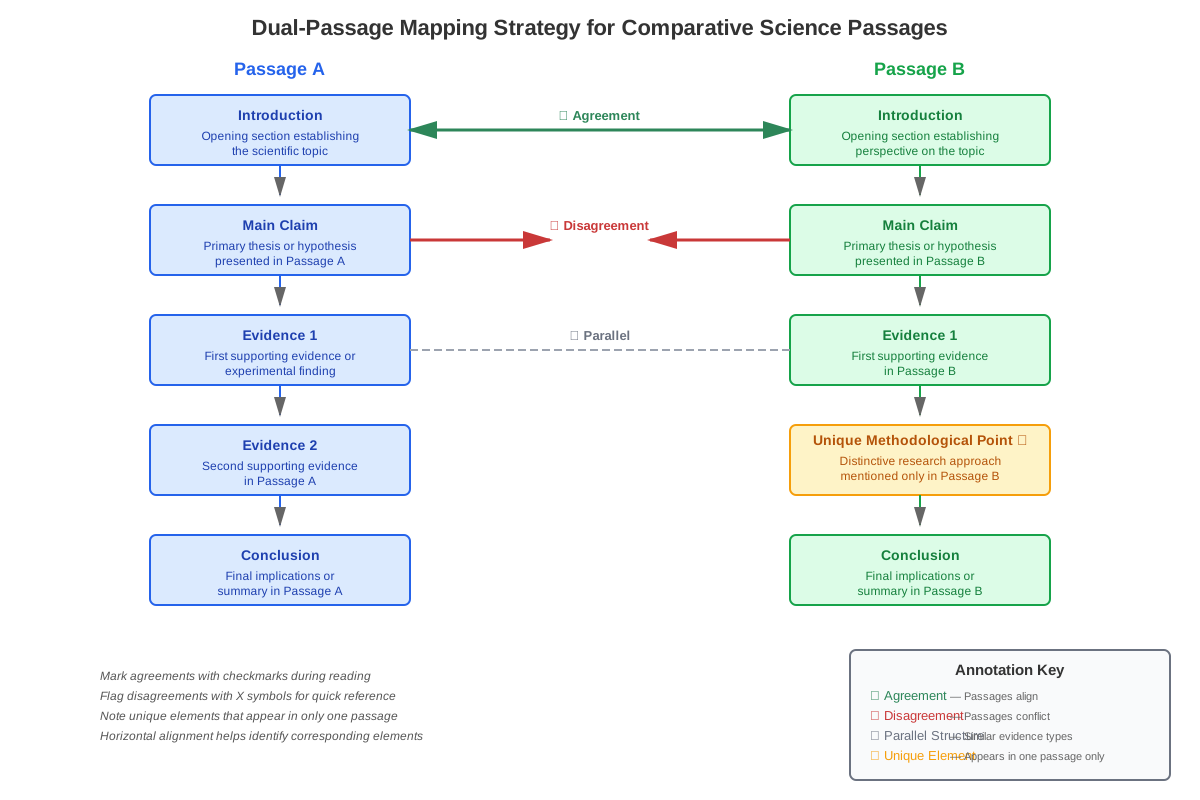
- [ ] Efficiently map the structure of both passages simultaneously to track parallel and divergent elements
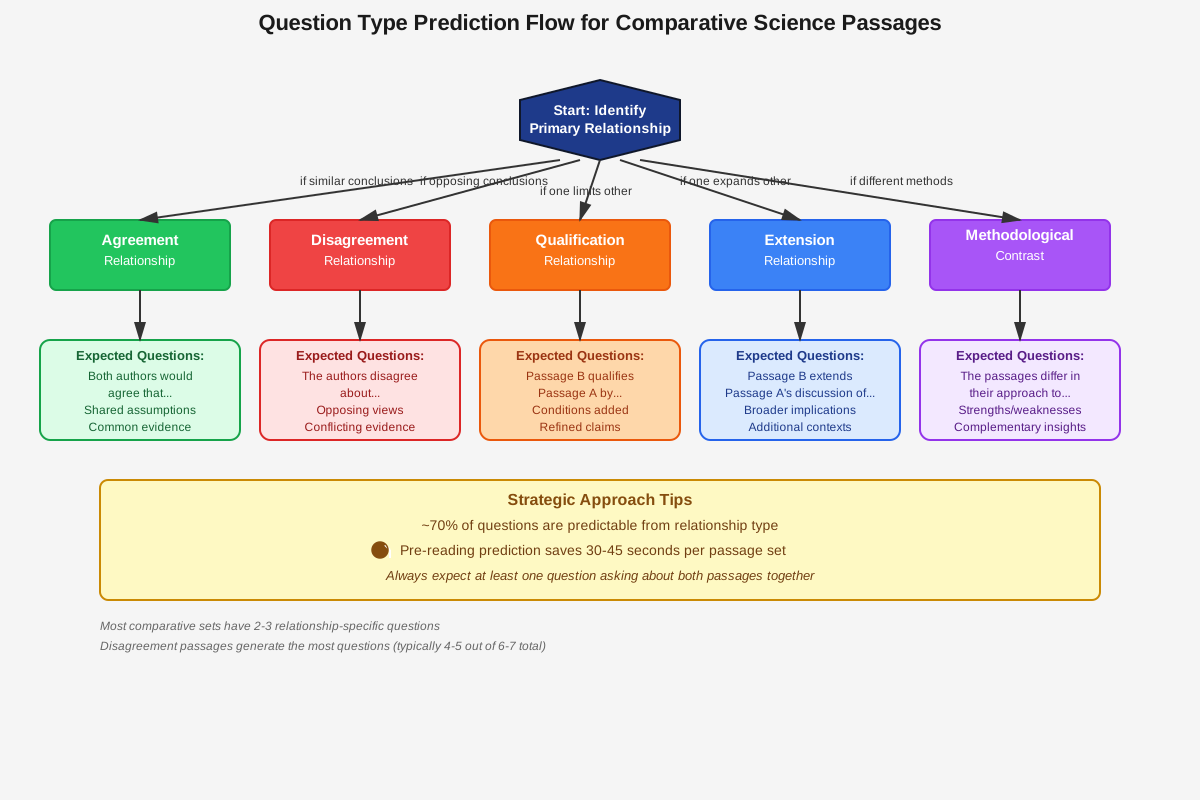
- [ ] Predict question types based on the relationship between passages before reading the questions
Prerequisites
Students should have mastery of the following concepts before studying comparative science passages:
- Basic scientific reasoning and experimental design: Understanding hypothesis formation, evidence evaluation, and conclusion drawing is essential because science passages frequently discuss research findings and methodological approaches
- Standard LSAT passage structure analysis: Recognizing main points, supporting evidence, author's tone, and argumentative purpose in single passages provides the foundation for tracking these elements across two passages
- Vocabulary for describing relationships: Familiarity with terms like "supports," "contradicts," "qualifies," "extends," and "challenges" enables precise understanding of how passages interact
- Time management for Reading Comprehension: Comparative passages require efficient reading strategies since they contain more text and relationship-tracking demands than single passages
Why This Topic Matters
Comparative science passages appear with guaranteed regularity on every LSAT administration—exactly one comparative reading set appears in each Reading Comprehension section, and science topics constitute approximately 40-50% of these comparative sets. This means students can expect to encounter comparative science passages on roughly every other LSAT exam they take. The questions associated with these passages are worth 5-7 points, representing approximately 12-15% of the entire Reading Comprehension section score.
Beyond their direct point value, comparative science passages test skills that appear throughout the LSAT. The ability to track multiple perspectives simultaneously mirrors the demands of Logical Reasoning questions that present competing viewpoints. The scientific content—ranging from evolutionary biology and neuroscience to physics and environmental studies—requires the same careful attention to evidence and methodology that appears in science-heavy Logical Reasoning stimuli. Students who excel at comparative science passages demonstrate the synthesis and analytical skills that correlate strongly with overall LSAT success.
In real-world applications, the skills developed through comparative science passage practice translate directly to legal reasoning. Attorneys regularly analyze competing expert testimonies, evaluate conflicting scientific studies in litigation, and synthesize multiple sources to build comprehensive arguments. The LSAT uses comparative science passages to assess whether candidates can handle the intellectual demands of legal practice, where understanding and reconciling multiple technical perspectives is routine.
Core Concepts
Structure of Comparative Science Passages
Lsat comparative science passages follow a consistent structural format that differs significantly from standalone passages. Each comparative set consists of two passages labeled "Passage A" and "Passage B," typically ranging from 200-250 words each. The passages share a common scientific topic or theme but approach it from different angles. The LSAT deliberately constructs these passages to create meaningful relationships that can be tested through questions.
The typical structure includes:
- A brief introductory statement (1-2 sentences) that frames the shared topic
- Passage A presenting one perspective, methodology, or set of findings
- Passage B presenting a related but distinct perspective, methodology, or set of findings
- Questions that test comprehension of individual passages and relationships between them
Understanding this structure allows students to anticipate the types of relationships they'll need to track and the questions they'll face.
Five Primary Relationship Types
The relationship between Passage A and Passage B in comparative science passages typically falls into one of five categories:
| Relationship Type | Description | Common Question Focus |
|---|---|---|
| Agreement/Support | Both passages support the same conclusion using different evidence or approaches | Identifying shared assumptions, synthesizing evidence |
| Disagreement/Opposition | Passages reach contradictory conclusions about the same phenomenon | Points of conflict, incompatible claims |
| Qualification/Nuance | One passage adds conditions, limitations, or refinements to the other's claims | Scope differences, conditional relationships |
| Extension/Development | One passage builds upon or expands the ideas presented in the other | Logical progression, additional implications |
| Methodological Contrast | Passages use different research approaches or frameworks to study the same topic | Comparing methodologies, evaluating approaches |
Recognizing which relationship type governs a particular passage pair enables students to predict question types and focus their attention on the most testable elements of the relationship.
Question Types Specific to Comparative Reading
Comparative science passages generate three distinct categories of questions:
Individual Passage Questions ask about Passage A or Passage B in isolation, testing the same comprehension skills as standalone passages. These questions typically appear first and allow students to demonstrate basic understanding before tackling relationship questions.
Relationship Questions explicitly ask students to compare, contrast, or synthesize information across both passages. Common stems include:
- "The author of Passage B would most likely respond to the claim in lines X-Y of Passage A by..."
- "Both passages are primarily concerned with..."
- "Which of the following best describes the relationship between the two passages?"
Synthesis Questions require students to apply information from both passages to new scenarios or to identify principles that emerge only when considering both texts together. These are typically the most challenging questions in the set.
Scientific Content Domains
LSAT comparative science passages draw from a consistent set of scientific domains, each with characteristic features:
Biological Sciences (evolutionary theory, genetics, neuroscience, ecology) often present competing hypotheses about mechanisms or interpretations of empirical findings. These passages frequently involve debates about causation versus correlation or competing explanatory models.
Physical Sciences (physics, chemistry, astronomy) typically focus on theoretical frameworks, experimental results, or the implications of scientific discoveries. These passages may present different interpretations of the same data or competing theoretical models.
Social Sciences with Scientific Methods (psychology, cognitive science, behavioral economics) often contrast different research methodologies or present competing theories about human behavior and cognition.
Environmental and Earth Sciences (climate science, geology, conservation biology) frequently present policy implications alongside scientific findings, with passages taking different stances on the relationship between scientific evidence and practical applications.
Active Reading Strategy for Comparative Passages
Effective analysis of comparative science passages requires a modified reading approach:
- Read the introductory statement carefully to identify the shared topic and anticipate potential relationships
- Read Passage A completely while noting: main point, key evidence, author's tone, and any qualifications or limitations
- Before reading Passage B, predict how it might relate to Passage A (agreement, disagreement, qualification, etc.)
- Read Passage B actively comparing to Passage A, noting: points of agreement, points of disagreement, different evidence or methodology, and different scope or focus
- Mentally articulate the relationship in one sentence before proceeding to questions
- Create a simple visual map (mentally or on scratch paper) showing parallel and divergent elements
This systematic approach prevents the common error of reading both passages passively and then struggling to reconstruct their relationship when answering questions.
Tracking Author Perspective and Tone
In comparative science passages, understanding each author's perspective and tone is crucial for answering relationship questions. Authors may be:
- Advocates presenting evidence for a particular theory or approach
- Skeptics questioning established views or highlighting limitations
- Synthesizers attempting to reconcile competing perspectives
- Methodologists focusing on research approaches rather than conclusions
- Pragmatists emphasizing practical applications over theoretical debates
The tone may range from enthusiastic support to cautious skepticism to neutral presentation. Recognizing these stances helps predict how authors would respond to each other's claims—a frequent question type in comparative reading.
Evidence and Methodology Comparison
Many comparative science passages hinge on differences in evidence type or research methodology. Students must distinguish between:
- Empirical evidence (experimental results, observational data) versus theoretical reasoning
- Quantitative approaches (statistical analysis, measurement) versus qualitative approaches (case studies, descriptive analysis)
- Laboratory studies versus field research
- Direct evidence versus indirect evidence or inference
Questions often ask students to identify which passage relies on which type of evidence or to evaluate the relative strengths of different methodological approaches.
Concept Relationships
The core concepts within comparative science passages form an interconnected system where each element supports and depends on others. Understanding passage structure enables efficient identification of relationship types, which in turn determines which question types will appear. The scientific content domains provide the subject matter, but the active reading strategy and author perspective tracking skills allow students to extract the testable relationships regardless of content.
The relationship flows as follows:
Passage Structure Recognition → Relationship Type Identification → Question Type Prediction → Efficient Answer Selection
Simultaneously, Scientific Content Understanding + Evidence/Methodology Analysis → Author Perspective Recognition → Accurate Relationship Characterization
These skills build directly on prerequisite knowledge of single-passage reading comprehension while adding the comparative dimension. Mastery of comparative science passages then enables progression to more advanced synthesis skills tested in the most difficult Reading Comprehension questions and provides practice for the multi-perspective reasoning required in Logical Reasoning sections.
High-Yield Facts
⭐ Exactly one comparative reading set appears in every LSAT Reading Comprehension section, and approximately 40-50% of these sets involve scientific topics.
⭐ The most common relationship type is disagreement or methodological contrast, where passages present competing theories, interpretations, or research approaches.
⭐ Questions explicitly asking about the relationship between passages are worth the most points and typically appear in the middle or end of the question set.
⭐ The author's tone and degree of certainty are more important in comparative passages than in standalone passages because they signal how authors would respond to each other's claims.
⭐ Most comparative science passages include at least one question asking how the author of one passage would respond to a specific claim in the other passage, making perspective-tracking essential.
- Comparative passages always share a common topic but differ in at least one significant dimension (perspective, methodology, scope, or conclusion).
- The introductory statement before Passage A provides crucial framing information that helps predict the relationship type.
- Individual passage questions (about only Passage A or only Passage B) typically appear before relationship questions in the question set.
- Wrong answers in relationship questions often accurately describe one passage but mischaracterize the other or the relationship between them.
- Time pressure is more acute with comparative passages because they contain more total text than standalone passages but are followed by a similar number of questions.
- Scientific terminology in comparative passages is almost always defined or explained in context—the LSAT tests reading comprehension, not prior scientific knowledge.
- When passages present different methodologies, questions often ask students to identify advantages or limitations of each approach.
- Synthesis questions requiring information from both passages are typically the most difficult and time-consuming in the set.
- The scope of each passage (broad versus narrow, theoretical versus applied) is a frequent source of contrast and a common question focus.
- Passages that initially appear to agree often contain subtle but important differences in scope, certainty, or implications that become the focus of questions.
Quick check — test yourself on Comparative science passages so far.
Try Flashcards →Common Misconceptions
Misconception: Comparative science passages require extensive prior knowledge of scientific concepts to answer correctly.
Correction: The LSAT tests reading comprehension, not scientific expertise. All necessary information to answer questions is contained within the passages themselves. Scientific terminology is defined or explained in context, and questions focus on relationships between ideas rather than technical knowledge.
Misconception: Students should read both passages completely before considering their relationship.
Correction: The most efficient approach involves reading Passage A completely, then actively comparing while reading Passage B. This prevents the need to re-read passages to reconstruct their relationship and reduces cognitive load by building the comparison incrementally.
Misconception: If passages discuss the same topic, they must be presenting opposing viewpoints.
Correction: While disagreement is common, passages may also agree while using different evidence, present complementary perspectives, or have one passage qualify or extend the other's claims. Assuming opposition can lead to mischaracterizing nuanced relationships.
Misconception: Relationship questions are always more difficult than individual passage questions.
Correction: While relationship questions often require more complex reasoning, they can be straightforward if students have accurately identified the relationship type during reading. Individual passage questions can be quite difficult if they involve subtle inferences or complex structural elements.
Misconception: The correct answer to a relationship question will always reference specific content from both passages.
Correction: Many correct answers describe the relationship at a structural or methodological level without referencing specific content details. Questions asking "which best describes the relationship between the passages" often have correct answers that characterize the relationship type rather than summarizing content.
Misconception: Students should spend equal time on each passage.
Correction: Passage B typically requires more active processing because students must simultaneously comprehend its content and compare it to Passage A. Allocating slightly more time and mental energy to Passage B while reading comparatively is more efficient than treating both passages identically.
Misconception: If one passage is more technical or detailed than the other, it represents the "correct" or "stronger" position.
Correction: The LSAT does not privilege one passage over the other. Differences in technicality or detail level are often the point of comparison, with questions testing whether students recognize that different approaches have different strengths and limitations.
Worked Examples
Example 1: Methodological Contrast in Neuroscience
Passage A (abbreviated): Researchers studying memory formation have made significant advances using functional MRI technology to observe brain activity in real-time. By scanning subjects while they encode and retrieve memories, scientists have identified specific neural networks involved in different types of memory. This approach has revealed that episodic memory and semantic memory activate distinct but overlapping brain regions, with the hippocampus playing a crucial role in episodic memory formation. The precision of fMRI allows researchers to correlate specific cognitive tasks with localized brain activity, providing unprecedented insight into memory mechanisms.
Passage B (abbreviated): While neuroimaging studies have contributed to our understanding of memory, behavioral research remains essential for understanding memory function. Laboratory experiments examining how variables like emotional valence, repetition, and context affect memory retention provide insights that brain imaging alone cannot offer. For instance, studies showing that emotionally charged events are remembered more vividly than neutral events reveal functional principles of memory that transcend specific neural mechanisms. Moreover, behavioral research can be conducted more efficiently and with larger sample sizes than expensive neuroimaging studies, allowing for more robust statistical conclusions about memory phenomena.
Question: Which one of the following best describes the relationship between the two passages?
Analysis Process:
- Identify the shared topic: Both passages discuss research approaches to studying memory
- Characterize Passage A's position: Advocates for neuroimaging (fMRI) as providing precise, mechanistic insights into memory through brain activity observation
- Characterize Passage B's position: Argues that behavioral research provides essential functional insights and practical advantages over neuroimaging
- Identify the relationship type: Methodological contrast—both passages accept that memory research is valuable but advocate for different research approaches
- Note key differences: Passage A emphasizes precision and mechanistic understanding; Passage B emphasizes functional principles and practical efficiency
- Predict answer characteristics: The correct answer will acknowledge that both passages discuss memory research but focus on different methodologies, with neither completely rejecting the other's approach
Correct Answer Type: "Passage A describes a technological approach to studying memory, while Passage B argues for the continued importance of a more traditional experimental approach."
Why this works: This answer accurately captures the methodological contrast without overstating the disagreement (neither passage claims the other approach is worthless) and recognizes that both passages are concerned with research methodology rather than competing theories about memory itself.
Connection to Learning Objectives: This example demonstrates how to identify comparative science passages in LSAT questions (recognizing the methodological contrast structure), explain the reasoning pattern (understanding that passages can differ in approach rather than conclusion), and apply this understanding to select accurate answers.
Example 2: Qualification Relationship in Climate Science
Passage A (abbreviated): Recent climate models incorporating improved ocean circulation data have increased confidence in projections of regional climate change. These models successfully reproduce historical climate patterns and show strong agreement in predicting temperature increases of 2-4°C by 2100 under current emission scenarios. The convergence of multiple independent models on similar projections strengthens the reliability of these predictions, providing policymakers with actionable information for climate adaptation planning.
Passage B (abbreviated): While climate models have improved substantially, their projections of regional precipitation patterns remain uncertain. Temperature predictions are more reliable because they depend primarily on well-understood radiative forcing, but precipitation involves complex interactions between atmospheric circulation, ocean currents, and local geography that models handle less consistently. Different models produce divergent precipitation forecasts for the same regions, and historical validation shows mixed success in reproducing past precipitation patterns. This uncertainty means that adaptation planning based on precipitation projections should incorporate wide margins of error and flexible strategies.
Question: The author of Passage B would most likely respond to the claim in Passage A about "actionable information for climate adaptation planning" by:
Analysis Process:
- Locate the specific claim: Passage A asserts that model convergence provides "actionable information for climate adaptation planning"
- Identify Passage B's relevant position: Passage B acknowledges model improvements but emphasizes continued uncertainty in precipitation predictions
- Determine the relationship: Passage B qualifies rather than contradicts Passage A—it doesn't reject climate models but adds important limitations
- Consider the scope difference: Passage A discusses temperature projections; Passage B focuses on precipitation uncertainty
- Predict the response: Passage B's author would likely agree that temperature projections are actionable but caution that precipitation uncertainty limits some adaptation planning
- Evaluate answer choices for: Acknowledgment of Passage A's valid points + introduction of limitations or qualifications
Correct Answer Type: "Pointing out that uncertainty in precipitation projections limits the usefulness of climate models for certain types of adaptation planning."
Why this works: This answer captures the qualification relationship—Passage B doesn't reject climate models or adaptation planning but adds an important caveat about precipitation uncertainty. It shows understanding that Passage B's author would partially agree with Passage A while introducing limitations.
Common Wrong Answer: "Arguing that climate models are too unreliable to provide any useful information for policymakers."
Why it's wrong: This overstates Passage B's position, turning a qualification into a complete rejection. Passage B acknowledges model improvements and doesn't claim models are useless—only that precipitation uncertainty requires cautious interpretation.
Connection to Learning Objectives: This example shows how to apply comparative science passage analysis to LSAT-style problems by recognizing qualification relationships and predicting how authors would respond to each other's specific claims, avoiding the trap of overstating disagreement.
Exam Strategy
Initial Approach
When encountering a comparative science passage set, invest 15-20 seconds reading the introductory statement and the first sentence of each passage before committing to full reading. This preview allows identification of the shared topic and preliminary prediction of the relationship type, priming the brain for comparative reading.
Trigger Words and Phrases
Watch for these high-yield indicators of relationship type:
Agreement signals: "Similarly," "likewise," "also supports," "consistent with," "corroborates"
Disagreement signals: "However," "in contrast," "challenges," "contradicts," "disputes," "alternative explanation"
Qualification signals: "Although," "while," "nevertheless," "with the caveat," "under certain conditions," "limited to"
Extension signals: "Furthermore," "additionally," "building on," "implications include," "extends to"
Methodological contrast signals: "different approach," "alternative method," "whereas X uses," "focuses instead on"
Process of Elimination Strategy
For relationship questions, eliminate answers that:
- Accurately describe only one passage but mischaracterize the other
- Overstate the degree of disagreement (turning qualification into opposition)
- Understate genuine disagreement (claiming agreement when passages contradict)
- Focus on minor details rather than the primary relationship
- Introduce information not present in either passage
For "author response" questions, eliminate answers where the author of one passage would:
- Ignore their own stated position to agree with the other passage
- Respond to a claim not actually made in the specified lines
- Take a stronger stance than their passage supports
- Misunderstand basic facts clearly stated in the other passage
Time Allocation
Allocate approximately 4 minutes for reading both passages and identifying their relationship, then 5-6 minutes for answering questions (roughly 50-60 seconds per question). This is slightly more reading time than standalone passages but similar question time. If running behind, prioritize relationship questions over individual passage questions, as they're typically worth more points and benefit most from careful passage analysis.
Exam Tip: If uncertain about the relationship type after reading both passages, proceed to the questions anyway. The question stems themselves often clarify the relationship by asking about specific points of agreement, disagreement, or contrast.
Strategic Question Order
Consider answering questions in this order rather than sequentially:
- Individual passage questions first (easier, build confidence, reinforce comprehension)
- Explicit relationship questions (e.g., "Which best describes the relationship...")
- Author response questions (require synthesis but have clear right answers)
- Complex synthesis questions last (most time-consuming, may require re-reading)
This approach builds momentum and ensures that easier points are secured before tackling the most challenging questions.
Memory Techniques
CREAM Mnemonic for Relationship Types
Contrast (methodological differences)
Rebut (direct disagreement)
Extend (building upon)
Agree (supporting same conclusion)
Modify (qualification/nuance)
This covers the five primary relationship types in comparative science passages.
The "Two Lawyers" Visualization
Imagine Passage A and Passage B as two lawyers presenting cases to a judge. Visualize:
- What each lawyer is arguing (main point)
- What evidence each presents (key support)
- Whether they're on the same side or opposing sides (relationship type)
- How each would respond to the other's argument (author response questions)
This legal framework aligns with LSAT's purpose and makes abstract relationships concrete.
The Comparison Matrix
While reading, mentally construct (or quickly sketch) a simple matrix:
| Passage A | Passage B | |
|---|---|---|
| Main Point | [brief note] | [brief note] |
| Evidence Type | [brief note] | [brief note] |
| Tone | [brief note] | [brief note] |
| Scope | [brief note] | [brief note] |
This structured approach ensures systematic comparison and prevents overlooking key differences.
Acronym: STAR for Active Reading
Shared topic (identify immediately)
Tone of each author (advocate, skeptic, neutral?)
Agreement or disagreement (primary relationship)
Reasoning differences (methodology, evidence, scope)
Apply STAR while reading Passage B to maintain comparative focus.
Summary
Comparative science passages represent a unique challenge within LSAT Reading Comprehension, combining the technical demands of scientific content with the analytical complexity of tracking relationships between two distinct perspectives. Success requires recognizing that these passages follow predictable structural patterns and relationship types—most commonly disagreement, methodological contrast, or qualification. The key to mastery lies in active comparative reading: fully comprehending Passage A, then reading Passage B while continuously comparing and contrasting its claims, evidence, methodology, and scope with the first passage. Students must track not only what each author says but also how each would likely respond to the other's claims, as this forms the basis for the highest-value questions in each set. Efficient performance depends on identifying relationship types quickly, predicting question focuses based on those relationships, and applying systematic elimination strategies that account for the comparative dimension. While the scientific content varies widely—from neuroscience to climate science to evolutionary biology—the analytical skills remain constant: identifying shared topics, characterizing each author's perspective and tone, recognizing points of agreement and disagreement, and synthesizing information across both passages to answer complex relationship questions.
Key Takeaways
- Comparative science passages appear exactly once per Reading Comprehension section, representing 5-7 questions and approximately 12-15% of section points
- The five primary relationship types (agreement, disagreement, qualification, extension, methodological contrast) account for virtually all comparative passage relationships
- Active comparative reading—fully understanding Passage A before reading Passage B while continuously comparing—is more efficient than reading both passages passively
- Author perspective and tone are crucial for predicting how authors would respond to each other's claims, the most common relationship question type
- Questions progress from individual passage comprehension to relationship identification to complex synthesis, with relationship questions typically worth the most points
- Scientific content knowledge is never required—all necessary information appears in the passages, and questions test reading comprehension and analytical reasoning
- Systematic elimination strategies focusing on accurate characterization of both passages and their relationship prevent common errors of overstating disagreement or missing subtle qualifications
Related Topics
Single-Passage Science Reading Comprehension: Mastering comparative science passages builds directly on skills developed with standalone science passages, including technical vocabulary comprehension, experimental design analysis, and evidence evaluation. Students who struggle with comparative passages should ensure solid foundation in single-passage science reading.
Comparative Humanities and Social Science Passages: The comparative reading skills developed with science passages transfer directly to other content domains. Humanities passages often involve literary criticism or historical interpretation, while social science passages may address policy debates or theoretical frameworks in economics or sociology.
Logical Reasoning: Competing Explanations: Many Logical Reasoning questions present competing hypotheses or explanations for phenomena, requiring similar skills in tracking multiple perspectives and identifying points of agreement and disagreement. Comparative passage practice strengthens these Logical Reasoning skills.
Argument Structure and Reasoning Patterns: Understanding how authors construct arguments, use evidence, and draw conclusions in comparative passages reinforces broader LSAT skills in argument analysis that appear throughout Logical Reasoning and Reading Comprehension sections.
Practice CTA
Now that you've mastered the core concepts and strategies for comparative science passages, it's time to apply this knowledge to authentic LSAT questions. Attempt the practice questions associated with this topic, focusing on implementing the active reading strategy and relationship identification techniques covered in this guide. As you work through practice passages, pay special attention to your process: Are you identifying relationship types before reading questions? Are you tracking author perspective and tone? Are you predicting question types based on passage relationships? Use the flashcards to reinforce high-yield facts and relationship type characteristics until recognition becomes automatic. Remember that comparative reading is a skill that improves dramatically with deliberate practice—each passage set you analyze strengthens your ability to efficiently track multiple perspectives and synthesize complex information, skills that will serve you throughout the LSAT and in legal practice. You've built a strong foundation; now transform that knowledge into consistent performance through focused practice.
Sign up free to keep reading
Create a free AnvayaPrep account to finish this LSAT guide on Comparative science passages — plus flashcards and practice questions.