Overview
Comparative inference is a critical skill tested in the LSAT's Reading Comprehension section, specifically within Comparative Reading passages. Unlike traditional single-passage questions that ask students to draw conclusions from one text, comparative inference questions require test-takers to synthesize information from two related passages (Passage A and Passage B) and make logical deductions about their relationship, similarities, differences, or combined implications. This skill demands not only comprehension of each passage independently but also the ability to hold multiple perspectives in mind simultaneously and reason about how they interact.
Mastering LSAT comparative inference is essential because these questions consistently appear on every modern LSAT administration. The Comparative Reading set, introduced in 2007, comprises one of the four Reading Comprehension passages on each test, and inference questions represent approximately 30-40% of the questions in this set. These questions test higher-order thinking skills that law schools value: the ability to compare legal precedents, reconcile conflicting interpretations, identify implicit agreements or disagreements between sources, and draw conclusions that neither passage explicitly states but both passages together support.
Within the broader landscape of reading comprehension, comparative inference sits at the intersection of several fundamental skills: standard inference-making (drawing conclusions supported by textual evidence), comparative analysis (identifying relationships between texts), and synthesis (combining information from multiple sources). Success with comparative inference questions builds directly on skills developed through standard inference questions while adding the complexity of managing dual perspectives—a skill that mirrors the analytical demands law students face when comparing case law, statutes, and legal commentary.
Learning Objectives
- [ ] Identify how Comparative inference appears in LSAT questions
- [ ] Explain the reasoning pattern behind Comparative inference
- [ ] Apply Comparative inference to solve LSAT-style problems accurately
- [ ] Distinguish between inferences supported by only one passage versus both passages
- [ ] Recognize the different types of comparative inference questions (agreement, disagreement, relationship, combined implication)
- [ ] Evaluate answer choices by systematically checking support from both passages
Prerequisites
- Standard inference questions: Understanding how to draw conclusions from single passages provides the foundation for making inferences across two passages
- Main point identification: Recognizing each passage's central argument is necessary to understand how the passages relate to each other
- Author's tone and attitude: Detecting subtle differences in perspective between authors helps identify points of agreement or disagreement
- Textual evidence evaluation: The ability to locate and assess supporting evidence in one passage extends to tracking evidence across two passages
Why This Topic Matters
Comparative inference questions test the analytical reasoning skills that form the bedrock of legal practice. Attorneys regularly compare multiple sources—conflicting witness testimonies, competing legal precedents, or different statutory interpretations—and must draw conclusions about their relationships and combined implications. Law school itself demands constant comparison: distinguishing cases, reconciling seemingly contradictory holdings, and synthesizing multiple authorities into coherent legal arguments.
On the LSAT, comparative inference questions appear with high frequency and predictability. Every test includes exactly one Comparative Reading set (two shorter passages totaling approximately the same length as a standard single passage), and this set typically contains 6-8 questions. Of these, 2-4 questions usually require comparative inference—making this question type responsible for approximately 5-10% of the entire Reading Comprehension section score. Given that Reading Comprehension comprises roughly 27% of the total LSAT score, mastering comparative inference can directly impact 1-3 points on the scaled score, potentially the difference between admission to a target school or not.
These questions appear in several recognizable forms: questions asking what both authors would agree about, what distinguishes the passages' approaches, what can be inferred from the passages taken together, how one author would respond to the other's argument, or what relationship exists between specific claims in each passage. The LSAT tests comparative inference across diverse subject matter—from competing theories in natural sciences to different perspectives on legal or social issues—ensuring that the skill being tested is the reasoning pattern itself, not specialized content knowledge.
Core Concepts
The Nature of Comparative Inference
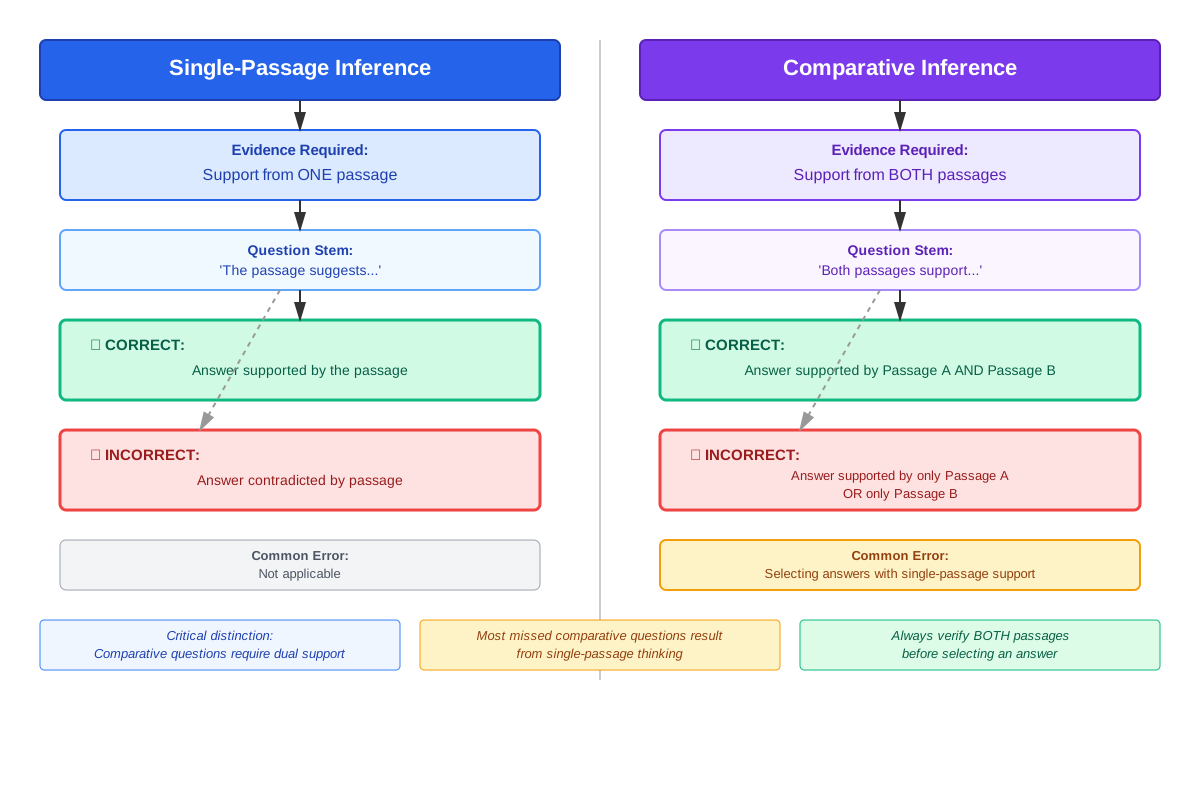
Comparative inference refers to the process of drawing conclusions based on the relationship between two passages rather than from either passage in isolation. Unlike standard inference questions where the answer must be supported by explicit or implicit information in a single text, comparative inference questions require synthesizing information across both passages. The inference might concern what both authors would agree on despite different emphases, how their arguments relate structurally, what their combined information implies, or how one author would likely respond to the other's claims.
The key distinguishing feature is that the correct answer to a comparative inference question cannot be fully justified by reference to only one passage. Even if Passage A strongly suggests something, if the question asks what "both passages suggest" or "the authors would agree," the answer must find support in Passage B as well. This dual-support requirement makes comparative inference questions particularly challenging and prone to trap answers.
Types of Comparative Inference Questions
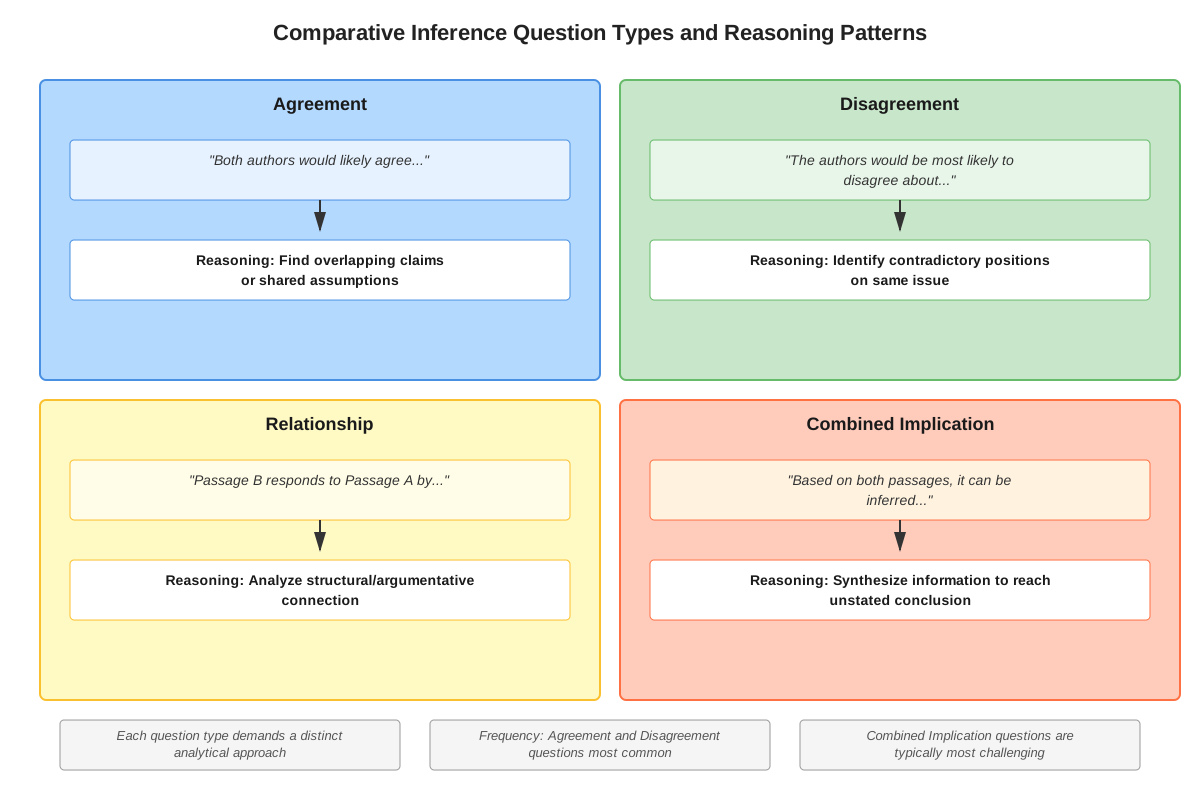
Agreement Questions ask what both authors would accept, agree with, or acknowledge. These questions require identifying common ground between the passages, which may be explicit (both passages directly state similar points) or implicit (both passages' arguments rest on shared assumptions or lead to compatible conclusions). The challenge lies in distinguishing between genuine agreement and superficial similarity—two passages might discuss the same topic using similar vocabulary while actually disagreeing about fundamental issues.
Disagreement Questions ask where the authors would differ, what distinguishes their approaches, or what one author accepts that the other rejects. These require careful attention to nuance, as disagreement might be explicit (directly contradictory claims) or implicit (different underlying assumptions or methodological approaches). Test-takers must avoid assuming disagreement simply because passages emphasize different aspects of a topic; true disagreement requires incompatible positions.
Relationship Questions ask how the passages relate to each other structurally or argumentatively. Common relationships include: one passage provides a specific example of a general principle discussed in the other; one passage offers a solution to a problem described in the other; one passage critiques or supports the approach taken in the other; or both passages address the same question from different perspectives. These questions test the ability to see the forest rather than the trees—understanding the passages' overall relationship rather than getting lost in details.
Combined Implication Questions ask what can be inferred from the information in both passages taken together. The correct answer synthesizes information that appears separately in each passage to reach a conclusion that neither passage explicitly states. For example, if Passage A establishes that "all X have property Y" and Passage B establishes that "Z is an X," the combined implication is that "Z has property Y," even though neither passage states this directly.
The Reasoning Pattern
The reasoning pattern for comparative inference follows a systematic process:
- Comprehend each passage independently: Understand each passage's main point, supporting arguments, tone, and scope before attempting to compare them
- Identify the relationship: Determine how the passages relate—do they agree, disagree, address different aspects of the same issue, or take different approaches to the same question?
- Map corresponding elements: Identify which parts of each passage address similar issues, even if using different terminology
- Evaluate the question stem carefully: Determine exactly what type of comparative inference is required (agreement, disagreement, relationship, combined implication)
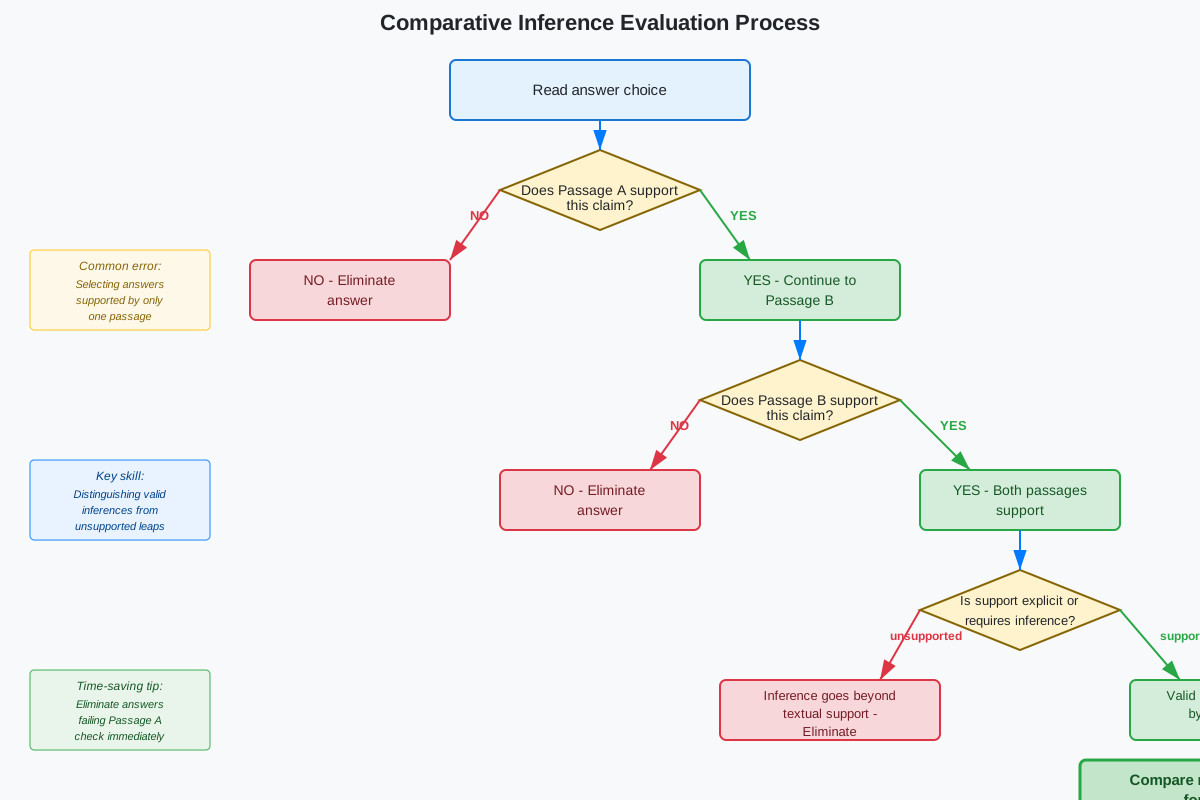
- Check each answer against both passages: For each answer choice, verify support from both passages (or verify that the claimed difference actually exists)
- Eliminate answers supported by only one passage: The most common trap answers in comparative inference questions are statements that one passage strongly supports but the other doesn't address or contradicts
Common Structural Patterns
Certain structural patterns appear repeatedly in LSAT Comparative Reading sets, and recognizing these patterns facilitates comparative inference:
| Pattern | Description | Inference Implications |
|---|---|---|
| Problem-Solution | Passage A describes a problem; Passage B proposes a solution | Likely to agree on the problem's existence; may differ on solution effectiveness |
| General-Specific | Passage A discusses a broad principle; Passage B provides a concrete example | Likely to agree on the general principle; Passage B illustrates Passage A's claims |
| Thesis-Antithesis | Passages present opposing viewpoints on the same issue | Clear disagreement on central claims; may share underlying assumptions |
| Different Aspects | Passages address different dimensions of the same topic | May not directly agree or disagree; relationship is complementary |
| Critique-Response | Passage A presents a view; Passage B critiques or responds to it | Passage B's author would likely reject Passage A's conclusions |
Evidence Tracking Across Passages
Successful comparative inference requires tracking evidence systematically across both passages. This involves:
- Parallel reading: As you read Passage B, actively recall corresponding points from Passage A
- Annotation strategy: Mark similar topics in both passages with consistent symbols or notations
- Assumption identification: Note what each passage assumes or takes for granted, as shared assumptions often form the basis of agreement questions
- Scope awareness: Track what each passage does and doesn't address, as many wrong answers exploit scope differences
The Role of Tone and Emphasis
Even when passages discuss similar content, differences in tone and emphasis can signal important distinctions. A passage that enthusiastically advocates for a position differs meaningfully from one that cautiously acknowledges the same position's merits. Similarly, what each author chooses to emphasize reveals priorities and perspectives that inform comparative inferences. An author who emphasizes practical applications likely has different concerns than one who emphasizes theoretical foundations, even if both discuss the same phenomenon.
Concept Relationships
The concepts within comparative inference form an interconnected system. Understanding the nature of comparative inference provides the foundation for recognizing types of comparative inference questions, which in turn guides application of the reasoning pattern. Recognizing common structural patterns accelerates the process of identifying passage relationships, which is the second step in the reasoning pattern. Evidence tracking and attention to tone and emphasis serve as implementation strategies for executing the reasoning pattern effectively.
Comparative inference connects to prerequisite topics in specific ways: standard inference skills provide the foundation, as comparative inference essentially applies standard inference techniques twice (once per passage) plus an additional synthesis step. Main point identification enables recognition of structural patterns and overall passage relationships. Author's tone and attitude detection becomes crucial for distinguishing genuine disagreement from mere difference in emphasis.
The relationship map flows as follows:
Standard Inference Skills → Comparative Inference Foundation → Types of Questions (Agreement/Disagreement/Relationship/Combined Implication) → Reasoning Pattern (Comprehend → Identify Relationship → Map Elements → Evaluate Question → Check Both Passages → Eliminate) → Implementation Strategies (Evidence Tracking + Tone Analysis) → Accurate Answer Selection
High-Yield Facts
⭐ Every comparative inference answer must be supported by both passages, not just one—this is the single most important principle for eliminating wrong answers
⭐ Agreement questions often hinge on shared assumptions rather than explicitly stated common ground—look for what both arguments take for granted
⭐ The most common trap answers are statements that one passage strongly supports but the other doesn't address—always verify support from both passages
⭐ Disagreement requires incompatible positions, not merely different emphases—passages can discuss different aspects of a topic without disagreeing
⭐ Combined implication questions require synthesizing information that appears separately in each passage—the correct answer typically isn't explicitly stated in either passage alone
- Comparative Reading sets always consist of two shorter passages (Passage A and Passage B) that together equal the length of a standard single passage
- Approximately 30-40% of questions in a Comparative Reading set require comparative inference
- The passages in a Comparative Reading set always relate to each other thematically but may agree, disagree, or address different aspects of the same topic
- Question stems containing "both passages," "both authors," "the two passages," or "Passage A and Passage B" signal comparative inference questions
- Correct answers to relationship questions often use structural or functional language (e.g., "provides an example of," "offers a critique of," "proposes a solution to")
- When passages appear to disagree, verify that they're actually addressing the same specific question—apparent disagreements sometimes result from different scopes or focuses
- Tone differences between passages often signal underlying disagreement even when explicit claims seem compatible
- The order of passages matters: Passage B is often written with awareness of Passage A's perspective, while Passage A is typically independent
- Comparative inference questions frequently test the ability to distinguish between what an author explicitly states versus what their argument implies
- Wrong answers often misrepresent the relationship by claiming agreement where only one passage supports the claim or by claiming disagreement where passages simply emphasize different points
Quick check — test yourself on Comparative inference so far.
Try Flashcards →Common Misconceptions
Misconception: If both passages discuss the same topic, the authors must agree on fundamental points.
Correction: Passages can discuss the same topic while disagreeing about causes, solutions, significance, or interpretation. Shared subject matter doesn't guarantee agreement; carefully evaluate whether the passages take compatible or incompatible positions on specific questions.
Misconception: If Passage A strongly supports a statement and Passage B doesn't contradict it, then both passages support the statement.
Correction: For an answer to be supported by both passages, each passage must provide positive evidence for it. Silence or non-contradiction in Passage B doesn't constitute support. Both passages must actively support the inference, either explicitly or implicitly.
Misconception: Disagreement questions require finding statements that are logical opposites or direct contradictions.
Correction: Disagreement can be more subtle than direct contradiction. Authors disagree when they hold incompatible positions, which might involve different underlying assumptions, different methodological approaches, or different conclusions about the same evidence—not just explicitly contradictory claims.
Misconception: The correct answer to a comparative inference question will be explicitly stated in at least one of the passages.
Correction: Comparative inference questions, especially combined implication questions, often require drawing conclusions that neither passage explicitly states. The correct answer must be supported by the passages but may require synthesizing information or recognizing implications that aren't directly stated.
Misconception: If the passages have different tones (e.g., one enthusiastic, one cautious), they must disagree on substance.
Correction: Tone differences don't necessarily indicate substantive disagreement. An author can cautiously support the same position another enthusiastically advocates. However, significant tone differences often do signal underlying disagreement, so they warrant careful investigation rather than automatic assumption of disagreement.
Misconception: Comparative inference questions are just twice as hard as regular inference questions.
Correction: Comparative inference questions involve qualitatively different reasoning, not just quantitatively more work. They require synthesis, relationship recognition, and simultaneous consideration of multiple perspectives—skills distinct from simply making inferences from a single text. The challenge is managing complexity and avoiding confusion, not just doing more of the same work.
Worked Examples
Example 1: Agreement Question
Passage A (abbreviated): "The traditional view holds that early human migration to the Americas occurred via a land bridge from Asia approximately 13,000 years ago. This theory, supported by archaeological evidence from Clovis sites, has dominated the field for decades. However, the Clovis-first model faces challenges from recent discoveries of pre-Clovis sites that suggest earlier human presence."
Passage B (abbreviated): "Recent genetic evidence has revolutionized our understanding of early American migration. DNA analysis of ancient remains indicates that the initial migration occurred earlier than previously thought, with some populations arriving before the last glacial maximum. While the exact timing remains debated, the genetic data clearly demonstrates that the simple Clovis-first narrative requires revision."
Question: Both passages suggest which of the following?
Answer Choices:
(A) The Clovis-first model accurately describes early human migration to the Americas
(B) Genetic evidence is more reliable than archaeological evidence for dating early migrations
(C) The traditional timeline for human arrival in the Americas has been challenged by recent findings
(D) Multiple waves of migration to the Americas occurred over thousands of years
(E) Archaeological evidence from Clovis sites has been misinterpreted
Worked Solution:
Step 1 - Comprehend each passage: Passage A discusses the traditional Clovis-first theory and mentions challenges from pre-Clovis sites. Passage B focuses on genetic evidence that suggests earlier migration than traditionally believed. Both passages have a tone of acknowledging that traditional views are being questioned.
Step 2 - Identify the relationship: Both passages address the same topic (early human migration to the Americas) and both suggest that traditional views are being revised based on new evidence. They're complementary rather than contradictory—Passage A mentions archaeological challenges, Passage B mentions genetic challenges.
Step 3 - Evaluate each answer against both passages:
(A) Eliminate: Both passages actually suggest the opposite—that the Clovis-first model faces challenges. Passage A explicitly states it "faces challenges," and Passage B says the "Clovis-first narrative requires revision."
(B) Eliminate: Passage A doesn't compare the reliability of genetic versus archaeological evidence. While Passage B emphasizes genetic evidence, it doesn't claim superiority over archaeological evidence. This answer is supported by neither passage.
(C) Keep: Passage A states that the traditional theory "faces challenges from recent discoveries." Passage B states that "the simple Clovis-first narrative requires revision" based on recent genetic evidence. Both passages support the idea that recent findings have challenged traditional timelines.
(D) Eliminate: Neither passage explicitly discusses multiple waves of migration. While this might be implied by some evidence mentioned, neither passage directly suggests this, and it goes beyond what both passages support.
(E) Eliminate: Neither passage suggests that Clovis evidence has been misinterpreted. Passage A treats Clovis evidence as valid support for the traditional view; the challenge comes from additional evidence, not reinterpretation of Clovis sites.
Correct Answer: (C)
This answer is supported by both passages: each acknowledges that traditional views about migration timing are being challenged by recent evidence (archaeological in Passage A, genetic in Passage B). This exemplifies how agreement questions often focus on shared implications rather than identical explicit statements.
Example 2: Relationship Question
Passage A (abbreviated): "Urban heat islands—metropolitan areas significantly warmer than surrounding rural areas—result from human modification of land surfaces. Dark surfaces like asphalt and buildings absorb solar radiation, while reduced vegetation decreases cooling through evapotranspiration. These effects can raise urban temperatures by 2-5°C, increasing energy consumption for cooling and exacerbating heat-related health problems."
Passage B (abbreviated): "Singapore has implemented an innovative approach to combating urban heat through its 'City in a Garden' initiative. By integrating extensive green spaces, green roofs, and vertical gardens throughout the urban landscape, the city has successfully reduced local temperatures in targeted areas. Temperature monitoring shows that neighborhoods with high vegetation density experience temperatures 2-3°C lower than comparable areas with minimal greenery."
Question: Which one of the following most accurately describes the relationship between the two passages?
Answer Choices:
(A) Passage A presents a theory that Passage B provides evidence against
(B) Passage A describes a problem for which Passage B presents a potential solution
(C) Passage A and Passage B use different methodologies to reach contradictory conclusions
(D) Passage A provides a general framework that Passage B applies to a specific case
(E) Passage A advocates for a policy that Passage B demonstrates to be ineffective
Worked Solution:
Step 1 - Identify each passage's purpose: Passage A explains what urban heat islands are, what causes them, and what problems they create. Passage B describes a specific city's approach to reducing urban heat through vegetation.
Step 2 - Recognize the structural pattern: This follows a Problem-Solution pattern. Passage A identifies and explains a problem (urban heat islands), while Passage B describes a specific solution being implemented (Singapore's vegetation initiative).
Step 3 - Evaluate each answer:
(A) Eliminate: Passage B doesn't provide evidence against Passage A's explanation of urban heat islands. In fact, Passage B's solution (adding vegetation) directly addresses the causes Passage A identifies (reduced vegetation and heat-absorbing surfaces). They're compatible, not contradictory.
(B) Keep: Passage A describes the problem of urban heat islands and their causes and effects. Passage B presents Singapore's vegetation initiative as an approach to reducing urban heat—directly addressing the problem Passage A describes. The temperature reductions mentioned in Passage B (2-3°C) align with the temperature increases Passage A attributes to urban heat islands (2-5°C).
(C) Eliminate: The passages don't reach contradictory conclusions. Passage A explains why urban areas are warmer; Passage B shows that adding vegetation reduces temperatures. These conclusions are compatible and complementary.
(D) Eliminate: While Passage A does provide general information about urban heat islands, it doesn't present a "framework" that Passage B "applies." Passage B isn't applying Passage A's concepts to analyze something; it's describing a practical solution to the problem Passage A describes.
(E) Eliminate: Passage A doesn't advocate for any specific policy—it simply explains the urban heat island phenomenon. Additionally, Passage B demonstrates that Singapore's approach is effective (reducing temperatures by 2-3°C), not ineffective.
Correct Answer: (B)
This relationship question requires recognizing the Problem-Solution structure. Passage A establishes that urban heat islands are problematic and explains their causes (including reduced vegetation), while Passage B describes a real-world initiative that addresses this problem by increasing urban vegetation. The passages work together rather than contradicting each other, and understanding this relationship is key to answering comparative inference questions about these passages.
Exam Strategy
Approach comparative inference questions systematically: First, ensure you understand each passage independently before attempting to compare them. Many students rush into comparison before fully comprehending each passage, leading to confusion and errors. Take time to identify each passage's main point, structure, and tone before considering their relationship.
Watch for trigger words in question stems: Phrases like "both passages," "both authors," "the two passages together," "Passage A and Passage B" clearly signal comparative inference questions. Questions asking "how would the author of Passage B respond to Passage A" or "what distinguishes the passages' approaches" also require comparative reasoning. Recognizing these triggers helps you activate the appropriate reasoning strategy.
Use the "both passages" test for elimination: For any answer choice to a comparative inference question, ask: "Is this supported by Passage A? Is this supported by Passage B?" If the answer to either question is "no" or "unclear," eliminate the choice. This systematic checking prevents the most common error—selecting answers supported by only one passage.
Pay special attention to scope differences: Many trap answers exploit differences in what each passage addresses. An answer might accurately describe something Passage A discusses but that Passage B never addresses. Even if Passage B doesn't contradict it, this answer isn't supported by both passages. Conversely, don't assume disagreement simply because passages emphasize different aspects of a topic.
Map corresponding elements while reading: As you read Passage B, actively note which parts correspond to elements in Passage A. Use consistent notation (e.g., mark both passages' discussions of causes with "C," effects with "E"). This mapping makes it easier to check answer choices against both passages and recognize relationships.
Distinguish between explicit and implicit support: For agreement questions, remember that both passages must support the answer, but this support can be implicit. An answer might not be directly stated in either passage but can be inferred from both. However, for disagreement questions, at least one passage typically takes an explicit position that conflicts with what the other passage states or implies.
Time allocation: Comparative Reading sets typically deserve the same time as other Reading Comprehension passages (8-9 minutes total), but allocate slightly more time to understanding the relationship between passages. Spending an extra 30 seconds identifying how the passages relate can save time on questions and improve accuracy. Don't rush the initial reading just because the passages are shorter.
Process of elimination for relationship questions: When asked about the relationship between passages, eliminate answers that mischaracterize either passage's purpose. If Passage A doesn't present a "theory," eliminate answers describing it as such. If Passage B doesn't "critique" anything, eliminate answers claiming it does. Accurate characterization of each passage's purpose is essential.
Memory Techniques
The "BOTH" Acronym for Checking Answers:
- Both passages must support the answer
- One passage alone is never sufficient
- Track evidence systematically across passages
- Hold both perspectives simultaneously in mind
The "RADAR" System for Comparative Reading:
- Read each passage independently first
- Analyze the relationship between passages
- Distinguish agreement from disagreement
- Annotate corresponding elements
- Review both passages when checking answers
Visualization Strategy: Picture the two passages as two people having a conversation. Are they agreeing with each other? Disagreeing? Is one person describing a problem while the other proposes a solution? Is one person giving a specific example of what the other person discussed generally? This personification makes abstract relationships more concrete and memorable.
The "Traffic Light" Method: As you evaluate each answer choice, mentally assign it a color for each passage: green (clearly supported), yellow (unclear or not addressed), or red (contradicted). Only answers that are green for both passages can be correct for comparative inference questions. This visual system helps track support systematically.
Mnemonic for Common Relationships: "PGSC" - Problem/Solution, General/Specific, Same topic/different aspects, Critique/Response. These four patterns cover most Comparative Reading relationships and provide a quick mental checklist when identifying how passages relate.
Summary
Comparative inference represents a sophisticated reasoning skill that synthesizes information across two related passages to draw conclusions about their relationship, points of agreement or disagreement, or combined implications. Success requires mastering several interconnected abilities: comprehending each passage independently, identifying structural relationships between passages, tracking corresponding elements across texts, and systematically verifying that answer choices receive support from both passages. The most critical principle is that correct answers to comparative inference questions must be supported by both passages, not just one—a requirement that distinguishes these questions from standard inference questions and creates the most common trap answers. Understanding the typical structural patterns (Problem-Solution, General-Specific, Thesis-Antithesis, Different Aspects, Critique-Response) accelerates relationship recognition and guides inference-making. The reasoning pattern involves comprehending each passage, identifying their relationship, mapping corresponding elements, carefully evaluating what the question asks, checking each answer against both passages, and eliminating answers supported by only one passage. Attention to tone, emphasis, and scope differences helps distinguish genuine disagreement from mere difference in focus and prevents false assumptions about agreement or disagreement.
Key Takeaways
- Comparative inference questions require support from both passages—the single most important principle for eliminating wrong answers and avoiding the most common trap
- Four main question types test comparative inference: agreement (what both authors would accept), disagreement (where authors differ), relationship (how passages connect structurally), and combined implication (what both passages together suggest)
- Common structural patterns (Problem-Solution, General-Specific, Thesis-Antithesis, Different Aspects, Critique-Response) appear repeatedly and recognizing them facilitates accurate inference
- Agreement often hinges on shared assumptions rather than explicitly stated common ground, while disagreement requires incompatible positions, not merely different emphases
- Systematic evidence tracking across both passages—using consistent annotation and actively mapping corresponding elements—prevents confusion and improves accuracy
- Scope awareness is critical: passages can discuss the same topic while addressing different aspects without disagreeing, and answers supported by only one passage are always wrong for comparative inference questions
- The reasoning pattern (comprehend independently → identify relationship → map elements → evaluate question → check both passages → eliminate) provides a reliable approach that reduces errors and improves efficiency
Related Topics
Standard Inference Questions: Mastering comparative inference builds directly on standard inference skills, as comparative questions essentially require making inferences from each passage and then synthesizing them. Strengthening standard inference abilities improves comparative inference performance.
Author's Purpose and Perspective: Understanding why each author wrote their passage and what perspective they bring helps identify relationships between passages and predict points of agreement or disagreement. This topic deepens comparative analysis skills.
Argument Structure Analysis: Recognizing how arguments are constructed—premises, conclusions, assumptions, counterarguments—enables more sophisticated comparison of passages and identification of where they align or diverge structurally.
Synthesis Questions in Logical Reasoning: The skill of combining information from multiple sources to reach new conclusions appears in other LSAT sections, particularly in Logical Reasoning questions that present multiple statements or perspectives. Comparative inference skills transfer to these questions.
Advanced Comparative Reading Strategies: After mastering basic comparative inference, students can develop more sophisticated strategies for managing complex relationships, handling passages with subtle differences, and efficiently navigating questions that require detailed cross-referencing.
Practice CTA
Now that you've mastered the core concepts and strategies for comparative inference, it's time to put your knowledge into practice. Attempt the practice questions and flashcards designed specifically for this topic—they'll reinforce the reasoning patterns you've learned and build the automaticity needed for test-day success. Remember, comparative inference is a high-yield skill that appears on every LSAT, and consistent practice with these question types will directly translate to points on test day. Each practice question you work through strengthens your ability to synthesize information across passages and avoid common traps. You've built the foundation—now apply it with confidence!
Sign up free to keep reading
Create a free AnvayaPrep account to finish this LSAT guide on Comparative inference — plus flashcards and practice questions.