Overview
Comparative purpose is a critical skill within the LSAT's Reading Comprehension section, specifically tested in comparative reading passages. Unlike traditional single-passage questions, comparative reading presents two shorter passages (Passage A and Passage B) that address related topics from different perspectives, with different emphases, or using different rhetorical approaches. Understanding comparative purpose means identifying and articulating the distinct authorial intentions behind each passage and recognizing how those purposes relate to one another—whether they complement, contrast, or build upon each other.
Mastering comparative purpose is essential for the LSAT because approximately one of the four Reading Comprehension passages on test day will be a comparative reading set, typically containing 6-8 questions. Many of these questions explicitly ask about the relationship between the passages' purposes, the authors' differing objectives, or how one passage's approach differs from the other's. Students who can quickly and accurately identify each author's purpose gain a significant strategic advantage, as this understanding provides a framework for answering multiple questions within the set efficiently.
Within the broader landscape of LSAT Reading Comprehension, comparative purpose builds upon fundamental passage analysis skills—identifying main ideas, recognizing tone, and understanding structure—while adding an additional layer of complexity: relational analysis. Rather than simply understanding what one author argues, test-takers must simultaneously grasp two distinct authorial intentions and evaluate how they interact. This skill connects directly to the LSAT's emphasis on analytical reasoning and the ability to synthesize multiple perspectives, competencies essential for legal education and practice.
Learning Objectives
- [ ] Identify how Comparative purpose appears in LSAT questions
- [ ] Explain the reasoning pattern behind Comparative purpose
- [ ] Apply Comparative purpose to solve LSAT-style problems accurately
- [ ] Distinguish between different types of purpose relationships (complementary, contrasting, building, responding)
- [ ] Recognize trigger language in questions that signal comparative purpose analysis
- [ ] Evaluate answer choices by matching them against both passages' purposes simultaneously
Prerequisites
- Single-passage main idea identification: Understanding an individual passage's primary purpose is foundational before comparing two passages' purposes
- Tone and attitude recognition: Recognizing authorial stance helps distinguish between passages with similar topics but different purposes
- Structural analysis of arguments: Identifying how passages are organized (problem-solution, chronological, compare-contrast) reveals authorial intent
- Basic logical relationships: Understanding concepts like support, opposition, and qualification enables accurate characterization of how purposes relate
Why This Topic Matters
In legal practice, attorneys constantly evaluate multiple perspectives on the same issue—opposing counsel's arguments, different precedents, competing policy considerations. The LSAT's comparative reading passages simulate this real-world skill by requiring test-takers to hold two distinct viewpoints in mind simultaneously while understanding their relationship. This cognitive flexibility is precisely what law schools seek to develop.
From an exam perspective, comparative purpose questions appear with high frequency and predictability. Statistical analysis of recent LSATs shows that comparative reading sets consistently include 2-3 questions directly testing comparative purpose, representing approximately 5-7% of all Reading Comprehension questions. These questions often appear early in the question set, making them strategic targets for establishing momentum and confidence.
Comparative purpose manifests in several common question formats: "The primary purpose of Passage A is to _____, while Passage B seeks to _____"; "Both passages are primarily concerned with..."; "Passage B differs from Passage A in that it..."; "The relationship between the two passages is best described as...". Additionally, even questions not explicitly about purpose often require understanding each passage's objective to eliminate incorrect answers. For instance, a question about what the author of Passage A would think about a claim in Passage B cannot be answered without understanding Passage A's underlying purpose and perspective.
Core Concepts
Defining Comparative Purpose
Comparative purpose refers to the analytical task of identifying each passage's primary authorial intention and characterizing the relationship between those intentions. Every LSAT passage has a purpose—the author's reason for writing—which might be to argue for a position, explain a phenomenon, critique an existing view, propose a solution, or describe a development. In comparative reading, test-takers must identify two distinct purposes and understand how they interact.
The key distinction between comparative purpose and simple main idea identification is the relational component. While identifying that Passage A argues for stricter environmental regulations and Passage B explains the economic costs of such regulations demonstrates main idea comprehension, recognizing that Passage B's purpose is to provide a counterbalancing perspective to proposals like those in Passage A demonstrates comparative purpose mastery.
Types of Purpose Relationships
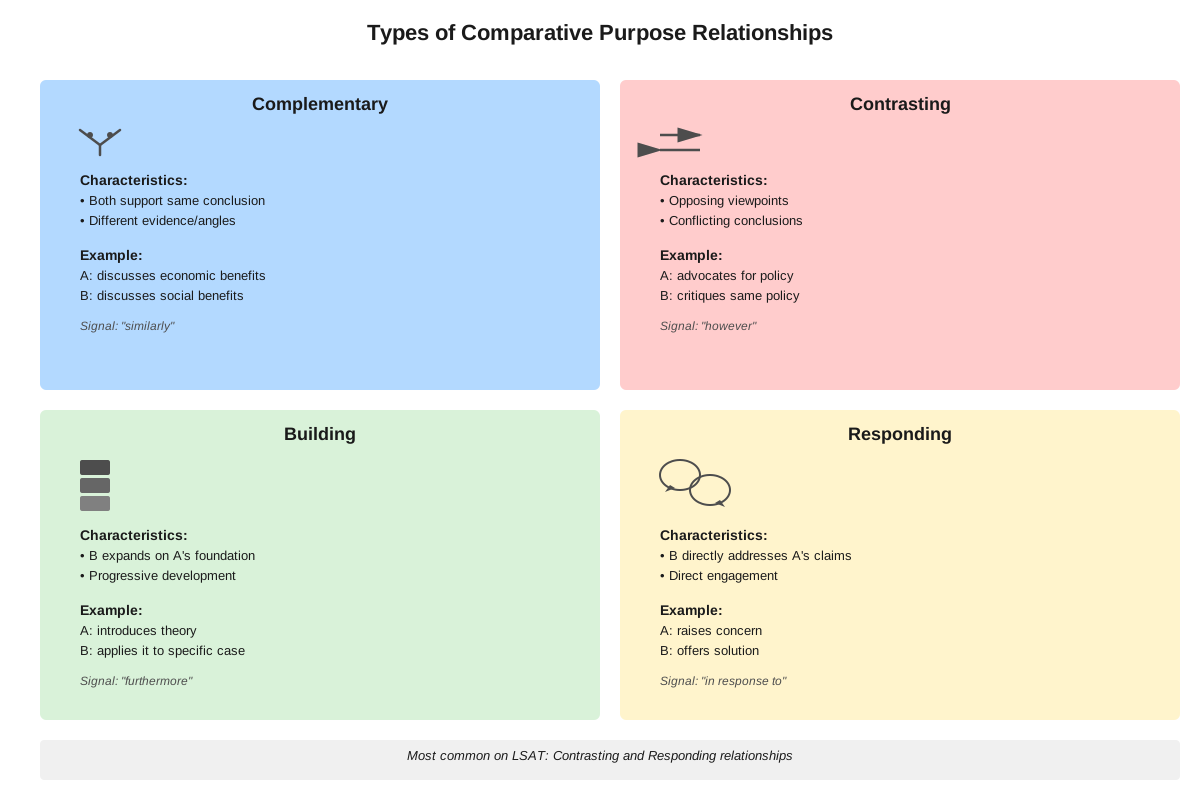
LSAT comparative purpose questions typically involve one of four relationship types:
| Relationship Type | Description | Example |
|---|---|---|
| Complementary | Both passages support the same general position from different angles | Passage A provides historical evidence for climate change; Passage B offers scientific data supporting the same conclusion |
| Contrasting | Passages take opposing stances on an issue | Passage A argues for increased copyright protection; Passage B argues such protection stifles innovation |
| Building/Extending | One passage provides foundation; the other develops or applies it | Passage A explains a legal principle; Passage B discusses its application to a specific case |
| Responding/Qualifying | One passage presents a view; the other critiques, qualifies, or responds to it | Passage A presents a theory; Passage B identifies limitations or exceptions |
Understanding which relationship type applies provides a framework for predicting correct answers and eliminating distractors.
Identifying Individual Passage Purposes
Before comparing purposes, each passage's individual purpose must be accurately identified. LSAT passages typically serve one of these primary purposes:
- Argue/Advocate: Present and support a specific position or claim
- Explain/Inform: Clarify how something works or why something occurs
- Critique/Challenge: Question or refute an existing view or practice
- Describe/Trace: Present a historical development or current situation
- Propose/Recommend: Suggest a solution or course of action
- Analyze/Evaluate: Examine multiple aspects of an issue without necessarily advocating
Key indicators of purpose include:
- Opening sentences: Often signal the passage's direction and scope
- Thesis statements: Explicit statements of the author's main claim
- Tone markers: Words like "unfortunately," "importantly," or "surprisingly" reveal attitude
- Structural patterns: Problem-solution structures indicate proposal purposes; chronological structures often indicate descriptive purposes
- Concluding emphasis: Final sentences frequently reinforce the primary purpose
Comparative Purpose Question Stems
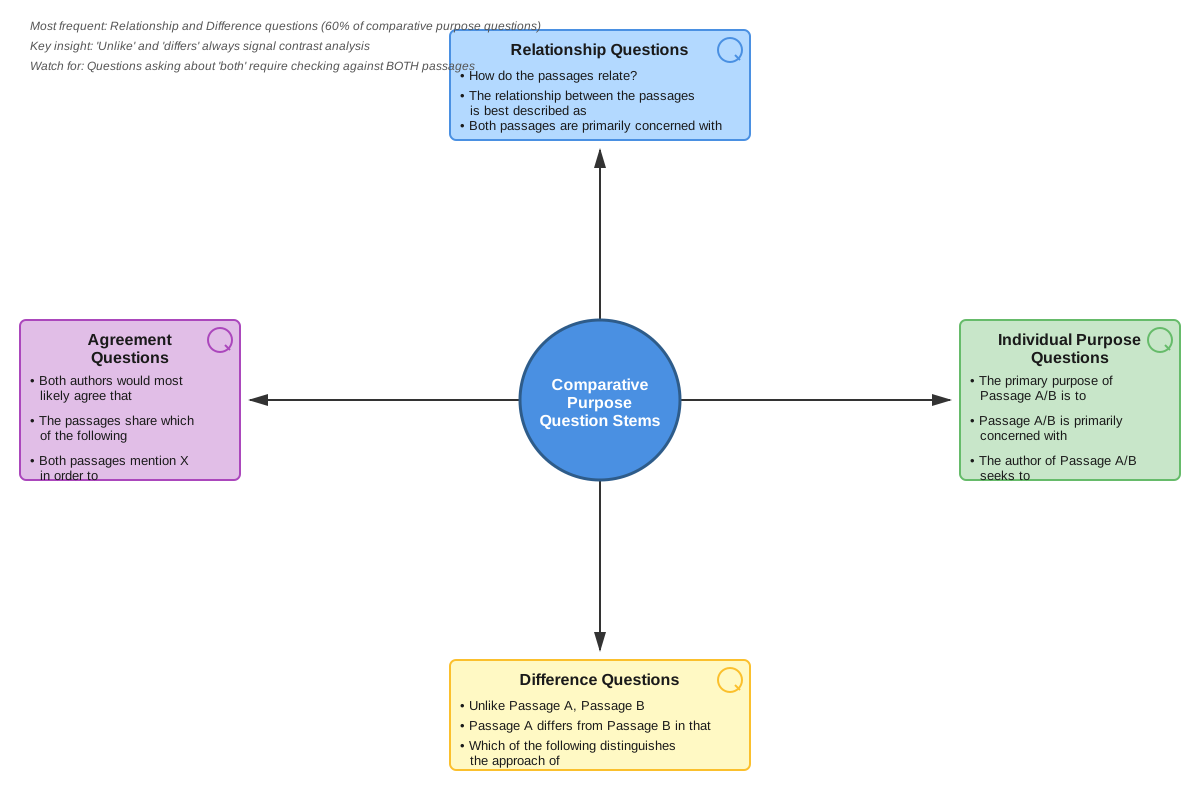
Recognizing question stems that test comparative purpose enables strategic approach. Common formulations include:
- "The primary purpose of Passage A is to _____, whereas Passage B _____"
- "Both passages are primarily concerned with..."
- "Which one of the following most accurately describes the relationship between the two passages?"
- "Passage B differs from Passage A in that Passage B..."
- "The approach taken by the author of Passage A differs from that taken by the author of Passage B in that..."
- "Unlike Passage A, Passage B..."
These stems require simultaneous consideration of both passages' purposes and their relationship, not merely sequential analysis.
The Comparative Purpose Analysis Process
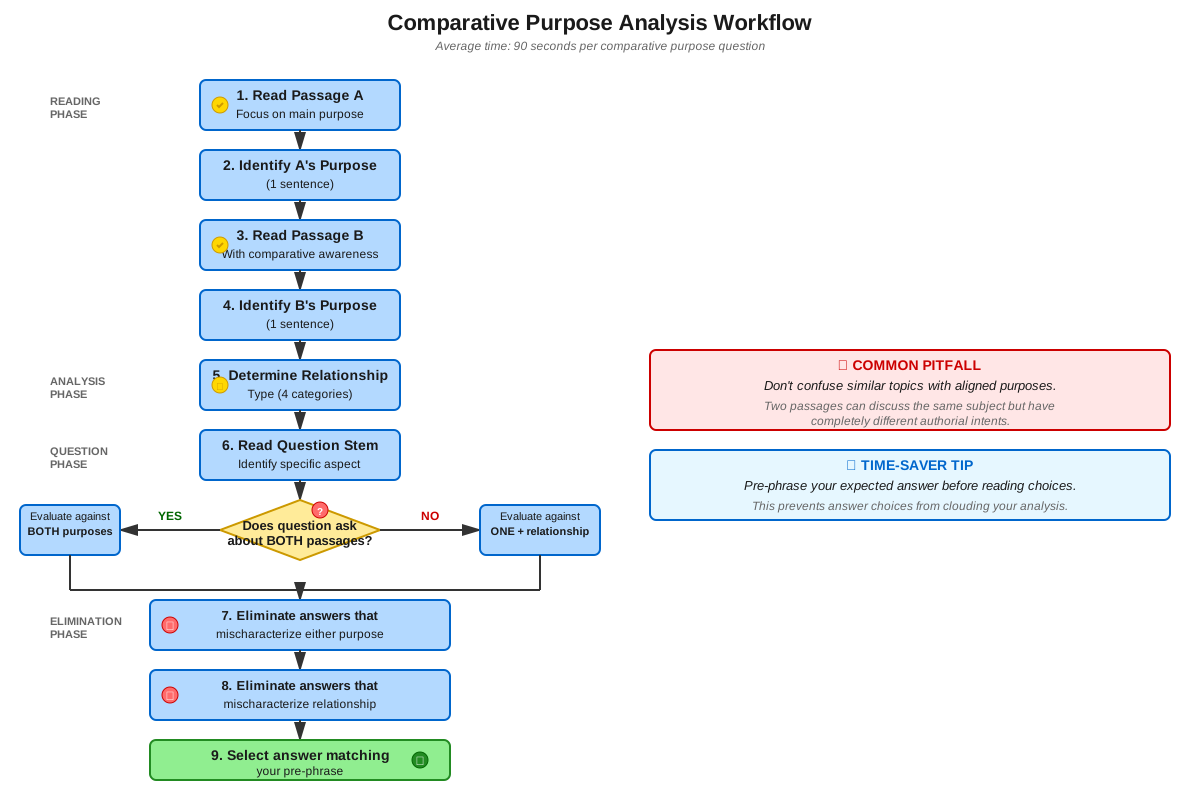
Effective comparative purpose analysis follows a systematic approach:
Step 1: Read Passage A actively, identifying its primary purpose using the indicators above. Mentally summarize: "This passage exists to [purpose verb] [object]."
Step 2: Before reading Passage B, anticipate possible relationships. Will it likely agree, disagree, qualify, or extend Passage A's discussion?
Step 3: Read Passage B actively, identifying its purpose and noting points of connection to Passage A—where they overlap, diverge, or interact.
Step 4: Characterize the relationship using one of the four relationship types, noting specific textual evidence supporting this characterization.
Step 5: When answering questions, eliminate choices that mischaracterize either individual purpose or their relationship.
Common Purpose Relationship Patterns
Certain topic pairings predict likely purpose relationships:
- Legal theory + case application: Building relationship (theory provides foundation for case analysis)
- Traditional view + modern critique: Contrasting or responding relationship
- Scientific explanation + policy implications: Building or complementary relationship
- Historical account + contemporary parallel: Complementary or contrasting relationship
- Problem description + solution proposal: Building relationship
Recognizing these patterns accelerates comprehension and prediction during the exam.
Concept Relationships
The concepts within comparative purpose form a hierarchical structure: Individual passage purpose identification serves as the foundation, requiring application of tone recognition and structural analysis. Once both purposes are identified, relationship type categorization becomes possible, which then enables question stem recognition and strategic answer choice elimination.
This topic connects to prerequisite knowledge in several ways: Main idea identification from single-passage reading directly transfers to identifying each passage's purpose individually. Tone and attitude recognition helps distinguish passages with similar topics but different purposes (one might be neutral-explanatory while another is critical-argumentative). Structural analysis reveals purpose through organizational patterns.
Comparative purpose also connects forward to other comparative reading skills: Understanding purpose relationships facilitates comparative detail questions (recognizing which passage would support or oppose specific claims) and author agreement/disagreement questions (predicting how authors would respond to each other's arguments).
Relationship map:
Single-passage analysis skills → Individual purpose identification (Passage A) + Individual purpose identification (Passage B) → Relationship type recognition → Question stem analysis → Strategic answer evaluation → Correct answer selection
High-Yield Facts
⭐ Approximately 25% of all Reading Comprehension passages on the LSAT are comparative reading sets, making comparative purpose a high-frequency skill.
⭐ The most common purpose relationship is contrasting, where passages take different positions on or approaches to the same general topic.
⭐ Comparative purpose questions typically appear early in the question set (questions 1-3 of 6-8), making them strategic priorities for establishing understanding.
⭐ Wrong answers frequently mischaracterize one passage's purpose while correctly describing the other's, requiring verification against both passages.
⭐ The relationship between passages is often more nuanced than simple agreement/disagreement—passages may agree on some points while differing in emphasis, scope, or approach.
- Passage A is always the shorter or equal-length passage; Passage B never appears first in the comparative set.
- Questions asking about "both passages" require identifying commonalities in purpose, topic, or approach despite differences.
- Tone differences between passages often signal purpose differences—a neutral tone suggests explanatory purpose while an evaluative tone suggests argumentative purpose.
- The introductory text before Passage A often provides context that clarifies the general topic both passages address, helping identify their relationship.
- Comparative purpose questions reward active reading strategies like marginal notation of each passage's purpose before proceeding to questions.
Quick check — test yourself on Comparative purpose so far.
Try Flashcards →Common Misconceptions
Misconception: If two passages discuss the same topic, they must have the same purpose.
Correction: Passages frequently address the same subject matter with entirely different purposes—one might explain a phenomenon while the other critiques a theory about it, or one might describe a historical development while the other argues for policy changes based on that history.
Misconception: Contrasting purposes mean the passages completely disagree about everything.
Correction: Passages can have contrasting purposes while agreeing on background facts or even some conclusions. The contrast often lies in emphasis, approach, or specific claims rather than total opposition. For example, both passages might acknowledge a problem exists but contrast in their proposed solutions.
Misconception: The purpose is always explicitly stated in the first or last sentence.
Correction: While opening and closing sentences often provide purpose clues, many LSAT passages require inference from tone, structure, and emphasis throughout. Some passages state their topic explicitly but leave their argumentative purpose implicit.
Misconception: "Both passages are concerned with..." questions are easier because they don't require identifying differences.
Correction: These questions are often more challenging because they require identifying the precise level of generality at which the passages share a common purpose while avoiding answer choices that are too specific (true for only one passage) or too broad (true but not the primary concern of either).
Misconception: Comparative purpose only matters for questions explicitly asking about purpose or relationship.
Correction: Understanding each passage's purpose is essential for virtually all questions in a comparative set, including detail questions, inference questions, and application questions, because purpose determines what claims the author would likely support or oppose.
Worked Examples
Example 1: Contrasting Purposes
Passage A (abbreviated): "Recent studies demonstrate that standardized testing provides valuable data for educational assessment. When properly designed, these tests measure student achievement objectively, allowing educators to identify learning gaps and allocate resources effectively. Critics who claim such tests narrow curriculum ignore the flexibility teachers retain in instructional methods..."
Passage B (abbreviated): "The proliferation of standardized testing has fundamentally distorted educational priorities. Teachers increasingly 'teach to the test,' sacrificing creative pedagogy and critical thinking development for test preparation. While proponents cite objective measurement benefits, this objectivity comes at the cost of reducing complex learning to simplistic metrics..."
Question: The primary purpose of Passage A is to _____, while Passage B seeks to _____.
Analysis Process:
Step 1: Identify Passage A's purpose. Key indicators: "demonstrate," "valuable data," "properly designed," "objectively," and the refutation of critics in the final sentence. Purpose: Argue in favor of/defend standardized testing's value.
Step 2: Identify Passage B's purpose. Key indicators: "distorted," "sacrificing," negative tone words, acknowledgment of proponents' claims followed by "but" structure. Purpose: Critique/challenge standardized testing's impact.
Step 3: Characterize relationship. These are clearly contrasting purposes—one defends what the other critiques.
Step 4: Predict answer. Correct answer will indicate Passage A defends/supports standardized testing while Passage B critiques/challenges it.
Correct answer format: "defend the value of standardized testing; critique its negative effects on education"
Common wrong answer: "explain how standardized testing works; describe its implementation" (This mischaracterizes both purposes as neutral/explanatory when both are actually argumentative)
Example 2: Building/Extending Relationship
Passage A (abbreviated): "Legal standing doctrine requires plaintiffs to demonstrate concrete injury before courts will hear their cases. This principle, rooted in Article III of the Constitution, prevents courts from issuing advisory opinions and ensures that judicial resources address actual disputes. Standing requires three elements: injury in fact, causation, and redressability..."
Passage B (abbreviated): "The application of standing doctrine to environmental cases presents unique challenges. When a corporation pollutes a river affecting thousands of residents, determining who has suffered sufficient 'injury in fact' becomes complex. The Supreme Court's decision in Massachusetts v. EPA expanded standing in environmental contexts by recognizing that procedural rights can constitute injury..."
Question: Which one of the following most accurately describes the relationship between the two passages?
Analysis Process:
Step 1: Passage A's purpose is to explain the general legal principle of standing doctrine—its rationale, constitutional basis, and elements. Tone is neutral-informative.
Step 2: Passage B's purpose is to discuss the application of standing doctrine (explained in A) to a specific context (environmental law), including complications and developments. Tone remains informative but focuses on particular implementation.
Step 3: This is a building/extending relationship. Passage A provides the foundational principle; Passage B examines its application in a specific domain. Passage B assumes understanding of concepts Passage A explains.
Step 4: Predict answer emphasizing that B applies or extends principles from A to a specific context.
Correct answer format: "Passage A explains a general legal principle that Passage B applies to a specific area of law"
Common wrong answer: "Passage A and Passage B present contrasting views on standing doctrine" (Mischaracterizes the relationship as oppositional when it's actually complementary/building)
Exam Strategy
Approaching Comparative Purpose Questions
Before reading: Note that this is a comparative set and allocate approximately 9 minutes total (slightly more than single passages due to relational complexity).
During Passage A: Read actively with purpose in mind. Make a brief marginal note summarizing purpose: "defends X," "explains Y," "critiques Z."
Between passages: Take 5-10 seconds to anticipate Passage B's likely relationship. Will it probably agree, disagree, or extend Passage A's discussion?
During Passage B: Actively note connections to Passage A—where they align, diverge, or build on each other. Make a marginal note about the relationship type.
Question approach: When encountering comparative purpose questions, refer to your marginal notes first, then verify against passage content.
Trigger Words and Phrases
In question stems:
- "primary purpose" → Focus on overall intent, not supporting details
- "differs from" → Identify specific point of divergence
- "both passages" → Find commonality at appropriate level of generality
- "relationship between" → Categorize using relationship types
In answer choices:
- Argumentative verbs (argue, advocate, defend, critique, challenge) → Indicate persuasive purpose
- Neutral verbs (explain, describe, trace, present) → Indicate informative purpose
- Relationship descriptors (whereas, while, in contrast, similarly, additionally) → Signal how purposes relate
Process of Elimination Strategy
For individual purpose characterization:
- Eliminate choices mischaracterizing tone (argumentative vs. neutral)
- Eliminate choices too narrow (focusing on supporting detail rather than main purpose)
- Eliminate choices too broad (true but not the specific focus)
- Verify remaining choice against opening, thesis, and conclusion
For relationship characterization:
- Eliminate choices that mischaracterize either individual purpose
- Eliminate choices that mischaracterize the relationship type (contrasting vs. complementary)
- Eliminate choices that are too vague ("discuss related topics")
- Verify remaining choice captures the specific nature of the relationship
Time Allocation
- Passage A reading: 2-2.5 minutes
- Passage B reading: 2-2.5 minutes
- Questions: 4-5 minutes (approximately 40-45 seconds per question)
- Comparative purpose questions: Prioritize these early; they establish framework for other questions
Exam Tip: If uncertain between two answer choices on a comparative purpose question, verify each choice against both passages separately. The correct answer must accurately characterize both purposes and their relationship; wrong answers typically fail on at least one dimension.
Memory Techniques
CRAP Acronym for Relationship Types
Complementary - passages support same conclusion from different angles
Responding - one passage replies to or qualifies the other
Adversarial (Contrasting) - passages take opposing positions
Progressive (Building) - one passage extends or applies the other
Purpose Verb Categories
Argumentative PACE:
- Persuade/Propose
- Advocate/Argue
- Critique/Challenge
- Evaluate (with judgment)
Neutral TIDE:
- Trace/Track
- Inform/Illustrate
- Describe/Delineate
- Explain/Elucidate
Visualization Strategy
Picture two arrows representing the passages:
- Parallel arrows (→ →) = Complementary purposes
- Opposing arrows (→ ←) = Contrasting purposes
- Sequential arrows (→ ⇒) = Building relationship
- Intersecting arrows (→ ↗) = Responding/qualifying relationship
The "Both-Each-Relationship" Checklist
For any comparative purpose question, mentally check:
- Both: What do both passages address? (topic level)
- Each: What is each passage's specific purpose? (individual level)
- Relationship: How do these purposes relate? (comparative level)
This three-step mental checklist ensures comprehensive analysis before selecting an answer.
Summary
Comparative purpose represents a sophisticated reading comprehension skill essential for LSAT success, requiring test-takers to identify two distinct authorial intentions and characterize their relationship. Mastery involves recognizing that passages addressing the same topic may serve different purposes—one might argue while another explains, one might defend while another critiques, or one might establish principles while another applies them. The four primary relationship types—complementary, contrasting, building, and responding—provide a framework for categorizing how purposes interact. Effective comparative purpose analysis follows a systematic process: identify each passage's individual purpose using tone, structure, and emphasis clues; categorize the relationship type; and verify answer choices against both passages simultaneously. This skill appears in approximately 25% of Reading Comprehension passages and directly impacts 2-3 questions per comparative set, while indirectly supporting accurate answers to additional questions requiring understanding of authorial intent. Success requires active reading with purpose in mind, strategic marginal notation, and careful answer choice evaluation that considers both individual purposes and their relationship.
Key Takeaways
- Comparative purpose requires analyzing two distinct authorial intentions and their relationship, not merely identifying two main ideas sequentially
- The four relationship types—complementary, contrasting, building, and responding—provide a framework for categorizing how passages interact
- Comparative purpose questions appear with high frequency (2-3 per comparative set) and often early in question sequences, making them strategic priorities
- Wrong answers typically mischaracterize one passage's purpose, the relationship, or both, requiring verification against both passages before selection
- Purpose differs from topic: passages can share a topic while serving entirely different purposes (explain vs. argue, describe vs. critique)
- Active reading with marginal notation of each passage's purpose and their relationship dramatically improves accuracy and efficiency on comparative reading questions
- Understanding comparative purpose provides a framework for answering multiple questions within the set, not just those explicitly asking about purpose
Related Topics
Comparative Detail Questions: Once comparative purpose is mastered, analyzing how specific details in one passage relate to claims in the other becomes more accessible. Understanding each passage's purpose helps predict which details the authors would emphasize or dispute.
Author Agreement/Disagreement Questions: These questions require inferring how one author would respond to the other's claims, which depends fundamentally on understanding each author's purpose and perspective.
Tone and Attitude in Comparative Reading: Recognizing tonal differences between passages helps distinguish their purposes and predict their relationship, building directly on comparative purpose skills.
Synthesis Questions: Advanced comparative reading questions may ask test-takers to synthesize information from both passages or identify principles both authors would accept, requiring deep understanding of how their purposes align or diverge.
Single-Passage Purpose Questions: Mastering comparative purpose strengthens skills for identifying purpose in traditional single passages, as the analytical process remains similar but without the relational component.
Practice CTA
Now that you understand the framework for analyzing comparative purpose, apply these concepts to practice questions and flashcards. Focus on identifying each passage's purpose before looking at answer choices, then categorize the relationship type using the CRAP framework. With deliberate practice, recognizing comparative purpose patterns becomes automatic, transforming these questions from challenging to high-confidence point opportunities. Remember: every comparative reading set on test day will reward your mastery of this skill. Start practicing now to build the pattern recognition and analytical speed that distinguish top LSAT performers.
Sign up free to keep reading
Create a free AnvayaPrep account to finish this LSAT guide on Comparative purpose — plus flashcards and practice questions.