Overview
Detail questions represent one of the most frequently tested reading comprehension question types on the LSAT, appearing in nearly every Reading Comprehension section. These questions ask test-takers to identify specific information explicitly stated or directly paraphrased in the passage. Unlike inference questions that require drawing conclusions beyond the text, detail questions focus on what the author actually said, making them theoretically straightforward but practically challenging due to the precision required and the subtle ways answer choices can distort passage content.
Mastering LSAT detail questions is essential because they constitute approximately 25-30% of all Reading Comprehension questions on any given test. These questions reward careful, active reading and punish assumptions or memory errors. Students who excel at detail questions demonstrate the ability to navigate complex passages efficiently, locate relevant information quickly, and distinguish between what was actually stated versus what seems plausible. This skill directly translates to higher scores, as detail questions are often among the more "gettable" points when approached systematically.
Within the broader landscape of reading comprehension, detail questions serve as the foundation for more complex question types. Before students can make inferences, understand main ideas, or analyze structure, they must first accurately comprehend what the passage explicitly states. Detail questions test this fundamental comprehension while also assessing test-taking skills like passage mapping, efficient scanning, and careful answer choice evaluation. They connect intimately with other question types: main point questions require synthesizing multiple details, inference questions build upon stated details, and function questions often reference specific details to ask about their purpose.
Learning Objectives
- [ ] Identify how Detail questions appears in LSAT questions
- [ ] Explain the reasoning pattern behind Detail questions
- [ ] Apply Detail questions to solve LSAT-style problems accurately
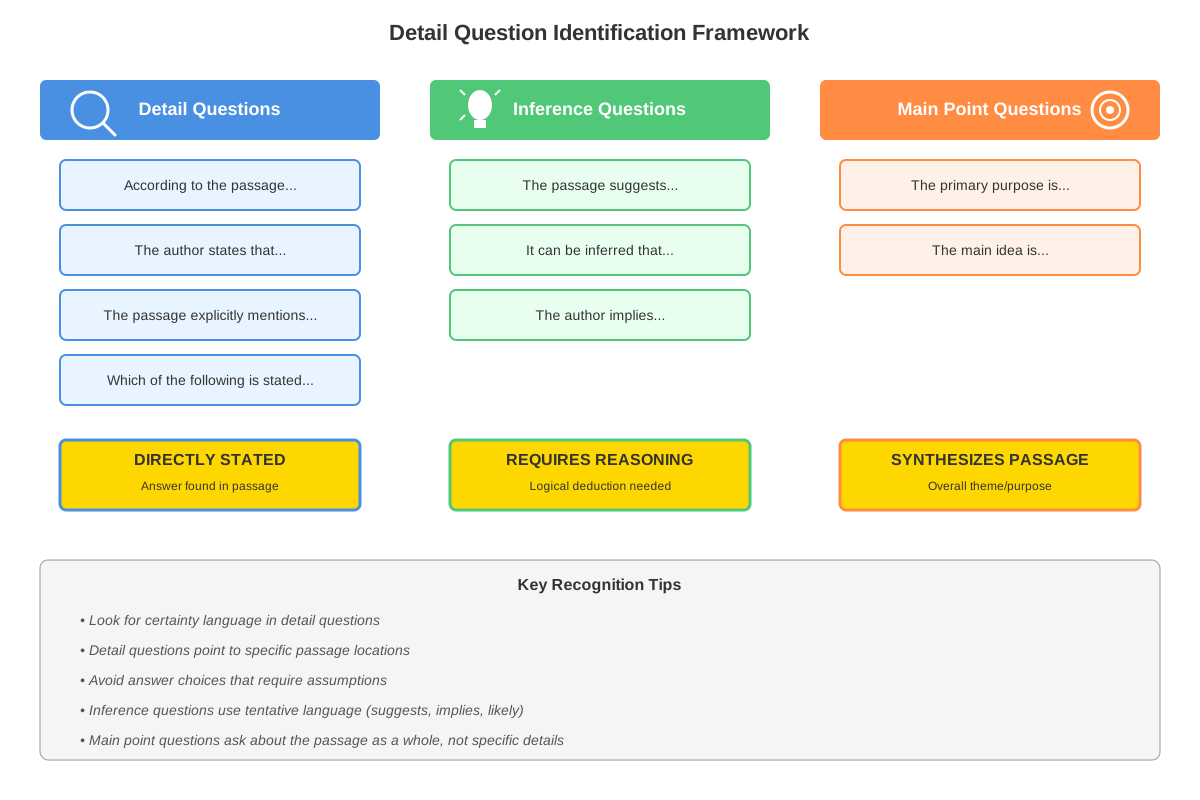
- [ ] Distinguish detail questions from inference and main point questions based on question stem language
- [ ] Develop efficient passage annotation strategies specifically for retrieving details under time pressure
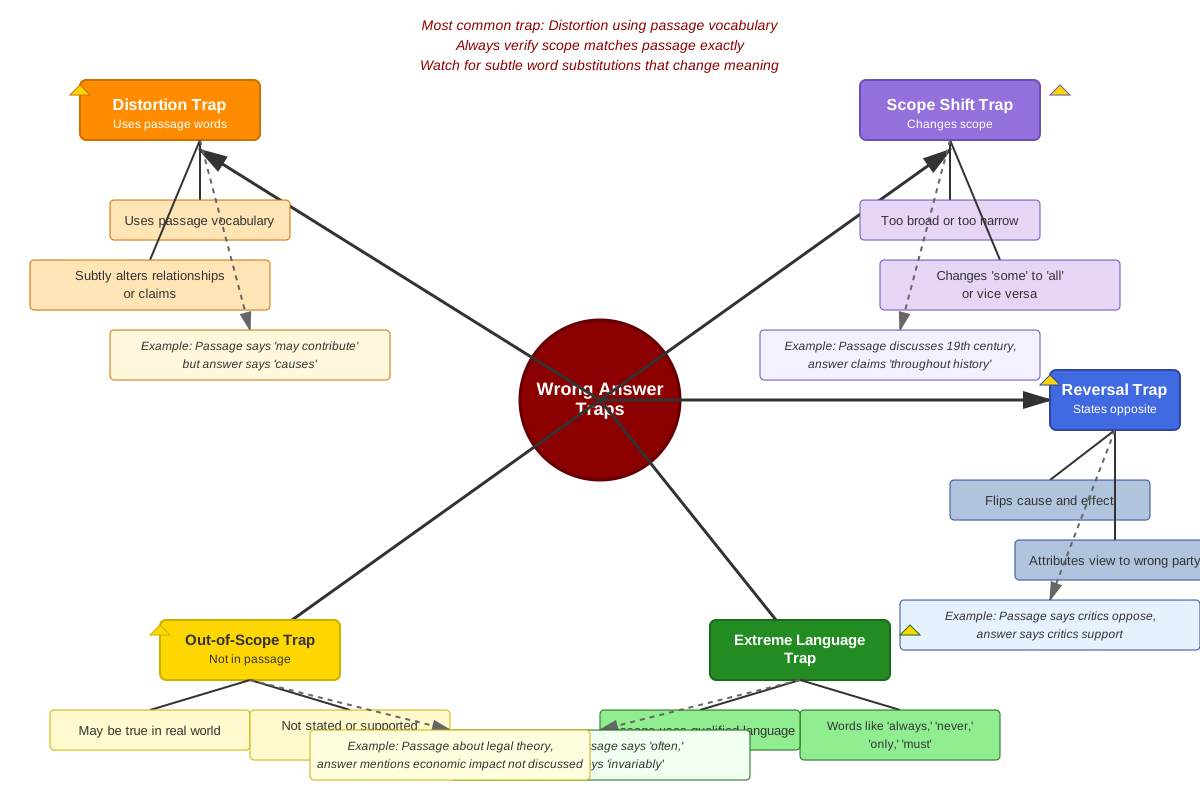
- [ ] Recognize the five most common wrong answer traps in detail questions and eliminate them systematically
Prerequisites
- Basic reading comprehension skills: The ability to understand complex academic prose is fundamental, as LSAT passages are dense and sophisticated.
- Familiarity with LSAT passage structure: Understanding that passages contain main points, supporting details, and authorial attitudes helps locate information efficiently.
- Knowledge of common LSAT passage topics: Exposure to law, science, humanities, and social science passages reduces cognitive load when encountering new material.
- Understanding of question stem terminology: Recognizing what "according to the passage" or "the author states" means ensures proper question identification.
Why This Topic Matters
Detail questions matter because they represent the most direct assessment of reading accuracy on the LSAT. In legal practice, attorneys must extract precise information from statutes, case law, and contracts—misreading a single detail can have significant consequences. The LSAT tests this skill through detail questions that reward precision and punish carelessness.
Exam statistics reveal that detail questions appear 6-8 times per Reading Comprehension section (out of approximately 27 questions total). They are distributed across all four passages, including the comparative reading passage pair. Statistically, students who master detail questions improve their overall Reading Comprehension score by 2-4 points, as these questions have high accuracy potential when approached correctly.
Detail questions commonly appear in several forms on the exam. They may ask about specific claims made by the author, factual information presented in the passage, examples used to illustrate concepts, or details about studies, theories, or historical events discussed. They frequently target information in the middle paragraphs of passages, where supporting details cluster. The LSAT also favors detail questions about nuanced distinctions the author makes, specific terminology definitions, or particular characteristics of phenomena described in scientific or technical passages.
Core Concepts
Defining Detail Questions
Detail questions, also called "specific information questions" or "according to the passage questions," ask test-takers to identify information explicitly stated in the passage. The defining characteristic is that the correct answer will be directly supported by specific passage text—not inferred, not assumed, but actually stated (though often paraphrased). These questions test whether students read carefully enough to distinguish what the passage says from what it implies or what seems reasonable.
The question stems for detail questions follow predictable patterns. They typically include phrases like:
- "According to the passage..."
- "The author states that..."
- "The passage indicates that..."
- "Which of the following is mentioned in the passage..."
- "The passage provides information that answers which of the following questions..."
The Reasoning Pattern Behind Detail Questions
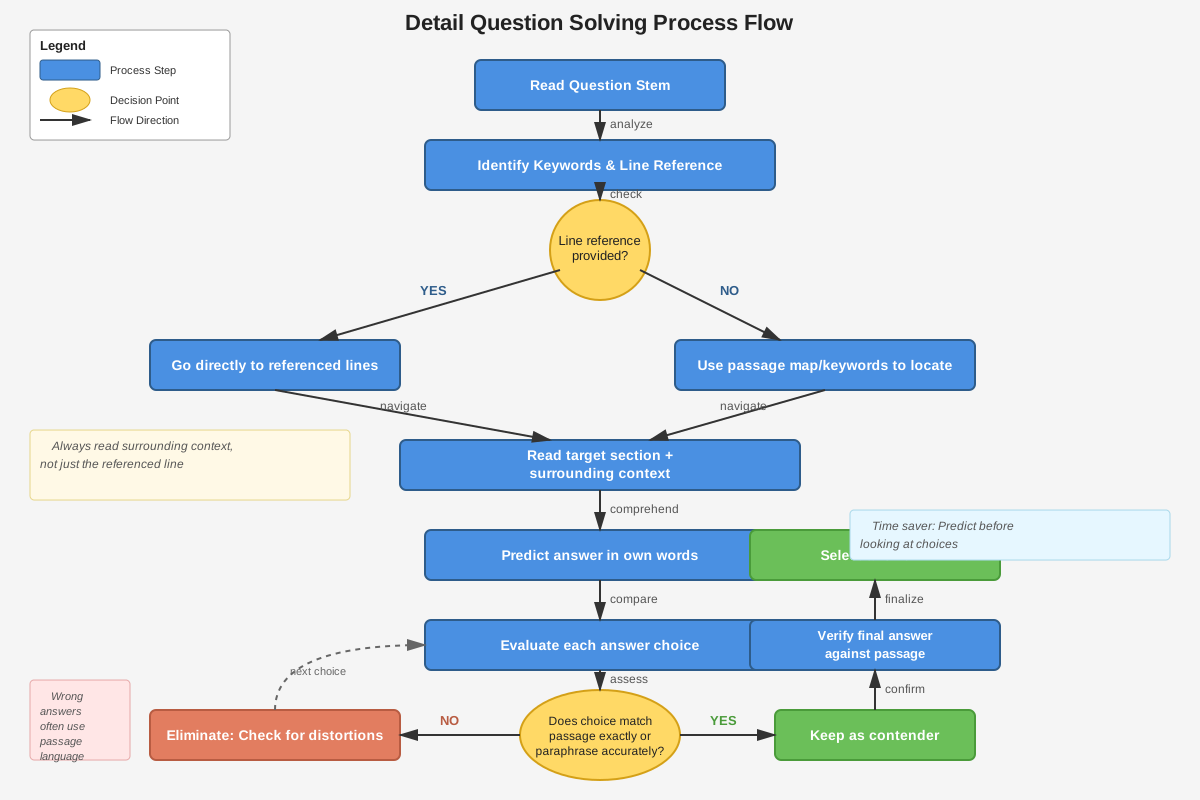
The fundamental reasoning pattern for detail questions involves direct textual support. Unlike inference questions where the answer follows logically from passage information but isn't explicitly stated, detail questions require finding the passage location where the answer is directly addressed. The reasoning process follows this sequence:
- Question Analysis: Identify that the question is asking for stated information (not inference)
- Location Strategy: Determine where in the passage the relevant information appears
- Passage Reference: Return to the specific passage location
- Answer Matching: Find the answer choice that accurately reflects the passage statement
- Verification: Confirm no distortion, addition, or omission has occurred
This pattern emphasizes retrieval accuracy over analytical reasoning. The challenge lies not in complex logical operations but in precise reading and careful comparison between passage text and answer choices.
Types of Detail Questions
Detail questions appear in several distinct varieties:
Explicit Fact Questions ask about straightforward factual claims made in the passage. Example: "According to the passage, in what year did the Supreme Court rule on this case?"
Definition Questions ask what the passage says a particular term means or how a concept is characterized. Example: "The passage indicates that 'legal realism' is best described as..."
Example/Illustration Questions ask about specific examples the author uses. Example: "Which of the following does the author mention as an example of judicial activism?"
Characteristic/Property Questions ask about features or attributes of something discussed. Example: "According to the passage, which of the following is true of common law systems?"
Comparison Questions ask about relationships or distinctions the passage explicitly draws. Example: "The passage indicates that Theory X differs from Theory Y in which of the following ways?"
Wrong Answer Patterns in Detail Questions
Understanding how wrong answers are constructed is crucial for efficient elimination. The LSAT uses five primary distortion patterns:
| Wrong Answer Type | Description | Example |
|---|---|---|
| Out of Scope | Information not mentioned in the passage | Passage discusses civil law; answer mentions criminal law |
| Extreme Language | Adds absolute language not in passage | Passage says "often"; answer says "always" |
| Distortion | Twists or misrepresents passage information | Passage says X causes Y; answer says Y causes X |
| Wrong Detail | Accurate information from wrong passage location | Combines details from different paragraphs incorrectly |
| Half-Right | Partially correct but includes one false element | Two-part answer where one part is accurate, one isn't |
Strategic Passage Reading for Detail Questions
Effective detail question performance begins during the initial passage reading. Active reading strategies include:
- Paragraph Purpose Notation: Briefly note what each paragraph accomplishes (introduces theory, provides example, presents criticism, etc.)
- Detail Clustering: Recognize where factual details concentrate (usually middle paragraphs)
- Structural Markers: Note transition words that signal important details ("specifically," "for example," "in particular")
- Proper Nouns and Dates: Circle or underline these as they're frequently tested
- Lists and Enumerations: Mark when the author lists multiple items, as these often become detail questions
This preparation enables efficient return to the passage when detail questions arise, reducing time pressure and improving accuracy.
Concept Relationships
Detail questions connect to other reading comprehension question types through a hierarchical relationship. They form the foundation: Detail Questions → Support → Inference Questions → Enable → Main Point Understanding → Informs → Structure Questions. Students must master retrieving stated details before they can reliably make inferences from those details or synthesize them into main ideas.
Within detail questions themselves, the concepts relate as follows: Question Stem Recognition → Determines → Location Strategy → Guides → Passage Return → Enables → Answer Matching → Requires → Wrong Answer Elimination. Each step depends on the previous one, creating a systematic approach.
Detail questions also connect to time management strategies. Because they require passage return, they typically take 45-75 seconds each (compared to 30-45 seconds for some inference questions that can be answered from memory). Understanding this relationship helps students allocate time appropriately across the Reading Comprehension section.
The relationship between passage structure and detail questions is particularly important. Detail questions most frequently target supporting paragraphs (paragraphs 2-4 in a typical passage), while main point questions target the introduction and conclusion. Recognizing this pattern helps students anticipate which information will be tested and how.
High-Yield Facts
⭐ Detail questions constitute approximately 25-30% of all Reading Comprehension questions on the LSAT
⭐ The correct answer to a detail question is always directly supported by specific passage text, though usually paraphrased
⭐ Question stems containing "according to the passage," "the author states," or "the passage indicates" signal detail questions
⭐ Wrong answers in detail questions most commonly use distortion (twisting passage information) or out-of-scope information
⭐ Detail questions typically require returning to the passage, making efficient passage mapping essential
- Detail questions appear across all passage types: humanities, social science, natural science, and law
- The comparative reading passage typically includes 2-3 detail questions
- Extreme language in answer choices ("always," "never," "only") is usually incorrect unless the passage uses equally extreme language
- Detail questions about examples or illustrations frequently appear in the middle paragraphs of passages
- Proper nouns, dates, and technical terms are high-yield targets for detail questions
Quick check — test yourself on Detail questions so far.
Try Flashcards →Common Misconceptions
Misconception: Detail questions can be answered from memory without returning to the passage.
Correction: While some details may be remembered, the LSAT designs answer choices to exploit memory errors and subtle misunderstandings. Returning to the passage ensures accuracy and protects against attractive wrong answers that seem correct but distort passage information.
Misconception: If an answer choice contains information from the passage, it must be correct.
Correction: Wrong answers frequently contain accurate passage information used incorrectly—either answering a different question, combining details inappropriately, or adding one false element to otherwise true information. The answer must address the specific question asked.
Misconception: Detail questions are easier than inference questions.
Correction: While detail questions test more straightforward comprehension, they can be equally challenging due to subtle answer choice distortions, time pressure, and the precision required. Many students miss detail questions by selecting answers that seem reasonable rather than verifying exact passage support.
Misconception: Paraphrasing in answer choices indicates a wrong answer.
Correction: The LSAT almost always paraphrases correct answers rather than quoting passage language directly. Students must recognize when paraphrasing accurately captures passage meaning versus when it subtly distorts it.
Misconception: Detail questions always ask about important passage information.
Correction: Detail questions can target minor details, parenthetical remarks, or subordinate clause information. The LSAT tests careful reading of all passage content, not just main ideas.
Misconception: If you can't find the answer in the passage, you should choose the most reasonable option.
Correction: If passage support isn't found, the search strategy needs adjustment—checking different paragraphs, considering paraphrasing, or re-reading the question stem. Choosing based on reasonableness rather than passage support leads to errors.
Worked Examples
Example 1: Explicit Fact Detail Question
Passage Excerpt: "The doctrine of stare decisis, which requires courts to follow precedent established in earlier cases, emerged gradually in English common law during the 18th century. While judges had long considered previous decisions, the formal obligation to adhere to precedent became established only after the court system was reorganized in 1873, creating a clear hierarchy of courts."
Question: According to the passage, the formal obligation to follow precedent in English common law:
(A) was established in the 18th century
(B) emerged gradually over several centuries
(C) became established after court reorganization in 1873
(D) has always been a feature of the common law system
(E) was created to establish a hierarchy of courts
Step-by-Step Solution:
- Identify Question Type: "According to the passage" signals a detail question requiring direct passage support.
- Locate Relevant Information: The question asks about when the "formal obligation" to follow precedent was established. The passage addresses this in the second sentence.
- Analyze Passage Statement: The passage states "the formal obligation to adhere to precedent became established only after the court system was reorganized in 1873."
- Evaluate Each Answer:
- (A) Wrong detail—the doctrine "emerged gradually" in the 18th century, but the "formal obligation" came later
- (B) Distortion—this describes the general emergence, not the formal obligation
- (C) CORRECT—directly matches the passage statement
- (D) Extreme/contradicted—passage says it emerged gradually, not "always"
- (E) Reversal—the reorganization created hierarchy, but the formal obligation wasn't created to establish hierarchy
- Verify: Choice (C) accurately paraphrases "became established only after the court system was reorganized in 1873" without adding, omitting, or distorting information.
Connection to Learning Objectives: This example demonstrates identifying detail questions through question stem language, applying the reasoning pattern of locating and matching passage information, and recognizing wrong answer patterns (wrong detail, distortion, extreme language).
Example 2: Characteristic Detail Question
Passage Excerpt: "Unlike traditional vaccines that use weakened or inactivated pathogens, mRNA vaccines provide cells with genetic instructions to produce a harmless piece of the pathogen, typically a protein. The immune system then recognizes this protein as foreign and builds an immune response. Importantly, mRNA vaccines never enter the cell nucleus where DNA is stored, and the mRNA degrades naturally within days after vaccination."
Question: The passage indicates that mRNA vaccines differ from traditional vaccines in that mRNA vaccines:
(A) provide longer-lasting immunity than traditional vaccines
(B) use genetic instructions rather than weakened pathogens
(C) alter the DNA in the cell nucleus
(D) produce a harmful version of the pathogen protein
(E) remain in the body permanently after vaccination
Step-by-Step Solution:
- Identify Question Type: "The passage indicates" signals a detail question about stated information.
- Recognize Comparison Structure: The question asks about a difference explicitly stated in the passage.
- Locate Comparison: The first sentence directly compares mRNA vaccines to traditional vaccines: "Unlike traditional vaccines that use weakened or inactivated pathogens, mRNA vaccines provide cells with genetic instructions..."
- Evaluate Each Answer:
- (A) Out of scope—duration of immunity is not discussed
- (B) CORRECT—accurately captures the stated difference
- (C) Contradicted—passage explicitly states mRNA "never enter the cell nucleus"
- (D) Distortion—passage says "harmless piece," not harmful
- (E) Contradicted—passage states "mRNA degrades naturally within days"
- Verify: Choice (B) paraphrases the passage's explicit comparison without distortion.
Connection to Learning Objectives: This example shows how detail questions test stated comparisons, demonstrates the importance of recognizing contradicted information, and illustrates how wrong answers use distortion and contradiction patterns.
Exam Strategy
Approaching Detail Questions Systematically
When encountering a detail question, follow this strategic process:
- Confirm Question Type (5 seconds): Verify the question stem asks for stated information, not inference
- Identify Content Focus (5 seconds): Determine what specific information the question targets
- Locate Passage Section (10-15 seconds): Use passage map or memory to find the relevant paragraph
- Read Targeted Section (15-20 seconds): Read the specific sentences containing the answer
- Predict Answer (5-10 seconds): Formulate what the correct answer should say before looking at choices
- Eliminate and Select (15-20 seconds): Eliminate wrong answers and confirm the correct choice
Exam Tip: Predicting the answer before reading choices dramatically improves accuracy by preventing attractive wrong answers from influencing judgment.
Trigger Words and Phrases
Question Stem Triggers that identify detail questions:
- "According to the passage"
- "The passage states/indicates/suggests that"
- "The author mentions"
- "Which of the following is cited in the passage"
- "The passage provides information that answers which"
- "As described in the passage"
Passage Triggers that signal testable details:
- "Specifically"
- "For example/For instance"
- "In particular"
- Dates, names, and technical terms
- Lists or enumerations ("First...second...third")
- Definitions ("X is defined as" or "X refers to")
Process of Elimination Strategy
For detail questions, eliminate answers that:
- Contain information not mentioned in the passage (out of scope)
- Use extreme language ("always," "never," "only") unless the passage does too
- Reverse or distort relationships stated in the passage
- Combine details from different passage sections inappropriately
- Add qualifiers not present in the passage ("primarily," "mainly," "most importantly")
Exam Tip: If two answers seem equally supported, return to the passage and read more carefully. The LSAT always provides clear textual support for one answer over others.
Time Allocation
Allocate 45-75 seconds per detail question:
- 20-30 seconds: Locating and reading passage information
- 25-45 seconds: Evaluating answer choices
If a detail question exceeds 90 seconds, mark it and move on—return if time permits. Detail questions should not consume disproportionate time since they're theoretically straightforward.
Memory Techniques
The LOCATE Acronym
Look at the question stem carefully
Orient to the passage section
Confirm the specific detail
Anticipate the answer
Test each choice against passage
Eliminate distortions
Visualization Strategy
Picture the passage as a building with floors (paragraphs). When a detail question asks about specific information, visualize which "floor" contains that information. This spatial memory technique helps retrieve passage location quickly.
The "Three Ds" of Wrong Answers
Distortion: Twists passage information
Different detail: Accurate but wrong location
Doesn't exist: Out of scope information
Paraphrase Recognition Practice
Train the brain to recognize paraphrasing by creating a mental "synonym bank" for common LSAT concepts:
- "Emerged" = developed, arose, came into being
- "Challenged" = questioned, disputed, contested
- "Advocated" = supported, promoted, championed
This helps recognize correct answers that paraphrase rather than quote.
Summary
Detail questions test the ability to identify information explicitly stated in LSAT Reading Comprehension passages. These questions, constituting 25-30% of all Reading Comprehension questions, reward precise reading and careful answer evaluation. The fundamental skill is locating specific passage information and matching it to answer choices while avoiding common traps like distortion, extreme language, and out-of-scope information. Success requires systematic question analysis, efficient passage navigation, answer prediction before evaluating choices, and rigorous elimination of wrong answers. Unlike inference questions that require reasoning beyond the text, detail questions demand accuracy in retrieving and recognizing stated information, even when paraphrased. Mastering detail questions provides a foundation for other question types and represents high-yield opportunities for score improvement, as these questions are highly "gettable" when approached with proper strategy and careful attention to passage language versus answer choice language.
Key Takeaways
- Detail questions ask for information explicitly stated in the passage, not inferred or assumed
- Question stems containing "according to the passage" or "the passage states" signal detail questions
- Always return to the passage to verify answers—memory is unreliable under test pressure
- Correct answers are typically paraphrased rather than directly quoted from the passage
- The five main wrong answer types are: out of scope, extreme language, distortion, wrong detail, and half-right
- Predict the answer before reading choices to avoid being misled by attractive wrong answers
- Detail questions typically take 45-75 seconds and require efficient passage navigation
Related Topics
Inference Questions: Build upon detail questions by asking what follows logically from stated information. Mastering detail questions provides the foundation for accurate inference-making.
Main Point Questions: Require synthesizing multiple details into the passage's central claim. Understanding how to identify and retrieve details enables better main point recognition.
Function Questions: Ask why the author included specific details. Mastering detail retrieval is prerequisite to analyzing the purpose of those details.
Passage Mapping Strategies: Techniques for annotating passages during initial reading to enable efficient detail retrieval. This skill directly supports detail question performance.
Comparative Reading Detail Questions: Special considerations when detail questions ask about similarities or differences between paired passages.
Practice CTA
Now that you understand the systematic approach to detail questions, it's time to apply these strategies to actual LSAT passages. Complete the practice questions for this topic, focusing on implementing the LOCATE method and recognizing wrong answer patterns. Use the flashcards to reinforce question stem recognition and wrong answer types. Remember: detail questions represent high-yield opportunities for score improvement because they reward systematic technique and careful reading. Every detail question you master brings you closer to your target score. Start practicing now to build the precision and efficiency these questions demand!
Sign up free to keep reading
Create a free AnvayaPrep account to finish this LSAT guide on Detail questions — plus flashcards and practice questions.