Overview
Comparing methods is a critical skill within the LSAT reading comprehension section, particularly in comparative reading passages. This topic requires test-takers to analyze how two different authors, researchers, or texts approach similar subject matter, problems, or questions using distinct methodologies, argumentative strategies, or analytical frameworks. Unlike simple comparison questions that ask about content differences, comparing methods questions probe deeper into how authors construct their arguments, present evidence, organize information, and reach conclusions.
Mastery of comparing methods is essential for LSAT success because these questions appear frequently in the comparative reading set—one of the four passages in every Reading Comprehension section. The LSAT tests this skill to evaluate a student's ability to think critically about argumentative structure and rhetorical strategy, not merely content comprehension. Questions targeting this skill often ask test-takers to identify similarities or differences in how authors support claims, the types of evidence they employ, their organizational patterns, or their underlying assumptions about approaching a topic.
Within the broader Reading Comprehension framework, comparing methods builds upon fundamental skills like identifying main ideas, recognizing argument structure, and understanding authorial purpose. It represents a more sophisticated analytical task that requires synthesizing information across two passages while maintaining awareness of each author's distinct approach. This skill connects directly to other comparative reading competencies, including identifying points of agreement and disagreement, understanding different perspectives on shared topics, and evaluating the relative strengths of competing arguments. Strong performance on comparing methods questions often correlates with overall Reading Comprehension success, as it demonstrates the higher-order thinking skills the LSAT prizes.
Learning Objectives
- [ ] Identify how Comparing methods appears in LSAT questions
- [ ] Explain the reasoning pattern behind Comparing methods
- [ ] Apply Comparing methods to solve LSAT-style problems accurately
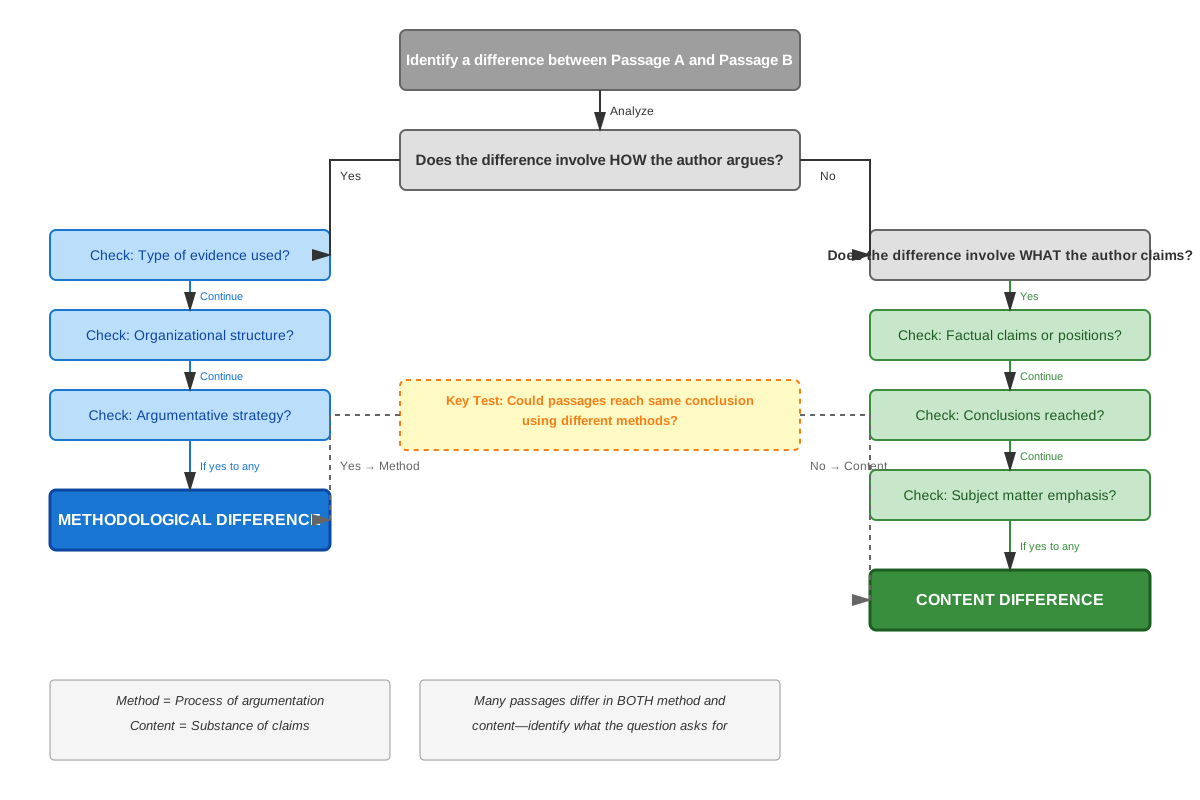
- [ ] Distinguish between methodological differences and content differences in paired passages
- [ ] Analyze the relationship between an author's method and their argumentative purpose
- [ ] Evaluate which methodological approach would be more effective for addressing specific questions or problems
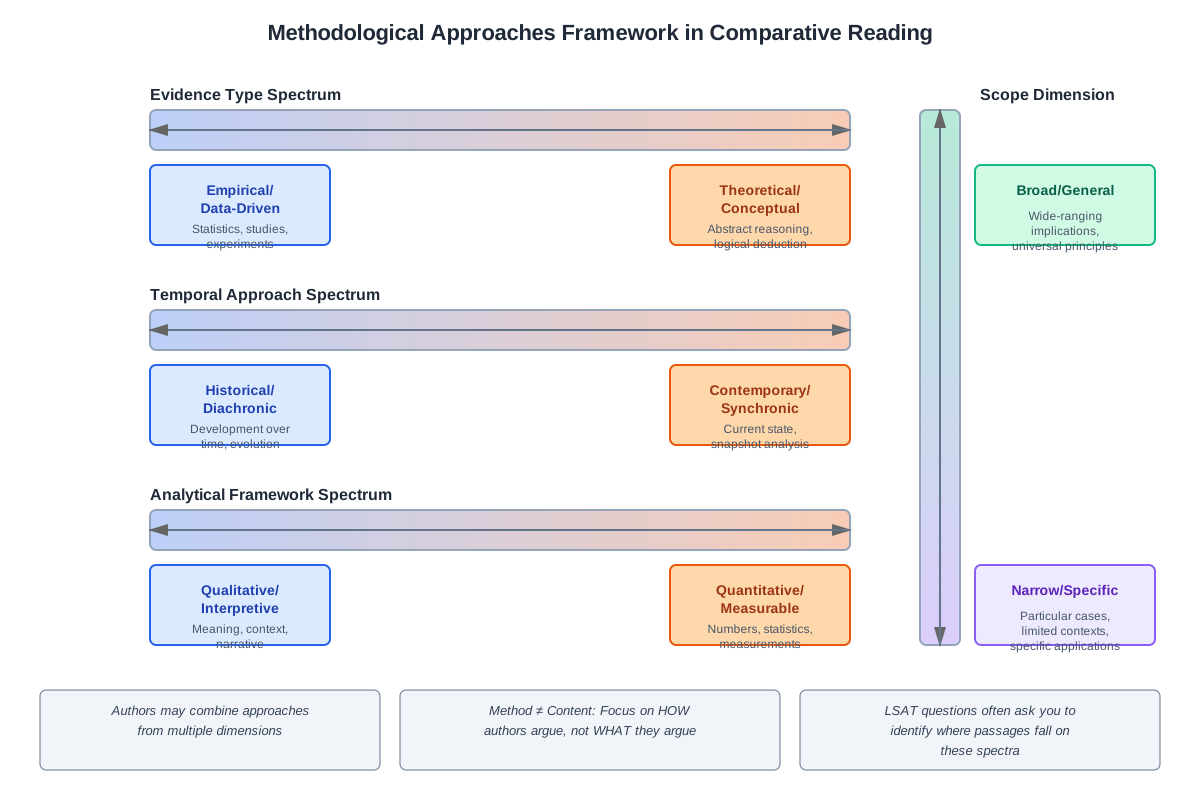
- [ ] Recognize common methodological patterns (empirical vs. theoretical, historical vs. contemporary, etc.)
Prerequisites
- Basic passage comprehension skills: Understanding main ideas, supporting details, and passage structure is necessary before analyzing how authors construct arguments
- Argument structure recognition: Identifying premises, conclusions, and evidence types provides the foundation for comparing how different authors build their cases
- Understanding of authorial purpose and tone: Recognizing why authors write and their attitudes toward subjects helps distinguish methodological choices from content choices
- Familiarity with comparative reading format: Knowing that comparative reading presents two shorter passages (Passage A and Passage B) on related topics allows focus on the unique challenges of cross-passage analysis
Why This Topic Matters
Comparing methods represents one of the most intellectually demanding skills tested in LSAT Reading Comprehension, reflecting the type of analytical thinking required in law school and legal practice. Attorneys must constantly evaluate competing approaches to legal problems, compare how different precedents address similar issues, and assess the relative merits of various argumentative strategies. The ability to distinguish between what someone argues and how they argue it is fundamental to legal reasoning.
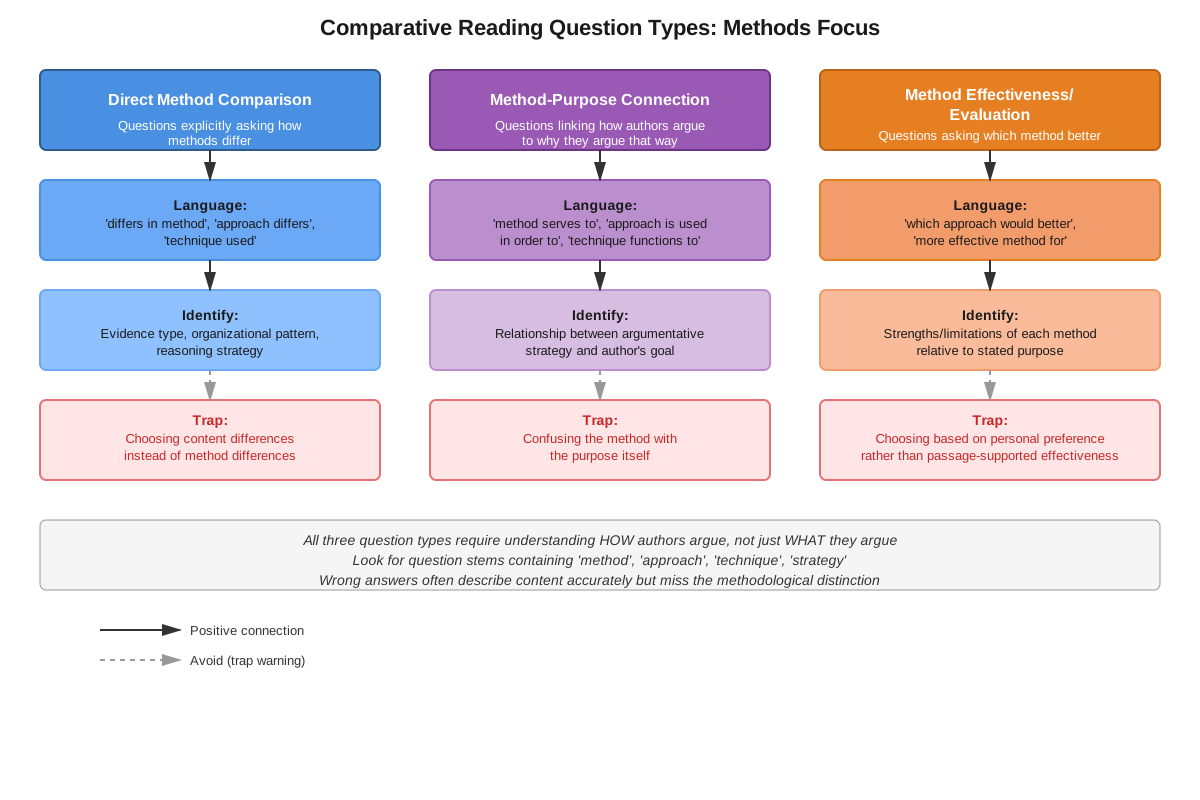
On the LSAT, comparing methods questions appear in approximately 60-70% of comparative reading sets, making them among the most frequent question types in this format. These questions typically account for 2-3 of the 5-8 questions accompanying comparative passages. They appear in various forms: direct comparison questions ("How do the methods differ?"), application questions ("Which method would be more useful for...?"), and structural relationship questions ("The relationship between the passages is best described as...").
Common manifestations in exam passages include: scientific passages where one author uses empirical data while another employs theoretical reasoning; legal or philosophical passages where one author takes a historical approach while another uses contemporary analysis; social science passages where one author relies on quantitative evidence while another uses qualitative case studies; and humanities passages where one author employs close textual analysis while another uses broader cultural contextualization. The LSAT deliberately pairs passages that share subject matter but diverge in methodology, creating rich opportunities to test this analytical skill.
Core Concepts
Defining Methodological Comparison
Comparing methods in LSAT comparative reading refers to the analytical process of identifying, contrasting, and evaluating the distinct approaches that two authors use to investigate, present, or argue about related topics. A "method" encompasses several dimensions: the type of evidence an author selects (empirical data, historical examples, logical reasoning, expert testimony, personal anecdotes), the organizational structure of the argument (chronological, problem-solution, cause-effect, compare-contrast), the analytical framework employed (scientific, historical, philosophical, legal), and the rhetorical strategies used to persuade readers.
The key distinction students must grasp is between content and method. Content refers to what an author discusses—the specific claims, facts, and conclusions presented. Method refers to how an author develops their discussion—the tools, strategies, and approaches used to present and support ideas. For example, two passages about climate change might both conclude that global temperatures are rising (shared content), but one might reach this conclusion through statistical analysis of temperature records (empirical method) while the other might argue from theoretical models of atmospheric physics (theoretical method).
Types of Methodological Differences
The LSAT employs several recurring patterns of methodological contrast that test-takers should recognize:
Evidence-Based Distinctions: One of the most common contrasts involves the type of evidence authors prioritize. Passage A might rely on quantitative data, statistics, and numerical analysis, while Passage B employs qualitative evidence such as case studies, interviews, or descriptive observations. Alternatively, one author might use contemporary evidence while another draws on historical examples. Some authors privilege expert opinion and scholarly consensus, while others emphasize primary source documents or firsthand accounts.
Analytical Framework Differences: Authors may approach the same topic through different disciplinary or conceptual lenses. A scientific approach emphasizes hypothesis testing, controlled observation, and empirical verification. A historical approach focuses on temporal development, contextual factors, and precedent. A philosophical approach employs logical analysis, conceptual clarification, and normative reasoning. A legal approach examines statutory interpretation, case law, and jurisprudential principles.
Structural and Organizational Patterns: The way authors organize their arguments reveals methodological choices. Some authors use deductive reasoning, starting with general principles and deriving specific conclusions. Others employ inductive reasoning, building from specific observations to general conclusions. Some authors structure arguments around problem-solution frameworks, while others use cause-effect analysis. Comparative structures, chronological narratives, and dialectical approaches (thesis-antithesis-synthesis) represent additional organizational methods.
Scope and Scale Variations: Methodological differences often manifest in the breadth and depth of analysis. One author might take a broad, sweeping approach that surveys multiple examples or considers wide-ranging implications, while another employs a narrow, focused method that examines a single case or specific aspect in detail. Macro-level analysis contrasts with micro-level examination, and comprehensive surveys differ from intensive case studies.
Recognizing Method Questions
LSAT questions targeting methodological comparison use specific language patterns that signal this focus. Common question stems include:
- "The approach in Passage A differs from that in Passage B in that..."
- "Unlike the author of Passage B, the author of Passage A..."
- "The method used in Passage A can best be described as..."
- "Which of the following best describes the relationship between the two passages?"
- "The passages employ which of the following strategies?"
- "Compared to Passage B, Passage A relies more heavily on..."
These questions require students to abstract away from specific content and identify the underlying structural or strategic choices authors make. The correct answer will describe the process or approach rather than the substance or conclusion.
Analytical Framework for Comparing Methods
To systematically compare methods across passages, students should employ a structured analytical approach:
| Analytical Dimension | Questions to Ask | Common Contrasts |
|---|---|---|
| Evidence Type | What kinds of support does each author provide? | Empirical vs. theoretical; quantitative vs. qualitative; contemporary vs. historical |
| Reasoning Pattern | How does each author move from premises to conclusions? | Deductive vs. inductive; abstract vs. concrete; general vs. specific |
| Disciplinary Lens | What framework shapes each author's analysis? | Scientific vs. humanistic; legal vs. philosophical; technical vs. accessible |
| Scope | How broad or narrow is each author's focus? | Comprehensive vs. focused; macro vs. micro; survey vs. case study |
| Purpose | What is each author trying to accomplish? | Persuade vs. inform; critique vs. defend; propose vs. analyze |
| Tone and Style | How does each author present ideas? | Objective vs. subjective; formal vs. informal; technical vs. general |
The Relationship Between Method and Purpose
Understanding why authors choose particular methods requires recognizing the connection between methodological choices and argumentative purposes. An author seeking to establish scientific credibility will likely employ empirical methods with quantitative data. An author aiming to reveal complexity might use a case study approach with rich qualitative detail. An author attempting to persuade a general audience might rely on accessible examples and analogies rather than technical terminology.
The LSAT often tests whether students recognize how methodological choices serve authorial goals. Questions might ask which method would be more effective for a particular purpose, or why an author chose a specific approach. Correct answers demonstrate understanding that methods are not arbitrary but strategically selected to achieve specific objectives.
Concept Relationships
The skill of comparing methods sits at the intersection of multiple Reading Comprehension competencies. It builds directly upon passage structure analysis, as recognizing how individual passages are organized provides the foundation for comparing organizational approaches across passages. Understanding authorial purpose is essential because methodological choices reflect and serve an author's goals—the how is determined by the why.
Comparing methods connects closely to argument evaluation, since assessing the strength of competing arguments requires understanding the methods that generate them. An empirical method might provide stronger support for certain claims, while a theoretical method might better address others. This skill also relates to identifying assumptions, as different methods rest on different underlying assumptions about what counts as valid evidence or sound reasoning.
Within comparative reading specifically, comparing methods works alongside other comparison skills: identifying points of agreement and disagreement (content-focused), understanding different perspectives (viewpoint-focused), and evaluating relative strengths (assessment-focused). The relationship can be mapped as:
Basic Comprehension → Argument Structure Recognition → Authorial Purpose Understanding → Comparing Methods → Evaluating Argumentative Effectiveness
Mastering comparing methods also prepares students for Logical Reasoning questions about argument structure and reasoning patterns, as the analytical skills transfer across sections. The ability to abstract methodological patterns from specific content represents sophisticated critical thinking applicable throughout the LSAT.
High-Yield Facts
⭐ Comparing methods questions focus on HOW authors argue, not WHAT they conclude—the distinction between process and content is fundamental.
⭐ Approximately 60-70% of comparative reading sets include at least one comparing methods question, making this among the most frequent question types in this format.
⭐ Common methodological contrasts include empirical vs. theoretical, quantitative vs. qualitative, historical vs. contemporary, and broad vs. narrow scope.
⭐ Question stems containing "approach," "method," "strategy," or "relies on" typically signal methodological comparison questions.
⭐ The correct answer to a comparing methods question will describe structural or strategic choices, not specific content or conclusions.
- Methodological differences often correlate with disciplinary differences—scientific, historical, legal, and philosophical approaches each have characteristic methods.
- Authors may share conclusions while employing different methods, or use similar methods while reaching different conclusions—both scenarios appear on the LSAT.
- Recognizing an author's method requires identifying patterns across the entire passage, not focusing on isolated sentences or paragraphs.
- The LSAT rewards students who can articulate methodological differences precisely using the language of argument structure and evidence types.
- Comparing methods questions often have wrong answers that describe content differences or mischaracterize the scope of methodological differences.
- Understanding why an author chose a particular method (the relationship between method and purpose) often helps eliminate wrong answers and confirm correct ones.
- Some passages explicitly discuss their own methodology, while others require students to infer methodological choices from how arguments are constructed.
- Methodological comparison questions may ask about similarities as well as differences—both passages might use historical examples but differ in other methodological dimensions.
Quick check — test yourself on Comparing methods so far.
Try Flashcards →Common Misconceptions
Misconception: Comparing methods is the same as comparing conclusions or main ideas.
Correction: Methods refer to the process of argumentation—how authors support claims, organize information, and present evidence—not the substance of what they conclude. Two authors might reach identical conclusions using completely different methods, or employ similar methods while reaching different conclusions.
Misconception: If both passages discuss the same examples or evidence, they must be using the same method.
Correction: Authors can reference the same evidence while employing it differently. One might use historical examples to establish a pattern (inductive reasoning), while another uses them as analogies to support a principle (deductive reasoning). The method lies in how evidence functions within the argument, not merely what evidence appears.
Misconception: The passage that uses more technical language or specialized terminology is always using a more "scientific" or "empirical" method.
Correction: Technical language relates to style and audience, not necessarily to method. A passage can employ rigorous empirical methodology while using accessible language, or use technical jargon while making purely theoretical arguments. Method concerns the type of evidence and reasoning pattern, not vocabulary level.
Misconception: Longer passages always use more comprehensive or broader methods than shorter passages.
Correction: Length doesn't determine methodological scope. A short passage might survey multiple examples broadly (comprehensive method), while a longer passage might examine a single case in depth (focused method). Method relates to analytical approach, not word count.
Misconception: If a passage mentions data or numbers, it must be using a quantitative method throughout.
Correction: Authors may incorporate various types of evidence within a single passage. A primarily qualitative analysis might include some statistical support, or a theoretical argument might reference empirical findings. The overall method is determined by the dominant pattern of reasoning and evidence, not isolated elements.
Misconception: Comparing methods questions always ask about differences; passages never share methodological similarities.
Correction: The LSAT sometimes asks about methodological similarities or asks students to identify the one dimension on which methods differ while others remain similar. Careful reading of question stems is essential to determine whether the question targets similarities, differences, or both.
Worked Examples
Example 1: Scientific vs. Historical Approach
Passage A (abbreviated): Climate scientists have documented a 1.2°C increase in global average temperatures since 1880 through analysis of temperature station data, satellite measurements, and ocean buoy readings. Statistical models incorporating these datasets project continued warming of 2-4°C by 2100 under current emission scenarios. Ice core samples provide additional corroboration, showing CO₂ levels unprecedented in the past 800,000 years.
Passage B (abbreviated): Historical records reveal that societies have repeatedly failed to respond to environmental warnings until crises became unavoidable. The deforestation of Easter Island, the collapse of the Mayan civilization due to drought, and the Dust Bowl of the 1930s all followed similar patterns: early warning signs, institutional inertia, and delayed response. Contemporary climate change discussions echo these historical precedents, suggesting that understanding past failures might illuminate present challenges.
Question: The approach in Passage A differs from that in Passage B in that Passage A
(A) reaches a more pessimistic conclusion about future outcomes
(B) relies primarily on quantitative data while Passage B employs historical analogies
(C) addresses a more urgent problem than Passage B
(D) focuses on scientific consensus while Passage B considers dissenting views
(E) provides more detailed evidence than Passage B
Analysis:
Step 1: Identify each passage's method. Passage A uses empirical, quantitative evidence (temperature measurements, statistical models, ice core data) to establish and project climate trends. This represents a scientific method focused on measurable data and predictive modeling.
Step 2: Passage B uses historical examples (Easter Island, Mayan civilization, Dust Bowl) to identify patterns in human response to environmental challenges. This represents a historical comparative method that draws lessons from past events.
Step 3: Evaluate answer choices by distinguishing method from content:
(A) Addresses conclusions (content), not methods. Both passages might be equally pessimistic or optimistic—the question asks about approach, not conclusions. Eliminate.
(B) Accurately describes the methodological difference: quantitative data (Passage A's measurements and models) versus historical analogies (Passage B's past examples). This describes how each author builds their argument. Strong candidate.
(C) Addresses the urgency of the problem (content/tone), not the method of analysis. Eliminate.
(D) Mischaracterizes both passages. Passage A doesn't focus on consensus, and Passage B doesn't present dissenting views—it presents historical patterns. Eliminate.
(E) Addresses the amount of detail (a quantitative assessment of content), not the type of method employed. Both passages could be equally detailed using different methods. Eliminate.
Correct Answer: (B). This question exemplifies how comparing methods questions require abstracting the analytical approach from specific content. The key is recognizing that Passage A's numbers and measurements represent a quantitative empirical method, while Passage B's historical examples represent an analogical historical method.
Example 2: Broad Survey vs. Focused Case Study
Passage A (abbreviated): Legal scholars have identified three primary approaches to interpreting constitutional rights: originalism, which seeks the framers' intent; living constitutionalism, which adapts interpretation to contemporary values; and textualism, which focuses strictly on the document's language. Each approach has shaped major Supreme Court decisions across multiple domains including free speech, privacy rights, and equal protection. The ongoing debate among these interpretive philosophies reflects fundamental disagreements about judicial authority and constitutional meaning.
Passage B (abbreviated): The Supreme Court's decision in Griswold v. Connecticut (1965) illustrates the complexities of constitutional interpretation. Justice Douglas's majority opinion identified a "right to privacy" not explicitly mentioned in the Constitution by finding it implicit in the "penumbras" and "emanations" of several amendments. This creative interpretive move generated intense controversy. Justice Black's dissent argued that judges cannot legitimately recognize rights not textually specified, warning against judicial overreach. The case remains a touchstone for debates about interpretive methodology.
Question: Compared to the approach in Passage A, the approach in Passage B is
(A) more critical of judicial activism
(B) more focused on a specific example to illustrate interpretive issues
(C) more concerned with historical development
(D) more reliant on expert opinion
(E) more theoretical and less practical
Analysis:
Step 1: Identify methodological characteristics. Passage A surveys multiple interpretive approaches (originalism, living constitutionalism, textualism) and mentions their application across various domains. This represents a broad, comprehensive survey method.
Step 2: Passage B examines a single case (Griswold v. Connecticut) in detail, exploring how different justices approached interpretation in that specific context. This represents a focused case study method.
Step 3: Evaluate answers:
(A) Addresses the content/tone regarding judicial activism, not the methodological approach. Both passages discuss interpretation without necessarily being "critical." Eliminate.
(B) Accurately captures the methodological difference: Passage B uses a focused, specific example (one case examined in detail) while Passage A surveys multiple approaches broadly. This describes the scope and structure of each analytical approach. Strong candidate.
(C) Neither passage emphasizes historical development particularly; both discuss interpretive approaches but not their evolution over time. Eliminate.
(D) Neither passage relies heavily on expert opinion; both discuss legal concepts and cases. Eliminate.
(E) Reverses the actual relationship. Passage A is more theoretical (discussing abstract interpretive philosophies), while Passage B is more practical (examining how interpretation works in a specific case). Eliminate.
Correct Answer: (B). This question tests recognition of scope-based methodological differences. The key insight is that "focused on a specific example" describes Passage B's case study method, contrasting with Passage A's survey of multiple approaches. Students must recognize that methodological differences include not just evidence type but also analytical scope.
Exam Strategy
When approaching comparing methods questions on the LSAT, employ this systematic strategy:
Step 1: Identify the Question Type. Look for trigger words like "approach," "method," "strategy," "relies on," or "employs." These signal that the question asks about how authors argue, not what they conclude. Mentally prepare to focus on structure and process rather than content and conclusions.
Step 2: Annotate Methods While Reading. During initial passage reading, note methodological features: "Passage A: uses statistics, scientific studies" or "Passage B: historical examples, chronological organization." This active annotation creates a methodological map that facilitates comparison when questions arise.
Step 3: Abstract from Specific Content. When evaluating answer choices, translate specific content into methodological categories. If a passage discusses "temperature measurements from 1880-2020," think "quantitative, empirical, longitudinal data." If a passage discusses "the fall of Rome and the collapse of the Soviet Union," think "historical analogies, comparative examples."
Step 4: Eliminate Content-Focused Answers. Wrong answers often describe what passages conclude, what topics they address, or what positions they take. Systematically eliminate any answer that focuses on conclusions, main ideas, or specific subject matter rather than analytical approach.
Step 5: Watch for Scope Mischaracterizations. Common wrong answers overstate or understate methodological differences. An answer might claim one passage "relies exclusively on" a particular method when the passage merely "emphasizes" that method while incorporating others. Precision matters—the correct answer accurately captures the degree and nature of methodological differences.
Exam Tip: If you're torn between two answers, ask yourself: "Does this answer describe the process of argumentation or the product of argumentation?" Method questions require process-focused answers.
Time Allocation: Comparing methods questions typically require 60-90 seconds. They demand careful analysis but reward systematic thinking. Don't rush—these questions test sophisticated analytical skills that require deliberate processing. However, if you've annotated methods during initial reading, you should have the foundation for efficient answering.
Common Trap Patterns:
- Answers that accurately describe one passage but mischaracterize the other
- Answers that identify a real difference but not a methodological difference
- Answers that describe similarities when the question asks for differences (or vice versa)
- Answers that use methodological vocabulary ("empirical," "theoretical") incorrectly or imprecisely
Memory Techniques
METHODS Acronym for analyzing methodological dimensions:
- Material: What type of evidence does the author use?
- Evidence pattern: How is evidence organized and deployed?
- Tone and style: How formal, technical, or accessible is the presentation?
- Horizon: How broad or narrow is the analytical scope?
- Organization: What structure shapes the argument?
- Discipline: What framework (scientific, historical, legal, etc.) guides analysis?
- Strategy: What rhetorical approach does the author employ?
Visualization Strategy: Picture two different paths up a mountain. Both paths reach the summit (the conclusion), but one path is a winding trail with many viewpoints (comprehensive survey method), while the other is a direct technical climb up one face (focused analytical method). The destination is shared, but the journey differs—this captures the essence of methodological comparison.
The "How vs. What" Mantra: Before selecting any answer to a comparing methods question, repeat: "Does this describe HOW they argue or WHAT they argue?" This simple check eliminates most wrong answers.
Evidence Type Spectrum: Visualize a spectrum from concrete to abstract:
Specific Examples → Statistical Data → Expert Opinion → Logical Reasoning → Theoretical PrinciplesPlacing each passage on this spectrum helps identify methodological differences in evidence type.
Summary
Comparing methods represents a sophisticated analytical skill that requires distinguishing between the content of arguments and the processes by which arguments are constructed. Success on LSAT comparing methods questions depends on recognizing that methodology encompasses evidence type, reasoning patterns, organizational structures, analytical frameworks, and scope of analysis. The most common methodological contrasts involve empirical versus theoretical approaches, quantitative versus qualitative evidence, historical versus contemporary analysis, and broad surveys versus focused case studies. Test-takers must abstract methodological patterns from specific content, recognizing that passages may share conclusions while employing different methods or use similar methods while reaching different conclusions. Systematic analysis using frameworks like the METHODS acronym helps identify and compare analytical approaches across passages. The key to success lies in maintaining focus on how authors construct arguments rather than what they conclude, eliminating answer choices that describe content rather than process, and precisely matching answer choices to the actual methodological patterns present in passages.
Key Takeaways
- Comparing methods questions ask HOW authors argue, not WHAT they conclude—this distinction is fundamental and eliminates most wrong answers
- Common methodological contrasts include empirical vs. theoretical, quantitative vs. qualitative, historical vs. contemporary, and broad vs. focused
- Annotate methodological features while reading passages to create a foundation for efficient question answering
- Abstract specific content into methodological categories: translate "temperature data from 1880-2020" into "quantitative, longitudinal, empirical evidence"
- Question stems containing "approach," "method," "strategy," or "relies on" signal methodological comparison questions
- Methodological choices reflect and serve authorial purposes—understanding why authors choose particular methods aids analysis
- Eliminate answers that describe conclusions, main ideas, or content rather than analytical processes and structural choices
Related Topics
Identifying Points of Agreement and Disagreement: While comparing methods focuses on how authors argue, this related skill examines what authors conclude and where their positions align or diverge. Mastering methodological comparison provides tools for understanding why authors reach different conclusions.
Argument Structure and Reasoning Patterns: The ability to identify premises, conclusions, and reasoning patterns in single passages provides the foundation for comparing how different authors structure arguments across passages.
Evaluating Argument Strength: Understanding different methods enables assessment of which approaches provide stronger support for particular claims, connecting methodological analysis to argument evaluation.
Author's Purpose and Tone: Recognizing why authors write and their attitudes toward subjects helps explain methodological choices, as methods are strategically selected to achieve specific purposes.
Logical Reasoning - Method of Reasoning Questions: The analytical skills developed for comparing methods in Reading Comprehension transfer directly to Logical Reasoning questions that ask about argumentative strategies and reasoning patterns.
Practice CTA
Now that you've mastered the core concepts of comparing methods, it's time to apply these skills to authentic LSAT-style questions. The practice questions and flashcards will reinforce your ability to identify methodological patterns, distinguish process from content, and systematically analyze how authors construct arguments. Remember: comparing methods is a learnable skill that improves with deliberate practice. Each practice question you complete strengthens your analytical framework and builds the pattern recognition that leads to confident, accurate performance on test day. Approach the practice materials with the same systematic strategy outlined in this guide, and you'll see measurable improvement in your comparative reading performance.
Sign up free to keep reading
Create a free AnvayaPrep account to finish this LSAT guide on Comparing methods — plus flashcards and practice questions.