Overview
Cross-passage question stems represent a unique and critical component of the LSAT Reading Comprehension section, specifically within the Comparative Reading format. Unlike traditional single-passage questions that test comprehension of one text, cross-passage questions require test-takers to synthesize information, identify relationships, and draw connections between two related passages presented side-by-side. These questions assess a higher-order cognitive skill: the ability to hold multiple perspectives in mind simultaneously while analyzing how they interact, contrast, or complement each other.
Mastering cross-passage question stems is essential for LSAT success because they appear consistently in every administration of the exam. Since 2007, when LSAC introduced Comparative Reading, one of the four Reading Comprehension sets always features paired passages followed by questions that explicitly require cross-textual analysis. These questions typically constitute 30-40% of the questions in a Comparative Reading set, making them a high-yield area for score improvement. Students who can quickly identify cross-passage question stems and apply appropriate analytical frameworks gain a significant strategic advantage.
Within the broader reading comprehension landscape, cross-passage questions build upon foundational skills like identifying main ideas, recognizing author's tone, and understanding argumentative structure—but they elevate these skills by demanding comparative analysis. This topic serves as a bridge between basic passage comprehension and advanced critical reasoning, preparing students not only for the LSAT but also for the type of multi-source synthesis required in law school case analysis. Understanding how to decode and approach these question stems efficiently is fundamental to achieving a competitive Reading Comprehension score.
Learning Objectives
By the end of this study guide, students should be able to:
- [ ] Identify how cross-passage question stems appear in LSAT questions
- [ ] Explain the reasoning pattern behind cross-passage question stems
- [ ] Apply cross-passage question stems to solve LSAT-style problems accurately
- [ ] Distinguish between cross-passage questions and single-passage questions within a Comparative Reading set
- [ ] Categorize cross-passage questions by type (relationship, agreement/disagreement, synthesis)
- [ ] Predict likely cross-passage question stems based on passage content and structure
Prerequisites
Students should have foundational knowledge in the following areas:
- Basic LSAT Reading Comprehension question types: Understanding standard question stems (main point, inference, author's attitude) provides the framework upon which cross-passage variations are built
- Passage structure analysis: Recognizing how arguments are constructed, including premises, conclusions, and supporting evidence, enables effective comparison between passages
- Active reading strategies: The ability to annotate, identify key claims, and track authorial purpose is essential when managing two passages simultaneously
- Comparative Reading format: Familiarity with how paired passages are presented and the general structure of Comparative Reading sets establishes the context for cross-passage questions
Why This Topic Matters
Cross-passage question stems matter because they test the exact analytical skills that law students and attorneys use daily: comparing precedents, synthesizing multiple sources, identifying points of agreement and disagreement among legal authorities, and understanding how different perspectives relate to a common issue. The LSAT uses these questions to assess whether candidates can move beyond surface-level comprehension to engage in sophisticated comparative analysis.
From an exam statistics perspective, cross-passage questions are both frequent and high-value. In a typical LSAT Reading Comprehension section containing 27 questions across four passages, approximately 6-8 questions will be cross-passage questions within the one Comparative Reading set. This represents roughly 22-30% of the entire section's questions. More importantly, these questions often separate mid-range scorers from high scorers because they require simultaneous processing of multiple texts—a skill that improves dramatically with targeted practice.
Comparative reading questions appear in predictable patterns. Common manifestations include questions asking how one author would respond to the other's argument, what both passages agree upon, how the passages differ in scope or purpose, and which principle or concept applies to both texts. The passages themselves typically share a common theme but approach it from different angles—for example, one might present a scientific perspective while the other offers a historical analysis, or one might advocate for a position while the other critiques it. Recognizing these structural relationships helps students anticipate the types of cross-passage questions they'll encounter.
Core Concepts
Understanding Cross-Passage Question Stems
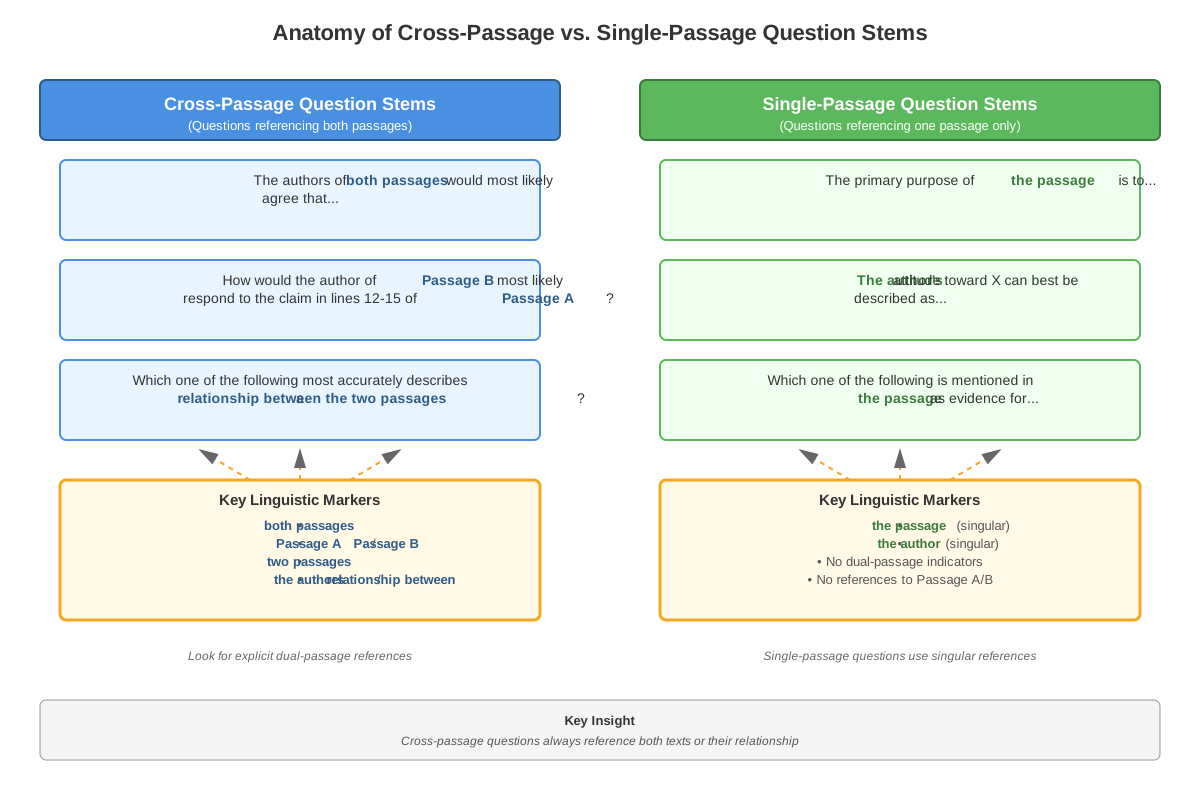
Cross-passage question stems are question prompts that explicitly require students to analyze, compare, or synthesize information from both passages in a Comparative Reading set. These stems are distinguished by language that references both passages simultaneously, using phrases like "both passages," "the authors would be most likely to agree," "Passage A differs from Passage B," or "the relationship between the two passages." The defining characteristic is that answering correctly requires engaging with content from both texts rather than focusing on a single passage.
The fundamental structure of these questions involves three components: (1) a clear signal that both passages are relevant, (2) a specific analytical task (comparing, contrasting, synthesizing), and (3) answer choices that require knowledge of both texts to evaluate. Unlike single-passage questions that may appear in the same Comparative Reading set, cross-passage questions cannot be answered accurately by reading only one passage—attempting to do so will lead to incorrect answers that may seem plausible based on partial information.
Types of Cross-Passage Question Stems
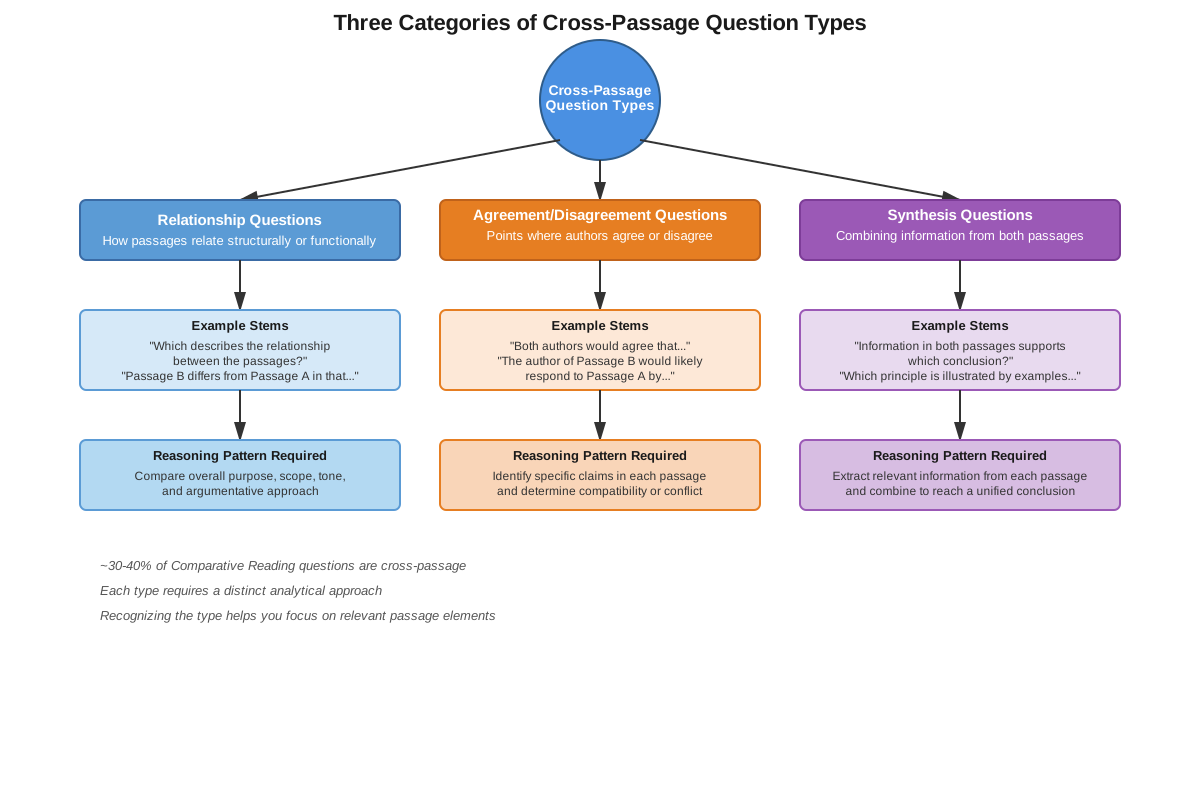
LSAT cross-passage question stems fall into several distinct categories, each testing different comparative reasoning skills:
| Question Type | Purpose | Common Stem Language | Cognitive Task |
|---|---|---|---|
| Agreement/Common Ground | Identify shared positions or principles | "Both passages mention/agree/support..." | Find overlap between texts |
| Disagreement/Contrast | Highlight differences in viewpoint or approach | "Unlike Passage A, Passage B..." | Identify divergent elements |
| Relationship/Structure | Describe how passages relate to each other | "Passage B relates to Passage A by..." | Characterize inter-textual connection |
| Response/Reaction | Predict how one author would view the other's claims | "The author of Passage A would most likely respond to Passage B by..." | Apply one perspective to another |
| Synthesis/Application | Apply a concept or principle to both passages | "Which principle is illustrated by both passages?" | Extract common underlying concept |
Agreement and Common Ground Questions
These questions ask students to identify what both passages share—whether that's a factual claim, an underlying assumption, a methodological approach, or a conclusion. The key challenge is distinguishing between genuine agreement (where both authors explicitly or implicitly endorse the same position) and superficial similarity (where both passages mention the same topic but take different stances).
Effective approach: Create a mental or written list of each passage's main claims, supporting points, and assumptions. Look for overlap at the level of principle rather than just topic. For example, two passages about climate change might both agree that "human activity affects global temperatures" even if they disagree about the severity or appropriate policy responses.
Disagreement and Contrast Questions
These stems highlight where passages diverge—in their conclusions, their evidence, their scope, their tone, or their underlying assumptions. The LSAT often tests whether students can identify subtle differences rather than obvious contradictions. For instance, one passage might address a broad question while the other focuses on a narrow subset of that question, or one might be prescriptive (arguing what should be done) while the other is descriptive (explaining what is the case).
Critical distinction: Disagreement doesn't require direct contradiction. Passages can disagree by emphasizing different aspects of an issue, by using different standards of evidence, or by addressing different questions entirely. The answer choices will often include traps that confuse "not mentioned in one passage" with "contradicted by one passage."
Relationship and Structural Questions
These questions ask students to characterize how the passages relate to each other at a structural or functional level. Common relationships include: one passage provides a concrete example of principles discussed abstractly in the other; one passage critiques or challenges the approach taken in the other; one passage offers historical context for contemporary issues discussed in the other; or both passages present competing solutions to a shared problem.
The key to these questions is stepping back from specific content to see the forest rather than the trees. Ask: What is each author trying to accomplish? How do these purposes relate? Is one passage more general or specific? More theoretical or practical? More optimistic or pessimistic?
Response and Reaction Questions
These sophisticated questions require students to extrapolate from one passage to predict how its author would respond to claims or arguments in the other passage. This demands deep comprehension of each author's perspective, values, and reasoning patterns. The correct answer must be consistent with everything stated in the first passage while accurately engaging with content from the second passage.
Strategy: Identify the relevant author's core commitments, methodological preferences, and explicit statements. Then evaluate each answer choice by asking: "Would this response align with what the author has already said? Does it accurately represent what's in the other passage?"
Synthesis and Application Questions
These questions ask students to identify principles, concepts, or patterns that apply to both passages, even if neither passage explicitly states them. This requires inferential reasoning and the ability to abstract from specific examples to general principles. For example, two passages about different historical events might both illustrate the principle that "technological change often outpaces regulatory adaptation."
The challenge here is avoiding answers that apply to only one passage or that are too broad to be meaningfully supported by both texts. The correct answer will be specific enough to be clearly demonstrated by both passages while general enough to encompass both.
Concept Relationships
The concepts within cross-passage question stems form a hierarchical and interconnected system. At the foundation lies passage comprehension—understanding each text individually in terms of main point, structure, tone, and supporting details. This foundational comprehension enables comparative analysis, which branches into three primary pathways: identifying similarities (agreement questions), identifying differences (contrast questions), and characterizing relationships (structural questions).
These three pathways converge in higher-order tasks: response questions require both understanding differences and predicting how those differences would manifest in dialogue between authors, while synthesis questions require identifying similarities at an abstract level that may not be explicitly stated. The relationship can be mapped as:
Individual Passage Comprehension → Comparative Analysis → branches into:
- Similarity Identification → Agreement Questions → Synthesis Questions
- Difference Identification → Contrast Questions → Response Questions
- Structural Analysis → Relationship Questions → informs all other question types
This topic connects to prerequisite knowledge of standard Reading Comprehension question types by adapting familiar question formats to a comparative context. For example, a standard "main point" question becomes "what would both authors agree is the main issue?" Similarly, inference questions become "what can be inferred about how Passage A relates to Passage B?"
The skills developed through mastering cross-passage question stems directly support success with other LSAT sections, particularly Logical Reasoning questions that require comparing arguments or identifying points of agreement and disagreement between speakers.
High-Yield Facts
⭐ Cross-passage questions always appear in the Comparative Reading set, which is one of the four Reading Comprehension passages on every LSAT.
⭐ Approximately 30-40% of questions in a Comparative Reading set are cross-passage questions, typically 3-4 questions out of 7-8 total.
⭐ The most common cross-passage question types are agreement/disagreement questions and relationship/structure questions.
⭐ Cross-passage question stems always contain explicit language referencing both passages, such as "both passages," "the two passages," "Passage A and Passage B," or "the authors."
⭐ Wrong answers to cross-passage questions frequently include statements that are true for only one passage but not both.
- Cross-passage questions cannot be answered correctly by reading only one passage, even if the answer seems plausible based on that single passage.
- The passages in Comparative Reading sets always share a common theme or topic but approach it from different perspectives, scopes, or purposes.
- Response questions ("How would the author of Passage A respond to Passage B?") require understanding not just what each passage says, but the reasoning patterns and values underlying each author's position.
- Synthesis questions often require identifying unstated principles or concepts that both passages illustrate through different examples.
- The order of cross-passage questions within a Comparative Reading set does not follow a predictable pattern—they may appear anywhere from the first question to the last.
Quick check — test yourself on Cross-passage question stems so far.
Try Flashcards →Common Misconceptions
Misconception: If both passages discuss the same topic, they must agree on fundamental points.
Correction: Passages can discuss the same topic while disagreeing on virtually every substantive point—the definition of the problem, its causes, its significance, and appropriate solutions. Topic overlap does not imply agreement.
Misconception: Cross-passage questions are always harder than single-passage questions in the same set.
Correction: Difficulty varies based on the specific question and the clarity of the passages. Some cross-passage questions (especially straightforward agreement questions) can be easier than complex inference questions about a single passage.
Misconception: To answer cross-passage questions efficiently, read both passages completely before looking at any questions.
Correction: While reading both passages first is necessary, the most efficient approach involves active reading with attention to potential comparison points, then using the question stems to guide focused re-reading of relevant sections.
Misconception: If a statement is true according to one passage and not contradicted by the other passage, it's something both passages agree on.
Correction: Agreement requires positive support from both passages. Silence or lack of contradiction in one passage does not constitute agreement—both passages must provide evidence supporting the claim.
Misconception: Response questions ask what one author would literally say to the other author.
Correction: Response questions ask what position or reaction would be consistent with one author's perspective when applied to the other passage's content. The answer must be inferrable from the passage, not a creative speculation about what the author might say.
Misconception: The correct answer to a relationship question will always describe the passages as disagreeing or contradicting each other.
Correction: Passages can relate in many ways beyond disagreement—one might provide an example of the other's theory, offer a different perspective on the same phenomenon, or address a related but distinct question. The relationship might be complementary rather than adversarial.
Worked Examples
Example 1: Agreement Question
Passage A Summary: Discusses how artificial intelligence systems can perpetuate historical biases present in their training data, arguing that developers must actively audit and correct these biases.
Passage B Summary: Examines how machine learning algorithms used in criminal justice have reproduced racial disparities, calling for greater transparency in algorithmic decision-making.
Question: The authors of both passages would be most likely to agree with which one of the following statements?
Answer Choices:
(A) Artificial intelligence systems should not be used in criminal justice contexts.
(B) Historical data always contains biases that cannot be corrected.
(C) Technology developers bear responsibility for addressing bias in automated systems.
(D) Transparency alone is sufficient to prevent algorithmic bias.
(E) Machine learning algorithms are inherently more objective than human decision-makers.
Analysis:
Step 1: Identify what each passage explicitly states or implies about responsibility and solutions.
- Passage A: States developers "must actively audit and correct" biases—this assigns responsibility to developers
- Passage B: Calls for "greater transparency"—this implies those creating/deploying systems should take action
Step 2: Evaluate each answer choice against both passages:
(A) Neither passage advocates for completely abandoning AI in any context; both suggest reforms rather than prohibition. Eliminate.
(B) Passage A explicitly argues biases "can" be corrected through active intervention, contradicting "cannot be corrected." Eliminate.
(C) Passage A directly assigns responsibility to developers ("must actively audit"). Passage B's call for transparency implies those controlling the systems (developers/deployers) should act. Both passages support this. Keep.
(D) Passage A emphasizes active correction beyond just transparency. Passage B calls for transparency but doesn't claim it's sufficient alone. Eliminate.
(E) Neither passage suggests algorithms are inherently more objective; both highlight how they reproduce biases. Eliminate.
Correct Answer: (C)
This question illustrates the agreement question type where the correct answer must be supported by evidence from both passages, even if they express the idea differently. The key was identifying the common principle (developer responsibility) underlying different specific recommendations (auditing vs. transparency).
Example 2: Relationship Question
Passage A Summary: Presents a theoretical framework for understanding how social movements gain momentum, identifying three key stages: emergence, coalescence, and institutionalization. Uses abstract language and draws on sociological theory.
Passage B Summary: Provides a detailed historical account of the environmental movement in the 1970s, describing specific events, organizations, and legislative achievements.
Question: Which one of the following most accurately describes the relationship between the two passages?
Answer Choices:
(A) Passage A proposes a theory that Passage B attempts to refute through counterexamples.
(B) Passage B provides a concrete historical example that illustrates the theoretical framework presented in Passage A.
(C) Passage A and Passage B present competing explanations for the same historical phenomenon.
(D) Passage B offers a more comprehensive analysis of social movements than the limited scope of Passage A.
(E) Passage A critiques the methodology used in historical studies like the one presented in Passage B.
Analysis:
Step 1: Characterize each passage's purpose and scope:
- Passage A: Theoretical, abstract, general framework applicable to many movements
- Passage B: Historical, concrete, specific to one movement and time period
Step 2: Identify the relationship:
- Does B challenge A? No indication of refutation or disagreement
- Does B exemplify A? The environmental movement could be analyzed using A's three-stage framework
- Do they compete? No—they operate at different levels of abstraction
- Does A critique B? No critical language indicated
Step 3: Evaluate answer choices:
(A) "Refute through counterexamples" requires Passage B to show A's framework doesn't work. No evidence of this. Eliminate.
(B) This describes a theory-to-example relationship, which matches the abstract-to-concrete pattern. The environmental movement's history could illustrate emergence, coalescence, and institutionalization. Keep.
(C) "Competing explanations" requires both to address the same specific phenomenon with different theories. A is general; B is specific. Eliminate.
(D) "More comprehensive" suggests B covers more ground than A, but they have different purposes—one is theoretical, one is historical. This misjudges the relationship. Eliminate.
(E) No indication that A critiques historical methodology. Eliminate.
Correct Answer: (B)
This relationship question requires recognizing how passages at different levels of abstraction relate to each other. The key insight is that theoretical frameworks and concrete examples have a complementary relationship—the example illustrates the theory without necessarily being explicitly connected in the text.
Exam Strategy
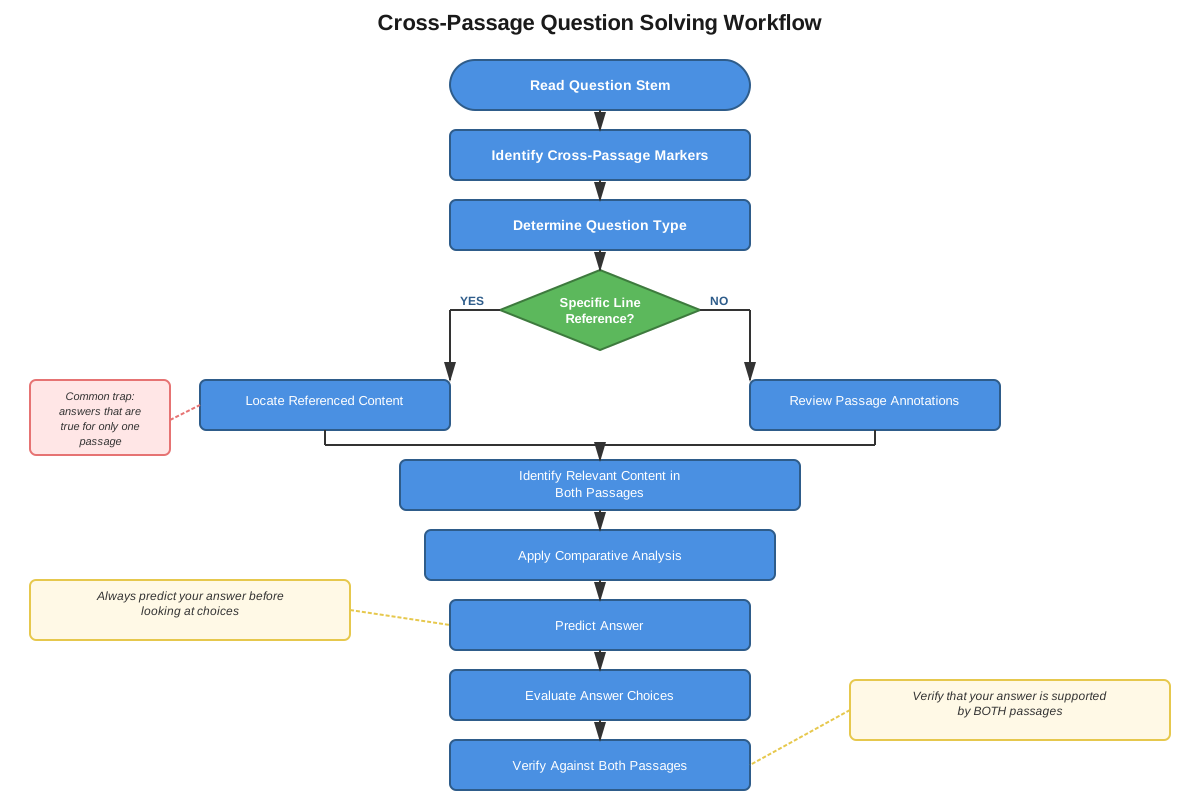
When approaching cross-passage questions on the LSAT, implement this systematic strategy:
Before Reading: Recognize that one of your four Reading Comprehension sets will be Comparative Reading. Budget approximately 8-9 minutes for this set, the same as other passages.
During Reading: As you read each passage, actively note:
- The main point and purpose of each passage
- The author's tone and attitude
- Key claims and supporting evidence
- Areas where the passages might overlap or diverge
Exam Tip: Create a simple two-column mental or written note system: "Passage A: [main point]" and "Passage B: [main point]" with 2-3 supporting details under each. This external memory aid prevents confusion when answering cross-passage questions.
Identifying Cross-Passage Questions: Look for these trigger words and phrases:
- "Both passages"
- "The two passages"
- "Passage A and Passage B"
- "The authors would most likely agree"
- "Unlike Passage A, Passage B"
- "The author of Passage A would most likely respond to Passage B"
- "Which one of the following is discussed in both passages"
Process of Elimination Strategy:
- Eliminate "one-passage-only" answers: The most common wrong answer type states something true about only one passage. Quickly check: Does this answer require information from both passages?
- Eliminate overgeneralizations: Answers that claim both passages "prove," "demonstrate conclusively," or "establish beyond doubt" are usually too strong unless both passages use emphatic language.
- Eliminate scope mismatches: For relationship questions, eliminate answers that mischaracterize the scope or purpose of either passage (e.g., calling a descriptive passage "prescriptive" or a specific passage "comprehensive").
- Verify positive support: For agreement questions, ensure both passages provide positive evidence for the answer, not just fail to contradict it.
Time Allocation: Don't spend disproportionate time on cross-passage questions. If a question requires extensive re-reading of both passages, mark it and return after completing easier questions. The strategic value of cross-passage questions is equal to single-passage questions—each is worth one point.
Common Trap Patterns:
- Answers that accurately describe one passage but mischaracterize the other
- Answers that describe what one passage says about the other passage's topic (rather than what both say)
- Answers that confuse "both passages mention X" with "both passages agree about X"
- For response questions: answers that represent a reasonable response but aren't supported by the passage's actual content
Memory Techniques
CROSS Acronym for Question Analysis:
- Compare the main points
- Recognize the relationship type
- Outline key differences
- Synthesize common ground
- Support must come from both passages
Visualization Strategy: Picture the two passages as two people having a conversation. For agreement questions, imagine what they'd nod their heads about together. For disagreement questions, imagine where they'd shake their heads at each other. For response questions, imagine one person responding to what the other just said.
The "Both Box" Technique: When reading, mentally create a "both box"—a space where you collect things that apply to both passages. As you read Passage B, actively ask: "Does Passage A also do this? Does Passage A also mention this? Would Passage A agree with this?" Items that go in the "both box" are prime material for cross-passage questions.
Relationship Types Mnemonic - "PACE":
- Parallel (both passages take similar approaches to similar topics)
- Application (one passage applies or exemplifies the other's principles)
- Contrast (passages take opposing views or different approaches)
- Extension (one passage extends, narrows, or broadens the other's scope)
For Response Questions - "WWAD" (What Would Author Do):
Think of the author as a character with consistent personality traits (their perspective, values, and reasoning patterns). Ask: "Based on everything this 'character' has said, how would they react to this new information?"
Summary
Cross-passage question stems are specialized question types within LSAT Comparative Reading that require students to analyze, compare, and synthesize information from two related passages. These questions appear consistently on every LSAT, comprising roughly 30-40% of questions in the Comparative Reading set. Success requires recognizing the distinctive language that signals cross-passage questions (references to "both passages," "the two passages," or "the authors"), understanding the five main question types (agreement, disagreement, relationship, response, and synthesis), and applying systematic strategies to avoid common traps. The most frequent errors involve selecting answers that accurately describe only one passage or confusing topic overlap with substantive agreement. Mastery demands active comparative reading, careful attention to what each passage actually states versus what it merely discusses, and the ability to hold multiple perspectives in mind simultaneously while analyzing their relationships.
Key Takeaways
- Cross-passage questions always contain explicit language referencing both passages and cannot be answered correctly using only one passage
- The five main types are agreement, disagreement, relationship, response, and synthesis questions, each requiring different analytical approaches
- The most common wrong answers describe only one passage accurately or confuse "mentioned in both" with "agreed upon by both"
- Effective strategy involves active comparative reading, creating mental or written notes about each passage's main point and key claims, and systematic elimination of one-passage-only answers
- Response questions require deep understanding of an author's reasoning patterns and values, not just their explicit statements
- Agreement requires positive support from both passages, not merely lack of contradiction in one passage
- Relationship questions demand stepping back from details to characterize how passages function relative to each other at a structural level
Related Topics
Single-Passage Questions in Comparative Reading: Understanding how to efficiently switch between cross-passage and single-passage questions within the same set, including recognizing question stems that reference only "Passage A" or "Passage B." Mastering cross-passage questions provides the foundation for this skill.
Author's Tone and Attitude in Comparative Contexts: Analyzing how authors' tones differ or align across passages, which frequently appears in cross-passage questions asking about the relationship between passages or how one author would respond to another.
Argument Structure and Reasoning Patterns: Deepening the ability to identify how arguments are constructed enables more sophisticated analysis of how passages relate to each other, particularly for response and synthesis questions.
Inference Questions Across Multiple Sources: Building on cross-passage skills to handle inference questions that require synthesizing unstated implications from both passages, a higher-order skill that combines inference and comparison.
Practice CTA
Now that you've mastered the conceptual framework for cross-passage question stems, it's time to put this knowledge into action. Attempt the practice questions and flashcards designed specifically for this topic—they'll help you recognize question types instantly, avoid common traps, and build the speed and accuracy needed for test day. Remember: cross-passage questions are high-yield opportunities for score improvement because they follow predictable patterns once you know what to look for. Each practice question you complete strengthens your ability to synthesize multiple perspectives efficiently, a skill that will serve you not just on the LSAT, but throughout your legal education and career. You've got this!
Sign up free to keep reading
Create a free AnvayaPrep account to finish this LSAT guide on Cross-passage question stems — plus flashcards and practice questions.