Overview
Passage B response to Passage A represents one of the most sophisticated and frequently tested question types within the comparative reading section of the LSAT Reading Comprehension. This question format requires test-takers to analyze how two distinct passages interact with each other, specifically focusing on how the second passage relates to, responds to, or engages with the ideas, arguments, or perspectives presented in the first passage. Unlike traditional single-passage questions that test comprehension in isolation, these questions demand a higher-order analytical skill: the ability to synthesize information across multiple texts and identify the nature of their intellectual relationship.
The LSAT introduced comparative reading passages in 2007, and since then, understanding how Passage B responds to Passage A has become essential for achieving competitive scores. These questions typically appear in one of the four Reading Comprehension sets on each LSAT, and they consistently account for 6-8 questions per test. The comparative format mirrors real-world legal analysis, where attorneys must evaluate competing arguments, reconcile conflicting authorities, or distinguish between similar but distinct legal principles. Mastering this skill demonstrates the kind of critical thinking that law schools value most highly.
Within the broader Reading Comprehension framework, lsat passage b response to passage a questions sit at the intersection of several key competencies: identifying main ideas, recognizing argumentative structure, understanding authorial tone and purpose, and synthesizing information across sources. These questions build upon foundational reading skills but elevate them by requiring students to think relationally rather than in isolation. Success with this topic directly enhances performance on questions about author agreement/disagreement, comparative purpose, and relationship characterization—all high-value question types that separate top scorers from average performers.
Learning Objectives
- [ ] Identify how Passage B response to Passage A appears in LSAT questions
- [ ] Explain the reasoning pattern behind Passage B response to Passage A
- [ ] Apply Passage B response to Passage A to solve LSAT-style problems accurately
- [ ] Distinguish between different types of responses (support, critique, qualification, extension, alternative perspective)
- [ ] Recognize trigger language in question stems that signals a Passage B response question
- [ ] Evaluate answer choices by mapping specific textual evidence from both passages
- [ ] Predict the most likely response relationship before reviewing answer choices
Prerequisites
- Basic passage comprehension skills: Understanding main ideas, supporting details, and argumentative structure within a single passage is essential because comparative analysis builds upon these foundational abilities
- Familiarity with author's purpose and tone: Recognizing whether an author is arguing, explaining, critiquing, or proposing enables accurate identification of how passages relate to each other
- Understanding of logical relationships: Knowledge of concepts like support, contradiction, qualification, and analogy provides the framework for categorizing how Passage B responds to Passage A
- Experience with standard Reading Comprehension question types: Comfort with inference, main idea, and detail questions establishes the baseline skills needed for more complex comparative questions
Why This Topic Matters
Understanding how Passage B responds to Passage A is not merely an academic exercise—it reflects the core analytical work that legal professionals perform daily. Attorneys regularly encounter situations where they must evaluate how one court's opinion responds to precedent, how a dissenting opinion relates to the majority view, or how competing scholarly interpretations address the same legal question. The LSAT tests this skill because it predicts success in law school seminars, legal writing, and ultimately, legal practice.
From an exam perspective, this topic appears with remarkable consistency. Every LSAT contains exactly one comparative reading set, comprising approximately 13-15% of all Reading Comprehension questions. Within that set, 2-4 questions typically focus specifically on how Passage B responds to Passage A. These questions carry the same weight as any other Reading Comprehension question, but they often prove more challenging because they require synthesizing information across two distinct texts while maintaining awareness of subtle differences in perspective, emphasis, or approach.
Common manifestations of this topic include questions asking how the author of Passage B would likely respond to a claim in Passage A, how Passage B's approach differs from Passage A's methodology, what criticism the author of Passage B might raise about Passage A's argument, or how Passage B's evidence relates to Passage A's thesis. The passages themselves typically present related but distinct perspectives on a shared topic—for example, two different approaches to environmental regulation, competing theories about artistic interpretation, or contrasting views on scientific methodology. The relationship between passages can range from direct opposition to subtle qualification, from supportive extension to alternative framing of the same issue.
Core Concepts
Types of Response Relationships
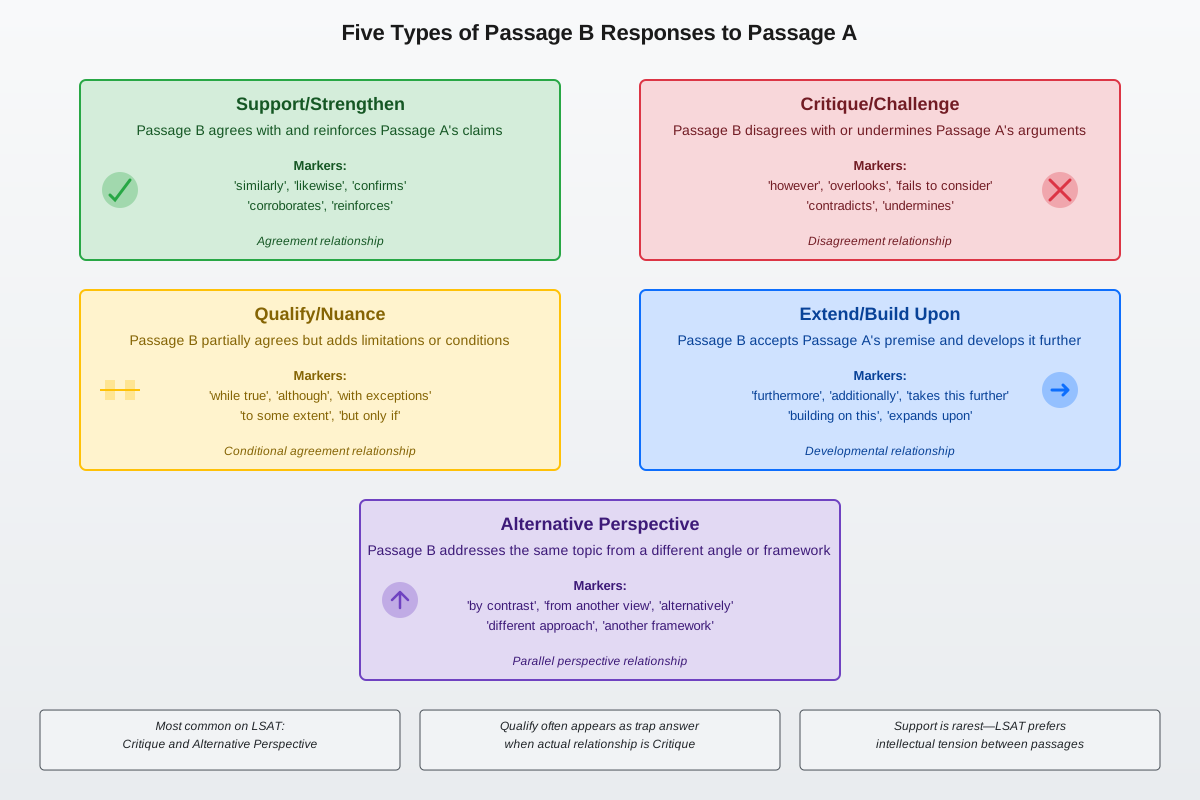
The foundation of mastering passage b response to passage a questions lies in recognizing that passages can relate to each other in several distinct ways. The LSAT most commonly presents five primary response relationships:
Direct Support or Agreement: Passage B reinforces, corroborates, or provides additional evidence for claims made in Passage A. Both passages align in their fundamental conclusions, though they may approach the topic from different angles or emphasize different aspects. For example, if Passage A argues that judicial activism undermines democratic principles, Passage B might provide historical examples that demonstrate this effect.
Critique or Opposition: Passage B challenges, refutes, or presents counterarguments to positions taken in Passage A. This relationship involves substantive disagreement about facts, interpretations, or conclusions. The critique may be comprehensive (rejecting Passage A's entire framework) or targeted (disputing specific claims while accepting others).
Qualification or Nuancing: Passage B accepts the general thrust of Passage A but introduces limitations, exceptions, or conditions that modify its claims. This relationship is more subtle than outright opposition—Passage B doesn't reject Passage A but rather suggests its conclusions are too broad, too narrow, or require contextual refinement.
Extension or Development: Passage B builds upon ideas introduced in Passage A, taking them further, applying them to new contexts, or exploring implications not addressed in the first passage. The passages share common ground, but Passage B moves beyond where Passage A stops.
Alternative Perspective or Reframing: Passage B addresses the same topic as Passage A but from a fundamentally different angle, using different assumptions, methodologies, or frameworks. Neither passage necessarily contradicts the other; instead, they offer complementary or parallel analyses that illuminate different facets of the issue.
Identifying Response Patterns Through Textual Evidence
Successful identification of how Passage B responds to Passage A requires systematic attention to specific textual markers. The opening sentences of Passage B often signal the relationship explicitly through transitional language. Phrases like "however," "nevertheless," or "despite these claims" indicate opposition or qualification. Conversely, phrases like "similarly," "this approach is further supported by," or "building on this foundation" suggest agreement or extension.
Beyond explicit transitions, the structural organization of Passage B provides crucial clues. If Passage B systematically addresses the same subtopics as Passage A in the same order, the author is likely engaging directly with Passage A's framework—either to support or critique it. If Passage B introduces entirely new categories of analysis or reorganizes the topic differently, this suggests an alternative perspective rather than direct engagement.
The tone and language choices in Passage B also reveal the nature of the response. Critical language ("overlooks," "fails to consider," "mistakenly assumes") signals opposition. Conditional language ("while this may be true in some cases," "under certain circumstances") indicates qualification. Enthusiastic or reinforcing language ("convincingly demonstrates," "provides compelling evidence") suggests support.
Question Stem Recognition and Interpretation
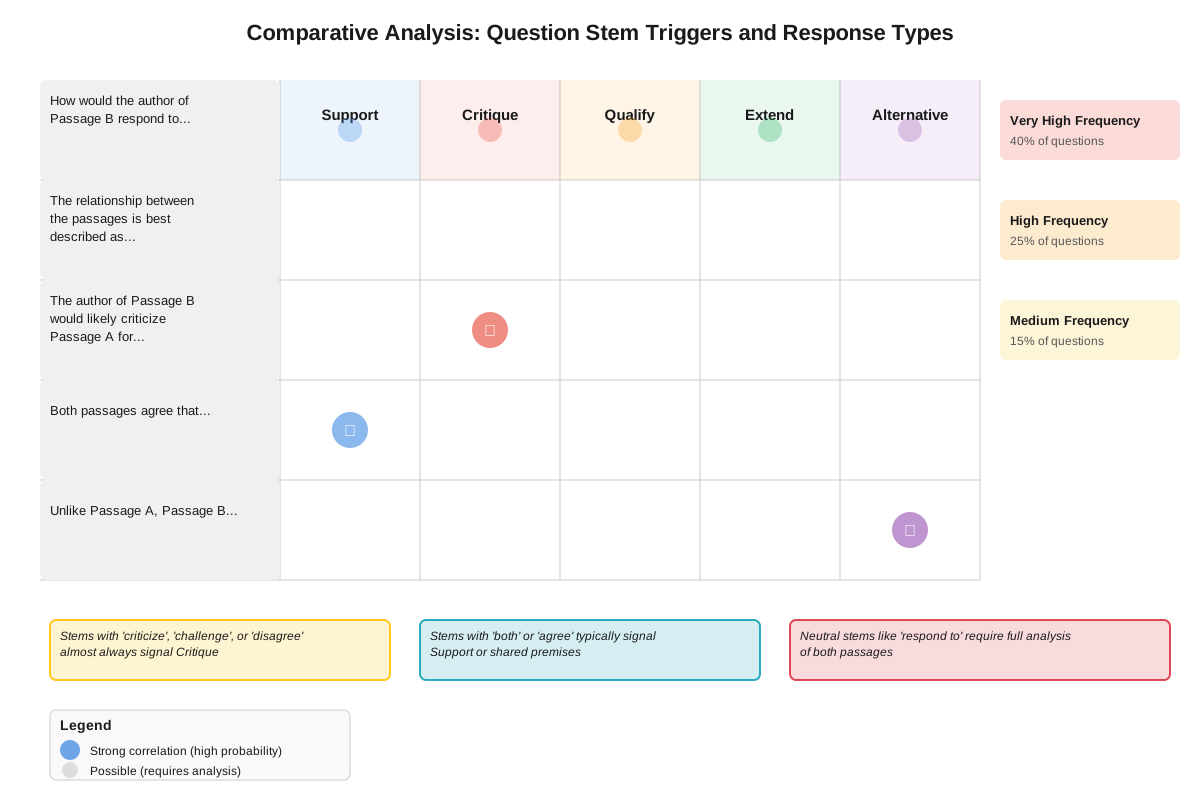
Lsat passage b response to passage a questions employ distinctive question stem formulations that test-takers must recognize instantly. Common phrasings include:
- "The author of Passage B would most likely respond to the claim in lines X-Y of Passage A by..."
- "How would the author of Passage B most likely characterize the approach taken in Passage A?"
- "The relationship between Passage B and Passage A is most analogous to..."
- "Which of the following best describes how Passage B responds to the central argument of Passage A?"
- "The author of Passage B would most likely criticize Passage A for..."
Each formulation requires slightly different analytical work. Questions asking how an author "would respond" require inference about unstated positions based on the author's demonstrated perspective. Questions asking about "characterization" focus on how one author would describe or categorize the other's approach. Questions about "relationship" require identifying the overall pattern of interaction between the passages.
Mapping Evidence Across Passages
The most reliable method for answering these questions involves creating a mental or physical map of corresponding elements across both passages. This process includes:
- Identifying parallel claims: Note where both passages address the same specific issue, even if they reach different conclusions
- Tracking supporting evidence: Observe what types of evidence each passage uses (empirical data, logical reasoning, historical examples, theoretical frameworks)
- Comparing scope and emphasis: Recognize where passages differ in how broadly or narrowly they frame the issue
- Noting explicit references: Pay special attention when Passage B explicitly mentions concepts, terms, or approaches from Passage A
- Evaluating underlying assumptions: Identify the foundational premises each author accepts or rejects
This mapping process enables precise prediction of correct answers before reviewing the options, significantly improving accuracy and speed.
Common Response Patterns by Topic Area
Different subject areas in LSAT reading comprehension tend to feature characteristic response patterns. Scientific passages often present Passage B as offering an alternative hypothesis or methodology to Passage A's approach. Legal and political passages frequently feature Passage B critiquing or qualifying Passage A's normative claims. Humanities passages commonly present complementary perspectives that illuminate different aspects of the same phenomenon.
Recognizing these patterns helps test-takers anticipate likely relationships and formulate predictions more efficiently. However, the LSAT deliberately includes variations to prevent over-reliance on patterns, so textual evidence must always take precedence over pattern recognition.
Concept Relationships
The concepts within this topic form an interconnected analytical framework. Understanding types of response relationships provides the categorical structure for analysis, while identifying response patterns through textual evidence supplies the practical methodology for determining which category applies. These two concepts work together: the categories give meaning to the textual evidence, while the evidence determines which category fits.
Question stem recognition serves as the entry point to the analytical process—it determines what specific aspect of the response relationship the question targets. This recognition then directs attention to the relevant mapping evidence across passages, which provides the specific textual support needed to evaluate answer choices. Finally, awareness of common response patterns by topic area functions as a heuristic that accelerates analysis without replacing careful textual examination.
The relationship to prerequisite knowledge is equally important. Basic passage comprehension skills enable accurate understanding of each passage individually, which is necessary before analyzing their relationship. Understanding author's purpose and tone provides the attitudinal context that often determines whether a response is supportive, critical, or neutral. Knowledge of logical relationships supplies the vocabulary and conceptual framework for categorizing responses.
This topic also connects forward to more advanced comparative reading skills, such as identifying points of agreement and disagreement, evaluating the relative strength of competing arguments, and synthesizing information across passages to answer inference questions. Mastery of how Passage B responds to Passage A creates the foundation for these higher-order tasks.
Conceptual Flow: Question Stem Recognition → Passage Comprehension (individual) → Response Relationship Identification → Evidence Mapping → Answer Choice Evaluation → Verification Against Text
High-Yield Facts
⭐ Every LSAT contains exactly one comparative reading set with two shorter passages instead of one long passage
⭐ Questions asking how Passage B responds to Passage A typically comprise 2-4 questions per comparative set
⭐ The five primary response relationships are: support, critique, qualification, extension, and alternative perspective
⭐ Opening sentences and transitions in Passage B most reliably signal the nature of the response relationship
⭐ Correct answers to response questions must be supported by specific textual evidence from both passages
- Questions may ask about the author's likely response to claims not explicitly addressed in the passage, requiring inference from stated positions
- Passage B may respond differently to different aspects of Passage A (supporting some claims while critiquing others)
- The most common wrong answer type is one that accurately describes Passage B but doesn't address its relationship to Passage A
- Tone and language intensity in Passage B provide crucial clues about whether the response is strongly oppositional, mildly qualifying, or supportive
- Response relationships can operate at multiple levels: Passage B might agree with Passage A's conclusion while critiquing its methodology
- Questions about "how the author of Passage B would characterize" Passage A require attention to Passage B's explicit or implicit evaluative language
- The LSAT often pairs passages where the response relationship is nuanced rather than simple agreement or disagreement
- Structural parallelism (both passages addressing the same subtopics in similar order) usually indicates direct engagement rather than alternative perspective
- When Passage B introduces entirely new evidence or examples, determine whether they support, challenge, or extend Passage A's claims
- Time pressure makes it tempting to rely on general impressions, but precise textual mapping is essential for accuracy
Quick check — test yourself on Passage B response to Passage A so far.
Try Flashcards →Common Misconceptions
Misconception: If Passage B discusses the same topic as Passage A, it must be responding directly to Passage A's specific claims.
Correction: Passages can address the same general topic while offering alternative perspectives that don't directly engage with each other's specific arguments. The response relationship requires explicit or implicit interaction, not merely shared subject matter.
Misconception: A response relationship must be consistent throughout—if Passage B critiques one aspect of Passage A, it must critique all aspects.
Correction: Response relationships can be multifaceted. Passage B might support Passage A's general conclusion while critiquing its methodology, or accept some claims while rejecting others. The LSAT frequently tests the ability to recognize these nuanced relationships.
Misconception: Strong language in Passage B always indicates opposition to Passage A.
Correction: Strong language can indicate passionate support as well as critique. The direction of the language (toward or against Passage A's position) matters more than its intensity. "Convincingly demonstrates" is strong language indicating support, while "seriously overlooks" is strong language indicating critique.
Misconception: The correct answer to a response question will always use language that appears explicitly in Passage B.
Correction: Correct answers often require inference from Passage B's stated positions to unstated implications. If Passage B argues that economic factors determine policy outcomes, the author would likely critique Passage A's emphasis on ideological factors, even if Passage B never explicitly mentions ideology.
Misconception: If both passages reach similar conclusions, Passage B must be supporting Passage A.
Correction: Passages can reach similar conclusions through different reasoning paths, representing alternative perspectives rather than mutual support. The response relationship depends on how the passages interact, not merely whether they agree on outcomes.
Misconception: Response questions always ask about Passage B's relationship to Passage A, never the reverse.
Correction: While questions more commonly ask about Passage B's response to Passage A (since Passage B comes second and can respond to what came before), some questions ask how Passage A would respond to Passage B or how the authors would respond to each other. The analytical process remains the same regardless of direction.
Misconception: The response relationship is always stated explicitly in Passage B's opening sentences.
Correction: While opening sentences often provide valuable clues, the full response relationship may only become clear through careful analysis of the entire passage. Some passages deliberately withhold explicit statement of the relationship, requiring readers to infer it from the overall argument structure and evidence presented.
Worked Examples
Example 1: Critique Relationship
Passage A Summary: Argues that mandatory minimum sentencing laws effectively deter crime by ensuring swift, certain punishment. Cites statistical correlations between implementation of such laws and crime rate reductions in several jurisdictions.
Passage B Summary: Discusses how crime rate reductions in the 1990s resulted from demographic changes (aging population) and economic factors (employment growth) rather than sentencing policy changes. Notes that jurisdictions without mandatory minimums experienced similar crime reductions.
Question: The author of Passage B would most likely respond to the statistical evidence presented in Passage A by:
Analysis Process:
- Identify Passage A's claim: Mandatory minimums caused crime reduction (supported by correlation data)
- Identify Passage B's relevant position: Crime reduction had alternative causes (demographics, economics); correlation doesn't prove causation
- Determine response type: Critique—Passage B challenges Passage A's causal interpretation
- Map specific evidence: Passage B's point about jurisdictions without mandatory minimums experiencing similar reductions directly undermines Passage A's causal claim
- Predict answer: Passage B would argue that Passage A's statistics show correlation but don't establish causation; alternative explanations account for the observed patterns
Correct Answer Type: "Pointing out that the correlation identified in Passage A does not establish a causal relationship and that alternative factors better explain the observed crime reduction"
Why This Works: The answer precisely captures how Passage B's evidence and reasoning challenge Passage A's interpretation without disputing the underlying statistics themselves. This demonstrates the nuanced nature of critique—Passage B doesn't claim Passage A's data is false, but rather that Passage A draws unwarranted conclusions from it.
Example 2: Qualification Relationship
Passage A Summary: Argues that artificial intelligence systems can now perform medical diagnoses more accurately than human physicians, citing studies showing higher accuracy rates for AI in identifying certain cancers from imaging data. Suggests AI should replace human judgment in diagnostic contexts.
Passage B Summary: Discusses how AI diagnostic systems excel at pattern recognition in well-defined contexts with large training datasets but struggle with unusual presentations, rare conditions, and cases requiring integration of diverse information sources. Emphasizes the continued importance of human clinical judgment for complex cases while acknowledging AI's value for routine screenings.
Question: Which of the following best characterizes the relationship between Passage B and Passage A?
Analysis Process:
- Identify Passage A's scope: Broad claim about AI superiority and replacement of human physicians
- Identify Passage B's scope: Conditional acceptance—AI superior in specific contexts but not universally
- Determine response type: Qualification—Passage B accepts part of Passage A's claim but introduces important limitations
- Note key differences: Passage A makes categorical claims; Passage B distinguishes between contexts where claims hold and where they don't
- Predict answer: Passage B qualifies or limits Passage A's claims by introducing contextual conditions
Correct Answer Type: "Passage B accepts the validity of Passage A's claims in certain contexts but argues that Passage A overgeneralizes by failing to distinguish between routine and complex diagnostic scenarios"
Why This Works: The answer captures the qualifying nature of the relationship—Passage B neither fully supports nor completely opposes Passage A. Instead, it introduces nuance by identifying conditions under which Passage A's claims hold and conditions under which they don't. This represents one of the most sophisticated and frequently tested response relationships on the LSAT.
Exam Strategy
Systematic Approach to Response Questions
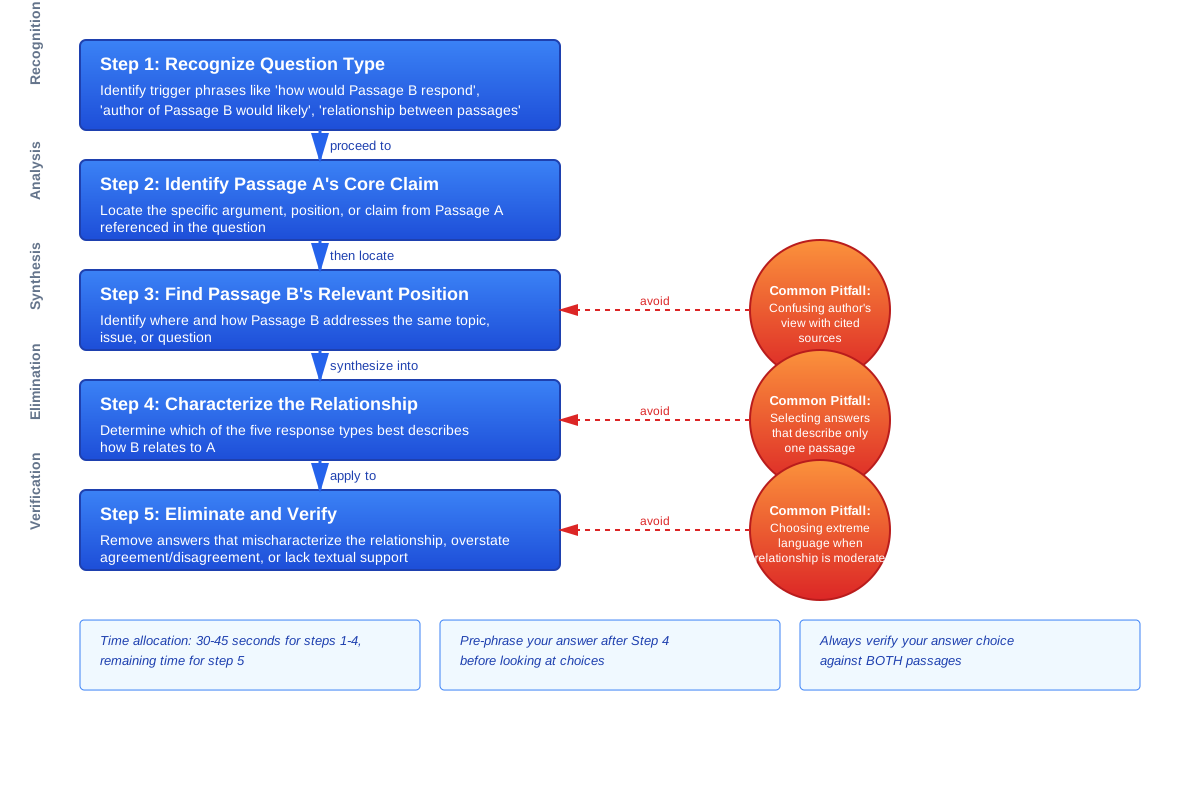
When encountering a passage b response to passage a question, implement this strategic sequence:
Step 1: Identify the specific claim or aspect of Passage A referenced in the question. If the question cites line numbers, reread those lines carefully. If it references "the central argument" or "the approach taken," recall your understanding of Passage A's main point and methodology.
Step 2: Locate Passage B's relevant position on the same issue. This may be explicitly stated or may require inference from Passage B's overall argument. Look for places where Passage B addresses the same topic, uses similar terminology, or discusses related concepts.
Step 3: Characterize the relationship using the five primary categories (support, critique, qualification, extension, alternative perspective). Be specific: if it's critique, what exactly is being criticized? If it's qualification, what limitation is being introduced?
Step 4: Predict the answer before reviewing choices. Formulate in your own words how Passage B responds, then look for the answer choice that matches your prediction.
Step 5: Eliminate answers that fail the "both passages" test. Wrong answers often accurately describe Passage B but don't address its relationship to Passage A, or they mischaracterize Passage A's position.
Trigger Words and Phrases
Question stems containing these phrases signal response questions:
- "would most likely respond"
- "would most likely characterize"
- "would most likely criticize/challenge/object to"
- "relationship between Passage B and Passage A"
- "how does Passage B's approach differ from"
- "the author of Passage B would probably agree with which criticism of Passage A"
In answer choices, watch for language indicating relationship types:
- Support indicators: "reinforces," "provides additional evidence for," "corroborates," "supports the conclusion that"
- Critique indicators: "challenges," "undermines," "calls into question," "overlooks," "fails to consider"
- Qualification indicators: "while accepting... introduces limitations," "applies only in certain contexts," "overgeneralizes," "requires modification"
- Extension indicators: "builds upon," "takes further," "explores implications of"
- Alternative perspective indicators: "offers a different framework," "approaches from another angle," "reframes the issue"
Process of Elimination Strategies
Eliminate answers that describe only one passage: If an answer choice accurately characterizes Passage B but says nothing about its relationship to Passage A, it's wrong—even if everything it says is true.
Eliminate answers that mischaracterize either passage: Before an answer can correctly describe a relationship, it must accurately represent both passages. If an answer attributes a position to Passage A that Passage A doesn't hold, eliminate it immediately.
Eliminate answers that describe the wrong type of relationship: If you've determined that Passage B qualifies Passage A's claims, eliminate answers suggesting complete agreement or total opposition.
Eliminate extreme answers when the relationship is nuanced: Words like "entirely," "completely," "totally rejects," or "fully endorses" are often too strong for the subtle relationships the LSAT favors.
Eliminate answers that reverse the relationship: Some wrong answers correctly identify the type of relationship but reverse which passage takes which position.
Time Allocation
Comparative reading sets deserve slightly more time than single-passage sets due to their complexity. Allocate approximately 4 minutes for reading both passages (2 minutes each) and 6-7 minutes for answering questions (about 1 minute per question, with response questions potentially requiring slightly more time).
For response questions specifically, invest the time to locate precise textual support before selecting an answer. Rushing through these questions leads to errors that careful analysis would prevent. If you find yourself uncertain between two answers, return to the passages and identify specific evidence that supports or contradicts each option.
Memory Techniques
The SCQEA Mnemonic
Remember the five primary response relationships using SCQEA:
- Support
- Critique
- Qualification
- Extension
- Alternative perspective
Visualize these as positions on a spectrum from agreement to disagreement, with qualification in the middle, and alternative perspective as a separate dimension.
The "Conversation" Visualization
Imagine Passage A and Passage B as two people having a conversation. Passage A speaks first, making claims and presenting evidence. When Passage B speaks, visualize the response:
- Nodding in agreement = Support
- Shaking head in disagreement = Critique
- Holding up one finger ("yes, but...") = Qualification
- Leaning forward eagerly ("and furthermore...") = Extension
- Turning to address the audience from a different angle = Alternative perspective
This visualization helps maintain awareness that you're analyzing a relationship, not just comprehending isolated passages.
The "Evidence Bridge" Technique
For each response question, mentally construct a bridge connecting specific evidence from Passage A to specific evidence from Passage B. The nature of this bridge (supportive, contradictory, conditional, etc.) determines the answer. Visualize writing the evidence from each passage on opposite sides of a page and drawing arrows between related points, labeling each arrow with the relationship type.
The Opening Sentence Anchor
Create a habit of paying special attention to Passage B's opening sentence and mentally categorizing it immediately:
- Agreement opening: "This approach is further supported by..."
- Critique opening: "However, this analysis overlooks..."
- Qualification opening: "While these claims have merit in certain contexts..."
- Extension opening: "Building on this foundation..."
- Alternative opening: "A different perspective emerges when..."
Anchoring your analysis with this initial categorization provides a framework for understanding the entire passage.
Summary
Mastering how Passage B responds to Passage A requires synthesizing multiple analytical skills: accurate comprehension of each passage individually, recognition of the five primary response relationship types (support, critique, qualification, extension, and alternative perspective), systematic mapping of evidence across passages, and precise evaluation of answer choices against textual support. Success depends on moving beyond general impressions to identify specific textual markers—opening transitions, structural parallelism, tone indicators, and explicit references—that reveal the nature of the response. Questions testing this skill appear consistently on every LSAT, typically comprising 2-4 questions per comparative reading set, and they reward careful, methodical analysis over rushed intuition. The key to accuracy lies in predicting the response relationship before reviewing answer choices, then eliminating options that fail to accurately characterize both passages or that describe the wrong relationship type. This topic represents not merely an exam skill but a fundamental legal competency: the ability to evaluate how different authorities, arguments, or perspectives relate to each other—a skill that defines success in law school and legal practice.
Key Takeaways
- Passage B response to Passage A questions test the ability to identify and characterize how two passages interact, requiring synthesis across texts rather than isolated comprehension
- The five primary response relationships—support, critique, qualification, extension, and alternative perspective—provide the categorical framework for analyzing passage interactions
- Opening sentences, transitions, structural organization, and tone in Passage B provide the most reliable textual evidence for determining the response relationship
- Correct answers must be supported by specific evidence from both passages and accurately characterize the relationship type, not merely describe one passage in isolation
- Systematic evidence mapping—identifying parallel claims, comparing supporting evidence, and noting explicit references—enables accurate prediction of correct answers before reviewing options
- Response relationships can be nuanced and multifaceted, with Passage B potentially supporting some aspects of Passage A while critiquing others
- Time invested in careful textual analysis of response questions yields higher accuracy than rushing to judgment based on general impressions
Related Topics
Points of Agreement and Disagreement: Building on response relationship analysis, this topic focuses specifically on identifying precise claims where passage authors align or diverge, requiring even more granular textual mapping.
Comparative Purpose and Methodology: Understanding how passages differ in their goals (persuading vs. explaining vs. analyzing) and approaches (empirical vs. theoretical vs. historical) deepens comprehension of response relationships.
Synthesis Questions: Advanced comparative questions that require combining information from both passages to answer inference questions or evaluate new scenarios, building directly on response relationship mastery.
Author's Attitude and Tone: Recognizing subtle differences in how authors express their positions (confident vs. tentative, critical vs. neutral) enhances ability to characterize response relationships accurately.
Argument Structure Analysis: Understanding how authors construct arguments—identifying premises, conclusions, assumptions, and evidence—provides the foundation for recognizing how one argument responds to another.
Practice CTA
Now that you've mastered the conceptual framework for analyzing how Passage B responds to Passage A, it's time to apply these skills to actual LSAT passages. The practice questions and flashcards will challenge you to identify response relationships under timed conditions, distinguish between subtle answer choices, and build the pattern recognition that separates good scores from great ones. Remember: every comparative reading set you practice strengthens not just your test-taking ability but the analytical skills that will serve you throughout law school and your legal career. Approach each practice passage as an opportunity to refine your evidence-mapping technique and deepen your understanding of how sophisticated arguments interact. You've built the foundation—now construct mastery through deliberate practice.
Sign up free to keep reading
Create a free AnvayaPrep account to finish this LSAT guide on Passage B response to Passage A — plus flashcards and practice questions.