Overview
The relationship between passages is a critical skill tested in the LSAT's Reading Comprehension section, specifically within Comparative Reading questions. Since 2007, the LSAT has consistently included one comparative reading set in each exam, presenting two shorter passages (Passage A and Passage B) that address related topics from different perspectives, methodologies, or conclusions. Understanding how these passages relate to one another—whether they agree, disagree, complement, or challenge each other—is essential for answering approximately 20-25% of all Reading Comprehension questions correctly.
Mastering the LSAT relationship between passages requires more than simply reading two texts sequentially. Test-takers must actively analyze how authors position their arguments relative to one another, identify points of convergence and divergence, and recognize subtle distinctions in tone, scope, and purpose. This skill demands simultaneous consideration of multiple viewpoints while maintaining clarity about each author's individual stance. The ability to synthesize information across passages and evaluate their interaction represents a higher-order cognitive task that the LSAT uses to differentiate top performers from average test-takers.
Within the broader reading comprehension framework, comparative reading builds upon foundational skills like identifying main ideas, understanding author's purpose, and recognizing argumentative structure. However, it adds an additional analytical layer by requiring students to construct a mental framework that encompasses both passages simultaneously. This topic connects directly to logical reasoning skills tested elsewhere on the LSAT, as students must evaluate how different arguments support, undermine, or modify one another—a skill equally valuable in the Arguments section and in legal practice itself.
Learning Objectives
- [ ] Identify how relationship between passages appears in LSAT questions
- [ ] Explain the reasoning pattern behind relationship between passages
- [ ] Apply relationship between passages to solve LSAT-style problems accurately
- [ ] Distinguish between different types of passage relationships (agreement, disagreement, complementary, extension)
- [ ] Analyze how specific details from one passage relate to claims in another passage
- [ ] Evaluate the relative strength of arguments across paired passages
- [ ] Synthesize information from both passages to answer inference questions
Prerequisites
- Main Idea Identification: Understanding the central claim of a passage is essential because comparative questions often ask how the main ideas of two passages relate to one another.
- Author's Purpose and Tone: Recognizing why an author wrote a passage and their attitude toward the subject enables comparison of authorial intent across passages.
- Argument Structure: Familiarity with how premises support conclusions allows students to compare the logical frameworks employed in different passages.
- Evidence Evaluation: The ability to assess how authors use evidence is necessary for determining whether passages support or challenge each other's claims.
Why This Topic Matters
In legal practice, attorneys constantly evaluate multiple perspectives on the same issue—comparing precedents, weighing competing interpretations of statutes, and synthesizing arguments from various sources. The comparative reading section directly simulates this professional skill by requiring test-takers to hold multiple viewpoints in mind simultaneously while assessing their relationships. Law school coursework relies heavily on this ability, as students must reconcile conflicting judicial opinions, compare scholarly interpretations, and understand how different legal theories interact.
On the LSAT, comparative reading appears in exactly one of the four Reading Comprehension passages on every exam, typically containing 6-8 questions. Approximately 40-50% of these questions explicitly test the relationship between passages, making this the highest-yield skill within comparative reading. Questions may ask test-takers to identify points of agreement or disagreement, determine how one author would respond to the other's argument, or recognize which concepts appear in both passages versus only one.
Common manifestations include passages presenting: two scientific theories addressing the same phenomenon; historical interpretations of the same event; legal arguments for opposing sides of a case; artistic critiques from different schools of thought; or policy proposals offering alternative solutions to the same problem. The passages typically range from 450-550 total words combined, with each individual passage being shorter than standard single passages but requiring equal or greater analytical effort due to the comparative dimension.
Core Concepts
Types of Passage Relationships
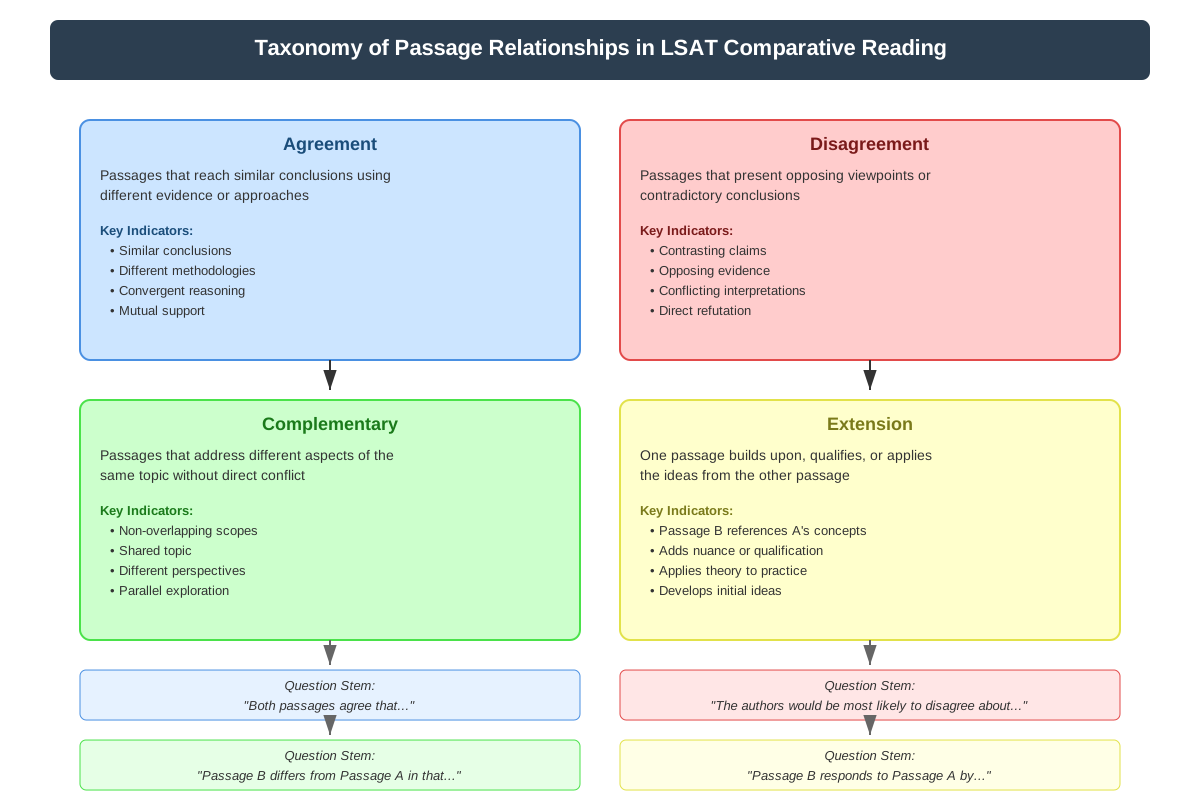
The relationship between passages on the LSAT falls into several distinct categories that test-takers must quickly identify. Understanding these relationship types provides a framework for organizing information and predicting question types.
Agreement/Support Relationships occur when both passages advance similar conclusions, though they may use different evidence or reasoning paths. Passage A might present empirical data supporting a theory, while Passage B offers theoretical justification for the same conclusion. These passages reinforce rather than challenge each other, though they maintain distinct approaches or emphases.
Disagreement/Opposition Relationships represent the most common comparative structure, where passages take conflicting positions on a central issue. One passage might argue for a policy while the other opposes it, or they might offer competing explanations for the same phenomenon. The disagreement may be fundamental (contradictory conclusions) or nuanced (different interpretations of shared evidence).
Complementary Relationships exist when passages address different aspects of the same topic without directly contradicting each other. Passage A might discuss the historical context of an issue while Passage B examines its contemporary implications. These passages fit together like puzzle pieces, each contributing unique information to a broader understanding.
Extension/Modification Relationships occur when one passage builds upon, qualifies, or refines ideas presented in the other. Passage B might accept Passage A's basic premise but argue for limitations, exceptions, or additional considerations. This relationship type requires careful attention to scope and degree of agreement.
Analytical Framework for Comparison
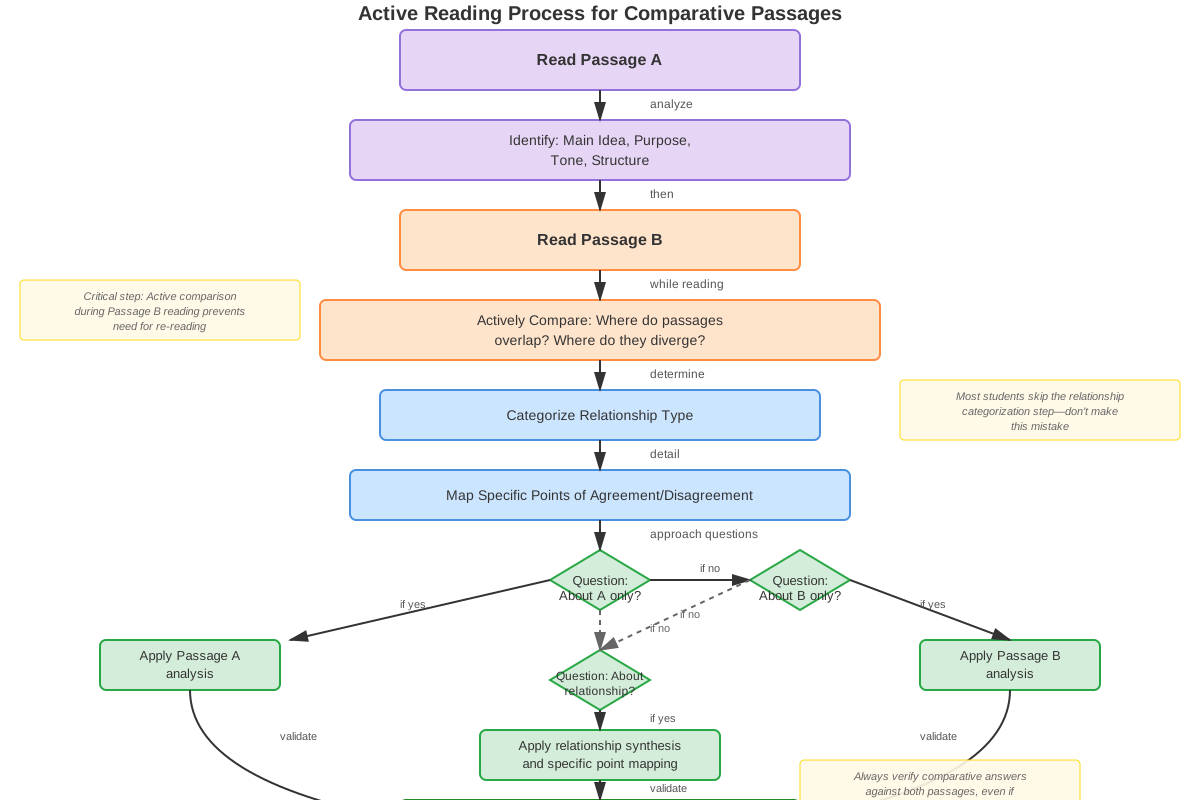
Successful comparative reading requires a systematic approach to analyzing passage relationships. The framework below guides efficient processing of paired passages:
Step 1: Individual Comprehension - Read each passage independently first, identifying the main point, author's purpose, tone, and key supporting evidence. Resist the temptation to compare while reading; establish a solid understanding of each passage's standalone argument.
Step 2: Relationship Identification - After reading both passages, explicitly articulate their relationship type. Ask: Do they agree or disagree? On what specific points? Where do they overlap, and where do they diverge?
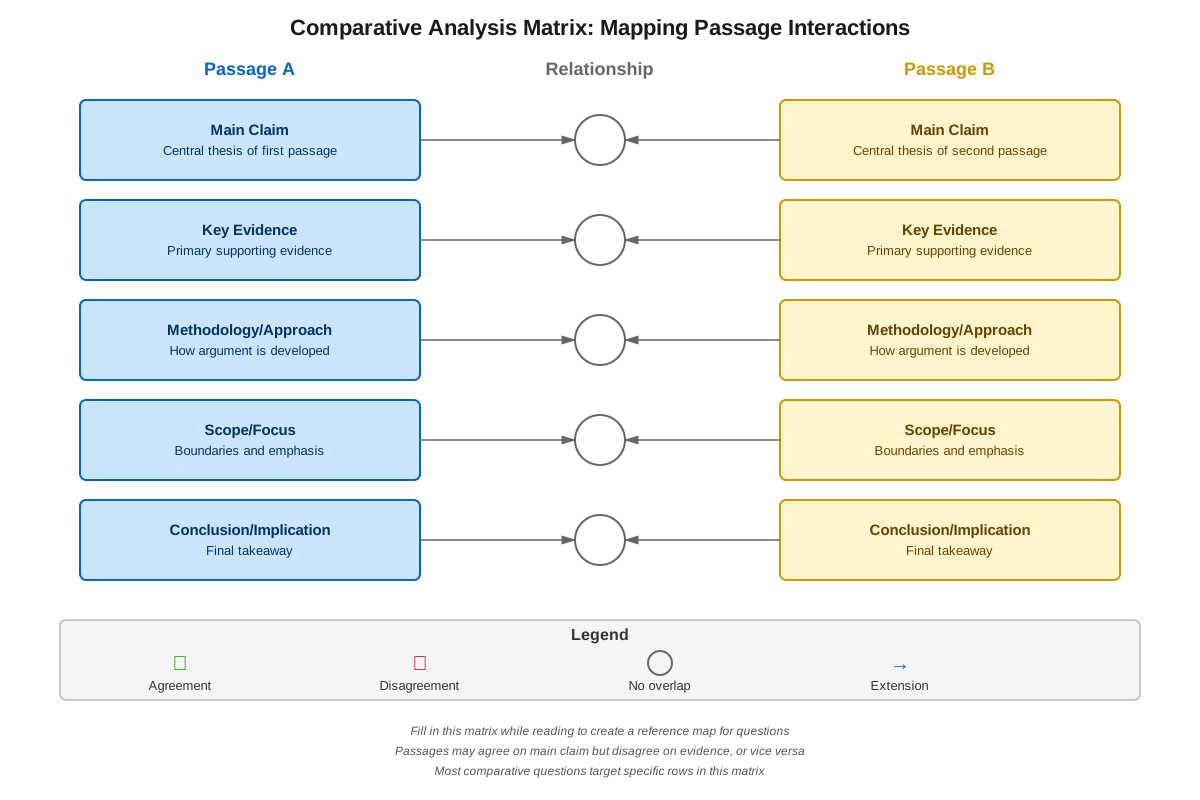
Step 3: Point-by-Point Mapping - Create a mental (or physical, during practice) comparison chart identifying which specific claims, evidence types, and conclusions appear in each passage. Note whether each element is unique to one passage or addressed by both.
Step 4: Tone and Scope Comparison - Evaluate whether the passages differ in tone (objective vs. advocative, cautious vs. confident) or scope (broad vs. narrow, theoretical vs. practical). These differences often generate questions.
Common Question Types
Questions testing passage relationships follow predictable patterns. Recognizing these patterns enables strategic reading and efficient question-answering.
| Question Type | What It Tests | Example Stem |
|---|---|---|
| Direct Relationship | Overall connection between passages | "Which one of the following most accurately describes the relationship between the two passages?" |
| Point of Agreement | Specific shared claims | "The authors of both passages would be most likely to agree with which one of the following statements?" |
| Point of Disagreement | Specific conflicting claims | "On which one of the following points would the authors most likely disagree?" |
| Response Questions | How one author would react to the other | "The author of Passage B would most likely respond to the argument in Passage A by..." |
| Unique vs. Shared Content | What appears in one or both passages | "Which one of the following is discussed in Passage A but not in Passage B?" |
| Comparative Purpose | Why authors wrote their passages | "The primary purpose of each passage is to..." |
Scope and Detail Analysis
A critical but often overlooked aspect of passage relationships involves comparing the scope and level of detail each passage employs. Passage A might present a broad theoretical framework while Passage B focuses narrowly on a specific application. Alternatively, one passage might offer detailed empirical evidence while the other provides only general claims. These differences in scope and specificity frequently generate questions and affect how passages relate to each other.
Test-takers must distinguish between passages that disagree fundamentally versus those that simply address different aspects of an issue. Two passages might appear contradictory at first glance but actually discuss different scopes—one addressing general principles, the other specific exceptions. Careful attention to qualifying language ("in most cases," "generally," "under certain conditions") helps identify these scope distinctions.
Evidence and Reasoning Comparison
Beyond comparing conclusions, effective comparative reading requires analyzing how each passage builds its argument. Does Passage A rely primarily on empirical data while Passage B uses logical reasoning? Does one passage cite expert opinion while the other presents original analysis? These methodological differences often matter as much as the conclusions themselves.
The LSAT frequently tests whether students recognize that passages can reach similar conclusions through different reasoning paths, or conversely, use similar evidence to support different conclusions. Questions might ask which type of evidence appears in both passages, or how the authors would evaluate each other's reasoning methods.
Concept Relationships
The relationship between passages concept integrates multiple reading comprehension skills into a unified analytical framework. At the foundation lies main idea identification—students cannot compare passages without first understanding each passage's central claim. This foundational skill leads directly to relationship categorization, where students classify the overall connection between passages (agreement, disagreement, complementary, etc.).
Relationship categorization then branches into two parallel analytical paths: content comparison and structural comparison. Content comparison involves identifying specific points of agreement and disagreement, mapping which topics appear in each passage, and evaluating how evidence and conclusions relate across passages. Structural comparison examines differences in scope, tone, purpose, and reasoning methodology.
Both analytical paths converge in synthesis and inference, where students must integrate information from both passages to answer questions that neither passage alone could address. This synthesis capability represents the highest-order skill in comparative reading, requiring simultaneous consideration of multiple perspectives while maintaining clarity about each passage's individual position.
The entire framework connects to broader LSAT skills, particularly logical reasoning. Evaluating how one passage's argument would respond to another's claims mirrors the "strengthen/weaken" questions in the Arguments section. Similarly, identifying assumptions underlying each passage's position and recognizing how those assumptions might conflict reflects skills tested throughout the exam.
High-Yield Facts
⭐ Comparative reading appears exactly once per LSAT exam, always as one of four Reading Comprehension passages, containing 6-8 questions.
⭐ Approximately 40-50% of comparative reading questions explicitly test passage relationships, making this the single highest-yield skill for this passage type.
⭐ The most common relationship type is disagreement/opposition, where passages take conflicting positions on a central issue while potentially agreeing on peripheral points.
⭐ Questions asking what "both passages discuss" or "both authors agree on" typically have answers addressing general, foundational concepts rather than specific details or conclusions.
⭐ When passages disagree, they often agree on the importance of the issue or share certain factual premises while differing on interpretation or implications.
- Passage B typically responds to, qualifies, or challenges ideas presented in Passage A, making the second passage's relationship to the first a frequent question focus.
- Questions about how one author would respond to the other require identifying not just what each passage says, but the underlying reasoning and assumptions.
- Differences in scope (broad vs. narrow) and tone (objective vs. advocative) generate as many questions as differences in content.
- "Discussed in Passage A but not Passage B" questions require careful attention to what is explicitly stated versus merely implied.
- The correct answer to relationship questions often uses neutral, descriptive language rather than extreme characterizations.
- Passages may use different terminology to discuss the same concept, requiring recognition of synonymous ideas.
- Time pressure makes comparative reading challenging; most test-takers should allocate 8-9 minutes for the entire comparative set.
Quick check — test yourself on Relationship between passages so far.
Try Flashcards →Common Misconceptions
Misconception: If passages discuss the same topic, they must disagree with each other.
Correction: Passages can address the same topic while taking complementary approaches, focusing on different aspects, or even reaching similar conclusions through different reasoning. Agreement and complementary relationships, though less common than disagreement, appear regularly on the LSAT.
Misconception: "Both passages mention X" means X appears explicitly in both passages.
Correction: Questions asking what both passages discuss require that the concept be explicitly addressed in both, not merely implied or tangentially related. A passage that implies something without stating it does not "discuss" that concept for LSAT purposes.
Misconception: The relationship between passages is always stated explicitly in the text.
Correction: Test-takers must infer the relationship by comparing the passages' claims, evidence, and conclusions. The passages themselves rarely contain phrases like "I disagree with the previous argument" or "This supports the earlier claim."
Misconception: Longer passages contain more important information than shorter ones.
Correction: In comparative reading, both passages receive equal weight regardless of length differences. A shorter passage's claims are just as important for answering questions as a longer passage's detailed arguments.
Misconception: If passages disagree on one point, they disagree on everything.
Correction: Passages frequently disagree on specific claims or conclusions while agreeing on other points, such as the significance of the issue, certain factual premises, or the validity of particular evidence. Questions often test the ability to identify these nuanced areas of partial agreement within overall disagreement.
Misconception: Response questions ("How would Author B respond to Author A?") can be answered by simply restating what Passage B says.
Correction: These questions require applying Passage B's reasoning and perspective to specific claims from Passage A, often requiring inference beyond what Passage B explicitly states. The answer must be consistent with Passage B's overall argument and methodology.
Worked Examples
Example 1: Identifying Relationship Type
Passage A (abbreviated): Archaeological evidence suggests that ancient Mesopotamian cities developed complex irrigation systems primarily for agricultural purposes. The scale and sophistication of these systems indicate centralized planning and substantial labor investment, supporting the theory that agricultural surplus drove urbanization.
Passage B (abbreviated): While irrigation systems in ancient Mesopotamia were indeed sophisticated, recent analysis suggests their primary purpose was flood control rather than agricultural enhancement. The systems' design features—particularly their drainage capabilities—align more closely with flood management than crop irrigation. This reinterpretation challenges traditional views of agricultural surplus as the primary driver of urbanization.
Question: Which one of the following most accurately describes the relationship between the two passages?
Analysis Process:
Step 1: Identify each passage's main point.
- Passage A: Irrigation systems were primarily agricultural, supporting the agricultural surplus theory of urbanization.
- Passage B: Irrigation systems were primarily for flood control, challenging the agricultural surplus theory.
Step 2: Determine the relationship type.
The passages disagree on the primary purpose of irrigation systems and, consequently, on the validity of the agricultural surplus theory. This is a disagreement/opposition relationship.
Step 3: Note areas of agreement.
Both passages agree that: (1) irrigation systems existed and were sophisticated; (2) these systems are relevant to understanding urbanization; (3) the systems required substantial planning and labor.
Step 4: Identify the specific point of disagreement.
The core disagreement concerns the primary purpose of the systems (agriculture vs. flood control) and the implications for urbanization theory.
Expected Answer Pattern: The correct answer would describe Passage B as challenging or questioning a claim made in Passage A, specifically regarding the purpose of irrigation systems or the agricultural surplus theory. Incorrect answers might overstate the disagreement (suggesting complete contradiction on all points) or understate it (suggesting mere complementary perspectives).
Example 2: Point of Agreement Question
Passage A (abbreviated): The rise of artificial intelligence in medical diagnostics promises unprecedented accuracy. Machine learning algorithms can analyze thousands of cases instantly, identifying patterns invisible to human practitioners. However, these systems should supplement rather than replace physician judgment, as medical practice requires contextual understanding and ethical reasoning that algorithms cannot provide.
Passage B (abbreviated): Concerns about AI replacing physicians are overblown. Current AI diagnostic tools excel at pattern recognition but lack the holistic patient understanding essential to medical practice. Rather than viewing AI as a threat, the medical community should embrace these tools as powerful aids that enhance, but do not substitute for, clinical expertise and human judgment.
Question: The authors of both passages would be most likely to agree with which one of the following statements?
Analysis Process:
Step 1: Identify each passage's position on AI in medicine.
- Passage A: AI is valuable but should supplement, not replace, physicians.
- Passage B: AI is valuable and should be embraced as an aid, not feared as a replacement.
Step 2: Recognize the overall relationship.
These passages agree on the fundamental relationship between AI and physicians—both advocate for AI as a supplementary tool rather than a replacement.
Step 3: Identify specific shared claims.
Both passages agree that:
- AI has valuable capabilities in medical diagnostics
- AI should not replace physician judgment
- Human physicians provide something essential that AI cannot
- The appropriate role for AI is as a supplement or aid to human practitioners
Step 4: Eliminate what they don't both support.
- Passage A's specific concern about ethical reasoning isn't mentioned in Passage B
- Passage B's characterization of concerns as "overblown" isn't shared by Passage A
- Specific capabilities mentioned in only one passage (e.g., "analyzing thousands of cases instantly") aren't necessarily endorsed by both
Expected Answer Pattern: The correct answer would state something like "AI diagnostic tools should be used to enhance rather than replace physician judgment" or "Medical practice requires human capabilities that AI systems currently lack." This captures their shared position without including details unique to either passage.
Exam Strategy
Pre-Reading Strategy
Before reading the passages, quickly scan the question stems to identify what types of relationships will be tested. If multiple questions ask about agreement or disagreement, prioritize tracking these elements while reading. If questions focus on what appears in each passage individually, prepare to create a mental content map.
Active Reading Approach
Read Passage A completely before starting Passage B, but read actively with comparison in mind. After finishing Passage A, take 5-10 seconds to articulate its main point and purpose. While reading Passage B, actively note where it relates to Passage A—does it agree, disagree, extend, or address different aspects? Mark or mentally note these connection points.
Exam Tip: After reading both passages but before attempting questions, spend 10-15 seconds explicitly stating the relationship type to yourself: "Passage B challenges Passage A's main conclusion but agrees on the underlying facts" or "These passages complement each other by addressing different aspects of the same issue."
Trigger Words and Phrases
Questions testing passage relationships often contain specific trigger language:
Agreement Questions: "both passages," "both authors would agree," "shared by both," "common to both"
Disagreement Questions: "point of disagreement," "authors would be most likely to disagree," "unlike Passage A, Passage B"
Response Questions: "author of Passage B would most likely respond," "how would the author of Passage A view," "author of Passage B would most likely regard"
Content Distribution Questions: "discussed in Passage A but not Passage B," "mentioned in both passages," "unique to Passage B"
Process of Elimination Strategy
For relationship questions, eliminate answers that:
- Overstate the relationship (e.g., claiming complete agreement when passages agree on only some points)
- Understate the relationship (e.g., claiming passages are unrelated when they clearly disagree)
- Confuse which passage makes which claim
- Include content from only one passage when the question asks about both
- Use extreme language ("entirely," "completely," "never") unless the passages truly support such characterizations
Time Management
Allocate approximately 3-4 minutes for reading both passages (slightly longer than a single passage due to comparative complexity) and 4-5 minutes for answering questions. If a relationship question proves difficult, skip it and return after answering content-specific questions about individual passages, as these often clarify the relationship.
Memory Techniques
COMPARE Acronym for analyzing passage relationships:
- Conclusions: What is each passage's main point?
- Opposition or agreement: Do they conflict or align?
- Methodology: What reasoning or evidence does each use?
- Purpose: Why did each author write their passage?
- Areas of overlap: What topics do both address?
- Range: What is each passage's scope (broad vs. narrow)?
- Evidence: What types of support does each provide?
The Three-Column Visualization: When practicing, create a mental three-column table:
- Left column: Content unique to Passage A
- Middle column: Content shared by both passages
- Right column: Content unique to Passage B
This visualization helps quickly answer "both passages discuss" and "Passage A but not B" questions.
Relationship Type Mnemonic - "DACE":
- Disagreement (most common)
- Agreement
- Complementary
- Extension/modification
When first finishing both passages, quickly identify which DACE category applies.
The Response Question Formula: For "How would Author B respond to Author A?" questions, use this mental formula:
- Identify the specific claim from Passage A referenced in the question
- Recall Passage B's position on that topic or related topics
- Apply Passage B's reasoning approach to that specific claim
- Select the answer that maintains consistency with Passage B's overall argument
Summary
The relationship between passages represents a critical skill in LSAT Reading Comprehension, tested through comparative reading sets that appear once per exam. Success requires identifying the overall relationship type (disagreement, agreement, complementary, or extension), mapping specific points of convergence and divergence, and understanding how each passage's scope, tone, and methodology relate to the other's. The most common relationship type involves disagreement on central claims while maintaining agreement on peripheral points or underlying facts. Questions test not only what each passage says individually but how the passages interact—requiring synthesis, inference, and the ability to apply one passage's reasoning to another's claims. Effective comparative reading demands a systematic approach: comprehending each passage independently, explicitly identifying their relationship, creating a mental map of shared versus unique content, and recognizing differences in scope and methodology. Approximately 40-50% of comparative reading questions directly test passage relationships, making this the highest-yield skill for this passage type. Mastery requires moving beyond sequential reading to simultaneous consideration of multiple perspectives while maintaining clarity about each author's distinct position.
Key Takeaways
- Comparative reading appears exactly once per LSAT exam, with 40-50% of its questions explicitly testing passage relationships—making this a high-yield topic
- The four main relationship types are disagreement/opposition (most common), agreement/support, complementary, and extension/modification
- Passages that disagree on conclusions often agree on the importance of the issue or share certain factual premises
- Effective analysis requires a systematic approach: understand each passage individually, identify the relationship type, map shared versus unique content, and compare scope and methodology
- "Both passages discuss" questions typically have answers addressing general concepts explicitly stated in both passages, not details unique to one or merely implied
- Response questions ("How would Author B respond to Author A?") require applying one passage's reasoning to the other's specific claims, not merely restating what the passage says
- Success depends on simultaneous consideration of multiple perspectives while maintaining clarity about each passage's individual position—a skill fundamental to legal reasoning
Related Topics
Main Idea and Primary Purpose: Understanding each passage's central claim and authorial intent forms the foundation for comparing passages. Mastering relationship analysis strengthens the ability to identify main ideas quickly and accurately.
Inference Questions in Single Passages: The synthesis skills developed through comparative reading—combining multiple pieces of information to reach conclusions—transfer directly to complex inference questions in standard passages.
Strengthen/Weaken Questions in Logical Reasoning: Evaluating how one passage's argument would respond to another's claims mirrors the analytical process required for strengthen/weaken questions, creating cross-section synergy.
Tone and Attitude Analysis: Recognizing differences in authorial tone between passages (objective vs. advocative, cautious vs. confident) builds upon and reinforces tone analysis skills applicable to all Reading Comprehension passages.
Argument Structure in Complex Passages: Comparative reading's requirement to track multiple argumentative frameworks simultaneously prepares students for analyzing complex, multi-layered arguments in challenging single passages.
Practice CTA
Now that you understand the framework for analyzing passage relationships, it's time to apply these concepts to actual LSAT-style questions. The practice questions and flashcards will help solidify your ability to quickly identify relationship types, map points of agreement and disagreement, and efficiently answer comparative reading questions under timed conditions. Remember: comparative reading is a learnable skill that improves dramatically with deliberate practice. Each practice set strengthens your ability to hold multiple perspectives simultaneously—a capability that will serve you not only on test day but throughout law school and legal practice. Approach the practice materials systematically, reviewing both correct and incorrect answers to understand the reasoning patterns the LSAT rewards.
Sign up free to keep reading
Create a free AnvayaPrep account to finish this LSAT guide on Relationship between passages — plus flashcards and practice questions.