Overview
Shared assumptions represent one of the most sophisticated and frequently tested concepts in LSAT reading comprehension, particularly within comparative reading passages. When two passages appear side-by-side on the LSAT, they often present different perspectives, arguments, or approaches to a common topic. Despite their differences, these passages frequently rest upon common foundational beliefs, premises, or unstated principles—these are the shared assumptions that test-makers expect students to identify and analyze.
Understanding shared assumptions requires moving beyond surface-level comprehension to recognize the deeper logical architecture supporting each author's argument. This skill demands that students distinguish between what authors explicitly state and what they implicitly accept as true without argument. On the LSAT, questions about shared assumptions test whether students can identify common ground between seemingly divergent viewpoints, recognize unstated premises that both authors rely upon, and understand the logical foundations that make each author's reasoning possible.
Mastery of shared assumptions connects directly to fundamental LSAT skills including assumption identification in Logical Reasoning, understanding argument structure, and synthesizing information across multiple sources. This topic builds upon basic reading comprehension skills while preparing students for the analytical rigor required in law school, where identifying common ground and unstated premises in legal arguments becomes essential for case analysis, negotiation, and persuasive writing.
Learning Objectives
- [ ] Identify how Shared assumptions appears in LSAT questions
- [ ] Explain the reasoning pattern behind Shared assumptions
- [ ] Apply Shared assumptions to solve LSAT-style problems accurately
- [ ] Distinguish between shared assumptions and shared explicit claims in comparative passages
- [ ] Evaluate answer choices to eliminate options that represent assumptions held by only one author
- [ ] Recognize the difference between shared assumptions and shared topics or subject matter
- [ ] Analyze how identifying shared assumptions reveals deeper logical connections between contrasting arguments
Prerequisites
- Basic argument structure: Understanding premises, conclusions, and how claims support one another is essential because shared assumptions function as unstated premises supporting both authors' reasoning.
- Assumption identification: The ability to recognize what an argument takes for granted without stating explicitly provides the foundation for identifying assumptions shared across multiple passages.
- Comparative passage structure: Familiarity with how LSAT presents paired passages and the relationship types between them (agreement, disagreement, complementary perspectives) enables efficient navigation when searching for shared assumptions.
- Inference skills: The capacity to draw logical conclusions from stated information helps students identify what must be true for both authors' arguments to function, even when unstated.
Why This Topic Matters
Shared assumptions questions appear with remarkable consistency in LSAT comparative reading sections, typically comprising 15-20% of all comparative passage questions. These questions directly assess a student's ability to perform sophisticated textual analysis—moving beyond surface disagreements to identify deeper logical commonalities. This skill proves invaluable not only for LSAT success but also for legal practice, where attorneys must identify common ground between opposing positions to facilitate negotiation, find persuasive angles, and understand the logical foundations of competing arguments.
On the LSAT, shared assumptions appear in several question formats: direct questions asking what both authors assume, questions about points of agreement (which often involve unstated premises), and questions requiring students to identify principles that both passages rely upon. The test-makers favor this concept because it distinguishes students who merely comprehend surface content from those who can analyze logical structure and identify implicit reasoning patterns.
In actual exam passages, shared assumptions commonly appear when two authors debate policy solutions while sharing assumptions about problem severity, when authors propose different theories while accepting common methodological principles, or when authors critique different aspects of a phenomenon while assuming its existence or importance. Recognizing these patterns enables students to anticipate where shared assumptions likely exist and approach questions strategically rather than rereading entire passages under time pressure.
Core Concepts
Definition and Nature of Shared Assumptions
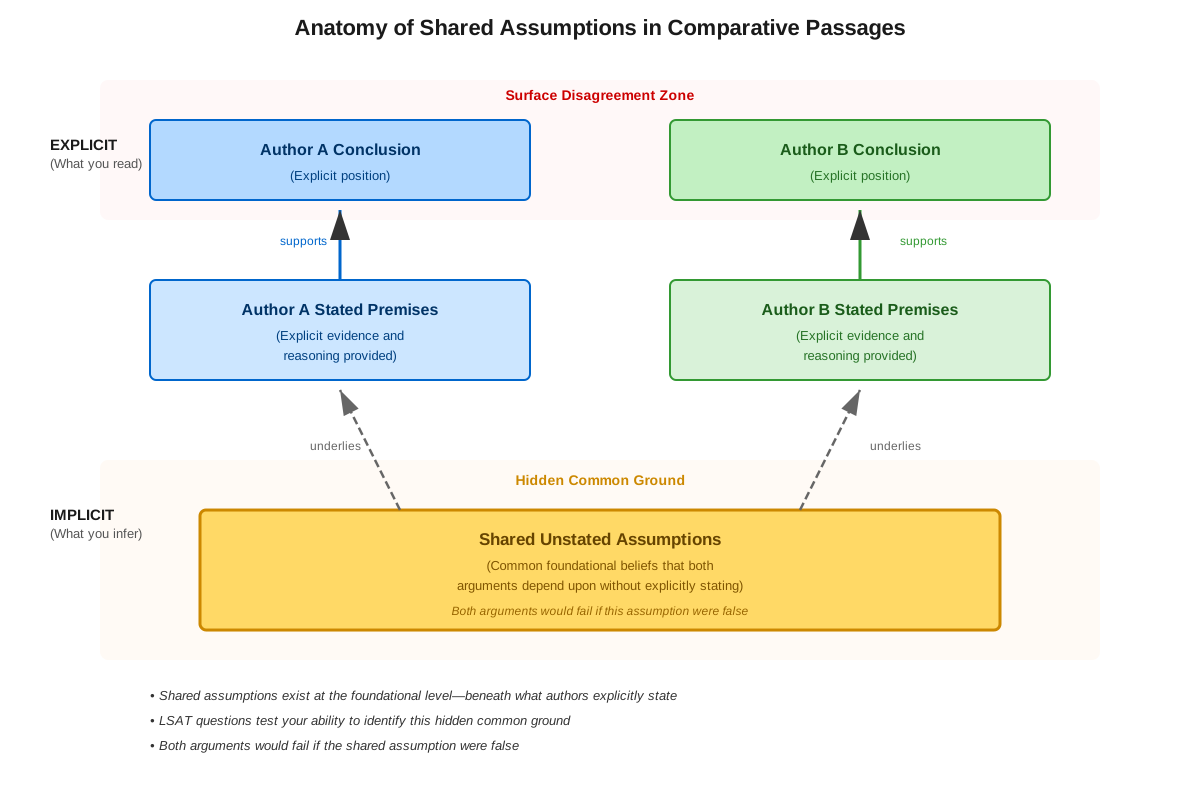
A shared assumption is an unstated premise or belief that both authors in a comparative reading passage accept as true and rely upon to support their respective arguments, even when those arguments reach different conclusions or advocate different positions. Unlike shared explicit claims—which both authors directly state—shared assumptions remain implicit, functioning as logical foundations that make each author's reasoning possible.
Shared assumptions possess several defining characteristics. First, they must be genuinely unstated by both authors; if either author explicitly articulates the claim, it becomes a shared explicit statement rather than an assumption. Second, they must be necessary for both arguments; each author's reasoning must depend upon the assumption being true. Third, they typically operate at a more fundamental level than the authors' main claims, often involving background beliefs about causation, value, methodology, or the nature of the problem being discussed.
Types of Shared Assumptions in LSAT Passages
Factual assumptions involve shared beliefs about what is true in the world. For example, two authors debating different approaches to reducing urban traffic congestion might both assume that current traffic levels create significant problems, even if neither explicitly states this premise. The assumption functions as the unstated justification for why any solution matters.
Methodological assumptions concern shared beliefs about appropriate ways to investigate, analyze, or solve problems. Two scientists proposing different explanations for a phenomenon might both assume that empirical evidence should guide theory selection, or that simpler explanations are preferable to more complex ones when both fit the data equally well.
Value assumptions involve shared normative commitments or priorities. Authors debating educational policy might disagree about specific reforms while both assuming that improving student outcomes should be the primary goal, or that educational equity matters more than efficiency.
Causal assumptions represent shared beliefs about cause-and-effect relationships. Authors might propose different interventions while both assuming that a particular factor actually influences the outcome they're discussing, or that changing certain variables will produce predictable results.
Distinguishing Shared Assumptions from Related Concepts
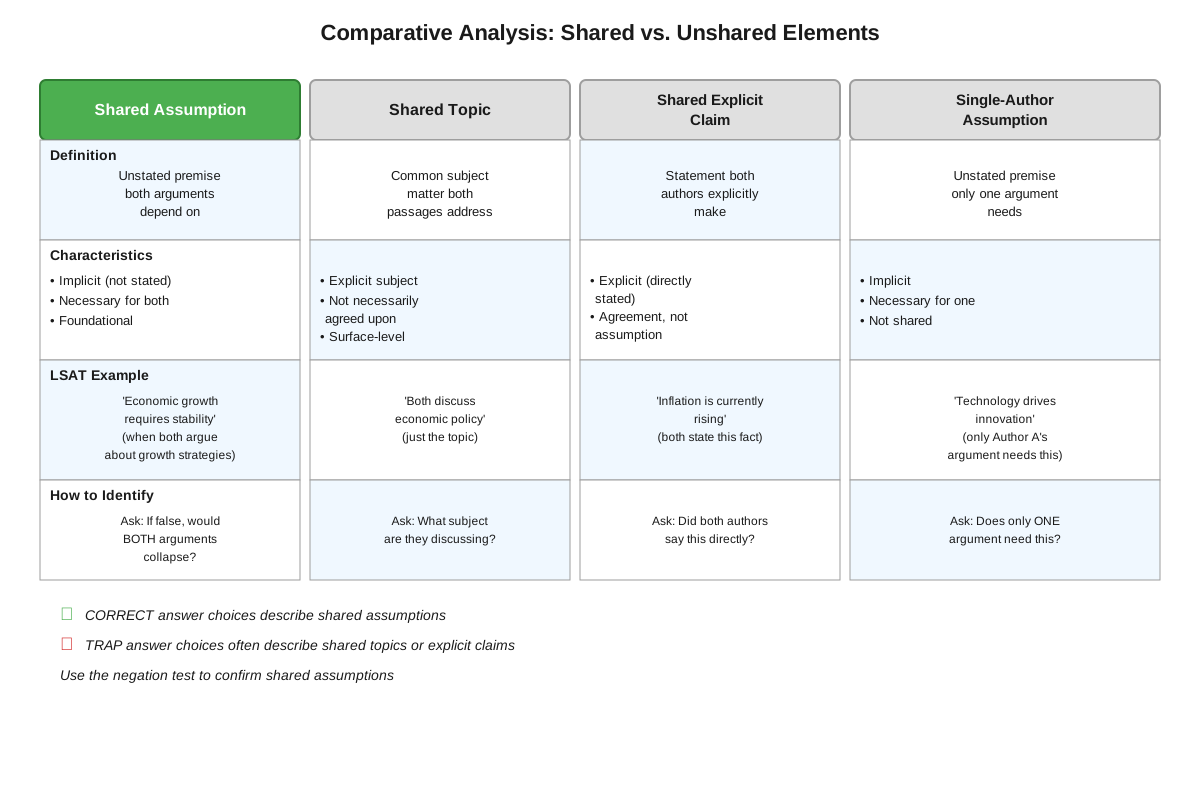
| Concept | Definition | Key Difference from Shared Assumptions |
|---|---|---|
| Shared Explicit Claims | Statements both authors directly make | Explicitly stated vs. unstated |
| Shared Topics | Subject matter both passages address | Topic vs. logical premise |
| Points of Agreement | Positions both authors endorse | May include explicit agreements; assumptions are always implicit |
| Common Conclusions | Similar final positions reached | Conclusions vs. foundational premises |
| Parallel Reasoning | Similar logical structures | Structure vs. content of premises |
Identifying Shared Assumptions: The Analytical Process
The process of identifying shared assumptions requires systematic analysis:
- Identify each author's main argument and conclusion: Understanding what each author ultimately argues provides context for recognizing what premises must be true for those arguments to succeed.
- Map explicit premises in each passage: Catalog what each author directly states as support for their position. This prevents confusing explicit claims with assumptions.
- Identify gaps in each argument: Determine what unstated premises each author's reasoning requires. Ask: "What must be true for this argument to work?"
- Compare the required assumptions: Look for overlap between the unstated premises each author needs. The intersection represents potential shared assumptions.
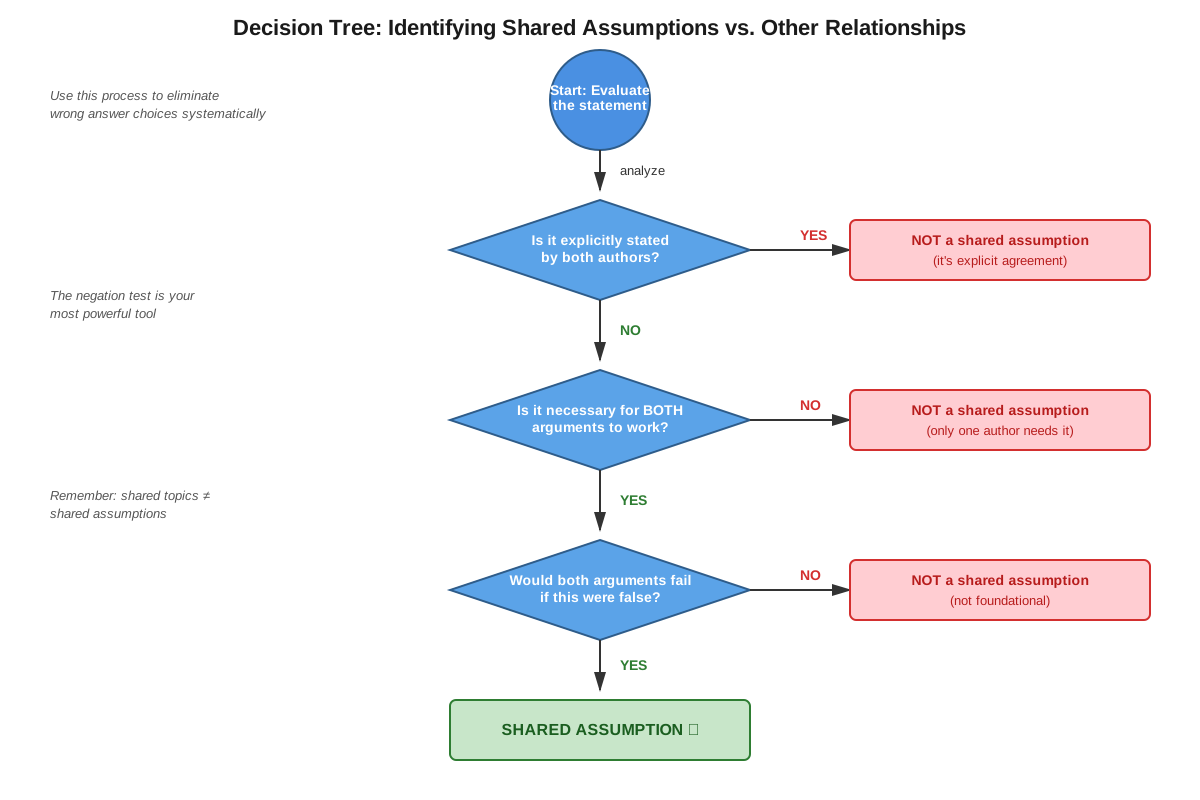
- Test the assumption: Verify that negating the potential shared assumption would undermine both authors' arguments. If both arguments collapse without the assumption, it's genuinely shared and necessary.
Common Patterns in Shared Assumptions
Certain patterns appear repeatedly in LSAT comparative passages. Problem-solution passages often share assumptions about problem severity, the possibility of solutions, or criteria for evaluating proposed solutions. Theory-comparison passages frequently share methodological assumptions about evidence evaluation or explanatory standards. Historical analysis passages commonly share assumptions about the reliability of certain sources or the relevance of historical patterns to current situations.
Understanding these patterns enables strategic reading. When encountering a problem-solution structure, students should anticipate that shared assumptions likely concern the problem's nature or importance. When reading theory comparisons, methodological assumptions become prime candidates for shared status.
Concept Relationships
Shared assumptions connect intimately with several core LSAT concepts. The skill builds directly upon assumption identification from Logical Reasoning, extending it to comparative contexts where students must identify assumptions common to multiple arguments rather than assumptions supporting a single argument. This extension requires additional analytical steps: first identifying assumptions for each passage independently, then comparing to find commonalities.
The concept also relates closely to points of agreement questions in comparative reading. While points of agreement may include explicit statements both authors make, shared assumptions represent a specific subset: implicit agreements that function as logical foundations. Understanding this relationship helps students recognize that some agreement questions specifically target unstated premises.
Furthermore, shared assumptions connect to argument structure analysis. Recognizing how premises support conclusions enables students to identify gaps where assumptions operate. The relationship flows: understanding argument structure → enables assumption identification → which facilitates finding shared assumptions across multiple arguments.
Relationship map: Argument Structure Analysis → Assumption Identification (single argument) → Comparative Analysis → Shared Assumption Identification → Points of Agreement Recognition
The concept also relates to inference questions, as identifying shared assumptions often requires inferring what must be true based on how each author reasons, even when neither explicitly states the assumption.
High-Yield Facts
- ⭐ Shared assumptions are always unstated by both authors; if either author explicitly states the claim, it's not an assumption
- ⭐ A valid shared assumption must be necessary for both authors' arguments to function; negating it should undermine both passages
- ⭐ Shared assumptions typically operate at a more fundamental level than the authors' main claims or conclusions
- ⭐ The most common wrong answers on shared assumption questions are claims that only one author assumes or that both authors explicitly state
- ⭐ Shared assumptions often concern the nature or importance of the problem being discussed, even when authors disagree about solutions
- Authors can share assumptions while reaching opposite conclusions or advocating contradictory positions
- Shared methodological assumptions frequently appear when authors propose different theories or explanations for the same phenomenon
- The correct answer to a shared assumption question will be consistent with both passages but not directly stated in either
- Extreme language in answer choices (always, never, only, must) often signals incorrect answers, as shared assumptions typically involve more moderate claims
- Shared assumptions questions require synthesizing information across both passages rather than analyzing either passage in isolation
Common Misconceptions
Misconception: If two authors discuss the same topic, they share assumptions about that topic.
Correction: Sharing a topic is not the same as sharing assumptions. Authors can discuss the same subject while making completely different assumptions about its nature, causes, importance, or solutions. Shared assumptions must be logical premises both arguments depend upon, not merely common subject matter.
Misconception: If both authors explicitly agree on something, that agreement represents a shared assumption.
Correction: Shared assumptions are by definition unstated. If both authors explicitly state a claim, it's a shared explicit statement or point of agreement, not an assumption. The defining feature of assumptions is that they remain implicit while supporting the argument's logic.
Misconception: Shared assumptions must relate to the authors' main conclusions.
Correction: Shared assumptions typically operate at a more foundational level than main conclusions. They often concern background beliefs about the problem's existence, the validity of certain evidence types, or general principles that make the specific arguments possible. They support the reasoning process rather than appearing as conclusions.
Misconception: If an assumption is necessary for one author's argument, and the other author doesn't contradict it, it's a shared assumption.
Correction: For an assumption to be genuinely shared, both authors must rely upon it for their reasoning to work. Mere non-contradiction is insufficient. The assumption must be necessary for both arguments, meaning that negating it would undermine both passages.
Misconception: Shared assumptions are always obvious and easy to identify.
Correction: Identifying shared assumptions requires sophisticated analysis precisely because they remain unstated. Test-makers deliberately craft passages where shared assumptions operate at deeper logical levels, requiring students to analyze argument structure and identify implicit premises rather than simply noting surface similarities.
Misconception: Authors who disagree cannot share assumptions.
Correction: Authors frequently share fundamental assumptions while disagreeing about conclusions, solutions, or specific claims. In fact, meaningful disagreement often requires shared assumptions about the problem's nature, relevant evidence types, or evaluative criteria. Without some common ground, authors would be arguing past each other entirely.
Quick check — test yourself on Shared assumptions so far.
Try Flashcards →Worked Examples
Example 1: Environmental Policy Passages
Passage A Summary: Argues that market-based incentives (carbon taxes, cap-and-trade systems) represent the most effective approach to reducing greenhouse gas emissions because they harness economic self-interest and allow flexibility in how reductions are achieved.
Passage B Summary: Argues that direct government regulation (emission standards, technology mandates) is necessary to reduce greenhouse gas emissions because market mechanisms alone cannot address the urgency and scale of the climate crisis.
Question: Which one of the following is an assumption shared by both authors?
Answer Choices:
(A) Economic incentives can influence corporate behavior regarding emissions
(B) Reducing greenhouse gas emissions should be a policy priority
(C) Market-based approaches are superior to regulatory approaches
(D) Government intervention in environmental matters is necessary
(E) Climate change poses an urgent threat requiring immediate action
Analysis Process:
Step 1: Identify what each author's argument requires to function.
- Author A's argument requires: (1) that reducing emissions matters enough to justify policy intervention, (2) that economic incentives can influence behavior, (3) that flexibility in achieving reductions has value
- Author B's argument requires: (1) that reducing emissions matters enough to justify policy intervention, (2) that the problem is serious enough to warrant government action, (3) that market mechanisms have limitations
Step 2: Examine each answer choice against both passages.
(A) This is necessary for Author A's argument (market incentives must be able to influence behavior) but Author B doesn't rely on this—Author B argues for regulation precisely because market incentives are insufficient. Not shared.
(B) Both authors propose policy interventions to reduce emissions. Neither would argue for any approach unless reducing emissions mattered. Author A advocates market mechanisms; Author B advocates regulation—but both positions only make sense if emission reduction is a worthwhile goal. Neither author explicitly states this, but both arguments collapse without it. Strong candidate.
(C) This is Author A's conclusion, not an assumption, and Author B explicitly rejects it. Not shared.
(D) Author B explicitly argues for government intervention, but Author A might view market-based incentives as minimal intervention that harnesses existing market forces. This isn't clearly necessary for Author A's argument. Not shared.
(E) Author B explicitly mentions urgency, but Author A doesn't emphasize this. Author A's argument works even if the problem is serious but not urgent. Not shared.
Correct Answer: (B)
Connection to Learning Objectives: This example demonstrates how to identify shared assumptions by analyzing what each argument requires to function (explaining the reasoning pattern), shows how to eliminate answers that only one author assumes or that are explicitly stated (applying the concept to solve problems), and illustrates the typical LSAT question format for this concept (identifying how shared assumptions appear in questions).
Example 2: Educational Technology Passages
Passage A Summary: Argues that online learning platforms can democratize education by providing access to high-quality instruction regardless of geographic location or economic status, citing examples of successful massive open online courses (MOOCs).
Passage B Summary: Argues that online learning cannot replace traditional classroom instruction because it lacks the interpersonal interaction and immediate feedback that are essential to effective learning, citing studies showing lower completion rates for online courses.
Question: The arguments in both passages depend on assuming which one of the following?
Answer Choices:
(A) Traditional classroom instruction is superior to online learning
(B) Access to education is currently limited by geographic and economic factors
(C) The quality of educational outcomes can be meaningfully assessed
(D) Technology will continue to improve educational delivery methods
(E) Student motivation affects learning outcomes
Analysis Process:
Step 1: Map each argument's logical structure.
- Author A: Online platforms provide access → This access democratizes education → Therefore, online learning has significant value
- Author B: Online learning lacks interaction/feedback → These elements are essential → Therefore, online learning cannot replace traditional instruction
Step 2: Identify what must be true for each argument to work.
- Author A must assume: (1) that democratizing access matters (requires that outcomes can be assessed as valuable), (2) that the education provided through these platforms has genuine value
- Author B must assume: (1) that we can identify what makes education effective (requires ability to assess educational quality), (2) that certain elements (interaction, feedback) are essential
Step 3: Evaluate answer choices.
(A) Author B might agree, but Author A explicitly argues against this by highlighting online learning's advantages. Not shared.
(B) Author A explicitly states this, but Author B's argument doesn't depend on it. Author B argues about educational quality, not access issues. Not shared (also, it's explicit for Author A).
(C) Both authors make claims about educational quality—Author A argues online platforms provide "high-quality instruction" and can "democratize education" (implying valuable outcomes), while Author B argues online learning lacks "essential" elements for "effective learning." Both arguments only make sense if we can assess and compare educational quality. Neither explicitly defends this assumption, but both arguments collapse without it. Strong candidate.
(D) Author A might assume this, but Author B's argument concerns current limitations and doesn't depend on future technological development. Not shared.
(E) While this might be true, neither argument explicitly depends on it. Author A focuses on access, Author B on instructional elements. Not shared.
Correct Answer: (C)
Connection to Learning Objectives: This example shows how shared assumptions often concern methodological or evaluative principles (explaining the reasoning pattern), demonstrates how to distinguish between explicit claims and unstated assumptions (identifying how the concept appears), and illustrates the elimination process for wrong answers (applying the concept accurately).
Exam Strategy
When approaching shared assumption questions on the LSAT, employ a systematic strategy that maximizes accuracy while managing time effectively.
Trigger words and phrases that signal shared assumption questions include:
- "Both authors assume that..."
- "The arguments in both passages depend on assuming..."
- "Which one of the following is presupposed by both passages?"
- "An assumption underlying both passages is..."
- "Both authors' arguments require the assumption that..."
Exam Tip: When you identify a shared assumption question, immediately recognize that you'll need to synthesize information across both passages rather than focusing on either passage alone. Budget slightly more time for these questions than for single-passage questions.
Strategic approach sequence:
- Before looking at answer choices, quickly identify each author's main argument and conclusion. This provides context for recognizing necessary assumptions.
- For each passage independently, ask: "What must be true for this argument to work?" Mentally note 1-2 key assumptions for each passage.
- Compare your identified assumptions to find potential overlap. This pre-work often allows you to predict the correct answer before reading choices.
- Evaluate answer choices systematically using elimination:
- Eliminate any choice that either author explicitly states (not an assumption)
- Eliminate any choice that only one author's argument requires
- Eliminate any choice that contradicts either passage
- Eliminate extreme answers unless both passages clearly require such strong claims
- Test your selected answer by negating it: If the assumption were false, would both arguments fall apart? If yes, you've found the shared assumption.
Process-of-elimination priorities specific to shared assumptions:
- First elimination pass: Remove answers that are explicitly stated by either author or that only relate to one passage's content
- Second elimination pass: Remove answers that use extreme language unless clearly necessary for both arguments
- Third elimination pass: Remove answers that concern surface topics rather than logical foundations
Time allocation: Allocate 90-120 seconds for shared assumption questions, slightly more than typical reading comprehension questions, because they require synthesis across passages. If you find yourself exceeding two minutes, make your best elimination-based choice and move forward.
Common trap answers to watch for:
- Claims that only one author assumes (often the more prominent or controversial author)
- Explicit statements from either passage presented as if they were assumptions
- Shared topics or subject matter rather than shared logical premises
- Assumptions that would strengthen one argument but aren't necessary for both
Memory Techniques
SHARED Acronym for identifying shared assumptions:
- Synthesis required - Must combine information from both passages
- Hidden premise - Never explicitly stated by either author
- Argument foundation - Supports the reasoning, not the conclusion
- Required by both - Necessary for both arguments to function
- Eliminate extremes - Moderate claims more likely than absolute statements
- Deeper level - Operates below surface claims and main conclusions
Visualization strategy: Picture two buildings (the two passages) with different visible structures (their explicit arguments) but built on the same underground foundation (shared assumptions). The foundation remains invisible but supports both structures. When analyzing passages, mentally "dig down" beneath surface arguments to find this common foundation.
The "Collapse Test" mnemonic: Remember "If it FALLS, it's SHARED"
- False assumption
- Arguments both
- Lose their
- Logic
- Simultaneously - Hence Assumption is Required by Each Dispute
When testing whether something is a shared assumption, imagine it's false. If both arguments collapse, you've found a shared assumption.
Pattern recognition memory aid: "PMS" for common shared assumption patterns:
- Problem importance (both authors assume the problem matters)
- Methodological principles (both authors accept certain ways of reasoning or evaluating evidence)
- Solution possibility (both authors assume solutions are possible, even if they disagree about which solution)
Summary
Shared assumptions represent unstated premises that both authors in comparative reading passages rely upon to support their respective arguments, even when those arguments reach different conclusions. Mastering this concept requires moving beyond surface-level comprehension to analyze the logical foundations supporting each author's reasoning. The key to identifying shared assumptions lies in systematically determining what each argument requires to function, then finding the overlap between these necessary premises. Shared assumptions differ from shared explicit claims (which are stated), shared topics (which concern subject matter rather than logical premises), and points of agreement (which may include explicit statements). On the LSAT, shared assumption questions typically appear in 15-20% of comparative reading questions and require synthesis across both passages rather than analysis of either passage alone. Success demands recognizing that assumptions operate at a more fundamental level than main conclusions, understanding that authors can share assumptions while disagreeing about solutions or conclusions, and applying systematic elimination strategies that remove answers representing only one author's assumptions or explicitly stated claims. The ability to identify shared assumptions proves essential not only for LSAT success but also for legal analysis, where recognizing common ground between opposing positions facilitates negotiation and reveals deeper logical connections between seemingly contradictory arguments.
Key Takeaways
- Shared assumptions are always unstated by both authors and function as necessary logical foundations for both arguments
- The correct answer to a shared assumption question must be required by both passages—negating it should undermine both arguments
- Distinguish carefully between shared assumptions (unstated), shared explicit claims (stated), and shared topics (subject matter)
- Common wrong answers include claims that only one author assumes, explicit statements from either passage, and surface topics rather than logical premises
- Employ systematic analysis: identify each argument's requirements independently, then compare to find overlap
- Shared assumptions typically operate at a more fundamental level than main conclusions, often concerning problem importance, methodological principles, or evaluative criteria
- Authors frequently share assumptions while disagreeing about conclusions, making meaningful debate possible through common logical ground
Related Topics
Points of Agreement in Comparative Reading: While shared assumptions represent implicit agreements, points of agreement questions may also target explicit claims both authors make. Mastering shared assumptions provides the foundation for recognizing all types of agreement, both stated and unstated.
Assumption Questions in Logical Reasoning: The single-argument assumption identification skills developed in Logical Reasoning directly transfer to comparative reading contexts. Strengthening assumption identification in Logical Reasoning enhances shared assumption recognition.
Argument Structure Analysis: Understanding how premises support conclusions across both Reading Comprehension and Logical Reasoning enables more efficient identification of gaps where assumptions operate, facilitating shared assumption recognition.
Inference Questions in Reading Comprehension: Both inference questions and shared assumption questions require reasoning beyond explicitly stated information. Skills developed for one question type strengthen performance on the other.
Synthesis Questions in Comparative Reading: Shared assumption questions represent one type of synthesis question requiring integration of information across passages. Mastering this concept prepares students for other synthesis question types.
Practice CTA
Now that you've developed a comprehensive understanding of shared assumptions in comparative reading, it's time to apply these concepts to actual LSAT-style questions. The practice questions and flashcards will reinforce your ability to identify shared assumptions quickly and accurately under timed conditions. Remember that mastery comes through deliberate practice—each question you analyze strengthens your pattern recognition and analytical skills. Approach the practice materials strategically, using the techniques and elimination strategies you've learned. Pay special attention to questions you find challenging, as these reveal opportunities for growth. Your investment in mastering shared assumptions will pay dividends not only on test day but throughout your legal education and career, where identifying common ground between opposing positions becomes an essential analytical skill.
Sign up free to keep reading
Create a free AnvayaPrep account to finish this LSAT guide on Shared assumptions — plus flashcards and practice questions.