Overview
The short passage strategy represents a critical skill set for tackling the Comparative Reading section of the LSAT Reading Comprehension. Unlike traditional single-passage questions, Comparative Reading presents two shorter passages (Passage A and Passage B) that address related topics, requiring test-takers to analyze each passage independently while also synthesizing relationships between them. This dual-analysis approach demands a specialized strategic framework that differs significantly from standard reading comprehension techniques.
Mastering LSAT short passage strategy is essential because Comparative Reading consistently appears as one of the four Reading Comprehension passages on every LSAT administration, accounting for approximately 25% of the Reading Comprehension score. The questions following these paired passages test not only comprehension of individual arguments but also the ability to compare perspectives, identify points of agreement and disagreement, and synthesize information across texts. Students who approach these passages without a deliberate strategy often waste valuable time re-reading or struggle to keep the distinct viewpoints separate in their minds.
Within the broader reading comprehension framework, short passage strategy serves as a bridge between basic passage analysis skills and advanced comparative reasoning. This topic builds upon fundamental reading comprehension techniques—such as identifying main points, recognizing argument structure, and understanding author's purpose—while introducing the additional layer of comparative reading analysis. The strategic approach developed here prepares students for the unique cognitive demands of managing multiple perspectives simultaneously, a skill that proves invaluable not only for the LSAT but also for legal practice, where comparing precedents and contrasting arguments forms the foundation of legal reasoning.
Learning Objectives
- [ ] Identify how Short passage strategy appears in LSAT questions
- [ ] Explain the reasoning pattern behind Short passage strategy
- [ ] Apply Short passage strategy to solve LSAT-style problems accurately
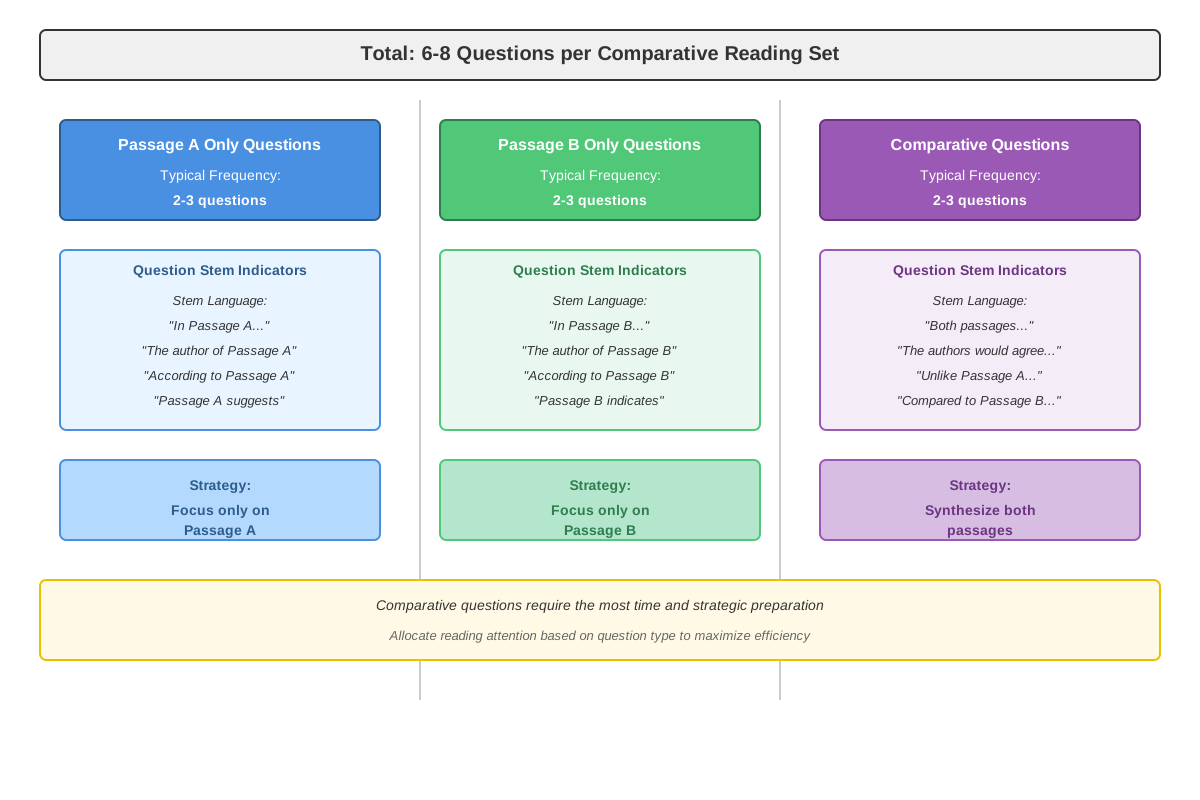
- [ ] Distinguish between passage-specific questions and comparative questions in paired passages
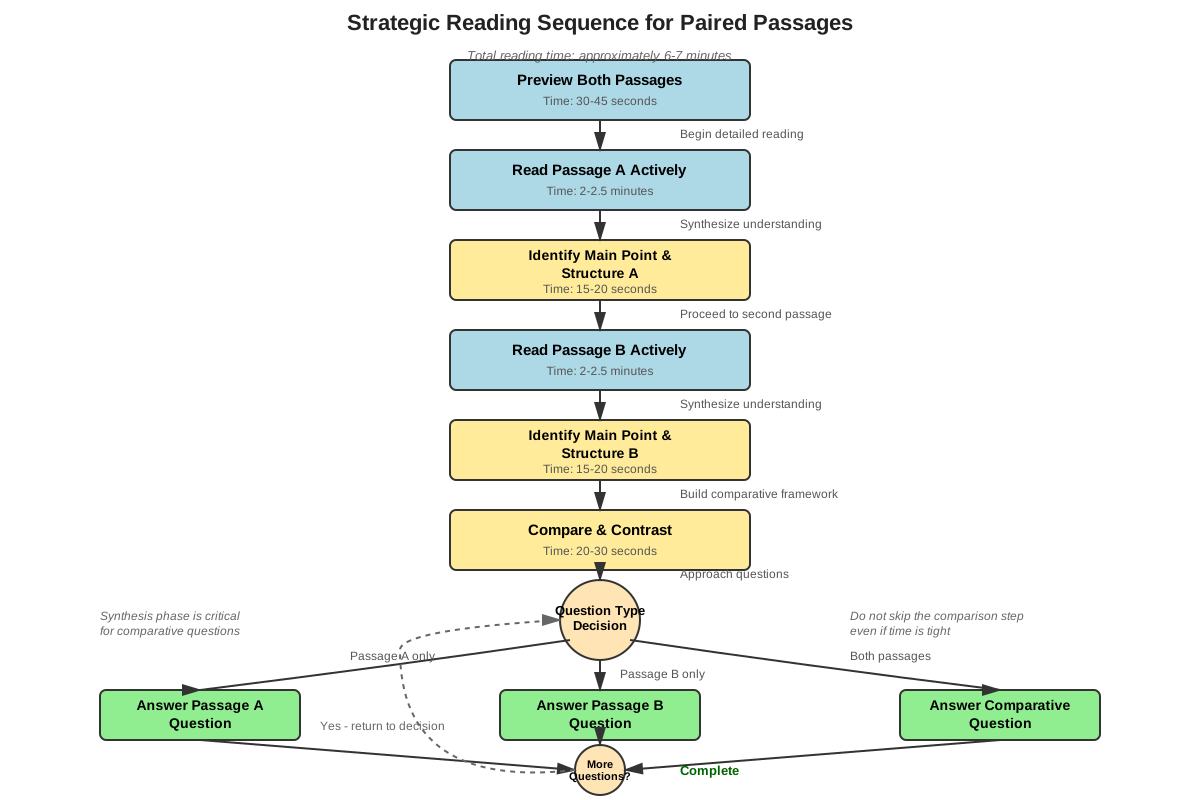
- [ ] Develop an efficient reading sequence that maximizes comprehension while minimizing time expenditure
- [ ] Construct mental frameworks for tracking similarities and differences between paired passages
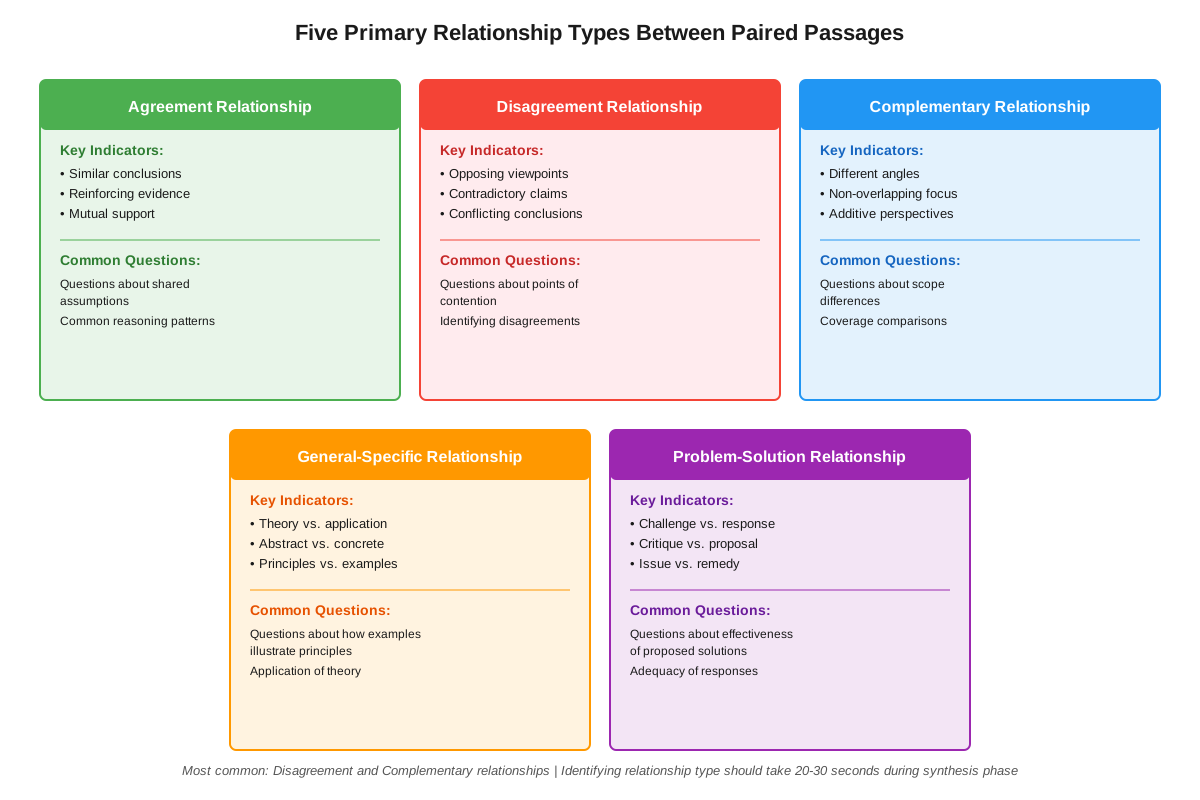
- [ ] Recognize the five primary relationship types between Passage A and Passage B
Prerequisites
- Basic passage reading skills: Understanding how to read actively and identify main ideas is fundamental before attempting to manage two passages simultaneously
- Argument structure recognition: Comparative passages require identifying premises and conclusions in each text, making this foundational skill essential
- Question type familiarity: Knowledge of standard LSAT question types (main point, inference, strengthen/weaken) enables focus on the comparative element rather than basic question mechanics
- Time management fundamentals: Students must already possess baseline pacing skills to allocate the additional time comparative passages require effectively
Why This Topic Matters
The Comparative Reading section represents a guaranteed component of every LSAT administration, making short passage strategy a non-negotiable element of test preparation. Since June 2007, when LSAC introduced this format, one of the four Reading Comprehension passages has consistently featured paired shorter passages rather than a single long passage. This format accounts for 6-8 questions per test, representing approximately 5-7% of the total LSAT score—a significant margin in a competitive testing environment where a single point can affect law school admissions outcomes.
From a practical perspective, the skills developed through short passage strategy extend far beyond test day. Legal practice regularly requires attorneys to compare competing precedents, contrast expert testimonies, or synthesize multiple statutory interpretations. The cognitive framework for managing dual perspectives while maintaining analytical precision directly translates to case analysis, appellate brief writing, and oral argument preparation. Law school itself demands this skill constantly, as students must reconcile competing scholarly viewpoints and distinguish between majority and dissenting opinions.
On the LSAT, Comparative Reading passages typically appear in several predictable formats: two authors presenting opposing viewpoints on a controversial issue, two perspectives offering complementary approaches to a problem, historical and contemporary views on a topic, or theoretical and practical applications of a concept. Questions following these passages fall into three categories: those asking exclusively about Passage A (typically 1-2 questions), those asking exclusively about Passage B (typically 1-2 questions), and those requiring comparison or synthesis of both passages (typically 3-5 questions). The comparative questions represent the highest-value targets, as they test the unique skills this format demands and often prove most challenging for unprepared test-takers.
Core Concepts
The Dual-Processing Framework
The foundation of effective short passage strategy rests on understanding that comparative passages require simultaneous engagement with two distinct cognitive processes: individual passage comprehension and relational analysis. Unlike single-passage reading, where the goal is simply to understand one author's argument, comparative reading demands that test-takers construct two separate mental models while continuously noting points of intersection, divergence, and relationship.
This dual-processing framework operates on three levels. First, the surface level involves tracking basic factual content—what each passage discusses, what examples each provides, and what conclusions each reaches. Second, the structural level requires identifying how each author builds their argument—whether through historical analysis, scientific evidence, logical reasoning, or rhetorical persuasion. Third, the relational level demands continuous comparison—where the passages agree, where they disagree, whether they address the same aspects of a topic, and how their methodologies differ.
The Three-Phase Reading Sequence
Effective short passage strategy employs a systematic three-phase approach that optimizes comprehension while managing time constraints:
Phase 1: Passage A Deep Read (2-3 minutes)
During this phase, read Passage A with full attention, exactly as you would approach a standard single passage. Identify the main point, note the argument structure, and understand the author's purpose and tone. Resist the temptation to skim or rush—establishing a solid understanding of Passage A creates the foundation for all subsequent comparative analysis.
Phase 2: Passage B Comparative Read (2-3 minutes)
When reading Passage B, maintain dual awareness: understand Passage B on its own terms while continuously noting relationships to Passage A. Ask yourself: Does this author agree or disagree with Passage A? Does this passage address the same aspects of the topic or different ones? Is the methodology similar or different? This active comparison during the initial read prevents the need for extensive re-reading later.
Phase 3: Relationship Synthesis (30-45 seconds)
Before proceeding to questions, pause briefly to articulate the core relationship between the passages. This synthesis might sound like: "Passage A argues for strict regulation based on safety concerns, while Passage B advocates market-based solutions emphasizing innovation. They agree that the current system is inadequate but disagree on the solution." This explicit articulation creates a mental framework that accelerates question-answering.
The Five Primary Relationship Types
Comparative passages on the LSAT typically exhibit one of five fundamental relationship patterns. Recognizing these patterns during the reading phase enables more efficient question-answering:
| Relationship Type | Description | Example Topics |
|---|---|---|
| Direct Opposition | Authors take contradictory positions on the same question | Gun control (pro vs. con), death penalty debates |
| Complementary Perspectives | Authors address different aspects of the same topic without conflict | Two benefits of renewable energy, different applications of a theory |
| Problem-Solution Variants | Both identify the same problem but propose different solutions | Climate change responses, education reform approaches |
| Theoretical-Practical | One passage presents abstract principles, the other concrete applications | Legal theory vs. case study, scientific principle vs. experimental results |
| Historical-Contemporary | One passage discusses past perspectives, the other current views | Evolution of constitutional interpretation, changing scientific paradigms |
Question Type Distribution and Strategy
Comparative Reading questions follow a predictable distribution that should inform strategic approach:
Passage-Specific Questions (30-40% of questions)
These questions ask exclusively about Passage A or Passage B, functioning identically to standard single-passage questions. The strategic key is recognizing these questions immediately and treating them as isolated comprehension tasks. Common question stems include: "The author of Passage A would most likely agree with which one of the following?" or "Which one of the following best describes the organization of Passage B?"
Direct Comparison Questions (40-50% of questions)
These questions explicitly require comparing or contrasting the passages. They represent the highest-value targets for strategic preparation because they test the unique skills comparative reading demands. Common stems include: "The authors would be most likely to disagree about which one of the following?" or "Which one of the following most accurately describes a difference in the content of the two passages?"
Synthesis Questions (10-20% of questions)
These questions require integrating information from both passages to reach a conclusion neither passage states explicitly. They often ask how one author would respond to the other's argument or what both passages together suggest about a broader issue. Example stems: "Based on what can be inferred from their titles, the relationship between the two passages is most analogous to the relationship between..." or "The passages most strongly support which one of the following generalizations?"
The Annotation System for Comparative Passages
Effective short passage strategy requires a modified annotation approach that tracks both individual passage content and comparative relationships. The recommended system uses:
- Brackets [ ] around the main point of each passage
- Underlines for key supporting evidence or examples
- Margin notes using "A:" and "B:" to track each passage's position on key issues
- Comparison symbols such as "≠" for disagreement, "=" for agreement, and "?" for unaddressed topics
This annotation system creates a visual map that enables rapid reference during question-answering, reducing the need for time-consuming re-reading.
The Agreement-Disagreement Matrix
A crucial element of short passage strategy involves systematically identifying points of agreement and disagreement. Many test-takers focus exclusively on differences, missing valuable agreement points that frequently appear in questions. The strategic approach involves mentally constructing a matrix:
Points of Agreement: What do both authors accept as true? What assumptions do they share? What problems do they both acknowledge?
Points of Disagreement: Where do their conclusions differ? What evidence does one accept that the other rejects? What values or priorities do they weigh differently?
Unaddressed Topics: What does Passage A discuss that Passage B ignores? What aspects does Passage B introduce that Passage A never mentions?
This matrix proves particularly valuable for elimination strategies, as incorrect answer choices often mischaracterize the relationship by claiming agreement where disagreement exists or vice versa.
Concept Relationships
The concepts within short passage strategy form an interconnected system where each element supports and enhances the others. The Dual-Processing Framework serves as the overarching cognitive model that explains why the Three-Phase Reading Sequence proves effective—each phase addresses one aspect of the dual-processing demand. The reading sequence, in turn, enables efficient identification of the Five Primary Relationship Types, as the comparative read in Phase 2 specifically directs attention toward relationship patterns.
The Question Type Distribution knowledge connects directly back to the reading sequence, as understanding that 60-70% of questions require comparison justifies the time investment in Phase 2's comparative reading. The Annotation System supports all other concepts by creating external memory aids that reduce cognitive load, allowing mental resources to focus on analysis rather than recall. Finally, the Agreement-Disagreement Matrix represents the practical application of the dual-processing framework, translating abstract cognitive demands into concrete analytical tasks.
These concepts also connect to prerequisite knowledge in important ways. Basic passage reading skills provide the foundation for Phase 1's deep read, while argument structure recognition enables the structural-level analysis within the dual-processing framework. Question type familiarity allows test-takers to quickly categorize questions as passage-specific, comparative, or synthesis, directing attention to the relevant passage(s) without wasted effort.
The relationship map flows as follows:
Dual-Processing Framework → informs → Three-Phase Reading Sequence → enables → Relationship Type Recognition → guides → Question Type Strategy → supported by → Annotation System → produces → Agreement-Disagreement Matrix → facilitates → Efficient Question-Answering
High-Yield Facts
⭐ Comparative Reading appears exactly once on every LSAT, consistently as one of four Reading Comprehension passages
⭐ Approximately 60-70% of questions following paired passages require comparison or synthesis of both passages, not just comprehension of individual passages
⭐ The most common relationship type is Direct Opposition, where authors take contradictory positions on the same central question
⭐ Questions asking what the authors would "disagree about" are among the most frequent comparative question types
⭐ Passage-specific questions (asking only about Passage A or only about Passage B) should be answered using only that passage, ignoring the other entirely
- The average length of each passage in a Comparative Reading set is 250-350 words, roughly half the length of a standard single passage
- Wrong answer choices in comparative questions frequently mischaracterize the relationship by claiming agreement where disagreement exists
- Time allocation for Comparative Reading should mirror single passages (8-9 minutes total), not receive extra time despite the dual-passage format
- The passages are always related in topic but may approach it from vastly different angles or disciplines
- Synthesis questions, though less frequent, often appear as the final question in the set and tend to be more difficult
Quick check — test yourself on Short passage strategy so far.
Try Flashcards →Common Misconceptions
Misconception: Comparative passages require less careful reading than single passages because each individual passage is shorter.
Correction: Comparative passages demand equal or greater attention because test-takers must not only comprehend each passage but also track relationships between them. The cognitive load is actually higher, not lower, despite shorter individual passages.
Misconception: The best strategy is to read both passages quickly, then re-read them carefully when answering questions.
Correction: This approach wastes significant time through redundant reading. The optimal strategy involves reading each passage carefully once while actively noting relationships, eliminating the need for extensive re-reading.
Misconception: All questions following comparative passages require information from both passages.
Correction: Approximately 30-40% of questions ask exclusively about Passage A or Passage B. Recognizing these passage-specific questions prevents wasted time searching for non-existent connections.
Misconception: If the passages disagree on one point, they disagree on everything.
Correction: Most comparative passages exhibit nuanced relationships with both points of agreement and disagreement. Authors may share assumptions or acknowledge the same problems while disagreeing on solutions or interpretations.
Misconception: The passages always present opposing viewpoints.
Correction: While Direct Opposition is common, passages may also present complementary perspectives, different applications of the same principle, or historical versus contemporary views without direct conflict.
Misconception: Passage B is always a response to or critique of Passage A.
Correction: The passages are typically independent texts addressing related topics, not a dialogue where Passage B responds to Passage A. Each author is usually unaware of the other's argument.
Misconception: Longer passages contain more important information.
Correction: In Comparative Reading, both passages receive equal weight in questions. A shorter passage may be just as important as a longer one, and questions are distributed across both passages.
Worked Examples
Example 1: Direct Opposition Relationship
Passage A (abbreviated): "The precautionary principle should guide environmental policy. When scientific uncertainty exists about potential harms, regulators must err on the side of caution, restricting activities until proven safe. The burden of proof should rest with those proposing potentially harmful activities, not with the public that might suffer consequences. Historical examples like asbestos and lead paint demonstrate the dangers of waiting for conclusive proof before acting."
Passage B (abbreviated): "Excessive caution in environmental regulation stifles innovation and economic growth. The precautionary principle, taken to its logical extreme, would prohibit virtually all new technologies since absolute safety can never be proven. Instead, policy should employ risk-benefit analysis, weighing potential harms against potential benefits. Many technologies initially feared as dangerous—such as pasteurization and vaccination—proved enormously beneficial. Regulatory paralysis itself carries costs."
Question: The authors would be most likely to disagree about which one of the following?
(A) Whether environmental policy should consider scientific evidence
(B) Whether the precautionary principle has ever been applied in practice
(C) Whether absolute certainty about safety is achievable
(D) Whether the burden of proof should rest with those proposing new activities
(E) Whether historical examples are relevant to current policy debates
Strategic Approach:
Step 1: Identify the question type. The stem "disagree about" signals a direct comparison question requiring analysis of both passages.
Step 2: Articulate the core disagreement. Passage A advocates for the precautionary principle with burden of proof on activity proponents; Passage B criticizes this approach and advocates for risk-benefit analysis.
Step 3: Evaluate each answer choice against both passages:
(A) Both authors consider scientific evidence—they disagree about how to handle uncertainty, not whether evidence matters. Eliminate.
(B) Neither passage discusses whether the principle has been applied in practice. Eliminate.
(C) Passage B mentions that "absolute safety can never be proven," but Passage A doesn't claim absolute certainty is achievable—it argues for action despite uncertainty. This isn't their core disagreement. Eliminate.
(D) Passage A explicitly states "the burden of proof should rest with those proposing potentially harmful activities," while Passage B implicitly rejects this by advocating risk-benefit analysis rather than requiring proof of safety before proceeding. This represents a clear point of disagreement. Strong candidate.
(E) Both authors use historical examples (A: asbestos and lead; B: pasteurization and vaccination), so they agree historical examples are relevant, though they draw different conclusions. Eliminate.
Answer: (D)
Connection to Learning Objectives: This example demonstrates how to identify comparative questions (Objective 1), apply the agreement-disagreement matrix reasoning pattern (Objective 2), and use systematic elimination to solve problems accurately (Objective 3).
Example 2: Complementary Perspectives Relationship
Passage A (abbreviated): "Urban green spaces provide crucial mental health benefits for city residents. Studies demonstrate that access to parks reduces stress, anxiety, and depression. The psychological mechanism involves both the restorative effects of nature and opportunities for physical activity. City planners should prioritize green space development as a public health intervention."
Passage B (abbreviated): "Urban green spaces deliver significant environmental benefits beyond their recreational value. Trees and vegetation reduce urban heat island effects, absorb stormwater runoff, and improve air quality by filtering pollutants. These ecosystem services provide economic value through reduced infrastructure costs and energy savings. Environmental considerations should drive urban green space policy."
Question: Which one of the following most accurately describes the relationship between the two passages?
(A) Passage A presents a theory that Passage B attempts to refute with empirical evidence
(B) Passage A and Passage B offer complementary reasons for the same policy recommendation
(C) Passage A discusses causes while Passage B discusses effects of the same phenomenon
(D) Passage A presents a problem for which Passage B proposes a solution
(E) Passage A and Passage B present opposing views on the value of urban planning
Strategic Approach:
Step 1: Recognize this as a synthesis question requiring characterization of the overall relationship.
Step 2: Identify the relationship type. Both passages advocate for urban green spaces but emphasize different benefits (mental health vs. environmental). This is a Complementary Perspectives relationship.
Step 3: Evaluate answer choices:
(A) Neither passage refutes the other; they address different aspects. Eliminate.
(B) Both passages conclude that urban green spaces should be prioritized (same policy recommendation) but for different reasons (mental health benefits vs. environmental benefits). This accurately describes a complementary relationship. Strong candidate.
(C) Passage A doesn't discuss causes of green spaces, and Passage B doesn't discuss effects of mental health. The passages discuss different types of benefits. Eliminate.
(D) Neither passage presents a problem; both present benefits. Eliminate.
(E) The passages present aligned views, not opposing ones. Eliminate.
Answer: (B)
Connection to Learning Objectives: This example illustrates recognizing relationship types (Objective 1), understanding the complementary reasoning pattern (Objective 2), and applying this understanding to synthesis questions (Objective 3).
Exam Strategy
Trigger Words and Phrases
Develop automatic recognition of language that signals question type:
Passage-Specific Triggers: "The author of Passage A," "According to Passage B," "Passage A suggests," "In Passage B, the author mentions"—these phrases indicate you should focus exclusively on one passage.
Comparison Triggers: "Both passages," "the authors would disagree," "unlike Passage A," "similar to," "in contrast to"—these phrases signal comparative questions requiring analysis of both passages.
Synthesis Triggers: "taken together," "the passages most strongly support," "the relationship between the passages," "both authors would be likely to agree"—these indicate synthesis questions requiring integration of both passages.
The Question Order Strategy
Approach questions strategically rather than sequentially:
- First, answer passage-specific questions about Passage A while that passage is freshest in memory
- Second, answer passage-specific questions about Passage B
- Third, tackle direct comparison questions, which benefit from having engaged with both passages through the specific questions
- Finally, address synthesis questions, which are often most difficult and benefit from the comprehensive understanding built through earlier questions
This sequence maximizes efficiency by leveraging the natural flow of memory and comprehension.
Process of Elimination Techniques
For disagreement questions: Eliminate answer choices where both authors would agree or where neither author expresses a view. The correct answer must identify a point where the passages take contradictory positions.
For agreement questions: Eliminate answer choices where the passages disagree or where only one passage addresses the topic. The correct answer must identify something both passages explicitly or implicitly support.
For relationship characterization questions: Eliminate extreme characterizations ("complete opposition," "total agreement") unless the passages truly exhibit that relationship. Most LSAT comparative passages show nuanced relationships.
Time Allocation
Allocate 8-9 minutes total for Comparative Reading passages, distributed as follows:
- Passage A reading: 2-3 minutes
- Passage B reading: 2-3 minutes
- Relationship synthesis: 30-45 seconds
- Questions: 4-5 minutes (approximately 45-60 seconds per question)
Resist the temptation to allocate extra time simply because two passages appear. The passages are shorter, and the total word count approximates a single standard passage.
The "Parking Lot" Technique
When a question requires information you cannot immediately locate, use the parking lot technique: make your best educated guess, mark the question for review, and move forward. Often, later questions will refresh your memory or provide context that makes the earlier question easier. Return to parked questions only if time permits after completing all other questions.
Memory Techniques
The "A vs. B" Mnemonic
When reading Passage B, continuously ask yourself the A vs. B questions:
- Agree or differ?
- viewpoint: same or separate?
- scope: overlapping or distinct?
- Basis: similar evidence or different?
This acronym ensures you maintain comparative awareness during the initial read.
The Relationship Visualization
Create a mental image for each relationship type:
- Direct Opposition: Two arrows pointing at each other (←→)
- Complementary Perspectives: Two arrows pointing in the same direction (→→)
- Problem-Solution Variants: A question mark followed by two different arrows (? → ↗)
- Theoretical-Practical: A cloud (theory) connected to a gear (practice)
- Historical-Contemporary: A timeline with two marked points
Visualizing these patterns during reading helps categorize the relationship quickly.
The Three-Column Mental Table
As you read, construct a mental three-column table:
| Passage A Only | Both Passages | Passage B Only |
|---|---|---|
| [Unique points] | [Shared points] | [Unique points] |
This mental organization facilitates rapid answering of both passage-specific and comparative questions.
The "COMPARE" Acronym
Use COMPARE to remember the systematic approach:
- Categorize the relationship type
- Outline each passage's main point
- Mark points of agreement
- Pinpoint disagreements
- Annotate key evidence
- Review the synthesis before questions
- Eliminate systematically
Summary
Short passage strategy represents a specialized skill set essential for success on the LSAT's Comparative Reading section, which appears once on every test administration. The strategy rests on a dual-processing framework that requires simultaneously comprehending individual passages while tracking relationships between them. The optimal approach employs a three-phase reading sequence: a deep read of Passage A, a comparative read of Passage B that actively notes relationships, and a brief synthesis before proceeding to questions. Recognizing the five primary relationship types—Direct Opposition, Complementary Perspectives, Problem-Solution Variants, Theoretical-Practical, and Historical-Contemporary—enables more efficient analysis. Questions following comparative passages divide into three categories: passage-specific questions (30-40%), direct comparison questions (40-50%), and synthesis questions (10-20%), each requiring distinct strategic approaches. Success demands systematic annotation, construction of an agreement-disagreement matrix, and recognition of trigger words that signal question type. The cognitive demands of comparative reading are substantial, but a disciplined strategic approach transforms this challenging format into a high-yield opportunity for score improvement.
Key Takeaways
- Comparative Reading appears exactly once on every LSAT, making short passage strategy a guaranteed score factor, not an optional skill
- The three-phase reading sequence (Passage A deep read, Passage B comparative read, relationship synthesis) prevents time-wasting re-reading while ensuring comprehensive understanding
- Approximately 60-70% of questions require comparison or synthesis, justifying significant attention to relationship analysis during the initial read
- The five primary relationship types (Direct Opposition, Complementary Perspectives, Problem-Solution Variants, Theoretical-Practical, Historical-Contemporary) provide a framework for rapid relationship categorization
- Passage-specific questions should be answered using only the relevant passage, while comparative questions demand systematic analysis of both passages' positions
- The agreement-disagreement matrix serves as the foundation for most comparative questions, making its construction during reading a high-value activity
- Strategic question ordering (passage-specific first, then comparative, finally synthesis) maximizes efficiency by leveraging natural memory patterns
Related Topics
Single Passage Reading Strategy: Mastering short passage strategy builds upon and reinforces single passage skills, as each passage in a comparative set must first be understood individually before comparison becomes possible.
Argument Structure Analysis: The ability to identify premises, conclusions, and reasoning patterns in individual passages directly supports the comparative analysis required in short passage strategy.
Inference Questions in Comparative Contexts: Understanding how to draw valid inferences from comparative passages represents an advanced application of short passage strategy, particularly for synthesis questions.
Perspective and Tone Recognition: Identifying each author's perspective and tone becomes crucial in comparative reading, as these elements often drive the relationship between passages.
Advanced Elimination Strategies: The process-of-elimination techniques specific to comparative questions build upon general elimination skills while adding the comparative dimension.
Practice CTA
Now that you have mastered the strategic framework for approaching LSAT Comparative Reading passages, it's time to put these concepts into practice. The practice questions and flashcards accompanying this guide will reinforce your understanding of the three-phase reading sequence, relationship type recognition, and question-type strategies. Remember that short passage strategy is a skill that improves dramatically with deliberate practice—each comparative passage you analyze strengthens your ability to process dual perspectives efficiently. Approach the practice materials with the same systematic strategy outlined in this guide, and you'll develop the automaticity that transforms comparative reading from a challenging obstacle into a scoring opportunity. Your investment in mastering this high-yield topic will pay dividends on test day and beyond.
Sign up free to keep reading
Create a free AnvayaPrep account to finish this LSAT guide on Short passage strategy — plus flashcards and practice questions.