Overview
In LSAT Reading Comprehension, one of the most frequently tested skills involves distinguishing between the author's own position and the views of others mentioned in the passage. This fundamental distinction—author versus others—appears in nearly every LSAT Reading Comprehension section and forms the basis for numerous question types. Understanding this concept means recognizing when the passage author is expressing their own opinion, analysis, or conclusion versus when they are merely reporting, describing, or critiquing someone else's viewpoint.
The ability to track author versus others is essential because LSAT passages deliberately weave together multiple perspectives. A typical passage might present a traditional theory, introduce critics of that theory, describe alternative viewpoints, and then reveal the author's own stance—which might align with one view, synthesize multiple perspectives, or present an entirely new position. Students who cannot accurately distinguish these voices will consistently miss questions about the author's attitude, purpose, and main point. This skill becomes even more critical in comparative reading passages, where two different authors present contrasting perspectives on the same topic.
Mastering author versus others connects directly to broader passage fundamentals in reading comprehension. It builds upon basic comprehension skills while serving as a foundation for more advanced tasks like identifying tone, evaluating argument structure, and predicting how an author would respond to new information. This topic represents a critical bridge between simply understanding what a passage says and analyzing how and why the author presents information in a particular way—the hallmark of high-scoring LSAT performance.
Learning Objectives
- [ ] Identify how Author versus others appears in LSAT questions
- [ ] Explain the reasoning pattern behind Author versus others
- [ ] Apply Author versus others to solve LSAT-style problems accurately
- [ ] Distinguish between direct authorial statements and reported viewpoints using textual markers
- [ ] Recognize the spectrum of authorial attitudes toward others' views (from endorsement to rejection)
- [ ] Predict question types that test author versus others distinctions
- [ ] Evaluate answer choices by determining whether they accurately attribute views to the correct source
Prerequisites
- Basic passage comprehension: Understanding literal meaning and main ideas is necessary before distinguishing whose ideas are being presented
- Familiarity with argument structure: Recognizing claims, evidence, and conclusions helps identify when the author is building their own argument versus describing others' arguments
- Understanding of rhetorical indicators: Knowledge of transition words and phrases that signal shifts in perspective (e.g., "however," "critics argue," "in fact")
- Awareness of passage organization: Recognizing how LSAT passages are structured helps predict where authorial commentary typically appears
Why This Topic Matters
The lsat author versus others distinction appears in approximately 60-70% of all Reading Comprehension questions, making it one of the highest-yield topics in the entire section. Questions explicitly testing this skill include "The author's attitude toward X is most accurately described as," "According to the passage, critics of the theory believe," and "The author mentions X primarily in order to." Even questions that don't directly ask about attribution often require students to distinguish authorial views from reported views to eliminate wrong answers.
In real-world applications, this skill mirrors critical thinking abilities essential for legal practice: distinguishing between a judge's holding and dicta, separating a client's claims from opposing counsel's arguments, and identifying which precedents a legal scholar endorses versus merely discusses. Law schools value this analytical capacity because it demonstrates the ability to navigate complex texts containing multiple competing perspectives—a daily requirement in legal education and practice.
LSAT passages employ several common patterns for presenting author versus others distinctions. Science passages often describe a prevailing theory, present challenges to it, and conclude with the author's evaluation of the debate. Humanities passages frequently introduce a traditional interpretation of an artwork or text, describe revisionist scholars' critiques, and reveal the author's position on which interpretation has merit. Social science passages typically present competing explanations for a phenomenon, with the author ultimately favoring one explanation or synthesizing elements from multiple views. Recognizing these patterns allows students to anticipate where authorial commentary will appear and what form it will take.
Core Concepts
Defining Author Versus Others
The author versus others framework refers to the fundamental distinction between statements, opinions, and arguments that represent the passage author's own position versus those that belong to other individuals, groups, or schools of thought mentioned in the passage. The "author" is the voice constructing the passage itself—the person selecting what information to include, how to frame it, and what conclusions to draw. "Others" encompasses any person, scholar, theory, school of thought, critic, or perspective that the author discusses, describes, or references.
This distinction matters because LSAT passages are not neutral reports. Even when presenting multiple viewpoints, the author makes choices about emphasis, organization, and commentary that reveal their own perspective. A passage might spend three paragraphs describing a theory the author ultimately rejects, or it might briefly mention a view the author strongly endorses. The length of discussion does not necessarily correlate with authorial support.
Textual Markers of Attribution
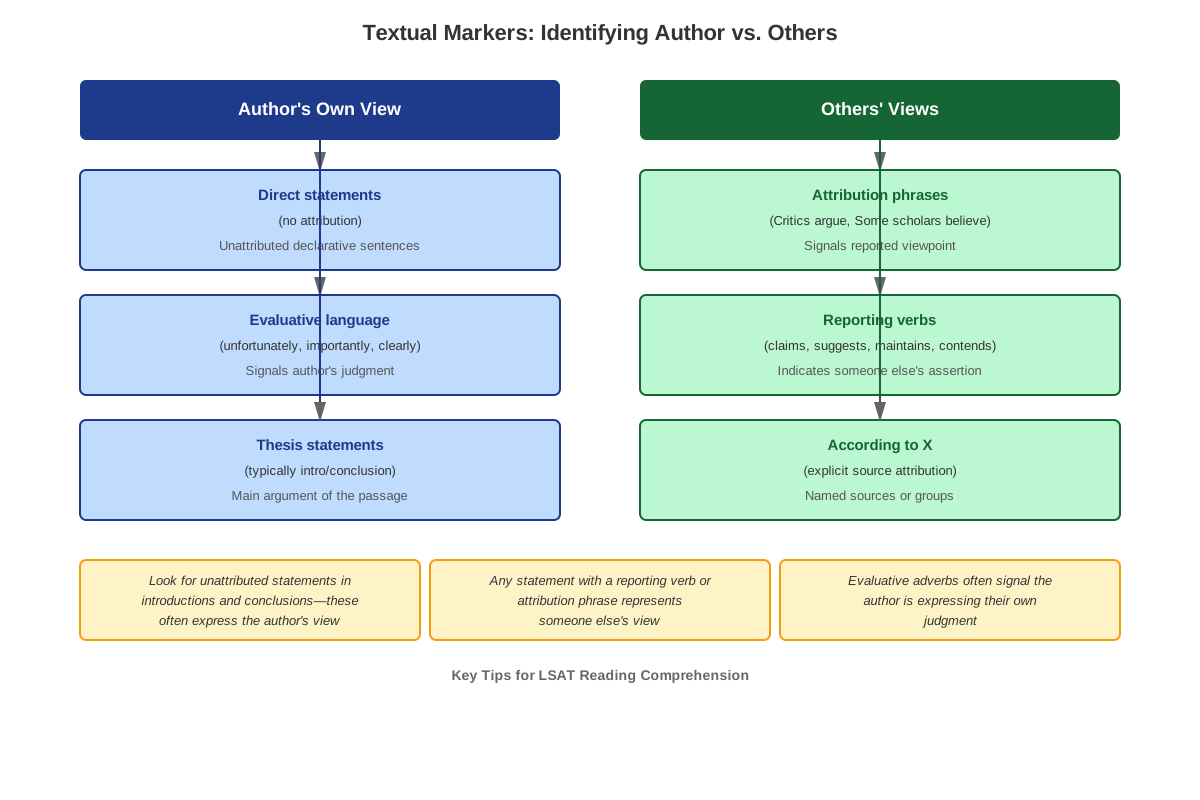
LSAT passages use specific linguistic markers to signal whose view is being presented. Recognizing these markers is essential for accurate tracking:
Direct Attribution Phrases explicitly identify the source of a claim:
- "According to Smith..."
- "Jones argues that..."
- "Critics contend..."
- "Proponents of the theory believe..."
- "Traditional scholars have maintained..."
Reporting Verbs indicate that the author is describing someone else's position:
- Claims, argues, suggests, proposes, maintains, asserts, contends
- Believes, thinks, considers, views, regards
- Notes, observes, points out, describes
Authorial Voice Indicators signal the author's own perspective:
- "In fact..." (often introduces author's correction of others' views)
- "However..." (frequently signals author's disagreement)
- "Indeed..." (typically reinforces author's own point)
- "It is clear that..." (usually expresses author's conclusion)
- Evaluative language without attribution (e.g., "This explanation fails to account for...")
The Spectrum of Authorial Attitudes
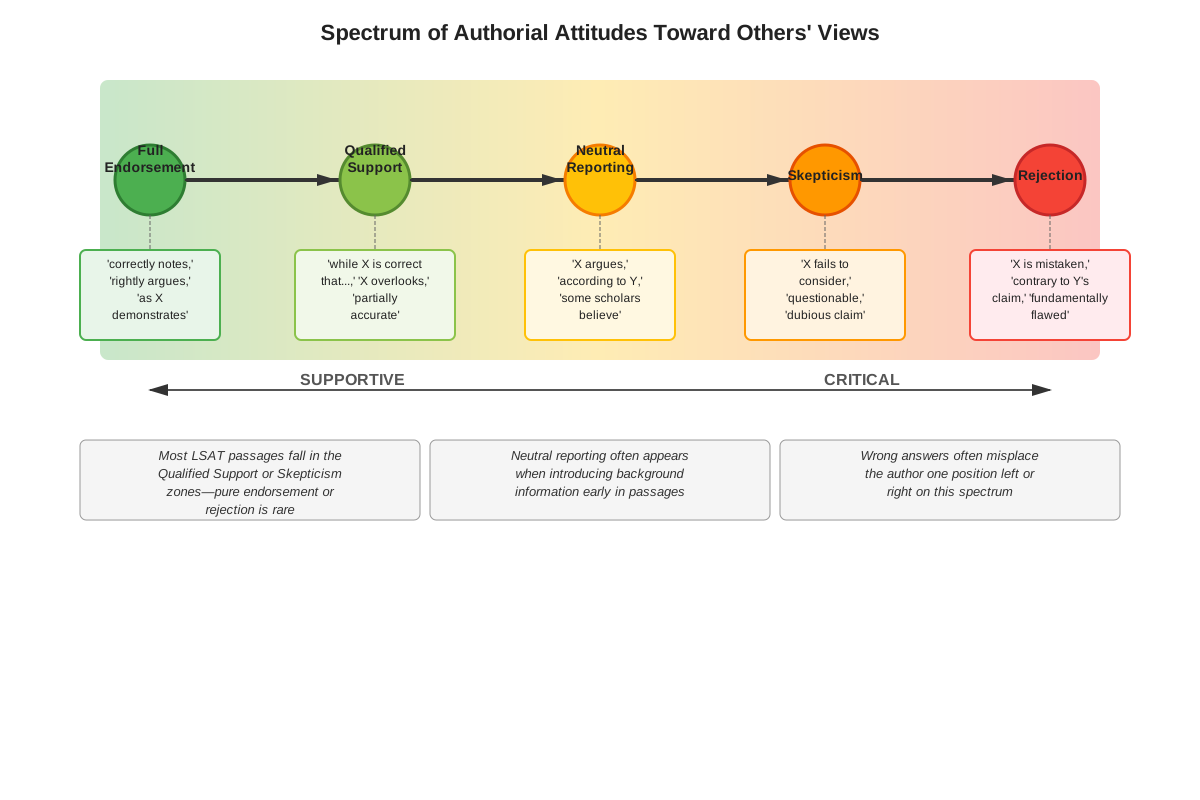
Authors don't simply agree or disagree with others' views; they adopt positions along a spectrum:
| Authorial Stance | Typical Markers | Example Language |
|---|---|---|
| Strong endorsement | "Correctly," "persuasively," "convincingly" | "Smith correctly identifies the flaw..." |
| Qualified support | "Largely accurate," "generally sound" | "While not without limitations, this approach..." |
| Neutral presentation | Pure description without evaluation | "The theory proposes three mechanisms..." |
| Mild skepticism | "Questionable," "overlooks," "fails to consider" | "This view, however, neglects..." |
| Strong rejection | "Mistakenly," "erroneously," "fundamentally flawed" | "This interpretation fundamentally misunderstands..." |
Understanding this spectrum prevents the common error of treating all non-endorsed views as equally rejected or assuming that any mentioned view has authorial support.
Implicit Authorial Commentary
Not all authorial perspective is explicitly stated. Authors often reveal their positions through:
Structural choices: Placing a view at the end of the passage (position of emphasis) often signals authorial preference. Beginning with a view and then spending most of the passage critiquing it signals authorial rejection.
Tone and word choice: Describing a theory as "elegant" versus "simplistic," or a scholar as "insightful" versus "dogmatic" reveals authorial attitude even without explicit agreement or disagreement.
Evidence selection: When an author provides extensive evidence supporting one view while merely mentioning counterarguments, the pattern of evidence reveals authorial preference.
Rhetorical questions: Questions like "But does this explanation account for all the evidence?" typically signal the author's skepticism toward the view being questioned.
Common Passage Structures
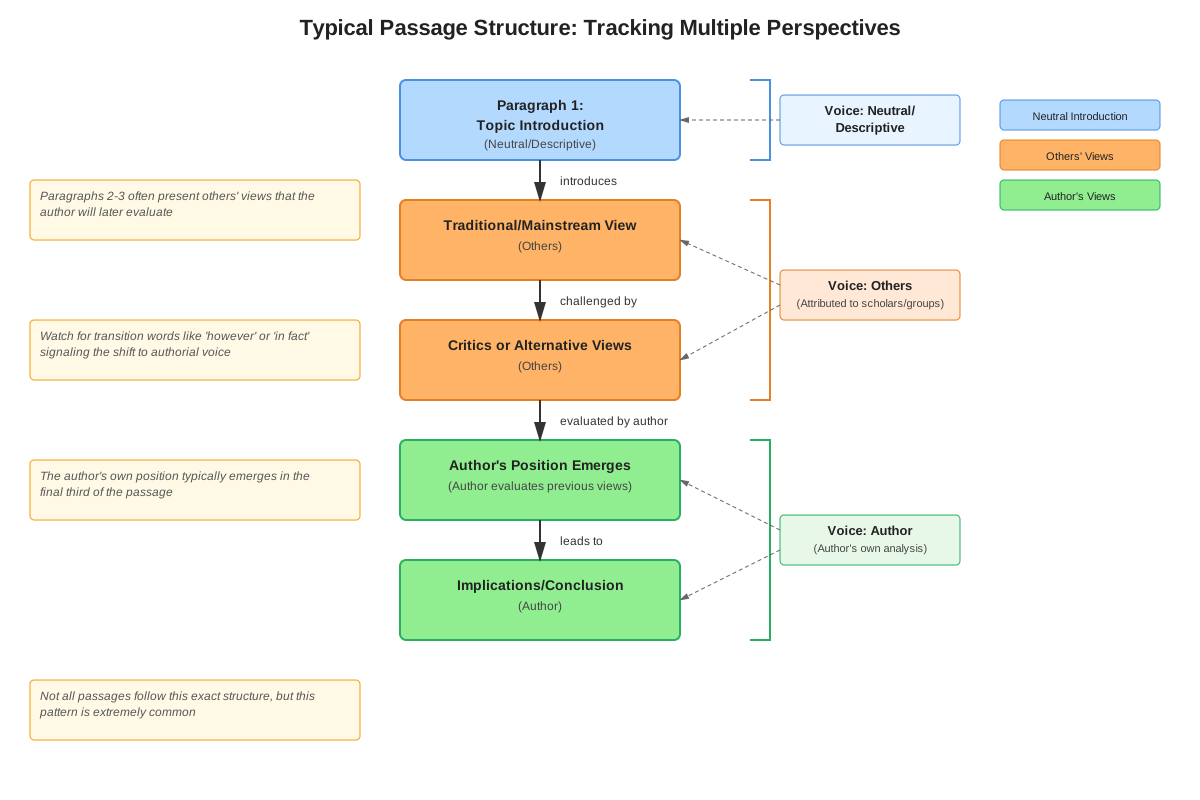
LSAT passages follow predictable patterns in presenting author versus others:
Pattern 1: Traditional View → Critique → Author's Position
- Paragraph 1: Describes established theory or interpretation
- Paragraph 2: Introduces critics or alternative views
- Paragraph 3: Author evaluates the debate and stakes a position
Pattern 2: Phenomenon → Competing Explanations → Author's Synthesis
- Paragraph 1: Describes a phenomenon requiring explanation
- Paragraphs 2-3: Present different scholars' explanations
- Paragraph 4: Author synthesizes or favors one explanation
Pattern 3: Thesis → Support → Counterarguments → Rebuttal
- Paragraph 1: Author states main claim
- Paragraph 2: Author provides supporting evidence
- Paragraph 3: Author acknowledges potential objections
- Paragraph 4: Author responds to objections
Recognizing these structures helps predict where authorial commentary will appear and what form it will take.
Concept Relationships
The author versus others distinction serves as a foundational concept that connects to virtually every other aspect of LSAT Reading Comprehension. Understanding whose view is being presented enables accurate identification of the main point (which is always the author's primary claim, not merely a view the author describes). It directly supports tone and attitude questions, which require recognizing the author's evaluative stance toward discussed views.
This concept builds upon basic comprehension skills—students must first understand what is being said before determining who is saying it. It then enables more advanced skills like argument analysis, where students must distinguish between the author's own reasoning and the reasoning of others the author discusses. The relationship flows: Basic Comprehension → Author vs. Others Attribution → Tone/Attitude Recognition → Argument Structure Analysis → Application Questions.
The connection to rhetorical structure is particularly strong. Authors use specific organizational patterns to signal their relationship to others' views: presenting a view early often means it will be critiqued later; introducing a view with qualifying language ("some scholars argue") signals distance from that view; presenting a view without attribution often indicates authorial endorsement.
In comparative reading passages, author versus others becomes even more complex, as students must track Author A's views, Author B's views, and each author's relationship to third-party views they discuss. The skill compounds: Author A versus Others mentioned by A, Author B versus Others mentioned by B, and Author A versus Author B.
High-Yield Facts
⭐ The author's main point is always the author's own position, never merely a view the author describes or reports.
⭐ Phrases like "according to," "critics argue," and "proponents believe" signal that the following content represents others' views, not the author's.
⭐ The author's attitude can be inferred from word choice, even without explicit agreement or disagreement statements.
⭐ Views presented at the end of a passage typically receive more authorial emphasis than views presented early.
⭐ When an author presents evidence supporting one view but not others, this pattern reveals authorial preference.
- Neutral description (e.g., "The theory proposes...") does not imply authorial endorsement.
- Authors often present views they ultimately reject in order to critique them or provide context.
- Rhetorical questions in LSAT passages typically signal authorial skepticism toward the view being questioned.
- The length of discussion devoted to a view does not necessarily correlate with authorial support for that view.
- Transition words like "however," "in fact," and "indeed" often signal shifts between others' views and the author's own perspective.
- Comparative reading passages require tracking four distinct perspectives: Author A's view, Author B's view, and the third-party views each author discusses.
- Authors may partially agree with a view while rejecting other aspects of it—authorial attitudes exist on a spectrum, not as binary agree/disagree.
Quick check — test yourself on Author versus others so far.
Try Flashcards →Common Misconceptions
Misconception: If the author describes a view in detail, they must agree with it.
Correction: Authors frequently provide detailed descriptions of views they ultimately reject, either to provide context or to set up a critique. Length of discussion does not indicate endorsement; look for explicit evaluative language or structural cues about the author's stance.
Misconception: Any view mentioned in the passage represents the author's perspective.
Correction: LSAT passages deliberately include multiple perspectives. Only statements made in the author's own voice (without attribution to others) or statements the author explicitly endorses represent the author's actual position. Most passages contain more "others' views" than authorial views.
Misconception: The author's view always appears in the first paragraph.
Correction: While some passages begin with the author's thesis, many follow a structure of presenting others' views first and revealing the author's position later. The author's main point often appears in the final paragraph or is built cumulatively throughout the passage.
Misconception: If the author doesn't explicitly disagree with a view, they must agree with it.
Correction: Neutral presentation without evaluative language typically means the author is simply reporting a view, not endorsing it. Absence of disagreement is not the same as agreement. Look for positive evaluative language (e.g., "correctly," "persuasively") to identify actual endorsement.
Misconception: Phrases like "it is believed that" or "it is thought that" represent the author's view.
Correction: These passive constructions typically indicate others' views that the author is reporting. They create distance between the author and the claim. The author's own views are usually stated more directly and assertively.
Misconception: The author's attitude toward a view is always clearly stated.
Correction: Authors often reveal their attitudes through subtle cues: word choice, evidence selection, structural placement, and tone. Recognizing implicit authorial commentary is essential for high-level performance on LSAT Reading Comprehension.
Worked Examples
Example 1: Science Passage
Passage Excerpt:
"For decades, scientists believed that the extinction of the dinosaurs resulted from a gradual climate shift. However, the discovery of high iridium concentrations in rock layers dating to the extinction period has led many researchers to favor the asteroid impact hypothesis. According to this theory, a massive asteroid collision created a dust cloud that blocked sunlight and disrupted photosynthesis. While this explanation accounts for the sudden nature of the extinction, it fails to explain why some species survived while closely related ones perished. A more nuanced view recognizes that multiple factors—including both asteroid impact and volcanic activity—likely contributed to the extinction event."
Question: The author's attitude toward the asteroid impact hypothesis is most accurately described as:
Analysis:
- Identify attribution markers: "scientists believed" (others' view), "many researchers favor" (others' view), "According to this theory" (others' view), "A more nuanced view recognizes" (likely author's view)
- Track authorial commentary: The phrase "While this explanation accounts for..." shows the author acknowledging a strength of the asteroid hypothesis. However, "it fails to explain" introduces a criticism. The final sentence beginning with "A more nuanced view" is presented without attribution, suggesting it represents the author's own position.
- Determine authorial stance: The author sees merit in the asteroid hypothesis (it "accounts for the sudden nature") but finds it incomplete (it "fails to explain" survival patterns). The author favors a multi-factor explanation that includes but is not limited to asteroid impact.
- Correct answer concept: The author's attitude is one of qualified support—recognizing the hypothesis's explanatory value while identifying its limitations and advocating for a more comprehensive explanation.
Connection to learning objectives: This example demonstrates how to identify textual markers distinguishing author from others (Objective 1), recognize the reasoning pattern of presenting others' views before revealing authorial perspective (Objective 2), and apply this understanding to determine authorial attitude (Objective 3).
Example 2: Humanities Passage
Passage Excerpt:
"Traditional art historians have interpreted Vermeer's domestic scenes as celebrations of Dutch middle-class virtue and prosperity. Recent scholars, however, argue that these paintings contain subtle critiques of the very values they appear to endorse. They point to symbolic elements—the empty chair, the discarded sewing—as evidence of underlying tension. Yet this revisionist reading, while intriguing, relies heavily on speculative interpretations of ambiguous details. The paintings' enduring power may lie precisely in their resistance to singular interpretation, inviting viewers to find both celebration and critique depending on their own perspectives."
Question: Which of the following best describes the author's view of the revisionist interpretation?
Analysis:
- Map the perspectives:
- Traditional historians: paintings celebrate virtue (others)
- Recent scholars: paintings critique values (others)
- Author's view: needs to be determined
- Identify evaluative language: "while intriguing" (mild positive), "relies heavily on speculative interpretations" (criticism), "The paintings' enduring power may lie..." (author's own claim, no attribution)
- Determine authorial stance: The author finds the revisionist reading "intriguing" (not dismissive) but criticizes its methodology as "speculative." The author then offers their own interpretation: the paintings' value lies in interpretive openness, not in either the traditional or revisionist reading being definitively correct.
- Correct answer concept: The author views the revisionist interpretation as interesting but methodologically flawed, ultimately preferring a third position that transcends the traditional/revisionist debate.
Connection to learning objectives: This example shows how authors can acknowledge merit in a view while ultimately rejecting it, demonstrating the spectrum of authorial attitudes and the importance of recognizing both explicit and implicit authorial commentary.
Exam Strategy
Primary Strategy: Create a mental or physical map as you read, marking each view with its source (Author, Traditional scholars, Critics, Theory X, etc.). This prevents the common error of conflating different perspectives.
Trigger words to watch for:
- Attribution signals: "according to," "argues that," "believes," "contends," "maintains," "suggests"
- Author's voice: "in fact," "however," "indeed," "actually," "clearly," evaluative adjectives without attribution
- Distancing language: "supposedly," "purportedly," "it is claimed that," "some argue"
- Endorsement markers: "correctly," "persuasively," "rightly," "as X convincingly demonstrates"
Process-of-elimination approach:
- For questions about the author's view, immediately eliminate any answer choice that describes a view explicitly attributed to someone else in the passage
- For questions about others' views, eliminate answer choices that reflect the author's own position or commentary
- Watch for answer choices that subtly shift attribution—describing as the author's view what the passage attributes to critics, or vice versa
- Be especially careful with answer choices using "the passage suggests" or "the passage indicates"—these could refer to either author or others depending on context
Time allocation:
- Spend extra time during initial reading noting whose view is being presented (this investment pays off across multiple questions)
- When a question asks about authorial attitude or others' views, return to the passage to verify attribution rather than relying on memory
- If uncertain about attribution, look for the textual markers described above rather than making assumptions
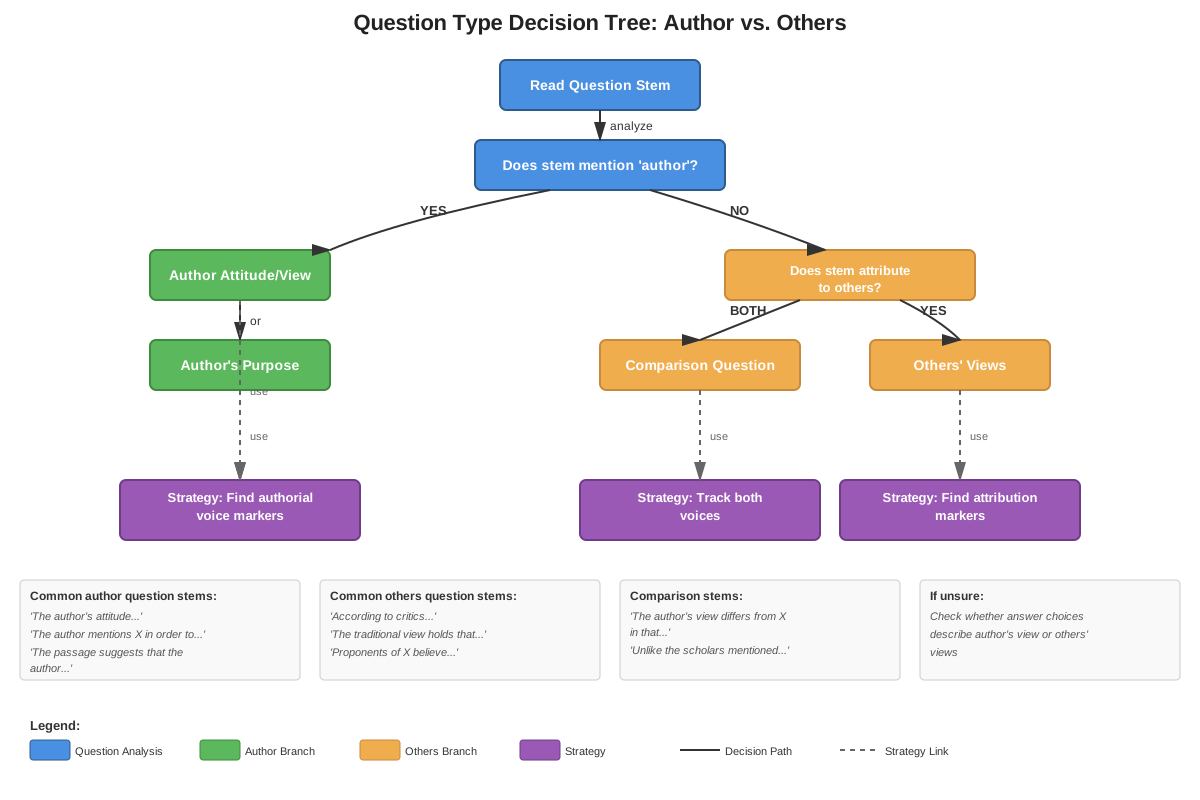
Question type recognition:
- "The author's attitude toward X..." = direct author versus others question
- "According to the passage, critics believe..." = testing whether you can identify others' views
- "The author mentions X primarily in order to..." = testing whether you understand the author's rhetorical purpose in discussing others' views
- "Which of the following would the author most likely agree with..." = requires understanding author's position as distinct from all discussed views
Memory Techniques
AUTHOR mnemonic for identifying authorial voice:
- Assertive language without attribution
- Unqualified evaluative statements
- Transitions that signal correction ("in fact," "however")
- Highlighting through structural position (often final paragraph)
- Opinion words showing judgment
- Rhetorical questions suggesting skepticism
OTHERS mnemonic for identifying reported views:
- Outside sources explicitly named
- Theories described with attribution
- Historical views presented as background
- Experts quoted or paraphrased
- Reporting verbs (argues, claims, believes)
- Schools of thought referenced
Visualization strategy: Picture the passage as a conversation at a conference. The author is the moderator who introduces various speakers (others), lets them present their views, and then offers their own commentary and conclusions. This mental model helps maintain clear attribution.
The "Says Who?" technique: After reading each claim in the passage, mentally ask "Says who?"—Author or Others? This active reading strategy prevents passive absorption that loses track of attribution.
Summary
The author versus others distinction is the single most important analytical skill in LSAT Reading Comprehension, appearing in the majority of questions across all passage types. Mastering this concept requires recognizing textual markers that signal attribution (reporting verbs, attribution phrases, evaluative language), understanding the spectrum of authorial attitudes from strong endorsement to outright rejection, and tracking multiple perspectives simultaneously. Authors reveal their positions both explicitly through direct statements and implicitly through structural choices, word selection, and evidence presentation. Common passage structures follow predictable patterns: presenting traditional views before introducing critiques, describing competing explanations before revealing authorial preference, or building toward an authorial synthesis. Success on LSAT Reading Comprehension depends on maintaining clear mental separation between what the author believes and what the author merely reports, describes, or critiques. This skill enables accurate responses to questions about main point, authorial attitude, purpose, and application—collectively representing the majority of Reading Comprehension questions.
Key Takeaways
- Author versus others attribution appears in 60-70% of Reading Comprehension questions, making it the highest-yield topic in the section
- Textual markers like "according to," "critics argue," and reporting verbs signal others' views, while assertive unattributed statements typically represent the author's voice
- Authorial attitudes exist on a spectrum from strong endorsement to outright rejection; neutral description does not imply agreement
- The author's main point is always their own position, never merely a view they describe or report
- Structural position, word choice, and evidence selection reveal authorial perspective even without explicit agreement or disagreement statements
- Creating a mental map of perspectives while reading prevents the common error of conflating author and others
- Return to the passage to verify attribution rather than relying on memory when answering questions about whose view is being presented
Related Topics
Tone and Attitude Questions: Building directly on author versus others, these questions require identifying the author's emotional or evaluative stance toward discussed topics. Mastering attribution enables accurate tone identification.
Main Point and Primary Purpose: These question types require distinguishing the author's central claim from supporting details and others' views—impossible without solid author versus others skills.
Argument Structure and Reasoning: Understanding whose argument is being presented (author's own reasoning versus others' reasoning the author describes) is essential for analyzing logical relationships.
Comparative Reading: This passage type intensifies author versus others complexity by requiring students to track two authors' perspectives and their relationships to third-party views.
Inference Questions: Many inference questions require understanding authorial perspective to predict what the author would likely agree with or how they would respond to new information.
Practice CTA
Now that you understand the critical distinction between author and others in LSAT Reading Comprehension passages, it's time to put this knowledge into practice. Work through the practice questions and flashcards for this topic, paying special attention to identifying attribution markers and tracking multiple perspectives. Remember: every passage you read is an opportunity to strengthen this essential skill. As you practice, actively ask yourself "Whose view is this?" after each claim you encounter. This deliberate practice will transform author versus others recognition from a conscious effort into an automatic analytical habit—the hallmark of top LSAT performers. Your investment in mastering this foundational concept will pay dividends across every Reading Comprehension question you encounter.
Sign up free to keep reading
Create a free AnvayaPrep account to finish this LSAT guide on Author versus others — plus flashcards and practice questions.