Overview
Author viewpoint is one of the most critical skills tested in LSAT Reading Comprehension. Unlike simply identifying what a passage says, determining the author's viewpoint requires students to distinguish between objective reporting of facts, presentation of others' opinions, and the author's own perspective on the subject matter. This skill forms the foundation for answering approximately 15-20% of all Reading Comprehension questions on the LSAT, making it an essential competency for achieving a competitive score.
The LSAT frequently presents passages where authors discuss complex theories, legal principles, scientific discoveries, or social phenomena. In these passages, authors may present multiple viewpoints—those of scholars, critics, historical figures, or competing schools of thought—while simultaneously revealing their own position through subtle linguistic cues. Mastering lsat author viewpoint questions requires developing the ability to detect tone, identify evaluative language, recognize rhetorical strategies, and distinguish between neutral exposition and authorial commentary. This skill directly impacts performance on questions asking about the author's attitude, primary purpose, or opinion regarding specific claims within the passage.
Understanding author viewpoint connects intimately with other passage fundamentals in reading comprehension. It builds upon the ability to identify main ideas and passage structure while serving as a prerequisite for more advanced skills like evaluating arguments and understanding comparative passages. The author's viewpoint often determines the passage's organizational structure, influences which details receive emphasis, and shapes the overall argumentative trajectory. Students who master this topic gain a significant advantage in quickly comprehending passages and efficiently eliminating incorrect answer choices.
Learning Objectives
- [ ] Identify how Author viewpoint appears in LSAT questions
- [ ] Explain the reasoning pattern behind Author viewpoint
- [ ] Apply Author viewpoint to solve LSAT-style problems accurately
- [ ] Distinguish between the author's viewpoint and viewpoints attributed to other parties in the passage
- [ ] Recognize linguistic markers that signal authorial opinion versus neutral reporting
- [ ] Evaluate answer choices by matching them against textual evidence of the author's perspective
- [ ] Synthesize multiple indicators throughout a passage to construct a complete picture of the author's stance
Prerequisites
- Basic reading comprehension skills: Understanding literal meaning and main ideas provides the foundation for detecting more subtle authorial attitudes
- Familiarity with passage structure: Recognizing how passages are organized helps identify where authors typically reveal their viewpoints
- Understanding of tone and connotation: Distinguishing between neutral and evaluative language is essential for detecting authorial opinion
- Ability to identify claims versus evidence: Separating what is being argued from what supports the argument clarifies whose viewpoint is being presented
Why This Topic Matters
Author viewpoint questions appear with remarkable consistency across LSAT administrations, typically comprising 2-4 questions per Reading Comprehension section. These questions directly test a fundamental lawyering skill: the ability to distinguish between objective facts, others' arguments, and one's own position—a critical competency in legal analysis, brief writing, and oral advocacy. Law schools value this skill because attorneys must constantly evaluate sources, understand opposing viewpoints, and articulate their own positions with precision.
On the LSAT, author viewpoint manifests in several question types: attitude questions ("The author's attitude toward X can best be described as..."), primary purpose questions ("The author's main purpose in the passage is to..."), and agreement questions ("With which of the following would the author most likely agree?"). These questions reward students who can move beyond surface-level comprehension to understand the author's underlying perspective, evaluative stance, and rhetorical goals.
In real-world legal practice, this skill translates directly to reading judicial opinions (distinguishing the court's holding from dicta or dissenting views), analyzing scholarly articles (understanding an author's thesis versus the theories they critique), and evaluating opposing counsel's arguments (separating their characterizations from the underlying facts). The LSAT tests this skill because it predicts success in the analytical reading required throughout law school and legal practice.
Core Concepts
Defining Author Viewpoint
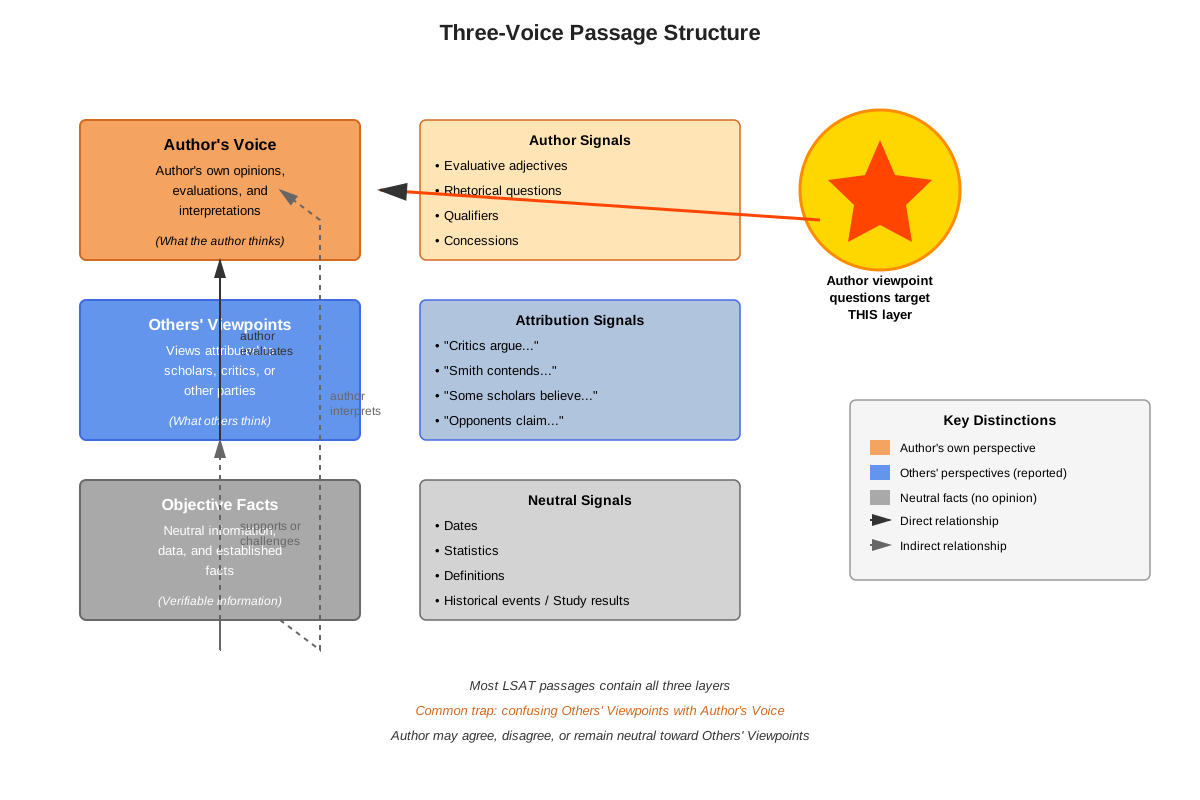
The author viewpoint refers to the author's own perspective, opinion, attitude, or evaluative stance toward the subject matter discussed in the passage. This differs fundamentally from the content the author reports, describes, or attributes to others. An author might discuss a scientific theory without endorsing it, present a legal argument without agreeing with it, or describe a historical event without evaluating it. The author's viewpoint encompasses their beliefs about the topic's significance, their assessment of various positions, and their judgment about which claims are valid or valuable.
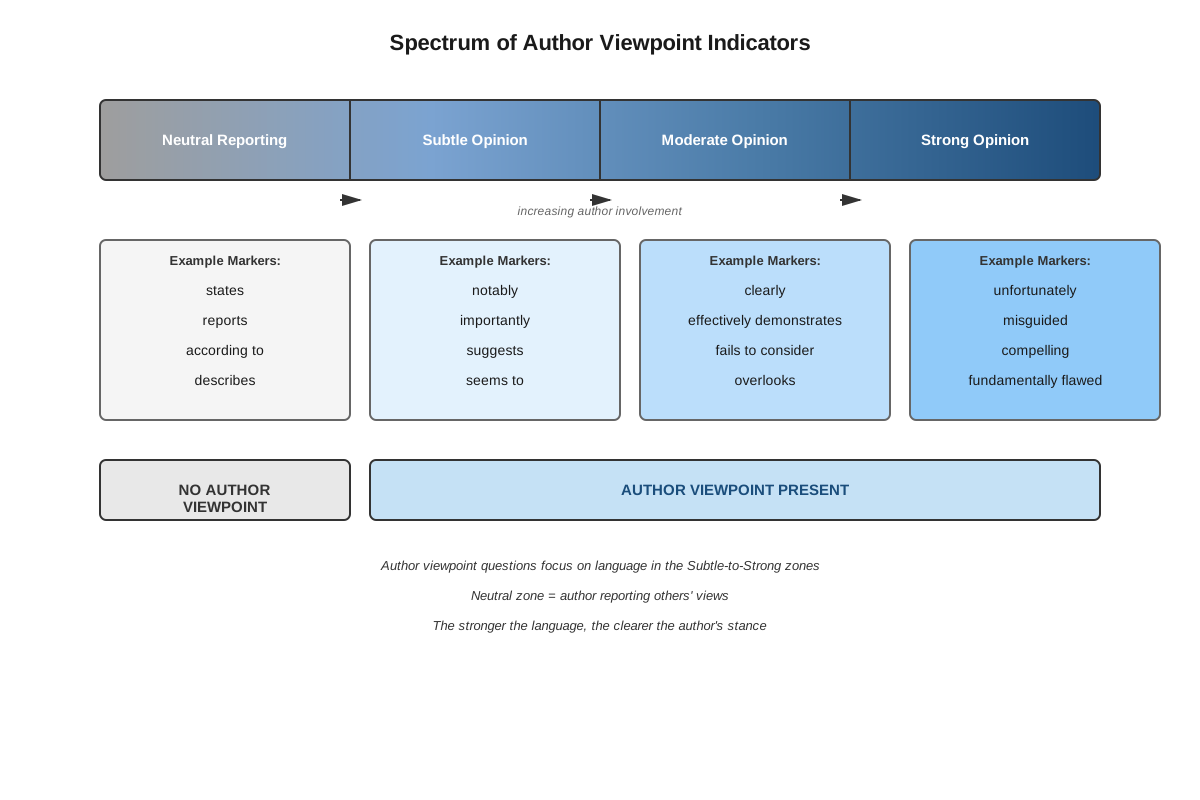
Author viewpoint exists on a spectrum from strongly positive to strongly negative, with many passages featuring moderate or qualified positions. The LSAT rarely presents authors with extreme views; instead, passages typically feature authors who are cautiously optimistic, mildly critical, analytically neutral, or thoughtfully ambivalent. Understanding this nuance is crucial for selecting correct answer choices, which often hinge on precise distinctions between "skeptical" and "dismissive," or between "enthusiastic" and "approving."
Explicit versus Implicit Viewpoint Indicators
Authors reveal their viewpoints through both explicit and implicit means. Explicit indicators include direct statements of opinion using first-person language ("I argue that..."), evaluative adjectives ("this flawed approach," "this promising development"), or clear endorsements ("Indeed, this theory best explains..."). However, LSAT passages more commonly employ implicit indicators that require careful reading to detect.
Implicit indicators include:
- Tone words: Adjectives and adverbs that carry evaluative weight (unfortunately, merely, surprisingly, significantly)
- Rhetorical questions: Questions that imply a particular answer reflecting the author's view
- Emphasis through structure: Devoting more space to positions the author favors or ending with the author's preferred view
- Contrast markers: Using "however," "but," or "yet" to signal disagreement with previously stated positions
- Qualifying language: Words like "purportedly," "allegedly," or "supposedly" that cast doubt on claims
- Strength of claims: The difference between "proves," "suggests," and "might indicate" reveals authorial confidence
Distinguishing Author's View from Others' Views
LSAT passages frequently present multiple viewpoints, making it essential to track whose opinion is being expressed at any given moment. The passage might discuss what "critics argue," what "traditional scholars believe," what "recent research suggests," or what "some theorists propose"—none of which necessarily reflects the author's own position. The author serves as a curator and commentator, selecting which views to present and how to frame them.
Key attribution markers include:
- Attribution phrases: "According to X," "Scholars have argued," "Critics contend"
- Reporting verbs: "Claims," "asserts," "maintains," "proposes" (often neutral or distancing)
- Quotation marks: Direct quotes always represent someone else's words, not the author's
- Temporal markers: "Traditionally," "historically," "in the past" often introduce views the author will critique
The author's viewpoint often emerges most clearly in how they respond to others' views—whether they defend, critique, qualify, synthesize, or remain neutral toward the positions they present.
Common Authorial Stances
LSAT passages typically feature authors adopting one of several recognizable stances:
| Stance | Characteristics | Common Language |
|---|---|---|
| Advocate | Argues for a specific position or theory | "demonstrates," "clearly shows," "compelling evidence" |
| Critic | Challenges or questions a prevailing view | "fails to account for," "overlooks," "problematic assumption" |
| Analyst | Examines multiple perspectives objectively | "suggests," "indicates," "raises questions about" |
| Synthesizer | Integrates different viewpoints into a new framework | "reconciles," "combines," "offers a middle ground" |
| Explainer | Clarifies complex ideas without strong evaluation | "involves," "consists of," "can be understood as" |
Recognizing which stance the author adopts helps predict their viewpoint on specific issues within the passage and guides answer choice selection.
The Role of Passage Structure in Revealing Viewpoint
Authors strategically organize passages to reveal their viewpoints. Common structural patterns include:
- Problem-Solution: Author identifies a problem with existing approaches, then presents a preferred solution
- Thesis-Support: Author states a position early, then provides evidence and reasoning
- Contrast: Author presents an opposing view, then counters it with their own perspective
- Evolution: Author traces how thinking has developed, often endorsing the most recent or sophisticated view
- Qualification: Author presents a view, then adds nuances or limitations to it
The author's viewpoint typically receives the most development, appears in structurally prominent positions (opening or closing paragraphs), and is supported with the strongest evidence or most detailed analysis.
Tone and Degree of Conviction
Beyond identifying whether an author supports or opposes something, LSAT questions often test understanding of the author's tone and degree of conviction. An author might be:
- Strongly convinced: Uses definitive language, presents extensive evidence, dismisses alternatives
- Moderately supportive: Acknowledges merits while noting limitations or uncertainties
- Cautiously optimistic: Sees promise but recognizes need for further development
- Skeptical but open: Questions claims while allowing they might have some validity
- Analytically neutral: Presents information without clear evaluative stance
Distinguishing these gradations is essential because incorrect answer choices often misrepresent the strength or direction of the author's viewpoint.
Concept Relationships
The concepts within author viewpoint form an interconnected system. Explicit and implicit indicators work together to reveal the author's stance, with implicit indicators often providing more reliable evidence since LSAT passages rarely feature overtly opinionated writing. Distinguishing the author's view from others' views depends on recognizing attribution markers and understanding how authors use others' positions as foils for their own perspectives. The authorial stance (advocate, critic, analyst, etc.) determines which structural patterns the passage will likely follow and influences the tone and degree of conviction the author displays.
This topic connects to prerequisite knowledge of passage structure because the author's viewpoint often determines organizational choices—critics typically present the view they oppose before offering their critique, while advocates might lead with their thesis. Understanding tone and connotation from general reading comprehension enables detection of the subtle evaluative language that signals authorial opinion. The skill of identifying claims versus evidence helps distinguish between positions the author reports (claims made by others) and positions the author endorses (claims supported with the author's own reasoning).
Author viewpoint serves as a foundation for more advanced Reading Comprehension skills. Mastering this topic enables students to better understand comparative passages (where tracking each author's distinct viewpoint is essential), argument evaluation (which requires understanding what the author is trying to prove), and inference questions (which often ask what the author would likely think about scenarios beyond the passage).
Relationship Map:
Attribution markers → Enable distinguishing author's view from others' views → Reveals authorial stance → Determines passage structure → Signals through tone and conviction → Manifests in explicit and implicit indicators → Answers author viewpoint questions
High-Yield Facts
⭐ Author viewpoint questions appear in approximately 15-20% of all LSAT Reading Comprehension questions, making them one of the most frequently tested concepts.
⭐ The author's viewpoint is most commonly revealed through implicit indicators (tone, structure, emphasis) rather than explicit first-person statements.
⭐ Words like "merely," "only," "simply," and "just" typically signal the author's dismissive or minimizing attitude toward a claim.
⭐ When an author presents multiple viewpoints, their own position typically appears last or receives the most detailed development.
⭐ Contrast words like "however," "but," "yet," and "nevertheless" often signal the author's disagreement with a previously stated position.
- Attribution phrases ("according to," "scholars argue," "critics contend") always indicate someone else's viewpoint, not the author's.
- Authors who use qualifying language ("may," "might," "could," "suggests") demonstrate moderate conviction rather than strong certainty.
- Rhetorical questions in LSAT passages typically imply the author's answer and reveal their perspective.
- The author's tone is usually moderate; extreme answer choices (completely dismissive, entirely enthusiastic) are rarely correct.
- Structural emphasis (paragraph length, level of detail, position in passage) indicates which viewpoints the author considers most important or valid.
- When authors use quotation marks around a term without attribution, they typically signal skepticism about that term's validity.
- Authors reveal their viewpoint through which counterarguments they address and how thoroughly they refute them.
Quick check — test yourself on Author viewpoint so far.
Try Flashcards →Common Misconceptions
Misconception: The author agrees with every viewpoint presented in the passage.
Correction: Authors frequently present others' viewpoints to critique, contextualize, or contrast with their own position. Presentation does not equal endorsement. Always check for attribution markers and the author's response to each viewpoint.
Misconception: If the author doesn't explicitly say "I believe" or "I argue," they have no viewpoint.
Correction: LSAT passages rarely use first-person language, yet authors consistently reveal their perspectives through tone, structure, emphasis, and evaluative language. Implicit indicators are more common and often more reliable than explicit statements.
Misconception: The author's viewpoint is always stated in the first paragraph.
Correction: While some passages present the author's thesis early, many passages build toward the author's position, presenting it in the final paragraph or revealing it gradually through commentary on others' views throughout the passage.
Misconception: Neutral or objective language means the author has no viewpoint.
Correction: Even passages with predominantly neutral language reveal authorial perspective through structural choices (which views receive more attention), subtle evaluative terms, and the selection of which information to include or emphasize.
Misconception: The author's viewpoint is always strongly positive or negative.
Correction: LSAT authors typically adopt moderate, nuanced positions. They might be "cautiously optimistic," "mildly critical," or "analytically ambivalent." Answer choices that suggest extreme attitudes are usually incorrect.
Misconception: The longest or most detailed section represents the author's viewpoint.
Correction: While emphasis can indicate the author's focus, authors sometimes devote significant space to explaining positions they will ultimately critique. The amount of space matters less than the evaluative language and structural positioning.
Misconception: If the author presents evidence for a claim, they must agree with it.
Correction: Authors often present evidence for positions they ultimately reject, either to show why others hold those views or to demonstrate the evidence's inadequacy. The author's response to the evidence matters more than its mere presentation.
Worked Examples
Example 1: Identifying Author Viewpoint Through Implicit Indicators
Passage Excerpt:
"Traditional approaches to urban planning have emphasized automobile accessibility, leading to sprawling developments and lengthy commutes. Proponents argue that this model maximizes individual freedom and economic efficiency. However, recent studies suggest that such planning creates significant environmental costs and reduces quality of life. A growing number of urban theorists now advocate for mixed-use, pedestrian-oriented development. This approach, which integrates residential, commercial, and recreational spaces, offers a promising alternative that addresses many of the shortcomings of automobile-centric design."
Question: The author's attitude toward pedestrian-oriented development can best be described as:
Analysis:
- Identify attribution: "Proponents argue" signals others' viewpoint about traditional planning, not the author's.
- Locate contrast markers: "However" in the third sentence signals the author's shift away from the traditional view.
- Detect evaluative language:
- "significant environmental costs" and "reduces quality of life" are negative characterizations
- "promising alternative" is positive evaluative language
- "addresses many of the shortcomings" indicates the author sees this as an improvement
- Analyze structure: The passage moves from traditional approach → its problems → alternative approach, a problem-solution structure suggesting the author favors the solution.
- Assess tone: "Promising" indicates optimism but not absolute certainty; "many of the shortcomings" (not "all") suggests measured support.
Conclusion: The author's attitude is moderately positive—cautiously optimistic or guardedly favorable. The author sees pedestrian-oriented development as an improvement over traditional planning but doesn't claim it's perfect (note "many" rather than "all" shortcomings).
Connection to Learning Objectives: This example demonstrates how to identify author viewpoint through implicit indicators (evaluative language, contrast markers, structural patterns) and explains the reasoning pattern (tracking whose view is presented, noting shifts, analyzing tone) behind determining authorial perspective.
Example 2: Distinguishing Author's View from Multiple Attributed Views
Passage Excerpt:
"The interpretation of quantum mechanics has divided physicists for decades. The Copenhagen interpretation, championed by Niels Bohr, holds that quantum systems exist in superposition until observed. Einstein famously rejected this view, insisting that 'God does not play dice with the universe.' More recently, the many-worlds interpretation has gained adherents, proposing that all possible outcomes actually occur in branching universes. While each interpretation has its defenders, none fully resolves the measurement problem. What remains clear is that our classical intuitions fail at the quantum level, requiring either a radical revision of our understanding of reality or acceptance of fundamental limits to human knowledge."
Question: Which of the following best describes the author's position regarding interpretations of quantum mechanics?
Analysis:
- Track attributed views:
- Copenhagen interpretation: attributed to Bohr
- Rejection of Copenhagen: attributed to Einstein
- Many-worlds interpretation: attributed to recent adherents
- Identify author's commentary:
- "none fully resolves the measurement problem" is the author's evaluation
- "What remains clear" introduces the author's own conclusion
- "requiring either...or..." presents the author's analysis of implications
- Analyze tone:
- The author doesn't endorse any specific interpretation
- "none fully resolves" indicates the author sees limitations in all views
- "remains clear" suggests confidence in the conclusion about classical intuitions failing
- Determine stance: The author adopts an analyst stance—evaluating multiple positions without strongly advocating for one, while drawing conclusions about what the debate reveals.
Conclusion: The author's viewpoint is that all current interpretations have limitations, but the debate itself demonstrates that quantum mechanics fundamentally challenges classical understanding. The author is analytically neutral regarding which interpretation is correct but confident that the phenomenon requires reconceptualizing reality or accepting knowledge limits.
Connection to Learning Objectives: This example shows how to distinguish the author's viewpoint from multiple attributed viewpoints, apply the reasoning pattern of tracking attribution and identifying authorial commentary, and solve LSAT-style problems by eliminating answers that confuse the author's view with others' views.
Exam Strategy
Approaching Author Viewpoint Questions
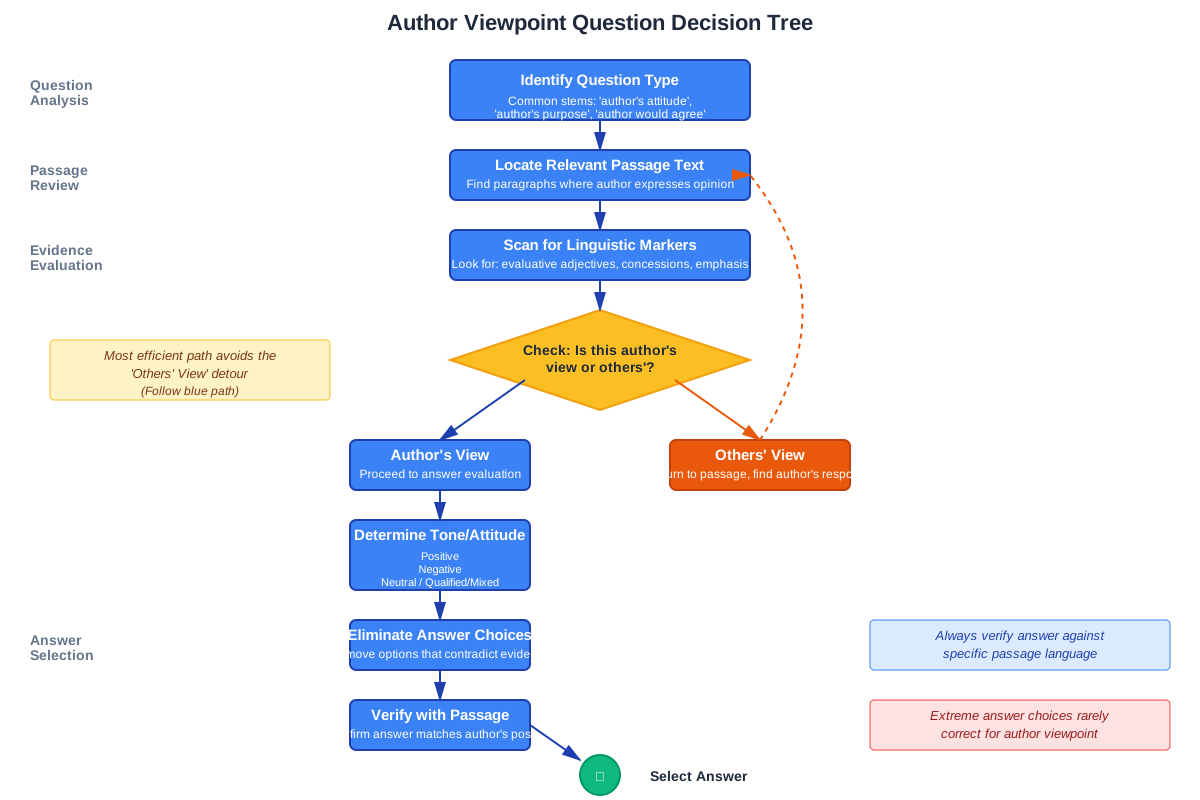
When encountering author viewpoint questions, follow this systematic approach:
- Identify the question type: Look for phrases like "the author's attitude," "the author would most likely agree," "the author's primary purpose," or "the author's view of X."
- Return to the passage strategically: Don't rely on memory alone. Locate the relevant section, but also consider the passage's overall structure and tone.
- Distinguish author from others: Eliminate any answer choices that reflect attributed viewpoints rather than the author's own perspective.
- Match tone and degree: The correct answer must match both the direction (positive/negative/neutral) and strength (strong/moderate/mild) of the author's viewpoint.
- Verify with textual evidence: The correct answer should be supportable with specific language from the passage, particularly evaluative terms or structural emphasis.
Trigger Words and Phrases
In Questions:
- "The author's attitude toward X is best described as..."
- "The author would most likely agree with which of the following..."
- "The author's primary purpose in the passage is to..."
- "The author mentions X primarily in order to..."
- "The author's tone in discussing X can best be characterized as..."
In Passages (signaling author's viewpoint):
- Contrast markers: however, but, yet, nevertheless, in fact, actually
- Evaluative adjectives: significant, mere, promising, problematic, compelling
- Qualifying terms: purportedly, allegedly, supposedly, ostensibly
- Emphasis markers: indeed, clearly, obviously, importantly, significantly
- Doubt indicators: questionable, dubious, uncertain, unclear
Process of Elimination Tips
Eliminate answers that:
- Confuse the author's view with an attributed view (check for proper attribution)
- Misrepresent the strength of the author's conviction (too extreme or too weak)
- Contradict explicit authorial commentary or evaluative language
- Reflect views the author presents only to critique or contextualize
- Use tone words inconsistent with the passage's overall evaluative language
Favor answers that:
- Align with the passage's structural emphasis and organizational pattern
- Match the degree of qualification in the author's language
- Reflect positions the author supports with detailed reasoning or evidence
- Correspond to conclusions drawn in structurally prominent positions
- Use moderate language consistent with typical LSAT authorial tone
Time Allocation Advice
Author viewpoint questions typically require 60-90 seconds to answer accurately. Invest time in:
- Carefully reading the question to identify exactly what aspect of the author's viewpoint is being tested (attitude toward a specific claim versus overall purpose)
- Locating relevant passage sections rather than relying on memory
- Eliminating clearly incorrect answers before choosing between close options
Exam Tip: If you're uncertain between two answer choices, check whether one confuses the author's view with an attributed view, or whether one uses language that's too extreme for the author's actual tone. These are the most common distinctions between correct and incorrect answers.
Memory Techniques
The TRACES Mnemonic for Detecting Author Viewpoint
Tone words (evaluative adjectives and adverbs)
Rhetorical questions (implying the author's answer)
Attribution markers (distinguishing author from others)
Contrast words (signaling disagreement or shift)
Emphasis through structure (space, position, detail)
Strength of claims (definitive versus qualified language)
The "Last Word" Principle
Visualize the author having the "last word" in a conversation. In LSAT passages, the author's viewpoint typically appears:
- Last in a sequence of viewpoints
- In the last paragraph
- After contrast markers like "however" or "but"
This isn't universal, but it's a useful starting point when the author's position isn't immediately clear.
The Attribution Test
When uncertain whether a statement reflects the author's view, apply this test:
- Can you identify who else this view is attributed to?
- Does the author respond to or evaluate this view?
- If yes to either, it's likely not the author's own position.
Tone Spectrum Visualization
Visualize author attitudes on a spectrum:
Dismissive — Skeptical — Neutral — Approving — EnthusiasticMost LSAT authors fall in the middle range (skeptical to approving). Visualizing this spectrum helps avoid selecting extreme answer choices.
Summary
Author viewpoint represents a fundamental skill in LSAT Reading Comprehension, requiring students to distinguish between objective reporting, attributed opinions, and the author's own perspective. This skill manifests in multiple question types and appears consistently across LSAT administrations. Authors reveal their viewpoints through both explicit statements and implicit indicators including tone words, structural emphasis, contrast markers, and evaluative language. The key to mastering author viewpoint questions lies in carefully tracking attribution, recognizing the author's stance (advocate, critic, analyst, synthesizer, or explainer), and matching answer choices to both the direction and strength of the author's position. LSAT passages typically feature authors with moderate, nuanced viewpoints rather than extreme positions, and the author's perspective often emerges most clearly in how they respond to others' views. Success requires systematic analysis of textual evidence, careful distinction between the author's voice and attributed voices, and attention to structural patterns that reveal which positions the author emphasizes or endorses.
Key Takeaways
- Author viewpoint questions comprise 15-20% of Reading Comprehension questions and are essential for achieving competitive LSAT scores
- Authors reveal their perspectives primarily through implicit indicators (tone, structure, evaluative language) rather than explicit first-person statements
- Distinguishing the author's view from attributed views requires careful attention to attribution markers and the author's responses to others' positions
- Contrast words like "however," "but," and "yet" frequently signal the author's disagreement with previously stated positions
- The correct answer to author viewpoint questions must match both the direction (positive/negative/neutral) and strength (strong/moderate/mild) of the author's actual position
- LSAT authors typically adopt moderate stances; extreme answer choices are usually incorrect
- Structural emphasis (position, detail, space devoted) reveals which viewpoints the author considers most valid or important
Related Topics
Main Purpose Questions: Understanding author viewpoint directly enables answering main purpose questions, which ask about the author's overall goal in writing the passage. The author's viewpoint determines their purpose—whether to advocate, critique, explain, or synthesize.
Tone and Attitude Questions: These questions specifically test the author's emotional or evaluative stance toward particular subjects within the passage, requiring the same skills used to identify author viewpoint but with greater focus on emotional valence.
Inference Questions: Many inference questions ask what the author would likely think about scenarios or claims not explicitly discussed in the passage. Mastering author viewpoint enables accurate predictions about the author's probable positions.
Comparative Passages: In comparative passages, students must track two distinct author viewpoints and understand how they relate to each other—whether they agree, disagree, or address different aspects of a topic. This builds directly on single-passage author viewpoint skills.
Argument Structure: Understanding how authors construct arguments requires recognizing their viewpoint, as the author's position determines which claims they support, which they challenge, and how they organize their reasoning.
Practice CTA
Now that you've mastered the fundamentals of author viewpoint, it's time to apply these concepts to actual LSAT passages. Complete the practice questions and flashcards for this topic to reinforce your understanding and build the speed and accuracy needed for test day. Remember: identifying author viewpoint is a skill that improves dramatically with deliberate practice. Each passage you analyze strengthens your ability to detect subtle indicators and distinguish between the author's voice and others' perspectives. Your investment in mastering this high-yield topic will pay dividends across the entire Reading Comprehension section. You've got this!
Sign up free to keep reading
Create a free AnvayaPrep account to finish this LSAT guide on Author viewpoint — plus flashcards and practice questions.