Overview
Common RC trap answers represent one of the most critical skills for success on the LSAT Reading Comprehension section. These are incorrect answer choices deliberately designed by test makers to appear correct to students who misread passages, make unwarranted assumptions, or fail to distinguish between what the passage states versus what seems plausible. Understanding trap answers is not merely about avoiding mistakes—it's about developing the analytical precision that separates average scores from elite performance.
The LSAT Reading Comprehension section tests more than simple reading ability; it evaluates whether students can identify exactly what an author has stated, implied, or argued without importing outside knowledge or making logical leaps. LSAT common RC trap answers exploit predictable cognitive biases and reading errors. They appear in virtually every Reading Comprehension question, making them a high-frequency, high-impact topic. Students who master trap answer recognition can often eliminate three or four choices immediately, dramatically improving both accuracy and speed.
Within passage fundamentals, trap answer recognition serves as the defensive counterpart to active reading strategies. While active reading helps students extract and organize information correctly, trap answer awareness prevents them from selecting superficially attractive but ultimately incorrect choices. This topic connects directly to question type strategies, passage structure analysis, and inference-making skills—all essential components of reading comprehension mastery. The ability to spot and avoid traps transforms test-taking from a guessing game into a systematic elimination process.
Learning Objectives
- [ ] Identify how common RC trap answers appear in LSAT questions
- [ ] Explain the reasoning pattern behind common RC trap answers
- [ ] Apply common RC trap answers recognition to solve LSAT-style problems accurately
- [ ] Distinguish between trap answers and correct answers under time pressure
- [ ] Categorize trap answers by type to develop targeted elimination strategies
- [ ] Predict which trap types are most likely for specific question stems
- [ ] Evaluate answer choices systematically using trap answer awareness
Prerequisites
- Basic passage reading skills: Students must be able to read and comprehend complex academic prose, as trap answers exploit misunderstandings of passage content
- Understanding of LSAT question types: Familiarity with Main Point, Detail, Inference, Purpose, and other question categories helps predict which traps are most likely
- Ability to locate information in passages: Trap answers often distort or misrepresent specific passage details, requiring students to verify claims against the text
- Logical reasoning fundamentals: Many traps involve subtle logical errors that require basic understanding of valid inference and scope
Why This Topic Matters
Trap answers appear in approximately 80% of all LSAT Reading Comprehension answer choices—four out of five options on every question are deliberately designed to mislead. This makes trap recognition the single most efficient skill for improving RC scores. Students who can quickly eliminate trap answers reduce cognitive load, save time, and increase confidence, creating a positive performance cycle.
On the LSAT, Reading Comprehension accounts for roughly 27% of the total score (one of four scored sections, with RC comprising one full section). Within that section, every question carries equal weight, and the difference between a 160 and a 170+ score often comes down to avoiding just 2-3 trap answers per section. Test makers invest significant resources in crafting traps that exploit common reading errors, making these wrong answers more dangerous than random distractors.
Common ways trap answers appear across question types:
- Main Point questions: Traps present details or subsidiary points as the main idea
- Detail/Support questions: Traps distort specific facts or combine elements from different parts of the passage
- Inference questions: Traps go too far beyond what the passage supports or contradict passage implications
- Purpose/Function questions: Traps confuse what the author does with what the author discusses
- Attitude/Tone questions: Traps present attitudes too extreme or opposite to the author's actual stance
- Application questions: Traps introduce scenarios inconsistent with passage principles
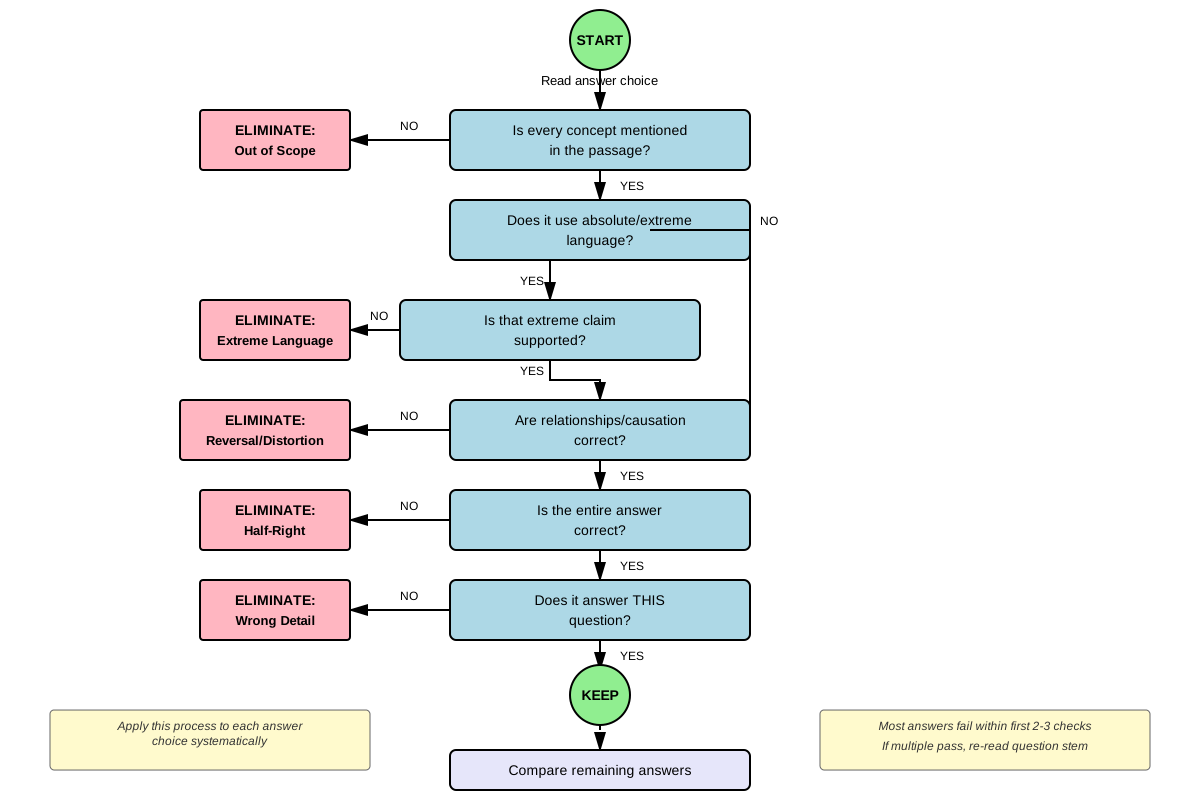
Understanding trap patterns allows students to approach each question with a mental checklist, systematically eliminating wrong answers rather than trying to "feel" which answer is correct.
Core Concepts
The Psychology Behind Trap Answers
Trap answers exploit predictable cognitive biases and reading errors that occur under time pressure. Test makers analyze thousands of student responses to identify which wrong answers attract the most test-takers, then refine these traps for maximum effectiveness. The most dangerous traps feel correct because they align with common misreadings, trigger recognition of familiar passage words, or seem to follow logically from passage content.
The fundamental principle: trap answers are wrong for specific, identifiable reasons. They are not randomly incorrect; each trap embodies a particular type of error. This systematic nature means students can learn to recognize and avoid them through pattern recognition rather than relying on intuition.
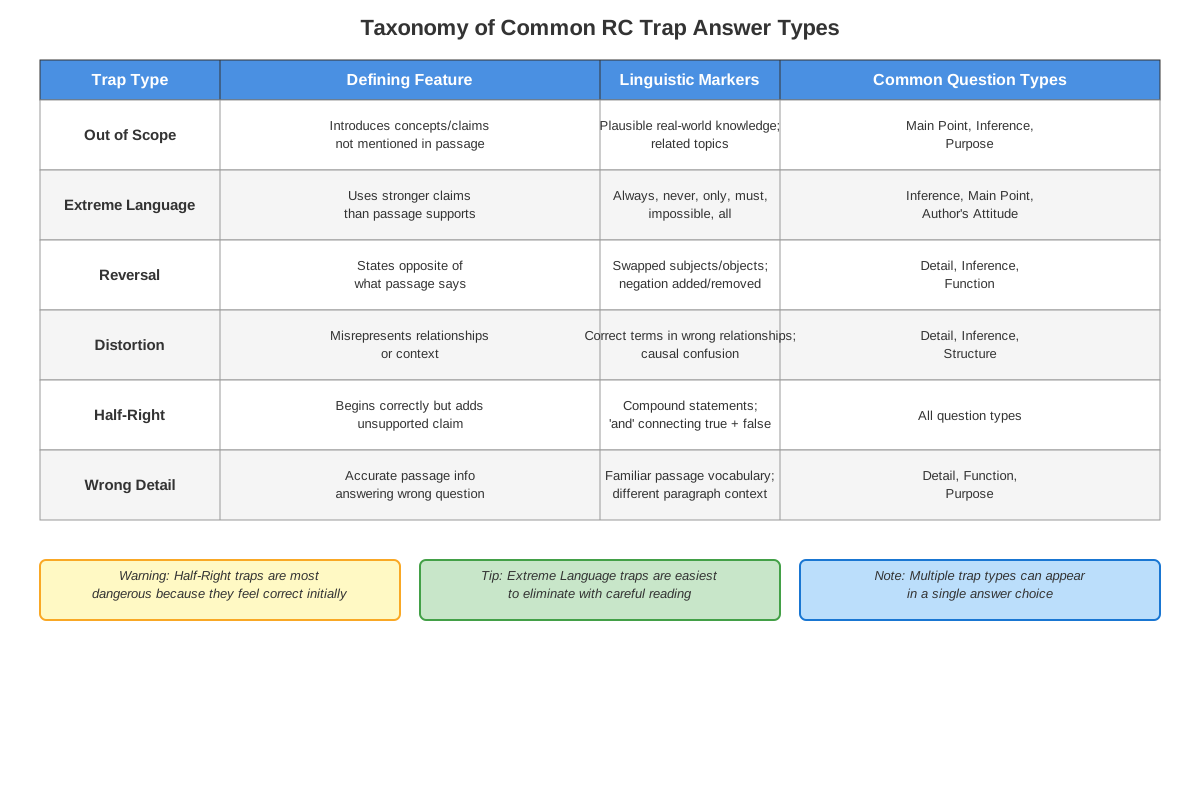
Major Categories of Common RC Trap Answers
1. Out of Scope (Beyond the Passage)
Out of scope trap answers introduce information, concepts, or claims not addressed in the passage. These answers may be factually true in the real world but are incorrect because the passage never discusses them. This trap type is particularly common in Inference and Must Be True questions.
Characteristics:
- Introduces new concepts not mentioned in the passage
- Makes claims about topics the author never addresses
- Extends passage reasoning to unrelated domains
- Often sounds plausible or even obviously true to someone with background knowledge
Example pattern: If a passage discusses how climate change affects coral reefs, an out-of-scope trap might discuss climate change's effects on mountain ecosystems—related but not addressed in the passage.
2. Extreme Language (Too Strong)
Extreme language traps use absolute or categorical terms that go beyond what the passage supports. LSAT passages typically present nuanced arguments with qualified claims, while trap answers remove these qualifications, making claims too broad or definitive.
Common extreme words:
- Always, never, all, none, every, only, must, impossible, certainly, definitely
- Any word suggesting 100% certainty or universal application
Contrast with correct answers:
- Often, usually, some, many, can, may, suggests, tends to, generally, likely
Important distinction: Extreme language is not automatically wrong—some correct answers use strong language when the passage genuinely supports it. The key is whether the passage provides sufficient evidence for the strength of the claim.
3. Distortion (Twisted Facts)
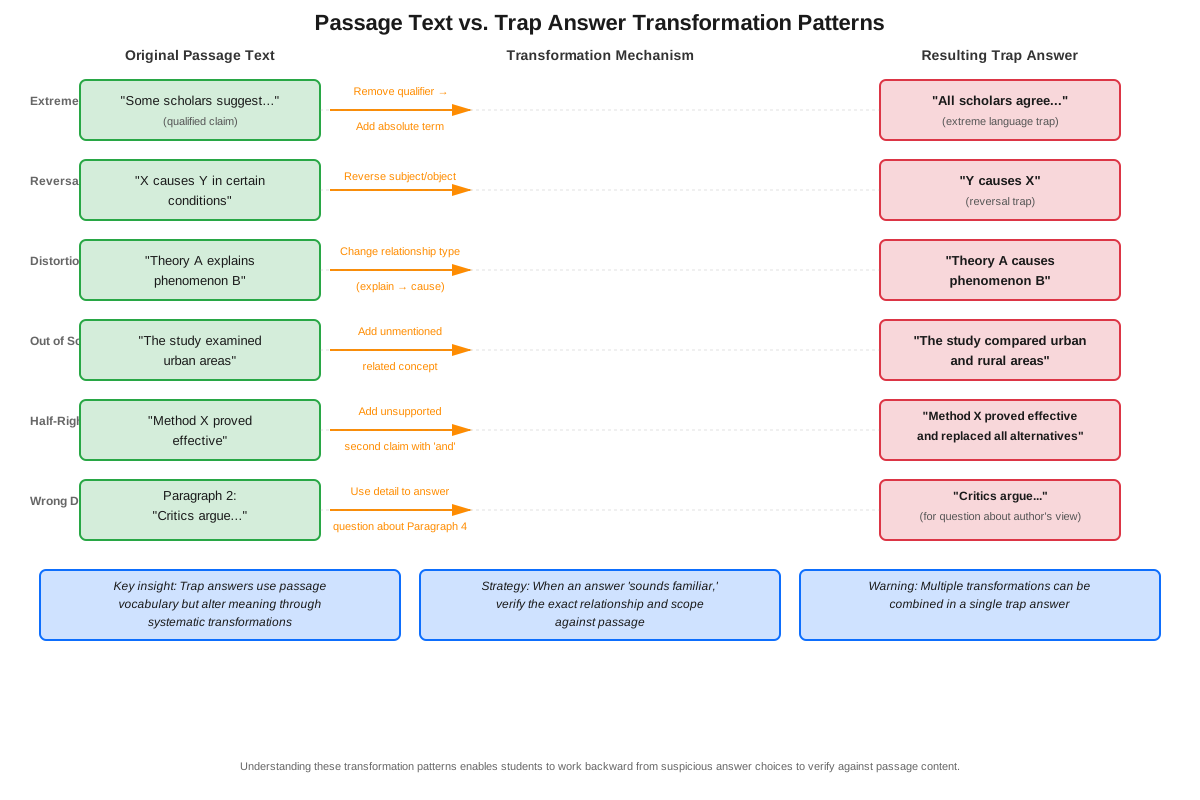
Distortion traps take actual passage content and subtly alter it, creating statements that sound familiar but are factually incorrect. These are among the most dangerous traps because they trigger recognition—students remember seeing related content and assume the answer is correct without verifying the details.
Common distortion techniques:
- Reversing cause and effect relationships
- Changing "some" to "all" or vice versa
- Substituting similar but distinct concepts
- Inverting the relationship between ideas (e.g., "A supports B" becomes "B supports A")
- Attributing views to the wrong person or group
4. Half-Right (Partially Correct)
Half-right traps begin with accurate passage information but then add incorrect elements, or they correctly describe one part of the passage but fail to address what the question asks. These traps are particularly effective because students who recognize the correct portion may select the answer without fully evaluating it.
Structure patterns:
- First clause correct, second clause wrong
- Correct information about the wrong part of the passage
- Accurate detail that doesn't answer the specific question asked
- True statement that addresses only part of a multi-part question
5. Opposite (Contradicts the Passage)
Opposite traps directly contradict passage content or present the inverse of what the author argues. While these might seem easy to avoid, they succeed when students misread the passage, confuse the author's view with opposing views discussed in the passage, or misread the question stem (especially in EXCEPT questions).
Common scenarios:
- Presenting a view the author criticizes as if it were the author's view
- Reversing the author's position on a controversial issue
- Stating the opposite of a factual claim from the passage
- Inverting the author's attitude (positive to negative or vice versa)
6. Wrong Part of the Passage
This trap type presents information that is accurate but comes from the wrong section of the passage relative to what the question asks. It's especially common in questions that ask about specific paragraphs, particular arguments, or the function of specific details.
Characteristics:
- Factually accurate regarding passage content
- Relevant to the passage's overall topic
- Located in a different paragraph or section than the question references
- May be correct for a different question about the same passage
7. Real-World Plausibility (Sounds Right But Unsupported)
These traps present statements that are true or reasonable in the real world but are not supported by or stated in the passage. They exploit students' tendency to import outside knowledge or make assumptions based on common sense rather than restricting themselves to passage content.
Key principle: The LSAT tests reading comprehension, not general knowledge. An answer can be factually correct in reality but wrong for the LSAT if the passage doesn't support it.
8. Mixing Passage Elements (Faulty Combination)
Faulty combination traps take legitimate concepts, facts, or ideas from different parts of the passage and combine them in ways the passage never does. These answers contain only passage vocabulary and concepts, making them feel authoritative, but they create relationships or connections the author never established.
Example pattern: If paragraph 2 discusses "economic factors" and paragraph 4 discusses "political reform," a trap might claim "economic factors drove political reform" when the passage never connected these elements.
The Relationship Between Question Type and Trap Type
Different question types attract different trap patterns:
| Question Type | Most Common Trap Types |
|---|---|
| Main Point | Wrong part of passage, too narrow/broad |
| Detail/Support | Distortion, opposite, wrong part |
| Inference | Out of scope, extreme language, too strong |
| Purpose/Function | Confusing what is discussed vs. what is done |
| Attitude/Tone | Extreme language, opposite |
| Strengthen/Weaken | Out of scope, irrelevant |
| Application | Out of scope, distortion |
Understanding these patterns allows students to enter each question with heightened awareness of likely traps.
Concept Relationships
The various trap answer types interconnect and often overlap. Extreme language frequently combines with out of scope errors—an answer might introduce a new concept AND make an absolute claim about it. Distortion often creates half-right answers by accurately stating one element while twisting another.
The relationship flows from reading errors to trap types:
Misreading passage details → leads to → Distortion and Opposite traps succeeding
Failing to track scope → leads to → Out of Scope and Extreme Language traps succeeding
Insufficient verification → leads to → Half-Right and Wrong Part traps succeeding
Importing outside knowledge → leads to → Real-World Plausibility traps succeeding
These trap types connect to broader passage fundamentals through the reading process:
Active reading and annotation → prevents → Wrong Part of Passage traps
Tracking author's purpose → prevents → Main Point and Purpose traps
Distinguishing author's view from others' views → prevents → Opposite traps
Careful scope management → prevents → Out of Scope and Extreme Language traps
Mastering trap recognition also enables progression to advanced skills like comparative reading (where traps often involve confusing which passage supports which claim) and complex inference questions (where multiple trap types may appear in a single answer choice).
Quick check — test yourself on Common RC trap answers so far.
Try Flashcards →High-Yield Facts
⭐ Approximately 80% of all RC answer choices are traps—four wrong answers for every correct one, making trap recognition more efficient than searching for the right answer.
⭐ Extreme language is not automatically wrong—the passage must be checked to see if it supports the strength of the claim; some correct answers use strong language.
⭐ Half-right traps are among the most dangerous—students recognize the correct portion and select the answer without fully evaluating the incorrect portion.
⭐ Out of scope traps often sound obviously true—they exploit real-world knowledge and common sense, but the LSAT only cares what the passage states or implies.
⭐ Distortion traps trigger false recognition—students remember seeing related content and assume accuracy without verifying details.
- Opposite traps frequently succeed on EXCEPT questions where students forget to reverse their thinking.
- Wrong part of passage traps are most common in questions that reference specific paragraphs or line numbers.
- Faulty combination traps use only passage vocabulary, making them feel authoritative despite creating unsupported connections.
- The most effective trap answers combine multiple trap types (e.g., distortion + extreme language).
- Trap answers in Inference questions most commonly involve going too far beyond what the passage supports.
- Main Point traps typically present details, examples, or subsidiary arguments as if they were the primary thesis.
- Attitude/Tone traps often present emotions or stances too extreme for academic writing (e.g., "angry" or "dismissive" when the author is merely "critical").
Common Misconceptions
Misconception: Extreme language always indicates a wrong answer.
Correction: Extreme language is only wrong when the passage doesn't support it. If a passage states "all participants showed improvement," an answer saying "all participants improved" is correct despite the absolute language. Always verify against passage content rather than applying blanket rules.
Misconception: If an answer contains passage vocabulary, it must be correct.
Correction: Trap answers deliberately use passage language to create false familiarity. Faulty combination traps and distortion traps rely heavily on passage vocabulary while creating unsupported relationships or twisting facts. Vocabulary recognition is a red flag to verify carefully, not a shortcut to the correct answer.
Misconception: The correct answer will restate passage content in similar words.
Correction: Correct answers often paraphrase passage content using different vocabulary, while trap answers may quote passage language directly but in misleading ways. Students must focus on meaning and logical relationships, not word matching.
Misconception: Real-world knowledge should guide answer selection when passage content is ambiguous.
Correction: The LSAT strictly tests reading comprehension of the specific passage. Outside knowledge is irrelevant and often leads to out-of-scope trap answers. If the passage doesn't address something, no answer choice should claim it does, regardless of real-world truth.
Misconception: Trap answers are randomly distributed among answer choices.
Correction: Test makers strategically place traps based on predicted student errors. The most attractive traps (those that catch the most students) are often placed in positions B, C, or D, while obviously wrong answers may appear in position A or E. However, students should never use position to guide selection—only content matters.
Misconception: If you can't find explicit support for an answer in an Inference question, it must be wrong.
Correction: Inference questions require drawing conclusions that go slightly beyond explicit statements while remaining firmly grounded in passage content. The correct answer won't be directly stated but will be strongly supported by combining passage information. The key is distinguishing between supported inferences and unsupported leaps.
Worked Examples
Example 1: Detail Question with Multiple Trap Types
Passage excerpt: "While early critics dismissed the Impressionist movement as technically deficient, more recent scholars have recognized that the Impressionists deliberately rejected traditional techniques in favor of methods better suited to capturing transient effects of light. This shift represented not a failure to master conventional approaches but a conscious artistic choice."
Question: According to the passage, recent scholars believe that Impressionist painters:
(A) lacked the technical skill to employ traditional painting methods
(B) were unsuccessful in their attempts to capture light effects
(C) intentionally departed from conventional techniques
(D) should have combined traditional and innovative methods
(E) were superior to earlier painters in technical ability
Analysis:
(A) is an Opposite trap. The passage explicitly states this was the view of "early critics," not recent scholars. Recent scholars believe the opposite—that Impressionists could have used traditional methods but chose not to. Students who confuse whose view is whose will select this trap.
(B) is a Distortion trap. The passage states Impressionists used "methods better suited to capturing transient effects of light," implying success, not failure. This trap reverses the passage's meaning while using similar vocabulary ("light effects").
(C) is CORRECT. This directly paraphrases "deliberately rejected traditional techniques" and "conscious artistic choice." The answer uses different vocabulary ("intentionally departed" for "deliberately rejected") but captures the exact meaning.
(D) is Out of Scope. The passage never discusses combining methods or suggests what Impressionists "should have" done. This trap introduces a new idea not addressed in the passage.
(E) is Extreme Language + Out of Scope. The passage never compares Impressionist technical ability to earlier painters, and "superior" makes an absolute claim unsupported by the text. This trap might attract students who infer too much from "conscious artistic choice."
Key lesson: Verify each answer against passage content. Recognize that traps often use passage vocabulary while distorting meaning, and watch for views attributed to the wrong group.
Example 2: Inference Question with Scope Issues
Passage excerpt: "The discovery of extremophile bacteria in deep-sea hydrothermal vents has forced scientists to reconsider the conditions necessary for life. These organisms thrive in environments previously thought uninhabitable—temperatures exceeding 100°C, crushing pressure, and complete absence of sunlight. This finding suggests that life may exist in a wider range of environments than previously believed."
Question: The passage most strongly supports which of the following inferences?
(A) Life definitely exists on other planets with extreme conditions
(B) Scientists' previous understanding of life's requirements was too restrictive
(C) Extremophile bacteria are more evolutionarily advanced than other organisms
(D) All bacteria can survive in extreme temperature and pressure conditions
(E) Hydrothermal vents are the most likely location for the origin of life on Earth
Analysis:
(A) is Out of Scope + Extreme Language. The passage discusses Earth-based discoveries and suggests life "may exist" in more environments, but never addresses other planets. "Definitely exists" is also too strong—the passage only suggests possibility.
(B) is CORRECT. The passage states scientists were "forced to reconsider" their views and that environments "previously thought uninhabitable" can support life. This directly supports the inference that prior understanding was too restrictive. The inference is modest and firmly grounded in passage content.
(C) is Out of Scope. The passage never discusses evolutionary advancement or compares extremophiles to other organisms in this way. This trap might attract students with biology knowledge, but the passage doesn't support it.
(D) is Extreme Language + Distortion. The passage discusses extremophile bacteria specifically, not "all bacteria." This trap takes a claim about some organisms and incorrectly extends it to all organisms.
(E) is Out of Scope. While the passage discusses hydrothermal vents, it never addresses the origin of life or makes claims about where life is "most likely" to have originated. This trap combines passage elements (hydrothermal vents, life) in an unsupported way.
Key lesson: In Inference questions, the correct answer will be strongly supported by passage content without requiring large logical leaps. Watch for traps that go beyond passage scope or make claims stronger than the passage supports.
Exam Strategy
Systematic Approach to Eliminating Trap Answers
Step 1: Read the question stem carefully to identify exactly what is being asked. Note whether it's asking for what the passage states, implies, or what the author does (not discusses).
Step 2: Predict the answer before looking at choices when possible. This prevents trap answers from influencing your thinking.
Step 3: Evaluate each answer choice systematically using the trap checklist:
- Does this introduce new information not in the passage? (Out of scope)
- Does this use extreme language unsupported by the passage? (Too strong)
- Does this twist or reverse passage facts? (Distortion/Opposite)
- Does this combine passage elements in unsupported ways? (Faulty combination)
- Does this come from the wrong part of the passage? (Wrong section)
Step 4: Verify the remaining answer(s) by locating specific passage support. Never select an answer without confirming it against the text.
Trigger Words and Phrases
Question stem triggers that predict specific trap types:
- "According to the passage" → Watch for distortion and opposite traps
- "The author implies/suggests" → Watch for out of scope and extreme language
- "The primary purpose" → Watch for wrong part of passage (details vs. main point)
- "The author's attitude" → Watch for extreme language (too strong or too weak)
- "EXCEPT/LEAST" → Watch for opposite traps (students forget to reverse thinking)
Answer choice triggers:
- Absolute language (all, never, only, must) → Verify passage supports this strength
- Familiar passage vocabulary → Verify the relationship/context is accurate, not just the words
- Real-world plausibility → Verify passage actually states or implies this
- Multiple concepts combined → Verify passage connects these elements
Process of Elimination Tips
Efficiency principle: Eliminate wrong answers rather than searching for the right one. With four traps and one correct answer, elimination is more efficient.
The "50% rule": If you can confidently eliminate even two answers, your odds improve dramatically. Don't agonize over finding the perfect answer—eliminate obvious traps first.
Common elimination order:
- Eliminate obvious out-of-scope answers (fastest to identify)
- Eliminate opposite answers (verify against passage)
- Eliminate extreme language unsupported by passage
- Carefully evaluate remaining answers for subtle distortions
Time Allocation
- Spend 3-4 minutes reading and annotating the passage
- Spend 45-60 seconds per question
- If stuck between two answers, mark and return if time permits
- Don't spend more than 90 seconds on any single question on first pass
Time-saving insight: Students who master trap recognition often finish RC sections with 3-5 minutes remaining, allowing review of flagged questions.
Memory Techniques
The DOES Acronym for Major Trap Types
Distortion - Facts are twisted or reversed
Out of scope - Information not in the passage
Extreme - Language too strong for passage support
Split (Half-right) - Partially correct, partially wrong
Visualization Strategy: The Passage Boundary
Visualize the passage as a fenced area. Correct answers stay within the fence (passage scope). Out-of-scope traps jump the fence into territory the passage never enters. Extreme language traps try to expand the fence beyond what the passage supports. This mental image helps maintain focus on passage content.
The "Prove It" Mantra
Before selecting any answer, mentally say "Prove it"—can you point to specific passage content that supports this answer? This simple technique prevents selection of plausible-sounding but unsupported answers.
Trap Type Shorthand for Annotation
When practicing, mark trap answers with shorthand:
- OS = Out of scope
- EX = Extreme
- DIS = Distortion
- OPP = Opposite
- HR = Half-right
- WP = Wrong part
This builds pattern recognition and helps identify personal vulnerability to specific trap types.
Summary
Common RC trap answers represent systematic, predictable errors deliberately designed to exploit typical reading mistakes and cognitive biases. The major trap categories—out of scope, extreme language, distortion, half-right, opposite, wrong part of passage, real-world plausibility, and faulty combination—account for virtually all incorrect answer choices on LSAT Reading Comprehension questions. Success requires shifting from trying to identify the correct answer to systematically eliminating trap answers through careful verification against passage content. Students must resist the temptation to rely on passage vocabulary recognition, real-world knowledge, or intuitive "rightness," instead grounding every answer selection in specific textual support. The most dangerous traps combine multiple error types and use passage language to create false familiarity. Mastering trap recognition transforms RC from a subjective reading exercise into a systematic elimination process, dramatically improving both accuracy and speed while reducing the cognitive burden of each question.
Key Takeaways
- Four out of five answer choices are traps—elimination is more efficient than searching for the correct answer
- Trap answers follow predictable patterns that can be learned and systematically identified
- Passage vocabulary in an answer choice is a warning sign, not confirmation of correctness—verify relationships and context
- The LSAT tests only what the passage states or strongly implies—real-world knowledge and plausibility are irrelevant
- Half-right traps are especially dangerous because partial correctness creates false confidence
- Different question types attract different trap patterns—knowing these patterns enables strategic elimination
- Extreme language requires verification, not automatic elimination—check whether the passage supports the strength of the claim
Related Topics
Question Type Strategies: Understanding specific approaches for Main Point, Inference, Detail, Purpose, and other question types builds on trap recognition by showing how different questions attract different trap patterns.
Passage Structure and Mapping: Learning to identify passage organization helps prevent "wrong part of passage" traps and enables quick verification of answer choices against specific passage sections.
Author's Purpose and Viewpoint: Distinguishing what the author believes from views the author discusses prevents opposite traps and helps identify the author's actual position.
Comparative Reading Passages: Trap answers in comparative passages often involve attributing information to the wrong passage or creating false connections between passages—an advanced application of trap recognition.
Advanced Inference Techniques: Building on basic trap recognition, advanced inference skills involve distinguishing between supported inferences and unsupported leaps, particularly important for the most difficult RC questions.
Practice CTA
Now that you understand the systematic patterns behind common RC trap answers, it's time to apply this knowledge. Attempt the practice questions for this topic, actively identifying which trap type each wrong answer represents. Use the flashcards to reinforce recognition of trap patterns until identification becomes automatic. Remember: trap recognition is a skill that improves dramatically with deliberate practice. Each trap you correctly identify strengthens your pattern recognition and builds the confidence needed for test day success. Your ability to systematically eliminate wrong answers is just as valuable as your ability to identify correct ones—often more so.
Sign up free to keep reading
Create a free AnvayaPrep account to finish this LSAT guide on Common RC trap answers — plus flashcards and practice questions.