Overview
Competing viewpoints represent one of the most frequently tested structures in LSAT reading comprehension passages. This pattern involves the presentation of two or more distinct perspectives, theories, or interpretations regarding a single phenomenon, historical event, scientific discovery, or legal principle. The LSAT uses competing viewpoints passages to assess a test-taker's ability to track multiple lines of reasoning simultaneously, distinguish between different positions, and understand how authors position themselves relative to these divergent perspectives.
Understanding competing viewpoints is essential for LSAT success because approximately 25-30% of reading comprehension passages employ this structure. These passages require students to maintain mental separation between different theories while simultaneously tracking the author's attitude toward each position. The complexity increases when authors introduce their own synthesis or critique of existing viewpoints, creating a three-way relationship that demands careful attention to textual evidence and logical structure.
Within the broader framework of passage fundamentals, competing viewpoints passages represent a specific organizational pattern that differs from descriptive passages, argumentative passages, or chronological narratives. Mastering this topic builds directly on fundamental skills like identifying main ideas, tracking author's tone, and understanding passage structure, while preparing students for more advanced tasks like comparative reading and complex inference questions. The ability to navigate competing viewpoints passages translates directly to success on approximately 5-7 questions per LSAT administration, making this a high-yield area for focused study.
Learning Objectives
- [ ] Identify how competing viewpoints appears in LSAT questions
- [ ] Explain the reasoning pattern behind competing viewpoints
- [ ] Apply competing viewpoints to solve LSAT-style problems accurately
- [ ] Distinguish between the author's position and the positions being described
- [ ] Recognize structural markers that signal transitions between competing perspectives
- [ ] Evaluate the relative strength and support provided for each viewpoint in a passage
- [ ] Predict question types most commonly associated with competing viewpoints passages
Prerequisites
- Basic passage structure recognition: Understanding how LSAT passages are organized into introduction, body paragraphs, and conclusions enables students to locate where different viewpoints are introduced and developed.
- Author's tone and attitude identification: Recognizing whether an author is neutral, critical, or supportive is essential for distinguishing the author's voice from the viewpoints being presented.
- Main idea comprehension: The ability to identify central claims allows students to grasp what each competing viewpoint fundamentally argues.
- Evidence and support recognition: Understanding how arguments are supported with examples, data, or reasoning helps evaluate the relative strength of competing positions.
Why This Topic Matters
Competing viewpoints passages appear in every LSAT administration, typically constituting one of the four reading comprehension passages in each section. These passages are drawn from diverse fields including science (competing theories about evolutionary mechanisms), law (different interpretations of constitutional principles), humanities (contrasting views on artistic movements), and social sciences (divergent explanations for economic phenomena). The ability to navigate these passages efficiently and accurately directly impacts a test-taker's percentile ranking.
From a practical perspective, the skill of analyzing competing viewpoints extends far beyond standardized testing. Legal practice routinely requires attorneys to understand opposing arguments, anticipate counterarguments, and synthesize multiple perspectives into coherent legal strategies. Academic research, policy analysis, and critical thinking in professional contexts all demand the ability to hold multiple perspectives in mind simultaneously while evaluating their relative merits.
On the LSAT, competing viewpoints passages generate specific question types with predictable patterns. Students can expect questions asking them to identify points of agreement or disagreement between viewpoints, determine which viewpoint would be strengthened or weakened by new information, recognize the author's attitude toward each position, and understand how specific details function within the broader debate. These passages also frequently feature inference questions that require synthesizing information across multiple viewpoints and application questions that ask how each perspective would respond to novel scenarios.
Core Concepts
Structure of Competing Viewpoints Passages
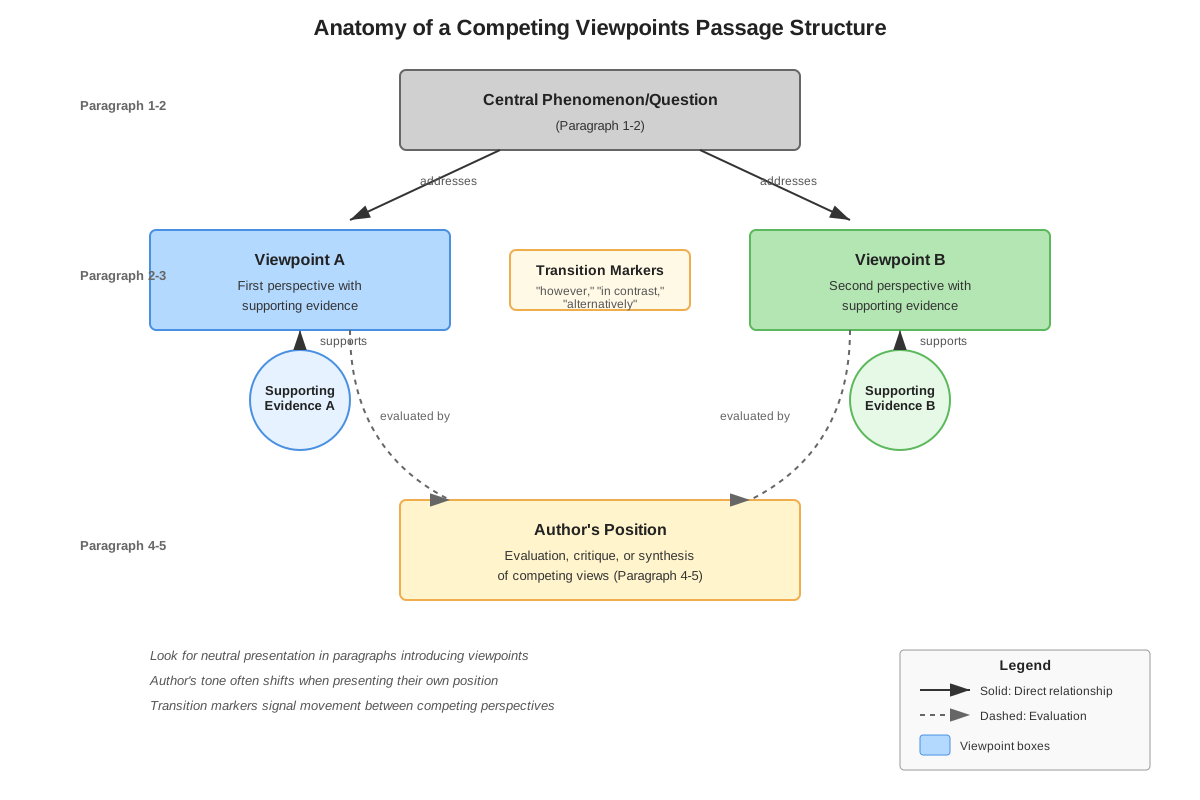
Lsat competing viewpoints passages follow recognizable structural patterns that, once identified, significantly improve comprehension and question accuracy. The typical structure begins with an introductory paragraph that establishes the phenomenon, question, or problem under discussion. This opening creates the context for why multiple viewpoints exist—there is genuine uncertainty, debate, or complexity that has generated different interpretations.
The body of the passage then presents two or more distinct viewpoints, usually dedicating one or more paragraphs to each perspective. Each viewpoint section typically includes: (1) identification of the proponent(s) or school of thought, (2) the core claim or thesis of that viewpoint, (3) supporting evidence, reasoning, or examples, and (4) sometimes the limitations or criticisms of that position. The passage may present viewpoints in various orders—chronologically (older theory first), by prominence (dominant view first), or by the author's preference (favored view last for emphasis).
The conclusion often reveals the author's position, which may involve: endorsing one viewpoint over others, proposing a synthesis that incorporates elements from multiple perspectives, critiquing all existing viewpoints while suggesting a new direction, or maintaining neutrality while acknowledging the ongoing nature of the debate.
Types of Competing Viewpoints
Direct Opposition: Two viewpoints that make contradictory claims about the same phenomenon. For example, one theory argues that a historical event was caused by economic factors while another attributes it to ideological motivations. These viewpoints cannot both be fully correct simultaneously.
Complementary Perspectives: Multiple viewpoints that address different aspects of a complex phenomenon without necessarily contradicting each other. For instance, one interpretation might focus on the aesthetic qualities of an artistic movement while another examines its social context. These can coexist and may be synthesized.
Hierarchical Disagreement: Viewpoints that disagree about the relative importance or priority of factors rather than their existence. One position might argue that legal precedent should be the primary consideration in constitutional interpretation, while another prioritizes original intent, without denying that both factors have some relevance.
Author's Relationship to Viewpoints
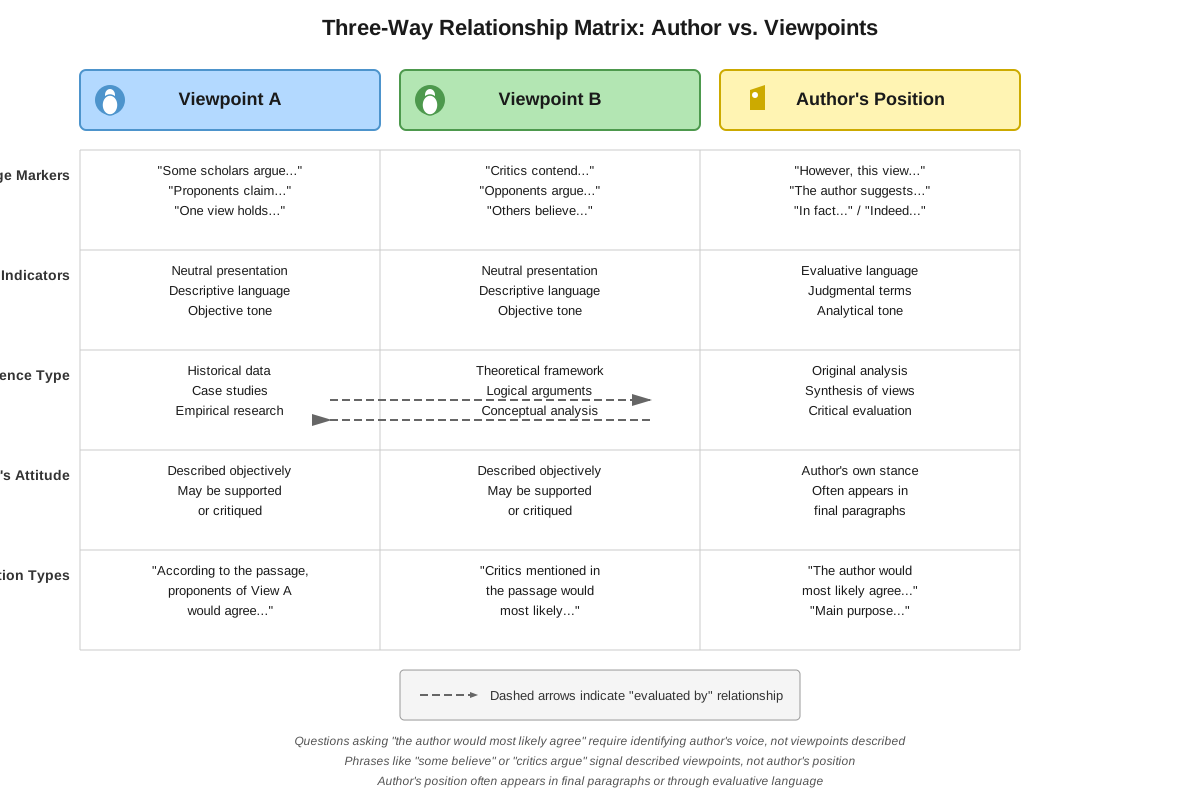
Understanding the author's positioning relative to competing viewpoints is crucial for answering attitude and tone questions correctly. The author may adopt several stances:
| Author Stance | Characteristics | Textual Markers |
|---|---|---|
| Neutral Reporter | Presents viewpoints without endorsement | "Some scholars argue...", "Another perspective holds...", absence of evaluative language |
| Critical Evaluator | Identifies weaknesses in one or more viewpoints | "However, this theory fails to account for...", "Critics point out...", "A significant limitation..." |
| Advocate | Clearly supports one viewpoint over others | "The most convincing explanation...", "Compelling evidence suggests...", "Persuasively demonstrates..." |
| Synthesizer | Combines elements from multiple viewpoints | "While both perspectives offer insights...", "A more complete understanding emerges from...", "Integrating these approaches..." |
Tracking Multiple Lines of Reasoning
Successful navigation of competing viewpoints passages requires maintaining clear mental separation between different positions. Effective readers create a mental or physical map that tracks:
- Viewpoint A: Core claim, main proponent(s), key evidence, strengths/weaknesses
- Viewpoint B: Core claim, main proponent(s), key evidence, strengths/weaknesses
- Author's Position: Which viewpoint (if any) does the author favor? What is the author's own contribution to the debate?
This tracking prevents the common error of attributing claims from one viewpoint to another or confusing the author's position with a described viewpoint. Annotation strategies such as using different symbols or margin notes for each viewpoint (e.g., "V1" for viewpoint one, "V2" for viewpoint two, "A" for author) help maintain this separation during active reading.
Transition Markers and Structural Signals
Competing viewpoints passages employ specific linguistic markers to signal shifts between perspectives:
- Introduction of new viewpoint: "In contrast," "Alternatively," "Other scholars contend," "A different interpretation," "Opponents argue"
- Continuation of same viewpoint: "Furthermore," "Additionally," "This perspective also suggests," "Supporting this view"
- Author's intervention: "However," "Yet," "In fact," "Actually," "More accurately," "The evidence suggests instead"
- Synthesis or conclusion: "Ultimately," "On balance," "A more nuanced view," "Reconciling these perspectives"
Recognizing these markers in real-time allows readers to anticipate structural shifts and adjust their comprehension strategy accordingly.
Evidence and Support Patterns
Each competing viewpoint is typically supported by specific types of evidence, and understanding these patterns helps evaluate the relative strength of positions:
- Empirical evidence: Data, studies, observations, experiments
- Logical reasoning: Deductive arguments, analogies, theoretical frameworks
- Historical examples: Precedents, case studies, documented events
- Expert testimony: Citations of authorities, scholarly consensus
- Conceptual analysis: Definitions, philosophical arguments, interpretive frameworks
The LSAT often tests whether students can identify what type of evidence supports which viewpoint and how new information would affect each position differently.
Concept Relationships
The core concepts within competing viewpoints passages form an interconnected system. The structure of competing viewpoints passages provides the framework within which all other elements operate. Within this structure, the types of competing viewpoints (direct opposition, complementary perspectives, hierarchical disagreement) determine the logical relationships between positions and influence what kinds of questions will be asked.
The author's relationship to viewpoints operates across the entire passage structure, sometimes subtly influencing how each viewpoint is presented. An author who ultimately advocates for one position might present that viewpoint with more detailed evidence or address counterarguments more thoroughly. This relationship connects directly to tracking multiple lines of reasoning, as students must maintain awareness of both what each viewpoint claims and how the author frames those claims.
Transition markers and structural signals serve as the navigational tools that make tracking possible. These markers indicate when the passage shifts from one viewpoint to another or when the author interjects their own perspective. Finally, evidence and support patterns provide the substance of each viewpoint, and understanding these patterns enables students to answer questions about what would strengthen or weaken each position.
This topic builds on prerequisite knowledge of passage structure by adding the complexity of multiple parallel arguments. It connects to related topics like comparative reading (which involves comparing entire passages rather than viewpoints within a single passage) and author's purpose questions (which require understanding why an author chose to present competing viewpoints in a particular way).
Relationship Map:
Passage Structure → Types of Viewpoints → Author's Relationship → Tracking Strategy → Recognition of Transitions → Analysis of Evidence → Question Answering
High-Yield Facts
⭐ Competing viewpoints passages appear in approximately 25-30% of LSAT reading comprehension sections, making them one of the most common passage types.
⭐ The author's position is not always explicitly stated and may need to be inferred from tone, emphasis, and the relative treatment of different viewpoints.
⭐ Questions asking about points of agreement between competing viewpoints are common and require identifying claims that both perspectives would accept.
⭐ When a passage presents two viewpoints, the author typically favors the viewpoint presented second or discussed more extensively, though this is not a universal rule.
⭐ Transition words like "however," "in contrast," and "alternatively" are critical markers that signal shifts between competing perspectives.
- Each competing viewpoint typically receives at least one full paragraph of development in LSAT passages.
- Questions about what would "strengthen" or "weaken" a viewpoint require understanding the specific evidence and reasoning that supports that position.
- The introduction of a competing viewpoints passage usually establishes why the debate exists—what phenomenon, question, or problem has generated multiple interpretations.
- Authors may critique all presented viewpoints while suggesting that a better explanation remains to be developed.
- Comparative questions (asking how Viewpoint A differs from Viewpoint B) are among the most common question types for these passages.
- The conclusion paragraph often contains the highest concentration of the author's own perspective and synthesis.
- Neutral presentation of viewpoints does not mean the author has no position; the author may be neutral or may reveal their stance through subtle cues.
Quick check — test yourself on Competing viewpoints so far.
Try Flashcards →Common Misconceptions
Misconception: The viewpoint presented first is always the one the author opposes.
Correction: While passages sometimes present a viewpoint first in order to critique it later, many passages present viewpoints chronologically, by prominence in the field, or in order of increasing complexity. The author's position must be determined by analyzing tone, emphasis, and explicit statements rather than assuming a pattern based on presentation order.
Misconception: If the author criticizes a viewpoint, that viewpoint must be entirely wrong.
Correction: Authors frequently acknowledge that competing viewpoints each capture some aspect of truth or offer valuable insights while still identifying limitations. A critique of one element of a viewpoint does not invalidate the entire perspective, and questions may ask about what aspects of a criticized viewpoint remain valid.
Misconception: Competing viewpoints passages always present exactly two opposing views.
Correction: While two-viewpoint passages are common, LSAT passages may present three or more perspectives, or may present multiple variations within broader schools of thought. Some passages present a dominant view and several alternative challenges to it, creating a one-versus-many structure.
Misconception: The author's viewpoint is always stated explicitly in the conclusion.
Correction: Many competing viewpoints passages require readers to infer the author's position from accumulated evidence throughout the passage, including word choice, the amount of space devoted to each viewpoint, the quality of evidence presented for each position, and the treatment of counterarguments. Some authors maintain genuine neutrality and never reveal a preference.
Misconception: Points of agreement between viewpoints are unimportant since the passage focuses on disagreement.
Correction: Questions specifically asking about points of agreement are common, and understanding what competing viewpoints share helps clarify the precise nature of their disagreement. Additionally, areas of agreement often represent foundational assumptions or established facts that both sides accept, which can be crucial for inference questions.
Misconception: All evidence in the passage supports one viewpoint or another.
Correction: Some evidence is presented as background information or established fact that all viewpoints must accommodate. Additionally, authors may introduce evidence that challenges all existing viewpoints or supports their own synthesis rather than any of the competing positions described.
Worked Examples
Example 1: Science Passage on Evolutionary Theory
Passage Summary: A passage discusses two competing explanations for the rapid diversification of mammalian species following the extinction of dinosaurs. The "ecological release" theory argues that mammals diversified to fill ecological niches left vacant by dinosaurs. The "intrinsic factors" theory contends that mammals had already developed key evolutionary innovations before the extinction event and would have diversified regardless. The author suggests that both factors likely played complementary roles.
Question: The author's attitude toward the ecological release theory can best be described as:
(A) Unqualified endorsement
(B) Cautious skepticism
(C) Measured appreciation with recognition of limitations
(D) Complete rejection
(E) Neutral description without evaluation
Step 1: Locate references to the ecological release theory
The passage dedicates paragraph 2 to this theory, presenting its core claim and supporting evidence. The author uses phrases like "compelling evidence" and "persuasively demonstrates" when discussing certain aspects of this theory.
Step 2: Identify evaluative language
The author acknowledges strengths: "The ecological release theory correctly identifies the temporal correlation between dinosaur extinction and mammalian diversification." However, the author also notes: "Yet this theory alone cannot explain why certain mammalian lineages diversified more rapidly than others."
Step 3: Analyze the conclusion
The author states: "A complete understanding requires integrating insights from both perspectives," suggesting that the ecological release theory captures important truths but is incomplete.
Step 4: Eliminate answer choices
- (A) is too strong—the author identifies limitations
- (B) is too negative—the author acknowledges the theory's strengths
- (D) is incorrect—the author incorporates this theory into their synthesis
- (E) is incorrect—the author clearly evaluates the theory
- (C) is correct—the author appreciates the theory's contributions while recognizing it doesn't provide a complete explanation
Connection to Learning Objectives: This example demonstrates how to identify the author's relationship to competing viewpoints by analyzing evaluative language and synthesis statements, directly addressing the objective to distinguish between the author's position and described positions.
Example 2: Legal Theory Passage on Constitutional Interpretation
Passage Summary: A passage presents three approaches to constitutional interpretation: originalism (interpreting based on the framers' intent), textualism (interpreting based on the plain meaning of the text), and living constitutionalism (interpreting based on evolving societal values). The author critiques all three approaches for different reasons but suggests originalism faces the most significant practical obstacles.
Question: Based on the passage, proponents of textualism and living constitutionalism would be most likely to agree that:
(A) The framers' intentions are impossible to determine with certainty
(B) Constitutional interpretation should adapt to changing social circumstances
(C) The text of the Constitution should be the starting point for interpretation
(D) Judicial precedent should outweigh original meaning
(E) Historical context is irrelevant to constitutional interpretation
Step 1: Identify what each viewpoint claims
- Textualism: Focus on plain meaning of text, skeptical of looking beyond the words themselves
- Living constitutionalism: Constitution should be interpreted in light of contemporary values
- Both are presented as alternatives to originalism's focus on framers' intent
Step 2: Find points of agreement
Both textualism and living constitutionalism are described as rejecting the originalist focus on framers' intentions, though for different reasons. Textualists argue that intentions are less important than textual meaning; living constitutionalists argue that intentions should not constrain contemporary interpretation.
Step 3: Evaluate answer choices
- (A) is correct—Both viewpoints, while disagreeing on much else, share skepticism about the originalist project of recovering framers' intentions. The passage states that textualists "question whether framers' intentions can be reliably determined" and living constitutionalists "argue that even if such intentions could be determined, they should not bind contemporary interpreters."
- (B) is incorrect—Textualists would reject this; they focus on fixed textual meaning
- (C) is partially true for textualists but not for living constitutionalists, who emphasize evolving values
- (D) is not supported for either viewpoint as described
- (E) is too extreme and not supported
Connection to Learning Objectives: This example demonstrates the application of competing viewpoints analysis to solve LSAT-style problems by identifying points of agreement between perspectives that otherwise disagree, a common question type for these passages.
Exam Strategy
Initial Passage Reading Strategy
When encountering a competing viewpoints passage, invest the first 3-4 minutes in active reading with specific goals. Immediately identify that the passage presents competing viewpoints by recognizing structural markers in the first paragraph (phrases like "debate," "competing theories," "different interpretations"). As you read, create a mental or physical map using margin annotations:
- Mark where each viewpoint begins (V1, V2, V3)
- Note the core claim of each viewpoint in 3-5 words
- Identify the author's voice with special attention (A or AUTH)
- Circle transition words that signal shifts between perspectives
Trigger Words and Phrases
Develop automatic recognition of language that signals competing viewpoints structure:
Viewpoint introduction: "Some scholars argue," "One interpretation," "Traditional view," "Recent research suggests," "Critics contend," "Proponents of X believe"
Contrast and opposition: "However," "In contrast," "Conversely," "On the other hand," "Alternatively," "Opponents argue," "Challenging this view"
Author's evaluation: "More accurately," "In fact," "Actually," "The evidence suggests," "A better explanation," "Ultimately," "Most convincingly"
Synthesis: "Both perspectives," "Integrating these views," "A more complete understanding," "Reconciling these approaches"
When you encounter these triggers, slow down slightly and ensure you understand whose voice is speaking and how this statement relates to the competing viewpoints structure.
Question Approach by Type
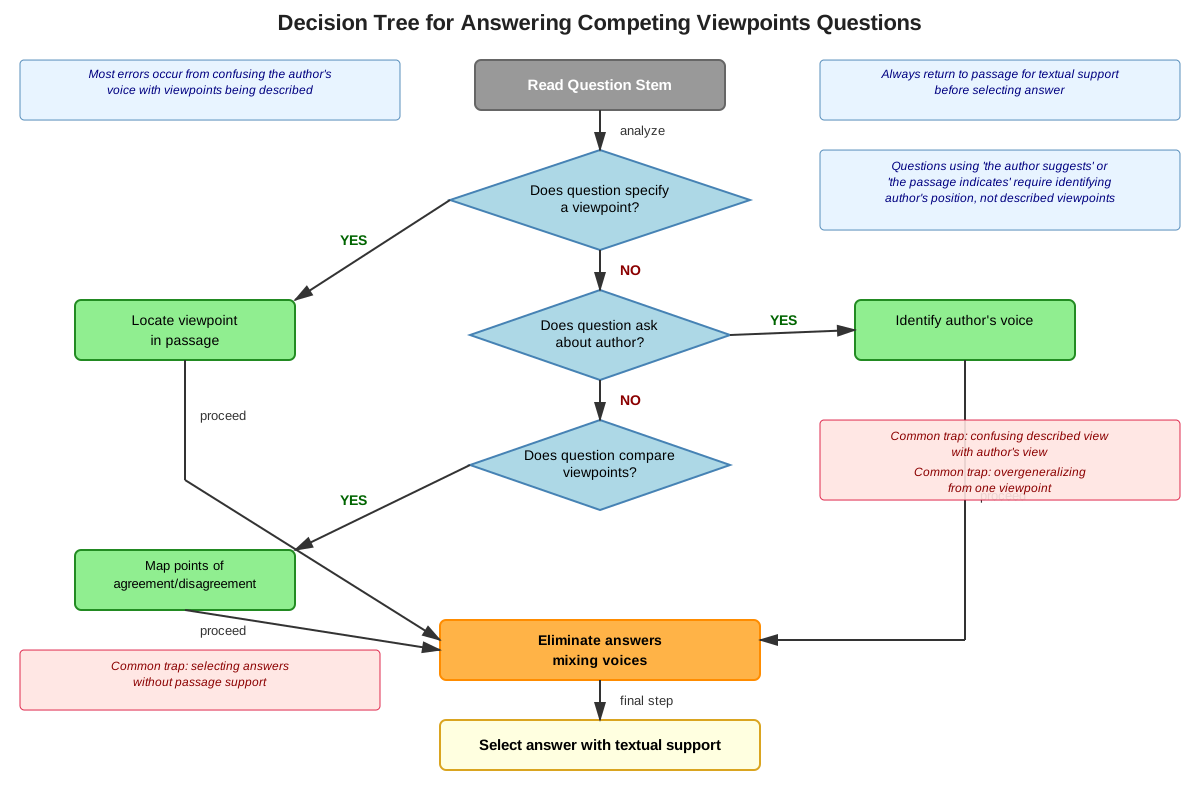
Attitude/Tone Questions: Always distinguish between the author's attitude and the attitudes of viewpoint proponents. Return to specific textual evidence rather than relying on general impressions. Look for evaluative adjectives, acknowledgment of strengths/weaknesses, and the relative space devoted to each viewpoint.
Agreement/Disagreement Questions: Create a mental Venn diagram. What do both viewpoints accept as true? Where do they diverge? Often the correct answer involves a foundational assumption or established fact that both sides must accommodate, even though they interpret it differently.
Strengthen/Weaken Questions: Identify the specific evidence and reasoning that supports the targeted viewpoint. New information strengthens a viewpoint if it provides additional evidence for its claims or undermines competing explanations. Information weakens a viewpoint if it contradicts its predictions or provides evidence for alternative explanations.
Inference Questions: Be especially careful to distinguish between what a viewpoint explicitly states and what can be inferred. Correct inferences must be supported by the specific viewpoint in question, not by the author's position or a competing viewpoint.
Process of Elimination Tips
Eliminate answer choices that:
- Attribute claims from one viewpoint to another viewpoint or to the author
- Use extreme language ("always," "never," "completely") unless the passage explicitly supports such extremity
- Contradict the passage's explicit statements about what a viewpoint holds
- Confuse the author's position with a described viewpoint
- Claim agreement where the passage indicates disagreement, or vice versa
Time Allocation
Spend approximately 3-4 minutes on the initial reading of a competing viewpoints passage (slightly longer than simpler descriptive passages) because the investment in understanding the structure pays dividends in question accuracy. Allocate 5-6 minutes for the associated questions. If a question requires returning to the passage, use your annotations to quickly locate the relevant viewpoint rather than re-reading large sections.
Memory Techniques
The "VVA" Framework
Remember Viewpoint 1, Viewpoint 2, Author as the three voices to track in every competing viewpoints passage. Visualize three distinct speakers in a conversation, each with their own position.
The "CREST" Mnemonic for Viewpoint Analysis
For each viewpoint, identify:
- Claim: What is the core thesis?
- Reasoning: What logic supports this claim?
- Evidence: What specific examples or data are provided?
- Strengths: What does this viewpoint explain well?
- Troubles: What limitations or criticisms are mentioned?
Spatial Visualization
Imagine competing viewpoints as physical locations on a map. Viewpoint 1 is on the left, Viewpoint 2 on the right, and the author's position might be in the center (synthesis), to one side (advocacy), or above (neutral observation). As you read, visualize moving between these locations.
The "But-However-Yet" Alert System
Train yourself to experience a mental "alert" whenever you encounter contrast words. These words almost always signal either a shift between viewpoints or the author's intervention to critique or qualify a viewpoint. Pausing for one second at these words to confirm whose voice is speaking prevents confusion.
Color Coding (for practice)
During practice, use different colored highlighters or underlines for different viewpoints and the author's voice. This physical separation reinforces the mental separation needed during the actual exam. After sufficient practice, the mental separation becomes automatic.
Summary
Competing viewpoints passages present two or more distinct perspectives on a phenomenon, requiring test-takers to track multiple lines of reasoning simultaneously while distinguishing the author's position from the described viewpoints. These passages follow predictable structural patterns: an introduction establishing the debate, body paragraphs developing each viewpoint with supporting evidence, and often a conclusion revealing the author's synthesis or evaluation. Success requires recognizing transition markers that signal shifts between perspectives, maintaining clear mental separation between different positions, and understanding the author's relationship to each viewpoint (neutral reporter, critical evaluator, advocate, or synthesizer). The most common question types ask about points of agreement or disagreement, the author's attitude toward each viewpoint, and how new information would affect different positions. Mastering this passage type is essential because competing viewpoints appear in approximately 25-30% of reading comprehension sections and generate 5-7 questions per LSAT administration. The key to accuracy is active reading with annotation, careful attention to whose voice is speaking at each point in the passage, and systematic analysis of how each viewpoint is supported and evaluated.
Key Takeaways
- Competing viewpoints passages require tracking multiple distinct perspectives while maintaining awareness of the author's position relative to those viewpoints
- Structural markers like "however," "in contrast," and "alternatively" signal critical transitions between viewpoints and must be recognized in real-time
- The author's attitude toward competing viewpoints ranges from neutral reporting to explicit advocacy and must be inferred from tone, emphasis, and evaluative language
- Questions about points of agreement between competing viewpoints are common and require identifying foundational assumptions or facts that all perspectives accept
- Success depends on active reading with annotation to maintain clear separation between Viewpoint 1, Viewpoint 2, and Author's position
- Each viewpoint is typically supported by specific types of evidence, and understanding these patterns enables accurate prediction of how new information would affect each position
- Approximately 25-30% of LSAT reading comprehension passages employ the competing viewpoints structure, making this a high-yield area for focused preparation
Related Topics
Comparative Reading: While competing viewpoints involves multiple perspectives within a single passage, comparative reading presents two complete passages on related topics and asks questions about their relationship. Mastering competing viewpoints provides essential skills for tracking multiple positions that transfer directly to comparative reading.
Author's Purpose and Tone: Understanding why an author chose to present competing viewpoints in a particular way and what attitude the author holds toward each perspective requires advanced analysis of authorial intent and tone, building on the foundational skills developed in this topic.
Argument Structure and Reasoning: Competing viewpoints passages present multiple arguments that must be analyzed for their logical structure, evidence, and reasoning patterns. Deepening understanding of formal argument analysis enhances the ability to evaluate competing positions.
Inference Questions Across Passage Types: The inference skills developed through competing viewpoints passages—distinguishing between explicit statements and logical implications, tracking what each perspective would accept or reject—apply across all reading comprehension passage types.
Practice CTA
Now that you understand the structure and strategy for competing viewpoints passages, it's time to apply these concepts to actual LSAT questions. Work through the practice questions associated with this topic, paying special attention to identifying the structure of each passage, tracking the author's position, and recognizing common question types. Use the annotation strategies and elimination techniques discussed in this guide. Remember that competing viewpoints passages reward careful, active reading—the time invested in understanding the structure during your initial read pays dividends in question accuracy. Review the flashcards to reinforce the trigger words and structural markers that signal competing viewpoints. With focused practice, you'll develop the automatic recognition patterns that enable efficient and accurate performance on test day. You've got this!
Sign up free to keep reading
Create a free AnvayaPrep account to finish this LSAT guide on Competing viewpoints — plus flashcards and practice questions.