Overview
The critical author stance represents one of the most frequently tested concepts in LSAT reading comprehension passages. This stance occurs when an author presents, analyzes, and ultimately critiques or evaluates another person's theory, argument, or viewpoint. Unlike passages where authors merely describe information neutrally or advocate for their own original position, a critical author stance involves a two-layered structure: the presentation of someone else's ideas followed by the author's analytical response to those ideas.
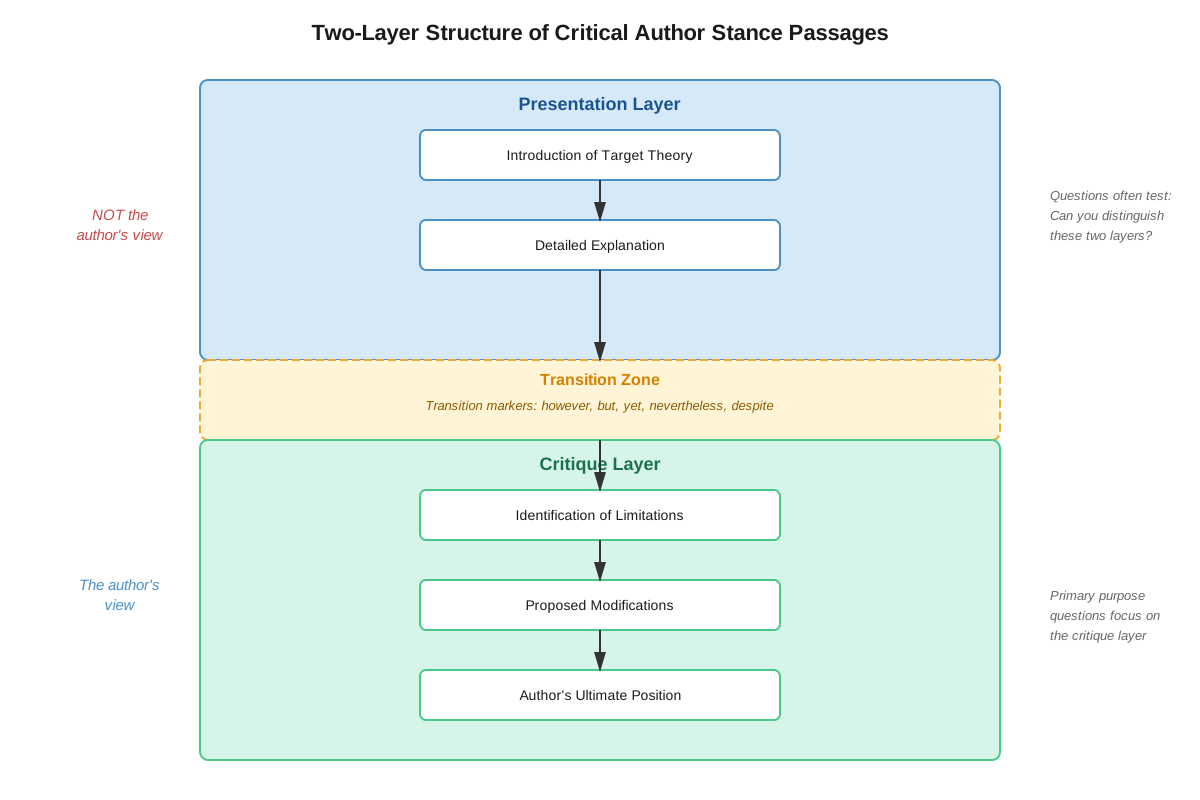
Understanding critical author stance is essential for LSAT success because it directly impacts how students should approach primary purpose questions, tone questions, and inference questions. When an author adopts a critical stance, the passage structure typically follows a predictable pattern: introduction of the target theory or viewpoint, detailed explanation of that position, followed by the author's critique, which may include identifying limitations, proposing modifications, or suggesting alternative interpretations. Recognizing this pattern allows test-takers to anticipate where key information will appear and understand the author's ultimate message.
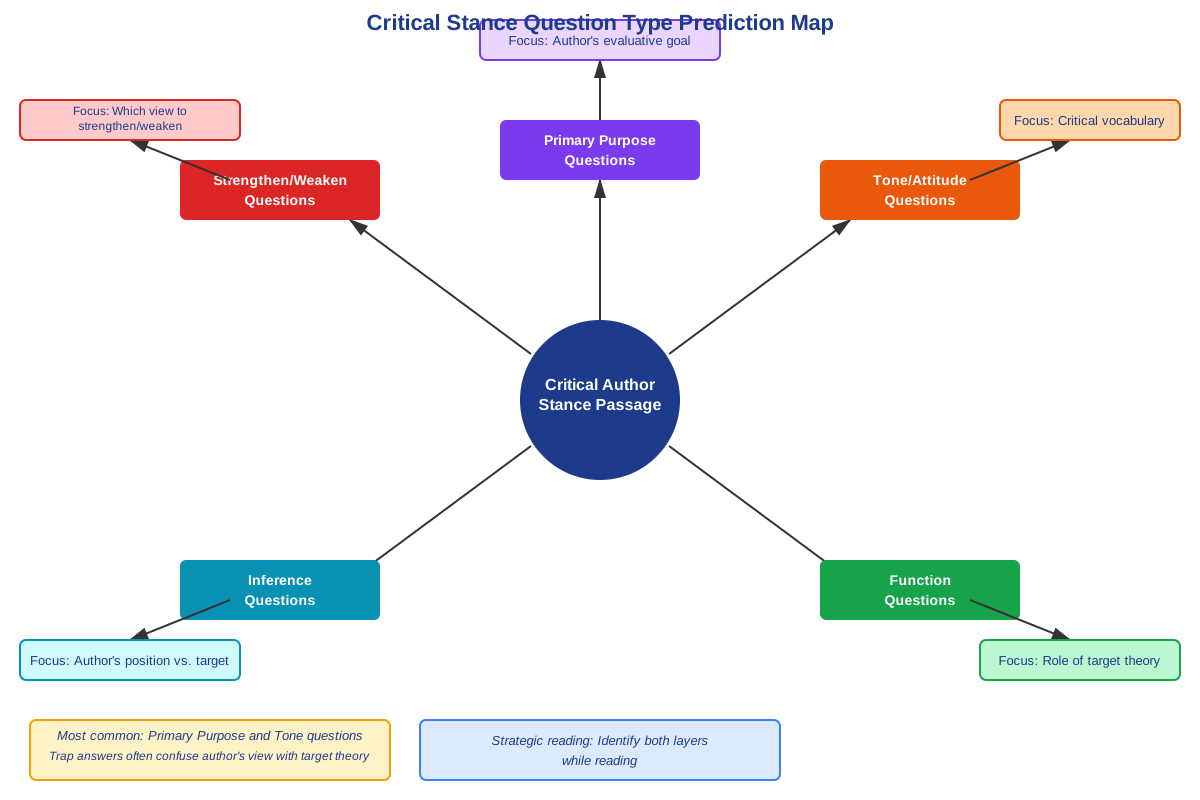
Within the broader framework of passage fundamentals, critical author stance sits alongside other authorial approaches such as neutral exposition, advocacy, and comparative analysis. Mastering this concept enables students to quickly categorize passages, predict question types, and eliminate wrong answer choices that mischaracterize the author's relationship to the material. The ability to distinguish between the views being critiqued and the author's own position is particularly crucial, as LSAT questions frequently test whether students can maintain this distinction under time pressure.
Learning Objectives
- [ ] Identify how Critical author stance appears in LSAT questions
- [ ] Explain the reasoning pattern behind Critical author stance
- [ ] Apply Critical author stance to solve LSAT-style problems accurately
- [ ] Distinguish between the author's critical position and the position being critiqued
- [ ] Recognize structural markers that signal transitions from exposition to critique
- [ ] Predict question types most likely to appear with critical author stance passages
- [ ] Evaluate answer choices based on their alignment with the author's critical perspective
Prerequisites
- Basic passage structure recognition: Understanding how LSAT passages are organized into introduction, body, and conclusion helps identify where critical analysis typically appears
- Tone and attitude vocabulary: Familiarity with words describing authorial attitudes (skeptical, cautious, dismissive, qualified approval) enables accurate identification of critical stances
- Argument structure fundamentals: Recognizing premises, conclusions, and evidence allows students to separate the critiqued argument from the author's critique
- Primary purpose question types: Knowing how LSAT asks about overall passage goals provides context for why identifying author stance matters
Why This Topic Matters
Critical author stance appears in approximately 25-30% of LSAT reading comprehension passages, making it one of the most common authorial approaches tested. This frequency reflects the legal profession's emphasis on analytical thinking—lawyers must constantly evaluate others' arguments, identify weaknesses, and propose alternatives. The LSAT tests this skill by presenting passages where authors engage critically with existing theories, research findings, or interpretive frameworks.
In real-world legal practice, attorneys regularly encounter situations requiring critical analysis: evaluating opposing counsel's arguments, assessing the reasoning in precedent cases, or analyzing expert testimony. The ability to understand not just what someone argues but also how that argument can be challenged or refined is fundamental to legal reasoning. LSAT passages with critical author stance mirror this professional skill by requiring students to track both the content being critiqued and the nature of the critique itself.
This topic commonly appears in passages about scientific theories (where an author critiques a prevailing hypothesis), literary criticism (where an author challenges an interpretation), historical analysis (where an author questions a conventional understanding), or legal theory (where an author identifies limitations in existing frameworks). Questions stemming from these passages frequently ask about the author's primary purpose (typically "to critique" or "to evaluate"), the author's attitude toward the theory discussed (often qualified or skeptical), and specific details of the critique. Additionally, inference questions may ask what the author would likely agree or disagree with, requiring students to extrapolate from the critical stance presented.
Core Concepts
Defining Critical Author Stance
Critical author stance refers to an authorial approach where the writer's primary purpose involves evaluating, analyzing, or challenging another person's or group's theory, argument, interpretation, or methodology. The key distinguishing feature is that the author presents ideas that are not originally their own, then subjects those ideas to systematic examination. This examination may reveal limitations, propose modifications, identify overlooked factors, or suggest alternative explanations.
The critical stance differs from pure advocacy (where authors argue for their own original position) and neutral exposition (where authors simply describe information without evaluation). In critical stance passages, the author maintains analytical distance from the material being discussed, treating it as an object of study rather than a position to defend or information to convey neutrally.
Structural Components of Critical Passages
Critical author stance passages typically follow a predictable architecture that students can learn to recognize:
- Introduction of the target: The passage begins by identifying whose theory, argument, or interpretation will be examined
- Detailed exposition: The author explains the target position thoroughly, often more extensively than students expect
- Transition to critique: Signal words or phrases indicate the shift from exposition to critical analysis
- The critique itself: The author presents specific objections, limitations, or alternative perspectives
- Implications or conclusions: The passage concludes by explaining the significance of the critique
Understanding this structure helps students navigate passages efficiently and locate information needed to answer questions. The exposition phase, while necessary for context, is not where the author's main point resides. The critique phase contains the author's actual contribution and represents the passage's primary purpose.
Types of Critical Stances
Not all critical stances are equally harsh or dismissive. The LSAT tests students' ability to recognize nuanced positions along a spectrum:
| Stance Type | Characteristics | Common Signal Words |
|---|---|---|
| Strongly Critical | Author finds fundamental flaws; theory is largely rejected | "fatally flawed," "fails to account for," "overlooks entirely" |
| Moderately Critical | Author identifies significant limitations but acknowledges some value | "however," "nevertheless," "while X has merit," "overstates" |
| Qualified Approval | Author generally supports the theory but suggests refinements | "although," "requires modification," "would benefit from" |
| Analytical Evaluation | Author presents both strengths and weaknesses without clear judgment | "on one hand," "conversely," "presents both advantages and limitations" |
Recognizing where an author falls on this spectrum is crucial for answering tone and attitude questions correctly. The LSAT frequently includes wrong answer choices that mischaracterize the degree of the author's criticism—either making it too harsh or too mild.
Signal Words and Transition Markers
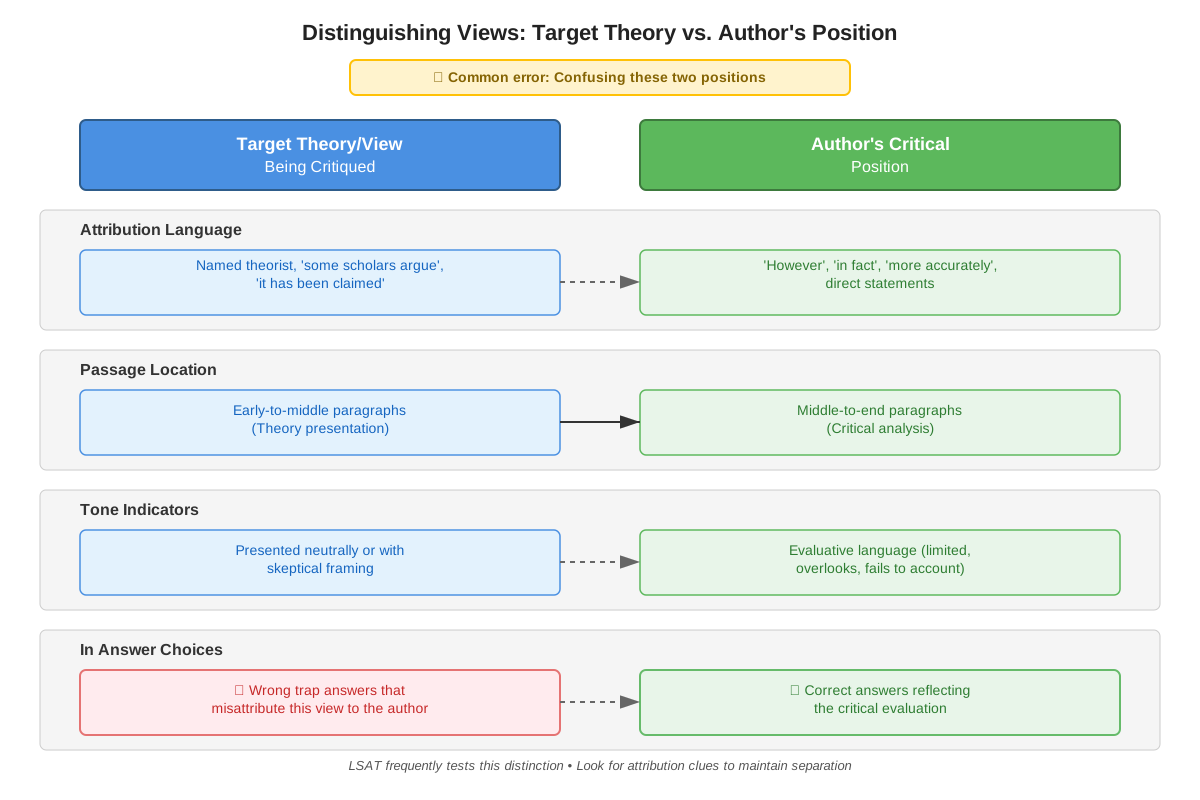
Certain linguistic markers reliably indicate when an author shifts from exposition to critique. These transition markers serve as roadmap signs, alerting careful readers that the author's own voice is about to emerge:
- Contrast indicators: "however," "yet," "but," "nevertheless," "nonetheless," "on the other hand"
- Limitation language: "fails to consider," "overlooks," "neglects," "does not account for"
- Qualification phrases: "while it is true that," "although X argues," "despite the appeal of"
- Evaluative verbs: "overestimates," "underestimates," "exaggerates," "oversimplifies"
- Alternative suggestion markers: "a more accurate view," "better explained by," "more plausibly"
Skilled test-takers train themselves to notice these markers immediately, understanding that the sentences following them likely contain the author's main point and will be heavily tested in questions.
The Two-Voice Problem
One of the most challenging aspects of critical author stance passages is maintaining clear distinction between two voices: the voice of the person or theory being critiqued and the voice of the author doing the critiquing. The LSAT deliberately tests whether students can keep these voices separate by including wrong answer choices that attribute the critiqued position's views to the author, or vice versa.
For example, if a passage discusses "Smith's theory that economic factors alone determine political outcomes" and the author critiques this theory by noting that "cultural factors also play significant roles," a wrong answer might state "the author believes economic factors alone determine political outcomes." This answer confuses Smith's position with the author's position.
To avoid this trap, students should actively track whose view is being presented in each paragraph. Annotating passages with "S" for Smith's view and "A" for author's view can help maintain this distinction under time pressure.
Critical Stance vs. Neutral Description
A crucial skill involves distinguishing passages with critical author stance from those with neutral descriptive stance. In neutral passages, authors present information, theories, or events without evaluating them. The author's role is that of reporter or educator, not critic or analyst.
Consider these contrasting examples:
Neutral stance: "Johnson's 1987 study concluded that urban planning policies in the 1960s prioritized automobile traffic over pedestrian access. The study examined five major cities and found consistent patterns of highway expansion and reduced sidewalk maintenance."
Critical stance: "Johnson's 1987 study concluded that urban planning policies in the 1960s prioritized automobile traffic over pedestrian access. However, this interpretation overlooks the significant variation among cities and fails to account for the economic constraints that limited planners' options."
The second example includes evaluation ("overlooks," "fails to account for"), marking it as critical stance. LSAT questions frequently test whether students recognize this distinction by asking about the author's primary purpose or the passage's main point.
Concept Relationships
The concepts within critical author stance form an interconnected system. The structural components (introduction, exposition, transition, critique, conclusion) provide the framework within which the types of critical stances (strongly critical, moderately critical, etc.) are expressed. Signal words and transition markers serve as the linguistic tools that make the structure visible to readers, allowing them to identify when the passage moves from exposition to critique.
The two-voice problem emerges directly from the structural nature of critical passages—because these passages necessarily present both the critiqued position and the author's response, students must actively work to maintain the distinction. This challenge is intensified by the fact that authors typically spend considerable space explaining the position they will critique, sometimes more space than they devote to the critique itself.
Understanding critical author stance connects to prerequisite knowledge of argument structure because critiques themselves are arguments—they present claims (the target theory has limitations) supported by reasons (specific flaws or overlooked factors). The ability to identify premises and conclusions thus applies both to understanding the critiqued position and to understanding the author's critique.
This topic also relates forward to more advanced reading comprehension skills such as comparative reading (where two passages may present different critical stances on the same topic) and complex viewpoint passages (where multiple critics' positions are discussed and evaluated). Mastering basic critical author stance provides the foundation for these more complex passage types.
Relationship Map:
Passage Structure Recognition → Identification of Critical Stance → Recognition of Signal Words → Distinction Between Two Voices → Accurate Answer Selection → Success on Primary Purpose, Tone, and Inference Questions
High-Yield Facts
- ⭐ Critical author stance passages always present someone else's theory or argument before critiquing it—the author is responding to existing ideas, not proposing original ones
- ⭐ The author's main point in a critical stance passage is located in the critique section, not in the exposition of the theory being critiqued
- ⭐ Signal words like "however," "yet," and "nevertheless" typically mark the transition from exposition to critique and indicate where the author's own voice emerges
- ⭐ Wrong answer choices frequently confuse the critiqued position with the author's position—maintaining the two-voice distinction is essential
- ⭐ The degree of criticism matters: authors may be strongly critical, moderately critical, or offer qualified approval—tone questions test this distinction
- Authors in critical stance passages typically spend more space explaining the target theory than presenting their critique, but the critique represents the passage's primary purpose
- The phrase "fails to account for" or "overlooks" almost always introduces a key element of the author's critique
- Critical stance passages commonly appear in scientific, historical, and literary criticism contexts on the LSAT
- Questions asking "the author would most likely agree with which of the following" require understanding the author's critical position, not the position being critiqued
- The author's critique may acknowledge some merit in the target theory while still identifying significant limitations—this nuanced position is frequently tested
Quick check — test yourself on Critical author stance so far.
Try Flashcards →Common Misconceptions
Misconception: If an author spends most of the passage explaining a theory, that theory must represent the author's own view.
Correction: In critical stance passages, authors often devote substantial space to explaining the theory they will critique. The amount of space devoted to exposition does not indicate endorsement; the author's actual position emerges in the critique section, which may be briefer but contains the main point.
Misconception: Critical author stance always means the author completely rejects the theory being discussed.
Correction: Critical stances exist on a spectrum from strongly critical to qualified approval. An author may identify limitations in a theory while acknowledging its partial validity or usefulness. The LSAT frequently tests whether students can recognize these nuanced positions rather than assuming all criticism is total rejection.
Misconception: The author's primary purpose is to describe or explain the theory discussed in the passage.
Correction: While description and explanation occur in critical stance passages, they serve as setup for the author's actual purpose: to evaluate, critique, or analyze the theory. Primary purpose questions will have wrong answers suggesting the author's goal is merely to "describe" or "explain" when the correct answer involves evaluation or critique.
Misconception: Any passage that mentions problems or limitations involves critical author stance.
Correction: Critical author stance specifically involves the author critiquing someone else's position. If an author discusses problems within a field or limitations of current knowledge without attributing these to a specific person or theory they're evaluating, this may be neutral exposition rather than critical stance. The key is whether the author is responding to and evaluating a specific argument or theory.
Misconception: Signal words like "however" always indicate the author's critique is beginning.
Correction: While "however" and similar transition words often mark the shift to critique, they can also appear within the exposition of the target theory (e.g., "Smith argues that X is important; however, Smith also notes that Y must be considered"). Context matters—students must determine whether the transition word introduces the author's voice or continues explaining the target position.
Misconception: The author's tone in critical stance passages is always negative or dismissive.
Correction: Critical analysis does not require negative tone. An author can critically evaluate a theory with a tone of respectful disagreement, analytical neutrality, or even qualified approval. The presence of critique does not automatically mean the tone is harsh or dismissive.
Worked Examples
Example 1: Identifying Critical Stance and Author's Main Point
Passage Excerpt:
"Historian Margaret Chen has argued that the decline of craft guilds in 18th-century Europe resulted primarily from the rise of factory-based manufacturing, which rendered the guilds' apprenticeship system obsolete. Chen supports this interpretation with extensive data showing the correlation between factory growth and guild membership decline in England and France. However, this explanation overlooks the significant role of government policy in undermining guild authority. In many regions, guilds remained economically viable but were legally prohibited from enforcing their traditional regulations. Furthermore, in areas where factories emerged slowly, such as parts of Germany and Italy, guilds declined at rates similar to those in rapidly industrializing regions, suggesting that factors beyond industrialization drove their demise."
Question: The author's primary purpose in the passage is most likely to:
(A) Describe Chen's theory about guild decline and present supporting evidence
(B) Argue that government policy was the sole cause of guild decline in Europe
(C) Critique Chen's explanation by identifying factors it fails to consider
(D) Compare the rate of guild decline across different European regions
(E) Explain why craft guilds became obsolete in the 18th century
Solution Process:
Step 1: Identify the passage structure. The first two sentences present Chen's theory and her supporting evidence. The third sentence begins with "However," a key transition marker indicating the author's critique is beginning.
Step 2: Determine whose voice is whose. Sentences 1-2 represent Chen's position (not the author's). Sentences 3-5 represent the author's critical response.
Step 3: Identify the author's main point. The author argues that Chen's explanation "overlooks" government policy and presents evidence (the Germany/Italy example) that challenges Chen's emphasis on industrialization.
Step 4: Evaluate answer choices:
- (A) is wrong because it suggests the author's purpose is merely to describe Chen's theory, ignoring the critique
- (B) is wrong because the author never claims government policy was the "sole" cause—this overstates the position
- (C) correctly identifies that the author's purpose is to critique Chen's explanation by pointing out overlooked factors
- (D) is wrong because regional comparison is evidence supporting the critique, not the primary purpose
- (E) is wrong because this describes Chen's purpose, not the author's purpose
Answer: (C)
Connection to Learning Objectives: This example demonstrates how to identify critical author stance (objective 1), recognize the reasoning pattern of presenting a theory then critiquing it (objective 2), and apply this understanding to select the correct answer (objective 3). It also illustrates the importance of distinguishing between the author's voice and Chen's voice (additional objective 4).
Example 2: Distinguishing Voices and Evaluating Tone
Passage Excerpt:
"Legal scholar Thomas Brennan contends that judicial precedent should be understood as binding only when the factual circumstances of cases are nearly identical. According to Brennan, judges have inappropriately extended precedents to cases with significantly different facts, thereby creating legal uncertainty. While Brennan correctly identifies instances where precedent has been applied too broadly, his proposed solution—requiring near-identical facts for precedent to apply—would paradoxically create even greater uncertainty. Legal systems depend on the ability to apply general principles derived from precedents to new situations. Brennan's approach would fragment the law into countless narrow rules, each applicable only to highly specific circumstances, undermining the predictability that precedent is meant to provide."
Question: The author's attitude toward Brennan's analysis of how precedent has been applied can most accurately be described as:
(A) Complete agreement with both Brennan's diagnosis and proposed solution
(B) Rejection of Brennan's concerns about overly broad application of precedent
(C) Partial agreement with Brennan's identification of a problem but disagreement with his solution
(D) Neutral presentation of Brennan's views without evaluation
(E) Dismissive skepticism toward all aspects of Brennan's argument
Solution Process:
Step 1: Identify where the author evaluates Brennan's analysis. The phrase "While Brennan correctly identifies" signals the author's evaluation.
Step 2: Determine what the author agrees with. The author states Brennan "correctly identifies instances where precedent has been applied too broadly"—this is partial agreement.
Step 3: Determine what the author disagrees with. The author argues Brennan's proposed solution "would paradoxically create even greater uncertainty" and explains why—this is disagreement with the solution.
Step 4: Assess the tone. The author uses measured language ("correctly identifies," "would paradoxically create") rather than harsh dismissal, indicating qualified criticism rather than complete rejection.
Step 5: Evaluate answer choices:
- (A) is wrong because the author disagrees with Brennan's solution
- (B) is wrong because the author explicitly agrees with Brennan's concerns ("correctly identifies")
- (C) accurately captures the author's partial agreement with the problem identification and disagreement with the solution
- (D) is wrong because the author clearly evaluates rather than neutrally presenting
- (E) is wrong because the author agrees with part of Brennan's argument and uses measured rather than dismissive language
Answer: (C)
Connection to Learning Objectives: This example shows how to distinguish between different aspects of a position being critiqued (objective 4), recognize the nuanced nature of critical stances (objective 2), and accurately characterize the author's tone (objective 1). It demonstrates that critical stance does not mean total rejection.
Exam Strategy
Approaching Critical Stance Passages
When encountering a reading comprehension passage, quickly determine whether it involves critical author stance by scanning the first paragraph for references to a specific person's theory, argument, or interpretation. If the passage introduces "Scholar X argues that..." or "Theory Y proposes that...", prepare for a critical stance structure.
As reading progresses, actively mark the transition point where the author's critique begins. Look for signal words like "however," "yet," "nevertheless," or evaluative phrases like "fails to account for" or "overlooks." Draw a line or make a notation at this transition point—this is where the author's main point begins and where most questions will focus.
Trigger Words and Phrases
Certain words and phrases reliably appear in critical stance passages and questions:
In passages:
- "X argues/contends/maintains/claims that..."
- "According to Y..."
- "However/Yet/Nevertheless/Nonetheless..."
- "Fails to consider/account for/recognize..."
- "Overlooks/Neglects/Ignores..."
- "Overestimates/Underestimates/Exaggerates..."
- "A more accurate/plausible explanation..."
In questions:
- "The author's primary purpose is to..."
- "The author's attitude toward X's theory can best be described as..."
- "The author mentions [detail] primarily in order to..."
- "The author would most likely agree with which of the following..."
- "Which of the following, if true, would most strengthen/weaken the author's critique..."
When questions use these phrasings, immediately recall the distinction between the author's voice and the critiqued position's voice.
Process of Elimination Tips
For primary purpose questions on critical stance passages:
- Eliminate answers suggesting the author's purpose is merely to "describe," "explain," or "present" unless they also include evaluative language
- Eliminate answers that attribute the critiqued position to the author
- Favor answers using words like "critique," "evaluate," "challenge," "question," or "analyze"
For tone/attitude questions:
- Eliminate extreme answers ("complete rejection," "unqualified enthusiasm") unless the passage language clearly supports them
- Eliminate answers suggesting neutrality when the passage contains clear evaluative language
- Look for answers reflecting nuanced positions ("qualified approval," "partial agreement," "respectful disagreement")
For inference questions asking what the author would agree with:
- Eliminate answers that restate the critiqued position without the author's modifications
- Favor answers that align with the critique the author presented
- Be cautious of answers that go beyond what the author explicitly argued
Time Allocation
Spend slightly more time on the initial read of critical stance passages compared to neutral descriptive passages—approximately 3.5-4 minutes rather than 3 minutes. This extra time investment pays dividends because:
- Clearly identifying the transition from exposition to critique prevents confusion later
- Understanding the two-voice structure reduces time spent re-reading when answering questions
- Recognizing the author's main point during the initial read makes primary purpose questions quick to answer
However, do not get bogged down trying to understand every detail of the theory being critiqued. The author's critique is what matters most for questions, so if the exposition of the target theory becomes dense or technical, read for general understanding and move forward—the critique section will clarify what aspects of the theory are important.
Memory Techniques
The CHESS Acronym for Critical Stance Structure
Critiqued position introduced
However (or other transition word) signals shift
Evaluation by author begins
Specific flaws or limitations identified
Significance or implications explained
This acronym helps students remember the typical structure and anticipate where key information will appear.
The Two-Voice Visualization
Imagine the passage as a dialogue or debate. Visualize the person being critiqued (e.g., "Scholar Smith") on the left side of a stage, presenting their theory. Then visualize the author on the right side of the stage, responding to Smith's presentation. When reading, mentally place each sentence on the appropriate side of the stage. This spatial visualization helps maintain the crucial distinction between voices.
The "However Hunt" Technique
Train yourself to notice transition words like "however" as if they were highlighted in bright yellow. These words are "treasure markers" indicating that the author's main point is nearby. When you see "however" or similar transitions, slow down slightly and read the following sentences with extra attention—this is where the passage's primary purpose resides.
Tone Spectrum Memory Aid
Remember the acronym SCAM for the spectrum of critical stances:
- Strongly critical (fundamental rejection)
- Cautiously critical (significant limitations noted)
- Approving with qualifications (generally positive but suggests refinements)
- Measured evaluation (balanced assessment of strengths and weaknesses)
This helps recall that critical stances exist on a spectrum and prevents the misconception that "critical" always means "harshly negative."
Summary
Critical author stance represents a fundamental pattern in LSAT reading comprehension where authors present, analyze, and evaluate someone else's theory, argument, or interpretation rather than advocating for their own original position or neutrally describing information. These passages follow a predictable structure: introduction of the target position, detailed exposition of that position, transition to critique (often marked by words like "however"), the author's evaluation identifying limitations or overlooked factors, and implications of the critique. Success with these passages requires maintaining clear distinction between two voices—the position being critiqued and the author's critical response—as LSAT questions deliberately test whether students confuse these voices. Critical stances exist on a spectrum from strong rejection to qualified approval, and recognizing the degree of criticism is essential for answering tone and attitude questions accurately. The author's main point resides in the critique section, not in the exposition of the target theory, even though exposition often occupies more space. Mastering critical author stance enables students to quickly identify passage structure, predict question types, and eliminate wrong answers that mischaracterize the author's relationship to the material discussed.
Key Takeaways
- Critical author stance passages present someone else's theory or argument, then evaluate it—the author responds to existing ideas rather than proposing original ones
- The transition from exposition to critique, often marked by "however" or similar signal words, indicates where the author's main point begins
- Maintaining distinction between the critiqued position and the author's position is crucial, as questions frequently test whether students confuse these voices
- Critical stances range from strong rejection to qualified approval—recognizing this spectrum prevents mischaracterizing the author's tone
- The author's primary purpose in critical stance passages involves evaluation, critique, or analysis, not mere description or explanation
- Most questions on critical stance passages focus on the critique section, making it the highest-yield area to understand thoroughly
- Wrong answers often attribute the critiqued position to the author or mischaracterize the degree of the author's criticism
Related Topics
Comparative Reading Passages: Building on critical author stance, comparative reading presents two passages that may take different critical stances on the same topic, requiring students to track multiple authors' positions and compare their evaluative approaches. Mastering basic critical stance provides the foundation for managing these more complex multi-voice passages.
Author's Tone and Attitude: This related topic explores the full range of authorial attitudes beyond critical stance, including advocacy, neutrality, ambivalence, and enthusiasm. Understanding critical stance as one type of authorial approach enables better recognition of when authors adopt other stances.
Argument Structure and Reasoning: Critical stance passages contain arguments both in the position being critiqued and in the author's critique itself. Deeper study of argument structure—premises, conclusions, assumptions, and reasoning patterns—enhances the ability to analyze both layers of argumentation in critical passages.
Primary Purpose and Main Point Questions: These question types appear frequently with critical stance passages and require precise understanding of the author's ultimate goal. Further study of how to identify and articulate main points across different passage types builds on the foundation established by mastering critical stance.
Practice CTA
Now that you understand the fundamentals of critical author stance, it's time to apply this knowledge to actual LSAT passages. Attempt the practice questions associated with this topic, focusing on identifying the transition from exposition to critique, maintaining the two-voice distinction, and recognizing the degree of the author's criticism. As you work through practice passages, actively mark transition words and annotate whose voice is speaking in each section. The flashcards will help reinforce key concepts like signal words and the spectrum of critical stances. Remember: recognizing critical author stance is a skill that improves dramatically with deliberate practice. Each passage you analyze strengthens your ability to quickly identify this pattern and answer questions accurately under time pressure. You're building a crucial skill that will serve you throughout the LSAT reading comprehension section—stay focused and practice consistently!
Sign up free to keep reading
Create a free AnvayaPrep account to finish this LSAT guide on Critical author stance — plus flashcards and practice questions.