Overview
Main point questions represent one of the most fundamental and frequently tested reading comprehension question types on the LSAT. These questions ask test-takers to identify the primary argument, central thesis, or overarching message that the author seeks to convey in a passage. Unlike detail questions that focus on specific facts or inference questions that require drawing conclusions beyond the text, main point questions demand a holistic understanding of the passage's structure and purpose. Success on these questions requires the ability to distinguish between the author's central claim and supporting evidence, examples, or tangential discussions that flesh out but do not constitute the core message.
The significance of mastering LSAT main point questions cannot be overstated. These questions typically appear at least once per passage in the reading comprehension section, making them among the most predictable question types on the exam. They serve as a gateway to understanding the passage as a whole—students who correctly identify the main point are better positioned to answer subsequent questions about details, structure, and author's purpose. Furthermore, the skills developed through main point analysis transfer directly to logical reasoning sections, where identifying conclusions in arguments is equally critical.
Main point questions occupy a unique position within the broader landscape of reading comprehension question types. They require synthesis rather than analysis, asking students to step back from the details and perceive the forest rather than the trees. This skill connects directly to structural questions (which ask about how the passage is organized) and primary purpose questions (which ask why the author wrote the passage). Mastering main point identification creates a foundation for tackling more complex question types, including those requiring evaluation of the author's tone, methodology, or implicit assumptions.
Learning Objectives
- [ ] Identify how Main point questions appears in LSAT questions
- [ ] Explain the reasoning pattern behind Main point questions
- [ ] Apply Main point questions to solve LSAT-style problems accurately
- [ ] Distinguish between main points and supporting details within complex passages
- [ ] Recognize common wrong answer patterns in main point questions
- [ ] Synthesize information from multiple paragraphs to construct a complete understanding of the author's central claim
- [ ] Evaluate answer choices for appropriate scope and precision relative to the passage's main point
Prerequisites
- Basic reading comprehension skills: The ability to understand college-level prose is essential for parsing LSAT passages, which often contain dense academic or professional writing.
- Understanding of argument structure: Recognizing the difference between premises and conclusions helps distinguish main points from supporting evidence.
- Familiarity with LSAT passage types: Knowledge that passages may be drawn from humanities, social sciences, natural sciences, or law helps set appropriate expectations for content and structure.
- Paragraph-level comprehension: The ability to identify topic sentences and understand how individual paragraphs contribute to a larger whole is necessary for synthesizing main points.
Why This Topic Matters
Main point questions are not merely academic exercises—they test a fundamental skill that lawyers must employ daily: extracting the essential argument from complex written material. Legal professionals constantly encounter lengthy briefs, judicial opinions, and statutory texts where identifying the central holding or primary argument is crucial for effective practice. The LSAT uses main point questions to assess whether candidates possess this critical analytical capacity.
From an exam statistics perspective, main point questions appear with remarkable consistency. Test-takers can expect to encounter approximately 4-6 main point questions across the four reading comprehension passages on any given LSAT. This represents roughly 15-20% of all reading comprehension questions, making them one of the most common question types alongside inference and detail questions. Their predictable appearance makes them high-value targets for focused preparation.
Main point questions manifest in several recognizable forms within LSAT passages. They may appear after single passages asking for the "main point" or "primary purpose" of the entire text. In comparative reading passages (where two shorter passages address related topics), main point questions may ask about the central claim of Passage A, Passage B, or the relationship between both passages. The questions typically appear early in the question set for each passage, as correctly identifying the main point facilitates answering subsequent questions. Common question stems include: "Which one of the following most accurately expresses the main point of the passage?" or "The primary purpose of the passage is to..."
Core Concepts
Defining Main Point Questions
Main point questions ask test-takers to identify the author's central claim, thesis, or overarching message in a passage. These questions differ fundamentally from detail questions (which focus on specific facts mentioned in the passage) and inference questions (which require drawing conclusions not explicitly stated). The main point represents what the author most wants the reader to understand or accept after reading the passage. It is the claim for which all other content in the passage provides support, context, or elaboration.
The main point typically possesses three key characteristics: scope (it encompasses the entire passage rather than just one paragraph or section), precision (it accurately captures the author's specific claim without being too broad or too narrow), and centrality (it represents the primary argument rather than a secondary observation or supporting detail). Understanding these characteristics helps test-takers evaluate answer choices effectively.
Recognizing Main Point Question Stems
LSAT main point questions employ predictable language patterns that signal their focus. Common question stems include:
- "Which one of the following most accurately expresses the main point of the passage?"
- "The primary purpose of the passage is to..."
- "The author's central claim is that..."
- "Which one of the following most accurately states the main idea of the passage?"
- "The passage is primarily concerned with..."
Recognizing these stems immediately alerts test-takers to the task at hand: synthesizing the entire passage into a single, comprehensive statement. This recognition should trigger a specific strategic approach focused on holistic understanding rather than detail-oriented reading.
The Structure of LSAT Passages and Main Points
LSAT reading comprehension passages typically follow recognizable organizational patterns that help reveal the main point. The most common structures include:
| Structure Type | Characteristics | Main Point Location |
|---|---|---|
| Thesis-Support | Author states main claim early, then provides evidence | Usually first or second paragraph |
| Problem-Solution | Passage identifies an issue, then proposes a resolution | Often in final paragraph or late in passage |
| Comparison-Contrast | Author examines two or more theories/approaches | Typically in conclusion, stating which is superior or how they relate |
| Historical Development | Passage traces evolution of an idea or field | Usually in final paragraph, synthesizing the significance |
| Critique | Author challenges an existing view | Often stated early, then elaborated through counterarguments |
Understanding these structures allows test-takers to predict where the main point is most likely to appear and how supporting content will be organized around it.
Distinguishing Main Points from Supporting Details
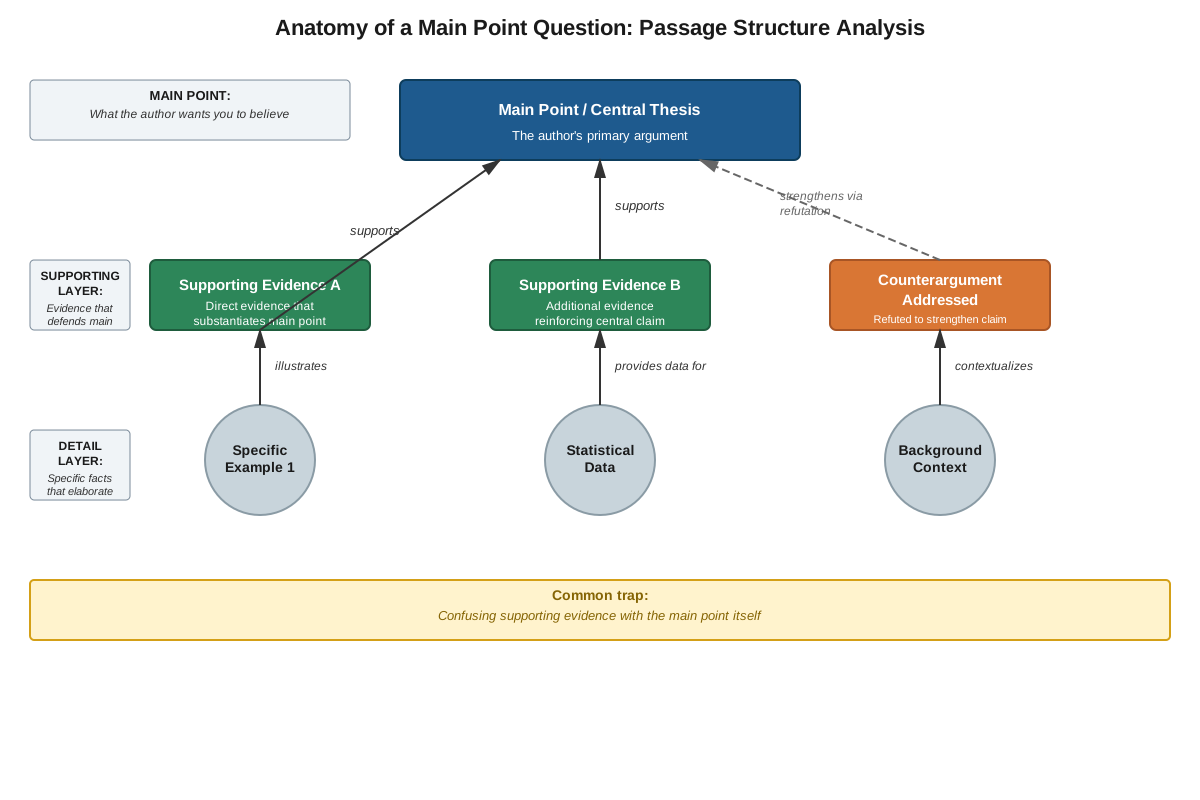
One of the most critical skills for main point questions is differentiating between the central claim and the various types of supporting content. Supporting details include:
- Examples and illustrations: Specific instances that demonstrate a broader principle
- Evidence and data: Facts, statistics, or research findings that support the main claim
- Background information: Historical context or definitions that set up the main argument
- Counterarguments: Opposing views mentioned to be refuted or qualified
- Elaborations: Explanations that clarify or expand upon the main point without constituting it
The main point is the claim that these elements support, not the elements themselves. A useful test: if you removed a particular sentence or paragraph, would the author's central argument still be comprehensible? If yes, that content is likely supporting detail rather than the main point.
The Role of Conclusion Indicators
Authors often signal their main points through conclusion indicators—words and phrases that mark important claims. These include:
- Therefore, thus, hence, consequently
- It follows that, we can conclude that
- The point is, the key insight is
- Ultimately, in the final analysis
- Most importantly, the crucial factor is
While not every main point is preceded by such indicators, their presence often marks significant claims worthy of special attention. However, test-takers must be cautious: conclusion indicators sometimes mark intermediate conclusions (sub-points that support the ultimate main point) rather than the passage's overall thesis.
Scope Issues in Answer Choices
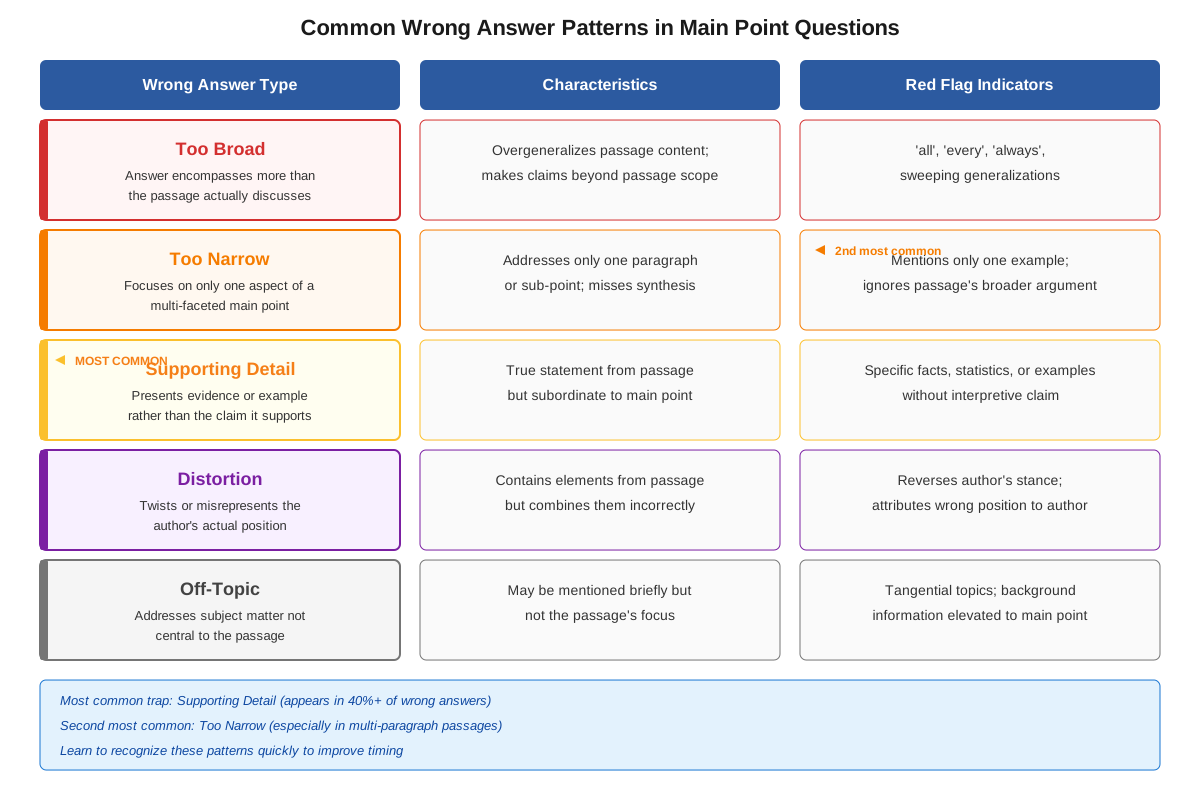
Wrong answers to main point questions frequently suffer from scope problems—they are either too broad or too narrow relative to the passage's actual focus.
Too broad: An answer choice that could apply to many passages or that encompasses topics not actually discussed. For example, if a passage discusses how a specific Supreme Court decision affected environmental law, an answer stating "The passage examines the role of courts in American society" would be too broad.
Too narrow: An answer choice that accurately describes one paragraph or section but fails to capture the entire passage. Using the same example, an answer stating "The passage describes the facts of the Supreme Court case" would be too narrow if the passage's main point concerns the decision's broader legal impact.
Correct answers demonstrate appropriate scope—they are broad enough to encompass the entire passage but specific enough to capture the author's particular argument.
Active Reading for Main Point Identification
Effective main point identification begins during the initial reading of the passage. Test-takers should employ active reading strategies:
- Read the first and last paragraphs carefully: These locations most frequently contain main point statements
- Note structural transitions: Words like "however," "but," "although," and "yet" often signal the author's true position after acknowledging opposing views
- Identify the author's voice: Distinguish between views the author describes versus views the author endorses
- Track the passage's progression: Notice how each paragraph contributes to building the overall argument
- Formulate a mental summary: After reading, articulate the main point in your own words before examining answer choices
This active approach transforms reading from passive absorption to engaged analysis, making main point identification more reliable and efficient.
Concept Relationships
The concepts within main point questions form an interconnected system. Recognizing question stems triggers the appropriate strategic approach, which involves active reading focused on passage structure. Understanding passage structure types (thesis-support, problem-solution, etc.) helps predict where the main point will appear and guides attention during reading. The ability to distinguish main points from supporting details depends on understanding the role of conclusion indicators and recognizing how examples and evidence function within arguments. Finally, evaluating answer choices requires careful attention to scope issues, ensuring the selected answer is neither too broad nor too narrow.
These concepts connect to prerequisite knowledge of argument structure: the main point functions as the conclusion in the passage's overall argument, while supporting details serve as premises. This relationship mirrors the structure of logical reasoning stimuli, creating valuable cross-section synergies.
The progression flows as follows:
Question stem recognition → Activates main point strategy → Focused reading using structural awareness → Identification of main point vs. supporting content → Evaluation of answer choices for scope and accuracy → Selection of correct answer
Mastery of main point questions also facilitates success on related question types. Primary purpose questions (asking why the author wrote the passage) are closely related to main point questions (asking what the author's central claim is). Similarly, structural questions (asking how the passage is organized) become easier when the main point is clearly identified, as the structure typically serves to support and develop that main point.
High-Yield Facts
⭐ Main point questions appear 4-6 times per LSAT reading comprehension section, representing approximately 15-20% of all reading comprehension questions.
⭐ The main point is most frequently located in the first paragraph (introducing the thesis) or the final paragraph (concluding with the central claim).
⭐ Correct answers to main point questions must have appropriate scope—broad enough to cover the entire passage but specific enough to capture the author's particular argument.
⭐ Wrong answers often describe supporting details, examples, or single paragraphs rather than the passage's overarching message.
⭐ The main point represents the claim for which everything else in the passage provides support, context, or elaboration.
- Main point questions typically appear early in the question set for each passage, often as the first or second question.
- Conclusion indicators (therefore, thus, ultimately) often signal important claims but may mark intermediate conclusions rather than the ultimate main point.
- In comparative reading passages, main point questions may ask about Passage A alone, Passage B alone, or the relationship between both passages.
- The author's main point is not always explicitly stated in a single sentence; sometimes it must be synthesized from multiple statements across paragraphs.
- Answer choices that use extreme language (always, never, only, all) are rarely correct for main point questions unless the passage itself uses such definitive language.
- Background information, historical context, and definitions typically appear early in passages but do not constitute the main point.
- When a passage presents multiple viewpoints, the main point usually involves the author's position on or synthesis of those viewpoints, not merely their description.
- Main point answers should capture both the topic (what the passage is about) and the author's specific claim or perspective on that topic.
Quick check — test yourself on Main point questions so far.
Try Flashcards →Common Misconceptions
Misconception: The main point is always explicitly stated in a single sentence within the passage.
Correction: While passages often contain sentences that closely express the main point, test-takers sometimes must synthesize the main point from multiple statements across paragraphs. The correct answer may paraphrase or combine ideas rather than quote directly from the passage.
Misconception: The first sentence of the passage is always the main point.
Correction: Although first sentences often introduce the topic or thesis, they may instead provide background information, pose a question, or describe a problem that the passage will address. The main point frequently appears later, after context has been established.
Misconception: The longest or most detailed paragraph contains the main point.
Correction: Length and detail indicate emphasis on supporting evidence or examples, not necessarily the main point itself. The main point is often stated concisely, with subsequent paragraphs providing elaboration and support.
Misconception: If an answer choice contains information from the passage, it must be correct.
Correction: All answer choices in main point questions typically contain information from the passage. The key is identifying which choice captures the central claim rather than supporting details, examples, or tangential observations.
Misconception: Main point questions and primary purpose questions are completely different and require different approaches.
Correction: These question types are closely related. The main point is what the author argues (the central claim), while the primary purpose is why the author wrote the passage (to argue that claim). Identifying one typically reveals the other, and the correct answers often express the same idea from slightly different angles.
Misconception: Technical details and specialized terminology are likely to appear in the correct answer to a main point question.
Correction: Main point answers typically use accessible language that captures the passage's overarching message. Highly technical details usually represent supporting evidence rather than the main point itself. Correct answers tend to be comprehensible even to readers unfamiliar with the passage's specialized subject matter.
Misconception: In passages presenting multiple theories or viewpoints, the main point is simply that these different views exist.
Correction: When passages present multiple perspectives, the main point typically involves the author's analysis, evaluation, or synthesis of those views—not merely their description. The author usually takes a position on which view is superior, how they relate, or what their comparison reveals.
Worked Examples
Example 1: Science Passage
Passage Summary: A passage discusses how traditional evolutionary theory emphasized competition as the primary driver of natural selection, but recent research has revealed that cooperation among organisms plays a more significant role than previously recognized. The first paragraph introduces the traditional view. The second paragraph presents new evidence of cooperative behaviors. The third paragraph explains why cooperation can be evolutionarily advantageous. The final paragraph concludes that evolutionary theory must be revised to account for cooperation as a major evolutionary force.
Question: Which one of the following most accurately expresses the main point of the passage?
Answer Choices:
(A) Competition among organisms has been overemphasized in traditional evolutionary theory.
(B) Recent research has demonstrated that cooperation among organisms is more common than scientists previously believed.
(C) Evolutionary theory must be revised to recognize cooperation as a significant evolutionary force alongside competition.
(D) Cooperative behaviors can provide evolutionary advantages in certain environmental conditions.
(E) Traditional evolutionary theory focused exclusively on competition and ignored cooperation entirely.
Analysis:
First, identify what the passage is fundamentally about: the relationship between cooperation and evolutionary theory, specifically how new understanding of cooperation requires revising traditional theory.
(A) This choice captures only part of the main point—the critique of traditional theory—but doesn't include the forward-looking claim about revising evolutionary theory. It's too narrow, focusing on what was wrong rather than what should change. Eliminate.
(B) This accurately describes the second paragraph's content (new research findings) but represents supporting evidence rather than the main point. The passage uses this evidence to support a larger claim about revising theory. Eliminate.
(C) This choice captures both key elements: the need to revise evolutionary theory and the specific revision required (recognizing cooperation as significant). It has appropriate scope, covering the entire passage's argument. Strong candidate.
(D) This describes content from the third paragraph explaining how cooperation works, but it's a supporting detail that helps explain why cooperation matters. It doesn't capture the passage's central claim about revising theory. Eliminate.
(E) The word "exclusively" makes this too extreme. The passage indicates traditional theory emphasized competition, not that it completely ignored cooperation. This distortion makes it incorrect. Eliminate.
Correct Answer: (C)
Connection to Learning Objectives: This example demonstrates identifying main point questions (the question stem "most accurately expresses the main point"), explaining the reasoning pattern (synthesizing information across all paragraphs to identify the overarching claim), and applying the concept to solve the problem (evaluating each answer for appropriate scope and accuracy).
Example 2: Humanities Passage
Passage Summary: A passage examines the work of a particular novelist. The first paragraph describes the novelist's early works, which were conventional in style. The second paragraph discusses a mid-career shift to experimental techniques. The third paragraph analyzes critical reception, noting that while some critics praised the experimentation, others found it alienating. The final paragraph argues that despite mixed reviews, the experimental works represent the novelist's most significant contribution to literature because they challenged readers' expectations and expanded the possibilities of the novel form.
Question: The author's central claim is that
Answer Choices:
(A) the novelist's experimental works received mixed critical reception
(B) the novelist's early works were more accessible than the later experimental works
(C) the novelist's experimental works, despite mixed reviews, constitute the most important contribution to literature
(D) experimental techniques in fiction often alienate readers and critics
(E) the novelist's career can be divided into conventional and experimental periods
Analysis:
The question stem "author's central claim" signals a main point question. The task is identifying what the author most wants to argue, not merely what the passage describes.
(A) This accurately describes the third paragraph's content but represents an observation about critical reception rather than the author's evaluative claim. The author mentions mixed reception but doesn't stop there—the passage argues for the works' significance despite that reception. Eliminate.
(B) This describes a comparison between early and later works but doesn't capture the author's evaluative judgment about significance. It's descriptive rather than argumentative. Eliminate.
(C) This captures the author's ultimate claim from the final paragraph: a judgment about which works matter most and why. It includes both the qualification ("despite mixed reviews") and the central evaluation ("most important contribution"). The scope is appropriate, as the entire passage builds toward this conclusion. Strong candidate.
(D) This generalizes beyond the specific novelist to make a broad claim about experimental fiction. The passage discusses this novelist specifically, not experimental techniques generally. The scope is too broad. Eliminate.
(E) This accurately describes the passage's organization (discussing two career periods) but confuses structure with main point. How the passage is organized differs from what it argues. Eliminate.
Correct Answer: (C)
Connection to Learning Objectives: This example illustrates distinguishing between main points and supporting details (recognizing that descriptions of career periods and critical reception support the ultimate evaluative claim), recognizing common wrong answer patterns (choices that describe passage structure or supporting details), and synthesizing information from multiple paragraphs to identify the central claim.
Exam Strategy
Approaching Main Point Questions Systematically
When encountering a main point question, employ this strategic sequence:
- Recognize the question type immediately through stem language ("main point," "primary purpose," "central claim")
- Recall your initial reading summary before looking at answer choices—what did you identify as the main point during active reading?
- Articulate the main point in your own words as a complete sentence
- Scan answer choices for scope before reading them carefully—eliminate any that are obviously too broad or too narrow
- Evaluate remaining choices for accuracy and completeness
- Select the answer that best matches your pre-formulated understanding
This systematic approach prevents the common error of being swayed by attractive wrong answers that describe supporting details or use appealing language from the passage.
Trigger Words and Phrases
Certain words in answer choices signal potential problems:
Red flags (suggesting the answer may be too narrow or represent supporting detail):
- "For example," "such as," "including"
- Specific names, dates, or technical terms from one paragraph
- "One reason," "a factor," "an aspect"
Green lights (suggesting appropriate scope):
- "The passage argues that," "the author's central claim"
- Language that synthesizes multiple paragraphs
- Evaluative or judgmental language matching the author's tone
Yellow flags (requiring careful evaluation):
- Extreme language: "always," "never," "only," "all," "none"
- Comparative language: "most important," "primary," "mainly"
These triggers help quickly assess answer choice viability during the elimination process.
Process of Elimination Strategies
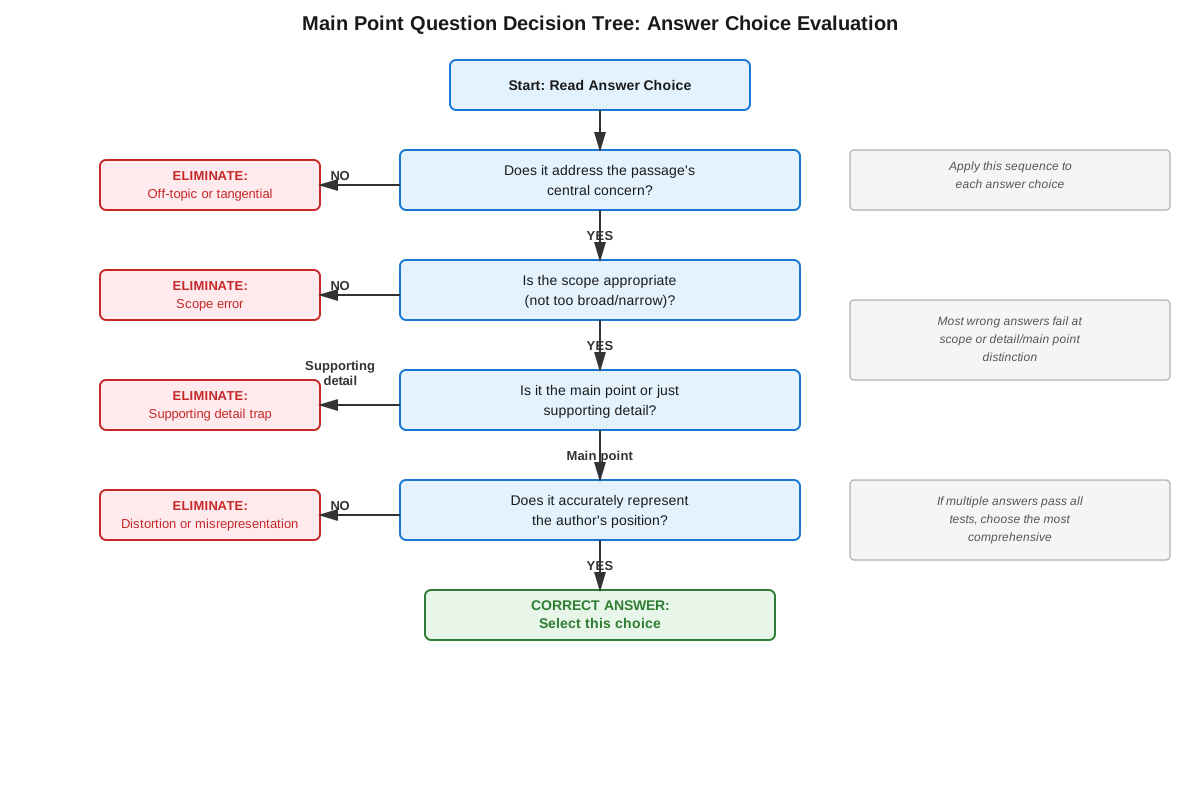
For main point questions, eliminate answers that:
- Describe only one paragraph or section rather than the entire passage
- Focus on examples or evidence rather than the claim those examples support
- Are too broad, applying to many passages or topics not actually discussed
- Distort the author's position through extreme language or mischaracterization
- Confuse structure with substance, describing how the passage is organized rather than what it argues
After elimination, if multiple answers remain viable, select the one that:
- Most completely captures the passage's scope
- Best matches the author's tone and level of certainty
- Most closely aligns with your pre-formulated summary
Time Allocation
Main point questions should be among the faster questions to answer, typically requiring 45-60 seconds once the passage has been read. They reward the time invested in careful initial reading and active comprehension. If a main point question is taking longer than 90 seconds, the issue likely stems from inadequate initial comprehension rather than the question itself—in such cases, briefly re-skim the first and last paragraphs to reorient before proceeding.
Because main point questions often appear first in a question set, answering them correctly and efficiently creates momentum and confidence for subsequent questions. Conversely, struggling with the main point question may indicate the need to re-read portions of the passage before proceeding to detail or inference questions.
Memory Techniques
The SCOPE Acronym
Remember to evaluate main point answers using SCOPE:
- Synthesizes the entire passage (not just one part)
- Captures the author's specific claim (not just the topic)
- Omits extreme distortions (unless the passage itself is extreme)
- Precise in its language (neither too broad nor too narrow)
- Expresses what the author argues (not just what the passage describes)
The "Umbrella Test" Visualization
Visualize the main point as an umbrella that covers all the content in the passage. Every paragraph, example, and detail should fit underneath this umbrella. If an answer choice leaves significant passage content "out in the rain" (uncovered), it's too narrow. If the umbrella is so large it could cover many other passages too, it's too broad. The correct answer provides an umbrella that's exactly the right size.
The "Cocktail Party Summary" Technique
Imagine explaining the passage to someone at a cocktail party who asks, "What was it about?" Your answer wouldn't be "Well, paragraph one said X, and paragraph two said Y..." Instead, you'd provide a concise summary of the author's main argument. This is the main point. Practice formulating these one-sentence summaries after reading each passage.
First and Last Paragraph Focus
Remember the mnemonic "FLAP": First and Last Are Primary. These paragraphs most frequently contain or strongly signal the main point. During initial reading, pay special attention to these locations, and when answering main point questions, consider re-reading them if uncertain.
Summary
Main point questions represent a cornerstone of LSAT reading comprehension, testing the fundamental skill of identifying an author's central claim within complex passages. These questions appear predictably and frequently, making them high-value targets for focused preparation. Success requires distinguishing the overarching thesis from supporting details, examples, and tangential observations. The main point possesses three essential characteristics: appropriate scope (covering the entire passage), precision (capturing the specific argument), and centrality (representing the primary claim rather than secondary observations). Effective strategy involves active reading focused on passage structure, formulating a mental summary before examining answer choices, and systematically eliminating options with scope problems or that describe supporting details rather than the central claim. The skills developed through main point mastery—synthesizing information, distinguishing claims from evidence, and evaluating scope—transfer directly to other reading comprehension question types and to the logical reasoning section, making this topic foundational for overall LSAT success.
Key Takeaways
- Main point questions appear 4-6 times per reading comprehension section, representing approximately 15-20% of questions and making them one of the most predictable question types
- The correct answer must have appropriate scope: broad enough to encompass the entire passage but specific enough to capture the author's particular argument
- Main points are most frequently located in first or final paragraphs, though sometimes they must be synthesized from multiple statements
- Wrong answers typically describe supporting details, examples, or single paragraphs rather than the overarching message
- Active reading strategies—including careful attention to first and last paragraphs, tracking structural transitions, and formulating mental summaries—make main point identification more reliable
- The main point represents the claim for which all other passage content provides support, context, or elaboration
- Systematic elimination of answers with scope problems (too broad or too narrow) and those describing supporting details rather than central claims increases accuracy and efficiency
Related Topics
Primary Purpose Questions: These closely related questions ask why the author wrote the passage rather than what the author's central claim is. Mastering main point questions provides the foundation for primary purpose questions, as the two are intimately connected—the primary purpose is typically to argue or explain the main point.
Passage Structure Questions: Understanding how passages are organized (thesis-support, problem-solution, comparison-contrast) facilitates main point identification. These questions ask explicitly about organizational patterns that main point questions require understanding implicitly.
Author's Tone and Attitude Questions: Identifying the main point requires distinguishing the author's position from views merely described in the passage. This skill directly supports questions asking about the author's attitude, perspective, or tone.
Inference Questions: While inference questions require drawing conclusions beyond what's explicitly stated, they build on the foundation of understanding the passage's main point. Strong main point identification helps determine which inferences are supported by the passage's overall argument.
Comparative Reading Questions: In passages presenting two related texts, main point questions may ask about each passage individually or about their relationship. Mastering single-passage main point identification is prerequisite to handling these more complex comparative questions.
Practice CTA
Now that you've mastered the core concepts of main point questions, it's time to put your knowledge into practice. Attempt the practice questions and flashcards associated with this topic to reinforce your understanding and build the pattern recognition that leads to consistent success. Remember: main point questions reward careful initial reading and systematic analysis. Each practice question you complete strengthens your ability to quickly identify central claims and eliminate attractive wrong answers. Your investment in mastering this high-frequency question type will pay dividends throughout the reading comprehension section and beyond. Approach practice with the same active reading strategies you've learned here, and watch your accuracy and confidence grow.
Sign up free to keep reading
Create a free AnvayaPrep account to finish this LSAT guide on Main point questions — plus flashcards and practice questions.