Overview
Humanities passages represent one of the four major passage types that appear consistently on the LSAT reading comprehension section, alongside natural science, social science, and law passages. These passages draw from disciplines such as art history, music theory, literary criticism, philosophy, cultural studies, and architectural analysis. What distinguishes humanities passages from other passage types is their focus on interpretive frameworks, aesthetic judgments, critical perspectives, and the evolution of artistic or philosophical movements. Students often find humanities passages challenging because they require navigating subjective viewpoints, understanding nuanced arguments about creative works, and tracking how authors build interpretive claims through evidence that may be more qualitative than empirical.
Understanding how to approach LSAT humanities passages is essential for achieving a competitive score on the reading comprehension section. These passages typically comprise 20-25% of all reading comprehension passages on any given LSAT administration, making them a high-frequency topic that cannot be ignored. The LSAT uses humanities passages to test a student's ability to comprehend complex argumentative structures, identify authorial purpose and tone, distinguish between competing interpretations, and evaluate the strength of evidence supporting aesthetic or philosophical claims. Unlike science passages that often present empirical findings, humanities passages frequently explore debates between schools of thought, trace the development of artistic movements, or analyze the significance of particular works within broader cultural contexts.
Mastering humanities passages builds directly on fundamental passage fundamentals skills while requiring specialized strategies for handling interpretive and evaluative content. The reasoning patterns in humanities passages often involve comparative analysis, historical contextualization, and the application of critical frameworks to specific works or phenomena. Success with these passages depends on recognizing how authors structure arguments about subjective matters, tracking shifts between description and interpretation, and understanding how evidence functions differently in humanistic versus scientific discourse. This topic serves as a bridge between basic passage comprehension skills and the advanced analytical abilities needed to tackle the most challenging reading comprehension questions on the LSAT.
Learning Objectives
- [ ] Identify how Humanities passages appears in LSAT questions
- [ ] Explain the reasoning pattern behind Humanities passages
- [ ] Apply Humanities passages to solve LSAT-style problems accurately
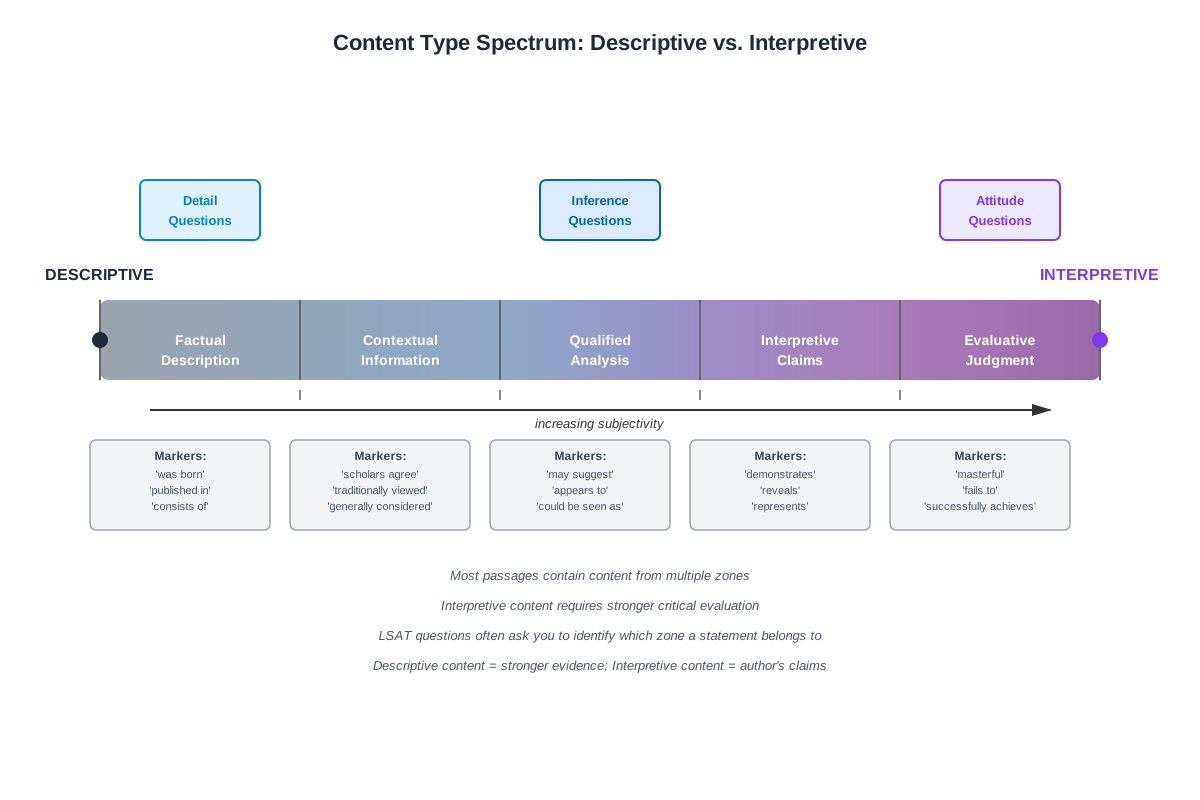
- [ ] Distinguish between descriptive and interpretive content within humanities passages
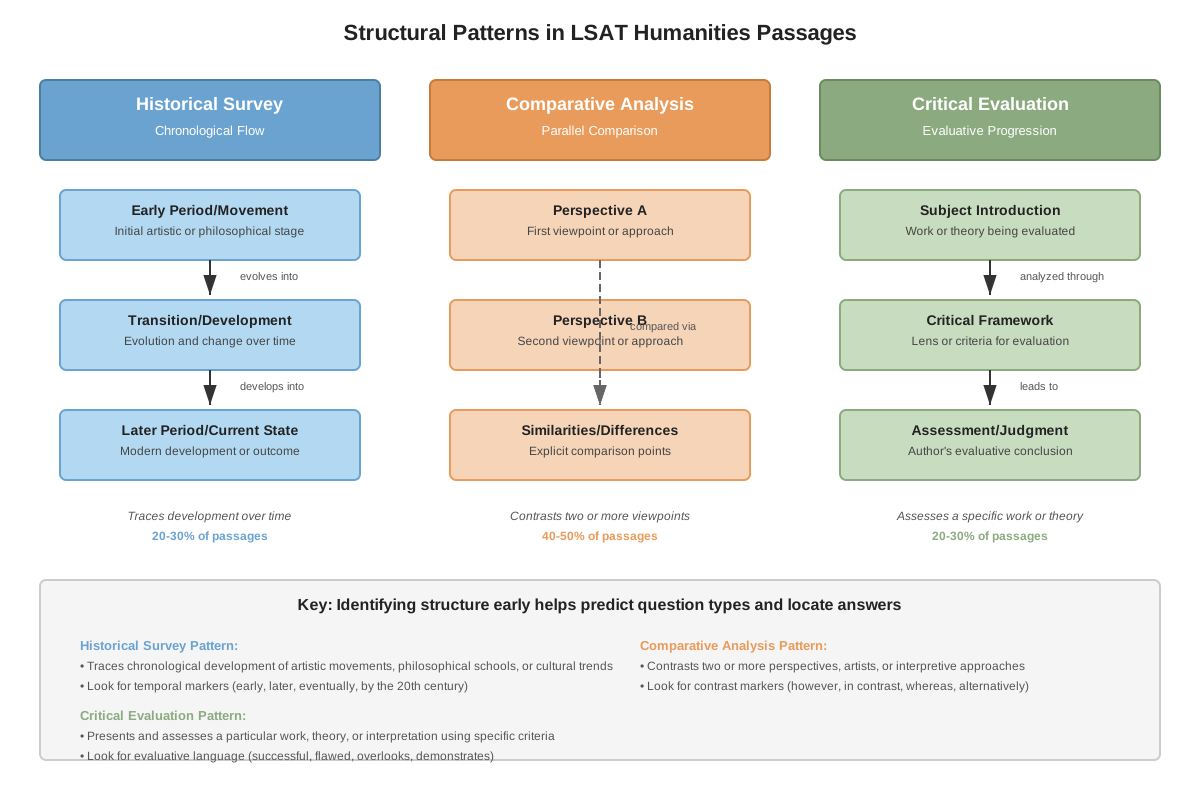
- [ ] Recognize common structural patterns in humanities passages (historical surveys, comparative analyses, critical evaluations)
- [ ] Evaluate the strength of evidence used to support aesthetic or philosophical claims
- [ ] Identify authorial attitude and tone markers specific to humanities discourse
Prerequisites
- Basic passage reading skills: Understanding how to read for structure, main point, and supporting details forms the foundation for all passage types
- Argument identification: Recognizing premises, conclusions, and evidence is essential since humanities passages often present interpretive arguments
- Vocabulary comprehension: Humanities passages frequently use specialized terminology from art, philosophy, and literary criticism
- Comparative reasoning: Many humanities passages compare different perspectives, requiring the ability to track multiple viewpoints simultaneously
Why This Topic Matters
Humanities passages test critical thinking skills that extend far beyond the LSAT itself. The ability to comprehend and evaluate interpretive arguments, understand how evidence supports subjective claims, and navigate competing perspectives applies directly to legal reasoning. Attorneys regularly encounter situations where they must interpret texts (statutes, contracts, precedents), evaluate competing interpretations, and build arguments based on qualitative evidence. The analytical skills developed through mastering humanities passages—particularly the ability to distinguish between fact and interpretation, recognize implicit assumptions, and evaluate the coherence of complex arguments—translate directly to law school case analysis and legal practice.
On the LSAT, humanities passages appear with remarkable consistency. Statistical analysis of recent LSATs shows that approximately 1 in 4 reading comprehension passages comes from the humanities domain. These passages generate questions across all major question types: main point, purpose, detail, inference, application, strengthen/weaken, and parallel reasoning. Humanities passages are particularly likely to feature questions about authorial attitude, tone, and purpose, as well as questions requiring students to apply critical frameworks discussed in the passage to new scenarios. The comparative reading format—where two shorter passages are presented together—frequently uses humanities content, requiring students to identify points of agreement, disagreement, and relationship between two perspectives on an artistic or philosophical topic.
Common manifestations of humanities passages on the LSAT include: analyses of specific artists or artistic movements (examining how a painter's work evolved or how a literary movement challenged previous conventions); explorations of philosophical concepts or debates (discussing different approaches to aesthetics or ethics); examinations of cultural phenomena through critical lenses (analyzing how architecture reflects social values); and discussions of interpretive methodologies (comparing different approaches to literary criticism or art historical analysis). These passages often feature a tension between traditional and revisionist perspectives, making the ability to track competing viewpoints essential for success.
Core Concepts
Characteristics of Humanities Passages
Humanities passages on the LSAT share several defining characteristics that distinguish them from passages in other domains. First, they typically center on interpretive claims rather than empirical findings. While a science passage might present experimental results that can be verified through replication, a humanities passage presents an interpretation of a text, artwork, or cultural phenomenon that can be supported with evidence but not definitively proven. This fundamental difference affects how arguments are constructed and how evidence functions within the passage.
Second, humanities passages frequently employ evaluative language that reveals the author's or a critic's judgment about aesthetic merit, cultural significance, or philosophical importance. Words like "masterful," "innovative," "derivative," "profound," or "superficial" signal evaluative content that students must recognize and track. Third, these passages often situate specific works or ideas within broader historical or cultural contexts, requiring readers to understand both the particular subject being discussed and its relationship to larger movements or traditions.
Common Structural Patterns
Understanding the typical organizational structures of humanities passages enables more efficient reading and better prediction of where key information will appear. The most common patterns include:
Historical Survey Structure: The passage traces the development of an artistic movement, philosophical school, or cultural phenomenon over time. These passages typically begin with earlier manifestations or influences, progress through key developments or turning points, and conclude with later innovations or contemporary perspectives. Questions on these passages often test understanding of chronological relationships and the evolution of ideas.
Comparative Analysis Structure: The passage examines two or more perspectives, approaches, or works, highlighting similarities and differences. This structure might compare traditional versus revisionist interpretations, contrast different artistic styles, or evaluate competing philosophical positions. The LSAT frequently uses this structure for comparative reading passages, where two shorter texts present different viewpoints on a shared topic.
Critical Evaluation Structure: The passage presents a critical assessment of a particular work, artist, or movement, typically advancing a specific interpretive claim supported by textual or contextual evidence. These passages often begin by introducing the subject and its conventional understanding, then present a new or alternative interpretation, and finally support this interpretation with detailed analysis.
Problem-Solution Structure: Less common but still significant, this pattern presents a challenge or question in humanities scholarship (such as how to interpret an ambiguous text or explain an apparent contradiction in an artist's work) and then explores one or more proposed solutions or interpretations.
Reasoning Patterns in Humanities Passages
The reasoning pattern behind humanities passages differs significantly from scientific or legal reasoning. Humanities arguments typically rely on several distinctive forms of support:
Textual Evidence: When discussing literature, philosophy, or written works, passages cite specific passages, phrases, or structural elements as evidence for interpretive claims. Students must understand how these textual details support broader interpretive arguments.
Contextual Evidence: Arguments about artistic or cultural significance often draw on historical context, biographical information about creators, or cultural circumstances surrounding a work's creation or reception. This evidence type requires understanding how external factors illuminate the meaning or importance of creative works.
Comparative Evidence: Humanities arguments frequently support claims by comparing the subject to other works, movements, or ideas. For example, a passage might argue that a novelist's technique was innovative by contrasting it with the conventions of earlier writers.
Theoretical Frameworks: Many humanities passages apply critical or theoretical lenses (feminist criticism, formalist analysis, postcolonial theory) to interpret works or phenomena. Understanding how these frameworks function as interpretive tools is essential for comprehending the passage's argument.
Evidence Evaluation in Humanities Contexts
A critical skill for humanities passages involves recognizing how evidence functions differently than in scientific contexts. In humanities passages, evidence typically supports interpretations rather than proving facts. Multiple interpretations of the same work can coexist, each supported by different evidence or emphasizing different aspects of the work. The LSAT tests whether students can:
- Distinguish between evidence that directly supports a claim versus evidence that is merely consistent with it
- Recognize when an interpretation goes beyond what the evidence can support
- Identify gaps or weaknesses in interpretive arguments
- Evaluate whether alternative interpretations might be equally well-supported
Authorial Attitude and Tone
Humanities passages frequently require students to identify the author's attitude toward the subject matter or toward competing interpretations. Unlike neutral scientific reporting, humanities writing often reveals the author's evaluative stance through word choice, emphasis, and argumentative structure. Key indicators include:
- Evaluative adjectives and adverbs (surprisingly, unfortunately, masterfully, merely)
- Contrast markers that signal the author's preference (however, in fact, actually)
- Rhetorical questions that imply criticism or support
- Qualification language that indicates reservations (somewhat, partially, arguably)
Concept Relationships
The concepts within humanities passages form an interconnected system where understanding one element enhances comprehension of others. The structural patterns (historical survey, comparative analysis, critical evaluation) determine how reasoning patterns will be deployed throughout the passage. For example, a comparative analysis structure naturally employs comparative evidence and requires tracking multiple perspectives simultaneously, while a critical evaluation structure emphasizes textual and contextual evidence supporting a specific interpretive claim.
Evidence evaluation skills build directly on understanding reasoning patterns—once students recognize that humanities arguments rely on interpretive rather than empirical evidence, they can better assess whether the evidence adequately supports the claims being made. Similarly, identifying authorial attitude and tone depends on recognizing the evaluative language and argumentative moves characteristic of humanities discourse.
These humanities-specific concepts connect to broader passage fundamentals in several ways. The skill of identifying main point and purpose, developed across all passage types, becomes more nuanced in humanities passages where the main point often involves an interpretive claim rather than a factual assertion. The ability to track paragraph structure and function, another fundamental skill, proves especially important in humanities passages where paragraphs often shift between description (of a work or movement) and interpretation (of its significance or meaning).
The relationship map flows as follows: Passage Fundamentals (structure, main point, purpose) → Humanities Passage Characteristics (interpretive focus, evaluative language) → Structural Patterns (historical, comparative, evaluative) → Reasoning Patterns (textual, contextual, comparative evidence) → Evidence Evaluation (assessing support for interpretive claims) → Question Application (using these insights to answer LSAT questions accurately).
High-Yield Facts
⭐ Humanities passages comprise approximately 20-25% of all LSAT reading comprehension passages, making them a high-frequency topic that appears on virtually every test administration.
⭐ The primary distinction between humanities passages and other passage types is their focus on interpretive claims rather than empirical findings, requiring different evidence evaluation strategies.
⭐ Comparative analysis is the most common structure for comparative reading passages in the humanities domain, requiring students to track agreements, disagreements, and relationships between two perspectives.
⭐ Questions about authorial attitude and tone appear more frequently with humanities passages than with any other passage type, making tone recognition a critical skill.
⭐ Evidence in humanities passages typically supports interpretations rather than proving facts, meaning multiple well-supported interpretations of the same work can coexist.
- Humanities passages frequently employ specialized vocabulary from art history, literary criticism, philosophy, and cultural studies that may be unfamiliar to students without backgrounds in these fields.
- Historical survey structures in humanities passages often include temporal markers (initially, subsequently, by the late period, contemporary) that signal chronological progression and help organize information.
- The LSAT uses humanities passages to test the ability to distinguish between what a passage states explicitly versus what it implies or suggests about a work's meaning or significance.
- Evaluative language in humanities passages (masterful, derivative, innovative, conventional) reveals critical judgments that often become the focus of inference and attitude questions.
- Humanities passages commonly present a traditional view or conventional interpretation before introducing a revisionist or alternative perspective, creating a contrast that generates multiple question opportunities.
- Questions asking students to apply a critical framework or interpretive approach discussed in the passage to a new scenario appear more frequently with humanities passages than with other passage types.
Quick check — test yourself on Humanities passages so far.
Try Flashcards →Common Misconceptions
Misconception: Humanities passages are purely subjective, so any interpretation is equally valid and questions have no definitively correct answers.
Correction: While humanities passages deal with interpretive content, LSAT questions always have one best answer that is most strongly supported by the passage text. The key is distinguishing between what the passage actually states or implies versus what might be true in general. Correct answers must be grounded in specific textual evidence, even when dealing with interpretive claims.
Misconception: Background knowledge in art, literature, or philosophy is necessary to answer questions about humanities passages correctly.
Correction: The LSAT is designed so that all information needed to answer questions is contained within the passage itself. While familiarity with humanities discourse may make reading more comfortable, questions can be answered correctly using only the passage content. In fact, relying on outside knowledge often leads to incorrect answers that reflect general truth but aren't supported by the specific passage.
Misconception: Descriptive content in humanities passages (biographical information, historical context, descriptions of artworks) is less important than interpretive content and can be skimmed quickly.
Correction: Descriptive content often provides essential evidence for interpretive claims made later in the passage. Understanding how contextual details support interpretive arguments is frequently tested. Moreover, detail questions may ask about specific descriptive information, making careful reading of these sections important.
Misconception: When a humanities passage presents multiple perspectives, the author's view is always the one presented last or most extensively.
Correction: The author's perspective must be determined through careful attention to tone markers, evaluative language, and argumentative structure rather than position or length. Sometimes authors present opposing views extensively in order to critique them. Identifying phrases like "however," "in fact," or "more accurately" helps reveal the author's actual position.
Misconception: Humanities passages are easier than science passages because they don't involve technical concepts or complex data.
Correction: Humanities passages present their own challenges, including abstract concepts, nuanced arguments, multiple competing interpretations, and subtle distinctions between similar positions. Many students find humanities passages more difficult because the reasoning patterns are less familiar and the language more evaluative and subjective. Success requires developing specific strategies for humanities content rather than assuming these passages are inherently easier.
Worked Examples
Example 1: Critical Evaluation Passage
Passage Excerpt: "Traditional interpretations of Vermeer's domestic interior paintings have emphasized their serene, timeless quality, viewing them as straightforward celebrations of Dutch bourgeois life. However, recent scholarship has revealed a more complex picture. Art historian Svetlana Alpers argues that Vermeer's paintings actually engage critically with contemporary debates about vision, knowledge, and representation. The seemingly simple domestic scenes, Alpers contends, are sophisticated meditations on the nature of seeing itself. Consider 'Woman Holding a Balance': while earlier critics saw merely a peaceful domestic moment, Alpers identifies the painting's careful juxtaposition of the woman's scales with the Last Judgment painting behind her as a deliberate commentary on the relationship between earthly and divine judgment, between material and spiritual weighing."
Question: The passage suggests that traditional interpretations of Vermeer's work differ from Alpers's interpretation primarily in their:
A) Assessment of Vermeer's technical skill as a painter
B) Understanding of the paintings' thematic complexity
C) Evaluation of Vermeer's influence on later artists
D) Analysis of Vermeer's use of light and color
E) Interpretation of the historical context of Dutch painting
Worked Solution:
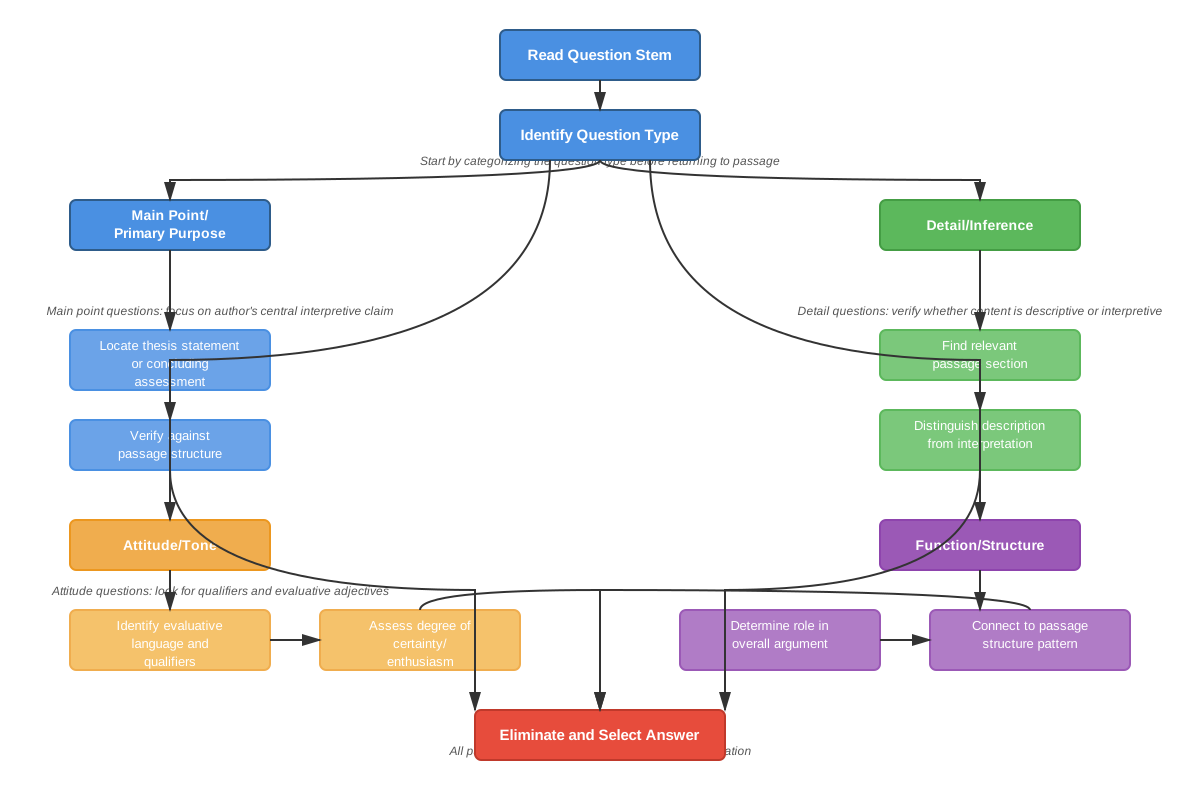
Step 1: Identify what the question asks. This is a comparative question requiring understanding of how two interpretations differ.
Step 2: Locate relevant passage content. The first two sentences establish the traditional view (serene, timeless, straightforward celebrations), while the subsequent sentences present Alpers's view (complex, critical engagement with debates, sophisticated meditations).
Step 3: Identify the key difference. Traditional interpretations saw the paintings as "straightforward" and simple, while Alpers sees them as "complex" and "sophisticated meditations." The difference centers on whether the paintings have deeper thematic layers beyond surface appearances.
Step 4: Evaluate answer choices:
- (A) Technical skill isn't discussed for either interpretation—eliminate
- (B) Matches the identified difference: traditional views saw straightforward content, Alpers sees complex themes—strong candidate
- (C) Influence on later artists isn't mentioned—eliminate
- (D) Light and color techniques aren't discussed—eliminate
- (E) Both interpretations involve historical context; this isn't the primary difference—eliminate
Answer: B
This question demonstrates how humanities passages test the ability to distinguish between competing interpretations and identify the specific dimension along which they differ. The correct answer requires recognizing that "straightforward" versus "complex" and "sophisticated meditations" represents a difference in perceived thematic complexity.
Example 2: Historical Survey with Application
Passage Excerpt: "The development of jazz criticism in the 1930s and 1940s reflected broader tensions between populist and elitist approaches to art. Early jazz critics like Hugues Panassié championed a purist approach, arguing that only traditional New Orleans-style jazz represented authentic expression, while dismissing swing and bebop as commercial corruptions. In contrast, critics such as Leonard Feather embraced jazz's evolution, viewing innovation and experimentation as essential to the music's vitality. Feather argued that attempts to freeze jazz in a particular historical moment contradicted the improvisational spirit that defined the genre. This debate paralleled similar controversies in other art forms, where traditionalists resisted modernist innovations while progressives celebrated formal experimentation."
Question: Based on the passage, Leonard Feather would most likely respond to a contemporary critic who dismisses current jazz fusion as a betrayal of jazz traditions by:
A) Agreeing that fusion dilutes jazz's essential characteristics
B) Arguing that resistance to innovation contradicts jazz's fundamental nature
C) Suggesting that fusion should be evaluated by different critical standards than traditional jazz
D) Claiming that commercial success indicates artistic authenticity
E) Recommending a return to New Orleans-style jazz as the authentic form
Worked Solution:
Step 1: Identify the question type. This is an application question requiring us to predict how Feather would respond to a new scenario based on his views described in the passage.
Step 2: Extract Feather's key positions from the passage:
- Embraced jazz's evolution
- Viewed innovation and experimentation as essential to jazz's vitality
- Argued that freezing jazz in a particular moment contradicts its improvisational spirit
Step 3: Analyze the scenario. A contemporary critic dismissing fusion as betraying traditions mirrors Panassié's position (dismissing new developments as corruptions of authentic jazz).
Step 4: Predict Feather's response. Based on his views, he would likely defend fusion by arguing that innovation is essential to jazz and that resisting it contradicts the genre's nature.
Step 5: Evaluate answer choices:
- (A) Contradicts Feather's embrace of evolution—eliminate
- (B) Directly aligns with Feather's argument that freezing jazz contradicts its improvisational spirit—strong candidate
- (C) Different standards aren't mentioned in Feather's approach—eliminate
- (D) Feather's argument was about innovation, not commercial success—eliminate
- (E) Contradicts Feather's position; this reflects Panassié's view—eliminate
Answer: B
This example demonstrates how humanities passages test the ability to apply critical frameworks or perspectives to new scenarios. Success requires accurately extracting a critic's core principles and recognizing how they would apply to analogous situations, even when the specific subject (fusion) wasn't mentioned in the passage.
Exam Strategy
When approaching humanities passages on the LSAT, employ a strategic reading process that accounts for their distinctive characteristics. Begin by identifying the passage type and structure within the first paragraph. Look for signals indicating whether the passage will present a historical survey (temporal markers like "initially," "by the 1920s," "contemporary"), a comparative analysis (contrast markers like "while," "in contrast," "alternatively"), or a critical evaluation (phrases like "traditional interpretations," "however, recent scholarship," "a more accurate view").
Trigger words and phrases that signal important content in humanities passages include:
- Evaluative language: "masterful," "innovative," "derivative," "profound," "superficial," "groundbreaking," "conventional"—these reveal critical judgments that often become question fodder
- Contrast markers: "however," "in contrast," "alternatively," "on the other hand"—these signal shifts between competing interpretations or perspectives
- Evidence introduction: "consider," "for example," "as evidenced by," "this is apparent in"—these introduce specific support for interpretive claims
- Qualification language: "somewhat," "partially," "to some extent," "arguably"—these indicate nuanced positions and authorial reservations
- Temporal markers in historical surveys: "initially," "subsequently," "by the late period," "contemporary"—these organize chronological development
Process-of-elimination strategies specific to humanities passages:
- Eliminate answers that confuse description with interpretation. Wrong answers often treat the author's interpretive claims as if they were factual descriptions, or vice versa.
- Eliminate answers that are too extreme for the passage's nuanced argument. Humanities passages rarely make absolute claims; watch for wrong answers containing "only," "never," "always," or "completely" that go beyond the passage's qualified language.
- For attitude/tone questions, eliminate answers that are too neutral if the passage contains evaluative language, or too extreme if the passage is measured and balanced.
- For application questions, eliminate answers that contradict the core principles of the critical framework or perspective being applied, even if they might be true in general.
Time allocation advice: Humanities passages typically require 3-4 minutes for initial reading and 5-6 minutes for questions, totaling 8-10 minutes per passage. Don't rush the initial reading—understanding the argumentative structure and authorial attitude during the first read saves time on questions. For comparative reading passages with humanities content, allocate slightly more time (9-11 minutes total) because tracking two perspectives requires additional attention.
Pay special attention to the relationship between descriptive and interpretive content. When the passage describes a work, movement, or historical context, immediately ask: "How does this description support the interpretive claim being made?" This active reading approach helps you understand the argumentative structure and prepares you for inference and reasoning questions.
Memory Techniques
CITE - Remember the four main types of evidence in humanities passages:
- Contextual (historical, biographical, cultural circumstances)
- Interpretive frameworks (critical theories, analytical lenses)
- Textual (specific passages, phrases, structural elements)
- Examples (comparative references to other works or movements)
SHADE - Remember what to track for authorial attitude:
- Superlatives and evaluative adjectives
- However and other contrast markers
- Adverbs that qualify or intensify
- Dismissive or endorsing language
- Emphasis through repetition or elaboration
Historical Survey Visualization: Picture a timeline with three zones—early (origins/influences), middle (development/key innovations), late (contemporary/legacy). As you read, mentally place information in the appropriate zone. This spatial organization helps you answer chronology questions and understand how ideas evolved.
Comparative Analysis Visualization: Draw a mental T-chart with two columns representing the competing perspectives. As you read, place each claim, piece of evidence, or characteristic in the appropriate column. This visual organization helps you track similarities and differences and prepares you for comparison questions.
The "So What?" Technique: After reading descriptive content (biographical details, historical context, descriptions of works), immediately ask "So what? Why is the author telling me this?" This forces you to connect description to interpretation and understand how evidence supports claims.
Summary
Humanities passages on the LSAT test the ability to comprehend and evaluate interpretive arguments about art, literature, philosophy, and culture. These passages differ from scientific passages in their focus on subjective interpretation rather than empirical findings, their use of evaluative language revealing critical judgments, and their reliance on textual, contextual, and comparative evidence to support claims. Success with humanities passages requires recognizing common structural patterns (historical surveys, comparative analyses, critical evaluations), understanding how evidence functions differently in interpretive contexts, and identifying authorial attitude through tone markers and evaluative language. The most effective approach involves active reading that distinguishes description from interpretation, tracks competing perspectives when present, and connects evidence to the interpretive claims it supports. Questions on humanities passages frequently test understanding of authorial purpose and attitude, the ability to apply critical frameworks to new scenarios, and skill in evaluating the strength of evidence for interpretive arguments. Mastering humanities passages requires developing specialized strategies for handling subjective content while remembering that LSAT questions always have one best answer firmly grounded in the passage text.
Key Takeaways
- Humanities passages focus on interpretive claims about art, literature, philosophy, and culture, requiring different reading strategies than empirical passages
- The three most common structural patterns—historical survey, comparative analysis, and critical evaluation—each generate predictable question types and require specific tracking strategies
- Evidence in humanities passages supports interpretations rather than proving facts, making evidence evaluation skills essential for distinguishing strong from weak support
- Authorial attitude and tone questions appear more frequently with humanities passages, making recognition of evaluative language and contrast markers critical
- Success requires distinguishing between descriptive content (facts about works, artists, or movements) and interpretive content (claims about meaning or significance)
- All information needed to answer questions is contained in the passage; outside knowledge of humanities subjects is unnecessary and can lead to wrong answers
- Active reading that connects evidence to interpretive claims and tracks competing perspectives when present is more effective than passive reading for humanities content
Related Topics
Comparative Reading Passages: Humanities content frequently appears in the comparative reading format, where two shorter passages present different perspectives on a shared topic. Mastering humanities passages provides the foundation for tracking agreements, disagreements, and relationships between paired texts.
Author's Purpose and Attitude Questions: These question types appear across all passage types but are especially common with humanities passages. Understanding how to identify authorial stance in humanities contexts builds skills applicable to all reading comprehension questions about purpose and tone.
Inference Questions in Interpretive Contexts: Drawing valid inferences from humanities passages requires understanding how interpretive claims relate to evidence. Mastering this skill in humanities passages strengthens inference abilities across all passage types.
Evidence Evaluation Across Passage Types: While humanities passages use distinctive evidence types, the fundamental skill of assessing whether evidence adequately supports claims applies to all LSAT reading comprehension passages and connects directly to logical reasoning questions.
Practice CTA
Now that you've mastered the core concepts of humanities passages, it's time to apply these strategies to actual LSAT-style questions. The practice questions and flashcards will reinforce your understanding of structural patterns, evidence evaluation, and authorial attitude recognition. Each practice question you complete strengthens your ability to navigate interpretive arguments efficiently and accurately. Remember: humanities passages appear on virtually every LSAT, making this practice time a high-yield investment in your score. Approach each practice passage actively, tracking structure and evidence as you read, and review both correct and incorrect answers to understand the reasoning patterns the LSAT rewards. Your ability to master humanities passages will not only boost your reading comprehension score but also develop critical thinking skills essential for law school success.
Sign up free to keep reading
Create a free AnvayaPrep account to finish this LSAT guide on Humanities passages — plus flashcards and practice questions.