Overview
Legal theory passages represent one of the four major passage types that appear consistently on the LSAT reading comprehension section, alongside natural science, social science, and humanities passages. These passages explore fundamental questions about the nature, purpose, and application of law itself—examining topics such as judicial interpretation, the relationship between law and morality, theories of punishment, legal reasoning methodologies, and debates about constitutional interpretation. Unlike passages that simply describe legal cases or statutes, legal theory passages engage with abstract philosophical questions about what law is, how it should function, and what principles should guide legal decision-making.
Understanding lsat legal theory passages is essential for LSAT success because they consistently appear on every administration of the exam and often prove challenging for test-takers unfamiliar with legal reasoning patterns. These passages require students to navigate dense argumentation, distinguish between competing theoretical frameworks, and identify the logical structure underlying complex legal debates. The LSAT uses legal theory passages to assess skills critical for law school success: the ability to comprehend sophisticated arguments, recognize assumptions and implications, understand how evidence supports conclusions, and evaluate competing viewpoints with precision.
Within the broader context of passage fundamentals, legal theory passages share structural elements with other passage types—including main point identification, author's purpose, and logical structure—but they also present unique challenges. They frequently employ specialized vocabulary from jurisprudence and philosophy, present multiple competing viewpoints that must be carefully distinguished, and require readers to track abstract arguments that may lack concrete examples. Mastering these passages builds foundational skills that transfer to analyzing all LSAT reading comprehension passages while preparing students for the type of theoretical reasoning they will encounter throughout law school.
Learning Objectives
- [ ] Identify how legal theory passages appear in LSAT questions
- [ ] Explain the reasoning pattern behind legal theory passages
- [ ] Apply legal theory passages to solve LSAT-style problems accurately
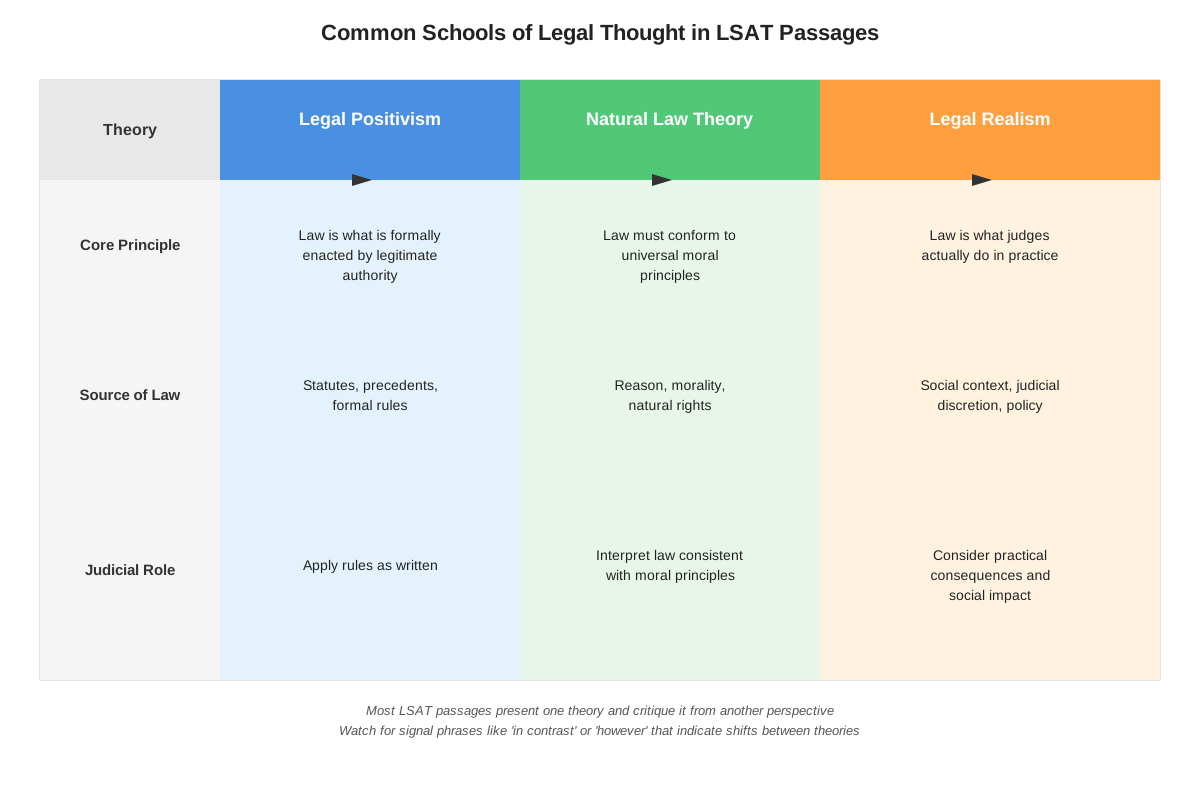
- [ ] Distinguish between different schools of legal thought presented in passages (e.g., legal positivism vs. natural law theory)
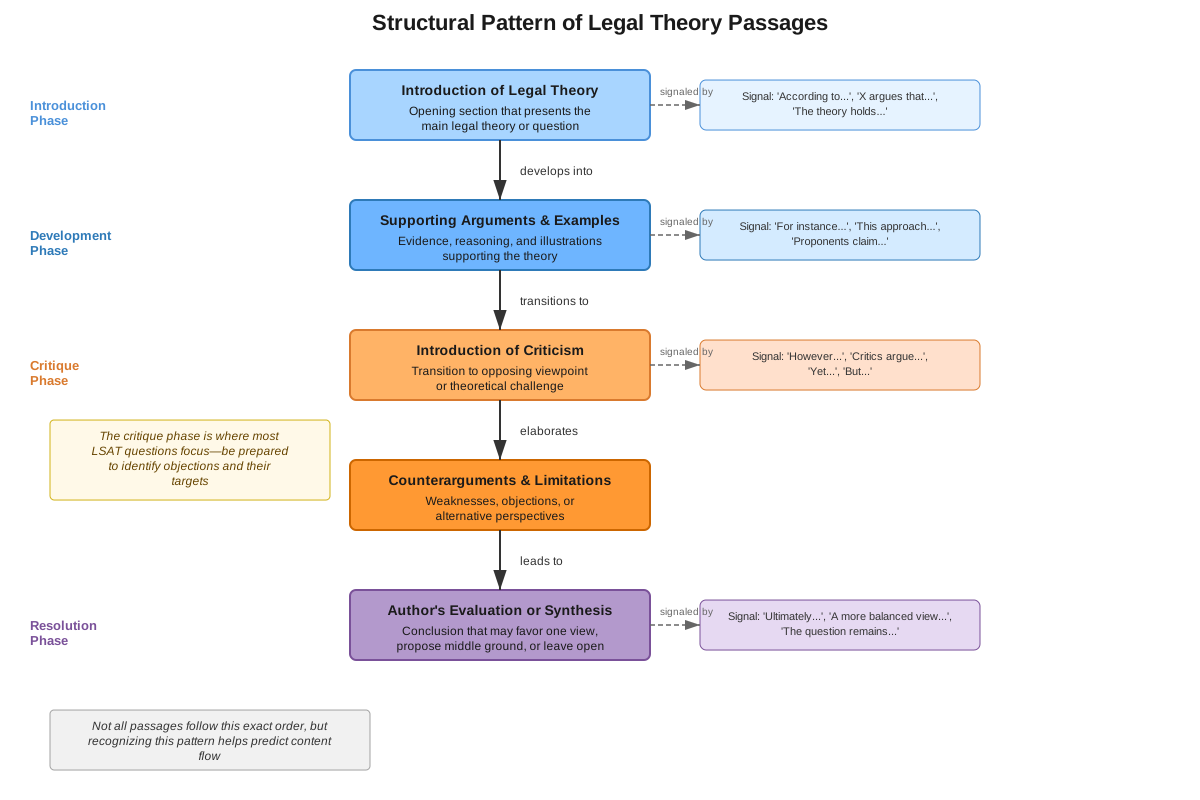
- [ ] Recognize the structural markers that signal shifts between presenting a theory, critiquing it, and proposing alternatives
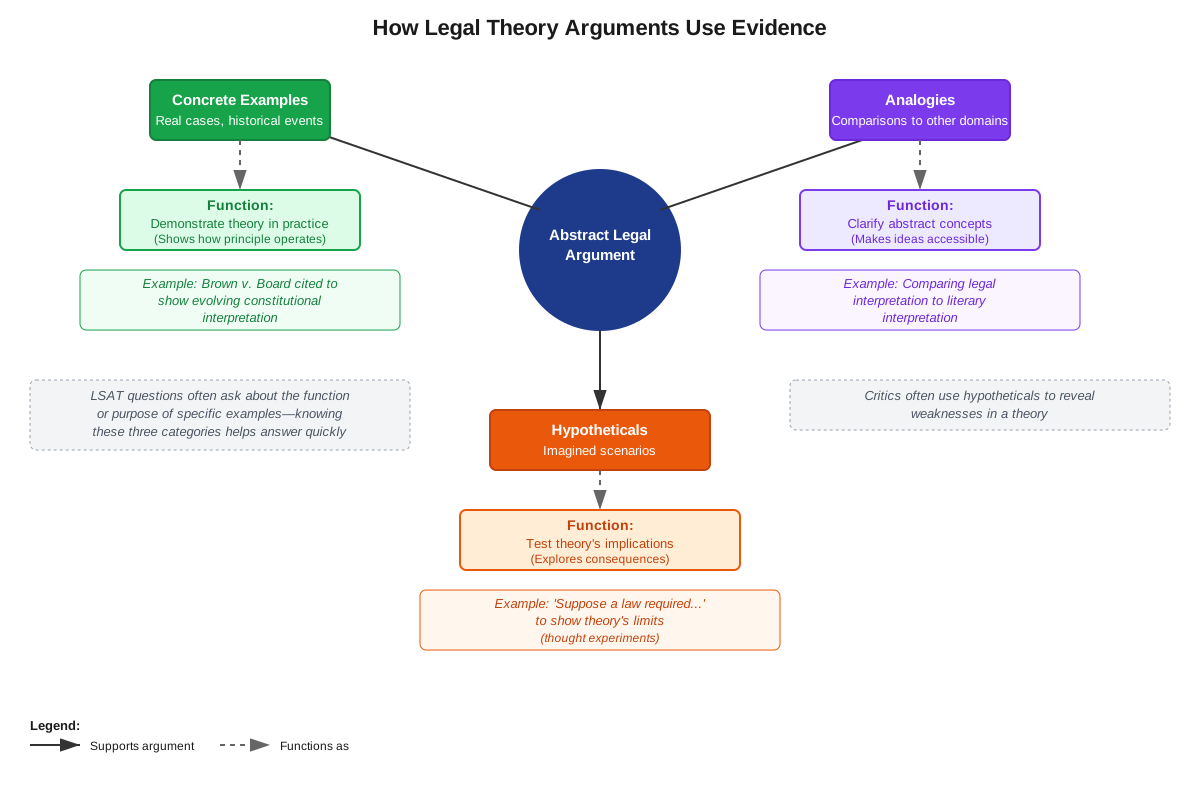
- [ ] Evaluate how authors use examples, analogies, and hypotheticals to support abstract legal arguments
Prerequisites
- Basic reading comprehension skills: Ability to identify main ideas, supporting details, and organizational structure in academic prose—essential for processing the dense argumentation in legal theory passages
- Logical reasoning fundamentals: Understanding of how premises support conclusions, recognition of assumptions, and ability to identify logical flaws—necessary for tracking the argumentative structure of theoretical debates
- Familiarity with LSAT question types: Knowledge of common question formats (main point, inference, function, strengthen/weaken)—required to apply passage understanding to specific questions
- Academic vocabulary: Comfort with college-level terminology and abstract concepts—important because legal theory passages employ sophisticated language from philosophy and jurisprudence
Why This Topic Matters
Legal theory passages hold profound real-world significance because they explore the foundational questions that shape legal systems and judicial decision-making. When judges interpret constitutional provisions, legislators craft new statutes, or lawyers argue novel cases, they implicitly or explicitly rely on theories about law's nature and purpose. Understanding competing legal theories—such as originalism versus living constitutionalism in constitutional interpretation, or retributive versus rehabilitative theories of punishment—provides insight into contemporary legal debates about issues ranging from criminal justice reform to civil rights protections.
On the LSAT, legal theory passages appear with remarkable consistency. Approximately 25% of all reading comprehension passages fall into the legal theory category, meaning students can expect to encounter at least one such passage on test day, and sometimes two. These passages generate questions across all major question types: main point questions that test comprehension of the passage's central argument, inference questions requiring students to extend the author's reasoning, function questions asking why the author included specific details, and comparative reasoning questions (especially in paired passages) that require synthesizing multiple theoretical perspectives.
Common manifestations of legal theory passages include: debates about judicial interpretation methodologies (textualism, purposivism, originalism); discussions of the relationship between law and morality; examinations of legal reasoning and precedent; analyses of specific legal concepts like rights, justice, or legal obligation; critiques of existing legal frameworks; and proposals for legal reform grounded in theoretical principles. These passages may present a single theorist's argument, contrast two competing schools of thought, trace the historical development of a legal concept, or evaluate the strengths and weaknesses of a particular theoretical approach.
Core Concepts
Structure of Legal Theory Passages
Legal theory passages typically follow one of several organizational patterns that students must recognize to navigate them efficiently. The single-theory exposition pattern presents one legal theorist's or school's perspective, explaining its core principles, supporting arguments, and implications. The comparative framework pattern contrasts two or more theoretical approaches, often highlighting their different assumptions, methodologies, or conclusions. The critique-and-response pattern introduces a dominant theory, presents objections to it, and may propose modifications or alternatives. The historical development pattern traces how legal thinking about a particular concept has evolved over time.
Regardless of organizational pattern, these passages share common structural elements. They typically begin by establishing context—identifying the legal question or problem that motivates theoretical inquiry. The body develops the theoretical argument through a combination of abstract principles, logical reasoning, and illustrative examples or hypotheticals. Passages frequently employ counterfactuals (hypothetical scenarios used to test theoretical principles) and analogies (comparisons to other domains that illuminate legal concepts). The conclusion often addresses implications, applications, or remaining questions.
Common Theoretical Frameworks
Understanding the major schools of legal thought helps students anticipate arguments and recognize distinctions. Legal positivism holds that law consists of rules created by human authorities and that legal validity is separate from moral validity—a law can be legally valid even if morally objectionable. Natural law theory contends that law must meet certain moral standards to be genuinely valid and that unjust laws lack true legal authority. Legal realism emphasizes that law in practice reflects judges' policy preferences, social context, and practical consequences rather than mechanical rule application.
Originalism in constitutional interpretation argues that constitutional provisions should be understood according to their original public meaning at the time of ratification. Living constitutionalism maintains that constitutional interpretation should evolve with changing social values and circumstances. Textualism focuses on the plain meaning of statutory language, while purposivism considers legislative intent and statutory purpose. These frameworks appear repeatedly in LSAT passages, and recognizing them helps students quickly grasp the passage's argumentative landscape.
Argumentative Techniques in Legal Theory
Legal theorists employ distinctive argumentative strategies that LSAT passages reflect. Conceptual analysis involves carefully defining and distinguishing concepts—for example, differentiating between "legal rights" and "moral rights" or between "interpretation" and "construction." Thought experiments present hypothetical scenarios designed to test theoretical principles: "If a statute clearly requires an unjust outcome, should judges apply it faithfully or find ways to avoid it?" Normative arguments make claims about what law should be or how judges ought to decide cases, often grounded in values like justice, fairness, or democratic legitimacy.
Descriptive arguments characterize how legal systems actually function, while prescriptive arguments recommend changes or reforms. Passages frequently move between these modes, and students must track which type of claim the author is making. Internal critiques challenge a theory on its own terms, showing that it fails by its own standards, while external critiques attack a theory's fundamental assumptions or values. Recognizing these argumentative moves helps students answer function questions and evaluate the logical structure of passages.
Relationship Between Theory and Practice
Legal theory passages often explore the connection between abstract principles and concrete legal outcomes. A passage might present a theoretical framework and then examine how it would resolve specific cases or controversies. Alternatively, a passage might begin with puzzling legal outcomes and propose a theory to explain or justify them. This theory-practice dialectic is central to legal reasoning and frequently generates LSAT questions.
Students must distinguish between descriptive claims about how courts do decide cases and normative claims about how courts should decide cases. A passage might argue that judges claim to follow one methodology (textualism) but actually employ another (purposivism), or that a particular theory better explains judicial behavior than judges' own stated rationales. These distinctions are crucial for answering inference and application questions accurately.
Key Vocabulary and Concepts
Legal theory passages employ specialized terminology that students should recognize. Jurisprudence refers to the philosophy or theory of law. Precedent (or stare decisis) is the principle that courts should follow earlier decisions on similar issues. Statutory interpretation involves determining the meaning and application of legislative enactments. Judicial discretion refers to judges' freedom to choose among legally permissible outcomes. Legal formalism suggests that legal reasoning proceeds through logical deduction from established rules, while legal instrumentalism views law as a tool for achieving social goals.
Rights-based theories ground legal analysis in individual rights, while consequentialist theories focus on outcomes and social welfare. Procedural justice concerns the fairness of legal processes, while substantive justice addresses the fairness of outcomes. Legitimacy refers to law's moral or political authority to command obedience. Familiarity with these concepts enables students to process passages more efficiently and recognize the theoretical commitments underlying arguments.
Concept Relationships
The concepts within legal theory passages form an interconnected web of relationships. Theoretical frameworks (positivism, natural law, realism) → provide foundational assumptions about law's nature → which shape interpretive methodologies (originalism, textualism, purposivism) → which determine approaches to specific legal questions → which generate practical outcomes in cases and controversies. Understanding this progression helps students trace arguments from abstract principles to concrete applications.
The relationship between descriptive and normative claims runs throughout legal theory passages. Descriptive accounts of how legal systems function often motivate normative proposals for reform: "Because judges actually consider policy consequences despite claiming to apply rules mechanically (descriptive), we should acknowledge this reality and develop better frameworks for policy reasoning (normative)." Conversely, normative theories may be evaluated by their descriptive accuracy: "This theory claims to explain judicial behavior, but it fails to account for these observed patterns."
Internal and external critiques relate differently to the theories they challenge. Internal critiques accept a theory's premises but show that its conclusions don't follow or that it generates contradictions. External critiques reject the theory's fundamental assumptions, offering alternative starting points. Passages often present both types of critique, and students must distinguish them to answer questions about the logical structure of arguments.
The concepts connect to prerequisite knowledge in important ways. Logical reasoning fundamentals → enable recognition of argumentative structure in legal theory passages → which supports identification of assumptions and evaluation of evidence → which are tested through standard LSAT question types. Similarly, basic reading comprehension skills → facilitate tracking multiple viewpoints → which is essential for comparative passages and questions requiring synthesis of competing theories.
High-Yield Facts
⭐ Legal theory passages appear on approximately 25% of LSAT reading comprehension sections, making them one of the four major passage types alongside natural science, social science, and humanities passages.
⭐ The most common organizational pattern contrasts two competing theoretical frameworks, requiring students to distinguish their assumptions, methodologies, and conclusions precisely.
⭐ Authors of legal theory passages frequently use hypothetical scenarios (thought experiments) to test theoretical principles, and questions often ask about the function or implications of these hypotheticals.
⭐ Distinguishing between descriptive claims (how law is) and normative claims (how law should be) is essential for answering inference and application questions accurately.
⭐ Legal theory passages typically employ more abstract reasoning and less concrete evidence than natural or social science passages, requiring students to track logical relationships between concepts rather than empirical data.
- Legal positivism and natural law theory represent fundamentally opposed views about the relationship between law and morality, a distinction that appears repeatedly in LSAT passages.
- Originalism and living constitutionalism offer competing approaches to constitutional interpretation, each with different implications for how courts should resolve contemporary controversies.
- The distinction between interpretation (determining meaning) and application (deciding how meaning applies to specific cases) is conceptually important in many legal theory passages.
- Legal realism challenges legal formalism by emphasizing that judicial decisions reflect policy preferences and social context rather than mechanical rule application.
- Questions about legal theory passages frequently test understanding of the author's purpose, the function of specific paragraphs or examples, and the logical relationship between different parts of the argument.
- Comparative reading passages (paired passages) often present competing legal theories, requiring students to synthesize and contrast the two perspectives.
- Legal theory passages may discuss the concept of legal legitimacy—what gives law the authority to command obedience—connecting to broader philosophical questions about political obligation.
Quick check — test yourself on Legal theory passages so far.
Try Flashcards →Common Misconceptions
Misconception: Legal theory passages are only about abstract philosophy with no practical relevance. → Correction: Legal theory passages consistently connect abstract principles to concrete legal outcomes, showing how theoretical commitments shape judicial decisions, statutory interpretation, and legal reform. Questions frequently test understanding of these practical implications.
Misconception: Students need prior knowledge of law or legal terminology to succeed on legal theory passages. → Correction: The LSAT is designed to be accessible to students without legal training. All necessary information appears in the passage itself, and questions test reading comprehension and logical reasoning rather than outside legal knowledge. Specialized terms are either defined in context or can be understood through careful reading.
Misconception: The author's view is always explicitly stated in legal theory passages. → Correction: Authors may present multiple perspectives without clearly endorsing one, may subtly signal their position through word choice and emphasis, or may critique all presented theories while suggesting the need for alternatives. Students must carefully track textual evidence to determine the author's stance.
Misconception: Legal theory passages present objective facts that can be memorized. → Correction: These passages present arguments, interpretations, and theoretical frameworks that are contested and debatable. The LSAT tests comprehension of the specific arguments made in the passage, not general knowledge about legal theory. Students must focus on what this particular passage claims, not what they might know from other sources.
Misconception: Longer, more complex sentences in legal theory passages can be skimmed over. → Correction: Dense, complex sentences often contain crucial distinctions, qualifications, or logical relationships that generate questions. Students should slow down for complex sentences, breaking them into components and identifying the logical connections between clauses.
Misconception: Examples and hypotheticals in legal theory passages are less important than abstract principles. → Correction: Examples and hypotheticals serve specific argumentative functions—illustrating principles, testing theories, or revealing limitations. Questions frequently ask about the purpose or implications of these concrete elements, making them high-yield content.
Worked Examples
Example 1: Single-Theory Exposition with Application
Passage Summary: A passage presents Professor Martinez's theory that judicial interpretation should focus exclusively on statutory text rather than legislative intent. Martinez argues that legislative intent is often unclear, that legislators may have conflicting intentions, and that focusing on text promotes democratic accountability by requiring legislators to express their intentions clearly in statutory language. The passage then discusses how Martinez's approach would resolve a case involving an environmental statute.
Question: According to the passage, Martinez would most likely agree with which of the following statements about statutory interpretation?
Answer Choices:
(A) Judges should consider legislative history when statutory text is ambiguous
(B) Democratic accountability requires judges to enforce statutes as written
(C) Legislative intent should guide interpretation when it conflicts with statutory text
(D) Statutory interpretation should promote the best policy outcomes
(E) Judges should defer to administrative agencies' interpretations of statutes
Worked Solution:
Step 1: Identify Martinez's core principle from the passage—interpretation should focus exclusively on statutory text, not legislative intent.
Step 2: Identify Martinez's justification—focusing on text promotes democratic accountability by requiring clear legislative drafting.
Step 3: Evaluate each answer choice against Martinez's stated position:
(A) Eliminate: Martinez argues against considering legislative history; this directly contradicts his textualist approach.
(B) Strong candidate: This connects Martinez's textualist methodology to his stated justification (democratic accountability), using language consistent with the passage.
(C) Eliminate: Martinez explicitly rejects prioritizing legislative intent over statutory text.
(D) Eliminate: The passage doesn't indicate Martinez supports policy-based interpretation; his focus is on textual meaning.
(E) Eliminate: The passage doesn't discuss administrative deference; this introduces an issue not addressed in Martinez's theory.
Step 4: Confirm (B) by connecting it to passage content. The passage states Martinez believes "focusing on text promotes democratic accountability by requiring legislators to express their intentions clearly in statutory language." Choice (B) captures this reasoning: democratic accountability requires enforcing statutes as written (the text), which pressures legislators to draft clearly.
Answer: (B)
Connection to Learning Objectives: This example demonstrates how to identify the reasoning pattern behind legal theory passages (a textualist methodology grounded in democratic accountability) and apply that understanding to solve LSAT-style problems by eliminating choices inconsistent with the theory's core commitments.
Example 2: Comparative Framework with Critique
Passage Summary: A passage contrasts two theories of punishment. Retributivism holds that punishment is justified when it gives offenders what they deserve based on their wrongdoing; the severity of punishment should be proportional to the seriousness of the crime. Consequentialism holds that punishment is justified only when it produces good outcomes, such as deterring future crime or protecting society. The passage notes that retributivism faces the challenge of explaining why society has the right to punish, while consequentialism faces the challenge that it might justify punishing innocent people if doing so would deter crime effectively.
Question: The passage suggests that consequentialist theories of punishment are vulnerable to which of the following objections?
Answer Choices:
(A) They cannot explain why punishment should be proportional to the crime
(B) They fail to account for the deterrent effect of punishment
(C) They might permit punishment of individuals who have committed no wrong
(D) They cannot justify any form of criminal punishment
(E) They rely on an implausible account of moral desert
Worked Solution:
Step 1: Locate the passage's discussion of challenges facing consequentialism: "consequentialism faces the challenge that it might justify punishing innocent people if doing so would deter crime effectively."
Step 2: Understand the logic of this objection. Consequentialism justifies punishment by its good outcomes (deterrence, public safety). If punishing an innocent person would produce these outcomes (perhaps by making an example that deters others), consequentialism seems committed to permitting this punishment—a troubling implication.
Step 3: Evaluate answer choices:
(A) Eliminate: Proportionality is a retributivist concern (punishment matching desert), not a consequentialist one. The passage doesn't present this as a challenge to consequentialism.
(B) Eliminate: This is backwards—consequentialism emphasizes deterrence as a justification for punishment, so it clearly accounts for deterrent effects.
(C) Strong candidate: This directly captures the objection stated in the passage—consequentialism "might justify punishing innocent people" (individuals who have committed no wrong).
(D) Eliminate: Too extreme. The passage doesn't suggest consequentialism cannot justify any punishment, only that it might justify problematic punishments.
(E) Eliminate: Moral desert is a retributivist concept. The passage presents this as a challenge to retributivism (explaining the right to punish based on desert), not to consequentialism.
Step 4: Confirm (C) matches the passage's explicit statement about consequentialism's vulnerability.
Answer: (C)
Connection to Learning Objectives: This example shows how to distinguish between different schools of legal thought (retributivism vs. consequentialism), identify the specific challenges each faces, and apply this understanding to answer questions about theoretical vulnerabilities—all while avoiding the trap of confusing which objection applies to which theory.
Exam Strategy
When approaching legal theory passages on the LSAT, begin by identifying the passage's organizational structure in the first reading. Ask: Is this presenting a single theory, contrasting multiple theories, critiquing an existing approach, or tracing historical development? Recognizing the structure helps predict where key information will appear and how questions will test comprehension.
Trigger words and phrases signal important theoretical moves. Watch for: "argues that," "contends," "maintains" (introducing a theorist's position); "however," "but," "yet," "nevertheless" (signaling contrasts or objections); "for example," "consider," "suppose" (introducing illustrative cases or hypotheticals); "therefore," "thus," "consequently" (marking conclusions); "assumes," "presupposes," "takes for granted" (identifying underlying assumptions). These markers help track the logical flow of arguments.
Create a mental map of competing positions as you read. For passages contrasting theories, note each theory's core principle, supporting arguments, and implications. Use the passage margins to mark where each theory is discussed. This preparation enables quick reference when questions ask about specific theoretical commitments or differences between approaches.
For function questions asking why the author included a particular example or paragraph, consider how that element serves the passage's overall argument. Does it illustrate an abstract principle? Test a theory's implications? Present an objection? Provide evidence for a claim? The answer will connect the specific element to the passage's broader argumentative structure.
Apply process of elimination strategically. Eliminate choices that: (1) confuse which theory holds which position; (2) make claims too extreme for the passage's measured language; (3) introduce issues the passage doesn't address; (4) contradict explicit passage statements; (5) confuse descriptive and normative claims. Often, eliminating three clearly wrong answers leaves a choice between two plausible options, requiring careful comparison to passage language.
Time allocation for legal theory passages should mirror other passage types: approximately 3-4 minutes for the initial reading, 5-6 minutes for questions. Don't get bogged down in dense theoretical language during the first reading; focus on grasping the overall structure and main arguments. You can return to specific sentences when questions require detailed analysis.
For comparative passages presenting two legal theories, read both passages before attempting questions. Note areas of agreement and disagreement, and pay special attention to questions asking about relationships between the passages. These questions test synthesis skills and often require recognizing that passages address the same issue from different theoretical perspectives.
Memory Techniques
Use the acronym PLAN to remember major schools of legal thought: Positivism (law as human-created rules), Legal realism (law as judicial policy-making), Anti-formalism (rejecting mechanical rule application), Natural law (law must meet moral standards). This covers the most frequently appearing theoretical frameworks.
For constitutional interpretation approaches, remember OL-TP: Originalism (original meaning), Living constitutionalism (evolving interpretation), Textualism (plain language), Purposivism (legislative intent). These four approaches appear repeatedly in LSAT passages about statutory and constitutional interpretation.
Visualize legal theory passages as conversations or debates between theorists. Imagine each theory as a person making an argument, with others responding, critiquing, or offering alternatives. This personification makes abstract arguments more concrete and memorable, helping track which position holds which view.
Create a mental checklist for passage analysis: (1) What question motivates this theoretical inquiry? (2) What answer(s) does the passage present? (3) What arguments support each answer? (4) What objections or limitations are noted? (5) What implications or applications are discussed? Running through this checklist during your first reading ensures comprehensive understanding.
For remembering the distinction between descriptive and normative claims, associate "descriptive" with "describes what IS" and "normative" with "norms about what SHOULD BE." This simple association prevents confusion when passages move between characterizing existing legal practice and proposing reforms.
Summary
Legal theory passages constitute a high-yield component of LSAT reading comprehension, appearing consistently on every test administration and requiring students to navigate sophisticated arguments about law's nature, purpose, and application. These passages employ distinctive organizational patterns—including single-theory exposition, comparative frameworks, and critique-and-response structures—and draw on major schools of legal thought such as legal positivism, natural law theory, legal realism, originalism, and living constitutionalism. Success requires recognizing these theoretical frameworks, tracking the logical structure of abstract arguments, distinguishing between descriptive and normative claims, and understanding how authors use examples and hypotheticals to support theoretical principles. Students must avoid common misconceptions, particularly the false belief that prior legal knowledge is necessary or that abstract passages lack practical relevance. By mastering the argumentative techniques characteristic of legal theory—conceptual analysis, thought experiments, internal and external critiques—students develop skills that transfer to all LSAT reading comprehension passages while preparing for the theoretical reasoning central to legal education.
Key Takeaways
- Legal theory passages appear on approximately 25% of LSAT reading comprehension sections and test the ability to comprehend sophisticated arguments about law's nature and application
- The most common organizational pattern contrasts competing theoretical frameworks, requiring precise distinction between their assumptions, methodologies, and implications
- Major schools of legal thought—positivism, natural law, legal realism, originalism, and living constitutionalism—appear repeatedly and should be recognized quickly
- Distinguishing between descriptive claims (how law is) and normative claims (how law should be) is essential for answering inference and application questions accurately
- Examples, hypotheticals, and thought experiments serve specific argumentative functions and frequently generate questions about their purpose or implications
- Success requires tracking the logical structure of abstract arguments, identifying assumptions and objections, and connecting theoretical principles to practical applications
- Strategic reading focuses on identifying passage structure, marking competing positions, and noting trigger words that signal important theoretical moves
Related Topics
Natural Science Passages: While legal theory passages emphasize abstract argumentation and normative claims, natural science passages focus on empirical evidence and descriptive accounts of phenomena. Mastering legal theory passages builds skills in tracking complex arguments that transfer to understanding scientific debates and theoretical disputes in natural science passages.
Comparative Reading Passages: Legal theory content frequently appears in paired passages that present competing theoretical perspectives. Success with single legal theory passages provides the foundation for synthesizing and contrasting the more complex comparative passages.
Logical Reasoning Arguments: The argumentative techniques in legal theory passages—identifying assumptions, recognizing objections, evaluating evidence—mirror the skills tested in Logical Reasoning sections. Mastery of legal theory passage analysis strengthens performance on Logical Reasoning questions involving legal or philosophical content.
Law School Casebook Reading: Legal theory passages provide excellent preparation for the theoretical discussions that frame cases in law school casebooks. The ability to distinguish competing interpretive methodologies and evaluate normative arguments transfers directly to first-year legal education.
Practice CTA
Now that you've mastered the fundamentals of legal theory passages, it's time to apply this knowledge through deliberate practice. Attempt the practice questions associated with this topic, focusing on implementing the strategies and recognizing the patterns discussed in this guide. Use the flashcards to reinforce key concepts, theoretical frameworks, and vocabulary. Remember that legal theory passages, while challenging, become manageable through systematic analysis and repeated exposure. Each passage you work through builds pattern recognition and strengthens your ability to navigate abstract argumentation—skills that will serve you not only on test day but throughout your legal education. Approach practice with confidence, knowing that you now possess a comprehensive framework for tackling one of the LSAT's most sophisticated passage types.
Sign up free to keep reading
Create a free AnvayaPrep account to finish this LSAT guide on Legal theory passages — plus flashcards and practice questions.