Overview
Science passages represent one of the four major passage types that appear consistently on the LSAT reading comprehension section, alongside humanities, social sciences, and law passages. These passages typically explore topics from the natural sciences—including physics, biology, chemistry, astronomy, and earth sciences—and present scientific theories, research findings, experimental methodologies, or debates within scientific communities. Unlike science courses that test factual recall, LSAT science passages assess a student's ability to comprehend complex arguments, understand the structure of scientific reasoning, and evaluate evidence-based claims without requiring any specialized scientific knowledge.
The LSAT deliberately selects science passages that are accessible to all test-takers regardless of their academic background. The exam tests reading comprehension skills—not scientific expertise. Students must extract the author's main point, understand how evidence supports conclusions, recognize the passage structure, and identify the logical relationships between different parts of the argument. Science passages often feature distinctive characteristics: they may present competing theories, describe experimental procedures and their implications, explain natural phenomena through causal mechanisms, or trace the historical development of scientific understanding.
Mastering science passages is crucial for LSAT success because they appear in every administration of the exam and often challenge students who lack confidence with scientific material. These passages serve as an excellent testing ground for fundamental passage fundamentals skills—identifying main ideas, understanding paragraph functions, recognizing author's tone and purpose, and making valid inferences. The analytical skills developed through science passage practice directly transfer to other passage types and strengthen overall reading comprehension performance, making this topic essential for achieving a competitive LSAT score.
Learning Objectives
- [ ] Identify how Science passages appears in LSAT questions
- [ ] Explain the reasoning pattern behind Science passages
- [ ] Apply Science passages to solve LSAT-style problems accurately
- [ ] Recognize the common structural patterns that organize science passages
- [ ] Distinguish between descriptive science passages and those presenting scientific debates
- [ ] Evaluate the strength of evidence presented in support of scientific claims
- [ ] Identify the author's attitude toward competing scientific theories or methodologies
Prerequisites
- Basic reading comprehension skills: The ability to identify main ideas, supporting details, and paragraph structure forms the foundation for tackling any LSAT passage type.
- Understanding of argument structure: Recognizing premises, conclusions, and how evidence supports claims is essential since science passages frequently present evidence-based reasoning.
- Familiarity with LSAT question types: Knowledge of main point, inference, function, and detail questions enables efficient application of science passage comprehension skills.
- Active reading strategies: The ability to annotate, track passage structure, and maintain focus while reading dense material ensures effective engagement with complex scientific content.
Why This Topic Matters
Science passages hold significant weight on the LSAT, appearing in approximately 25% of reading comprehension passages—meaning students can expect to encounter at least one science passage on test day, and sometimes two. These passages frequently generate questions that test critical reasoning skills at a sophisticated level, making them high-value targets for score improvement. The LSAT uses science passages to assess whether students can handle complex, technical material—a skill directly relevant to legal education, where students must quickly master unfamiliar subject matter in various legal specialties.
In legal practice, attorneys regularly encounter scientific evidence in cases involving medical malpractice, environmental law, patent disputes, forensic evidence, and product liability. The ability to comprehend scientific arguments, evaluate methodological soundness, and identify logical flaws in scientific reasoning translates directly to professional competencies lawyers need. LSAT science passages simulate this real-world demand by requiring students to engage with technical material critically rather than passively.
Common manifestations of science passages on the LSAT include: explanations of natural phenomena (how earthquakes occur, why certain species evolved specific traits), presentations of competing scientific theories (different explanations for mass extinctions, debates about cosmological models), descriptions of experimental research and its implications (studies revealing unexpected findings about animal cognition, experiments challenging established assumptions), and discussions of scientific methodology (critiques of research approaches, explanations of how scientific consensus develops). These passages may also address the history of scientific discovery, the relationship between observation and theory, or the limitations of scientific knowledge.
Core Concepts
Structure of Science Passages
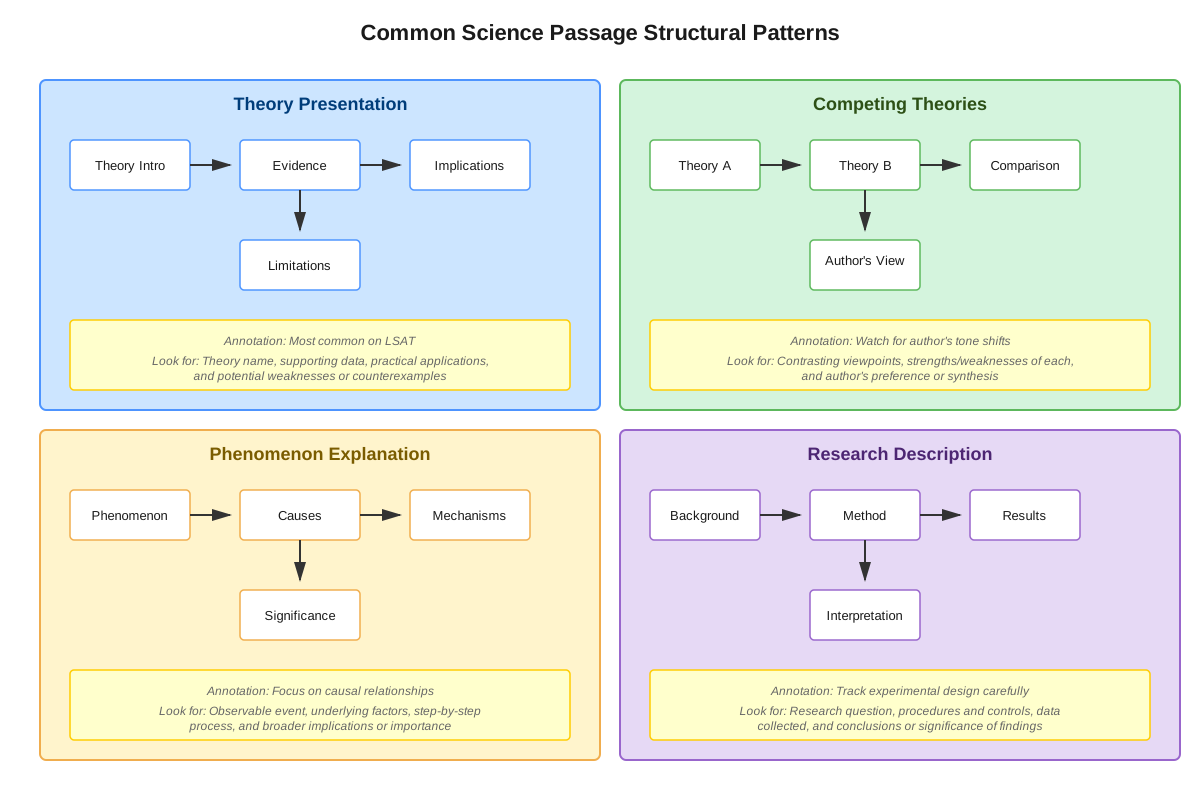
Science passages on the LSAT follow predictable organizational patterns that, once recognized, significantly enhance comprehension efficiency. The most common structure presents a scientific phenomenon or question in the opening paragraph, followed by one or more explanatory theories or research findings, and concludes with implications, limitations, or remaining questions. Understanding this architecture allows students to anticipate where key information will appear and how different paragraphs function within the overall argument.
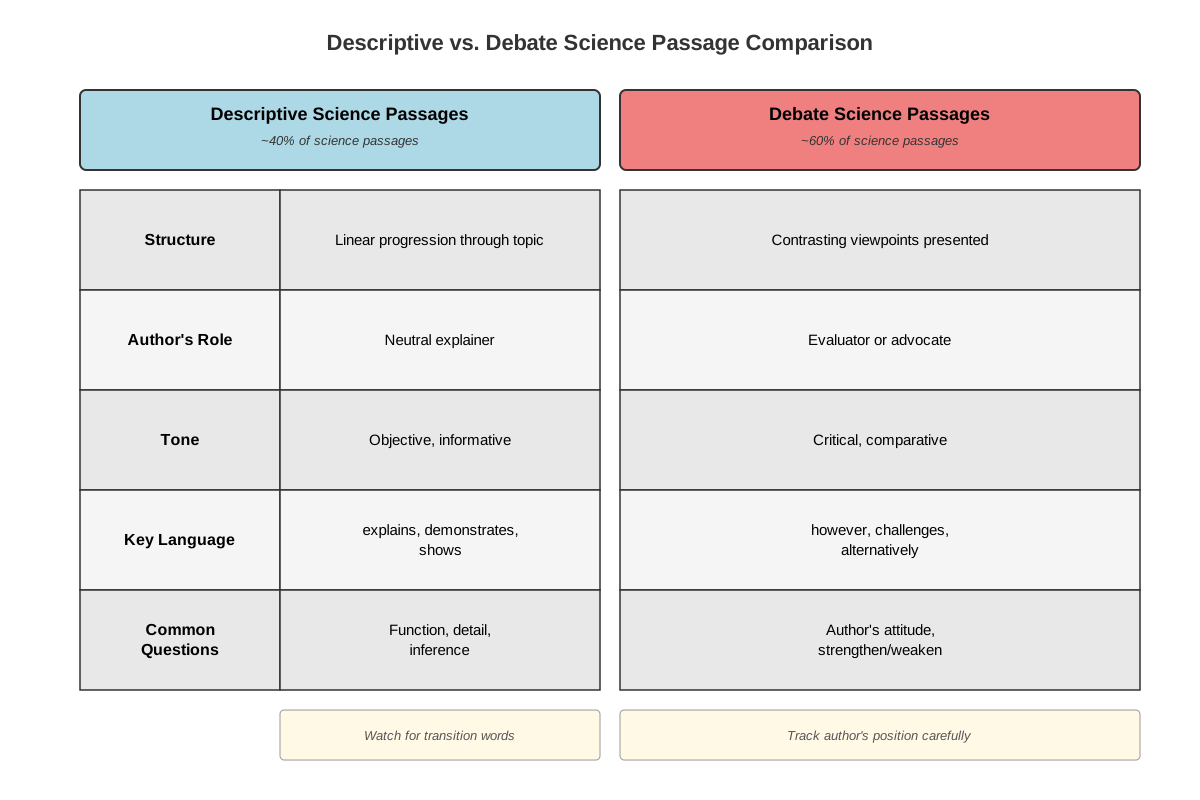
A second frequent structure presents competing theories or viewpoints within the scientific community. These passages typically introduce a traditional or established view, present a challenge or alternative perspective, provide evidence supporting the new view, and may conclude with the author's assessment or note areas requiring further research. Recognizing this debate structure helps students track which evidence supports which position—a critical skill for answering questions about the passage's argumentation.
Descriptive science passages, another common type, systematically explain how something works or why something occurs. These passages move logically through causal chains, mechanisms, or processes. They may describe the stages of a geological process, explain the biochemical pathway of a cellular function, or detail the physical principles underlying a natural phenomenon. The key to comprehending these passages lies in tracking the logical progression and understanding how each step connects to the next.
Scientific Reasoning Patterns
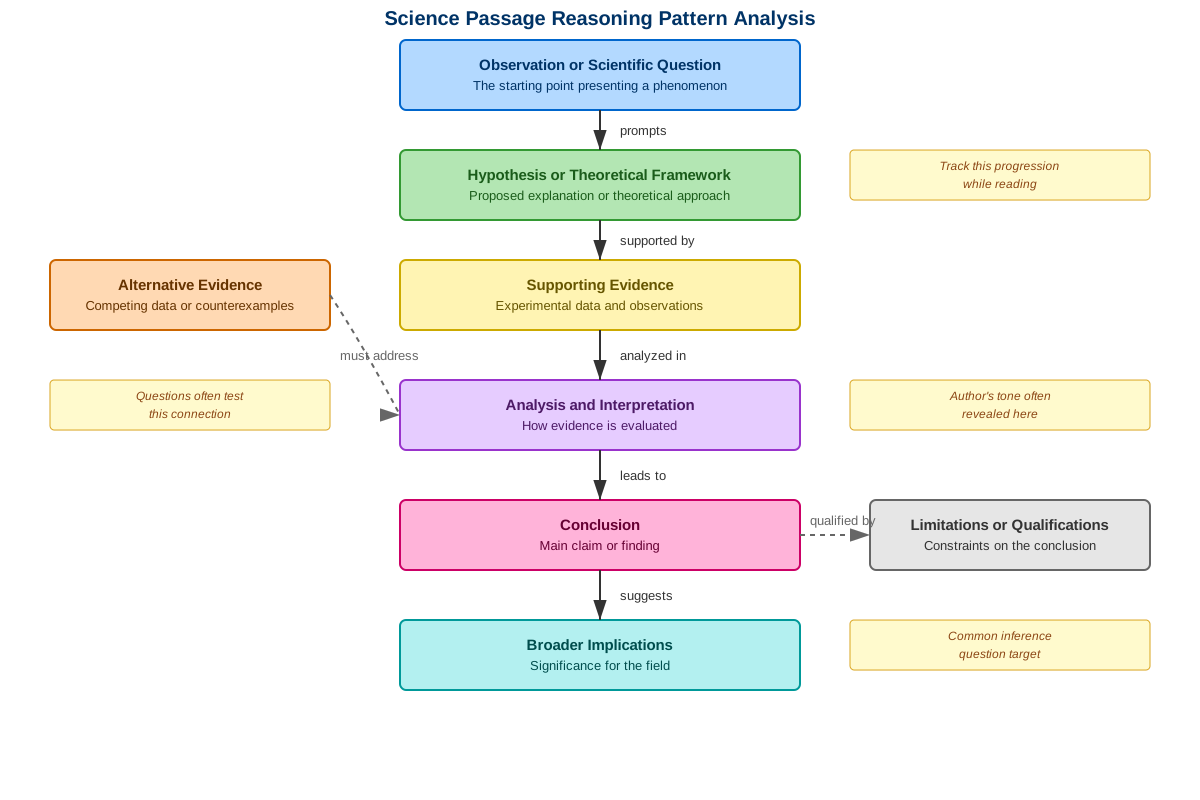
Science passages employ distinctive reasoning patterns that differ from other passage types. Hypothesis-evidence reasoning forms the backbone of many science passages: a theory or hypothesis is proposed, and evidence is marshaled to support or challenge it. Students must identify what claim is being made and evaluate whether the evidence genuinely supports that claim. The LSAT frequently tests whether students can distinguish between evidence that strongly supports a conclusion versus evidence that merely suggests a possibility.
Causal reasoning appears prominently in science passages, where authors explain why phenomena occur or what factors produce specific outcomes. Students must recognize causal claims and understand the difference between correlation and causation. The LSAT often includes questions that test whether students can identify what would strengthen or weaken a causal argument, or what alternative explanations might account for observed phenomena.
Comparative reasoning structures passages that contrast different theories, methodologies, or findings. These passages require students to track multiple viewpoints simultaneously and understand the specific points of agreement and disagreement. Questions may ask students to identify what distinguishes one theory from another, what evidence would favor one explanation over alternatives, or how different researchers would respond to new findings.
Technical Vocabulary and Jargon
Science passages inevitably contain specialized terminology, but the LSAT carefully ensures that all necessary terms are either defined within the passage or comprehensible from context. Students should never panic when encountering unfamiliar scientific vocabulary. Instead, they should look for contextual clues that reveal the term's meaning or function within the argument. Often, the precise technical definition matters less than understanding the term's role in the passage's logical structure.
When passages define technical terms, these definitions frequently become the subject of test questions. Students should mark or note definitions as they read, recognizing them as high-yield content. The LSAT may ask students to identify what a term means, apply the definition to a new scenario, or recognize when something does or does not fit the defined category.
Author's Tone and Purpose
Unlike some humanities passages where authors express strong opinions, science passages typically maintain a more neutral, explanatory tone. However, subtle indicators of the author's attitude appear throughout: qualifying language ("may suggest," "appears to indicate"), evaluative terms ("surprisingly," "unfortunately," "elegantly"), and the relative emphasis given to different viewpoints. Recognizing these tonal markers helps students answer questions about the author's attitude, purpose, or likely response to new information.
The author's purpose in science passages generally falls into several categories: explaining a phenomenon, presenting a debate within the scientific community, describing research findings and their significance, or critiquing a scientific approach or theory. Identifying the primary purpose early in the reading process provides a framework for understanding how individual paragraphs contribute to the overall goal.
Evidence and Support
Science passages present various types of evidence: experimental results, observational data, theoretical reasoning, analogies to better-understood phenomena, and expert consensus. Students must evaluate how effectively this evidence supports the claims being made. The LSAT frequently tests whether students can identify what type of evidence is being used, recognize gaps in the evidence, or determine what additional evidence would strengthen or weaken an argument.
Understanding the relationship between evidence and conclusion is paramount. Strong science passage readers constantly ask: What claim is this evidence supposed to support? Does it actually support that claim? What assumptions connect the evidence to the conclusion? Are there alternative explanations for the evidence? These critical reading habits enable students to answer the most challenging inference and reasoning questions.
Concept Relationships
The concepts within science passages form an interconnected web of relationships. The structure of science passages determines where specific reasoning patterns will appear: debate-structured passages naturally feature comparative reasoning, while descriptive passages emphasize causal reasoning. Understanding passage structure enables students to anticipate what reasoning patterns they'll encounter and where key information will be located.
Technical vocabulary serves as the building blocks for scientific reasoning patterns—students cannot follow hypothesis-evidence reasoning or causal arguments without comprehending the key terms involved. However, the relationship flows both ways: understanding the reasoning pattern helps students infer the meaning of unfamiliar vocabulary from context.
The author's tone and purpose shapes how evidence and support are presented. An author explaining a phenomenon will present evidence straightforwardly to build understanding, while an author critiquing a theory will highlight weaknesses in the evidence or reasoning. Recognizing the author's purpose helps students evaluate why certain evidence is included and what role it plays in the overall argument.
This relationship map illustrates the connections:
Passage Structure → determines organization of → Reasoning Patterns → expressed through → Technical Vocabulary → supports → Evidence and Support → reveals → Author's Tone and Purpose → guides interpretation of → Passage Structure
These concepts also connect to broader passage fundamentals: identifying main ideas requires understanding passage structure, making valid inferences depends on recognizing reasoning patterns, and answering function questions necessitates understanding how evidence supports claims. Mastery of science passages strengthens these fundamental skills, which then transfer to all other passage types.
High-Yield Facts
- ⭐ Science passages appear in approximately 25% of LSAT reading comprehension sections, guaranteeing at least one science passage per test
- ⭐ No specialized scientific knowledge is required or tested—all necessary information appears within the passage
- ⭐ Science passages commonly present competing theories, with questions testing the ability to distinguish between viewpoints and their supporting evidence
- ⭐ Technical terms are always defined in the passage or comprehensible from context; definitions frequently become question topics
- ⭐ The author's tone in science passages is typically neutral or explanatory, though subtle evaluative language reveals attitudes toward theories or findings
- Causal reasoning appears more frequently in science passages than in other passage types, making it essential to distinguish causation from correlation
- Experimental methodology and research findings often appear in science passages, with questions testing understanding of what the research demonstrates
- Science passages frequently conclude with limitations, remaining questions, or implications of the discussed theories or findings
- Questions about strengthening or weakening arguments appear more commonly with science passages than with other passage types
- The first paragraph of a science passage typically introduces the phenomenon, question, or debate that the passage will address
- Comparative structures in science passages require tracking which evidence supports which theory—a common source of wrong answer choices
- Science passages may describe historical development of scientific understanding, testing whether students can track how theories evolved
Quick check — test yourself on Science passages so far.
Try Flashcards →Common Misconceptions
Misconception: Science passages require background knowledge in the scientific field being discussed. → Correction: The LSAT is designed to be fair to all test-takers regardless of academic background. Every piece of information needed to answer questions appears within the passage itself. Students should rely exclusively on passage content, not outside knowledge, which may actually lead to incorrect answers if it contradicts passage information.
Misconception: Understanding every technical term is necessary for comprehension. → Correction: While important terms are defined or contextually clear, students often can answer questions correctly by understanding the term's function in the argument rather than its precise scientific meaning. Focus on how terms relate to the passage's reasoning structure rather than memorizing definitions.
Misconception: Science passages present objective facts that should be accepted as true. → Correction: Science passages often present theories, hypotheses, or competing explanations—not established facts. Students must recognize when the passage presents tentative conclusions, debated positions, or preliminary findings. The LSAT tests critical evaluation of scientific claims, not passive acceptance.
Misconception: The most complex or technical passage will be the hardest. → Correction: Passage difficulty depends more on reasoning complexity and question design than on technical vocabulary. A passage with simpler vocabulary but intricate argumentation may prove more challenging than one with technical terms but straightforward logic. Students should avoid prejudging difficulty based on subject matter.
Misconception: Science passages always favor newer theories over traditional ones. → Correction: The LSAT presents balanced discussions of scientific debates. Authors may support traditional views, favor new theories, or remain neutral. Students must carefully track textual evidence of the author's attitude rather than assuming newer equals better.
Misconception: Experimental results presented in science passages definitively prove the researchers' conclusions. → Correction: The LSAT frequently tests whether students recognize the limitations of evidence. Experimental results may suggest, support, or be consistent with a theory without proving it conclusively. Alternative explanations may exist, or the evidence may be limited in scope. Critical evaluation of evidence strength is essential.
Worked Examples
Example 1: Competing Theories Passage
Passage Summary: A science passage discusses two theories explaining why certain bird species migrate at night rather than during the day. The traditional theory holds that night migration helps birds avoid daytime predators. A newer theory suggests that night migration allows birds to use daytime hours for feeding, which is more efficient than feeding at night. The passage presents evidence that birds migrating at night show no difference in predation rates compared to day-migrating species, but do show significantly better energy efficiency. The author concludes that the feeding-efficiency theory better explains the phenomenon.
Question: The author's attitude toward the traditional predator-avoidance theory can best be described as:
Analysis Process:
- Identify what the question asks: Author's attitude toward a specific theory
- Locate relevant passage content: The passage presents evidence that "birds migrating at night show no difference in predation rates compared to day-migrating species"
- Evaluate the author's language: The author presents evidence contradicting the traditional theory and concludes that the alternative theory "better explains" the phenomenon
- Eliminate extreme answers: The author doesn't completely dismiss the traditional theory as absurd or impossible, but does favor the alternative
- Select the answer reflecting measured skepticism: The author is skeptical of the traditional theory based on evidence, but maintains a professional, measured tone
Correct Answer Type: Something like "respectfully skeptical" or "politely unconvinced"—showing the author questions the theory based on evidence while maintaining professional tone.
Connection to Learning Objectives: This example demonstrates how to identify the reasoning pattern (competing theories with evidence favoring one), recognize the author's attitude through textual evidence, and apply these skills to answer LSAT-style questions accurately.
Example 2: Causal Mechanism Passage
Passage Summary: A science passage explains how certain deep-sea fish produce light through bioluminescence. The passage describes the chemical reaction involving luciferin and luciferase enzymes, explains that this light production requires oxygen, and notes that the fish use this ability to attract prey in the dark ocean depths. The passage then discusses how scientists initially believed all bioluminescent fish produced their own light-generating chemicals, but recent research revealed that some species actually harbor symbiotic bacteria that produce the light.
Question: According to the passage, which of the following is necessary for bioluminescence to occur in deep-sea fish?
Analysis Process:
- Identify question type: This is a detail question asking what is necessary (required) for the phenomenon
- Locate relevant information: The passage states "this light production requires oxygen"
- Distinguish between necessary and sufficient conditions: The passage mentions luciferin, luciferase, and oxygen, but only oxygen is explicitly stated as required
- Avoid trap answers: Wrong answers might mention symbiotic bacteria (only some species use these) or prey attraction (this is the purpose, not a requirement for the chemical process)
- Verify the answer against passage language: The word "requires" in the passage directly indicates necessity
Correct Answer: Oxygen (or the presence of oxygen)
Connection to Learning Objectives: This example shows how to identify the reasoning pattern (causal mechanism explanation), extract specific details accurately, and distinguish between different types of relationships (necessary conditions, purposes, and characteristics that apply to only some cases).
Exam Strategy
Initial Reading Approach
When encountering a science passage, invest the first 30-45 seconds identifying the passage structure and main purpose before diving into details. Ask: Is this explaining a phenomenon, presenting a debate, or describing research findings? This structural awareness guides where to focus attention and what to expect in questions. Mark or mentally note the function of each paragraph—introduction of topic, presentation of theory A, evidence for theory B, author's conclusion, etc.
Trigger Words and Phrases
Watch for language indicating competing viewpoints: "traditionally," "however," "in contrast," "an alternative explanation," "recent research suggests," "challenges the assumption." These phrases signal that the passage presents multiple perspectives, making it crucial to track which evidence supports which view.
Identify qualifying language that reveals the strength of claims: "may indicate," "suggests," "demonstrates," "proves," "appears to," "definitively shows." The LSAT frequently tests whether students recognize the difference between tentative suggestions and strong conclusions.
Note causal language: "causes," "results in," "leads to," "produces," "is responsible for," "explains why." These phrases indicate causal reasoning, which often becomes the subject of strengthen/weaken questions or questions about alternative explanations.
Process of Elimination Tips
For science passages, eliminate answers that:
- Require outside knowledge: If an answer choice depends on scientific information not mentioned in the passage, it's wrong
- Confuse which theory holds which position: In debate-structured passages, wrong answers often attribute evidence or claims to the wrong viewpoint
- Overstate the evidence: If the passage says research "suggests" something, an answer saying it "proves" that thing is too strong
- Introduce new causal claims: Be suspicious of answers that claim causal relationships not established in the passage
- Misidentify the author's tone: Extreme language (completely dismissive, enthusiastically supportive) rarely matches the measured tone of science passages
Time Allocation
Science passages deserve the same time allocation as other passages—approximately 3.5 minutes for reading and 5-6 minutes for questions. However, if a science passage feels particularly dense or technical, resist the urge to reread extensively during the initial reading. Instead, get the main structure and purpose, then return to specific paragraphs when questions direct attention there. Most questions point to specific passage locations, making detailed initial memorization unnecessary.
Question-Specific Strategies
For main point questions on science passages, the correct answer typically captures both the phenomenon/debate discussed and the passage's conclusion or resolution. Wrong answers often focus on details from one paragraph rather than the overall point.
For inference questions, stay close to the passage text. Valid inferences in science passages usually involve combining two explicitly stated pieces of information or recognizing what must be true given the passage's claims. Avoid answers that require speculative leaps.
For function questions asking why the author mentions something, consider how that detail relates to the passage structure. Does it provide evidence for a theory? Challenge an assumption? Illustrate a concept? The answer should reflect the detail's role in the overall argument.
Memory Techniques
SCIENCE Acronym for Passage Approach
Structure: Identify the organizational pattern (explanation, debate, description)
Claims: Note the main claims or theories presented
Inferences: Consider what logically follows from the information
Evidence: Track what evidence supports which claims
Neutral tone: Remember the author typically maintains professional objectivity
Causal reasoning: Watch for cause-effect relationships
Evaluate: Assess the strength of arguments and evidence
Visualization for Competing Theories
When a science passage presents competing theories, visualize two columns in your mind or on scratch paper. Label one "Traditional/Theory A" and the other "New/Theory B." As you read, mentally place evidence in the appropriate column. This visualization prevents confusion about which evidence supports which position—a common source of wrong answers.
The "No Outside Knowledge" Mantra
Repeat to yourself: "The passage is my universe." This reminder prevents the intrusion of outside scientific knowledge that might contradict passage content. If you know something about the topic from prior study, consciously set that knowledge aside and rely exclusively on what the passage states.
Paragraph Function Shorthand
As you read, jot brief notes about each paragraph's function using shorthand:
- "Intro prob" (introduces the problem/phenomenon)
- "Trad theory" (presents traditional explanation)
- "Challenge" (introduces alternative view)
- "Evidence" (provides supporting data)
- "Conclusion" (author's final assessment)
This active annotation keeps you engaged and creates a roadmap for returning to specific information when questions require it.
Summary
Science passages on the LSAT test reading comprehension and analytical reasoning skills through content drawn from natural sciences, requiring no specialized scientific knowledge. These passages follow predictable structural patterns—explaining phenomena, presenting competing theories, or describing research findings—and employ distinctive reasoning patterns including hypothesis-evidence reasoning, causal reasoning, and comparative reasoning. Success with science passages depends on identifying the passage structure quickly, tracking the relationship between evidence and claims, recognizing the author's tone and purpose, and understanding technical vocabulary from context. The LSAT uses science passages to assess whether students can comprehend complex arguments, evaluate evidence critically, and make valid inferences—skills directly applicable to legal education and practice. Students should approach science passages by identifying structure first, tracking competing viewpoints carefully when present, noting qualifying language that reveals claim strength, and eliminating answers that require outside knowledge or misrepresent the passage's reasoning. Mastery of science passages strengthens fundamental reading comprehension skills that transfer to all passage types, making this topic essential for achieving competitive LSAT scores.
Key Takeaways
- Science passages appear in approximately 25% of reading comprehension sections and require no specialized scientific knowledge—all necessary information is in the passage
- The three main structural patterns are: explaining phenomena, presenting competing theories, and describing research findings and their implications
- Track the relationship between evidence and claims carefully, distinguishing between strong proof and tentative suggestions
- Technical vocabulary is always defined or comprehensible from context; focus on terms' functions in the argument rather than memorizing precise definitions
- The author's tone is typically neutral or explanatory, but subtle qualifying language reveals attitudes toward theories and the strength of conclusions
- Causal reasoning appears frequently in science passages; distinguish between causation and correlation, and watch for alternative explanations
- Eliminate answers that require outside knowledge, overstate evidence strength, or confuse which theory holds which position in debate-structured passages
Related Topics
Humanities Passages: After mastering science passages, students can apply similar analytical skills to humanities passages, which often present arguments about art, literature, or philosophy. The structural awareness developed with science passages transfers directly to identifying how humanities authors build and support their interpretations.
Social Science Passages: These passages share science passages' emphasis on evidence-based reasoning but focus on human behavior, societies, and institutions. Understanding how to evaluate research findings and competing theories in science passages prepares students for similar content in social science contexts.
Law Passages: The critical evaluation skills honed through science passages—assessing evidence strength, identifying assumptions, and recognizing logical relationships—apply directly to law passages, which present legal reasoning, case analysis, and jurisprudential debates.
Comparative Reading: This LSAT format presents two shorter passages on related topics, often requiring students to identify points of agreement and disagreement. The skills developed tracking competing theories in science passages directly support success with comparative reading passages.
Practice CTA
Now that you've mastered the core concepts of science passages, it's time to apply these skills to actual LSAT-style questions. The practice questions and flashcards will reinforce your understanding of passage structures, reasoning patterns, and question strategies. Remember: science passages become significantly less intimidating once you recognize their predictable patterns and approach them with confidence. Each practice passage you complete strengthens your analytical skills and builds the speed and accuracy needed for test day success. Approach your practice with the same critical mindset you've learned here—identify structure, track evidence, and evaluate reasoning carefully. You've built a strong foundation; now solidify it through deliberate practice!
Sign up free to keep reading
Create a free AnvayaPrep account to finish this LSAT guide on Science passages — plus flashcards and practice questions.