Overview
The neutral author stance is one of the most frequently tested concepts in LSAT reading comprehension passages. Understanding how to identify and interpret a neutral authorial voice is essential for correctly answering questions about the author's tone, purpose, and attitude—question types that appear in nearly every LSAT Reading Comprehension section. A neutral author stance occurs when the passage writer presents information, arguments, or perspectives without explicitly endorsing or criticizing them. The author acts as an objective reporter or analyst, describing various viewpoints, theories, or phenomena while maintaining professional distance from the content.
Mastering the neutral author stance is critical because the LSAT frequently tests whether students can distinguish between what an author merely describes versus what an author actually advocates. Many incorrect answer choices exploit students' inability to recognize this distinction, attributing strong opinions to authors who are simply presenting information objectively. This skill becomes particularly important in comparative reading passages and passages discussing controversial topics, where the author's restraint in taking sides is a deliberate rhetorical choice.
Within the broader framework of passage fundamentals, recognizing neutral author stance connects directly to understanding passage structure, identifying primary purpose, and analyzing rhetorical strategies. This concept serves as a foundation for more advanced skills like distinguishing between author and cited sources, evaluating argument strength, and predicting how authors will respond to counterarguments. The ability to accurately assess authorial neutrality also supports critical skills in other LSAT sections, particularly Logical Reasoning, where understanding the difference between description and advocacy is equally important.
Learning Objectives
- [ ] Identify how neutral author stance appears in LSAT questions
- [ ] Explain the reasoning pattern behind neutral author stance
- [ ] Apply neutral author stance to solve LSAT-style problems accurately
- [ ] Distinguish between neutral presentation and subtle authorial bias in complex passages
- [ ] Recognize language markers that signal neutrality versus advocacy
- [ ] Evaluate answer choices that mischaracterize a neutral author as having strong opinions
- [ ] Predict which passage types are most likely to employ neutral author stance
Prerequisites
- Basic passage structure recognition: Understanding how LSAT passages are organized helps identify where authors typically reveal their stance (or lack thereof), particularly in introductions and conclusions.
- Familiarity with question stems: Recognizing question types that ask about author attitude, tone, or purpose is necessary to know when neutral author stance analysis is required.
- Understanding of argumentative vs. expository writing: Distinguishing between passages that argue for a position versus those that explain or describe information provides context for when neutrality is likely.
- Vocabulary for tone and attitude: Knowledge of words describing authorial stance (skeptical, enthusiastic, ambivalent, objective) enables accurate identification of neutral positions.
Why This Topic Matters
In legal practice, attorneys must frequently present information objectively, summarize opposing viewpoints fairly, and distinguish between personal opinion and factual reporting. The LSAT's emphasis on neutral author stance reflects these professional requirements. Law students and practicing lawyers regularly encounter judicial opinions, legal briefs, and scholarly articles where understanding the author's degree of commitment to various positions is crucial for proper interpretation and response.
On the LSAT itself, questions testing neutral author stance appear with remarkable frequency. Approximately 60-70% of Reading Comprehension passages include at least one question asking about the author's attitude, tone, or degree of commitment to ideas presented. These questions often serve as "giveaway" points for well-prepared students but trap those who conflate description with endorsement. The most common question stems include: "The author's attitude toward X can best be described as...," "The author mentions Y primarily in order to...," and "Which one of the following best describes the author's stance regarding Z?"
Neutral author stance appears most commonly in three passage types: (1) scientific or technical passages explaining theories or research findings without advocating for particular conclusions, (2) historical or descriptive passages that chronicle events or developments objectively, and (3) analytical passages that present multiple perspectives on a topic while the author remains an impartial observer. Recognizing these patterns helps students anticipate when heightened attention to authorial neutrality is necessary.
Core Concepts
Defining Neutral Author Stance
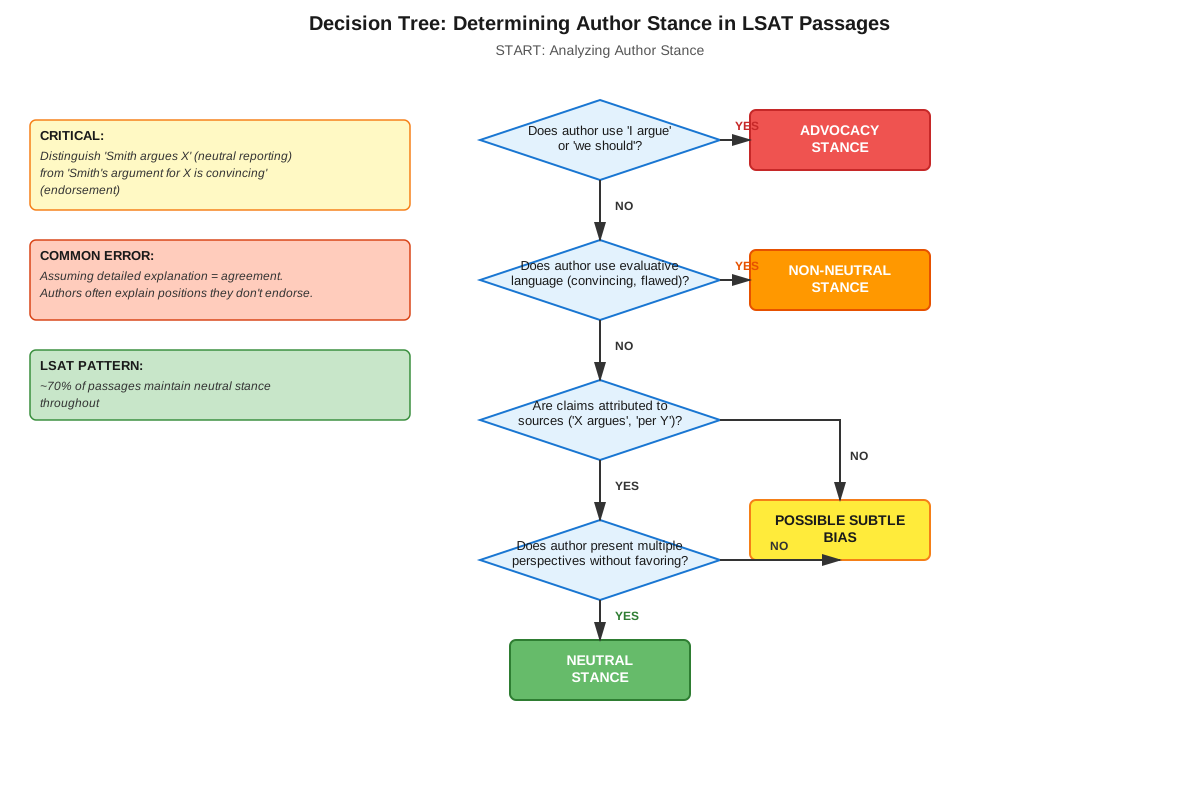
A neutral author stance exists when the passage writer presents information, arguments, theories, or viewpoints without explicitly indicating personal agreement, disagreement, approval, or disapproval. The author functions as a conduit for information rather than an advocate for a particular position. This neutrality manifests through specific linguistic choices: the author uses objective language, attributes claims to their sources, presents multiple perspectives with equal treatment, and avoids evaluative adjectives or adverbs that reveal personal judgment.
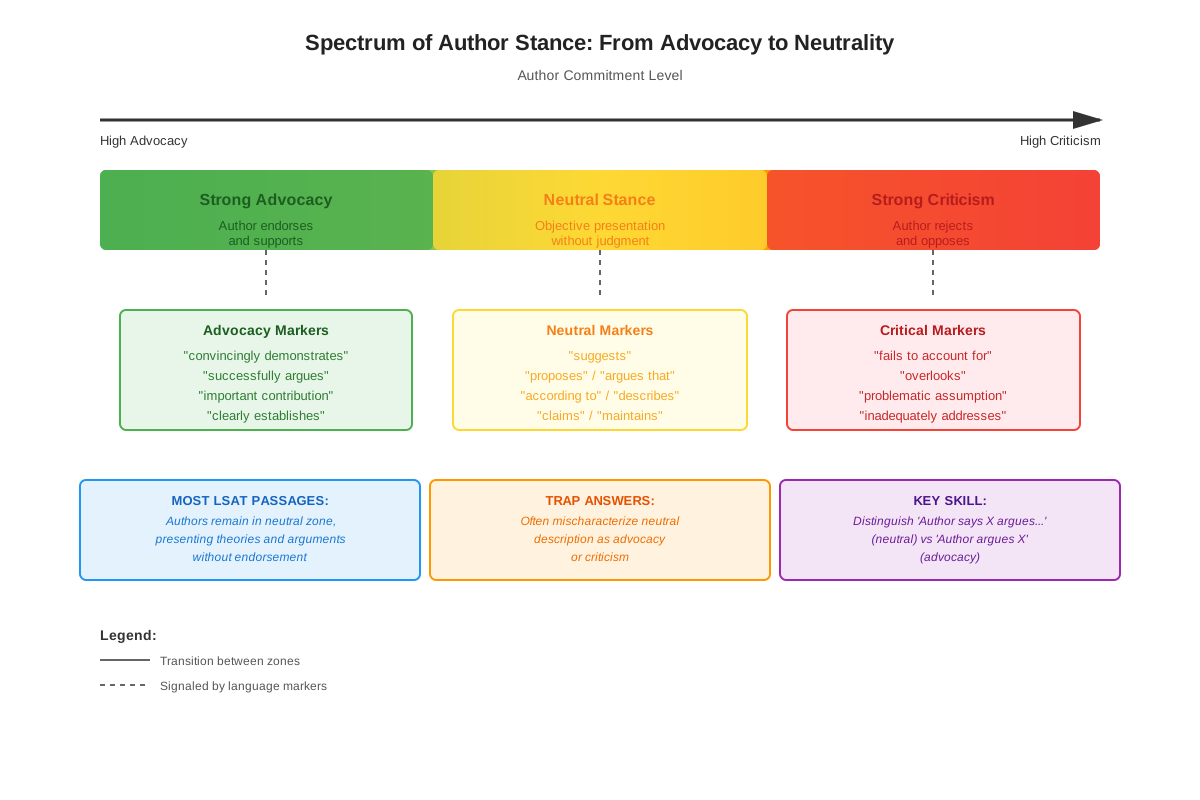
Neutrality exists on a spectrum rather than as an absolute binary. Some authors maintain strict objectivity throughout, while others exhibit subtle preferences through word choice, emphasis, or organizational structure. The LSAT tests whether students can accurately calibrate where on this spectrum a particular author falls, distinguishing between complete neutrality, mild preference, and strong advocacy.
Language Markers of Neutrality
Several linguistic patterns reliably signal neutral author stance. Attribution phrases such as "According to scholars," "Researchers have found," "Critics argue," and "Proponents claim" indicate the author is reporting others' views rather than asserting personal beliefs. Conditional language including "may," "might," "could," "appears to," and "suggests" demonstrates the author's reluctance to make definitive claims. Balanced presentation where the author devotes roughly equal attention and neutral language to competing viewpoints signals objectivity.
Conversely, certain language markers indicate the author has moved beyond neutrality. Unattributed assertions presented as fact without qualification suggest authorial endorsement. Evaluative language such as "unfortunately," "remarkably," "merely," "significantly," or "surprisingly" reveals the author's judgment about the information. Rhetorical questions often signal the author's implicit position, as do emphatic constructions like "clearly," "obviously," or "undoubtedly."
| Neutral Indicators | Non-Neutral Indicators |
|---|---|
| "Some scholars believe..." | "The correct interpretation is..." |
| "This theory suggests..." | "This theory proves..." |
| "Proponents argue..." | "As anyone can see..." |
| "One possible explanation..." | "The only reasonable conclusion..." |
| "Research indicates..." | "Fortunately, research shows..." |
Distinguishing Description from Endorsement
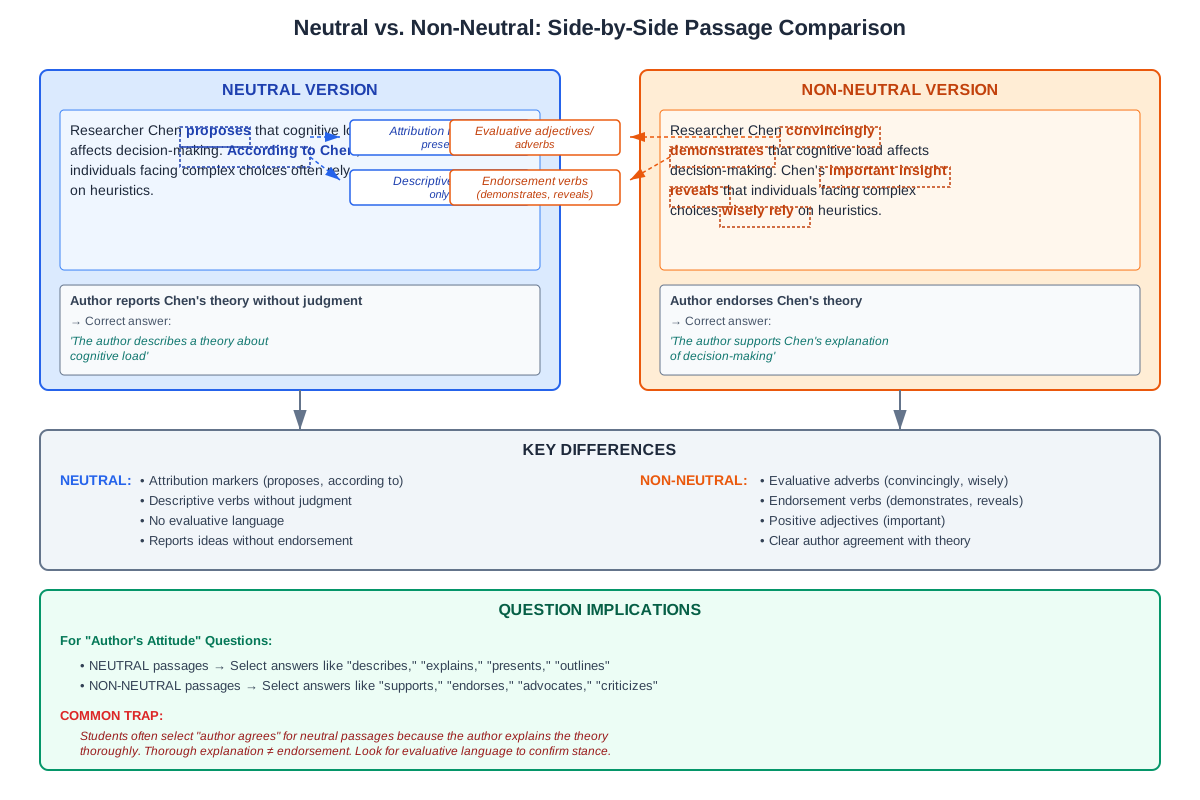
The most critical skill in recognizing neutral author stance is distinguishing between description (reporting what others think or what exists) and endorsement (indicating agreement or approval). When an author writes, "Many economists believe that inflation will rise," this is pure description—the author reports an economic consensus without indicating personal agreement. However, "Economists are right to predict rising inflation" clearly signals endorsement.
This distinction becomes more challenging when authors describe ideas in detail or with apparent enthusiasm. Extensive explanation does not equal endorsement. An author might devote three paragraphs to explaining a controversial theory simply because it's complex or influential, not because the author agrees with it. The LSAT frequently exploits this confusion by offering incorrect answer choices that assume detailed description implies authorial support.
Neutral Stance in Different Passage Types
Scientific and technical passages most commonly employ neutral author stance. These passages typically explain research findings, describe competing theories, or outline technical processes. The author's role is educational—helping readers understand complex material—rather than persuasive. For example, a passage might explain both the wave and particle theories of light without indicating which the author considers superior.
Historical passages often maintain neutrality when chronicling events, describing historical figures' actions, or explaining how past societies functioned. The author acts as historian rather than judge, presenting what happened without moral evaluation. However, students must watch for subtle shifts where the author moves from describing historical events to evaluating their significance or impact.
Comparative passages present unique challenges for identifying neutral stance. When two passages present opposing viewpoints, students must recognize that the passage authors themselves may be advocates (non-neutral) while the test-makers' framing remains neutral. Questions may ask about the stance of Passage A's author, Passage B's author, or how these authors would respond to each other—requiring careful tracking of multiple perspectives.
The Function of Neutral Stance
Authors choose neutral stance for specific rhetorical purposes. Educational goals drive neutrality when the author's primary purpose is to inform or explain rather than persuade. Establishing credibility motivates neutrality when authors want to appear fair-minded and objective, particularly when introducing controversial topics. Presenting preliminary analysis before later evaluation leads authors to describe positions neutrally in early paragraphs before revealing their own stance in later sections.
Understanding why an author maintains neutrality helps predict where that neutrality might end. Many LSAT passages follow a pattern: neutral description of background information or competing theories, followed by the author's own analysis or position in the final paragraphs. Recognizing this structure prevents students from incorrectly attributing the author's eventual position to the entire passage.
Subtle Departures from Neutrality
The LSAT frequently tests whether students can detect subtle non-neutrality—cases where the author maintains an overall objective tone but reveals slight preferences through careful word choice or emphasis. An author might describe Theory A in straightforward language while describing Theory B using slightly more positive or negative terms. These subtle cues often appear in:
- Adjective choice: "Theory A's simplistic approach" versus "Theory B's elegant framework"
- Verb selection: "Theory A claims" versus "Theory B demonstrates"
- Structural emphasis: Placing one viewpoint in a prominent position (first or last) while burying alternatives
- Space allocation: Devoting significantly more text to explaining one position than others
- Qualification patterns: Heavily qualifying one position with limitations while presenting another without caveats
Concept Relationships
Neutral author stance connects fundamentally to passage structure because authors typically signal their stance (or lack thereof) through organizational choices. A passage that presents multiple theories with equal weight and parallel structure likely maintains neutrality, while one that builds toward a particular conclusion in the final paragraph reveals authorial preference. Understanding structure helps predict where stance shifts might occur.
The relationship between neutral stance and primary purpose is direct: when the author's primary purpose is "to describe," "to explain," or "to present," neutrality is likely; when the purpose is "to argue," "to advocate," or "to critique," the author has moved beyond neutrality. Correctly identifying primary purpose often depends on accurately assessing authorial stance.
Tone questions explicitly test neutral author stance recognition. These questions ask students to characterize the author's attitude using adjectives like "objective," "impartial," "analytical," "critical," "enthusiastic," or "dismissive." Neutral stance corresponds to descriptors like "objective," "detached," "analytical," and "impartial," while non-neutral stances align with more emotionally charged or evaluative terms.
The concept also connects to source attribution—distinguishing between the author's voice and the voices of cited experts, critics, or proponents. When an author writes, "Critics argue that the policy will fail," the criticism belongs to the critics, not the author. Confusion about attribution leads students to incorrectly attribute others' strong opinions to a neutral author.
Relationship Map:
Passage Structure → reveals → Author Stance → determines → Primary Purpose → guides → Tone Characterization → requires → Source Attribution → supports → Accurate Stance Assessment
High-Yield Facts
⭐ Neutral author stance means the author describes or explains without explicitly endorsing or criticizing the content presented.
⭐ Attribution phrases like "according to," "scholars argue," and "proponents claim" signal the author is reporting others' views, not expressing personal opinion.
⭐ Detailed explanation of a theory or position does NOT imply the author agrees with it—description ≠ endorsement.
⭐ Evaluative language (unfortunately, remarkably, merely, clearly) indicates the author has moved beyond neutrality.
⭐ Many LSAT passages maintain neutrality in early paragraphs while revealing authorial stance in later sections.
- Neutral authors use conditional language (may, might, could, appears to) rather than definitive assertions.
- Scientific and technical passages most commonly employ neutral author stance throughout.
- Incorrect answer choices frequently attribute strong opinions to neutral authors or claim neutral authors are "ambivalent" when they're simply objective.
- Balanced presentation of competing viewpoints with equal space and neutral language signals authorial neutrality.
- The author's stance can be neutral toward the topic while still having a clear purpose (to explain, describe, or analyze).
- Rhetorical questions often signal non-neutrality, as they typically imply the author's position.
- Comparative passages require tracking multiple stances: each passage author's stance and the relationship between them.
- Subtle word choice differences (elegant vs. simplistic, demonstrates vs. claims) can reveal slight departures from complete neutrality.
- Questions asking about the author's "primary purpose" or "main point" often hinge on correctly identifying whether the author maintains neutrality or advocates a position.
- An author can present one viewpoint more extensively than others for explanatory reasons without endorsing it.
Quick check — test yourself on Neutral author stance so far.
Try Flashcards →Common Misconceptions
Misconception: If an author explains something in detail, they must agree with it.
Correction: Authors frequently provide detailed explanations of theories, positions, or phenomena they neither endorse nor reject. Explanation serves educational purposes and does not imply agreement. The LSAT specifically tests whether students confuse thorough description with authorial support.
Misconception: Neutral authors have no purpose or point—they're just presenting information randomly.
Correction: Neutral authors have clear purposes (to explain, to describe, to analyze, to compare) even while maintaining objectivity about the content. Neutrality refers to the author's stance toward the subject matter, not the absence of organizational purpose or rhetorical goals.
Misconception: If an author presents multiple viewpoints, they must be "ambivalent" or "uncertain" about the topic.
Correction: Presenting multiple perspectives reflects objectivity and thoroughness, not ambivalence. A neutral author can be quite certain about the facts while remaining objective about which interpretation is superior. "Ambivalent" implies the author has conflicting feelings, while "neutral" means the author maintains professional distance.
Misconception: Words like "important," "significant," or "interesting" always indicate non-neutrality.
Correction: Context determines whether such words reveal authorial bias. "This discovery is significant" might simply acknowledge consensus importance rather than expressing personal evaluation. However, "This discovery is unfortunately overlooked" clearly reveals authorial judgment through "unfortunately."
Misconception: The author's stance in the first paragraph applies to the entire passage.
Correction: Many LSAT passages shift from neutral description in opening paragraphs to authorial analysis or argument in later sections. Students must track stance throughout the passage, noting where transitions occur. The author's ultimate stance often appears in the final paragraphs after neutral groundwork.
Misconception: Neutral passages are easier because they don't require tracking the author's opinion.
Correction: Neutral passages can be more challenging because students must carefully distinguish between what the author describes and what various cited sources believe. The complexity of tracking multiple perspectives while recognizing the author's objectivity often makes neutral passages more demanding than clearly argumentative ones.
Misconception: If the passage discusses a controversial topic, the author must take a side.
Correction: Authors frequently maintain neutrality even on controversial subjects, particularly in academic or analytical contexts. The LSAT values the ability to present controversial material objectively, and many passages deliberately maintain neutrality on divisive topics to test whether students can recognize this restraint.
Worked Examples
Example 1: Identifying Neutral Stance
Passage Excerpt:
"Recent archaeological discoveries have prompted scholars to reconsider the timeline of early human migration to the Americas. Traditional theories placed the first arrivals at approximately 13,000 years ago, coinciding with the opening of an ice-free corridor through North America. However, new evidence from coastal sites in South America suggests human presence as early as 15,000 years ago. Proponents of the coastal migration theory argue that early humans traveled by boat along the Pacific coast, bypassing inland ice sheets entirely. Critics of this theory point to the limited number of coastal sites discovered and the difficulty of definitively dating the artifacts found there. Meanwhile, some researchers propose that multiple migration waves occurred, potentially reconciling both sets of evidence."
Question: The author's attitude toward the coastal migration theory can best be described as:
(A) Strongly supportive
(B) Cautiously optimistic
(C) Neutral and explanatory
(D) Mildly skeptical
(E) Dismissive
Analysis:
Let's examine the language the author uses regarding the coastal migration theory:
- "Proponents of the coastal migration theory argue..." - This is pure attribution; the author reports what proponents say without indicating agreement
- The author presents both supporting evidence (South American coastal sites) and criticisms (limited sites, dating difficulties) with equal, neutral treatment
- No evaluative language appears—no "unfortunately," "remarkably," "convincingly," or other judgment words
- The author devotes similar space to traditional theories, coastal migration theory, and the multiple-wave hypothesis
- The passage structure is explanatory: describing various theories and evidence without building toward a conclusion favoring any position
Correct Answer: (C) Neutral and explanatory
The author maintains objectivity throughout, describing competing theories and evidence without indicating personal preference. Answer (A) is incorrect because the author never endorses the coastal theory. Answer (B) is wrong because "cautiously optimistic" implies the author leans toward accepting the theory, which isn't supported. Answer (D) incorrectly suggests the author doubts the theory, when the author simply reports others' criticisms. Answer (E) is far too strong—nothing in the passage dismisses the coastal theory.
Connection to Learning Objectives: This example demonstrates how to identify neutral author stance by examining attribution patterns, balanced presentation, and absence of evaluative language—directly addressing the first learning objective.
Example 2: Distinguishing Subtle Non-Neutrality
Passage Excerpt:
"Two competing frameworks dominate contemporary discussions of artificial intelligence ethics. The consequentialist approach evaluates AI systems based solely on their outcomes, arguing that an AI's ethical status depends entirely on whether it produces beneficial results. This straightforward methodology has attracted numerous adherents in the tech industry, where measurable outcomes align well with engineering practices. The deontological approach, by contrast, insists that AI systems must be designed according to inherent ethical principles, regardless of outcomes. Proponents argue that certain actions are intrinsically wrong even if they produce good results, and AI systems must respect fundamental rights and duties. This more nuanced framework requires careful consideration of competing principles and their application to novel technological contexts."
Question: The author's presentation of the two ethical frameworks suggests:
(A) Complete neutrality toward both approaches
(B) Slight preference for the deontological approach
(C) Strong advocacy for the consequentialist approach
(D) Equal skepticism toward both frameworks
(E) Ambivalence about which framework is superior
Analysis:
While the author maintains overall objectivity, subtle language differences reveal a slight preference:
Consequentialist approach language:
- "straightforward methodology" - neutral to slightly simplistic connotation
- "attracted numerous adherents" - describes popularity without evaluation
- "align well with engineering practices" - practical but not necessarily sophisticated
Deontological approach language:
- "more nuanced framework" - positive connotation suggesting sophistication
- "careful consideration" - implies thoughtfulness and rigor
- "insists" vs. "arguing" - slightly stronger verb for deontological position
The author hasn't abandoned neutrality entirely—there's no explicit endorsement—but the word choices reveal subtle preference for the deontological approach's complexity and thoughtfulness.
Correct Answer: (B) Slight preference for the deontological approach
Answer (A) is incorrect because the subtle language differences indicate slight preference rather than complete neutrality. Answer (C) is wrong—the author shows no advocacy for consequentialism. Answer (D) incorrectly suggests skepticism when the author presents both frameworks respectfully. Answer (E) is incorrect because "ambivalence" implies conflicted feelings, while the author simply shows mild preference through word choice.
Connection to Learning Objectives: This example addresses the fourth learning objective—distinguishing between neutral presentation and subtle authorial bias—and demonstrates the fifth objective regarding language markers that signal degrees of neutrality versus advocacy.
Exam Strategy
When approaching LSAT Reading Comprehension questions about author stance, implement this systematic process:
Step 1: Pre-read for stance indicators
Before diving into questions, quickly note during your initial passage reading:
- Where does the author use attribution phrases versus unattributed assertions?
- Does the passage structure suggest building toward a conclusion or maintaining balance throughout?
- Are there any evaluative words or phrases that reveal authorial judgment?
Step 2: Identify trigger words in question stems
Questions testing neutral author stance typically include these phrases:
- "The author's attitude toward X..."
- "The author's tone can best be described as..."
- "The author mentions Y primarily in order to..."
- "The author would most likely agree with..."
- "The passage suggests that the author..."
Exam Tip: When you see these question stems, immediately recall whether the author maintained neutrality or revealed a position. Don't rely on memory alone—scan back to relevant passage sections to confirm.
Step 3: Eliminate extreme answer choices first
For neutral authors, immediately eliminate answers suggesting:
- Strong emotions (enthusiastic, dismayed, outraged, delighted)
- Definitive positions (convinced, certain, adamant)
- Extreme skepticism (dismissive, contemptuous, derisive)
Neutral authors align with moderate descriptors: objective, analytical, impartial, explanatory, descriptive, balanced.
Step 4: Watch for description/endorsement confusion
The LSAT's most common trap is answer choices that claim the author supports a position the author merely described. Ask yourself: "Did the author just explain this, or did the author indicate agreement?" If you can't find explicit endorsement language, the author is likely neutral.
Step 5: Check for structural shifts
Many passages begin neutrally but reveal authorial stance in later paragraphs. Before selecting "neutral" or "objective" as your answer, verify that the author maintains this stance throughout, particularly in the conclusion. Look for transition words like "however," "nevertheless," or "in fact" that might signal the author's own position emerging.
Time allocation: Spend 15-20 seconds confirming authorial stance during your initial passage reading. This upfront investment saves time on multiple questions that test this concept. When answering stance-specific questions, allocate 30-45 seconds: 15 seconds to locate relevant passage sections, 15-20 seconds to eliminate wrong answers, 10 seconds to confirm your choice.
Process of elimination priorities:
- First, eliminate answers with extreme language inappropriate for the author's actual tone
- Second, eliminate answers that confuse description with endorsement
- Third, eliminate answers that attribute others' views to the author
- Finally, choose between remaining moderate options based on specific textual evidence
Memory Techniques
The DANE Acronym for Neutral Stance:
- Description, not advocacy
- Attribution to sources
- No evaluative language
- Equal treatment of perspectives
When you encounter a passage, mentally ask: "Is this author being DANE?" If yes, expect neutral stance questions and prepare accordingly.
The Spectrum Visualization:
Picture authorial stance as a horizontal line:
STRONG OPPOSITION ← → MILD SKEPTICISM ← → NEUTRAL ← → MILD SUPPORT ← → STRONG ADVOCACYAs you read, mentally place the author on this spectrum. Neutral authors stay in the center, even when describing positions at the extremes. This visualization prevents conflating the content discussed with the author's stance toward that content.
The Attribution Test:
When uncertain whether the author endorses an idea, mentally add "According to the author" before the statement. If it sounds wrong or unsupported, the author is likely just describing someone else's view. For example:
- Passage: "Critics argue the policy will fail."
- Test: "According to the author, the policy will fail." ← If this feels unsupported, the author is neutral.
The "Unfortunately" Test:
Imagine inserting "unfortunately" or "fortunately" before key statements. If the addition would align with the passage's tone, the author isn't neutral. If it would feel jarring or inappropriate, the author maintains objectivity.
The Reporter Analogy:
Think of neutral authors as news reporters who present facts and multiple perspectives without editorializing. When the author sounds like a reporter rather than an opinion columnist, neutrality is likely. This analogy helps distinguish objective presentation from advocacy.
Summary
Neutral author stance represents one of the most testable concepts in LSAT Reading Comprehension, appearing in approximately 60-70% of passages through questions about tone, attitude, and purpose. A neutral author describes, explains, or analyzes information without explicitly endorsing or criticizing the content presented. This stance manifests through specific linguistic markers: attribution phrases that assign views to sources rather than the author, conditional language that avoids definitive claims, balanced presentation of competing perspectives, and absence of evaluative language that reveals judgment. The critical skill is distinguishing between description and endorsement—recognizing that detailed explanation does not imply agreement. Students must track authorial stance throughout passages, noting where shifts from neutrality to advocacy might occur, typically in concluding paragraphs. The LSAT exploits common misconceptions by offering incorrect answers that attribute strong opinions to neutral authors or confuse the views of cited sources with the author's own position. Mastering neutral author stance requires careful attention to word choice, passage structure, and the subtle differences between objective reporting and subtle bias. This skill connects fundamentally to identifying primary purpose, characterizing tone, and distinguishing between the author's voice and cited sources—all essential competencies for LSAT Reading Comprehension success.
Key Takeaways
- Neutral author stance means describing or explaining without endorsing or criticizing—the author reports objectively rather than advocates.
- Attribution phrases ("according to," "scholars argue," "proponents claim") signal the author is presenting others' views, not personal opinions.
- Detailed explanation ≠ endorsement; authors frequently explain positions thoroughly without agreeing with them.
- Evaluative language (unfortunately, remarkably, clearly, merely) indicates departure from neutrality and reveals authorial judgment.
- Many passages begin with neutral description but reveal authorial stance in later paragraphs—track stance throughout the entire passage.
- The most common LSAT trap is answer choices that attribute strong opinions to neutral authors or confuse description with advocacy.
- Neutral authors align with moderate descriptors (objective, analytical, impartial) rather than extreme terms (enthusiastic, dismissive, adamant).
Related Topics
Author's Primary Purpose: Understanding neutral stance directly supports identifying whether the author's purpose is to explain/describe (neutral) or to argue/advocate (non-neutral). Mastering stance recognition makes purpose questions significantly easier.
Tone and Attitude Questions: These question types explicitly test neutral author stance recognition, requiring students to select adjectives that accurately characterize the author's emotional and intellectual position toward the subject matter.
Source Attribution and Perspective Tracking: Distinguishing between the author's voice and cited sources' voices builds on neutral stance concepts, requiring careful attention to who believes what in complex passages with multiple perspectives.
Passage Structure and Organization: Recognizing how authors organize neutral versus argumentative passages helps predict where stance shifts might occur and supports strategic reading approaches.
Comparative Reading Passages: These passages require tracking multiple authors' stances simultaneously while recognizing that individual passage authors may be advocates even as the overall presentation remains balanced.
Practice CTA
Now that you've mastered the fundamentals of neutral author stance, it's time to apply these concepts to actual LSAT-style passages and questions. The practice questions and flashcards accompanying this guide will reinforce your ability to identify neutrality, distinguish description from endorsement, and eliminate incorrect answer choices that mischaracterize authorial stance. Remember: recognizing neutral author stance is a high-yield skill that appears in the majority of Reading Comprehension sections. Every minute you invest in practicing this concept directly translates to points on test day. Approach the practice materials systematically, checking your reasoning against the core concepts outlined in this guide. You've built a strong foundation—now strengthen it through deliberate practice!
Sign up free to keep reading
Create a free AnvayaPrep account to finish this LSAT guide on Neutral author stance — plus flashcards and practice questions.