Overview
Paragraph function is one of the most critical skills tested in LSAT Reading Comprehension. Understanding how individual paragraphs contribute to the overall structure and argument of a passage enables test-takers to navigate complex texts efficiently and answer questions with precision. On the LSAT, reading comprehension passages are carefully constructed with each paragraph serving a specific rhetorical purpose—whether introducing a thesis, presenting evidence, acknowledging counterarguments, or synthesizing conclusions. Recognizing these functions allows students to create mental roadmaps of passages, making it easier to locate information and understand authorial intent.
The LSAT frequently tests paragraph function directly through questions that ask "What is the primary purpose of the second paragraph?" or "The author mentions X in paragraph three in order to..." These questions assess whether students can move beyond surface-level comprehension to understand the structural role each paragraph plays. Mastering lsat paragraph function analysis transforms reading from a passive activity into an active, strategic process where students anticipate how arguments will develop and identify the logical architecture underlying complex texts.
Within passage fundamentals, paragraph function serves as a bridge between micro-level sentence comprehension and macro-level passage structure understanding. While individual sentences convey specific information, paragraphs organize these ideas into functional units that advance the author's overall purpose. This topic connects directly to identifying main points, understanding author's tone and attitude, and recognizing argumentative structures—all essential components of LSAT Reading Comprehension success.
Learning Objectives
- [ ] Identify how Paragraph function appears in LSAT questions
- [ ] Explain the reasoning pattern behind Paragraph function
- [ ] Apply Paragraph function to solve LSAT-style problems accurately
- [ ] Categorize paragraphs according to their common rhetorical functions (introduction, evidence, counterargument, synthesis)
- [ ] Predict likely paragraph functions based on passage structure and transitional language
- [ ] Distinguish between primary and secondary functions within a single paragraph
- [ ] Evaluate answer choices by matching them against the actual structural role of a paragraph
Prerequisites
- Basic reading comprehension skills: Understanding literal meaning of sentences and paragraphs is necessary before analyzing their structural functions
- Familiarity with argument structure: Recognizing premises, conclusions, and evidence helps identify how paragraphs support overall arguments
- Understanding of passage types: Knowledge of different LSAT passage categories (law, science, humanities, social science) provides context for typical organizational patterns
- Awareness of author's purpose: Distinguishing between descriptive, analytical, and argumentative writing helps predict paragraph functions
Why This Topic Matters
Paragraph function questions appear with remarkable consistency on the LSAT, typically comprising 15-20% of all Reading Comprehension questions. These questions test a fundamental skill that law schools value highly: the ability to understand how legal arguments are constructed and how different sections of legal documents serve specific purposes. In legal practice, attorneys must quickly identify which paragraphs of contracts, briefs, or judicial opinions contain key definitions, establish precedents, present counterarguments, or state holdings.
On the LSAT, paragraph function appears in several question formats:
- Direct function questions: "The primary purpose of the third paragraph is to..."
- Reference questions: "The author mentions X in paragraph two primarily in order to..."
- Structural relationship questions: "Which of the following best describes the relationship between the second and third paragraphs?"
- Organization questions: "The passage is structured to..."
Understanding paragraph function provides strategic advantages beyond answering these specific question types. Students who identify paragraph functions while reading can:
- Create more effective mental outlines of passages
- Locate information more quickly when answering detail questions
- Better understand the author's overall argument and attitude
- Predict where certain types of information are likely to appear
- Eliminate wrong answers more efficiently by recognizing structural mismatches
The skill of analyzing paragraph function transfers directly to law school, where students must brief cases by identifying the function of different sections (facts, procedural history, issue, holding, reasoning, dissent) and understand how legal arguments are constructed across multiple paragraphs or sections.
Core Concepts
Common Paragraph Functions
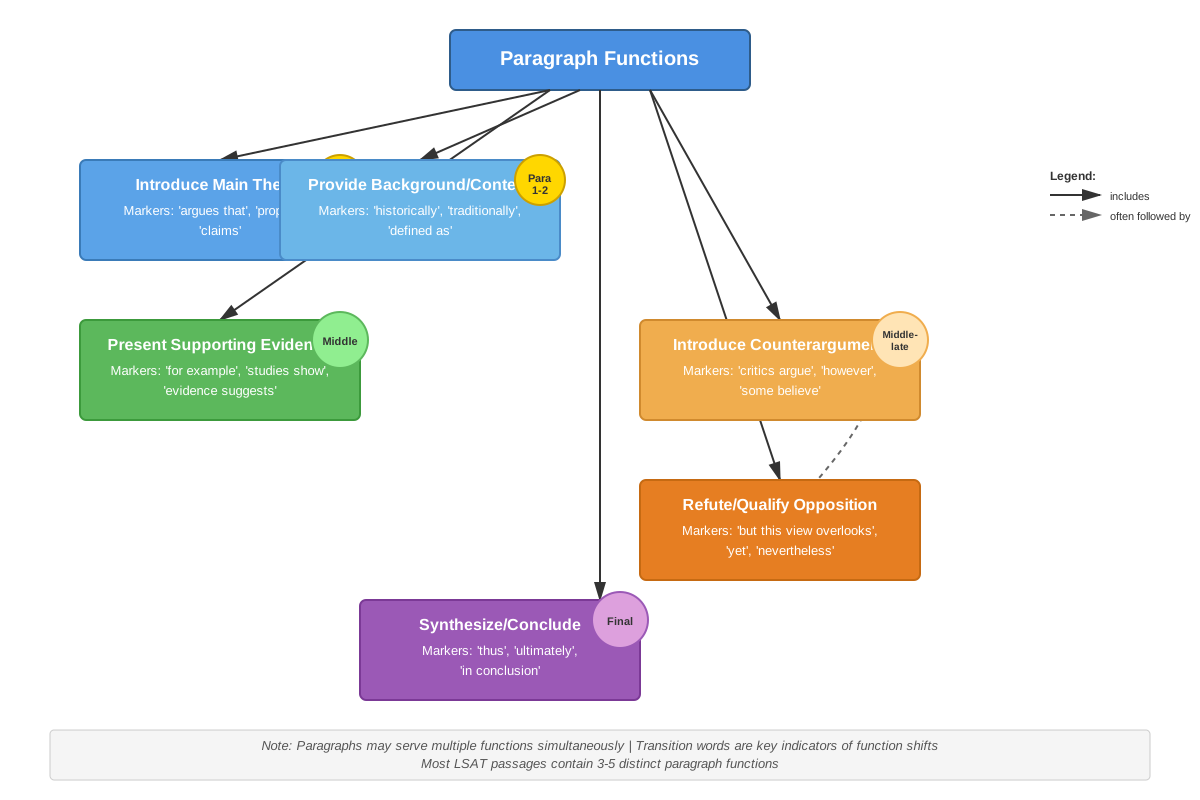
Paragraph function refers to the specific rhetorical or structural role a paragraph plays within the overall passage. While content varies widely across LSAT passages, paragraphs typically serve a limited set of functions that recur predictably. Understanding these common functions enables rapid passage analysis and accurate question answering.
Introduction/Thesis Presentation: Opening paragraphs typically introduce the main topic and may present the author's thesis or the central question the passage will address. These paragraphs establish context, define key terms, or present a phenomenon that requires explanation. In LSAT passages, introductory paragraphs often present a puzzle, controversy, or traditional view that subsequent paragraphs will address.
Background/Context: Some paragraphs provide historical context, define technical terms, or explain circumstances necessary for understanding the main argument. These paragraphs don't advance the argument directly but establish the foundation for claims that follow. They often appear early in passages but can occur anywhere context is needed.
Evidence/Support: Many paragraphs present evidence, examples, data, or reasoning that supports the author's main claim or a subsidiary point. These paragraphs contain the substance of the argument—the facts, studies, expert opinions, or logical reasoning that justify the author's position. Evidence paragraphs are crucial for detail questions and inference questions.
Counterargument/Alternative View: Sophisticated LSAT passages frequently include paragraphs that present opposing viewpoints, alternative theories, or potential objections to the author's position. These paragraphs serve to acknowledge complexity and often set up the author's rebuttal or qualification. Recognizing counterargument paragraphs prevents students from confusing opposing views with the author's own position.
Rebuttal/Critique: Following counterargument paragraphs, authors often dedicate space to refuting alternative views or explaining why opposing theories are inadequate. Rebuttal paragraphs advance the author's argument by eliminating competing explanations or demonstrating the superiority of the author's approach.
Synthesis/Conclusion: Final paragraphs often synthesize previous points, restate the main argument with added nuance, or discuss implications and applications of the ideas presented. Conclusion paragraphs may also acknowledge limitations or suggest directions for future inquiry.
Qualification/Nuance: Some paragraphs add complexity to earlier claims by introducing exceptions, limitations, or conditions under which the main argument holds. These paragraphs demonstrate sophisticated thinking and prevent overgeneralization.
Identifying Paragraph Function
Determining paragraph function requires analyzing both content and structural position. Several textual clues reliably indicate function:
Transitional language provides explicit signals about paragraph function. Phrases like "however," "on the other hand," or "critics argue" typically introduce counterarguments. "Moreover," "furthermore," and "additionally" signal continued support for the same point. "Therefore," "thus," and "consequently" indicate conclusions or synthesis.
Paragraph position within the passage constrains likely functions. First paragraphs rarely present rebuttals (nothing has been argued yet to rebut). Final paragraphs seldom introduce entirely new evidence without connecting it to previous points. Middle paragraphs often contain the substantive evidence and argumentation.
Relationship to the main point determines function. Paragraphs that directly support the author's thesis serve an evidence function, while those presenting views the author ultimately rejects serve a counterargument function, even if they contain factual information.
Scope and specificity help distinguish functions. Paragraphs with broad, general statements often serve introductory or concluding functions, while those with specific examples, data, or detailed analysis typically provide evidence or illustration.
Multiple Functions Within Paragraphs
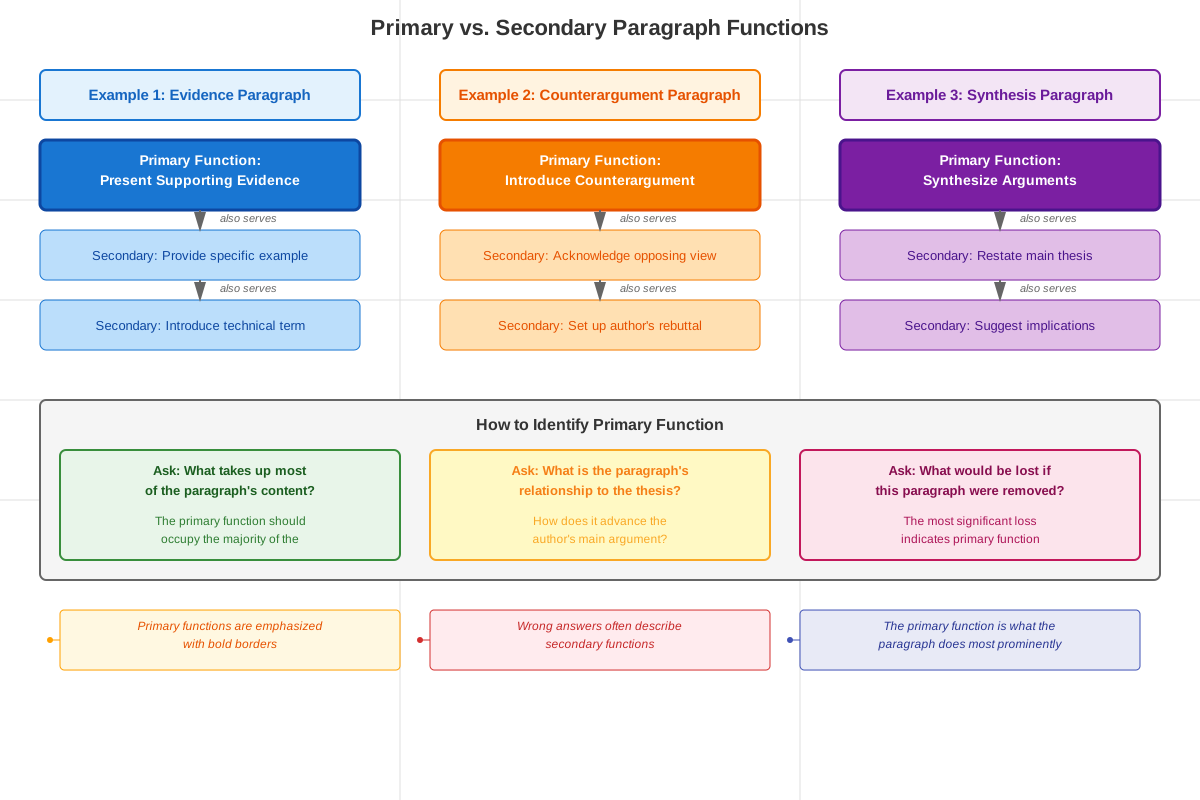
Complex LSAT paragraphs often serve multiple functions simultaneously. A paragraph might introduce a counterargument in its first sentence, then immediately rebut it in subsequent sentences. Another might provide evidence for the main claim while also offering a qualification or limitation. When analyzing paragraph function:
- Identify the primary function: What is the paragraph's main contribution to the passage structure?
- Note secondary functions: What additional roles does the paragraph play?
- Consider the paragraph as a whole: Don't let a single sentence mislead you about the paragraph's overall function
For LSAT questions asking about paragraph function, the correct answer typically captures the primary function, though it may acknowledge secondary roles through careful wording.
Function vs. Content
A critical distinction exists between what a paragraph says (content) and what it does (function). Two paragraphs might discuss the same topic but serve entirely different functions. For example:
| Content | Function A | Function B |
|---|---|---|
| Discussion of a scientific theory | Present the author's preferred explanation | Describe a theory the author will critique |
| Description of historical events | Provide background context | Serve as evidence for a claim about causation |
| Analysis of a legal principle | Introduce the main topic | Apply a previously stated principle to a specific case |
LSAT wrong answers often describe paragraph content accurately but mischaracterize function. Students must train themselves to ask "Why did the author include this paragraph?" rather than merely "What does this paragraph say?"
Structural Relationships Between Paragraphs
Understanding individual paragraph functions enables recognition of how paragraphs relate to each other structurally:
- Sequential support: Multiple paragraphs each provide different evidence for the same claim
- Thesis-antithesis-synthesis: One paragraph presents a view, another presents an opposing view, a third reconciles or adjudicates between them
- Problem-solution: One paragraph identifies a problem or puzzle, subsequent paragraphs present and evaluate potential solutions
- General-to-specific: An opening paragraph makes a broad claim, following paragraphs provide increasingly specific examples or applications
- Chronological development: Paragraphs trace the evolution of an idea, theory, or practice over time
Recognizing these patterns helps predict what subsequent paragraphs will likely discuss and enables more efficient navigation of passages.
Concept Relationships
Paragraph function analysis builds directly on fundamental reading comprehension skills. Understanding literal meaning (prerequisite) → enables recognition of what each paragraph says → which allows identification of what each paragraph does (paragraph function) → which facilitates understanding of overall passage structure.
Within the topic itself, concepts connect hierarchically:
Common paragraph functions (the taxonomy of possible roles) → Identifying paragraph function (the process of determining which function applies) → Multiple functions within paragraphs (recognizing complexity) → Function vs. content (avoiding common errors) → Structural relationships (understanding how functions combine to create passage architecture)
Paragraph function connects forward to several advanced Reading Comprehension topics:
- Main point identification: The paragraph containing or supporting the main point typically serves a thesis or synthesis function
- Passage organization: Understanding individual paragraph functions reveals overall organizational patterns
- Author's attitude: Paragraphs presenting views the author endorses vs. critiques reveal authorial stance
- Inference questions: Knowing a paragraph's function helps determine what can legitimately be inferred from it
The relationship flows: Sentence comprehension → Paragraph function → Passage structure → Question answering strategy
High-Yield Facts
⭐ Paragraph function questions constitute approximately 15-20% of LSAT Reading Comprehension questions
⭐ The correct answer to a function question describes what the paragraph does, not merely what it says
⭐ Counterargument paragraphs present views the author does not endorse; confusing these with the author's position is a common trap
⭐ Transitional words and phrases at paragraph beginnings reliably signal function (however = counterargument; moreover = additional support; therefore = conclusion)
⭐ First paragraphs typically introduce topics or present theses; they rarely contain rebuttals or conclusions
- Evidence paragraphs contain specific examples, data, studies, or detailed reasoning supporting claims
- Synthesis paragraphs often appear at passage ends and connect multiple previous points
- A single paragraph can serve multiple functions, but LSAT questions typically ask about the primary function
- Wrong answers often accurately describe paragraph content but mischaracterize structural function
- Paragraph function understanding accelerates passage navigation and improves performance on all question types, not just direct function questions
- Qualification paragraphs add nuance or limitations to earlier claims and often include words like "although," "while," or "except"
- The relationship between consecutive paragraphs (support, contrast, application) provides clues about individual paragraph functions
Quick check — test yourself on Paragraph function so far.
Try Flashcards →Common Misconceptions
Misconception: A paragraph's function is determined solely by its content or topic.
Correction: Function depends on the paragraph's structural role in the passage. Two paragraphs discussing the same topic can serve entirely different functions—one might present the author's view while another presents an opposing view the author will critique.
Misconception: If a paragraph contains factual information, its function must be to provide evidence.
Correction: Factual information can serve multiple functions. A paragraph might present facts as part of a counterargument the author rejects, as background context, or as evidence. The function depends on how those facts relate to the author's overall argument.
Misconception: The first sentence of a paragraph always indicates the paragraph's function.
Correction: While opening sentences often signal function, some paragraphs shift function mid-paragraph. A paragraph might begin by acknowledging a counterargument, then pivot to rebutting it. The paragraph's overall function must be determined by considering all sentences.
Misconception: Longer paragraphs serve more important functions than shorter ones.
Correction: Paragraph length doesn't determine functional importance. A brief concluding paragraph synthesizing the argument may be more functionally significant than a longer paragraph providing one of several examples.
Misconception: Every paragraph serves only one function.
Correction: Complex paragraphs often serve multiple functions simultaneously. A paragraph might provide evidence while also qualifying an earlier claim. LSAT questions typically ask about the primary or main function, acknowledging that secondary functions may exist.
Misconception: If a paragraph mentions the author's main point, its function must be to state the main point.
Correction: Many paragraphs reference the main point while serving other functions. A paragraph might mention the thesis while providing evidence for it, or acknowledge the main claim while presenting a potential objection to it.
Misconception: Counterargument paragraphs always begin with explicit phrases like "critics argue" or "opponents claim."
Correction: While such phrases are helpful signals, counterarguments can be presented more subtly. Authors sometimes present alternative views without explicit attribution, expecting readers to recognize from context that these views will be challenged.
Worked Examples
Example 1: Identifying Primary Function
Passage excerpt (paragraph 3 of 4):
"However, recent archaeological discoveries have challenged this traditional interpretation. Excavations at three separate sites have uncovered evidence of sophisticated irrigation systems dating to a period 200 years earlier than previously thought possible. These findings suggest that the civilization's agricultural capabilities were far more advanced than historians had assumed, potentially requiring a complete reassessment of the timeline of technological development in the region."
Question: The primary function of the third paragraph is to:
(A) Provide background information about archaeological methodology
(B) Present evidence that contradicts an established historical view
(C) Describe the agricultural practices of an ancient civilization
(D) Argue that historians have deliberately misinterpreted evidence
(E) Introduce the main thesis of the passage
Analysis:
Step 1: Identify transitional signals. The paragraph opens with "However," immediately signaling a contrast with previous content. This suggests the paragraph will present information that contradicts or complicates what came before.
Step 2: Determine what the paragraph says (content). The paragraph discusses archaeological discoveries of irrigation systems that are older than expected.
Step 3: Determine what the paragraph does (function). The paragraph presents new evidence ("recent archaeological discoveries") that challenges a previous interpretation ("challenged this traditional interpretation"). The phrase "potentially requiring a complete reassessment" indicates this evidence has significant implications for existing understanding.
Step 4: Evaluate answer choices against function:
(A) Incorrect - While the paragraph mentions archaeological excavations, it doesn't explain archaeological methodology. This confuses content (archaeology is mentioned) with function (explaining methods).
(B) Correct - This accurately captures the paragraph's function: presenting evidence (archaeological discoveries) that contradicts an established view (traditional interpretation). The function is to challenge existing understanding with new data.
(C) Incorrect - Though the paragraph mentions irrigation systems (agricultural practice), describing these practices is not the paragraph's primary function. The irrigation systems are mentioned as evidence for a larger point about challenging historical interpretations.
(D) Incorrect - The paragraph suggests historians' assumptions were incorrect, but doesn't argue for deliberate misinterpretation. This answer choice adds content not present and mischaracterizes the tone.
(E) Incorrect - As the third of four paragraphs, this is unlikely to introduce the main thesis (typically done in paragraph 1). The paragraph advances an argument but doesn't introduce the passage's overall thesis.
Connection to learning objectives: This example demonstrates how to identify paragraph function by analyzing transitional language, distinguishing content from function, and matching the paragraph's structural role against answer choices.
Example 2: Multiple Functions and Structural Relationships
Passage excerpt (paragraphs 2-3 of 4):
"[Paragraph 2] Proponents of the economic theory argue that market forces alone can adequately regulate environmental protection. They contend that as resources become scarce, prices rise, incentivizing conservation and innovation in alternative resources. According to this view, government intervention distorts these natural market mechanisms and leads to inefficient outcomes.
[Paragraph 3] While this argument has theoretical appeal, empirical evidence suggests significant limitations. Studies of fisheries management demonstrate that unregulated markets frequently lead to resource depletion before price signals become strong enough to change behavior. The tragedy of the commons—where individual rational actors collectively deplete shared resources—illustrates a fundamental market failure that economic theory alone cannot address."
Question: The second paragraph functions primarily to:
(A) Present the author's solution to an environmental problem
(B) Describe an economic theory that the author will critique
(C) Provide evidence supporting market-based environmental regulation
(D) Introduce a controversy that the passage will resolve
(E) Summarize the consensus view among economists
Analysis:
Step 1: Analyze paragraph 2 in isolation. The paragraph presents views of "proponents" of an economic theory, using phrases like "they argue" and "according to this view." This language indicates the author is describing others' positions rather than endorsing them.
Step 2: Analyze the relationship between paragraphs 2 and 3. Paragraph 3 begins with "While this argument has theoretical appeal" (acknowledging the view from paragraph 2) but immediately follows with "empirical evidence suggests significant limitations" (signaling critique). The relationship is counterargument → rebuttal.
Step 3: Determine paragraph 2's function in context. Paragraph 2 presents a view that paragraph 3 will challenge. This is a classic counterargument function—presenting a position to set up its critique.
Step 4: Evaluate answer choices:
(A) Incorrect - The paragraph presents others' views ("proponents argue"), not the author's solution. The author's position appears in paragraph 3.
(B) Correct - This accurately captures both what the paragraph does (describes an economic theory) and its structural role (sets up the author's critique in paragraph 3). The word "will critique" indicates understanding of the relationship between paragraphs.
(C) Incorrect - While the paragraph describes arguments for market-based regulation, it doesn't provide evidence supporting them. It reports what proponents claim, which is different from providing evidence. Additionally, the author doesn't endorse this view.
(D) Incorrect - The paragraph presents one side of a controversy but doesn't introduce the controversy itself (that likely happened in paragraph 1). Also, nothing indicates the passage will "resolve" the controversy—it may simply argue for one side.
(E) Incorrect - The paragraph describes views of "proponents," not a consensus. This answer choice mischaracterizes the scope of support for the theory.
Connection to learning objectives: This example demonstrates how paragraph function depends on structural relationships between paragraphs, how to distinguish between presenting a view and endorsing it, and how transitional language in subsequent paragraphs clarifies the function of earlier ones.
Exam Strategy
Approaching Paragraph Function Questions
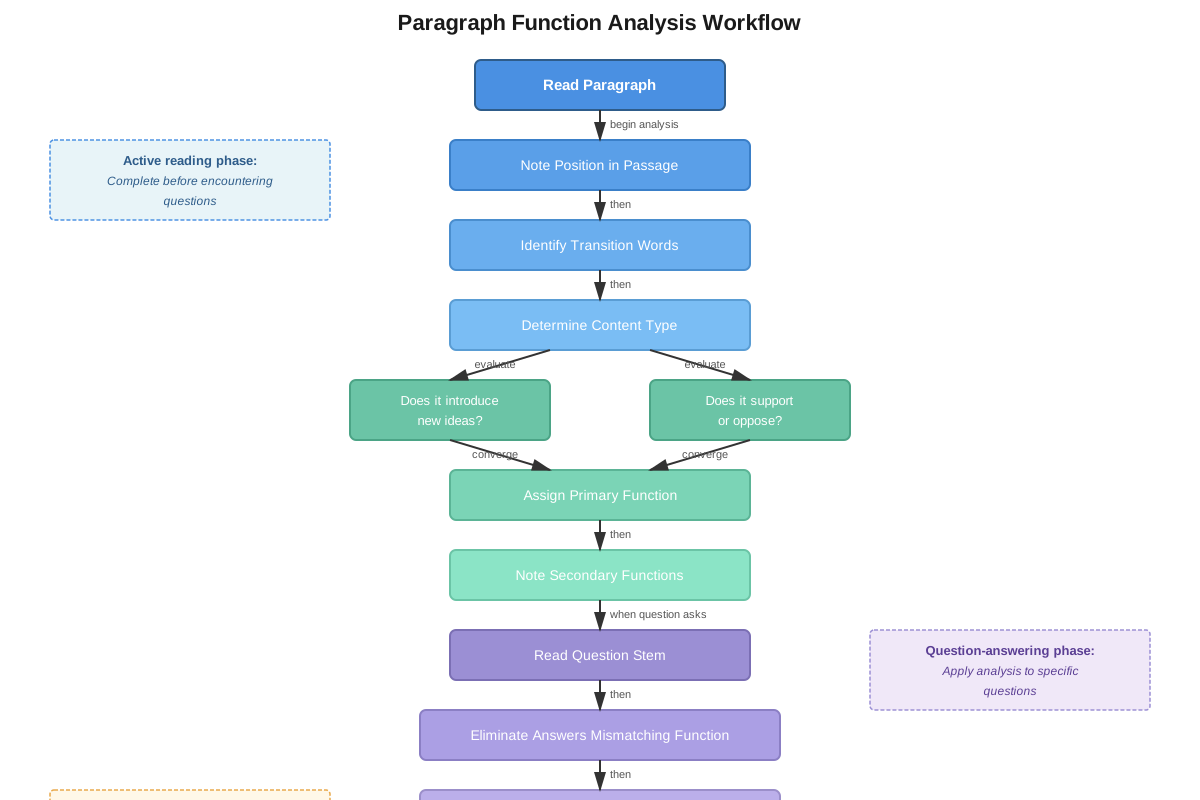
Step 1: Read actively for structure during initial passage reading. As you read each paragraph, mentally note its function using shorthand: "intro," "evidence," "counterarg," "rebuttal," etc. This creates a structural map that makes answering function questions nearly automatic.
Step 2: Identify transitional signals. Pay special attention to the first sentence of each paragraph and transitional words/phrases. These provide explicit clues about function:
- "However," "Nevertheless," "On the other hand" → contrast or counterargument
- "Moreover," "Furthermore," "Additionally" → continued support
- "For example," "To illustrate" → evidence or application
- "Therefore," "Thus," "Consequently" → conclusion or synthesis
Step 3: Ask "Why did the author include this?" rather than "What does this say?" Function questions test purpose, not content. Train yourself to think structurally.
Step 4: Consider the paragraph's relationship to surrounding paragraphs. A paragraph's function often becomes clearer when you understand what comes before and after it.
Trigger Words in Questions
Recognize these common phrasings for paragraph function questions:
- "The primary purpose of the [X] paragraph is to..."
- "The author mentions [X] in paragraph [Y] in order to..."
- "Which of the following best describes the function of..."
- "The [X] paragraph serves primarily to..."
- "In the context of the passage, the [X] paragraph..."
The words "primary," "primarily," and "main" indicate that the paragraph may serve multiple functions, but you should identify the most important one.
Process of Elimination Tips
Eliminate answers that describe content without addressing function. If an answer choice simply restates what the paragraph says without explaining why the author included it, eliminate it.
Eliminate answers that misidentify the author's position. If a paragraph presents a view the author opposes, eliminate answers suggesting the paragraph presents the author's view.
Eliminate answers with scope problems. If an answer claims a paragraph "introduces the main thesis" but it's paragraph 3 of 4, be skeptical. If an answer says a paragraph "provides the only evidence" but other paragraphs also provide evidence, eliminate it.
Eliminate answers with extreme language. Words like "solely," "exclusively," "completely," or "only" are often too strong for paragraph function answers, which typically acknowledge complexity.
Verify the correct answer by checking it against the paragraph. The right answer should accurately describe both what the paragraph does and how it relates to the passage's overall structure.
Time Allocation
Paragraph function questions should be among the quickest to answer if you've read actively for structure. Allocate approximately:
- 30-45 seconds if you noted paragraph functions during initial reading
- 60-75 seconds if you need to reread the paragraph to determine function
- 90+ seconds if you need to analyze relationships between multiple paragraphs
If a function question is taking longer than 90 seconds, you may need to improve your initial structural reading. Consider spending slightly more time during initial passage reading to note paragraph functions, which will save time on questions.
Memory Techniques
The CERBIS Acronym
Remember common paragraph functions with CERBIS:
- Context/Background
- Evidence/Support
- Rebuttal/Critique
- Bridge/Transition
- Introduction/Thesis
- Synthesis/Conclusion
When you encounter a paragraph, mentally check which CERBIS function it serves.
The "What vs. Why" Mantra
Repeat to yourself: "Content is WHAT; Function is WHY." This simple distinction prevents the most common error on function questions—choosing answers that accurately describe content but mischaracterize function.
Visualization: The Building Metaphor
Visualize passages as buildings where each paragraph is a structural component:
- Foundation = Introduction/Context paragraphs
- Support beams = Evidence paragraphs
- Counterweights = Counterargument paragraphs
- Reinforcements = Rebuttal paragraphs
- Roof = Conclusion/Synthesis paragraphs
This metaphor emphasizes that each paragraph serves a structural purpose in supporting the overall argument.
The Transition Signal Chart
Memorize this quick reference for transitional signals:
CONTRAST: However, Nevertheless, On the other hand, Yet, Conversely
CONTINUATION: Moreover, Furthermore, Additionally, Also, Similarly
CAUSATION: Therefore, Thus, Consequently, As a result, Hence
ILLUSTRATION: For example, To illustrate, Specifically, In particular
CONCESSION: Although, While, Despite, Admittedly, Granted
When you see these words at paragraph beginnings, you immediately know something about the paragraph's function.
Summary
Paragraph function analysis is a foundational skill for LSAT Reading Comprehension success, requiring students to move beyond understanding what passages say to recognizing what paragraphs do within the passage's overall structure. Common paragraph functions include introducing topics, providing evidence, presenting counterarguments, offering rebuttals, and synthesizing conclusions. Identifying these functions depends on analyzing transitional language, paragraph position, relationship to the main point, and connections between paragraphs. The critical distinction between content (what a paragraph says) and function (why the author included it) separates correct from incorrect answers on function questions. Students who actively read for structure, noting each paragraph's function during initial passage reading, can answer function questions quickly and accurately while also improving performance on other question types. Mastering paragraph function enables efficient passage navigation, accurate main point identification, and sophisticated understanding of argumentative structure—skills essential not only for LSAT success but for law school and legal practice.
Key Takeaways
- Paragraph function describes the structural role a paragraph plays, not merely its content or topic
- Common functions include introduction, evidence, counterargument, rebuttal, and synthesis—learn to recognize these patterns
- Transitional words and phrases at paragraph beginnings reliably signal function and should be noted during active reading
- The correct answer to function questions explains why the author included the paragraph, not just what it discusses
- Understanding paragraph function improves performance on all Reading Comprehension question types by creating mental passage maps
- Counterargument paragraphs present views the author does not endorse—confusing these with the author's position is a common trap
- Active structural reading—noting each paragraph's function during initial passage reading—dramatically improves speed and accuracy
Related Topics
Main Point Identification: Understanding paragraph functions directly facilitates identifying the passage's main point, as the thesis typically appears in or is supported by paragraphs serving introduction or synthesis functions. Mastering paragraph function provides the structural framework for distinguishing main points from supporting details.
Passage Organization: Analyzing how individual paragraph functions combine reveals overall organizational patterns (problem-solution, chronological, thesis-antithesis-synthesis). This topic builds directly on paragraph function analysis to understand macro-level passage structure.
Author's Tone and Attitude: Recognizing which paragraphs present views the author endorses versus views the author critiques reveals authorial attitude. Paragraph function analysis prevents confusing counterarguments with the author's position.
Inference Questions: Understanding a paragraph's function helps determine what can legitimately be inferred from it. Evidence paragraphs support different inferences than counterargument paragraphs, even when discussing similar content.
Comparative Reading: In comparative passages, analyzing how paragraphs in Passage A relate functionally to paragraphs in Passage B (agreement, disagreement, complementary evidence) extends paragraph function skills to multiple-passage contexts.
Practice CTA
Now that you understand the principles of paragraph function analysis, it's time to apply these concepts to actual LSAT passages. Complete the practice questions to test your ability to identify paragraph functions quickly and accurately. Use the flashcards to reinforce the common paragraph functions and transitional signals that appear repeatedly on the exam. Remember: paragraph function is a skill that improves dramatically with deliberate practice. Each passage you analyze with structural awareness strengthens your ability to navigate complex arguments efficiently—a skill that will serve you not only on test day but throughout law school and your legal career. You've built the foundation; now construct mastery through practice!
Sign up free to keep reading
Create a free AnvayaPrep account to finish this LSAT guide on Paragraph function — plus flashcards and practice questions.