Overview
Passage organization patterns are the structural blueprints that authors use to arrange ideas, arguments, and information within LSAT Reading Comprehension passages. Understanding these patterns is fundamental to success on the LSAT because they provide a roadmap for navigating complex texts efficiently and accurately. Rather than reading passages as undifferentiated blocks of text, skilled test-takers recognize recurring organizational structures that help them predict where key information will appear, understand the author's purpose, and quickly locate details needed to answer questions.
The LSAT Reading Comprehension section consistently tests whether students can identify not just what a passage says, but how it is constructed. Questions frequently ask about the passage's structure, the function of specific paragraphs, or the relationship between different parts of the text. Recognizing LSAT passage organization patterns allows test-takers to work more efficiently under time pressure, anticipate the direction of arguments, and eliminate wrong answer choices that mischaracterize the passage's structure. These patterns appear across all four passage types (humanities, social sciences, natural sciences, and law), making them universally applicable skills.
Within the broader context of reading comprehension and passage fundamentals, organization patterns serve as the architectural framework upon which all other analytical skills rest. Before evaluating arguments, identifying main ideas, or analyzing tone, students must understand how the passage is built. This structural awareness enables more sophisticated analysis and creates a mental scaffold for retaining information during the test. Mastering passage organization patterns directly improves performance on structure questions, function questions, and even inference questions that require understanding how different parts of the passage relate to one another.
Learning Objectives
- [ ] Identify how passage organization patterns appears in LSAT questions
- [ ] Explain the reasoning pattern behind passage organization patterns
- [ ] Apply passage organization patterns to solve LSAT-style problems accurately
- [ ] Distinguish between at least six common organizational structures used in LSAT passages
- [ ] Predict the likely content and function of subsequent paragraphs based on organizational cues
- [ ] Map the relationship between paragraph functions within a multi-paragraph passage
- [ ] Recognize structural keywords and transitions that signal organizational patterns
Prerequisites
- Basic paragraph structure: Understanding topic sentences, supporting details, and concluding statements is essential because passage organization patterns operate at both the paragraph and multi-paragraph level
- Main idea identification: Recognizing the central claim or purpose of a passage provides the foundation for understanding how the author organizes supporting material around that core idea
- Active reading strategies: The ability to annotate, take brief notes, and engage critically with text enables students to track organizational patterns as they read
- Argument structure basics: Familiarity with premises, conclusions, and evidence helps students recognize when passages are organized around argumentative versus descriptive frameworks
Why This Topic Matters
Understanding passage organization patterns is not merely an academic exercise—it reflects the real-world skill of efficiently processing complex written material. Legal professionals, academics, and business leaders must regularly extract key information from lengthy documents, identify the structure of arguments, and understand how different pieces of information relate to one another. The LSAT tests this skill because it predicts success in law school, where students must quickly comprehend case law, statutes, and legal scholarship that employ various organizational strategies.
On the LSAT specifically, passage organization patterns appear with remarkable frequency and consistency. Approximately 15-25% of Reading Comprehension questions directly test structural understanding through questions like "Which one of the following most accurately describes the organization of the passage?" or "The author mentions X in order to..." Even questions that don't explicitly ask about structure are easier to answer when students understand how the passage is organized, because they can quickly navigate to relevant sections and understand the function of specific details within the broader argument.
Common manifestations in LSAT passages include: passages that present a theory and then critique it; passages that compare and contrast two competing viewpoints; passages that trace the historical development of an idea; passages that present a problem and evaluate potential solutions; and passages that describe a phenomenon and explain its causes or effects. Recognizing these patterns within the first paragraph or two allows test-takers to anticipate what's coming, read more strategically, and answer questions more efficiently—critical advantages given the section's tight time constraints.
Core Concepts
The Six Primary Organizational Patterns
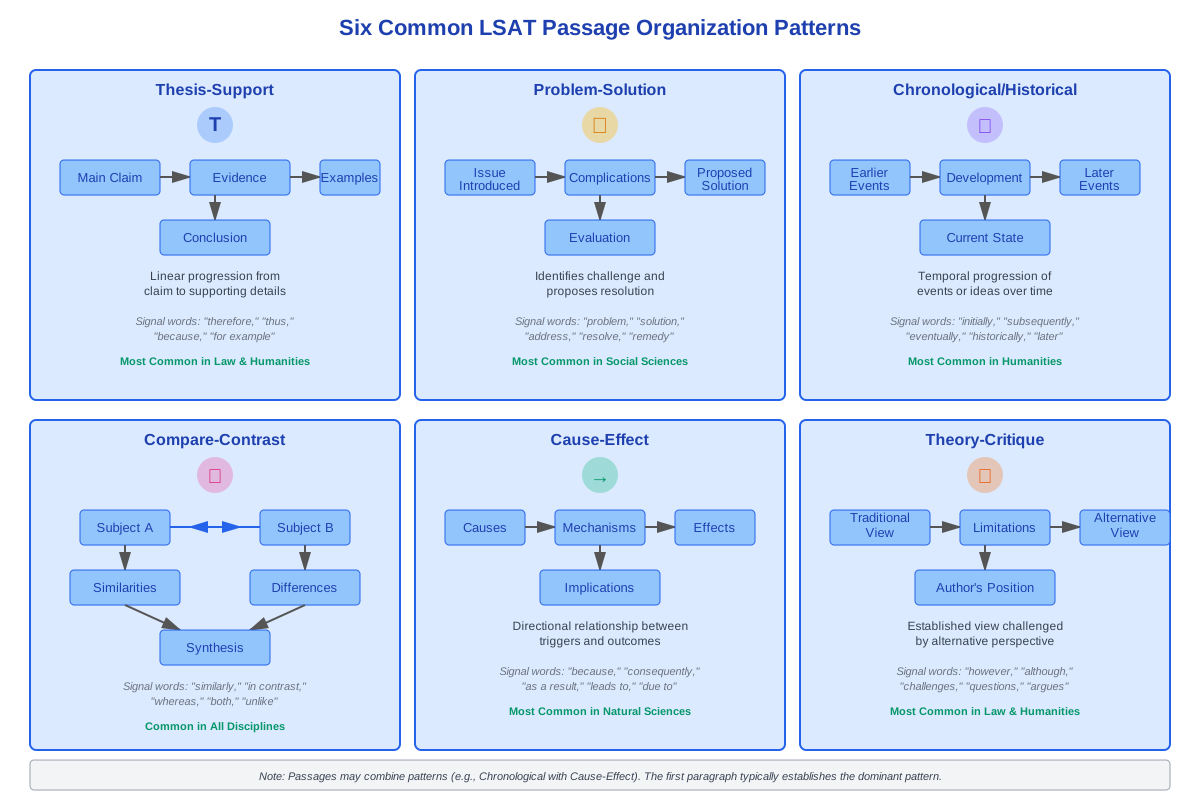
LSAT passage organization patterns fall into six major categories, each with distinctive characteristics and common variations. Understanding these patterns enables test-takers to quickly categorize passages and adjust their reading strategy accordingly.
1. Theory/Critique Pattern
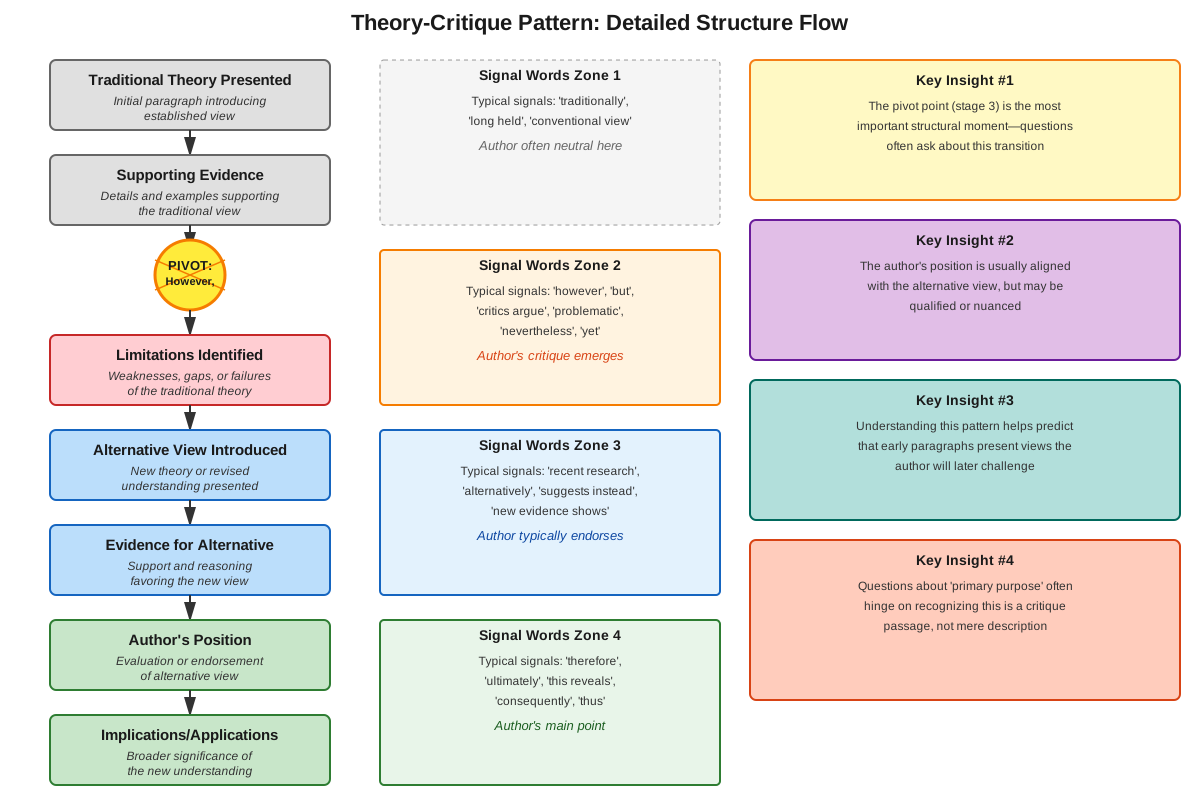
The theory/critique pattern presents an idea, theory, or viewpoint in the opening paragraphs, then introduces criticism, limitations, or alternative perspectives. This is one of the most common structures on the LSAT, appearing in approximately 20-25% of passages.
Structure:
- Paragraph 1: Introduces a theory, conventional wisdom, or established viewpoint
- Paragraph 2-3: Presents criticisms, limitations, or challenges to the theory
- Paragraph 4 (if present): May offer synthesis, resolution, or the author's position
Key transitions: "However," "Critics argue," "This view has been challenged," "Recent research suggests," "Despite these claims"
Strategic approach: Pay close attention to the shift from presentation to critique, as questions often focus on the relationship between the theory and its critics, or ask about the author's attitude toward each position.
2. Comparison/Contrast Pattern
The comparison/contrast pattern examines two or more subjects, theories, approaches, or phenomena, highlighting their similarities and differences. This pattern appears frequently in humanities and social science passages.
Structure:
- Paragraph 1: Introduces the subjects being compared
- Paragraphs 2-3: Either discusses each subject separately (block method) or alternates between subjects point-by-point (alternating method)
- Final paragraph: May synthesize or evaluate the relative merits of each
Key transitions: "In contrast," "Similarly," "Unlike," "Whereas," "On the other hand," "Both X and Y"
Strategic approach: Create a mental or written chart tracking which characteristics belong to which subject. Questions often test whether students can keep the subjects distinct or identify accurate comparisons.
3. Problem/Solution Pattern
The problem/solution pattern identifies a challenge, dilemma, or question, then presents one or more proposed solutions or responses. This structure is particularly common in social science and natural science passages.
Structure:
- Paragraph 1: Establishes the problem or question
- Paragraphs 2-3: Presents potential solutions, responses, or approaches
- Final paragraph: May evaluate the effectiveness of solutions or indicate which is most promising
Key transitions: "One approach," "To address this issue," "A potential solution," "This problem might be resolved by"
Strategic approach: Clearly distinguish between the problem description and the solution proposals. Questions often ask about the relationship between specific solutions and the problem, or test whether students understand the limitations of proposed solutions.
4. Chronological/Historical Development Pattern
The chronological pattern traces the evolution of an idea, theory, artistic movement, or scientific understanding over time. This pattern appears frequently in humanities passages and some science passages.
Structure:
- Paragraph 1: Introduces the subject and its earliest form or understanding
- Paragraphs 2-3: Traces developments through time periods or stages
- Final paragraph: May discuss current understanding or future directions
Key transitions: "Initially," "Subsequently," "By the mid-twentieth century," "More recently," "Eventually," "Over time"
Strategic approach: Track the timeline mentally and note major shifts or turning points. Questions often test whether students can sequence events correctly or understand how earlier developments influenced later ones.
5. Cause/Effect Pattern
The cause/effect pattern explains why something occurs or what consequences follow from a particular phenomenon. This structure is common in natural science passages and some social science passages.
Structure:
- Paragraph 1: Introduces the phenomenon or effect
- Paragraphs 2-3: Explains causes, mechanisms, or resulting consequences
- May work forward (cause → effect) or backward (effect → cause)
Key transitions: "As a result," "Consequently," "Because," "This leads to," "The reason for," "Due to"
Strategic approach: Clearly map the causal chain and distinguish between direct causes, contributing factors, and effects. Questions often test whether students understand the direction and strength of causal relationships.
6. Descriptive/Analytical Pattern
The descriptive/analytical pattern examines a subject in detail, breaking it down into components, characteristics, or aspects without necessarily arguing for a particular position. This pattern is less common but appears in passages that explore complex phenomena or artistic works.
Structure:
- Paragraph 1: Introduces the subject
- Paragraphs 2-3: Examines different aspects, components, or characteristics
- Organization may be by importance, category, or another logical principle
Key transitions: "Another aspect," "Additionally," "Furthermore," "A related characteristic"
Strategic approach: Identify the organizing principle (what determines the order of discussion) and track which details relate to which aspect of the subject.
Paragraph Function Within Organizational Patterns
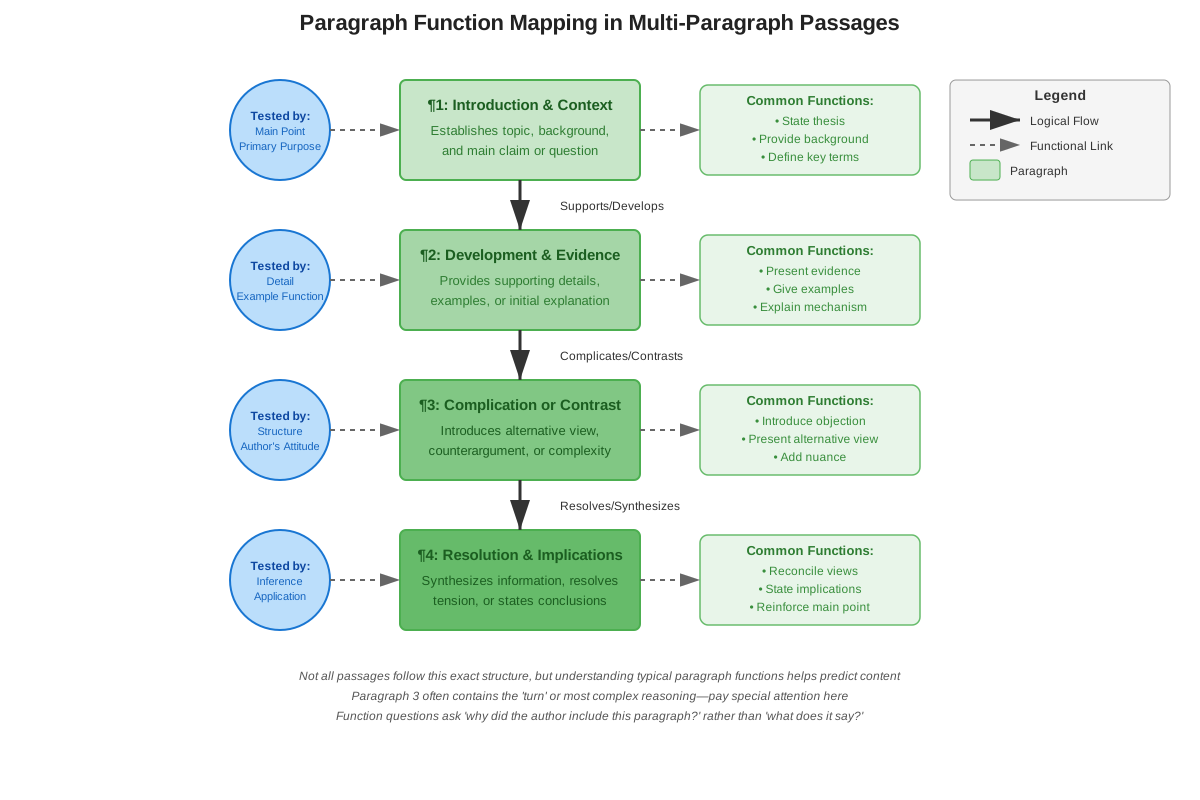
Beyond recognizing overall passage structure, successful test-takers understand the function each paragraph serves within the larger organizational pattern. Common paragraph functions include:
| Function | Purpose | Common Locations |
|---|---|---|
| Introduction | Establishes topic, context, or main question | Paragraph 1 |
| Background | Provides historical context or necessary information | Paragraphs 1-2 |
| Thesis/Main Claim | States the author's primary argument or position | Paragraph 1 or 2 |
| Support/Evidence | Offers examples, data, or reasoning supporting a claim | Middle paragraphs |
| Counterargument | Presents opposing views or potential objections | Middle paragraphs |
| Rebuttal | Responds to counterarguments | Following counterargument |
| Qualification | Acknowledges limitations or exceptions | Middle or final paragraphs |
| Synthesis/Conclusion | Integrates ideas or restates main points | Final paragraph |
Understanding these functions helps answer questions like "The author mentions X primarily in order to..." or "The second paragraph serves primarily to..."
Structural Keywords and Transition Signals
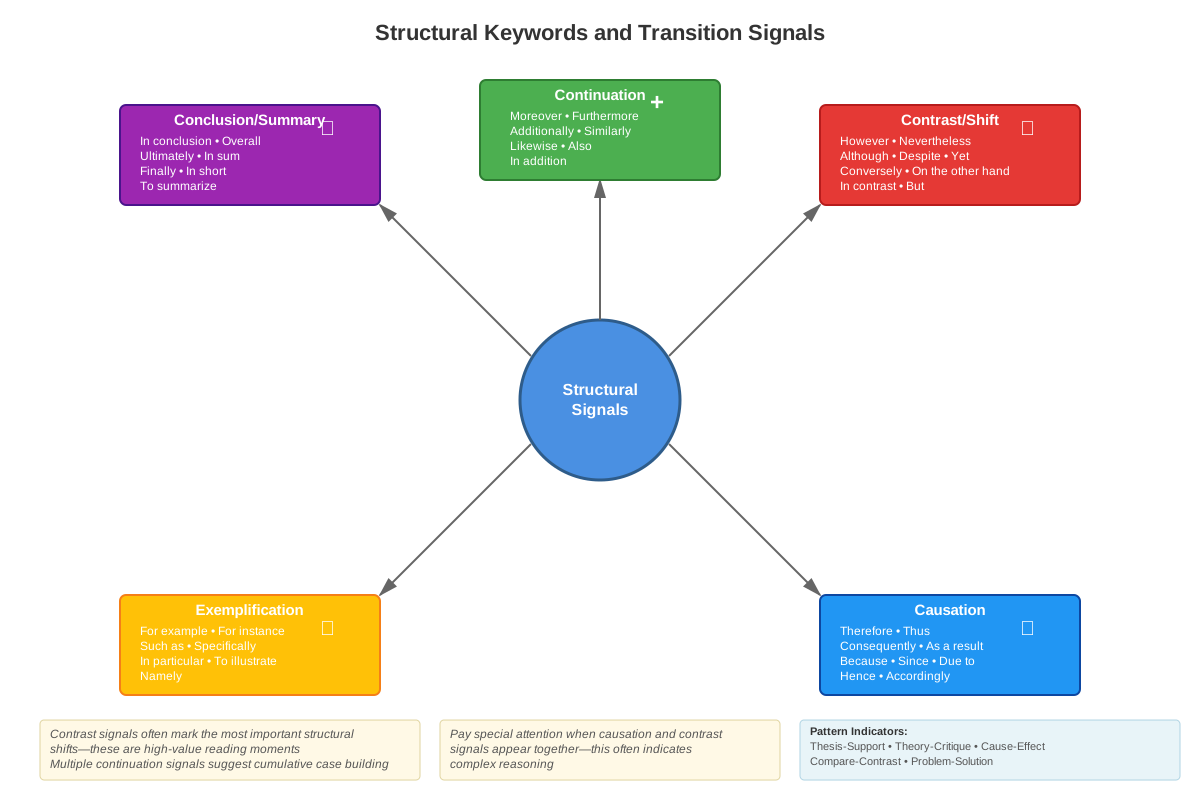
Structural keywords are linguistic markers that signal organizational patterns and relationships between ideas. Recognizing these keywords allows test-takers to anticipate structure and track the passage's logical flow.
Continuation signals (same direction): furthermore, additionally, moreover, also, in addition
Contrast signals (change direction): however, but, yet, nevertheless, despite, although, in contrast
Cause/effect signals: because, since, therefore, thus, consequently, as a result
Example signals: for instance, for example, such as, to illustrate
Emphasis signals: indeed, in fact, notably, especially, particularly
Sequence signals: first, second, finally, subsequently, then, next
Exam Tip: Circle or underline contrast signals as you read. These often mark the most important structural shifts in LSAT passages and are frequently tested.
Concept Relationships
The six primary organizational patterns are not mutually exclusive; many LSAT passages combine elements of multiple patterns. For example, a passage might use a chronological pattern to trace the development of a theory, then shift to a theory/critique pattern to examine modern challenges to that theory. Understanding how patterns can nest within or transition between one another enables more sophisticated structural analysis.
The relationship between organizational patterns and paragraph functions is hierarchical: the overall organizational pattern determines the sequence and purpose of paragraphs, while individual paragraph functions contribute to executing that larger pattern. For instance, in a theory/critique pattern, the first paragraph typically serves an "introduction" function while also presenting the theory, and the second paragraph serves a "counterargument" function while executing the critique portion of the pattern.
Structural keywords serve as the linguistic connective tissue that makes organizational patterns explicit. These transitions signal relationships between ideas and help readers track movement through the pattern. The presence of contrast keywords, for example, often signals the shift from theory to critique, or from one side of a comparison to another.
Relationship map:
Overall Organizational Pattern → determines → Sequence of Paragraph Functions → signaled by → Structural Keywords → enable → Reader's Structural Comprehension → improves → Question-Answering Accuracy
This chain demonstrates how mastering each component builds toward the ultimate goal of answering questions correctly and efficiently.
High-Yield Facts
⭐ Approximately 20-25% of Reading Comprehension questions directly test understanding of passage organization and structure
⭐ The theory/critique pattern is the most common organizational structure on the LSAT, appearing in roughly one-quarter of passages
⭐ Contrast keywords (however, but, yet, nevertheless) almost always mark structurally significant shifts that are tested in questions
⭐ The first sentence of each paragraph typically signals that paragraph's function within the overall organizational pattern
⭐ Questions asking about "the organization of the passage" or "the structure of the argument" require identifying the overall organizational pattern
- Passages can combine multiple organizational patterns, with one pattern dominating the overall structure and others appearing in individual paragraphs
- The comparison/contrast pattern can be organized using either the block method (discussing each subject completely before moving to the next) or the alternating method (going back and forth between subjects)
- Problem/solution passages often present multiple solutions, and questions frequently test whether students can distinguish between them or understand their relative advantages
- Chronological passages may include flashbacks or flash-forwards that disrupt strict temporal sequence, requiring careful attention to time markers
- The author's main point often appears at a structural turning point—after presenting background, after introducing a critique, or after comparing alternatives
- Function questions ("The author mentions X in order to...") are answered by understanding the paragraph's role within the overall organizational pattern
- Passages organized around a central argument typically place the thesis in the first or second paragraph, while descriptive passages may not have a single thesis statement
Quick check — test yourself on Passage organization patterns so far.
Try Flashcards →Common Misconceptions
Misconception: All LSAT passages follow a single, pure organizational pattern throughout.
Correction: Most passages combine elements of multiple patterns. A passage might use chronological organization in the first two paragraphs to provide background, then shift to theory/critique for the remainder. Recognizing these hybrid structures is essential for accurate comprehension.
Misconception: The organizational pattern is always explicitly stated in the passage.
Correction: While structural keywords provide clues, test-takers must actively infer the organizational pattern from the content and flow of ideas. The LSAT rewards students who can recognize implicit structure, not just explicit signposting.
Misconception: Identifying the organizational pattern is only useful for structure questions.
Correction: Understanding passage organization improves performance on all question types. It helps locate relevant information for detail questions, understand relationships for inference questions, and evaluate answer choices for main point questions.
Misconception: The first paragraph always contains the main point or thesis.
Correction: While the first paragraph often introduces the topic, the main point may appear in the second paragraph (after background information) or even later. Some passages build toward a thesis rather than stating it upfront.
Misconception: Comparison/contrast passages always present both subjects equally or neutrally.
Correction: Many comparison passages favor one subject over another or use the comparison to advance an argument. The author may compare two theories to show why one is superior, making the passage both comparative and argumentative.
Misconception: Chronological passages simply list events in order without analysis.
Correction: LSAT chronological passages typically trace developments to make an analytical point—showing how ideas evolved, why changes occurred, or what patterns emerge over time. The chronology serves an argumentative or explanatory purpose.
Misconception: Descriptive passages lack structure or organization.
Correction: Even purely descriptive passages follow organizational principles, such as moving from general to specific, organizing by category, or proceeding from most to least important. Identifying this organizing principle is crucial for understanding the passage.
Worked Examples
Example 1: Identifying Theory/Critique Pattern
Passage Excerpt:
For decades, economists have relied on the rational actor model, which assumes that individuals make economic decisions by carefully weighing costs and benefits to maximize their self-interest. This model has provided the foundation for countless economic theories and policy recommendations, from market regulation to tax policy.
However, behavioral economists have increasingly challenged this traditional view. Research by Kahneman and Tversky demonstrated that people systematically violate the predictions of rational actor theory, making decisions influenced by cognitive biases, emotional factors, and social context. Their prospect theory showed that people treat potential losses differently than equivalent gains, contradicting the rational actor model's assumption of consistent utility maximization.
Despite these challenges, some economists argue that the rational actor model remains useful as an approximation. They contend that while individuals may deviate from perfect rationality in laboratory settings, market forces and competition push real-world economic behavior toward rational outcomes.
Analysis:
Step 1: Identify the organizational pattern by examining the structure and transitions.
The first paragraph presents the "rational actor model" as an established theory that has been widely used. The second paragraph begins with "However," a key contrast signal, and introduces "behavioral economists" who "challenged this traditional view." The third paragraph begins with "Despite these challenges," indicating a response to the critique. This is a clear theory/critique pattern with an additional element of defense/response.
Step 2: Map the paragraph functions.
- Paragraph 1: Introduction and presentation of the theory (rational actor model)
- Paragraph 2: Critique (behavioral economics challenges)
- Paragraph 3: Qualified defense or response to critique
Step 3: Predict likely question types.
Questions might ask:
- "Which one of the following most accurately describes the organization of the passage?" (Answer: presents a theory, introduces challenges to it, then discusses a defense)
- "The author mentions Kahneman and Tversky primarily in order to..." (Answer: provide evidence for the behavioral economics critique)
- "The relationship between the first and second paragraphs is best described as..." (Answer: the second paragraph challenges claims made in the first)
Connection to learning objectives: This example demonstrates how to identify passage organization patterns in LSAT questions (Objective 1), explains the reasoning pattern behind the theory/critique structure (Objective 2), and shows how to apply this knowledge to predict and answer questions (Objective 3).
Example 2: Distinguishing Comparison/Contrast from Problem/Solution
Passage Excerpt A:
Two competing approaches have emerged in contemporary urban planning. New Urbanism advocates for mixed-use, walkable neighborhoods with diverse housing types, emphasizing community interaction and reduced automobile dependence. In contrast, conventional suburban development prioritizes single-family homes, separated land uses, and automobile-oriented infrastructure. While New Urbanism promotes density and public transportation, conventional development offers larger private lots and greater separation between residential and commercial areas.
Passage Excerpt B:
Urban sprawl has created significant environmental and social challenges, including increased carbon emissions, loss of agricultural land, and social isolation. To address these problems, some planners have advocated for New Urbanism, an approach emphasizing mixed-use, walkable neighborhoods. This strategy aims to reduce automobile dependence and create more sustainable communities. Other planners propose strengthening urban growth boundaries to contain sprawl, while still others suggest improving public transportation to existing suburban areas.
Analysis:
Excerpt A follows a comparison/contrast pattern:
- Introduces two approaches (New Urbanism vs. conventional suburban development)
- Uses contrast signals ("In contrast," "While")
- Discusses characteristics of each approach
- No problem is explicitly identified; the focus is on distinguishing the two approaches
Excerpt B follows a problem/solution pattern:
- Begins by identifying a problem (urban sprawl and its consequences)
- Uses problem-solution language ("To address these problems")
- Presents multiple potential solutions (New Urbanism, growth boundaries, improved transit)
- The focus is on responding to the identified problem
Key distinction: While both excerpts mention New Urbanism, Excerpt A uses it as one side of a comparison to understand different planning philosophies, while Excerpt B presents it as a solution to a specific problem. The organizational pattern depends on the author's purpose and the relationship between ideas, not just the topics discussed.
Strategic application: When reading the first paragraph of an LSAT passage, ask: "Is the author comparing/contrasting different things, or identifying a problem and proposing solutions?" This question helps quickly categorize the organizational pattern and adjust reading strategy accordingly.
Connection to learning objectives: This example shows how to distinguish between similar-seeming organizational patterns (Objective 4), demonstrates the reasoning behind each pattern (Objective 2), and illustrates how to apply this knowledge to actual passage analysis (Objective 3).
Exam Strategy
Initial Reading Strategy
When beginning an LSAT Reading Comprehension passage, invest the first 30-45 seconds in identifying the organizational pattern. Read the first paragraph carefully, noting:
- Whether it presents a theory, describes a problem, introduces subjects for comparison, or begins a chronological account
- The presence of structural keywords that signal the pattern
- The author's apparent purpose (to argue, explain, compare, or describe)
After the first paragraph, quickly scan the opening sentence of each subsequent paragraph to confirm or refine your understanding of the pattern. This initial investment pays dividends by making the rest of the passage more predictable and easier to navigate.
Trigger Words for Structure Questions
Questions explicitly testing organizational patterns often include these phrases:
- "Which one of the following most accurately describes the organization of the passage?"
- "The structure of the passage can best be described as..."
- "The author's primary purpose in the passage is to..."
- "The passage proceeds by..."
- "The relationship between the first and second paragraphs is..."
When you see these triggers, immediately recall the organizational pattern you identified during your initial reading. Eliminate answer choices that describe different patterns or mischaracterize the sequence of ideas.
Process of Elimination for Structure Questions
Eliminate answers that:
- Describe patterns not present in the passage (e.g., if there's no comparison, eliminate "compares and contrasts")
- Reverse the actual sequence (e.g., if the passage presents a theory then critiques it, eliminate "critiques a theory then presents it")
- Overstate or understate the author's role (e.g., if the author neutrally presents views, eliminate "advocates for" or "argues against")
- Include elements not present (e.g., if no solution is proposed, eliminate "proposes a solution")
Favor answers that:
- Accurately capture the sequence of major ideas
- Use neutral language when the author is neutral, and evaluative language when the author takes a position
- Match the level of detail in the passage (general answers for general passages, specific answers for detailed passages)
Time Allocation
Spend approximately:
- 30-45 seconds: Initial reading of paragraph 1 and scanning paragraph openings to identify organizational pattern
- 2.5-3 minutes: Complete reading of the passage with the organizational pattern in mind
- 30-45 seconds per question: Answering questions, with structure questions often taking slightly less time because you've already identified the pattern
Understanding organizational patterns actually saves time by making the passage more predictable and reducing the need to re-read when answering questions.
Annotation Strategy
While reading, use minimal annotations to track structure:
- Bracket or mark the location where the passage shifts from one major section to another (e.g., from theory to critique)
- Circle key contrast words (however, but, yet) that signal structural shifts
- Write brief margin notes indicating paragraph function (e.g., "theory," "critique," "example")
These minimal annotations create a structural map that makes navigation during questions much faster.
Memory Techniques
The "TTCPCD" Mnemonic for Six Primary Patterns
Remember the six main organizational patterns with TTCPCD:
- Theory/Critique
- Time/Chronological
- Comparison/Contrast
- Problem/Solution
- Cause/Effect
- Descriptive/Analytical
Visualize these as six different architectural blueprints, each creating a different type of building (passage).
The "SHIFT" Acronym for Recognizing Pattern Changes
When you encounter contrast keywords, remember SHIFT to recognize structural transitions:
- Signal word appears (however, but, yet)
- Halt and note the transition
- Identify what's changing (from theory to critique, from one subject to another)
- Function of new section (counterargument, alternative view, limitation)
- Track the relationship between sections
Visualization: The Passage as a Journey
Visualize each organizational pattern as a different type of journey:
- Theory/Critique: Walking forward, then turning around to look back critically
- Comparison/Contrast: Walking parallel paths and noting differences
- Problem/Solution: Encountering an obstacle and finding ways around it
- Chronological: Walking a timeline from past to present
- Cause/Effect: Following a chain of dominoes falling
- Descriptive: Examining an object from multiple angles
This spatial metaphor helps encode organizational patterns in memory and makes them easier to recognize during the test.
The "First Sentence Rule"
Remember: "First sentences forecast functions." The opening sentence of each paragraph typically signals that paragraph's role in the overall structure. Train yourself to pay special attention to these sentences, as they provide the clearest structural cues.
Summary
Passage organization patterns are the structural frameworks that authors use to arrange ideas in LSAT Reading Comprehension passages. The six primary patterns—theory/critique, comparison/contrast, problem/solution, chronological/historical development, cause/effect, and descriptive/analytical—appear consistently across all passage types and are directly tested in approximately 20-25% of questions. Successful test-takers identify the organizational pattern within the first paragraph by recognizing structural keywords, understanding paragraph functions, and noting the author's purpose. This structural awareness enables more efficient reading, faster question-answering, and better performance across all question types, not just those explicitly asking about structure. Mastering organizational patterns requires understanding both the overall blueprint of the passage and the function of individual paragraphs within that structure, recognizing that many passages combine elements of multiple patterns. The key to success is active reading that constantly asks "How is this passage organized?" and "What function does this paragraph serve?"—questions that transform passive comprehension into strategic analysis.
Key Takeaways
- The six primary LSAT passage organization patterns (theory/critique, comparison/contrast, problem/solution, chronological, cause/effect, and descriptive) account for the vast majority of passage structures
- Identifying the organizational pattern within the first paragraph enables more efficient reading and more accurate question-answering throughout the passage
- Structural keywords—especially contrast signals like "however," "but," and "yet"—mark the most important transitions and are frequently tested
- Understanding paragraph function within the overall organizational pattern is essential for answering "The author mentions X in order to..." questions
- Most LSAT passages combine elements of multiple organizational patterns rather than following a single pure pattern throughout
- Structure questions are often among the fastest to answer when you've correctly identified the organizational pattern during your initial reading
- Recognizing organizational patterns improves performance on all question types, not just those explicitly asking about structure, by creating a mental map of the passage
Related Topics
Main Idea and Primary Purpose: Understanding organizational patterns directly supports identifying the main idea, as the structure often reveals the author's central claim or purpose. A theory/critique passage, for example, often has a main idea related to the validity or limitations of the theory discussed.
Paragraph Function Questions: These questions explicitly test understanding of how individual paragraphs contribute to the overall organizational pattern. Mastering organizational patterns makes these questions significantly easier.
Argument Structure and Reasoning: Many LSAT passages are organized around arguments, and understanding organizational patterns helps identify premises, conclusions, counterarguments, and rebuttals—skills that transfer directly to the Logical Reasoning section.
Comparative Reading: The comparative reading passage (one of the four passages in each Reading Comprehension section) requires understanding how two shorter passages relate to each other, which is essentially an exercise in recognizing organizational patterns across texts.
Tone and Attitude: The organizational pattern often reveals the author's attitude. A passage that presents a theory then extensively critiques it likely indicates skepticism, while a problem/solution passage may indicate optimism about proposed solutions.
Practice CTA
Now that you understand passage organization patterns, it's time to apply this knowledge to actual LSAT passages. Work through the practice questions associated with this topic, actively identifying the organizational pattern in each passage before attempting the questions. As you practice, you'll develop the pattern recognition skills that separate high scorers from average performers. Create flashcards for the six primary patterns and their characteristics, and review them regularly until pattern identification becomes automatic. Remember: every passage you read is an opportunity to strengthen these skills. The investment you make in mastering organizational patterns will pay dividends across every Reading Comprehension passage you encounter on test day. You've built the foundation—now build the skill through deliberate practice!
Sign up free to keep reading
Create a free AnvayaPrep account to finish this LSAT guide on Passage organization patterns — plus flashcards and practice questions.