Overview
Scholarly debate passages represent one of the most intellectually demanding and frequently tested passage types in LSAT Reading Comprehension. These passages present two or more competing viewpoints on a specific academic or theoretical question, requiring test-takers to track multiple perspectives, understand nuanced disagreements, and identify points of convergence and divergence between scholars. Unlike straightforward expository passages that present information linearly, scholarly debate passages demand that readers maintain simultaneous awareness of multiple argumentative threads while evaluating the logical relationships between competing claims.
The LSAT consistently features scholarly debate passages because they test the precise analytical skills required for legal education and practice. Attorneys must regularly navigate competing interpretations of statutes, precedents, and constitutional principles—skills directly mirrored in the ability to parse academic disagreements. These passages typically appear in one of two formats: either as a single passage presenting multiple viewpoints sequentially, or as "Comparative Reading" passages where two shorter texts by different authors are paired together. Understanding how to efficiently process these debates is essential for achieving a competitive LSAT score, as questions about these passages frequently test the most sophisticated reading comprehension skills.
Mastering lsat scholarly debate passages builds directly upon fundamental passage fundamentals and enhances overall reading comprehension abilities. The skills developed here—identifying argumentative structure, recognizing points of agreement and disagreement, and understanding how evidence supports competing claims—transfer seamlessly to analyzing all other passage types. Students who excel at scholarly debate passages demonstrate the advanced critical reading abilities that correlate strongly with success in the upper score ranges.
Learning Objectives
- [ ] Identify how scholarly debate passages appear in LSAT questions
- [ ] Explain the reasoning pattern behind scholarly debate passages
- [ ] Apply scholarly debate passages to solve LSAT-style problems accurately
- [ ] Distinguish between points of agreement and disagreement among scholars in a passage
- [ ] Recognize the structural markers that signal transitions between competing viewpoints
- [ ] Evaluate how evidence is deployed differently by scholars supporting opposing positions
- [ ] Predict question types most commonly associated with scholarly debate passages
Prerequisites
- Basic passage structure recognition: Understanding how LSAT passages are organized with main ideas, supporting details, and conclusions is essential because scholarly debate passages layer multiple argumentative structures simultaneously.
- Argument identification skills: The ability to recognize claims, evidence, and reasoning is necessary because each scholar's position constitutes a distinct argument that must be tracked independently.
- Active reading techniques: Proficiency in annotation and mental mapping enables readers to maintain clarity when tracking multiple competing perspectives within a single passage.
- Vocabulary for academic discourse: Familiarity with terms like "contends," "argues," "posits," and "challenges" helps identify when the passage shifts between different scholarly positions.
Why This Topic Matters
Scholarly debate passages appear with remarkable consistency on the LSAT, typically constituting 25-40% of all Reading Comprehension passages on any given test. The LSAT includes four Reading Comprehension passages per test, and at least one—often two when counting Comparative Reading—will present competing scholarly viewpoints. This frequency makes scholarly debate passages one of the highest-yield topics for focused preparation.
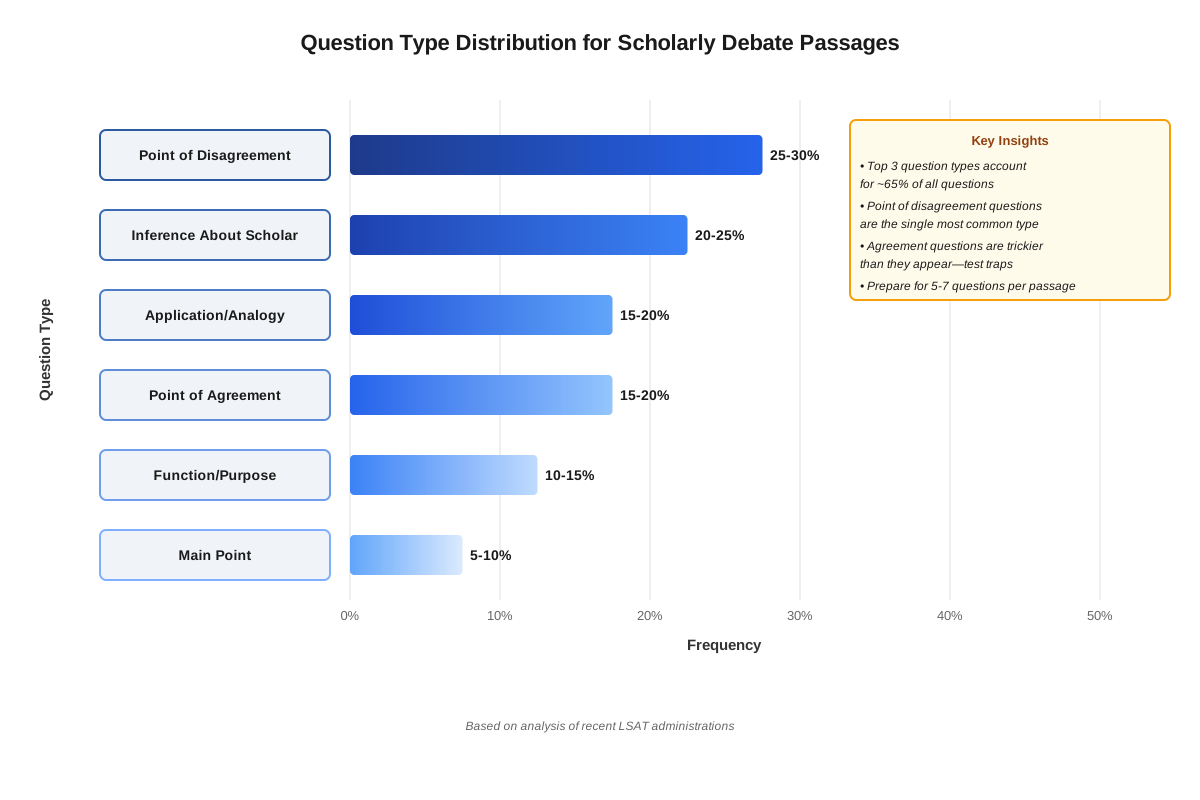
These passages generate questions across all major question types, but they particularly favor questions about: (1) identifying points of agreement or disagreement between scholars, (2) determining what one scholar would likely say about the other's position, (3) understanding the function of specific evidence in supporting one view over another, and (4) recognizing the logical structure of competing arguments. Questions stemming from scholarly debate passages tend to be among the most difficult on the test, with correct answer rates often 10-15% lower than questions from straightforward expository passages.
In real-world legal practice, attorneys constantly engage with scholarly debates—whether analyzing competing interpretations in legal scholarship, navigating circuit splits where different courts have reached opposing conclusions, or presenting alternative theories of a case. The cognitive skills tested by these passages—maintaining multiple perspectives simultaneously, identifying subtle distinctions between similar positions, and recognizing unstated implications of competing claims—are precisely the skills that distinguish exceptional legal reasoning from merely adequate performance.
Core Concepts
Structure of Scholarly Debate Passages
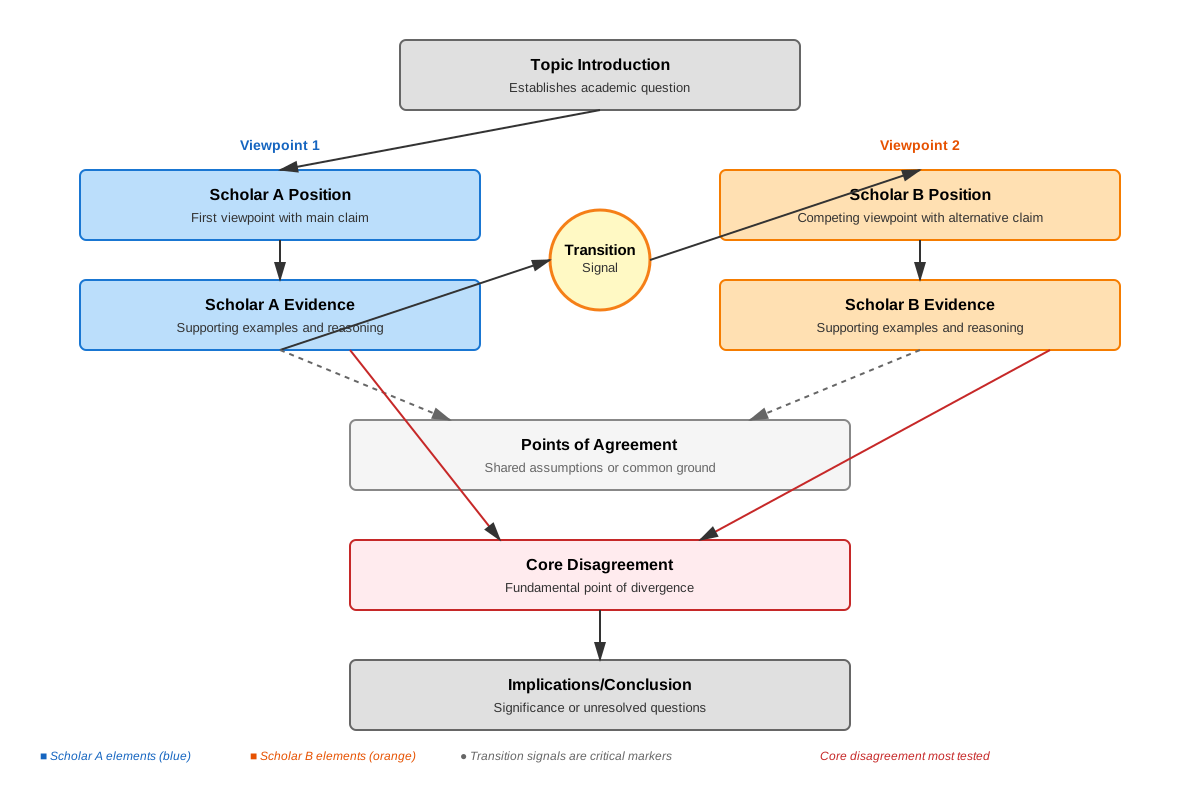
Scholarly debate passages follow predictable organizational patterns that, once recognized, dramatically improve comprehension efficiency. The most common structure presents Scholar A's position in the first one or two paragraphs, followed by Scholar B's competing or contrasting view in subsequent paragraphs. Transitional phrases like "However, other scholars argue," "In contrast," or "Challenging this view" signal the shift between perspectives. Some passages present a third, mediating position that attempts to synthesize or reconcile the competing views, typically appearing in the final paragraph.
The passage typically opens with background context establishing the scholarly question or problem under debate. This introductory material is crucial because it defines the scope of disagreement—scholars may agree on many foundational points while disagreeing sharply on specific interpretations or implications. The passage then presents each scholar's central claim, supporting evidence, and reasoning. Strong readers identify not just what each scholar believes, but why they believe it and what assumptions underlie their positions.
Types of Scholarly Disagreements
Scholarly debates in LSAT passages fall into several recurring categories. Interpretive disagreements involve competing readings of the same evidence—for example, two historians examining identical documents but reaching different conclusions about causation. Methodological disagreements center on which approach or framework should be used to study a phenomenon, such as whether literary texts should be analyzed through formalist or historicist lenses. Evaluative disagreements involve differing assessments of significance or value, like scientists debating whether a particular research finding represents a major breakthrough or an incremental advance.
Understanding the type of disagreement helps predict question content and identify relevant passage details. Interpretive disagreements generate questions about how each scholar would interpret specific evidence. Methodological disagreements produce questions about the assumptions underlying each approach. Evaluative disagreements lead to questions about the criteria each scholar uses to make judgments.
Points of Agreement vs. Disagreement
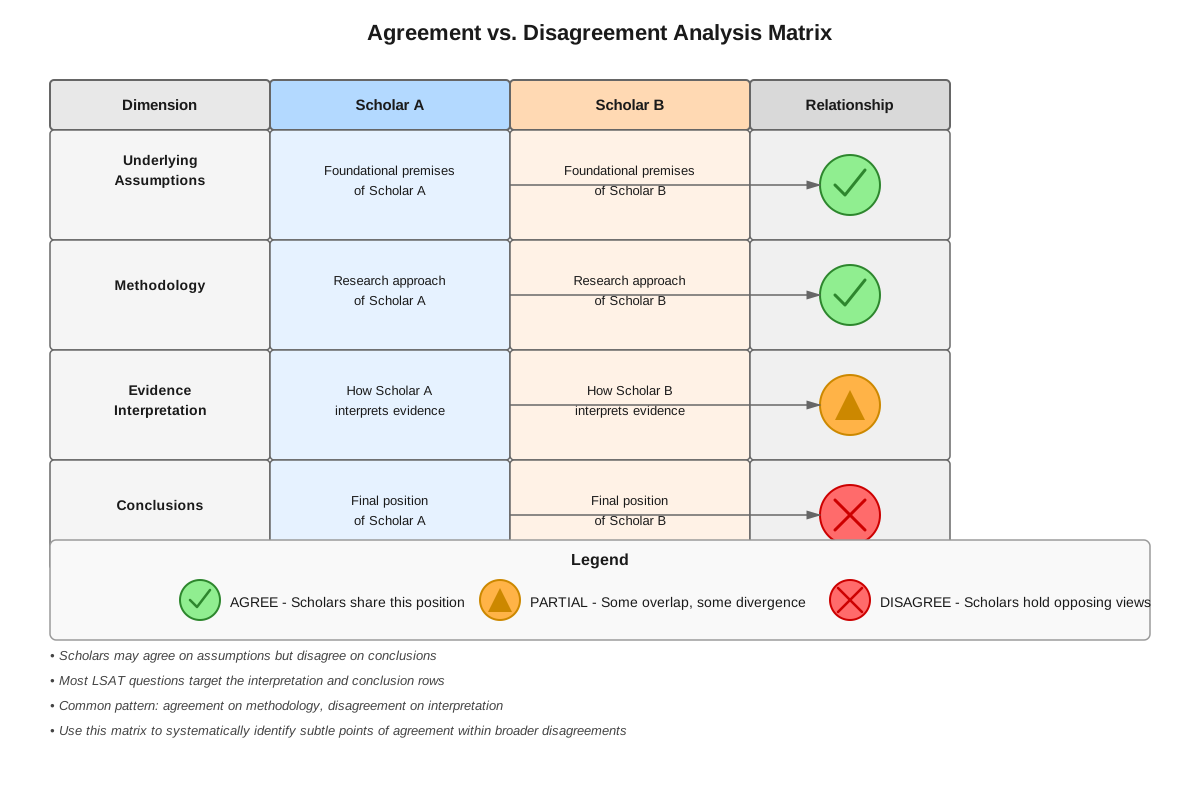
A critical skill for scholarly debate passages involves distinguishing what scholars agree upon from what they dispute. The LSAT frequently tests this distinction because it requires careful, nuanced reading. Scholars often share substantial common ground—accepting the same basic facts, acknowledging similar constraints, or pursuing related goals—while disagreeing on specific interpretations, implications, or solutions.
Identifying points of agreement requires attention to statements that both scholars would endorse. These often appear in the introductory context or in concessions one scholar makes about the other's position ("While X is correct that..."). Points of disagreement are typically more explicit, marked by contrasting language and direct challenges. However, the most sophisticated questions test implicit disagreements—positions that logically conflict even when scholars don't directly address each other's claims.
| Element | Points of Agreement | Points of Disagreement |
|---|---|---|
| Typical Location | Introduction, concessions, shared assumptions | Body paragraphs, explicit contrasts, conclusions |
| Language Markers | "Both acknowledge," "scholars agree," "it is accepted that" | "However," "in contrast," "challenges," "disputes" |
| Question Frequency | Moderate (15-20% of questions) | High (40-50% of questions) |
| Difficulty Level | Medium to High | Medium to Very High |
Evidence Deployment in Debates
Each scholar in a debate passage uses evidence strategically to support their position. Strong readers track not just what evidence appears, but how each scholar interprets it. The same piece of evidence may be cited by both scholars but given different significance or meaning. Alternatively, scholars may rely on entirely different bodies of evidence, revealing underlying methodological commitments.
Questions frequently ask how one scholar would respond to evidence cited by another, requiring readers to extrapolate from stated positions to unstated implications. This demands understanding the logical structure of each argument well enough to predict how it would handle new or contrary information.
Comparative Reading Format
When scholarly debates appear as Comparative Reading passages, two shorter texts (typically 15-25 lines each) present related but distinct perspectives. These passages may feature scholars directly disagreeing, or they may present complementary approaches to related questions. The key difference from single-passage debates is that each text stands alone as a complete mini-argument, whereas single-passage debates integrate multiple perspectives into one continuous text.
Comparative Reading questions emphasize relationships between passages: How would Author A respond to Author B's claim? What do both passages suggest about a particular issue? How do the passages differ in tone, purpose, or scope? Efficient readers of Comparative Reading passages read Passage A completely, briefly note its main point and structure, then read Passage B while actively comparing it to Passage A.
Authorial Voice vs. Scholar's Voice
A subtle but important distinction in scholarly debate passages involves separating the passage author's voice from the scholars' voices. The passage author typically maintains neutrality, presenting each position fairly without endorsing either. However, subtle cues—like the amount of space devoted to each view, the strength of evidence presented, or qualifying language—may suggest the author's perspective.
Questions sometimes ask about the passage author's attitude toward the debate or purpose in presenting it. These questions require distinguishing between what the scholars claim and what the author does in presenting those claims. The author might aim to illustrate the complexity of an issue, trace the evolution of scholarly thought, or demonstrate the limitations of current approaches—purposes distinct from any individual scholar's goals.
Concept Relationships
The concepts within scholarly debate passages form an interconnected system where understanding one element enhances comprehension of others. The structure of scholarly debate passages provides the framework within which all other elements operate—recognizing this structure enables efficient identification of types of scholarly disagreements and helps distinguish points of agreement from points of disagreement.
Understanding types of scholarly disagreements (interpretive, methodological, evaluative) directly informs how readers should track evidence deployment, since different disagreement types involve different uses of evidence. Interpretive disagreements feature competing readings of shared evidence, while methodological disagreements may involve entirely different evidence bases.
The skill of distinguishing points of agreement vs. disagreement depends on recognizing authorial voice vs. scholar's voice, since the passage author's neutral presentation of common ground differs from scholars' explicit acknowledgments of shared positions. This distinction becomes especially important in Comparative Reading format, where the absence of an integrating authorial voice requires readers to independently identify relationships between passages.
Relationship Map:
Passage Structure Recognition → Enables → Identifying Disagreement Types → Guides → Tracking Evidence Deployment → Supports → Distinguishing Agreement/Disagreement → Requires → Separating Authorial/Scholarly Voices → All Skills Integrate in → Comparative Reading Analysis
High-Yield Facts
⭐ Scholarly debate passages appear in approximately 25-40% of all LSAT Reading Comprehension passages, making them one of the most frequently tested passage types.
⭐ The most common question types for scholarly debate passages ask about points of disagreement, how one scholar would respond to another's claim, and the function of specific evidence in supporting competing positions.
⭐ Transitional phrases like "However," "In contrast," "Other scholars argue," and "Challenging this view" reliably signal shifts between competing scholarly positions.
⭐ Scholars in debate passages often agree on foundational facts and background context while disagreeing on interpretations, implications, or methodological approaches.
⭐ Questions asking what both scholars would agree with are among the most difficult, requiring identification of implicit common ground rather than explicit statements.
- Comparative Reading passages always involve some form of relationship between texts, whether direct disagreement, complementary perspectives, or different approaches to related questions.
- The passage author typically maintains neutrality in presenting scholarly debates, though subtle cues may reveal the author's perspective on the debate's significance.
- Evidence in scholarly debate passages often serves dual purposes: supporting one scholar's position while potentially being reinterpreted by the opposing scholar.
- The final paragraph of scholarly debate passages frequently presents either a third mediating position or the passage author's assessment of the debate's current state.
- Questions about scholarly debate passages have correct answer rates approximately 10-15% lower than questions from straightforward expository passages, indicating higher difficulty.
- Scholars may disagree about the significance of agreed-upon facts, creating disagreements that are evaluative rather than factual.
- The scope of disagreement is typically narrower than test-takers initially perceive—scholars often share more common ground than their contrasting positions suggest.
Quick check — test yourself on Scholarly debate passages so far.
Try Flashcards →Common Misconceptions
Misconception: Scholars in debate passages disagree about everything and share no common ground. → Correction: Scholars typically agree on substantial foundational material, including basic facts, the importance of the question being debated, and often the general framework for analysis. Their disagreements are usually specific and focused, even when strongly stated. Identifying this common ground is essential for answering questions about points of agreement.
Misconception: The passage author always favors one scholar's position over the other. → Correction: LSAT passage authors typically maintain strict neutrality when presenting scholarly debates, giving fair representation to each perspective. While subtle cues about the author's view may exist, assuming the author endorses one position often leads to incorrect answers. Questions about the author's purpose usually involve presenting the debate itself, not advocating for one side.
Misconception: In Comparative Reading, Passage A and Passage B must directly contradict each other. → Correction: Comparative Reading passages may present direct disagreements, but they often feature complementary perspectives, different approaches to related questions, or specific and general treatments of the same topic. The relationship between passages varies considerably, and assuming direct contradiction can cause misinterpretation.
Misconception: Evidence cited by one scholar automatically undermines the opposing scholar's position. → Correction: Evidence in scholarly debates is often subject to multiple interpretations. The same evidence may be acknowledged by both scholars but given different significance or meaning. Strong answers recognize that evidence can be compatible with multiple interpretive frameworks.
Misconception: The scholar whose position appears first in the passage represents the older or more traditional view. → Correction: The order of presentation does not reliably indicate chronology or scholarly consensus. The LSAT presents positions in various orders for structural and rhetorical reasons unrelated to which view is more established or recent.
Misconception: Questions about scholarly debate passages always have obvious trigger words like "agree" or "disagree." → Correction: While many questions explicitly ask about agreement or disagreement, others test the same concepts indirectly by asking how one scholar would respond to a claim, what assumption underlies a position, or what evidence would strengthen one view. Recognizing these as debate-structure questions requires understanding the underlying concepts, not just spotting keywords.
Worked Examples
Example 1: Identifying Points of Agreement and Disagreement
Passage Summary: Two art historians debate the influence of Japanese prints on French Impressionist painters. Scholar A argues that Japanese prints fundamentally transformed Impressionist composition, citing specific formal elements like asymmetrical framing and flattened perspective. Scholar B contends that while Japanese prints were admired by Impressionists, the movement's innovations derived primarily from European artistic traditions and scientific discoveries about light and color perception.
Question: The two scholars would be most likely to agree on which of the following?
Answer Choices:
(A) Japanese prints were widely collected by French Impressionist painters
(B) Asymmetrical framing was the most important compositional innovation of Impressionism
(C) Scientific discoveries about light perception had minimal influence on Impressionist technique
(D) European artistic traditions were incompatible with Japanese aesthetic principles
(E) The formal elements of Japanese prints were superior to those of European art
Analysis:
Step 1: Identify what each scholar explicitly states and what they logically must accept.
Scholar A's position: Japanese prints fundamentally transformed Impressionist composition (strong claim about influence). This scholar must acknowledge that Impressionists encountered Japanese prints.
Scholar B's position: Japanese prints were admired but not the primary influence (weaker claim about influence). This scholar explicitly states prints were "admired," indicating Impressionists knew about and valued them.
Step 2: Evaluate each answer choice against both positions.
(A) Both scholars must accept that Impressionists had access to and interest in Japanese prints—Scholar A needs this to argue for influence, Scholar B explicitly mentions admiration. This represents common ground. STRONG CONTENDER
(B) Scholar A cites asymmetrical framing as evidence of Japanese influence, but doesn't claim it was "most important." Scholar B would likely reject this as overemphasizing Japanese influence. ELIMINATE
(C) Scholar B explicitly cites scientific discoveries as important, so would reject this. Scholar A doesn't address science, but the claim is too strong. ELIMINATE
(D) Neither scholar suggests incompatibility—Scholar A argues for successful integration, Scholar B doesn't claim traditions were incompatible. ELIMINATE
(E) Neither scholar makes comparative value judgments about superiority. This goes beyond both positions. ELIMINATE
Correct Answer: (A)
This question illustrates how agreement questions require finding common ground that both positions logically entail, even when scholars emphasize different aspects. Both scholars must accept that Impressionists engaged with Japanese prints—they disagree only about the degree and nature of influence.
Example 2: Predicting One Scholar's Response to Another's Evidence
Passage Summary: Two economists debate the causes of wage stagnation. Economist X argues that technological automation has eliminated middle-skill jobs, creating wage pressure. Economist Y contends that declining union membership and weakened labor protections better explain wage stagnation, noting that automation has occurred throughout history without producing similar wage effects.
Question: Economist X would most likely respond to Economist Y's historical observation about automation by:
Answer Choices:
(A) Denying that automation has occurred in previous historical periods
(B) Arguing that the current wave of automation differs qualitatively from previous technological changes
(C) Accepting that union decline is the sole cause of wage stagnation
(D) Claiming that historical wage data is unreliable and should not inform current policy
(E) Suggesting that automation and union decline are unrelated phenomena
Analysis:
Step 1: Understand Economist Y's challenge. Y points out that automation has historical precedent without similar wage effects, implying X's automation explanation is insufficient.
Step 2: Consider how X could defend their position while acknowledging Y's historical point.
X could: (1) distinguish current automation from historical precedent, (2) argue for multiple causes including automation, or (3) reinterpret the historical evidence.
Step 3: Evaluate answer choices for logical consistency with X's position.
(A) This would be factually indefensible and unnecessary—X doesn't need to deny historical automation. ELIMINATE
(B) This preserves X's core claim while addressing Y's challenge. X could argue that AI and robotics differ fundamentally from mechanization, making historical comparisons inapplicable. STRONG CONTENDER
(C) This abandons X's position entirely, which is illogical. Scholars defend their positions, potentially modifying but not abandoning them. ELIMINATE
(D) This is an extreme response unsupported by X's stated methodology. Questioning all historical data is too broad. ELIMINATE
(E) X doesn't need to claim these are unrelated—multiple factors can contribute to wage stagnation. This doesn't address Y's challenge. ELIMINATE
Correct Answer: (B)
This question demonstrates how scholars typically respond to challenges by refining rather than abandoning their positions. Economist X would most logically distinguish current automation from historical precedent, maintaining their core argument while acknowledging the historical observation. This pattern—defending a position by drawing distinctions—appears frequently in scholarly debate passages.
Exam Strategy
When approaching scholarly debate passages on the LSAT, implement a systematic reading strategy that prioritizes tracking multiple perspectives efficiently. During the first read-through, identify and mark (mentally or with notation) where each scholar's position begins and ends. Create a mental map: "Paragraphs 1-2: Scholar A's position; Paragraphs 3-4: Scholar B's position; Paragraph 5: Synthesis or author's assessment."
Trigger words and phrases that signal scholarly debate structure include:
- Introducing first position: "Some scholars argue," "According to [Name]," "One interpretation holds"
- Shifting to opposing view: "However," "In contrast," "Other scholars contend," "Challenging this view," "An alternative explanation"
- Indicating agreement: "Both acknowledge," "Scholars agree," "There is consensus that"
- Showing disagreement: "Disputes," "Rejects," "Takes issue with," "Contradicts"
For process-of-elimination, scholarly debate questions reward systematic evaluation:
- For agreement questions: Eliminate any choice that one scholar would clearly reject. The correct answer must be acceptable to both, even if neither explicitly states it.
- For disagreement questions: Eliminate choices about which scholars would agree or about which the passage provides no information regarding either scholar's view.
- For "response" questions (how would Scholar A respond to Scholar B's claim): Eliminate responses that abandon Scholar A's core position or that are too extreme. Scholars typically defend their positions by drawing distinctions or reinterpreting evidence, not by making extreme concessions.
- For evidence function questions: Eliminate answers that mischaracterize which scholar cites the evidence or that describe functions unsupported by the passage text.
Time allocation for scholarly debate passages should be slightly longer than for straightforward expository passages—approximately 4 minutes for reading and mapping the passage, then 6-7 minutes for questions. The additional reading time investment pays dividends by reducing confusion during question-answering. If time pressure is severe, prioritize understanding the core disagreement over tracking every supporting detail—questions about the main point of disagreement are more common than questions about minor supporting evidence.
When stuck between two answer choices, return to the passage text rather than reasoning abstractly. Scholarly debate questions reward precise textual support, and the difference between correct and incorrect answers often hinges on subtle distinctions that become clear when checking against the passage.
Memory Techniques
DEBATE - Acronym for approaching scholarly debate passages:
- Distinguish the scholars' positions clearly
- Evidence: track how each scholar uses it
- Agreement: identify common ground
- Boundaries: understand the scope of disagreement
- Author: separate author's voice from scholars' voices
- Transitions: mark where the passage shifts between views
- Extrapolate: predict how scholars would respond to new claims
Visualization strategy: Picture scholarly debate passages as a courtroom with two attorneys presenting opposing cases. The passage author is the court reporter, neutrally recording both arguments. This mental model helps maintain awareness that you're tracking multiple perspectives presented by a neutral third party, not reading a single unified argument.
The "Agreement Sandwich" technique: Points of agreement typically appear at the beginning (shared background/context) and sometimes at the end (acknowledged limitations or future research needs), with disagreement as the "filling" in the middle paragraphs. Visualizing this structure helps locate common ground quickly.
Color-coding mental map: Assign each scholar a color mentally (Scholar A = blue, Scholar B = red). As you read, mentally "highlight" claims in the appropriate color. Points of agreement are purple (blue + red). This creates a visual mental map of the passage structure.
Summary
Scholarly debate passages represent a high-frequency, high-difficulty passage type on the LSAT Reading Comprehension section, appearing in 25-40% of passages and generating questions that test sophisticated analytical reading skills. These passages present two or more competing scholarly viewpoints on an academic question, requiring readers to simultaneously track multiple perspectives, distinguish points of agreement from disagreement, and understand how evidence supports competing claims. Success with scholarly debate passages depends on recognizing predictable structural patterns—typically presenting Scholar A's position followed by Scholar B's contrasting view, with transitional phrases marking shifts between perspectives. The most challenging and frequently tested questions ask about points of disagreement, how one scholar would respond to another's claims, and the function of evidence in supporting competing positions. Efficient readers identify not just what each scholar believes but why they believe it, enabling prediction of how scholars would respond to new evidence or challenges. Mastering scholarly debate passages requires distinguishing the passage author's neutral voice from the scholars' argumentative voices, recognizing that scholars often share substantial common ground while disagreeing on specific interpretations, and understanding that evidence can be compatible with multiple interpretive frameworks. These skills transfer directly to legal reasoning, where attorneys must regularly navigate competing interpretations and maintain multiple perspectives simultaneously.
Key Takeaways
- Scholarly debate passages appear in 25-40% of LSAT Reading Comprehension sections and generate disproportionately difficult questions, making them essential for score improvement.
- Transitional phrases like "However," "In contrast," and "Other scholars argue" reliably signal shifts between competing positions and should be marked during active reading.
- Scholars typically agree on more foundational material than test-takers initially recognize—identifying this common ground is crucial for answering agreement questions correctly.
- Questions asking how one scholar would respond to another's claim reward understanding the logical structure of each argument, not just memorizing stated positions.
- The passage author maintains neutrality in presenting debates; distinguishing authorial voice from scholars' voices prevents misattribution of claims.
- Evidence in scholarly debates often serves multiple purposes and may be interpreted differently by competing scholars—the same facts can support different conclusions.
- Systematic passage mapping (tracking where each position begins and ends) and strategic time allocation (slightly more reading time, efficient question-answering) optimize performance on these challenging passages.
Related Topics
Comparative Reading Passages: Building directly on scholarly debate skills, Comparative Reading presents two shorter passages with related perspectives, requiring explicit comparison and relationship identification between texts. Mastering scholarly debate passages within single texts provides the foundation for analyzing relationships between separate passages.
Author's Purpose and Tone: Understanding why passage authors present scholarly debates and what attitude they take toward the competing positions deepens comprehension of passage structure and improves performance on questions about the author's perspective or primary purpose.
Argument Structure and Reasoning: Scholarly debate passages contain multiple embedded arguments, each with claims, evidence, and reasoning. Strengthening general argument analysis skills enhances the ability to track and evaluate competing scholarly positions.
Inference Questions in Reading Comprehension: Many questions about scholarly debate passages require inferring unstated implications of scholars' positions, such as predicting responses to new evidence or identifying underlying assumptions. Developing inference skills specifically for debate contexts improves accuracy on these high-difficulty questions.
Practice CTA
Now that you understand the structure, strategy, and common patterns of scholarly debate passages, it's time to apply these concepts to actual LSAT questions. Work through the practice questions and flashcards for this topic, paying special attention to identifying points of agreement and disagreement, tracking how evidence supports competing positions, and predicting how scholars would respond to challenges. Each practice question you complete strengthens your pattern recognition and builds the confidence needed to tackle these challenging passages efficiently on test day. Remember: scholarly debate passages reward systematic analysis and careful attention to textual support—skills that improve dramatically with focused practice. You've built the conceptual foundation; now reinforce it through application.
Sign up free to keep reading
Create a free AnvayaPrep account to finish this LSAT guide on Scholarly debate passages — plus flashcards and practice questions.