Overview
Art criticism passages represent one of the most intellectually demanding and frequently tested passage types in the LSAT Reading Comprehension section. These passages typically explore theoretical debates about the nature, purpose, and evaluation of art, often presenting competing perspectives on aesthetic theory, the role of the artist versus the audience, or the relationship between art and society. Unlike straightforward descriptive passages, art criticism passages require test-takers to navigate abstract philosophical arguments, trace the development of complex theoretical positions, and understand how critics build and defend their interpretations of artistic works or movements.
The LSAT regularly features art criticism passages because they effectively test the analytical skills central to legal reasoning: identifying argumentative structure, recognizing implicit assumptions, distinguishing between claims and evidence, and evaluating the strength of competing positions. These passages often discuss specific artists, movements, or works as concrete examples of broader theoretical principles, requiring students to move fluidly between abstract concepts and particular applications. The density of these passages—combined with specialized vocabulary from aesthetics and art history—makes them particularly challenging for test-takers who lack strategies for managing technical content under time pressure.
Mastering lsat art criticism passages is essential not only for maximizing Reading Comprehension scores but also for developing the broader analytical toolkit needed across all LSAT sections. The skills required to parse art criticism—identifying main arguments, recognizing authorial attitude, understanding how examples function within theoretical frameworks—directly transfer to analyzing legal reasoning, philosophical arguments, and scientific debates that appear elsewhere on the exam. Within the broader framework of passage subjects and strategies, art criticism passages serve as an excellent training ground for handling abstract, theory-heavy content that characterizes the most difficult LSAT passages.
Learning Objectives
- [ ] Identify how Art criticism passages appears in LSAT questions
- [ ] Explain the reasoning pattern behind Art criticism passages
- [ ] Apply Art criticism passages to solve LSAT-style problems accurately
- [ ] Recognize the common structural patterns in art criticism arguments (formalist vs. contextualist approaches, intentionalist vs. anti-intentionalist debates)
- [ ] Distinguish between descriptive claims about art and normative claims about how art should be evaluated or created
- [ ] Analyze how authors use specific artworks or artists as evidence for broader theoretical positions
- [ ] Evaluate the relationship between an art critic's theoretical framework and their interpretation of particular works
Prerequisites
- Basic reading comprehension skills: Ability to identify main ideas, supporting details, and authorial purpose in complex texts—essential for navigating the dense theoretical content typical of art criticism passages
- Understanding of argument structure: Recognition of premises, conclusions, and how evidence supports claims—necessary for tracking how critics build their theoretical positions
- Familiarity with LSAT question types: Knowledge of inference, main point, function, and attitude questions—required to apply passage comprehension to specific question formats
- Comfort with abstract reasoning: Ability to work with theoretical concepts and general principles—critical for understanding aesthetic theories that may lack concrete referents
Why This Topic Matters
Art criticism passages hold significant real-world relevance beyond the LSAT. The analytical frameworks used in aesthetic criticism—evaluating competing interpretations, assessing the role of context in meaning-making, and determining what counts as valid evidence—directly parallel the interpretive challenges lawyers face when analyzing legal texts, precedents, and statutory language. The ability to understand how theoretical commitments shape interpretive conclusions is fundamental to legal reasoning, making art criticism passages an excellent proxy for the intellectual work of legal practice.
From an exam perspective, art criticism passages appear with remarkable frequency on the LSAT. Statistical analysis of recent tests reveals that approximately 15-20% of Reading Comprehension passages fall into the arts and humanities category, with art criticism representing a substantial portion of these passages. These passages typically generate 5-8 questions each, making them high-stakes components of the Reading Comprehension section. The LSAT favors art criticism passages because they naturally generate the types of questions that test sophisticated reading skills: questions about the function of examples, the relationship between competing theories, implicit assumptions underlying critical positions, and the application of theoretical principles to new cases.
Common manifestations of art criticism passages include: debates between formalist critics (who focus on internal artistic elements) and contextualist critics (who emphasize historical and social context); discussions of whether artistic meaning resides in authorial intention, the work itself, or audience interpretation; examinations of how new artistic movements challenge or redefine aesthetic standards; and analyses of the relationship between aesthetic value and moral, political, or social concerns. These passages frequently feature specific artists or works as case studies for broader theoretical claims, requiring test-takers to understand both the particular examples and the general principles they illustrate.
Core Concepts
The Structure of Art Criticism Arguments
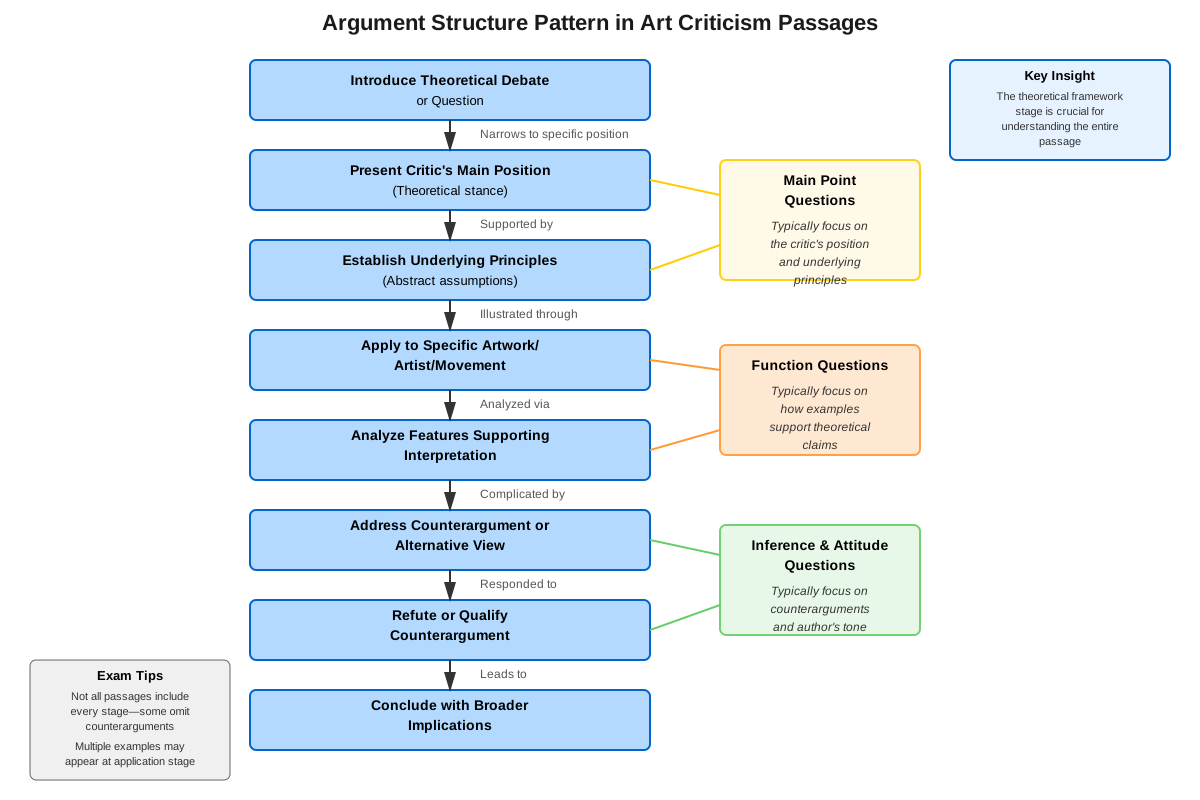
Art criticism passages on the LSAT typically follow a predictable argumentative structure that, once recognized, significantly aids comprehension. Most passages present a theoretical framework—a set of principles or assumptions about how art should be understood, evaluated, or created—and then apply this framework to specific cases. The passage may defend a single theoretical position against alternatives, present competing positions without fully endorsing either, or trace the evolution of critical thinking about a particular issue.
The opening paragraph usually establishes the critical question or debate at stake: What makes art valuable? How should we interpret artistic meaning? What role does historical context play in aesthetic judgment? Subsequent paragraphs typically develop the author's position (or present multiple positions), provide examples from specific artworks or artists, address potential objections, and draw broader conclusions. Understanding this structure allows test-takers to anticipate where key information will appear and how different parts of the passage relate to each other.
Formalism vs. Contextualism
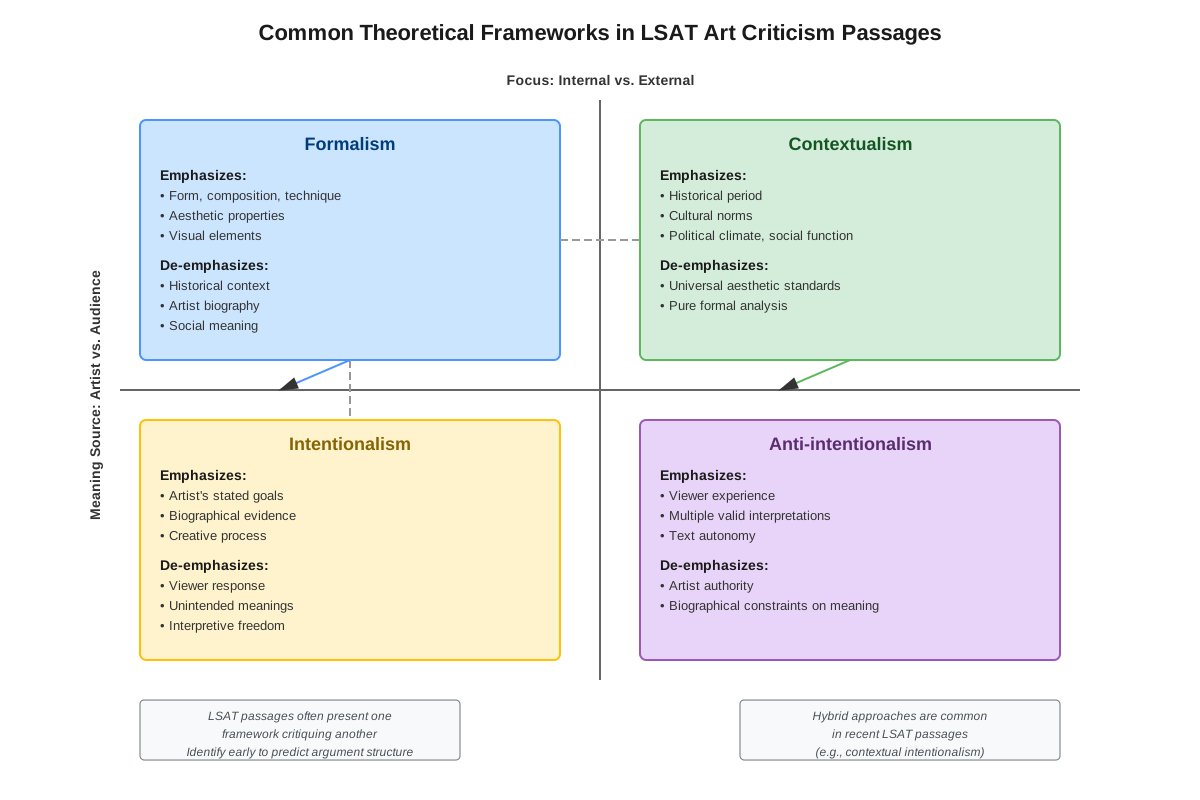
One of the most frequently tested distinctions in lsat art criticism passages is the divide between formalist and contextualist approaches to art. Formalist critics argue that the aesthetic value and meaning of an artwork reside primarily in its internal formal properties—composition, color, line, structure, technique—rather than in external factors like the artist's biography, historical circumstances, or social context. For formalists, proper art criticism focuses on analyzing how these formal elements work together to create aesthetic effects.
Contextualist critics, by contrast, maintain that artworks cannot be properly understood or evaluated in isolation from their historical, social, cultural, and biographical contexts. They argue that meaning emerges from the interaction between the work and its surrounding circumstances, and that ignoring context leads to impoverished or distorted interpretations. A contextualist might emphasize how a painting reflects the political tensions of its era or how an artist's personal experiences shaped their creative choices.
| Formalist Approach | Contextualist Approach |
|---|---|
| Focuses on internal formal properties | Emphasizes external historical/social context |
| Seeks universal aesthetic principles | Recognizes culturally specific meanings |
| Values close analysis of the work itself | Requires knowledge beyond the work |
| Treats art as autonomous from life | Views art as embedded in social reality |
| Prioritizes aesthetic over other values | May integrate aesthetic with moral/political concerns |
Intentionalism vs. Anti-Intentionalism
Another central debate in art criticism passages concerns the role of authorial intention in determining artistic meaning. Intentionalists argue that the correct interpretation of an artwork is the one that aligns with what the artist intended to communicate. For intentionalists, discovering the artist's intended meaning is the primary goal of interpretation, and biographical information, artist statements, and historical context serve as evidence for reconstructing this intention.
Anti-intentionalists reject the privileging of authorial intention, arguing instead that meaning resides in the work itself (as formalists might claim) or in the interaction between work and audience (as reader-response theorists maintain). They contend that artists may not fully understand their own works, that intentions can be unconscious or contradictory, and that artworks often communicate meanings their creators never intended. Some anti-intentionalists argue that once an artwork enters the public sphere, it becomes independent of its creator and open to multiple valid interpretations.
The Function of Examples in Art Criticism
LSAT art criticism passages regularly use specific artworks, artists, or movements as concrete examples to illustrate abstract theoretical principles. Understanding how these examples function is crucial for answering questions correctly. Examples may serve several purposes:
- Illustrative: The example demonstrates a general principle in action (e.g., citing a specific painting to show how formalist analysis works)
- Evidential: The example provides support for a theoretical claim (e.g., pointing to multiple works that share a feature to argue for a general pattern)
- Contrastive: The example highlights differences between approaches (e.g., showing how formalist and contextualist readings of the same work diverge)
- Problematic: The example presents a challenge or counterexample to a theory (e.g., a work that doesn't fit neatly into established categories)
Test-takers must distinguish between the specific details of examples and the broader principles they're meant to illustrate. Questions often ask about the function or purpose of an example rather than about the example's specific content.
Normative vs. Descriptive Claims
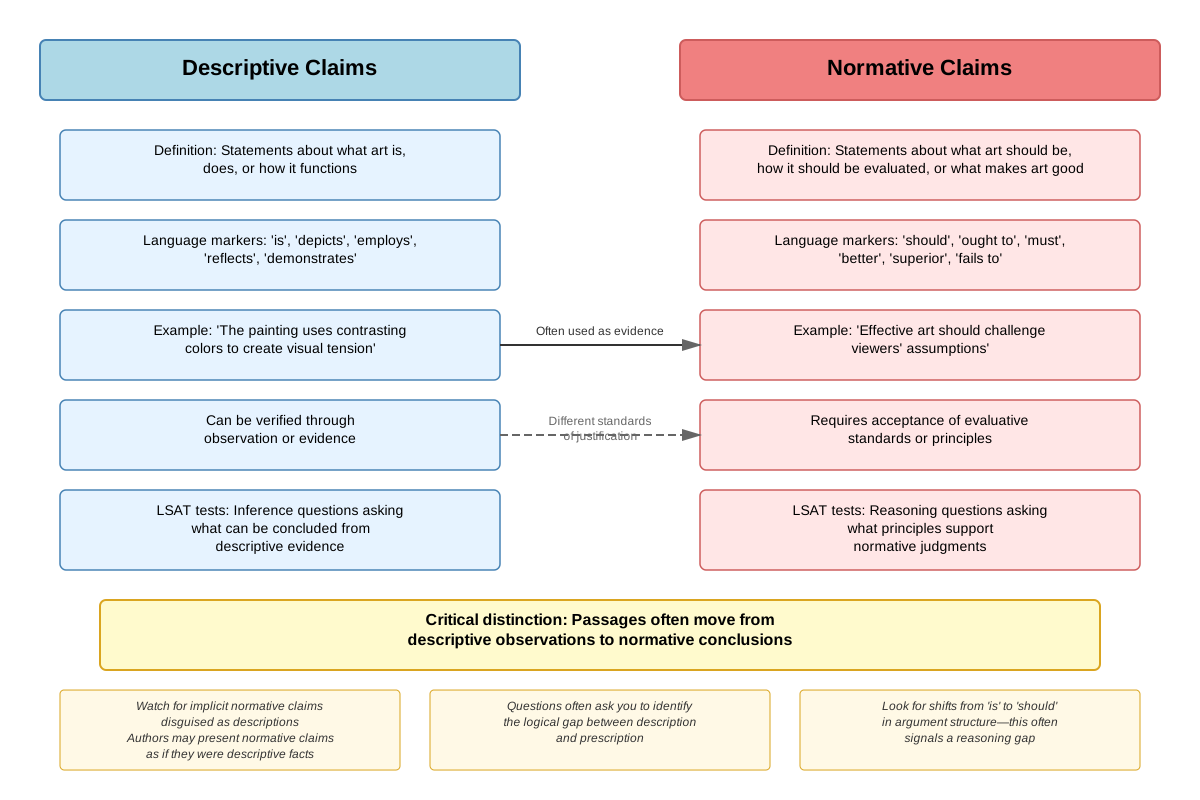
Art criticism passages frequently blend descriptive claims (statements about what is the case) with normative claims (statements about what should be the case or what has value). Descriptive claims might include: "Impressionist painters used broken brushstrokes" or "Many critics in the 1950s interpreted abstract expressionism as apolitical." Normative claims include: "Art should challenge social conventions" or "Aesthetic value depends on formal coherence."
Recognizing this distinction helps test-takers understand the logical structure of arguments and identify assumptions. When a critic moves from descriptive observations about art to normative conclusions about how art should be evaluated, there's often an implicit assumption bridging the gap—and LSAT questions frequently target these assumptions.
Authorial Attitude and Tone
Unlike some LSAT passages that maintain strict neutrality, art criticism passages often reveal the author's attitude toward the theories or positions discussed. The author might be advocating for a particular critical approach, critiquing a dominant view, or presenting a balanced assessment of competing positions. Identifying authorial attitude is essential for answering questions about the author's purpose, likely agreement with statements, or tone.
Attitude indicators include: evaluative language (describing a theory as "persuasive," "problematic," or "oversimplified"), the amount of space devoted to different positions, the presence or absence of counterarguments, and the passage's conclusion. An author who presents objections to a theory without adequately addressing them likely opposes that theory; an author who acknowledges limitations but defends a position overall likely supports it with qualifications.
Concept Relationships
The core concepts within art criticism passages form an interconnected network of ideas. The formalism vs. contextualism debate directly relates to the intentionalism vs. anti-intentionalism debate: formalists often align with anti-intentionalism (since both focus on the work itself rather than external factors), while contextualists frequently embrace intentionalism (since authorial intention is part of the historical context). However, these alignments aren't absolute—some contextualists reject intentionalism, arguing that social forces shape meaning independently of individual intentions.
The distinction between normative and descriptive claims cuts across all other concepts. Both formalists and contextualists make normative claims about how art should be evaluated, and both make descriptive claims about how art actually functions. Recognizing when a critic shifts from description to prescription helps identify the logical structure of their argument and potential vulnerabilities.
Understanding how examples function depends on grasping the theoretical framework being illustrated. A formalist example will highlight formal properties, while a contextualist example will emphasize historical circumstances. The same artwork might serve as an example in both formalist and contextualist arguments, but the features highlighted and the conclusions drawn will differ dramatically.
Authorial attitude emerges from how the author deploys all other concepts. An author sympathetic to formalism will present formalist arguments more fully, address objections more thoroughly, and use examples that showcase formalist insights. Tracking attitude requires synthesizing evidence throughout the passage.
Relationship map: Theoretical framework (formalism/contextualism, intentionalism/anti-intentionalism) → shapes selection and interpretation of examples → supports normative claims about art → reveals authorial attitude → determines passage structure and emphasis
High-Yield Facts
⭐ Art criticism passages appear in approximately 15-20% of LSAT Reading Comprehension sections, making them one of the most frequent passage types in the arts and humanities category.
⭐ The formalist vs. contextualist debate is the single most common theoretical framework tested in art criticism passages.
⭐ Questions about the function or purpose of examples (rather than their specific content) are extremely common in art criticism passages.
⭐ Authorial attitude in art criticism passages is often qualified or nuanced rather than strongly positive or negative—watch for phrases like "while acknowledging" or "despite certain limitations."
⭐ When a passage presents two competing theories, the LSAT frequently asks which new scenario would support or challenge each theory.
- Art criticism passages typically contain more abstract vocabulary and theoretical terminology than other passage types, requiring careful attention to how terms are defined within the passage.
- The relationship between specific examples and general principles is bidirectional: examples illustrate principles, but unusual examples can also challenge or refine principles.
- Intentionalist arguments often rely on biographical information or artist statements as evidence, while anti-intentionalist arguments emphasize textual features or audience responses.
- Passages that discuss how new artistic movements challenged existing aesthetic standards often test understanding of how criteria for evaluation can change over time.
- Art criticism passages frequently contain implicit assumptions about the nature of aesthetic value, artistic meaning, or the purpose of criticism—these assumptions are prime targets for LSAT questions.
- The distinction between intrinsic properties (features of the work itself) and extrinsic properties (features of the work's context) is fundamental to many art criticism debates.
- When passages discuss multiple artworks or artists, pay attention to whether they're being used as parallel examples of the same principle or contrasting examples of different approaches.
Quick check — test yourself on Art criticism passages so far.
Try Flashcards →Common Misconceptions
Misconception: Art criticism passages require specialized knowledge of art history or specific artists to answer questions correctly. → Correction: The LSAT is designed to be answerable based solely on information in the passage. While familiarity with art terminology helps with reading speed, all necessary information for answering questions is provided. Focus on understanding the logical relationships and arguments within the passage rather than bringing in outside knowledge.
Misconception: Formalist critics completely ignore historical context and biographical information. → Correction: Formalists prioritize formal analysis but don't necessarily reject all contextual information. They argue that formal properties should be the primary focus of aesthetic evaluation, not that context is entirely irrelevant. The distinction is about emphasis and priority, not absolute exclusion.
Misconception: When a passage presents two competing theories, the author must favor one over the other. → Correction: Many LSAT passages present balanced assessments of competing positions without clearly endorsing either. The author's purpose may be to clarify the debate, identify strengths and weaknesses of each position, or show how both capture important insights. Don't assume advocacy where the passage maintains neutrality.
Misconception: Examples in art criticism passages are primarily tested for their specific factual details. → Correction: While some questions ask about details within examples, most questions focus on the function or purpose of examples—why the author included them, what principle they illustrate, or how they relate to the broader argument. Understanding the role of examples is more important than memorizing their specific content.
Misconception: Normative claims in art criticism are merely subjective opinions that can't be evaluated logically. → Correction: While aesthetic judgments involve values, the arguments supporting them can be analyzed for logical coherence, consistency, and adequacy of evidence. The LSAT tests your ability to understand and evaluate the reasoning behind normative claims, not to determine whether you personally agree with them.
Misconception: Anti-intentionalist critics believe artists have no intentions or that intentions don't exist. → Correction: Anti-intentionalists acknowledge that artists have intentions; they argue that these intentions shouldn't be privileged in determining the correct interpretation of artworks. The debate is about the authority of intention, not its existence.
Worked Examples
Example 1: Formalist vs. Contextualist Analysis
Passage excerpt: "Traditional art historians have emphasized the social and political circumstances surrounding the creation of Renaissance paintings, arguing that understanding patronage systems, religious controversies, and civic rivalries is essential to interpreting these works. However, recent formalist critics contend that this approach obscures what makes these paintings aesthetically significant. They argue that the innovative use of perspective, the sophisticated manipulation of light and shadow, and the careful compositional balance are what give these works their enduring value—qualities that can be appreciated without extensive historical knowledge. While acknowledging that historical context may enrich our understanding, formalists maintain that aesthetic analysis should focus primarily on the formal properties that make a painting successful as art."
Question: The passage suggests that formalist critics would most likely agree with which of the following statements?
A) Historical knowledge is completely irrelevant to art appreciation
B) The aesthetic value of Renaissance paintings depends primarily on their formal qualities
C) Social and political circumstances have no influence on artistic creation
D) Traditional art historians are wrong to study patronage systems
E) Compositional balance is the only important feature of Renaissance paintings
Worked solution:
Step 1: Identify the formalist position in the passage. The formalists argue that "aesthetic analysis should focus primarily on the formal properties" and that these properties "give these works their enduring value."
Step 2: Note the qualifications. The passage states formalists "acknowledge that historical context may enrich our understanding," so they don't completely reject historical knowledge—they just don't prioritize it.
Step 3: Evaluate each answer choice:
- (A) is too extreme. The passage says formalists "acknowledge" that context "may enrich" understanding, so they don't view it as "completely irrelevant."
- (B) accurately captures the formalist position: aesthetic value depends "primarily" (not exclusively) on formal qualities. This matches "focus primarily on the formal properties."
- (C) confuses influence on creation with relevance to evaluation. Formalists might acknowledge that social circumstances influenced what artists created while still maintaining that formal properties determine aesthetic value.
- (D) is too strong. Formalists disagree with traditional historians' priorities but don't necessarily think studying patronage is "wrong"—just that it shouldn't be the primary focus of aesthetic analysis.
- (E) is too narrow. The passage mentions compositional balance as one of several formal properties (along with perspective and light/shadow), not as the only important feature.
Answer: B
Connection to learning objectives: This example demonstrates how to identify the reasoning pattern in art criticism passages (formalist emphasis on internal properties vs. contextualist emphasis on external factors) and apply this understanding to solve LSAT-style problems by carefully attending to qualifications and avoiding extreme answer choices.
Example 2: Function of Examples
Passage excerpt: "Critics who argue that artistic meaning is determined solely by authorial intention face a significant challenge when confronting works like Kafka's novels. Kafka explicitly instructed his friend Max Brod to destroy all his unpublished manuscripts after his death, suggesting he did not intend for these works to be read by a public audience. Yet Brod preserved and published the manuscripts, and these novels are now considered masterpieces of twentieth-century literature. If we accept that authorial intention determines meaning, we must conclude that these works have no legitimate meaning for readers, since Kafka intended them not to exist as public artworks at all. This conclusion seems absurd, suggesting that the intentionalist position requires modification."
Question: The author's discussion of Kafka's novels serves primarily to:
A) Illustrate the typical relationship between authors and their literary executors
B) Provide evidence that Kafka was ambivalent about his own artistic achievements
C) Present a problematic case that challenges the intentionalist position
D) Demonstrate that authorial intentions are impossible to determine with certainty
E) Show that twentieth-century literature is particularly difficult to interpret
Worked solution:
Step 1: Identify what the passage is arguing. The main claim is that intentionalism "faces a significant challenge" and "requires modification."
Step 2: Determine how the Kafka example relates to this claim. The example shows a case where following intentionalist principles leads to an "absurd" conclusion (that the novels have no legitimate meaning).
Step 3: Identify the function. The example is being used as a problematic case—a counterexample or challenge to a theory rather than a straightforward illustration of the theory in action.
Step 4: Evaluate answer choices:
- (A) focuses on the relationship between Kafka and Brod, but this relationship is mentioned only as background. The passage's purpose is to challenge intentionalism, not to discuss literary executors generally.
- (B) makes a psychological claim about Kafka's feelings that isn't supported by the passage. The passage discusses what Kafka intended (destruction of manuscripts), not whether he was ambivalent about his achievements.
- (C) accurately identifies the function: the example presents a "problematic case" (Kafka's instruction to destroy manuscripts) that "challenges" (creates difficulties for) "the intentionalist position."
- (D) misidentifies the problem. The passage doesn't suggest we can't determine Kafka's intention—we know he intended the manuscripts to be destroyed. The problem is that following this intention leads to absurd conclusions.
- (E) is too broad and doesn't connect to the passage's argument about intentionalism. The difficulty isn't specific to twentieth-century literature.
Answer: C
Connection to learning objectives: This example shows how to identify the function of examples in art criticism passages (in this case, a problematic case that challenges a theory) and demonstrates the reasoning pattern of using counterexamples to critique theoretical positions.
Exam Strategy
When approaching art criticism passages on the LSAT, begin by identifying the theoretical framework in the first paragraph. Ask yourself: What critical question or debate is this passage addressing? Is it about how to interpret art, how to evaluate art, or what makes something art in the first place? Recognizing the framework early helps you anticipate the passage's structure and understand how details fit into the larger argument.
Trigger words and phrases that signal important theoretical positions include: "formalist critics argue," "contextualist approach," "authorial intention," "aesthetic value," "interpretation," "meaning resides in," "proper understanding requires," and "critics who emphasize." When you encounter these phrases, slow down and ensure you understand the position being described. Also watch for contrast words like "however," "by contrast," "while," and "although," which often signal shifts between competing positions.
For process of elimination, be especially wary of answer choices that:
- Use extreme language ("completely," "only," "never," "always") when the passage presents qualified positions
- Confuse descriptive and normative claims (e.g., treating a statement about what critics do as a claim about what critics should do)
- Attribute positions to the wrong theorists (e.g., claiming formalists emphasize historical context)
- Focus on specific details of examples when the question asks about function or purpose
- Go beyond the scope of the passage by making claims about art generally when the passage discusses only specific cases
Time allocation for art criticism passages should account for their density. These passages often require 4-5 minutes for initial reading (slightly longer than average) because of abstract vocabulary and complex theoretical relationships. However, this investment pays off in faster question-answering, since understanding the theoretical framework allows you to eliminate wrong answers quickly. Don't rush the initial read; ensure you grasp the main argument and how examples relate to it.
When answering questions, constantly refer back to the passage rather than relying on memory. Art criticism passages contain subtle distinctions that are easy to misremember. For questions about authorial attitude, look for evaluative language throughout the passage, not just in one location. For questions about what a theorist would agree with, identify the core commitments of that theoretical position and eliminate answers that contradict those commitments.
Memory Techniques
FOCI mnemonic for remembering the key elements of Formalist criticism:
- Formal properties (composition, color, line, structure)
- Object-centered (focus on the work itself)
- Close analysis (detailed attention to internal elements)
- Intrinsic value (aesthetic worth resides within the work)
CHASE mnemonic for remembering the key elements of Contextualist criticism:
- Cultural context (social and historical circumstances)
- Historical embedding (art exists within time and place)
- Artist's situation (biographical and social position)
- Social meaning (interpretation requires external knowledge)
- Extrinsic factors (elements outside the work matter)
Visualization strategy: Picture a painting in a frame (formalism) versus the same painting in a museum with wall text explaining historical context (contextualism). The frame isolates the work; the museum setting embeds it in context. This mental image helps distinguish the two approaches.
The "I-A-W" triangle for remembering the three loci of meaning in interpretation debates:
- Intention (intentionalism: meaning comes from artist's intent)
- Audience (reader-response: meaning comes from audience interpretation)
- Work (formalism: meaning resides in the work itself)
Visualize a triangle with these three points, and remember that different critical theories privilege different points of the triangle.
Summary
Art criticism passages on the LSAT present theoretical debates about how art should be understood, interpreted, and evaluated. These passages typically revolve around core distinctions: formalism (focusing on internal formal properties) versus contextualism (emphasizing historical and social context), and intentionalism (privileging authorial intention) versus anti-intentionalism (locating meaning in the work or audience). Success with these passages requires identifying the theoretical framework early, understanding how specific examples function within broader arguments, distinguishing descriptive from normative claims, and recognizing authorial attitude through evaluative language and argumentative structure. The LSAT tests these passages through questions about the function of examples, the application of theories to new cases, implicit assumptions, and the relationship between competing positions. While the abstract vocabulary and dense theoretical content make art criticism passages challenging, their predictable structure and recurring debates make them highly learnable. Mastering these passages develops analytical skills—tracking complex arguments, evaluating competing interpretations, and understanding how theoretical commitments shape conclusions—that transfer directly to legal reasoning and other LSAT content.
Key Takeaways
- Art criticism passages test analytical reasoning through theoretical debates about art, appearing in 15-20% of Reading Comprehension sections with high question yield
- The formalist vs. contextualist distinction is the most frequently tested framework: formalists focus on internal formal properties, while contextualists emphasize external historical and social context
- Examples in art criticism passages serve specific functions (illustrative, evidential, contrastive, problematic) that are more important than their specific details for answering questions
- Distinguishing normative claims (what should be) from descriptive claims (what is) helps identify argument structure and implicit assumptions
- Authorial attitude is often qualified rather than extreme—watch for phrases like "while acknowledging" or "despite limitations" that signal nuanced positions
- Process of elimination should target extreme language, scope errors, and answers that confuse theoretical positions or misidentify the function of examples
- All necessary information for answering questions is provided in the passage—avoid relying on outside knowledge of art history or specific artists
Related Topics
Legal interpretation and statutory construction: The debates in art criticism about how to interpret texts (intentionalism vs. textualism vs. reader-response) directly parallel debates in legal theory about how to interpret statutes and constitutional provisions. Mastering art criticism passages prepares students for understanding these legal interpretation debates.
Scientific theory passages: Like art criticism passages, scientific theory passages present competing theoretical frameworks and use specific examples to illustrate or challenge theories. The analytical skills developed with art criticism transfer directly to understanding scientific debates.
Philosophy passages: Art criticism is a branch of philosophy (aesthetics), and many of the reasoning patterns—distinguishing normative from descriptive claims, evaluating competing theories, identifying implicit assumptions—appear throughout philosophical passages on the LSAT.
Comparative passages: Art criticism topics frequently appear in comparative passage format, where Passage A presents one critical approach and Passage B presents a competing approach. Understanding the core debates in art criticism is essential for handling these comparative structures effectively.
Practice CTA
Now that you've mastered the theoretical foundations and strategic approaches for art criticism passages, it's time to put your knowledge into practice. Work through the practice questions and flashcards for this topic, paying special attention to identifying theoretical frameworks, determining the function of examples, and distinguishing between competing critical positions. Remember that art criticism passages, while initially challenging, become highly predictable once you recognize their recurring patterns and debates. Each practice passage you complete strengthens your ability to navigate abstract theoretical content—a skill that will serve you throughout the LSAT and in legal education. Approach these practice materials with confidence, knowing that you now have a comprehensive framework for tackling one of the LSAT's most sophisticated passage types.
Sign up free to keep reading
Create a free AnvayaPrep account to finish this LSAT guide on Art criticism passages — plus flashcards and practice questions.