Overview
Philosophy passages represent one of the most intellectually demanding and frequently appearing passage types in the LSAT Reading Comprehension section. These passages typically explore abstract concepts, ethical theories, epistemological questions, or debates about the nature of reality, knowledge, and human experience. Unlike passages drawn from natural sciences or law, philosophy passages require test-takers to navigate dense argumentation, subtle distinctions between similar concepts, and complex logical relationships that may span multiple paragraphs.
Understanding how to approach philosophy passages is essential for LSAT success because they appear in approximately 20-25% of Reading Comprehension sections and often generate the most challenging questions. These passages test not only comprehension but also the ability to trace intricate lines of reasoning, identify implicit assumptions, and distinguish between an author's view and the views they describe or critique. The LSAT frequently uses philosophy passages to assess higher-order thinking skills such as recognizing argument structure, understanding counterarguments, and evaluating the logical implications of theoretical positions.
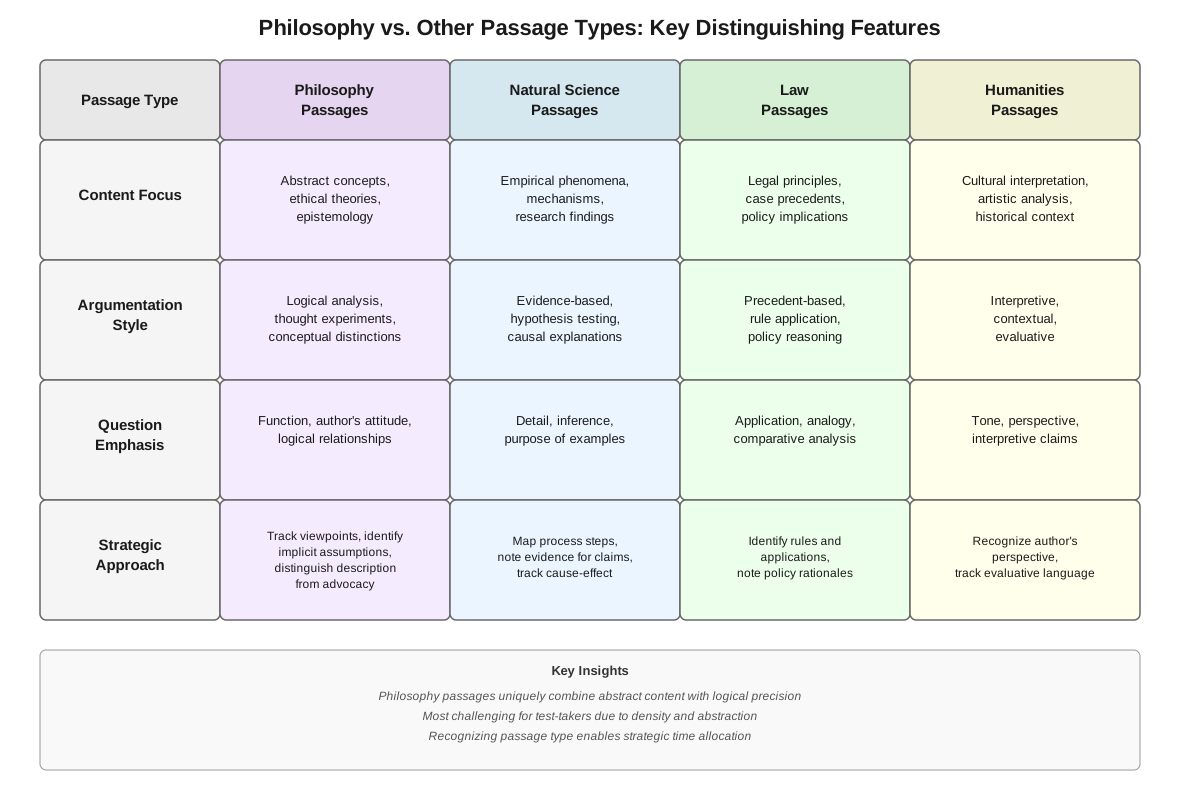
Within the broader framework of passage subjects and strategies, philosophy passages occupy a unique position. They share characteristics with humanities passages in their focus on interpretation and argumentation, yet they demand the logical precision typically associated with analytical reasoning. Mastering philosophy passages strengthens overall reading comprehension skills by developing the ability to parse complex syntax, track multiple viewpoints simultaneously, and maintain focus through abstract discussions—capabilities that transfer directly to analyzing legal reasoning and other dense LSAT content.
Learning Objectives
- [ ] Identify how Philosophy passages appears in LSAT questions
- [ ] Explain the reasoning pattern behind Philosophy passages
- [ ] Apply Philosophy passages to solve LSAT-style problems accurately
- [ ] Recognize the structural markers that distinguish philosophical argumentation from other passage types
- [ ] Evaluate the relationship between abstract philosophical concepts and concrete examples within passages
- [ ] Distinguish between descriptive accounts of philosophical positions and normative arguments advocating for specific views
- [ ] Synthesize information from multiple paragraphs to answer questions about overall passage structure and purpose
Prerequisites
- Basic argument structure recognition: Understanding premises, conclusions, and supporting evidence is essential because philosophy passages are fundamentally argumentative in nature
- Familiarity with abstract reasoning: Philosophy passages require comfort with non-concrete concepts and theoretical frameworks
- Standard LSAT question types: Knowledge of main point, inference, function, and author's attitude questions enables effective application of philosophy passage strategies
- Active reading techniques: The ability to annotate, track viewpoints, and identify passage structure provides the foundation for managing complex philosophical content
Why This Topic Matters
Philosophy passages hold significant real-world relevance beyond test preparation. The analytical skills developed through engaging with philosophical arguments—identifying assumptions, evaluating logical consistency, and recognizing subtle distinctions—directly parallel the reasoning required in legal practice. Attorneys regularly encounter abstract principles, competing interpretations of concepts like justice or rights, and arguments that require careful logical analysis. The LSAT uses philosophy passages precisely because they simulate the intellectual demands of legal education and practice.
From an exam statistics perspective, philosophy passages appear with remarkable consistency on the LSAT. Recent test administrations include at least one philosophy passage in approximately 75% of Reading Comprehension sections, and these passages generate questions across all major question types. Main point questions frequently test whether students can distinguish between a philosopher's central thesis and supporting arguments. Inference questions often require synthesizing abstract principles with specific applications. Function questions probe understanding of how examples, counterarguments, or qualifications serve the passage's overall argumentative structure.
Philosophy passages commonly appear in several recognizable forms: debates between competing philosophical schools (e.g., rationalism versus empiricism), explorations of a single philosopher's theory and its implications, critiques of traditional philosophical positions, or applications of philosophical frameworks to contemporary issues. The LSAT particularly favors passages that present a philosophical problem, explore attempted solutions, and either advocate for or critically examine one approach. Understanding these common patterns enables more efficient passage navigation and question anticipation.
Core Concepts
Characteristics of LSAT Philosophy Passages
LSAT philosophy passages exhibit distinctive features that set them apart from other passage types. First, they prioritize abstract reasoning over empirical evidence. While science passages rely on experimental data and observations, philosophy passages build arguments through logical analysis, thought experiments, and conceptual distinctions. The vocabulary tends toward technical philosophical terms—epistemology, ontology, phenomenology, normative, descriptive—though the LSAT typically provides sufficient context for understanding these terms without prior philosophical training.
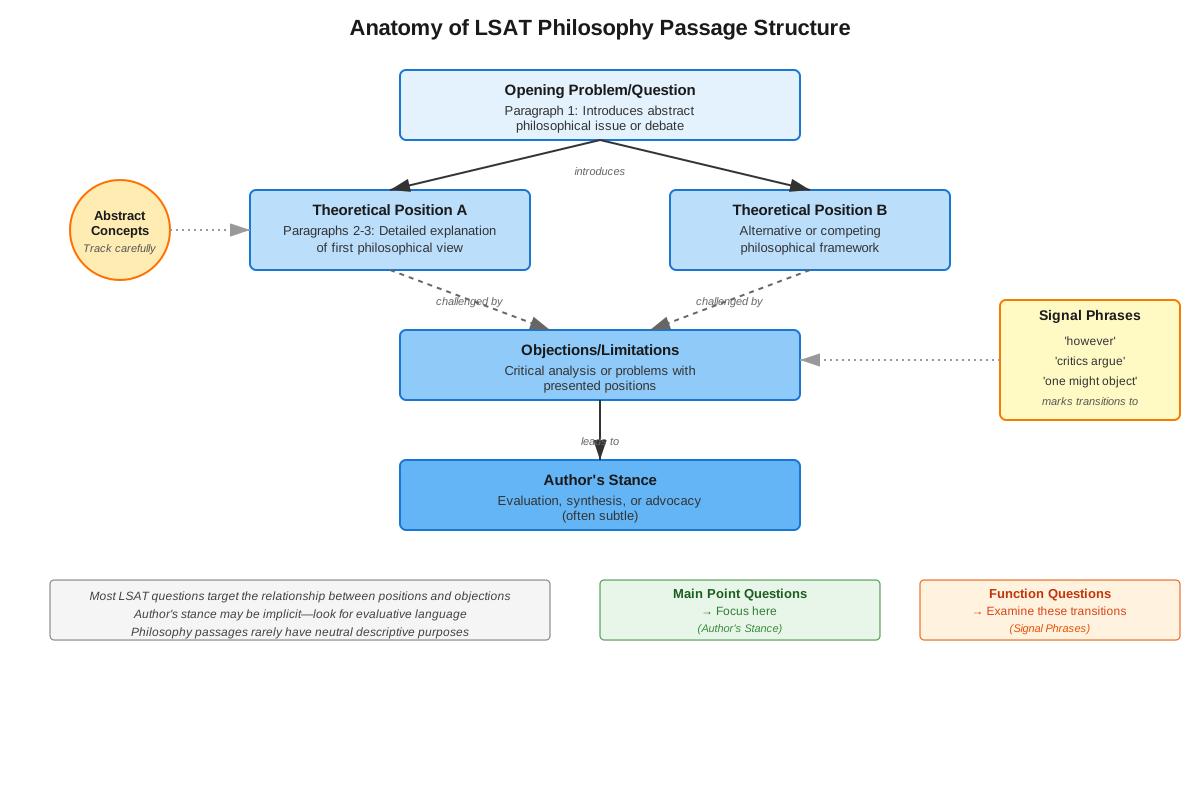
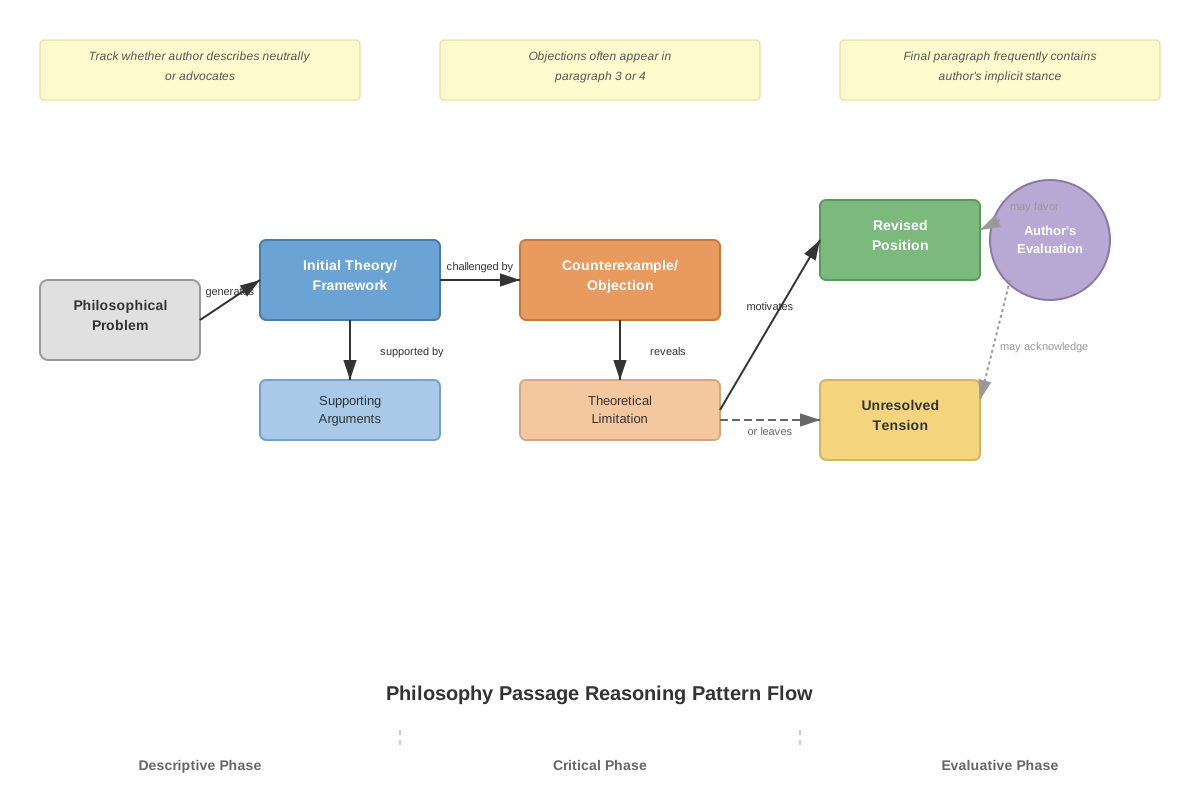
Second, philosophy passages frequently employ a dialectical structure, presenting a thesis, considering objections or alternative views, and then responding to those challenges. This back-and-forth movement requires careful tracking of whose view is being presented at any given moment. A passage might describe Theory X in paragraph one, present criticisms of Theory X in paragraph two, and then explain how proponents of Theory X respond to those criticisms in paragraph three. Test-takers must distinguish between the author's own position (if stated) and the various positions being described.
Third, these passages often use hypothetical scenarios and thought experiments to illustrate abstract principles. A passage about personal identity might present a scenario involving memory transfer or gradual replacement of body parts. These examples serve specific argumentative functions—typically to test the implications of a theory or reveal its counterintuitive consequences. Questions frequently ask about the purpose of these examples or what they demonstrate about the theory under discussion.
Common Philosophical Topics on the LSAT
The LSAT draws from several recurring philosophical domains. Epistemology (the study of knowledge) appears frequently, with passages exploring questions like: What constitutes justified belief? How do we distinguish knowledge from mere opinion? Can we have certain knowledge about the external world? These passages often discuss skepticism, empiricism, rationalism, or theories of justification.
Ethics and moral philosophy constitute another high-yield area. Passages may examine consequentialist versus deontological approaches to morality, debates about moral relativism versus moral realism, or questions about the foundations of ethical obligations. The LSAT particularly favors passages that explore tensions between competing ethical principles or challenge common moral intuitions.
Philosophy of mind passages investigate consciousness, mental states, and the relationship between mind and body. Topics include the nature of subjective experience, whether mental states can be reduced to physical states, and how we understand other minds. These passages often engage with both philosophical arguments and relevant findings from cognitive science or neuroscience.
Aesthetics (philosophy of art) and political philosophy appear less frequently but still merit attention. Aesthetic passages might explore what makes something art, the role of artist intention in interpretation, or the nature of aesthetic judgment. Political philosophy passages typically examine concepts like justice, rights, liberty, or the legitimacy of political authority.
Argument Patterns in Philosophy Passages
Philosophy passages follow recognizable reasoning patterns that, once identified, significantly enhance comprehension and question performance. The problem-solution pattern presents a philosophical puzzle or challenge and then explores one or more proposed solutions. For example, a passage might introduce the problem of free will in a deterministic universe, then examine compatibilist attempts to reconcile free will with determinism.
The critique pattern describes an established philosophical position and then presents objections or limitations. The passage might conclude by suggesting modifications to the original position or advocating for an alternative approach. Recognizing this pattern helps anticipate passage structure and identify the author's likely attitude toward the position being critiqued.
The comparative analysis pattern examines two or more philosophical approaches to a question, often highlighting their respective strengths and weaknesses. These passages may remain neutral, presenting each view fairly, or may subtly favor one approach through the language used to describe it. Attention to evaluative language—words like "merely," "unfortunately," "promising," or "compelling"—reveals authorial attitude.
The application pattern takes an abstract philosophical principle or theory and applies it to specific cases or contemporary issues. These passages test whether students can trace the logical connection between general principles and particular instances, often asking what the theory would imply about scenarios not explicitly discussed in the passage.
Navigating Abstract Language and Dense Syntax
Philosophy passages challenge readers with complex sentence structures and abstract terminology. Sentences may extend across multiple lines with embedded clauses, qualifications, and technical vocabulary. Effective strategies include identifying the core subject-verb-object structure before processing modifying phrases, and recognizing that philosophical precision often requires lengthy, carefully qualified statements.
When encountering unfamiliar philosophical terms, context usually provides sufficient understanding for LSAT purposes. If a passage introduces "phenomenology" and then explains it involves studying conscious experience from the first-person perspective, that contextual definition suffices for answering questions. The LSAT tests reading comprehension, not prior philosophical knowledge.
Logical indicators deserve special attention in philosophy passages. Words like "therefore," "thus," "consequently," and "it follows that" signal conclusions. "Because," "since," "given that," and "for" introduce premises or reasons. "However," "nevertheless," "although," and "despite" mark contrasts or objections. "Moreover," "furthermore," and "additionally" indicate supporting points. Tracking these indicators clarifies argument structure even when content remains abstract.
Author's Purpose and Attitude
Determining the author's purpose in philosophy passages requires distinguishing between descriptive and argumentative aims. Some passages primarily explain a philosophical position or debate without advocating for any particular view—the author's purpose is expository. Other passages advance a specific thesis, using philosophical arguments to persuade readers of a particular conclusion—the purpose is argumentative or persuasive.
The author's attitude may range from neutral description to strong advocacy or criticism. Subtle linguistic cues reveal attitude: "X argues persuasively that..." suggests approval, while "X merely assumes that..." implies criticism. "Unfortunately," "problematically," and "fails to consider" indicate negative evaluation. "Importantly," "crucially," and "successfully demonstrates" suggest positive assessment. Questions about author's attitude require careful attention to these evaluative markers rather than imposing assumptions about what the author "should" think.
Concept Relationships
The concepts within philosophy passages form an interconnected web of relationships. Abstract reasoning serves as the foundation, enabling engagement with the philosophical topics (epistemology, ethics, philosophy of mind) that provide content. These topics are explored through characteristic argument patterns (problem-solution, critique, comparative analysis, application), which are expressed using dense syntax and abstract language. Successfully navigating this language allows identification of logical indicators that reveal argument structure. Understanding argument structure, in turn, enables accurate determination of author's purpose and attitude, which directly impacts performance on main point, inference, and attitude questions.
This topic connects to prerequisite knowledge of basic argument structure by applying those foundational concepts to more abstract and complex content. While simpler arguments might concern concrete matters (whether a policy will reduce crime), philosophical arguments address abstract questions (whether moral truths exist independently of human beliefs). The skills developed through philosophy passages—tracking multiple viewpoints, identifying implicit assumptions, evaluating logical relationships—transfer directly to analyzing legal reasoning in other LSAT sections and in law school itself.
The relationship map flows as follows: Abstract reasoning ability → enables comprehension of → Philosophical topics and theories → which are presented through → Characteristic argument patterns → expressed via → Dense syntax and abstract language → containing → Logical indicators → that reveal → Argument structure → which determines → Author's purpose and attitude → leading to → Successful question answering.
High-Yield Facts
⭐ Philosophy passages appear in approximately 75% of LSAT Reading Comprehension sections, making them one of the most frequent passage types
⭐ The dialectical structure (thesis → objection → response) is the most common organizational pattern in philosophy passages
⭐ Questions about the function of examples or hypothetical scenarios appear in nearly every philosophy passage
⭐ Author's attitude in philosophy passages is typically more neutral or measured than in passages about social issues or policy debates
⭐ Distinguishing between views being described and the author's own view is the most common source of wrong answers on philosophy passage questions
- Epistemology, ethics, and philosophy of mind collectively account for approximately 80% of philosophical topics on the LSAT
- Philosophy passages average 450-500 words, slightly longer than typical science passages but shorter than comparative reading passages
- "Inference" and "function" question types appear more frequently with philosophy passages than "specific detail" questions
- Thought experiments in philosophy passages almost always serve to test a theory's implications or reveal potential problems
- The LSAT rarely requires prior knowledge of specific philosophers or philosophical movements; all necessary information appears in the passage
- Passages that critique a philosophical position typically present the strongest objection in the final third of the passage
- When a philosophy passage presents multiple views without explicit evaluation, the author's purpose is usually to explain a debate rather than resolve it
- Abstract philosophical terms are almost always defined or contextualized within the passage itself
Quick check — test yourself on Philosophy passages so far.
Try Flashcards →Common Misconceptions
Misconception: Philosophy passages require prior knowledge of philosophical theories and terminology to answer questions correctly.
Correction: The LSAT is designed to test reading comprehension, not prior knowledge. All information necessary to answer questions appears within the passage itself. While familiarity with philosophical concepts may increase reading speed, it provides no advantage in answering questions and may even create problems if test-takers rely on outside knowledge rather than passage content.
Misconception: The author's view is always stated explicitly in philosophy passages.
Correction: Many philosophy passages remain descriptive rather than argumentative, presenting multiple philosophical positions without the author advocating for any particular view. Even when the author does take a position, it may be expressed subtly through evaluative language rather than explicit statements like "I believe" or "the correct view is."
Misconception: Hypothetical scenarios and thought experiments in philosophy passages are merely illustrative examples that can be skimmed quickly.
Correction: These scenarios serve crucial argumentative functions—typically testing a theory's implications, revealing counterintuitive consequences, or demonstrating problems with a position. Questions frequently ask about the purpose or significance of these examples, making them high-yield content that requires careful attention.
Misconception: Philosophy passages are inherently more difficult than other passage types and should be saved for last.
Correction: While philosophy passages contain abstract content, they often follow predictable structural patterns and generate straightforward questions about argument structure and function. Many test-takers find philosophy passages more manageable than dense science passages or passages about unfamiliar cultural practices. Passage selection should be based on individual strengths rather than assumptions about difficulty.
Misconception: Understanding every sentence in a philosophy passage is necessary before attempting questions.
Correction: Perfect comprehension of every detail is neither possible nor necessary within LSAT time constraints. The goal is understanding the passage's overall structure, main argument, and key distinctions. Many questions can be answered by returning to specific paragraphs after reading the question stem, making initial perfect comprehension less critical than strategic passage mapping.
Misconception: Technical philosophical vocabulary always signals the most important content in a passage.
Correction: While philosophical terms deserve attention, the most testable content often involves the relationships between ideas, the structure of arguments, and the function of different passage components. A passage might use terms like "epistemological" or "ontological" without those terms themselves being tested, while questions focus on whether a theory successfully addresses an objection or how an example functions in the argument.
Worked Examples
Example 1: Identifying Argument Structure and Author's Purpose
Passage Excerpt: "Traditional theories of personal identity have focused on psychological continuity—the idea that what makes a person the same person over time is the continuity of their memories, beliefs, and personality traits. However, this approach faces a significant challenge from cases of severe memory loss. If a person loses all memories of their past, does psychological continuity theory imply they are literally a different person? Some philosophers have responded by modifying the theory to require only overlapping chains of psychological connections rather than direct memory links to one's past. This modification, while addressing the memory loss problem, introduces new complications regarding the transitivity of identity."
Question: The primary purpose of the passage is to:
(A) Advocate for psychological continuity theory as the best account of personal identity
(B) Present a challenge to psychological continuity theory and describe an attempted solution
(C) Argue that memory loss cases definitively refute psychological continuity theory
(D) Compare psychological continuity theory with competing theories of personal identity
(E) Explain why personal identity remains an unsolvable philosophical problem
Worked Solution:
Step 1: Identify the passage structure. The passage follows a problem-solution pattern: it presents a theory (psychological continuity), introduces a challenge (memory loss cases), and describes a proposed solution (overlapping chains modification).
Step 2: Determine the author's stance. The author uses neutral, descriptive language throughout ("have focused on," "faces a challenge," "some philosophers have responded"). There are no evaluative terms suggesting the author advocates for or against the theory.
Step 3: Evaluate each answer choice:
(A) "Advocate for" suggests the author supports the theory. The neutral tone and presentation of problems without resolution contradicts this. Eliminate.
(B) This accurately captures the problem-solution structure: challenge presented (memory loss) and attempted solution described (overlapping chains modification). Strong contender.
(C) "Definitively refute" is too strong. The passage presents a challenge and notes that philosophers have attempted responses, suggesting ongoing debate rather than definitive refutation. Eliminate.
(D) The passage focuses on one theory and its internal challenges rather than comparing multiple theories. Eliminate.
(E) While the passage mentions "new complications," it doesn't conclude that personal identity is unsolvable—only that one modification introduces further issues. Eliminate.
Answer: (B)
This question tests the learning objective of explaining the reasoning pattern behind philosophy passages by requiring recognition of the problem-solution structure and neutral authorial purpose.
Example 2: Function of a Hypothetical Scenario
Passage Excerpt: "Utilitarian ethics holds that the morally right action is the one that produces the greatest overall happiness. Critics have challenged this view with cases like the following: Imagine a surgeon who could save five patients needing organ transplants by killing one healthy person and distributing their organs. Utilitarianism seems to imply this action is morally required, since five lives outweigh one. Yet most people find this conclusion morally abhorrent. Utilitarians have offered various responses, including arguing that such actions would have negative long-term consequences for social trust, or that rule-utilitarianism (following rules that generally maximize utility) avoids this problem."
Question: The author introduces the organ transplant scenario primarily in order to:
(A) Demonstrate that utilitarian ethics is the correct moral theory
(B) Illustrate a practical application of utilitarian principles in medical ethics
(C) Present a case that appears to generate a counterintuitive implication of utilitarianism
(D) Prove that utilitarian ethics cannot account for the value of individual rights
(E) Show that most people's moral intuitions are unreliable guides to ethical truth
Worked Solution:
Step 1: Identify the function of the example within the passage structure. The scenario appears immediately after "Critics have challenged this view," indicating it serves as part of a critique or objection to utilitarianism.
Step 2: Analyze what the example demonstrates. The passage explicitly states that utilitarianism "seems to imply" the organ harvesting is morally required, but "most people find this conclusion morally abhorrent." This creates a tension between the theory's implications and common moral intuitions.
Step 3: Evaluate answer choices:
(A) The example is introduced by critics to challenge utilitarianism, not to support it. Eliminate.
(B) While the scenario involves medical ethics, its purpose is not to illustrate practical application but to reveal a problematic implication. The passage emphasizes that the conclusion is "morally abhorrent," not that this is how utilitarianism should be applied. Eliminate.
(C) This accurately captures the function: the scenario generates an implication (organ harvesting is required) that conflicts with moral intuitions (this seems wrong), making it counterintuitive. The word "appears" appropriately reflects that utilitarians dispute whether this truly follows from their theory. Strong contender.
(D) "Prove" is too strong—the passage notes that utilitarians have offered responses, suggesting the objection isn't conclusive. Additionally, the passage doesn't explicitly discuss "individual rights." Eliminate.
(E) The passage doesn't argue that moral intuitions are unreliable; rather, it presents the tension between utilitarian implications and intuitions as a challenge utilitarians must address. Eliminate.
Answer: (C)
This question addresses the learning objective of identifying how philosophy passages appear in LSAT questions, specifically testing understanding of how thought experiments function within philosophical arguments.
Exam Strategy
When approaching philosophy passages on the LSAT, begin by identifying the passage type within the first paragraph. Look for signals indicating whether the passage will present a problem-solution structure, critique an existing view, compare competing theories, or apply a philosophical framework. This initial classification enables prediction of likely question types and passage organization.
Trigger words and phrases deserve special attention. When reading, mark or mentally note:
- Contrast indicators: "however," "nevertheless," "but," "although," "despite"—these signal objections, limitations, or alternative views
- Support indicators: "moreover," "furthermore," "additionally"—these introduce additional evidence or arguments
- Conclusion indicators: "therefore," "thus," "consequently," "it follows that"—these mark main claims or implications
- Evaluative language: "unfortunately," "problematically," "successfully," "compelling"—these reveal author's attitude
For viewpoint tracking, create a simple mental or written map distinguishing between: (1) the main theory or position being discussed, (2) objections or alternative views, (3) responses to objections, and (4) the author's own view (if stated). Many wrong answers result from confusing whose view is being presented.
Process-of-elimination strategies specific to philosophy passages include:
- Eliminate extreme language in answer choices unless the passage itself uses extreme language. Philosophy passages typically employ measured, qualified statements. Answers with "always," "never," "proves," "definitively," or "completely" are often incorrect.
- Eliminate answers that confuse description with advocacy. If the passage neutrally describes a philosophical position, answers suggesting the author "argues for" or "advocates" that position are likely wrong.
- Eliminate answers that attribute views to the wrong source. If a passage describes Theory X, presents Critic Y's objection, and then explains how proponents of Theory X respond, answers that attribute the objection to Theory X proponents or the response to Critic Y are incorrect.
- For function questions, eliminate answers that describe content rather than purpose. If asked why the author mentions an example, "to illustrate the theory's counterintuitive implications" (purpose) is better than "to describe a medical scenario" (content).
Time allocation for philosophy passages should follow standard Reading Comprehension pacing: approximately 3-4 minutes for initial reading and passage mapping, then 5-6 minutes for questions. Resist the temptation to reread excessively when encountering abstract content. If a sentence remains unclear after one careful reading, mark it and move forward—the passage's overall structure and subsequent content often clarify earlier confusing points. Return to specific paragraphs when answering questions rather than attempting perfect comprehension before seeing questions.
For question anticipation, expect:
- Main point questions testing whether you can distinguish the passage's central claim from supporting arguments
- Function questions about why the author includes examples, objections, or qualifications
- Inference questions requiring synthesis of information from multiple paragraphs
- Attitude questions testing whether you've tracked evaluative language
- Application questions asking what a theory would imply about scenarios not explicitly discussed
Memory Techniques
For remembering common philosophical topics on the LSAT, use the acronym MEAP:
- Mind (philosophy of mind, consciousness, mental states)
- Epistemology (knowledge, justification, skepticism)
- Aesthetics (art, beauty, interpretation)
- Politics and ethics (morality, justice, rights, political authority)
To recall the most common argument patterns, visualize the acronym PCPA:
- Problem-solution (philosophical puzzle → proposed solution)
- Critique (established view → objections → possible responses)
- Comparative (Theory A vs. Theory B, with strengths and weaknesses)
- Application (abstract principle → specific cases)
For tracking viewpoints in complex passages, use the TORA framework:
- Theory: What is the main philosophical position being discussed?
- Objection: What challenges or criticisms are presented?
- Response: How do proponents address the objections?
- Author: What is the author's own view (if stated)?
Visualize philosophy passages as conversations or debates rather than monologues. When the passage shifts from describing a theory to presenting objections, imagine a critic entering the conversation. When it shifts to responses, imagine the theory's defender replying. This mental model makes the dialectical structure more intuitive and memorable.
For remembering that thought experiments serve argumentative functions, use the phrase: "Examples aren't just illustrations—they're tests." This reminds you that hypothetical scenarios in philosophy passages typically test a theory's implications or reveal potential problems, making them high-yield content for questions.
Summary
Philosophy passages represent a high-frequency, high-importance component of LSAT Reading Comprehension, appearing in approximately three-quarters of test administrations. These passages explore abstract concepts in epistemology, ethics, philosophy of mind, aesthetics, and political philosophy through characteristic argument patterns including problem-solution, critique, comparative analysis, and application structures. Success requires recognizing these patterns, tracking multiple viewpoints through dialectical argumentation, understanding the function of thought experiments and hypothetical scenarios, and distinguishing between views being described and the author's own position. The dense syntax and abstract terminology characteristic of philosophy passages demand attention to logical indicators and argument structure rather than perfect comprehension of every detail. Questions predominantly test understanding of argument structure, the function of passage components, and the ability to make inferences by synthesizing information across paragraphs. Mastering philosophy passages develops transferable skills in abstract reasoning, logical analysis, and careful distinction-making that enhance performance across all LSAT sections and prepare students for the analytical demands of legal education.
Key Takeaways
- Philosophy passages appear in approximately 75% of LSAT Reading Comprehension sections and follow predictable structural patterns (problem-solution, critique, comparative, application)
- The dialectical structure—presenting a view, considering objections, and describing responses—is the most common organizational pattern and requires careful tracking of whose view is being presented at each stage
- Thought experiments and hypothetical scenarios serve crucial argumentative functions (testing implications, revealing problems) rather than merely illustrating concepts, making them high-yield content for questions
- Distinguishing between the author's own view and views being described is essential; many wrong answers result from confusing description with advocacy
- Success depends on identifying argument structure and logical relationships rather than achieving perfect comprehension of every abstract detail—strategic passage mapping and targeted rereading when answering questions is more effective than exhaustive initial reading
- Evaluative language (unfortunately, successfully, merely, compelling) reveals author's attitude and is critical for attitude and main point questions
- The LSAT tests reading comprehension, not prior philosophical knowledge; all necessary information appears within the passage, and outside knowledge may actually hinder performance if it conflicts with passage content
Related Topics
Humanities Passages: Philosophy passages share characteristics with broader humanities content, including focus on interpretation, argumentation, and multiple perspectives. Mastering philosophy passages provides strategies applicable to passages about literature, art history, and cultural criticism.
Science Passages with Theoretical Content: Some science passages explore theoretical debates (competing models in physics, interpretations of quantum mechanics) that resemble philosophical argumentation. Skills developed through philosophy passages transfer to these theory-heavy science passages.
Comparative Reading Passages: When comparative passages involve philosophical content, the viewpoint-tracking skills essential for single philosophy passages become even more critical for distinguishing between authors and managing four distinct perspectives (Author A's view, views A describes, Author B's view, views B describes).
Logical Reasoning - Method of Reasoning Questions: Philosophy passages develop the ability to identify argument structure and the function of argument components, skills directly applicable to Method of Reasoning questions in the Logical Reasoning section.
Logical Reasoning - Principle Questions: The application pattern in philosophy passages (abstract principle → specific cases) mirrors the reasoning required for Principle questions, where test-takers must connect general rules to particular situations or vice versa.
Practice CTA
Now that you've mastered the core concepts, patterns, and strategies for philosophy passages, it's time to apply this knowledge to actual LSAT-style questions. The practice questions and flashcards will reinforce your ability to identify argument structures, track viewpoints through dialectical reasoning, and recognize the function of examples and objections. Remember: philosophy passages become significantly more manageable once you recognize their predictable patterns and know what to look for. Each practice passage you complete strengthens your pattern recognition and builds confidence for test day. Approach the practice materials strategically, focusing not just on getting answers correct but on understanding why wrong answers are wrong and how the correct answer connects to passage structure. Your investment in mastering philosophy passages will pay dividends across the entire Reading Comprehension section!
Sign up free to keep reading
Create a free AnvayaPrep account to finish this LSAT guide on Philosophy passages — plus flashcards and practice questions.